Let Me Explain, Dear (1932)

<strong>Let Me Explain, Dear (1932)</strong>

The introduction of sound film in Britain around 1930 opened up more opportunities for filmmakers to produce comedies based on dialogue rather than slapstick. As London’s theatre sector was thriving, many comic plays transferred over to the silver screen. Popular plays such as Pygmalion were turned into films, and of course a whole series of popular farces performed at the Aldwych theatre were also adapted.

Almost more than any other genre of film, comedy is specific to the time and place in which it was made. An adaptation of a 1915 comedy play made in 1932 is a good example of this. Let Me Explain, Dear was based on the play ‘A Little Bit of Fluff’, the full text of which is available to read online. ‘A Little Bit of Fluff’ was a great success when it was first staged and it ran for the majority of the First World War at the Criterion Theatre, no doubt giving audiences a welcome respite from the war news (the theatre poster available on Wikipedia highlights that the Criterion was ‘built entirely underground’ and therefore safe in case of air raids).

The play was adapted into a film in 1919 by the short-lived Q Film Productions company, and again in 1928 for a larger-scale production starring Betty Balfour as one of the female leads. Let Me Explain, Dear is the first sound film adaptation of the play; all three adaptations are produced in Britain for the domestic market, as they cater to a specific cultural sensibility. ‘A Little Bit of Fluff’ is positioned as a farce, but its comedy is much broader than that of the Aldwych farces that had become so popular by the time Let Me Explain, Dear was released.

The story of the film, which is only slightly evolved from the play, is simple enough. George Hunter is married to Angela, a domineering woman who holds the financial purse strings in the relationship. When George believes Angela to be away from home, he meets Mamie, a glamourous young woman with an undefined job in some sort of performance-related industry. Mamie has borrowed an expensive pearl necklace from a banker boyfriend.

Mamie (Jane Carr) and George (Gene Gerrard) getting cozy in a taxi in Let Me Explain, Dear

The necklace accidentally ends up with George and then Angela. In an attempt to retrieve the necklace or make enough money to buy a replacement, George ropes in the help of his neighbour Merryweather to scam a newspaper insurance scheme. Eventually personal relations, necklaces, and scams get hopelessly tangled up before George ends up reconciled with Angela and Mamie returns to her banker boyfriend.

One of the ways in which the film has updated the original play text is through the inclusion of the apparently newfangled and fictitious concept of the ‘water taxi’. At the opening of the film, George takes a ‘water taxi’, a speedboat across the Thames, because he sees Mamie inside it. Due to George’s clumsiness, the taxi ends up crashing into the side of a much bigger vessel. This accident later forms the basis of George’s attempt to claim insurance money from his newspaper. In the original play, the alleged accident was that of a bus. The inclusion of the water taxi allows for some spectacular shots of the boat speeding across the Thames – and by 1932 buses were much safer than they had been in 1915, perhaps making the idea of a bus accident slightly less believable.

The ‘water taxi’ in action in Let Me Explain, Dear

The fact that George tries to scam money from an insurance scheme run by a popular newspaper also does not appear in the original text. In the play, the insurance scheme is run by the bus company itself – prior to the unification of London Transport in 1933 separate bus companies maintained the various routes across London. By the time Let Me Explain, Dear was made, the ‘newspaper wars’ were in full swing and popular newspapers tried to gain more subscribers in part by offering generous insurance schemes. Let Me Explain, Dear uses this to bring its plot right up to date for contemporary viewers.

Let Me Explain, Dear has the occasional moment of verbal wit that has stood the test of time – when Angela reveals the pearl necklace she has found in George’s overcoat pocket, she snaps ‘What do you say to that?’ George’s friend Merryweather responds: ‘I don’t know, I’ve never talked to one before.’ Mostly, though, the blatant sexism underpinning the entire plot and dialogue alienates the film from modern viewers. The relationship between George and Angela appears to be solely built on mutual distrust and annoyance. When Merryweather asks George how he came to be married to Angela, his response is ‘I just sort of sobered up and there she was.’

Merryweather (Claude Hulbert); Angela (Viola Lyel) and George (Gene Gerrard) in Let Me Explain, Dear

Whereas in the play it is made clear that George is such a bad entrepreneur that his work activities were actively costing the couple money, and that is why Angela has demanded he stop ‘working’, in the film Angela appears to solely want to emasculate George by paying everything for him. George’s quick work to woo Mamie is not judged, and Mamie herself is a cardboard character who prances around in underwear and starts screaming hysterically (and then faints) when she thinks her pearl necklace has been stolen.
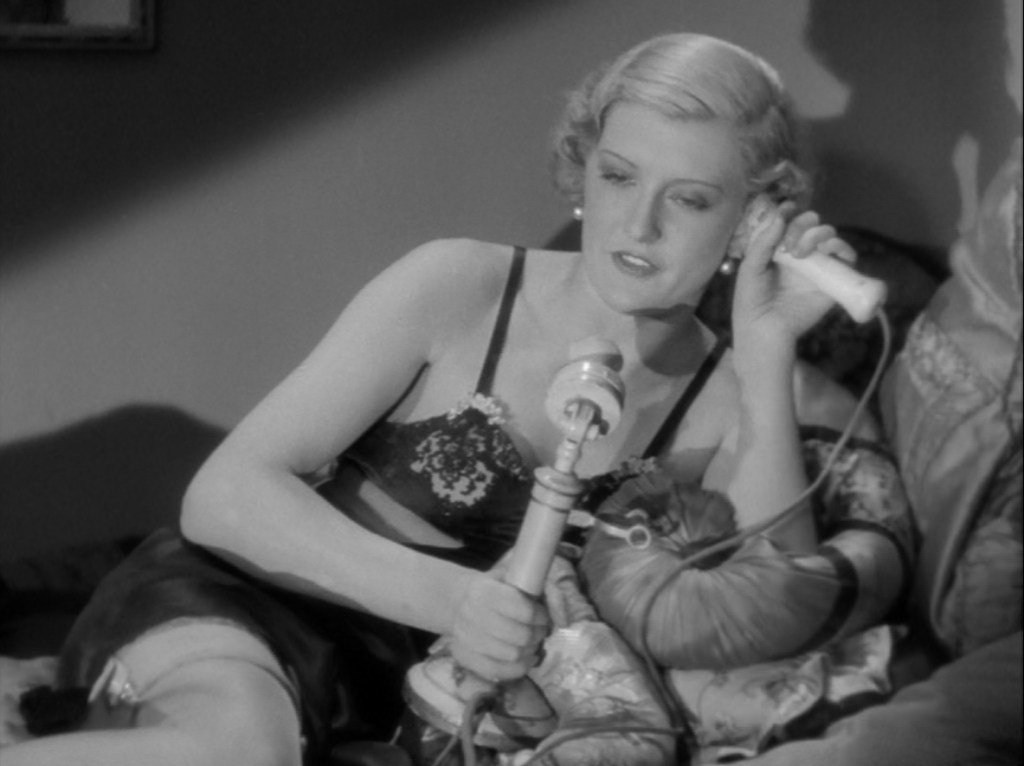
Mamie (Jane Carr) relaxing at home in Let Me Explain, Dear

Lead actor Gene Gerrard also co-wrote and co-directed Let Me Explain, Dear; a feat he repeated in the same year with Lucky Girl, another light comedy adapted from a stage play. Alhtough there is not much to recommend Let Me Explain, Dear to modern audiences, it is a necessary reminder of the range and variety of output of the British film industry during the interwar period.
Aerodromes in interwar Britain

So far, this blog has had plenty to say about the increase of car ownership in interwar Britain; the development of public transport; and even the popularity of competitive cycling. It has, however, not yet touched upon that other mode of transport which swiftly developed during the 1920s and 1930s: airplanes.

Like many of the changes that became embedded into British society during the interwar period, it started in the Edwardian period. After the Wright brothers made their pioneering flight in the US in 1903, the first flight in England took place in 1908. As is common with the development of new technologies, its first application was in the military. Germany’s successful use of Zeppelins and Gotha bomber planes during the First World War prompted the British army to expand the activities of the Royal Flying Corps (later to become the RAF) and develop a first aircraft factory in Croydon.[1]

A short-lived RAF base in Hounslow hosted the first ever commercial international flight in 1919, to Le Bourget airport in Paris. Shortly thereafter, the facilities at Croydon developed into the only international airport in Britain, launching flights to Paris, Rotterdam and Cologne. The Hounslow base closed, although after the Second World War Heathrow Airport was developed nearby.

Early flights were not just for passengers, but also for the transport of ‘air mail’, allowing much swifter international communications than had hitherto been possible. The pilots of these commercial flights were often ex-RFC pilots, as they were the only group of people already trained to fly planes.[2]

Although Croydon was the international airport, there were many other airfields in existence throughout the interwar period, including around London. The types of planes used in the interwar period were light and flew relatively low to the ground compared to modern jet planes. They therefore did not need extensive runways to take off and land. A large and level field was usually all that was required. This is visible, for example, in this British Pathé footage from 1927 showing ‘Mousehold Aerodrome’ in Norfolk:

Mousehold was a former RAF base which after the First World War housed a flying club, and eventually developed into Norwich Airport in 1933 (NB the current Norwich Airport is on a different site). Throughout the 1930s, many local airports opened up across Britain as domestic flights were viewed as the modern alternative to rail travel. Once again, the need to expand air travel was framed as a competition with Germany, where passenger numbers were much higher.[3] The general enthusiasm for flight and flying which also expressed itself in literature and other art forms has frequently been referred to as ‘airmindedness.’[4]

In addition to the development of commercial domestic and international flights, aerodromes were also sights of spectacle when they hosted the arrival or take-off of celebrity aviators. Throughout the 1920s especially, there was an appetite for developing new flight routes and setting new speed records. Although Alcock and Brown managed the first successful non-stop transatlantic flight in 1919 (from Newfoundland to Ireland), the man who managed to do the trip as a solo flyer received much more attention. Charles Lindbergh flew from Long Island to Paris in 1927. When he landed in Croydon a week later, an estimated 120,000 people attended the airfield to welcome him.[5]

A few years later, Britain’s own Amy Johnson became an icon of modernity when she flew on her own from England to Australia in 1930 – the first woman to manage that feat. An article in the Daily Mirror at the end of that year lauded 1930 as ‘the most wonderful year in history for women’ partially because of them being ‘outstanding in aerial feats.’[6] Johnson herself savvily used the media to secure an income, as she did not receive any formal sponsorships. She sold the exclusive reporting rights of her flight to Australia to the Daily Mail and continued to use this tactic for subsequent record-breaking attempts.[7]

The development of jet planes after the Second World War shifted aviation from something that was potentially accessible to a large portion of the population, to a technology that required large capital investment and specialist training. Croydon Airport could not accommodate the newer, bigger planes and Heathrow, opened in 1946, took its place as London’s premier airport. Many of the local airports either closed down or became solely used by amateur flying clubs. The war had demonstrated the devastation that bomber planes could cause, tempering previous enthusiasm for air flight. For a brief period, however, Britain had been enamoured by the modern possibilities of going up in the air.


[1] Bob Learmonth, Joanna Bogle, Douglas Cluett, The First Croydon Airport: 1915-1928 (Sutton: Sutton Libraries and Arts Services, 1977), pp. 19-20

[2] Ibid., pp. 40-48

[3] Michael John Law, 1938: Modern Britain – Social Change and Visions of the Future (London: Bloomsbury, 2018), pp. 115-120

[4] Michael McCluskey and Luke Seaber (eds), Aviation in the Literature and Culture of Interwar Britain (London: Palgrave, 2020)

[5] Learmonth, Bogle, Cluett, The First Croydon Airport, p. 72

[6] ‘1930 the most wonderful year in history for women’, Daily Mirror, 29 December 1930, p. 3

[7] Bernhard Rieger, ‘‘Fast couples’: technology, gender and modernity in Britain and Germany during the nineteen-thirties’, Institute of Historical Research, vol 73, no. 193 (2003), 369

Cycling in interwar Britain

Alongside the expansion of London’s public transport network, and the increased popularity of cars, cycling also held an important place in British interwar culture. Although modern ‘safety’ bikes with pneumatic tyres were first mass-produced in the 1880s, the interwar period saw an ever-greater adoption of bikes not only as a means of transport, but also as a vehicle for recreation and sport. Between 1924 and 1937, over 2 million bicycles were manufactured in Britain.[1]

According to social historian Michael John Law, in the interwar period the ‘bicycle was used for short journeys that would today be made by car, for pleasure trips out of the suburbs into the countryside, for cycling club outings and also for quite long distance commuting.’[2] Although cycling may have been challenging in central London due to the large number of motorised vehicles on the narrow roads, those living in the city’s outskirts could comfortable cycle around their neighbourhoods. Bikes were primarily associated with the working classes, as they were relatively cheap to purchase and, unlike cars and motor bikes, did not demand an ongoing supply of fuel.

Beyond the use of bicycles for day-to-day commuting and navigation of the urban environment, many thousands of people joined cycle clubs during the interwar period – an estimated 100,000 people were members of such clubs by the mid-1930s.[3] These clubs were very popular in London as well as the countryside. As early as 1921, a London rally attracted more than a thousand participants.[4]

Bikes also quickly became popular in organised sporting events. One pioneering cyclist, Mabel Hodgson, organised a number of extremely popular rallies in London, as well as a 106-mile race from London to the Sussex coast.[5] In south London, the still operational Herne Hill Velodrome opened in 1891. There exist various ‘Topical Budget’ and British Pathé films from the 1920s which show races at Herne Hill, including one which involved a competition of already old-fashioned Victorian penny farthings.

As well as providing a human interest piece of the cinema newsreel, these films’ intertitles also boast about the modern cameras which enabled the capture of high-speed pursuits on film: ‘you’ve never seen a picture like this – taken with “Topicals” special camera which makes the thrills, thrillier”’

One noteworthy feature of these cycle competitions is that they were open to men as well as women. One Topical Budget film from 1929 shows an all-female race at Herne Hill. The riders clearly go around the track at great speed and one is shown tightening the bolts on her bike; however, the riders’ femininity is underlined by a shot of two competitors powdering their noses and applying lipstick before the start of the race. The threat of women engaging in a leisure pursuit which potentially does not align with gender expectations is diffused by the immediate visual assertion that these women still wear make-up and fashionable outfits. The high-speed cycling on display in this video also required the riders to wear shorts, providing a further visual pleasure to the (male) spectator.

In addition to the increased number of women participating in amateur cycling clubs, the interwar period also saw the emergence of the first professional female cyclists. Sport historian Neil Carter has identified Marguerite Wilson as a pioneer in this respect: Wilson obtained full-time sponsorship in 1939 and in the same year set a record cycling from Land’s End in Cornwall to John O’Groats in Scotland.[6] Typist Billie Dovey, who in 1938 broke the record of most miles cycled in a year (29,603.4) also received professional sponsorship.[7]

Cycling, then, was popular in interwar Britain and London and people participated in it in a variety of ways: as a means of commuting; as a leisure activity; and as a professional sport. Nonetheless, in popular fiction and film of the period cycling is often passed over in favour of more glamorous means of transport such as cars, trains and planes. As a primarily working-class pastime, interwar cycling was not given the same exposure as other recreations, which has exacerbated the possibility for this piece of history to remain overlooked today.


[1] Neil Carter, ‘Marguerite Wilson and other ‘hardriding…feminine space eaters’: cycling and modern femininity in interwar Britain’, Sport in History, vol 40, no. 4 (2020), 482-504 (486)

[2] Michael John Law, ‘The car indispensable: the hidden influence of the car in inter-war suburban

London’, Journal of Historical Geography, vol. 38 (2012), 424-433 (426)

[3] Carter, ‘Marguerite Wilson’, 486

[4] Ibid.

[5] Neil Carter, Cycling and the British: A Modern History (London: Bloomsbury Academic, 2020), p. 156

[6] Carter, ‘Marguerite Wilson’, 482-495

[7] Ibid., 487

Films by the GPO: Night Mail (1936) and N or NW (1938)

Films by the GPO: Night Mail (1936) and N or NW (1938)

One of the features of interwar Britain is its rapid modernisation and the expansion of its infrastructure. This extended to the General Post Office (GPO) which looked after the expanding telephone network as well as paper mail delivery and the sending of telegrams. Although telephones rapidly became more widely used during the interwar period, placing phone calls outside one’s own exchange district, or outside of working hours, could still be a very costly affair. Writing letters remained very popular, and of course most business affairs were also conducted by writing. With the introduction of long-distance commercial flights in the 1920s, it became possible to send and receive letters to all corners of the Empire much more quickly than before.

In 1933, the GPO established its own film unit, to produce documentaries and propaganda films about the GPO’s work. Britain already had an Empire Marketing Board which produced films to favour the Empire, so the establishment of a specific unit for the GPO was a small step. The GPO film unit was headed up by pioneering director John Grierson.

In 1936 the GPO produced a documentary short about the postal train which travelled from London to Scotland every night. Night Mail has become a documentary classic, mixing art with fly-on-the wall footage of the postal service in action. WH Auden wrote a poem for the documentary, which features as its voice over, and the music was written by Benjamin Britten.

In its runtime of just over 23 minutes, Night Mail shows real postal workers in the business of running the nightly postal train from Euston up to the highlands. On its route, it passes railway workers, passengers on other trains, and farmers. The infrastructure of the railway line is intimately connected with the vast infrastructure of the postal service, which ensures that any letter is delivered to the correct address in record time. Cutting through the country from south to north, the postal train is depicted as cutting through all layers and sections of British society. A high-tech control room, which was in constant connection with station managers up and down the line, ensured that the whole system kept running smoothly.

The control room in Night Mail

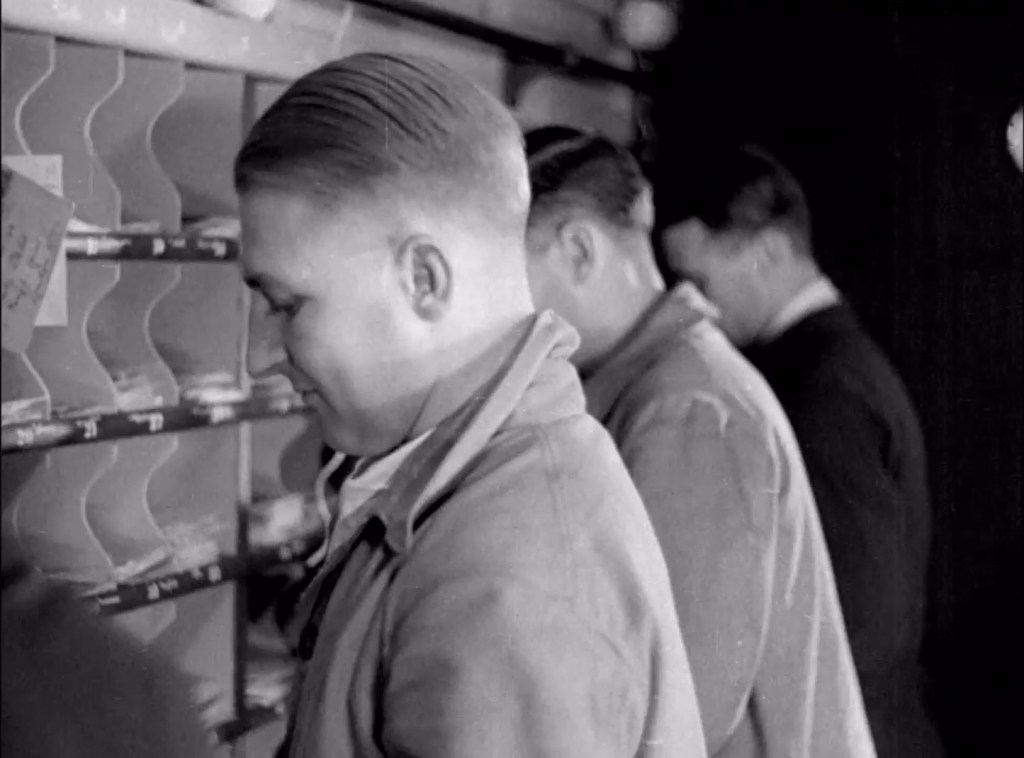
The rural scenes the train passes are juxtaposed with the ingenious systems the GPO had devised to ensure maximum efficiency. Postal workers up and down the line hung bags of post from poles, destined for towns further up north. These bags which were picked up by the train as it sped past through a specially designed system. At the same time, workers on the train chucked out bags of mail for postal workers to pick up and distribute. Inside the carriages, dozens of men sorted individual items of post into pigeonholes at high speed.

Postal workers sorting post on the train in Night Mail

Where Night Mail presents the successful running of the postal delivery system as a collective endeavour which uses the latest technology to benefit the whole country, a film made by the GPO film unit a few years later focuses on the personal side of sending post. N or NW was made in 1938, several years after the first introduction of lettered postcode districts in central London. Postcodes in central London are based on compass points, so N for north London, SE for South East and so on.

Map of postal districts in N or NW

In N or NW we are introduced to Jack and Evelyn, a young couple who have recently had an argument. Evelyn is writing a letter to Jack, which she relates to us in voiceover. Jack has been ‘simply beastly’ to her: he got angry with her for going to a party with a male friend. Evelyn demands that Jack sends her a written apology by return post, otherwise the relationship is ‘ruined’.

Upon receiving this missive, Jack is eager to apologise and he quickly pens his response. However, when it comes to addressing the letter, he cannot remember if the postcode for Evelyn’s home in Islington is N or NW. He eventually plumps on NW. We then return to Evelyn, who has waited in vain for Jack’s letter to arrive and is now writing him another one, in which she encloses the ring he gave her. But! Just as Evelyn is about to leave the house to post this final rebuttal, the postman arrives with Jack’s apology.

Evelyn and Jack go out picnicking the water in the countryside, their relationship restored. It is revealed that the post office corrected the address on Jack’s letter, changing the postcode from NW to N. A postman informs the audience that writing addresses clearly and without errors will ensure prompt delivery. However, the film implies that even if you do make a mistake in the address, the GPO is there to correct your mistakes and avert disaster.

Watch N or NW

N or NW has an experimental formalism belied by its thin and sentimental storyline. The film is full over superimpositions, characters speaking to camera and other surprising shots, all set over an upbeat jazz soundtrack. Like Night Mail, it paid attention to its form as well as its message. The films combine instruction with visual innovation. Despite their different perspectives, both presented the postal service as kind, community-based and highly efficient and reliable.

Night Mail can be viewed for free on BFI Player by people in the UK.

The Wrecker (1929) and The Flying Scotsman (1929)

During the silent film period, which in Britain lasted until roughly 1930, film production was a very international affair. Because the majority of the film’s plot was communicated to audiences with gesture, movement and facial expressions as opposed to dialogue, directors could relatively easily make films outside their own national context. One such director was the Hungarian Géza von Bolváry. Von Bolváry started his film directing career in Germany where he worked for most of the 1920s. In 1928, however, British International Pictures invited him to spend a year at the London studios. During this year he directed three silent films: Bright Eyes and The Vagabond Queen (both starring Betty Balfour), and The Wrecker.

The Wrecker was based on a 1924 play by the same name, which was also turned into a novel published in 1928. It is a prime example of the kind of cross-medial adaptations on which many interwar films are based. It is also one of several interwar British films which foreground public transport as a prime site of action.

The hero of The Wrecker is Roger ‘Lucky’ Doyle, the nephew of a train company magnate. A nefarious criminal, known only as ‘The Wrecker’, is repeatedly facilitating train crashes on Lucky’s uncle’s trainlines. Together with Mary, his uncle’s secretary (played by Benita Hume), Lucky attempts to uncover the Wrecker’s true identity. Eventually, with the help of the Wrecker’s female accomplice Beryl, Lucky finds out that his uncle’s business rival Ambrose Barney is behind the train crashes. Barney runs a company of long-distance charabancs, and the public’s panic about train crashes is boosting his own business. Lucky publicly denounces Barney, and of course wins Mary’s affections as well.

The Wrecker’s main selling point, both when it was released and today, is that Southern Railway allowed the studio to use its real rolling stock. Von Bolváry staged one spectacular train crash on a disused railway line, which is shown near the start of The Wrecker. The use of the real trains (as opposed to models) heightens the veracity of the crash scene and counteracts the sometimes somewhat overblown silent screen acting. The spectacle of the train crash was a draw for contemporary audiences. The value of the train crash sequence is underlined by the fact that its footage was reused for the Walter Forde-directed The Ghost Train which was released two years later.

The train crash in The Wrecker (1929)

Shortly after The Wrecker was released, cinema audiences could enjoy another train-based film with spectacular stunts. The Flying Scotsman, directed by Castleton Knight, was also released in 1929. This short feature is about an engine driver, Bob, who is working his last day on the London to Edinburgh line. A disgruntled ex-employee makes it onto the train with the intention of causing an accident. Bob’s daughter and a younger train colleague work together to avert the disaster.

Pauline Johnson, who played Barney’s accomplice Beryl in The Wrecker, takes the role of the leading lady in The Flying Scotsman, which sees her walking on the outside of an LNER train while it is in full motion. Johnson did the stunt herself, and like the crash scene in The Wrecker, the authenticity of the action creates a high-impact scene.

Pauline Johnson clambering down the side of a moving training in The Flying Scotsman (1929)

High-speed rail travel was not a novelty in interwar Britain. Trains had been running ever faster since their introduction in the early 19th century, and rail travel was popular for long-distance journeys and holiday travel. Although newspapers occasionally reported on the risks passengers faced on public transport, those risks were mainly due to other passengers, not technical faults. The almost simultaneous production of The Wrecker and The Flying Scotsman did not respond to a wider social anxiety about the safety of rail transport. Rather, it is likely that the technological advancements at the end of the silent era allowed directors to move their cameras more freely, which in turn enabled them to capture stunts and high-speed transport more effectively.

With the introduction and rapid expansion of sound film from 1930, cameras once again became static as they had to be connected to microphones and be kept still to avoid the recording of ambient noise. Filming actors clambering down the side of moving trains was no longer possible. By 1935 the climax of the action-comedy Bulldog Jack sees Jack Buchanan clamber over the top of a moving Tube, in an attempt to stop the rogue driver from crashing the train. Shots of characters inside the Tube are interspersed with shots taken from the front of the train and from platforms, and shots of Buchanan clambering horizontally across a ledge. The rapid editing gives the viewer the illusion that Buchanan is really on top of the train, but there is no doubt that the stunt is not real.

Although the introduction of sound film allowed for different types of storytelling on the screen, it also caused the loss of some visual capabilities which took decades to recover. The introduction of sound made film plots more dependent on dialogue, which also reduced the possibility of actors and directors working across national boundaries.

Bulldog Jack can be viewed on YouTube.

Women and Public Transport

Public transport became part of daily life in the 19th century, particularly in urbanised areas. Almost from its inception, women were at risk in public transport spaces, and this risk is still present in the 21st century.[1] It is no surprise then that in London of the interwar period, too, there were countless attacks on women in public transport, ranging from relatively minor aggressions to murder. Newspapers of the period did report on such cases, but with a view to stress the human or sensational element of such cases without addressing any structural issues that may have led to violence against women.

In newspaper reports, attacked passengers were almost always young women travelling alone, and the reports stressed how the seemingly random attacks were carried out by strangers. A typical article appeared in the Daily Mirror in December 1929. It describes how a Miss Organ, who was in her mid-twenties, was “suddenly attacked by a youth who followed her into a compartment” on the suburban train from Bromley to Charing Cross.[2] The isolation of the train compartment meant that Miss Organ was quite seriously hurt, and her attacker managed to escape before other passengers could come to her aid.

Train compartments were designed to be like private domestic spaces, so that passengers would feel at ease in them. But their public accessibility made them dangerous, too.[3] The repeated attention on female victims reinforced the notion that travelling was especially dangerous for women, and implied that they were perhaps better off by avoiding using transport on their own, thus limiting women’s freedom to move around the city.

Earlier in the same decade, the Daily Express reported on a ‘mysterious outrage in a Tube train’.[4] Daisy Tyler, a 16-year-old from Barking, had her plait of hair cut loose in a crowded Underground train. Interestingly the hair wasn’t stolen – it was severed to the point that it was only held together by Miss Tyler’s hairclip, and it was only when the clip was removed that Miss Tyler realised what had happened. A ‘close friend’ confided to the Express that Miss Tyler was particularly distressed ‘as she was going to a dance’ that evening.

The article goes on to speculate that women with ‘golden’ hair may be at particular risk of these (attempted) hair robberies, alleging that several instances of women and girls having their hair forcibly cut off had taken place in recent months. Again in the words of Miss Tyler’s ‘friend’, it was ‘extraordinary’ that no-one in the packed Tube had noticed the attack. Anyone who has ever been harassed on a busy train or bus will note that busy carriages can actually create an environment in which it is easier to harass unnoticed, as the mass of commuters’ bodies can hide a lot of activity from view.

Far worse than the fate of Miss Tyler was that of an unnamed, unidentified girl whose body parts were found in a paper parcel on a train running from Waterloo to Windsor in 1922.[5] A ‘girl’s hand, arm, shinbone and foot’ were found wrapped up ‘on the rack of a third-class compartment’ in this suburban train. The parcel was initially handed in as lost property by an unsuspecting passenger before it was opened up by station staff the next day, and its contents were revealed.

Even in this initial report the Daily Mail reporter manages to hint at the horrors that may have led to the girl’s death. The police surgeon concluded that the body was dismembered ‘in the same way as anatomical specimens in a surgical laboratory’. The man who found the parcel was quick to allege that his fellow passenger, who had been sitting below the parcel for part of the journey, had been reading a book ‘which I believe was a work on surgery’. The mystery man supposedly also had a stethoscope in his attaché case. This fellow traveller may have had nothing to do with the case, but the description provided in the article allows the reader to fantasise about the supposed surgeon’s nefarious deeds. The article ends with a paragraph on a ‘bushel of human bones’ found by Scotland Yard in Hampstead, north London (miles away from Waterloo or Windsor) which included ‘a skull with the top sawn off, proving that it had been used for anatomical purposes.’

Like the article on Miss Tyler’s hair, the Daily Mail report is quick to draw a picture of a nebulous but nonetheless threatening presence in London, which is attacking young women (invariably referred to as ‘girls’). London’s transport network provided rapid connections to increasingly far-flung parts of the city. Whilst public transport provided a great benefit to Londoners wishing to travel from one part of the capital to the other, these swift connections could also allow criminals to quickly move around the city. Young women were increasingly using public transport to navigate to and from work, disrupting expected patterns of behaviour and movement. In the narratives of these newspaper articles, these women can expect to put themselves at risk of attack if they choose to use the public transport network.

You can read more about the representation of London’s transport network in interwar newspapers in my book: Interwar London After Dark in British Popular Culture.


[1] See Caroline Criado Perez, Invisible Women: exposing data bias in a world designed for men (London: Vintage, 2020)

[2] ‘Girl Attacked and Robbed in a London Train’, Daily Mirror, 5 December 1929, 3.

[3] Colin Divall, ‘Civilising velocity: Masculinity and the marketing of Britain’s passenger trains, 1921-39’, The Journal of Transport History, 32:2 (2011), 164-191, here 179.

[4] ‘Girl Robbed of Hair’, Daily Express, 20 April 1921, p. 5

[5] ‘Girl’s Limbs in a Parcel,’ Daily Mail, 18 September 1922, p. 7

Sabotage (1936)

As noted elsewhere on the pages of this blog, Alfred Hitchcock started out as a director during Britain’s silent film period. He continued making films in Britain during the 1930s, before making his move to Hollywood around 1940. In 1936, he directed Sabotage, a Gaumont production based on the Joseph Conrad novel The Secret Agent. (Rather confusingly, in the same year Hitchcock also directed a film called Secret Agent which in turn was based on a novel titled Ashenden.)

By the mid-1930s, the tense European political situation was reflected in a spate of British films about spies and international criminal networks. Although Conrad’s source novel was published in 1907, and its plot is set in the 1880s, Hitchcock had little difficulty in adapting the storyline for a contemporary audience which was, again, concerned about German expansionism.

In Sabotage, a couple called Mr and Mrs Verloc run a cinema in central London. Mr Verloc is of unidentified Eastern European origin, whereas Mrs Verloc appears to be British. With them lives Stevie, Mrs Verloc’s teenage brother. Mr Verloc hides a secret from his wife – he is part of an international terrorist gang which is planning a series of attacks to disrupt British society. Scotland Yard have their eye on Mr Verloc, and undercover agent Ted Spencer is keeping a close eye on the cinema from a vegetable stall across the road.

Mr Verloc’s gang plan to blow up Piccadilly Circus underground station with a bomb hidden in a film reel tin. As Verloc suspects he’s being watched, he sends Stevie to drop off the package at the station’s cloakroom. Stevie, however, gets waylaid on the way to the station and the bomb goes off while he is still on the bus, killing him and all the passengers. When Mrs Verloc realises that her husband is responsible for her brother’s death, and he starts threatening her too, she kills him with a large kitchen knife. Ted Spencer, who by now has fallen for Mrs Verloc, shields her from arrest at the film’s end.

The sequence of Stevie travelling to Piccadilly Circus with the bomb is the most-discussed – and indeed, often the only discussed – part of Sabotage. Stevie is unaware of the real contents of the parcel he is carrying, he simply knows he needs to leave it in the luggage collection point in Piccadilly Circus station by 1.30pm. The audience knows that the bomb will go off at 1.45pm. Sabotage heightens the tension by a series of close-ups alternating between the parcel of explosives, Stevie, and various clocks which he sees on shop fronts along the way. As the clocks inch closer to 1.45pm, the individual shorts become shorter and shorter, culminating in an extreme close-up of the hand on a clock moving to 1.45pm. The bus spectacularly explodes, and Stevie and all the other passengers are killed in the blast.

Critics of Sabotage have pointed out that the rationale for Mr Verloc’s criminal gang is not defined. At the start of the film, the gang causes a mass electrical failure in London which causes widespread disruption. Their planned bombing of Piccadilly Circus would not just cause great material damage and loss of life – Piccadilly Circus was the symbolic centre of London, England, and the British Empire. When its underground station was completed in 1928, it was hailed as a feat of engineering. London Underground even produced a poster depicting the station’s tunnel network as the ‘stomach’ and digestive system of London. The motivation of the criminal gang, then, is to disrupt society, to cause unrest without providing a clear enemy against which people can direct their anger. The threat of destabilisation was keenly felt in 1930s Britain, as people watched great social change in Germany, Italy and elsewhere unfold. Many films of the period feature shady and undefined foreign criminal networks, including Laburnum Grove (1936), Midnight Menace (1937), and Bulldog Jack (1935).

The cinema is extensively used as a location in Sabotage. Mr and Mrs Verloc live in a flat situated behind the auditorium. To enter the flat, one has to go through the auditorium, and characters are frequently shown to pass through here whilst patrons enjoy the screening, apparently undisturbed. During his investigations, Ted Spencer is able to approach the flat unseen because the cinema audience is engrossed in a farcical comedy film. Spencer then enters the space behind the screen, in which there is a connecting window to the Verlocs’ living room. Spencer uses this window to eavesdrop on Verloc’s conversation, without the cinema audience being any the wiser.

After Stevie’s death, Mr Verloc tries to justify and explain himself to Mrs Verloc. Following this conversation, Mrs Verloc walks out of the flat and into the cinema auditorium, where a children’s showing of Disney’s Who Killed Cock Robin? is in progress. The children’s laughter prompts Mrs Verloc to first grimace in despair, before she turns to the screen and sits down to watch the show. Despite the centrality of its cinema location, this is the only time any of Sabotage’s main characters actually takes the position as audience member.

Engrossed in the cartoon, Mrs Verloc starts to laugh through her grief. She is unable to process the enormity of her emotions and uses the film as a welcome distraction. The distraction is all too brief: the cartoon bird gets shot, which plunges Mrs Verloc back in despair. This breaks the spell of the cinema for her, and she gets up and walks back through the auditorium with determination to see things out with her husband. Soon after returning upstairs, Mrs Verloc stabs her husband to death. After the spectacle of the bus explosion, the killing of Mr Verloc is understated. Mrs Verloc picks up a knife to carve dinner. She then pauses to look at it for a minute whilst an idea seemingly dawns on her. When Mr Verloc stands next to her to speak to her, she turns around and sticks the large knife in his abdomen. It is a murder which originates from a deep despair, rather than from anger or a desire for revenge.

Immediately after the murder, one of Verloc’s associates sets the flat on fire. Ted Spencer meets Mrs Verloc outside; although she confesses the murder to him and wants to give herself up to the police, Spencer tells his superiors that Verloc died in the blaze. Because Mr Verloc was a foreigner set to disrupt British society, and he stooped so low to use a child as an unwitting assistant to his plans, Mrs Verloc is allowed to go unpunished for her crime. Her insistence that she should give herself up to the police only serves to set her out as even more deserving. One perspective on Sabotage is that it argues that as long as British citizens are willing to make personal sacrifices, they can collaborate with the police to successfully neutralise foreign threats; and it is their duty to do so.

The Secret Agent by Joseph Conrad can be read for free via Project Gutenberg.

W. Lusty & Sons Ltd – Furniture Makers

W. Lusty & Sons Ltd – Furniture Makers

During the 1930s, London’s suburbs developed and expanded at a rapid pace.[1] The droves of new ‘white-collar’ workers were sold on the promise that they, too, could own their own home and garden. All these new homes needed furniture. Before IKEA, there was W Lusty & Sons, makers of solid-wood furniture for affordable prices.

The workshop of Lusty & Sons was based in Bromley-by-Bow, more specifically just south of Empson Street. The yard bordered on the Limehouse Cut, which allowed for the easy transportation of goods in and out of the premises. Customers were obviously not expected to attend here; instead, the company maintained a showroom in Paul Street (just east of Old Street station). The bulk of Lusty & Sons customers, however, appear to have bought out of their catalogues. The company boasted a UK wide delivery service by goods or even passenger train – the latter if the order was particularly urgent.

Drawing of Lusty & Sons yard in Bromley-by-Bow, as included in 1936 catalogue

To allow for these shipping methods, Lusty & Sons built furniture that was delivered in parts, and could be easily assembled in the home. Dining tables, which in 1936 ranged in price from 7 shilling and 3 pence to £1, 19 shilling and 9 pence, came with detachable legs. The catalogue reassured prospective customers that this novel way of furniture production was not dangerous: ‘Although the legs are detachable, the tables, when fitted together, are perfectly rigid and strong.’[2]

It is not just the affordable prices for the cheaper versions of the furniture that indicate that Lusty & Sons clientele were white-collar workers rather than the leisured classes. The company also provided a number of furniture styles which were explicitly designed to fit into modest houses. The ‘cottage’ dining table range, for example, came with two fold-out leaves.[3] When folded away, the table took up minimal space, and for dinner it could be extended to give everyone a seat at the table. This design has, of course, continued to be a welcome solution to those living in smaller spaces.

Their kitchen furniture catalogue reveals even more strongly that Lusty & Sons furniture was aimed at newly married couples of reasonably modest means, setting up house together. The supply of domestic servants had been steadily shrinking since the Edwardian era: by the 1930s, young women had plenty of other employment options which were more appealing than a life in service.[4] Additionally, the expense of live-in servants was one that newlywed couples were unlikely to be able to afford. Lucky for the inexperienced housewife, then, that Lusty & Sons could supply her with an all-in-one kitchen unit which provided her with all the tools she needed to run her household.

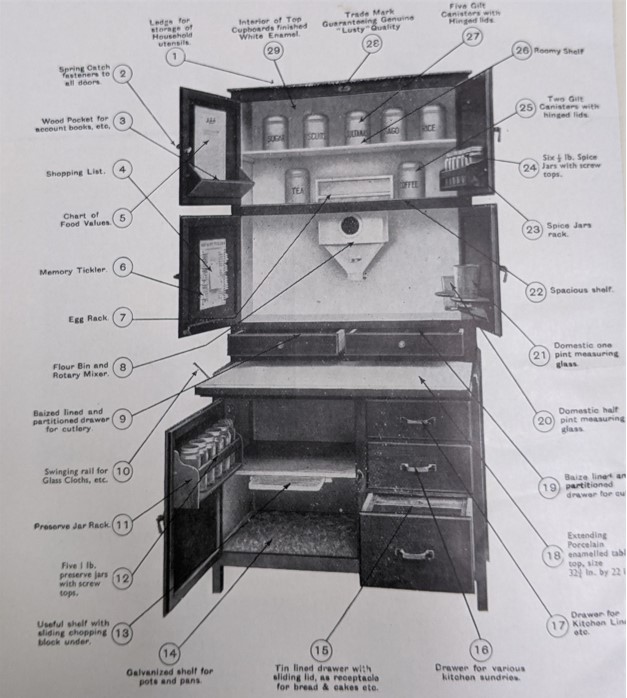
Multi-functional kitchen cabinet sold by Lusty & Sons in 1936

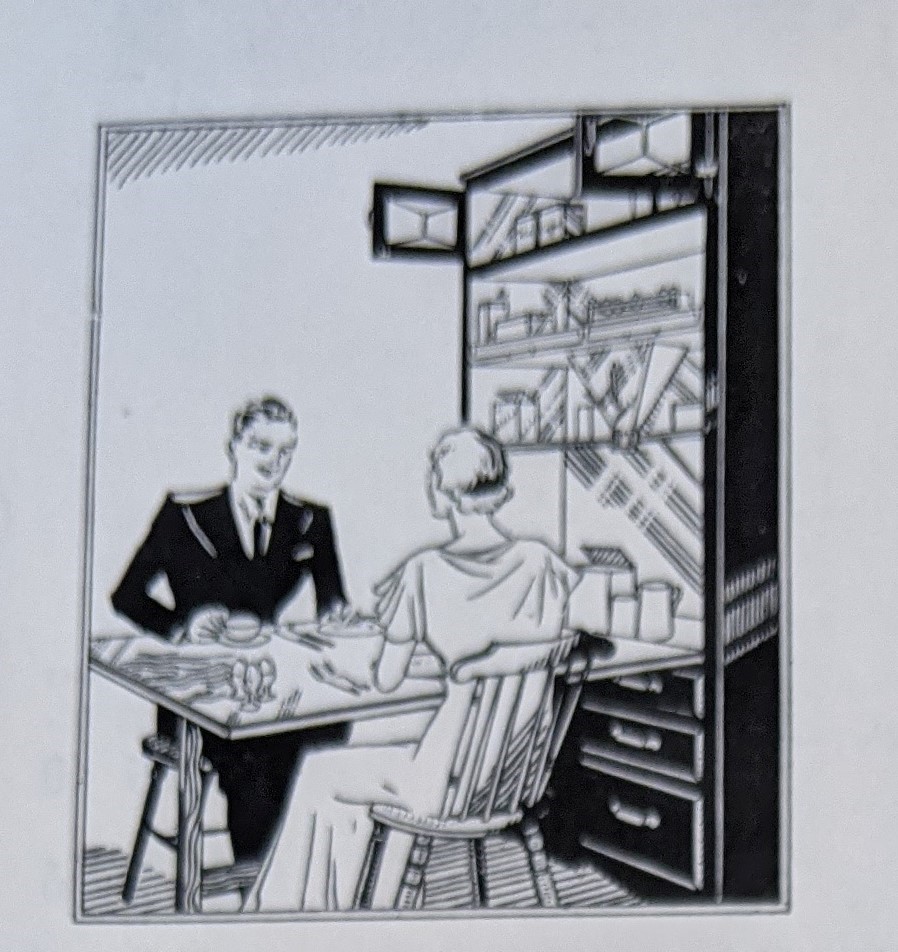
These comprehensive kitchen cabinets again came in a range of prices; the more expensive the model, the more functionality it had. This model, which at £9 was one of the more expensive ones, came with an instructive image which explained to the prospective buyer exactly how to use the unit. The 29 (!) arrows tell the housewife that she should put her large household utensils on top of the cabinet; keep her preserves in the jars in the bottom left cabinet; and put her ‘various kitchen sundries’ in the middle drawer on the bottom right. This particular cabinet comes with a chart of food values built in, and a pocket for household account books: these underline that the housewife’s task is a serious one. The health and economic survival of the household are her responsibility. The porcelain table top extends to a dining table; the catalogue provides a drawing that depicts the white-collar couple harmoniously at breakfast, using the full range of the cabinet’s functions.

Drawing included in catalgue, demonstrating use of cabinet

The Lusty & Sons furniture catalogues shine a light on how the new interwar workers furnished their homes. Like contemporary mass-furniture makers, each piece of Lusty & Sons furniture was available in a wide range of finishes. Customers were able to personalise their furniture to fit their tastes and budgets, thus avoiding the risk of having exactly the same furniture as their neighbours. At the same time, the catalogues instructed customers on how to use the furniture, and by extension, how to manage their households. Far from being a neutral object, the catalogue’s tacit and explicit instructions make visible what was considered an appropriate way of living for white-collar workers in the mid-1930s.


[1] Mark Clapson, Suburban Century: social change and urban growth in England and the United States (Oxford: Berg, 2003), p. 2

[2] ‘W. Lusty & Sons Ltd Catalogue’, 1936, held by Tower Hamlets Local History Library and Archives, LC10550

[3] Ibid.

[4] Miriam Glucksmann, Women Assemble: women workers and the new industries in inter-war Britain (London: Routledge, 1990), pp. 52-3

Death in a Taxi

The hansom cab has been a mainstay of the London streets since the 17th century.[1] The black horse-drawn carriages were largely replaced by motorised vehicles by the end of the First World War. The designs of the motorcar taxis were based on the hansom cab that preceded it, which meant that the driver was seated in the open air, or under a canvas roof, and was physically separated from the passengers. This design ensured that the passenger(s) continued to enjoy privacy during their trip and did not have to share it in close proximity to a stranger. It also assuaged any class anxieties about wealthier passengers having to share a space with a driver from a lower socio-economic background.

Taxis occupy a unique position in the transport landscape: they are open to all users who can afford them but provide a private transport experience; they are also essentially urban and predominantly found in big cities. Both these features as well as the separation of passenger and driver all stress the anonymity of the taxi experience. There were no records of who used taxis beyond what a driver could remember of his customers.

It was presumably for these reasons that for some people, the London taxi was the chosen site for murder or suicide. Tabloids reported on a number of such cases in the first half of the 1920s. In November 1923 the Daily Mirror printed the headline ‘Dead Woman in Cab’.[2] The article described that at the end of the afternoon the previous day, a young man had come into a police station in Knightsbridge and said to the officer on duty ‘the woman is in the cab outside’. In the taxi the police found the body of Ethel Howard, with a wound to the throat and a razor lying next to the body.

Daily Mirror, 16 November 1923, p. 2

At first glance this could be a case of either suicide or murder. The man who reported the death remained unnamed in the article but was described as a ‘portrait painter’. This immediately sought to evoke images of bohemia in the newspaper reader’s mind. The romance and mystery of the case was brought crashing down to earth in the follow up article printed the next day, which reported on the magistrate’s inquest on the case.[3]

The ‘portrait painter’ was in fact the 24-year-old butcher’s assistant George William Iggulden. Iggulden and Ethel Howard had been engaged to be married on 16 November. Instead, Iggulden murdered his fiancée the night before the wedding. The Mirror called this ‘the irony of fate’, although the reader may conclude that this was not so much fate as George Iggulden using desperate measures to get out of his commitment. In the taxi, he found a confined space where Ethel would not be able to escape from, and where he was sure not to be interrupted. In this second newspaper article, Iggulden is reported not just to have said ‘the woman is in the cab outside’ but also ‘I did it with a razor’. He was duly remanded to stand trial for murder.

The party who is curiously absent in all this is the taxi driver. The only oblique reference to their presence is in the second article, which described that Iggulden ‘asked to be driven to the nearest police station’ rather than to Chelsea, halfway through the drive. The police are not reported to have spoken to the driver or gotten their statement, and there is no consideration as to what the impact of a murder being committed several feet away from them may have had.

A taxi driver did have a more active role in proceedings in a case in 1925. On 23 April of that year, the Daily Express reported on a ‘Mystery of A Taxicab’.[4] On 21 April, a Sunday, Major Frank Montague Noel Newton had engaged a cab to take him from his club to his hotel. Immediately it is clear to the reader that this passenger is a man of substance, who comfortably moves around the West End. Upon passing the Hotel Metropole (now known as the Corinthia Hotel) just off Trafalgar Square, the driver heard a noise ‘as though someone was knocking on the window with a stick’. The driver was evidentially located outside the cab, with a window separating him and his passenger.

Daily Express, 23 April 1925, p. 9

The driver didn’t notice anything out of the ordinary when he turned to look through the window, so he drove on to Major Newton’s hotel. Once he arrived there, he engaged the help of the hotel porter to try and rouse Major Newton, who appeared to be asleep. Then the men realised that there was a revolver on the floor of the cab, and that the noise the driver had heard was Major Newton shooting himself.

One must make allowances for the noise cars in the 1920s generated, but it still seems extraordinary that a driver would not identify a shot fired within such close proximity. However, the story repeated itself a year later:

On arriving at Charing Cross Station about midnight on Monday the driver of a taxicab found his fare shot dead. The man hailed the driver on Cromwell Road and nothing occurred during the journey to attract attention. When he did not alight at Charing Cross, the driver got down from his seat and found the man lying dead. A revolver was on the floor.[5]

Evidently, for these men, the mobile and anonymous nature of the taxi provided a suitable space for them to commit suicide. They knew they would not be disturbed for the duration of the trip, and that they would be found by a stranger. The man who was driving to Charing Cross was reported to be a Swede visiting London. Like Major Newton, he did not have a fixed address in the city; the locations of their deaths underscore this sense of fluidity and lack of permanency.

For the drivers, finding a dead body in their vehicle appears to have been something they were expected to handle in the course of their employment. They remain anonymous in the reports, their taxis indistinguishable from the rest of the fleet that swarmed London’s streets. It is this anonymity which made their taxis such appealing sites for illicit and illegal behaviour in interwar London.


[1] George N Georgano, A History of the London Taxicab (Newton Abbot: David and Charles, 1972), p. 110

[2] ‘Dead Woman in Cab’, Daily Mirror, 16 November 1923, p. 2

[3] ‘Dead Girl in Taxi’, Daily Mirror, 17 November 1923, p. 2

[4] ‘Mystery of a Taxicab’, Daily Express, 23 April 1925, p. 9

[5] ‘Shot Dead in Taxi’, Daily Mirror, 3 November 1926, p. 2