New Year’s Eve 1923

As is tradition, the final blog post of the year looks back at New Year’s Eve one hundred years ago. You can read the 1921 edition here and the 1922 edition here.

In 1923, New Year’s Eve fell on a Monday. Unlike today, when British workers generally get given the 1 January off as a Bank Holiday, in the 1920s staff in London had to work as normal on the first day of the new year. ‘Northerners’ apparently did get the day off. The Evening Standard, as London’s evening paper, reported on 1 January:

London to-day is largely populated by tired but happy people who but a few hours ago in a thousand various ways were deliberately making a night of it. And none of them seem ashamed of it. Their eyelids may sag as they bend over their work, but they are full of conscious virtue. They have begun the New year well.[1]

As was common every year, the New Year’s Eve celebrations in the capital were reported to have been the most successful yet, although it appears to have been raining heavily on 31 December 1923. The people of London celebrated in the usual way: the rich went to hotels and restaurants, and everyone else partied on the streets, with St Paul’s cathedral a particular focal point for those who were perhaps religiously-minded. The Daily Telegraph noted that well-heeled Londoners increasingly stayed in a hotel for the whole Christmas period: ‘It is not at all unusual for groups of friends to move into an hotel for Christmas and the New Year, thus, while enjoying the nightly round of festivities, avoiding the trouble of getting home to the suburbs in the early hours of the morning.’[2] The ‘shortage of servants’ which was starting to bite in the post-War years, was quoted as one reason to outsource all Christmas festivities to professional caterers.

Although celebrations in London were largely business as usual, two things happened on New Year’s Eve 1923 that radically altered the nation’s experience of the festive period. The BBC had been founded in October 1922, and by the end of 1923 it had sufficiently established itself, and enough people in the country now owned wireless (radio) sets, to allow two things to happen. First, at 6.35pm, the Archbishop of Canterbury addressed the nation with a New Year’s message. As the Manchester Guardian reported: ‘every word came through quite clearly. The Archbishop spoke from the British Broadcasting Company’s premises in London.’ His speech related the ‘glamour’ of the War years to the ‘common-place’ lives most people now found themselves in:

We must translate the poetry and glamour of the exciting war years into the prose of common days. The Ypres salient, or the North Sea minesweeper on a stormy night, or the Anzac beach and cliff, or the midnight vigil of the hospital, with the ghastly stretchers coming in: these things, with all their dreadness, had an uplift of their own. There is no such uplift in your rather commonplace sitting-room, or at the clerk’s dull office desks, or behind the shop counter. But such are the “settings” in 1924 of many of the self-same men and women who six years ago had the other, the “romantic” setting.[3]

Although we may today primarily think of the 1920s as a decade of glitz and glamour, the Archbishop clearly picked up on a mood of discontent in the nation. Presenting the war as glamorous and exciting is a shift away from how newspapers had generally discussed the war until that point, as a period of hardship and sacrifice. The increased distance from the horrors of war allowed space for alternative viewpoints to be aired.

The other momentous thing that happened was that for the first time ever, the whole country could hear Big Ben chime at midnight over the radio:

Cover it up as we may, it is a solemn moment as the New Year is ushered in. And these sonorous notes of Big Ben, carried so magically through space, struck the right note at the right moment. (…) The broadcasting of Big Ben is a big idea which will remain with us. It has something of the power of the Two Minutes Silence in it.[4]

The Evening Standard reporter had the right instinct, as the chiming of Big Ben is still broadcast by the BBC and still the definitive start of the new year across the British isles. In 1924, it demonstrated the unifying power of the new mass media, binding together people from all across the country to the same moment and sound; and irrevocably placing a historical London landmark at the centre of that unification. How different would it be if instead, the BBC had chosen to broadcast church bells from Middlesborough, Swansea or Perth?

The New Year’s Honours list, normally good for extensive coverage in newspapers, got very short shrift in 1924. It was shorter than usual, there was no-one on the list who may be known by the wider public, and there were no women on it at all – the latter was, even in 1924, unusual.[5] There were also no interesting new laws that were coming into effect on 1 January 1924. Where’s 1923 had seen a change to the divorce and unemployment laws which potentially affected millions, in 1924 the most significant new law was the ‘Salmon and Freshwater Fisheries Act (…) designed to prevent the destruction of salmon and trout by such methods as the use of the spear and explosives.’[6]

Finally, the London Underground shared its annual statistics with the readers of The Times. In 1923, it transported 1.7 billion passengers: ‘so that every Londoner travelled, on average, 219 times in the year in either its railway cars, tramcars or motor omnibuses.’[7] It was the busiest year yet for the transport body. The advert links this increase in travel to an increase in general employment figures: ‘The number of passengers is growing steadily. This means that trade is improving and unemployment lessening.’ For the new year, the board predicted continued expansion of both passenger numbers and rolling stock.

A general note of optimism pervaded the newspapers at the start of 1924, although the memories of the First World War were fading away. There were no references to relief that the war was over, or remembrance of those who had fallen. Instead, the Archbishop’s speech indicates that relief was being replaced with frustration and boredom. The country had to figure out how to settle back into normality after years of disruption that, with hindsight, could have taken on a sheen of glamour.


[1] ‘London goes to work on the “morning after”’, Evening Standard, 1 January 1924, front page

[2] ‘Greeting the New Year – Music, Mirth and Dancing’, Daily Telegraph, 1 January 1924, p. 7

[3] ‘Primate Broadcasts his New Year Message’, Daily Telegraph, 1 January 1924, p. 13

[4] ‘London goes to work on the “morning after”’, Evening Standard, 1 January 1924, front page

[5] ‘A Londoner’s Diary’, Evening Standard, 1 January 1924, p. 4

[6] ‘New Legislation’, The Times, 1 January 1924, p. 9

[7] ‘A New Year’s Message from the Underground’, The Times, 1 January 1924, p. 10

A Week in Whitechapel (1933)

FeaturedA Week in Whitechapel (1933)

In early 1933, international politics was increasingly tense, with Mussolini having overseen a Fascist regime in Italy for over 10 years, and the inexorable rise of Hitler and the National Socialist Party in Germany. It had become increasingly clear to Britons that anti-Semitism was a key tenet of Nazism.

In the run-up to the March 1933 German federal election, which Hitler hoped to use to reach a majority in parliament, the Daily Express printed a 6-part series of articles headlined ‘A Week in Whitechapel.’ Although the Express was in no way a left-wing paper, it used this series of articles to shine a positive light on Whitechapel’s Jewish community. Although the articles are not labelled as explicitly political, and present as ‘human interest’, they were printed for six consecutive days on page 3 of the paper, a prominent position otherwise reserved for national and international news reports.

The headline of the first article, which appeared on Monday 27 February 1933, states ‘Jewish Youth Looks Westward’. Although the body of the article makes it clear that this is meant to be London’s West End, the headline holds the double connotation of Jewish people looking to Western Europe as the basis for its future. According to the article, Jewish people have ‘found sanctuary’ in Whitechapel after persecutions in ‘Europe’.[1] A young Jewish woman is described as ‘lusciously pretty’ and dressed ‘magnificently.’ Although the young Jews are presented as dressing slightly more loudly than British (white) people, the overall tone of the article is not derogatory and the Jewish woman is presented as desirable.

The second article, printed the next day, champions a Jewish business owner who, according to the article headline, had a ‘£5,000 business built up in four years – Photographic studio opened with a capital of 6s 6d.’[2] In contradiction to the anti-Semitic stereotype of money-obsessed Jews, this anonymous photographer is held up as a savvy businessman. The man argues that ‘The Gentile [a non-Jewish person] works for an old-age pension: the Jew to be his own master.’ The reporter has to conclude that the Jewish photographer has made the better deal – he has £5,000 in capital, whereas ‘the old-age pension is only 10s a week.’[3]

On the same day, the front page of the Express was given over to a large report on the Reichstag fire, which had occurred the previous night. Historians agree that this fire, for which Hitler blamed Communists, was a key event in the establishment of Nazi power. It allowed Hitler to argue for emergency powers, which allowed him to order the arrest of thousands of Communists, only days before the federal election. The Daily Express’s juxtaposition of this story with the positive depiction of Jewish Londoners in the ‘A Week in Whitechapel’ series highlights how much attitudes towards Jewish people were contested in this period.

The series of reports continues on 1 March with a description of a Jewish wedding, which was again positive although it followed a tried-and-tested tabloid reporting method by highlighting the custom of shattering glass: this would have appeared unusual to any readers not familiar with Jewish traditions. Nevertheless, the article is not exploitative in its tone. For the fourth instalment, the reporter visited a Jewish pub. Again, a potential stereotype – Jewish people eat a lot of food – is touched on but turned into a positive: ‘Everywhere was food, for the Jew eats as he drinks, and so surpasses a Gentile in sobriety.’[4]

For the penultimate article, the reporter attended a Christian mission attempting (and failing) to convert Jews, and a synagogue. The rabbi is described as ‘a marvel of learning’ and the Jewish school as a place where ‘the seed is lovingly sown. The shoot is exquisitely nurtured.’[5] The Christian mission, by contrast, is described as providing free healthcare to the poor only as long as they attend a Christian gospel service.

Only for the final article, printed on Saturday 4 March, the day before the German elections, does the series touch on the other thing that made Whitechapel famous: the Jack the Ripper murders.[6] This is the only of the articles which does not focus on the Jewish community, instead quoting an East End housewife whom the author encountered. Several pages further in the same paper, a Sidney Strube cartoon was very clear about what he thought about the German elections – a shaking old man is intimidated and led up to a ballot box placed under a guillotine.[7]

A Sidney Strube cartoon, printed in the Daily Express, 4 March 1933, p. 8

Although the Daily Express was not as politically explicit as some of its competitor papers like the Daily Mail or the Daily Herald (on the right and left of the political spectrum, respectively), it commissioned and printed a series of articles which spoke positively about the Jews. At a politically fraught period for Jews in Europe, this indicates that the paper’s editors were willing to quietly counteract the anti-Semitic sentiments that were also becoming more prominent in Britain, following the founding of the British Union of Fascists the year before.


[1] ‘Jewish Youth Looks Westward’, Daily Express, 27 February 1933, p. 3

[2] ‘£5,000 Business Built Up in Four Years’, Daily Express, 28 February 1933, p. 3

[3] Ibid.

[4] ‘The Landlord of the Aspidistra has a Plan to Settle the Irish Problem’, Daily Express, 2 Mach 1933, p. 3

[5] ‘The Definition of Hope – A Mission to the Jews’, Daily Express, 3 March 1933, p. 3

[6] ‘Along the “Ripper’s” Route’, Daily Express, 4 March 1933, p. 3

[7] ‘Vox Populi’, Daily Express, 4 March 1933, p. 8

So-called Schools of Journalism

FeaturedSo-called Schools of Journalism

Journalism boomed during the interwar period – the British were avid newspaper readers: its post-war newspaper consumption per capita was the highest in the world.[1] The increased popularity of newsprint fuelled the demand for more journalists – by 1938 there were an estimated 9000 people working as journalists in Britain.[2] The often glamorous depiction of journalists in novels, autobiographies and (Hollywood) films, plus the fact that there were no formal entry requirements to the profession, made journalism an appealing potential career path.

As has been covered elsewhere in the blog, a formal University Diploma for Journalism launched at the University of London after the First World War. Additionally, there was a flourishing market of self-help books aimed at teaching novices how to become professional writers. The University qualification, however, was not accessible to many people as it was only taught in-person in London and required entrants to have matriculated (i.e. passed a University entry exam). Self-help books required substantial self-discipline on the part of the aspiring journalist. It is no wonder, then, that a third potential route into journalism gained popularity: attendance at a non-accredited ‘School of Journalism.’

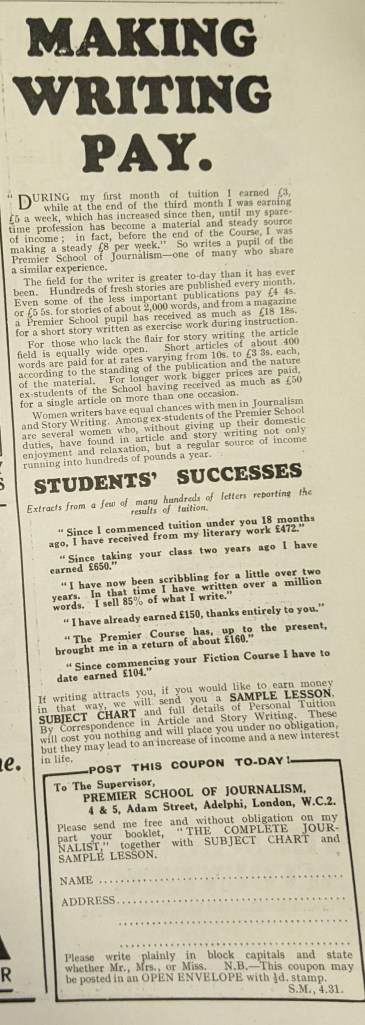
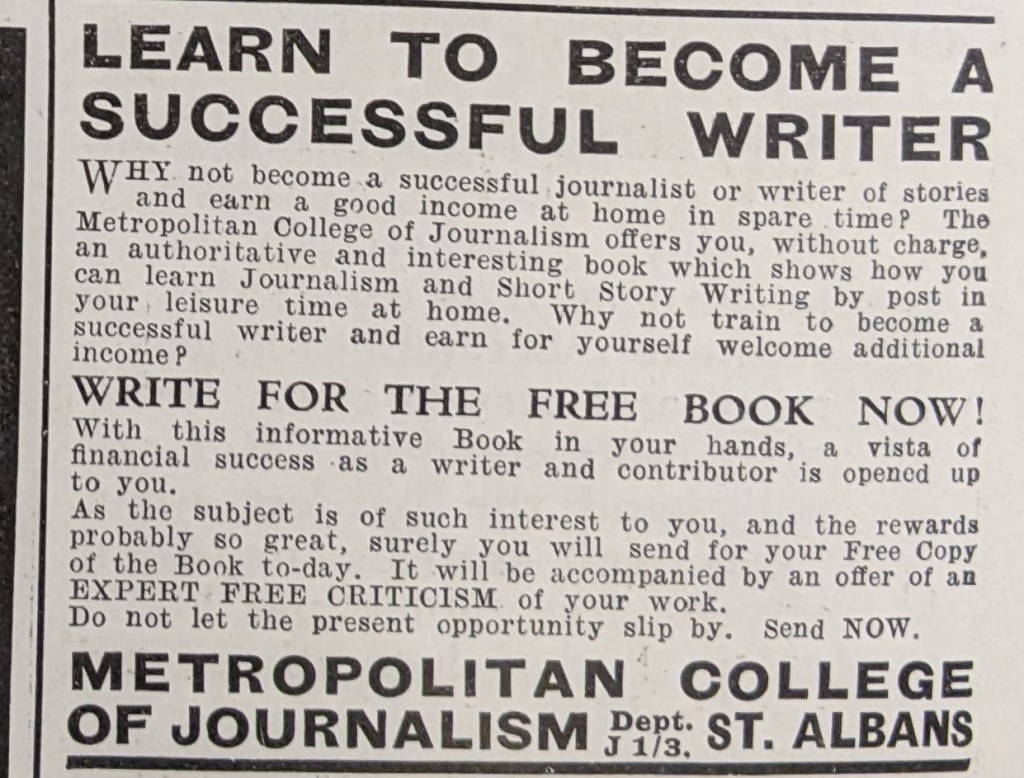
There has not been any historical research published on the phenomenon of ‘schools of journalism’, but my own research indicates that they started up immediately after the First World War, and that in a short space of time many different establishments were formed. A single issue of The Strand Magazine, a monthly publication of fiction short stories and non-fiction pieces, contained adverts for the Premier School of Journalism (‘Making Writing Pay.’), the Metropolitan College of Journalism (‘Learn to become a successful writer’) and The Regent Institute (‘Free Lessons for New Writers’). These schools all offered potential clients an easy route into a remunerative writing career. As the advert for the Metropolitan College posed: ‘Why not become a successful journalist or writer of stories and earn a good income at home in spare time?’

Most Schools of Journalism offered a variation of the same: a correspondence course in which students could submit their trial articles, which would then be corrected by tutors and sent back to students with constructive feedback. After a set period of study, students were promised that their writing would be good enough to sell. The advert for the Premier School of Journalism includes (alleged) testimonials of former students quoting significant financial gains from their work: ‘Since taking your class two years ago I have earned £650’ and ‘Since I commenced tuition under you 18 months ago, I have received from my literary work £472.’ For comparison, the minimum weekly pay for a staff journalist in the early 1930s was just shy of £5 – and that was a considerably better wage than journalists had been paid before the National Union of Journalists pushed for national pay agreements.[3]

The aggressive advertising of these journalism schools caused considerable anxiety and disgruntlement for members of the NUJ, who were either worried that these schools would lead to a surplus of journalists and therefore a competitive job market; or felt that these schools were scams designed to make money off unsuspecting people. One of the first schools to launch after the First World War was The London School of Journalism (which still operates today). It was founded by novelist Max Pemberton and it ran a prominent advertising campaign in the national press. In August 1920, NUJ member and journalist John Ramage Jarvie argued that this advertising campaign must have cost the School a significant amount; and that as the fees they charged students were modest, the School’s operating model must rely on recruiting a high volume of students in order to make a profit. Jarvie therefore considered it inevitable that businesses like the LSJ would increase unemployment amongst journalists by flooding the market.[4]

The NUJ initially did not pick up on its members’ concerns about the LSJ and similar ventures, and gave Max Pemberton a platform to advertise his school to NUJ members. Pemberton stated in an article for the Union monthly newsletter that his school actually told many potential students that journalism was not the right career for them. He presented his initiative as a sort of gatekeeper for the profession, and argued (rather disingenuously) that the School’s adverts did not explicitly promise to turn students into journalists.[5]

Pemberton’s arguments failed to convince the NUJ membership, and the Union’s executive swiftly decided that they would only provide advertising space to training initiatives aimed at current, working journalists. Nevertheless, the schools continued to do business throughout the interwar period. Journalist Harold Herd described how he set up his own school in the late 1910s, which was still trading by the time he wrote his memoir in 1936. Like Pemberton, he argued that he only took on students who had a chance of making it as a professional journalist: ‘Every year we reject hundreds of people on the ground that they do not reveal sufficient promise to justify a recommendation to enrol.’[6]

Despite the protestations of school founders, the sheer volume of such organisations; their modest tuition fees; and the simplicity of their teaching materials (one correspondence course mainly encouraged students to learn from, and copy, existing writers’ work) suggest that it is unlikely that many of their students found professional success. Despite there being no formal entry requirements to becoming a journalist, these unregulated schools sold a dream of easy earnings which could not become a reality for most of their pupils.


[1] Adrian Bingham, ‘‘It Would be Better for the Newspapers to Call a Spade a Spade’: the British Press and Child Sexual Abuse, c. 1918–90’, History Workshop Journal, vol. 88 (2019), 91

[2] Political and Economic Planning, Report on the British Press (London: PEP, 1938), p. 13

[3] A.M. Carr-Saunders and P.A. Wilson, The Professions (Oxford: Clarendon Press, 1933), p. 268

[4] J.R. Jarvie, ‘The London School of Journalism LTD’, The Journalist, August 1920, p. 68

[5] Max Pemberton, ‘The London School of Journalism LTD’, The Journalist, October 1920, p. 90

[6] Harold Herd, Press Days and Other Days (London: Fleet Publications, 1936), p. 124

Featured

From investigation to trial

This is the fourth and final post of this year’s May Murder Month. You can read posts one, two and three elsewhere on the blog.

Most contemporary readers will get their knowledge about interwar murder stories from the realms of fiction – Hercule Poirot gathering together suspects for a drawing room reveal (a device which Agatha Christie actually only used sparingly) or a hard-boiled police officer picking up on a seemingly minute clue that unravels the whole case. Once the murderer is identified, interwar fiction is either silent about what happens next, or the perpetrator is given the opportunity to take the ‘honourable way out’ by committing suicide.[1]

In reality, of course, investigations were conducted by police inspectors. Unlike in modern criminal cases, there was no Crown Prosecution Service in interwar England. Instead, the police both conducted the investigation and prepared the documentation for the criminal trial. The Director of Public Prosecutions was ultimately responsible for bringing the case to trial in the interest of the people. England then, as now, had a two-tier criminal justice system. The magistrate courts were convened locally and dealt with most of the day-to-day criminal offences. Crown courts were reserved for jury trials, which included murder charges.

Before a case could be referred to the crown court, a prima facie case had to be established in the magistrate court that a crime had been committed and it was of a magnitude appropriate to be considered in the crown court. Interwar murder trials were therefore effectively heard twice: once in the magistrate court and then again in the crown court, where the sentencing would take place. It was generally the latter proceedings that drew the attention of the national press. In murder cases, the coroner’s inquest ran in tandem to the magistrate court proceedings. In the interwar period, coroner courts sat with their own juries, who were tasked with determining whether death had occurred naturally, through suicide, accident, or murder. Usually, if foul play was suspected but the police investigation was ongoing, the coroner would suspend the inquest to give the police more time to complete their investigations.

The reading public, then, were experiencing criminal narratives in two different ways. When reading newspapers, the reports mostly focused on the criminal trial, with its rhythm of prosecution, defence, cross-examination, witness statements, a possible statement by the accused, and the judge’s summing up, all cumulating to the jury’s verdict. In crime fiction, the narrative focused on the investigation, with witness statements noted as the investigation developed. Particularly in stories where the protagonist is an amateur sleuth as opposed to a police officer, the formal police and court procedures can be completely outside the scope of the narrative. As crime historian Victoria Stewart has noted: ‘Detective novels tend not to recount the trial of the individual whom the investigator identifies as the guilty party because the watertightness of the investigation itself acts as a substitute for the depiction of the judicial process. An account of the trial would simply reiterate the findings of the investigation that has formed the body of the narrative.’[2]

Other scholars have noted that trial reporting reveals contemporary attitudes to potentially contentious topics such as changing attitudes to gender identity and sexuality.[3] Newspaper historians have also argued that the increased popularity of crime fiction changed crime reporting, with journalists paying more attention to ‘human interest detail’ of the story as opposed to the judicial process. This, in turn, potentially obscured the public’s awareness of legal procedures.[4] Additionally, journalists on occasion played a very active role in gathering evidence that led towards a conviction, for example in the case of Buck Ruxton who murdered his wife and a servant.[5] Conversely, crime fiction novels which had a police inspector as their protagonist, such as the Inspector French novels by Freeman Wills Croft, potentially educated their readership about police procedures in more detail than newspaper reports did.

Whether fictional or factual, murder stories fascinated interwar audiences and allowed them to explore the limits of what was considered acceptable or transgressive behaviour; and how this changed over the course of the two decades. Newspapers and crime novels presented readers with two different lenses through which to consider the criminal justice process, from investigation to trial.


[1] Lord Peter Wimsey’s increasing mental distress at sending murderers to the gallows, which comes to a head at the end of the final Wimsey novel Busman’s Honeymoon, is a notable exception.

[2] Victoria Stewart, Crime Writing in Interwar Britain (Cambridge: University of Cambridge Press, 2017), p. 11

[3] Lucy Bland, Modern Women on Trial: sexual transgressions on the age of the flapper (Manchester: Manchester University Press, 2013), p. 2

[4] Judith Rowbotham; Kim Stevenson; Samantha Pegg, Crime News in Modern Britain (London: Palgrave, 2013), p. 140

[5] Shani D’Cruze, ‘Intimacy, Professionalism and Domestic Homicide in Interwar Britain: the case of Buck Ruxton’, Women’s History Review, vol. 16, no. 5 (2007), 701-722

Featured

Short story writing in interwar Britain

Short stories are a relatively niche genre of fiction writing these days. The fiction short story appears to have originated in the 1820s. It is primarily the short stories of famous novelists that have stood the test of time: Sir Walter Scott, Charles Dickens, and, on the other side of the pond, Edgar Allan Poe, F. Scott Fitzgerald and Ernest Hemingway.[i] For the interwar period, literary authors such as James Joyce and Katherine Mansfield may come to mind. Yet the works of Joyce and Mansfield were only read by a limited audience at the time of their publication. They are decidedly ‘highbrow’ authors with no mass-market appeal.

Alongside these literary outputs, thousands of other, now forgotten, short stories were published in interwar Britain. They were found in newspapers, weekly magazines and dedicated publications such as the Strand Magazine. Due to their placement, short story writing was often considered aligned with journalism. Dozens of guide books appeared in the 1920s and 1930s instructing young hopefuls in how to ‘live off the pen’, whether that was through writing news articles; human interest stories; short stories; or novels (or even screenplays for films).

Literary critic Q.D. Leavis let rip against this commercial market of fiction writing in her 1932 polemic Fiction and the Reading Public. She is highly critical of the marketisation of fiction, which in her view sees editors prioritise high circulation figures above all else. ‘The kind of fiction published in this way – the briefest inspection will show that it is all of a kind – is carefully chosen by the editors in accordance with the policy of wat is called ‘Giving the Public what it wants.’’[ii] The result, Leavis argues, is that the public is inundated with ‘fiction that requires the least effort to read and will set the reader up with a comfortable state of mind.’[iii]

Although the tone of Leavis’ book is snobbish in her assumption that the increased commercialisation of literature signals a cultural decline, an inspection of 1920s and 1930s guide books on ‘how to become a writer’ demonstrates that these books did consistently advise to keep the readership in mind when writing short stories. Often, these books break the short story down into constituent elements and tell the aspirant writer how to put together a successful story. They actively warn against individualism or stylistic flourishes in writing. For example, the author of the 1934 book Short Stories and How to Write Them declares: ‘My earnest advice to all at this stage is to study the markets. The stories you find should be your models. Every story should be written with a definite market in view.’[iv] Similarly, The Craft of the Short Story, published two years later, argues that ‘Always remember that your purpose in writing a short story is, or should be, to amuse and entertain.’[v] It is the reader, not the writer, who is the most important part of the equation.

The explosion of print media had made commercial writing an attractive career option for many people. Unlike professions such as medicine or law, you did not need an expensive university education to become a journalist or writer. Indeed, many of the books on the subject argued that all that was needed was a sound grasp of the English language, some stationary supplies and probably a cheap typewriter, and resilience, as the aspiring writer could expect many of their first attempts to be rejected by editors.

One author who made a good living out of the writing of guide books was Michael Joseph, who was also a literary agent and from 1935 a publisher (Michael Joseph continues to exist as an imprint of Penguin). Joseph wrote eight books on the topic of writing and making money, between 1924 and 1931. His prominence in the field is acknowledged by Leavis, who repeatedly uses his books as examples of how writing has become a business. In How to Write a Short Story, Joseph argues that ‘Many writers actually cannot visualise their market when they set to work on a story. Artistically, there is a good deal of justification for this; commercially, it is liable to result in failure to place the MS [manuscript].’[vi] Some of his other books tackle the business side of writing even more explicitly, by listing publications which accept submissions and explaining in detail how one goes about submitting a manuscript.

If the self-study of guidebooks was not enough, the aspiring writer could also enrol into one of dozens of writing schools and correspondence courses that were available in the interwar period. Often these were advertised in short story publications. Professional writers were generally highly sceptical of these ‘schools’ which tended to promise unrealistic returns on investment. Yet some writers set up schools themselves. One of the earliest and most commercially successful was the London School of Journalism, founded by novelist Max Pemberton and still in business today. ‘The Short Story Course’ offered by the School in the 1920s consisted of 12 lessons, each ending with a few exercises which the student could complete and send back to the School to be marked. Lessons include ‘About Plot’ (lesson 2); ‘Heroes and Heroines’ (lesson 4); and ‘Atmosphere’ (lesson 5). Exercises often included copying out examples of existing short stories to study them. The main advice at the end of the course is to ‘work with diligence every day’ and apply oneself, and then success is sure to follow.

All of these courses and books demonstrate that the writing of short stories was big business in interwar Britain, at least for the happy few who were able to claim authority in the field and make a living out of encouraging others to follow the same career path. All of the books highlight resilience and consistency as key to success, but do not mention elements more traditionally linked to artistic endeavours such as inspiration or reflection. Like journalism, which had become increasingly commercialised, short story writing became ‘hack work’ in the interwar period.


[i] All male, of course – not because men are better short story writers but because they have traditionally been more readily classed as ‘great authors’ and have had their oeuvres canonized accordingly.

[ii] Q.D. Leavis, Fiction and the Reading Public (London: Chatto & Windus, 1968 [1932]), p. 27

[iii] Ibid.

[iv] Cecil Hunt, Short Stories and How to Write Them (London: George Harrap & Co, 1934), p. 187

[v] Donald McConochie, The Craft of the Short Story (London: Sir Isaac Pitman & Sons, 1936), p. 27

[vi] Michael Joseph, How to Write a Short Story (London: Hutchinson & Co, 1925), p. 91

New Year’s Eve 1922

New Year’s Eve 1922

As is tradition on this blog, for the final post of the year we cast our minds back to exactly one hundred years ago and have a look at how New Year’s Eve was celebrated in London that night. After some rain earlier in the day, the evening of Sunday 31 December was cold and a bit windy but dry: no doubt a relief to Londoners keen to let their hair down.[1] According to the Manchester Guardian pre-midnight celebrations were ‘more subdued’ than in previous years owing to 31 December being a Sunday! Due to a special licensing hour dispensation, hotels could stay open till 2am.[2]

Well-heeled Londoners were excited to ring in the new year with elaborate parties in hotels and restaurants. Hotels spared no cost in their interior decoration: the dining room of the Berkeley Hotel ‘was transformed into a lighted vineyard’ and at Claridge’s guests walked through an Italy-inspired landscape.[3] At the Savoy Hotel, a large amount of Christmas crackers were pulled during an ‘elaborate banquet’ – 25,000 crackers according to the Daily Express, but 35,000 according to the Mirror.[4] Some venues put on performances: at the Metropole Hotel midnight was marked by ‘a dainty little girl dressed as Cupid [appearing] from a huge cracker, which was pulled by Father Christmas.’[5] At the Piccadilly Hotel grill room a female singer appeared out of the top of a huge champagne bottle at midnight to sign Auld Lang Syne.[6]

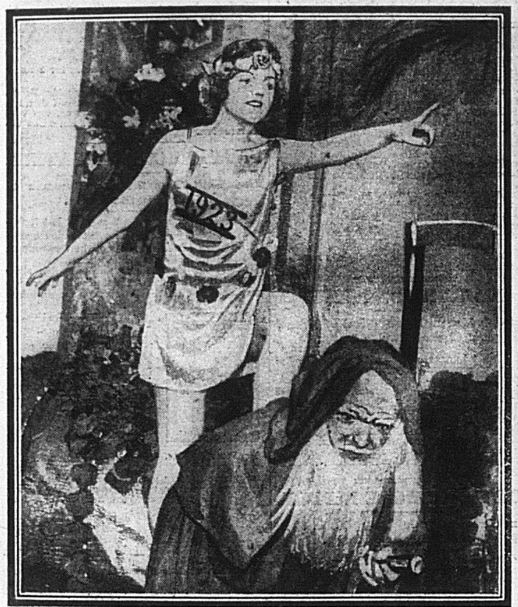
A young woman, representing 1923, banishing old 1922 in an unspecified performance. Image: Daily Mirror, 1 January 1923, front page

For those who could not afford to be in the hotels, the streets of London provided a suitable party venue. The steps of St Paul’s Cathedral were one of the traditional sites of celebration, and crowds started gathering there hours in advance.[7] The Daily Express reporters, always ready with more evocative language then their colleagues at rival papers, described the crowds in the West End as follows:

They were “grown ups” who surged in dense masses through the streets, but the joy of childhood – Christmas party childhood – was rampant. Every one wore a paper hat, and nearly every one was blowing a toy trumpet. Street corners were impromptu ballrooms.[8]

Aside from the evening celebrations, the New Year also meant the publication of the annual honours list, announcing which luminaries had been bestowed honorary titles. In 1923, the prominent and popular Home Office pathologist, Bernard Spilsbury, was knighted and could henceforth call himself Sir Bernard Spilsbury.[9]

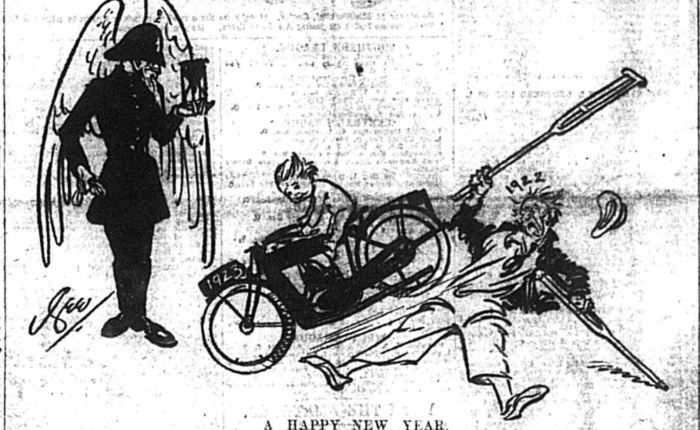
Cartoon in News of the World of 31 December 1922 reflecting the growing concerns on the dangers of motorized traffic, which would come to a head in the early 1930s.

The beginning of the new year also meant the start of winter sales in all the big department stores. The growing importance of consumerism, and the increase in disposable income, are marked by the prominent articles appearing in the popular press about the sales. ‘Thousands of women will to-day celebrate the coming of 1923 by “raiding” the great London stores in the breathless but happy hunt for bargains’ predicted the Daily Mirror.[10] In an article that essentially sums up the offers at each of the great stores, readers are advised that whilst buying ‘indiscriminately’ is never a good idea, one can’t go wrong with staples such as ‘gloves, shoes, underclothes etc’.[11]

The Sunday papers on 31 December had already carried large adverts for each of the store, preparing shoppers to the bargains that could be had. Like the Daily Mirror article, these were almost exclusively aimed at the female readership. It was clearly understood that shopping in a sale was the kind of frivolous activity that only women would engage in. At Dickins & Jones, a clearance of ‘model gowns’ (ie. those used for display purposes) meant that prices started at 7 ½ guineas – a guinea being 1 pound and 1 shilling.[12] On the same page, competitor Marshall & Snelgrove advertised a fur coat for 89 guineas; it had previously been between 125 and 179 guineas so this discount was indeed a ‘wonderful bargain’ although it was clearly out of reach for the vast majority of the population.[13]

By the time the Evening Standard appeared in the afternoon, it was able to report on the ‘bargain day scenes’ in breathless and rather sexist tones. ‘The occasion had much more significance for the ladies than the mere advent of the New Year, and (…) they stormed the whole of the shopping centres in their myriads.’[14] Some of the items on offer according to this article were velour coats with mole collar and cuff trimmings at 4 ½ guineas, and a knitted woollen gown at 27 shillings and sixpence; clearly the readership of the Evening Standard had less to spend than the readers of the Observer.

Elsewhere, the Evening Standard reported on the continued imprisonment of Edith Thompson and Freddie Bywaters, who would be executed on 9 January for the murder of Edith’s husband. Other papers noted the republic of Ireland’s recent independence, which was officially finalised in December 1922.[15] All was not well in the remainder of the Union either, with Scottish hunger marchers protesting in London on the first day of 1923.[16] Although the New Year’s Eve parties and January sales gathered the most prominent coverage, it is clear that below the celebratory surface troubles were brewing as Britain continued to deal with the fall-out of the Great War.


[1] ‘Week-end Weather’, The Observer, 31 December 1922, p. 14

[2] ‘New Year Revels in London’, Manchester Guardian, 1 January 1923, p. 7

[3] ‘At the Hotels’, Daily Express, 1 January 1923, front page

[4] Ibid.; ‘1923 Danced In by Merry Throngs’, Daily Mirror, 1 January 1923, p. 3

[5] ‘1923 Danced In’, Daily Mirror

[6] ‘New Year Revels in London’, Manchester Guardian

[7] Ibid.

[8] ‘Great Crowds in the Streets’, Daily Express, 1 January 1923, front page

[9] ‘New Years Honours’, Daily Express, 1 January 1923, p. 7

[10] ‘Sales Carnival Begins To-Day’, Daily Mirror, 1 January 1923, p. 2

[11] Ibid.

[12] ‘Dickins & Jones’ advert, The Observer, 31 December 1922, p. 9

[13] ‘Marshall & Snelgrove’ advert, The Observer, 31 December 1922, p. 9

[14] ‘Bargain Day Scenes,’ Evening Standard, 1 January 1923, front page

[15] ‘Politics at Home and Abroad’, Daily Telegraph, 1 January 1923, p. 4

[16] ‘Hunger Marchers’ Complaints’, Evening Standard, 1 January 1923, p. 8

Newspaper wars

Although this blog focuses on the period between the First and Second World War, the interwar period was not without its conflicts. One of the social changes which took place in the first half of the 1930s has retrospectively been dubbed the ‘newspaper wars’ which was fought between popular newspaper titles.

A host of daily newspapers aimed at the lower-middle classes were launched in Britain at the turn of the twentieth century. The Daily Mail arrived in 1896, followed by the Daily Express in 1900, the Daily Mirror in 1903 and the Daily Herald in 1912. These newspapers represented a completely new type of written press. Existing papers such as The Times and the Daily Telegraph were aimed at upper class, male readers. They contained columns of densely printed text without illustrations. Advertising mostly consisted of personal adverts which took up the entire front page. There were no big headlines, and reporting included lengthy verbatim reports of parliamentary discussions.

The new popular papers founded at the start of the twentieth century disrupted this model. Partially due to educational reform, general literacy levels increased, and there was now room in the market for newspapers aimed at a wider readership. However, whereas broadsheet papers were aimed at men who could afford to spend hours reading a paper over breakfast or in their members club, the new newspapers recognised that their readership likely could only snatch a few minutes at a time to read their paper. Moreover, the newspaper bosses realised that their readership was more interested in snappy articles and the new invention of the ‘human interest’ story than in long and precise reports about complicated subjects.

From the beginning, popular papers therefore printed shorter articles, more images, and more headlines. The Express was the first to adopt an ‘American’ lay-out which meant that it printed news on the front page, as opposed to the ubiquitous personal adverts –  a practice eventually adopted by all national newspapers. These papers generally cost only one pence per issue, to keep them affordable to the working classes and lower-middle classes. This did mean that the papers’ main revenue source was advertising. In order to attract the most lucrative advertising deals, each paper had to ensure its circulation was constantly growing. It was particularly coveted to increase the number of subscribers as they provided a more stable source of income than those who bought a paper only occasionally.

Throughout the Edwardian period and the 1920s the popular papers were able to increase their circulation by targeting people who did not yet subscribe to any paper at all. By the early 1930s, however, market saturation had been reached, and newspapers had to change their tactics. The only way to continue growing their circulation was by actively persuading readers to switch papers. The fight for new subscribers became so heated that this period has later been dubbed the ‘newspaper wars’.

Newspapers used different tactics to persuade more readers to subscribe to them. One was to ensure that they offered a clear political identity. The Daily Herald had been, from its foundation, an outspoken left-wing newspaper, and from 1922 it was formally affiliated with the Trade Union Congress (TUC), the overarching body of trade unions. By 1933 the Herald’s circulation had grown larger than it had ever been, to two million copies a day, and it started to form a real threat to the other popular papers, which had mostly supported a conservative agenda.

The owners of the Daily Mirror, therefore, relaunched the Mirror in 1934 as a left-leaning paper, but without formal affiliation to the TUC. This enabled the Mirror to present itself as the paper of choice for the non-radical, non-unionised working classes. It also differentiated itself clearly from the Mail and Express who continued to support the Conservative party.

Whilst the Express did not differentiate itself through its political stance, it did radically change its layout in 1933, in a bid to attract more readers. A new editorial team introduced clearer headlines and wider spacing, which made the paper easier to read. Their biggest innovation was to no longer print articles strictly across one column, top to bottom. Instead they adopted the ‘jigsaw’ approach which is familiar to newspaper readers today: articles cut across multiple columns and readers read horizontally across rather than only vertically. Up until that point, every national newspaper in Britain had rigidly stuck to printing their articles vertically.

A third tactic employed by newspapers to gain more readers was the liberal use of stunts and insurance schemes. The latter allowed newspaper subscribers to buy insurance through their newspaper, which would then be paid out to their relatives in case of illness, accident or death. Newspapers in turn were able to print stories of how they had helped widows and children of deceased readers which made them seem magnanimous. Insurance schemes were available prior to the newspaper wars, but they did become a feature of the inter-paper competition. Newspaper insurance schemes are a central part of the plot of the 1932 comedy film Let Me Explain, Dear.

Arguably, the Express came out on top after the newspaper wars, as it was the best-selling newspaper in Britain from the mid-1930s until the late 1940s. This was not only due to their improved lay-out, but also due to their policy of adopting an optimistic editorial line, perhaps best summarised in their infamous August 1939 front page headline ‘No War This Year’.[1] This editorial policy set them apart from the Mail, which traditionally took a more alarmist approach. The (falsely) reassuring tone of the Express ultimately resonated more with a reading public that could still vividly remember the last War.


[1] Marianne Hicks, ‘No War This Year: Selkirk Panton and the editorial policy of the Daily Express, 1938–39’, Media History, 2008, 14:2, 167-183

Women and Public Transport

Public transport became part of daily life in the 19th century, particularly in urbanised areas. Almost from its inception, women were at risk in public transport spaces, and this risk is still present in the 21st century.[1] It is no surprise then that in London of the interwar period, too, there were countless attacks on women in public transport, ranging from relatively minor aggressions to murder. Newspapers of the period did report on such cases, but with a view to stress the human or sensational element of such cases without addressing any structural issues that may have led to violence against women.

In newspaper reports, attacked passengers were almost always young women travelling alone, and the reports stressed how the seemingly random attacks were carried out by strangers. A typical article appeared in the Daily Mirror in December 1929. It describes how a Miss Organ, who was in her mid-twenties, was “suddenly attacked by a youth who followed her into a compartment” on the suburban train from Bromley to Charing Cross.[2] The isolation of the train compartment meant that Miss Organ was quite seriously hurt, and her attacker managed to escape before other passengers could come to her aid.

Train compartments were designed to be like private domestic spaces, so that passengers would feel at ease in them. But their public accessibility made them dangerous, too.[3] The repeated attention on female victims reinforced the notion that travelling was especially dangerous for women, and implied that they were perhaps better off by avoiding using transport on their own, thus limiting women’s freedom to move around the city.

Earlier in the same decade, the Daily Express reported on a ‘mysterious outrage in a Tube train’.[4] Daisy Tyler, a 16-year-old from Barking, had her plait of hair cut loose in a crowded Underground train. Interestingly the hair wasn’t stolen – it was severed to the point that it was only held together by Miss Tyler’s hairclip, and it was only when the clip was removed that Miss Tyler realised what had happened. A ‘close friend’ confided to the Express that Miss Tyler was particularly distressed ‘as she was going to a dance’ that evening.

The article goes on to speculate that women with ‘golden’ hair may be at particular risk of these (attempted) hair robberies, alleging that several instances of women and girls having their hair forcibly cut off had taken place in recent months. Again in the words of Miss Tyler’s ‘friend’, it was ‘extraordinary’ that no-one in the packed Tube had noticed the attack. Anyone who has ever been harassed on a busy train or bus will note that busy carriages can actually create an environment in which it is easier to harass unnoticed, as the mass of commuters’ bodies can hide a lot of activity from view.

Far worse than the fate of Miss Tyler was that of an unnamed, unidentified girl whose body parts were found in a paper parcel on a train running from Waterloo to Windsor in 1922.[5] A ‘girl’s hand, arm, shinbone and foot’ were found wrapped up ‘on the rack of a third-class compartment’ in this suburban train. The parcel was initially handed in as lost property by an unsuspecting passenger before it was opened up by station staff the next day, and its contents were revealed.

Even in this initial report the Daily Mail reporter manages to hint at the horrors that may have led to the girl’s death. The police surgeon concluded that the body was dismembered ‘in the same way as anatomical specimens in a surgical laboratory’. The man who found the parcel was quick to allege that his fellow passenger, who had been sitting below the parcel for part of the journey, had been reading a book ‘which I believe was a work on surgery’. The mystery man supposedly also had a stethoscope in his attaché case. This fellow traveller may have had nothing to do with the case, but the description provided in the article allows the reader to fantasise about the supposed surgeon’s nefarious deeds. The article ends with a paragraph on a ‘bushel of human bones’ found by Scotland Yard in Hampstead, north London (miles away from Waterloo or Windsor) which included ‘a skull with the top sawn off, proving that it had been used for anatomical purposes.’

Like the article on Miss Tyler’s hair, the Daily Mail report is quick to draw a picture of a nebulous but nonetheless threatening presence in London, which is attacking young women (invariably referred to as ‘girls’). London’s transport network provided rapid connections to increasingly far-flung parts of the city. Whilst public transport provided a great benefit to Londoners wishing to travel from one part of the capital to the other, these swift connections could also allow criminals to quickly move around the city. Young women were increasingly using public transport to navigate to and from work, disrupting expected patterns of behaviour and movement. In the narratives of these newspaper articles, these women can expect to put themselves at risk of attack if they choose to use the public transport network.

You can read more about the representation of London’s transport network in interwar newspapers in my book: Interwar London After Dark in British Popular Culture.


[1] See Caroline Criado Perez, Invisible Women: exposing data bias in a world designed for men (London: Vintage, 2020)

[2] ‘Girl Attacked and Robbed in a London Train’, Daily Mirror, 5 December 1929, 3.

[3] Colin Divall, ‘Civilising velocity: Masculinity and the marketing of Britain’s passenger trains, 1921-39’, The Journal of Transport History, 32:2 (2011), 164-191, here 179.

[4] ‘Girl Robbed of Hair’, Daily Express, 20 April 1921, p. 5

[5] ‘Girl’s Limbs in a Parcel,’ Daily Mail, 18 September 1922, p. 7

Typist or servant?

The Daily Mirror was originally launched in 1903 as a newspaper specifically for women.[1] Although its original format was a commercial failure, after a re-launch as a picture paper the Mirror continued to cater to female audiences. As well as covering news stories, the paper also contained feature articles on topics of interest to women.

In November 1934, author Ellen Dorothy Abb wrote up a three-column article for the Mirror under the heading ‘Which is better off, typist or servant?’.[2] Alongside adverts for Phillips Rubber Soled Shoes, antiseptic ointment and a Vaseline for children, Abb sets out to convince the reader that a young girl is better off working as a servant than as a typist. Before the First World War, domestic service was one of the few types of employment available to uneducated women. By the mid-1930s, women had a range of other jobs they could choose from, for example in factories or, as Abb suggests, in offices.[3] Nonetheless, about a quarter of working women were domestic servants at the beginning of the 1930s.

The tone of Abb’s article, however, suggests that women needed convincing to enter domestic service. There was certainly a perception that young women, particularly in the cities, were keen to work in offices instead. Abb’s argument is primarily an economic one. Two-and-a-half of the three columns discuss the supposed material advantages of the servant’s job. These mainly concern the savings servants make on not having to pay for rent, transport or food (pre-supposing the servant in question lives with their employers full-time, which was an increasingly rare occurrence). She neglects to mention that unlike typists, servants had no entitlement to National Insurance benefits.

In Abb’s telling, the servant’s life seems almost luxurious compared to that of the typist:

[The servant] eats her excellent meals at leisure and never has to scamp them to catch a train or fit in half an hour’s shopping at lunch hour.[4]

This may well be true, but the prospect of an employer who can ring for you at any time of the day or night, including during mealtimes, is not raised. Nor is the very frequent occurrence of servants being given poorer quality food than their masters, mentioned. When discussing the daily routine, Abb’s juxtaposition of the typist and the servant stretches credulity even more:

[The servant] has none of the tiring morning and evening rush the typist knows, with washing and mending making further inroads into her scanty leisure, even if she has not to start cooking and cleaning when she gets home.[5]

Again, the generally much longer working hours of the servant are ignored, and there is no suggestion why the servant would not be required to do her personal mending after the chores of the house have been completed. In Abb’s telling, however, the servant’s life seems to be one mostly of leisure, whereas the typist is presented as having to work in ‘noisy, dusty, crowded offices, badly ventilated and using artificial light all day.’[6]

Abb then moves to that sleight-of-hand beloved of interwar journalists, and references an anonymous example which the reader is assured refers to a real person. In this case, a 35-year-old typist decided to switch careers to domestic service. Unsurprisingly, this ‘person’ found that they had more money to spare as a domestic, and they were berating themselves for not starting in service earlier as that would have allowed them to have progressed to a more senior position by now.

After setting out the case for the servant’s superior financial and domestic comfort at such lengths, Abb finally turns to the reasons why the majority of young women choose to ‘accept the pinching and scraping that goes with the typist’s life’ – complete freedom during leisure hours, social recognition, and the opportunity to meet friends and potential partners. Being a servant carried a certain social stigma, as Abb concludes that for most girls it would be too shaming to admit to a potential partner if they worked in service.

At the end of the article there is a call to action for the readers, inviting them to write in and give their opinion on the matter. The invitation is specifically to female readers, as the editors want to know ‘Which would you sooner be? If you are one or the other – would you like to change – and why?’ There is no follow-up article but a short notice printed on the following Tuesday that due to the sheer number of responses received, letter writers will not be getting an individual response – a time-honoured convention to give the illusion of popularity without having to provide any evidence for it.[7]

Clearly, the article taps into a wider debate on what constituted an appropriate job for a women. Female typists were a relatively new phenomenon in the 1930s, an evolution of the 1920s flapper which had caused considerable consternation in the British press. Abb and the Daily Mirror carefully calibrated the article to elicit responses from both those who believed women should go into domestic service, and those who thought being a typist was the better option. Ultimately, however, the article sets up an artificial rivalry between two groups of women in order to generate debate. Although the Mirror may be aimed at women and provide articles written by women, it is far from supportive to women.


[1] Adrian Bingham and Martin Conboy, Tabloid Century, (Oxford: Peter Lang, 2015), pp. 8-9; Kevin Williams, Get me a murder a day!, 2nd ed. (London: Bloomsbury, 2010) p. 55

[2] Ellen Dorothy Abb, ‘Which is better off, typist or servant?’, Daily Mirror, 16 November 1934, p. 12

[3] Miriam Glucksmann, Women Assemble: women workers and the new industries in inter-war Britain (London: Routledge, 1990), pp. 52-3 

[4] Abb, ‘Which is better off’, p. 12

[5] Ibid.

[6] Ibid.

[7] ‘Typist or Servant’, Daily Mirror, 20 November 1934, p. 10