Leonard Gribble – The Arsenal Stadium Mystery (1939)

Ahead of the 2022 World Cup starting in Qatar, there will be a couple of weeks of football-related content on the blog. Football was a popular sport for working-class spectators in interwar Britain, alongside (greyhound) racing and motor sports. Some historians even credit the popularity of football with bringing diverse social and ethnic groups togethers as neighbours went to support their local teams.[1] By the end of the interwar period, football clubs at the top end of the league were almost completely populated by professional footballers; but there were also still plenty of amateur clubs which delivered players of a high calibre. League matches were usually played on a Saturday afternoon, as most workers finished their weekly shifts at lunchtime on Saturday.

At the close of the 1930s, the Daily Express decided to capitalise on the increased popularity of professional football by commissioning author Leonard Gribble to write a serialised murder mystery which featured the real-life players and staff of Arsenal Football Club.[2] After serialisation, The Arsenal Stadium Mystery was published as a book and a film version was made almost immediately; both appearing shortly before the outbreak of the Second World War.

The plot of The Arsenal Stadium Mystery is fairly straightforward: Arsenal play an amateur team, the Trojans. During the match, one of the Trojan players, Doyce, collapses on the field and dies shortly afterwards. Scotland Yard are called in and conclude Doyce was poisoned; Inspector Slade methodically works through the possible suspects until the case is resolved. Although a number of Arsenal players appear as characters in the book (and the Arsenal manager, George Allinson, even got a speaking part in the film adaptation) they are naturally not implicated in the murder or its resolution.

The police investigation concentrates solely on the Trojan players and staff. The conceit of the football game provides the type of ‘closed circle’ which interwar detective fictions liked to use: a very limited number of suspects, a tightly controlled window in which the murder must have taken place; and limited ways in which the weapon could be disposed of.

Aside from the murder story, The Arsenal Stadium Mystery provides the modern reader with plenty of insight into 1930s professional football practices. Gribble was clearly given access to the Arsenal club players and grounds in the writing of the book – the parts of the stadium to which the public do not usually have access are described in detail. The rapid professionalisation of football is reflected in the vigorous training practices of the players: ‘The game to-day is faster than it has ever been (…) Only the fit can survive.’[3] Arsenal also apparently already had a youth academy set up, dubbed a ‘nursery’, to train up promising young players.[4]

When it comes to the game itself, Gribble provides a diagram reflecting the starting positions of both teams. Both Arsenal and Trojans are shown to play with five forwards, three midfielders and two defenders[5]; a formation that was much more common in the early days of professional football than it is today. The author also provides an almost play-by-play account of the match, in sections of the story clearly written with football-mad Daily Express readers in mind.

As well as details about the actual gameplay, Gribble pays substantial attention to convey the culture of football fandom. For example, he spends several pages describing the convivial atmosphere in the streets and train stations around the stadium after the match is over:

‘In the trains the corridors and entrance platforms are choked (…) The air is full of expunged breath, smoke, human smells, and heat. But there is plenty of laughter, plenty of Cockney chaff. Whatever happens, however great the discomfort, the crowd keeps its good-temper. This herded homegoing is just part of the afternoon’s entertainment.’[6]

Needless to say, this ‘entertainment’ is described as an innately masculine past-time. It would not be possible for women to enter this crush of human bodies. When Inspector Slade of Scotland Yard enters the story, he too enters in a social pact with the football players which excludes women. During his investigation, he questions one of the Trojan players, Morring, in front of a woman friend, Jill. Morring implies in guarded language that his fiancée, Pat Laruce, had had an affair with the victim, Doyce. Slade:

‘‘I take it you told him to be careful or next time he’d have more painful reason to regret his – um – interference?’ The two men grinned, while the girl looked from one to the other, wide-eyed, unable to appreciate a humour that was essentially masculine.’[7]

Phrases like this make it clear enough that Gribble was writing for a male audience; he also made the main female character, Pat Laruce, extremely unlikeable. Not only is Pat revealed as having cheated on her fiancé Morring, Gribble also portrays her as an extremely calculating woman who uses fake emotional outbursts to control men’s behaviour. He describes her as follows: ‘The daughter of a chorus girl who had married a publican after burning her fingers with a scion of the aristocracy, she [Pat] had imbibed her mother’s outlook on life.’[8]

Pat works as a model for advertisements; a job that entails her offering up her physical appearance for (male) consumption. Pat’s independence and modernity are unequivocally rejected by Gribble, and presented as intergenerational faults that are passed on from mother to daughter. There are several points in the book at which Pat is described as confused that her emotional manipulations are not working on men as she expects them to. Her friend Jill, by contrast, is presented as pure and innocent (as in the quote above which implies her complete ignorance about sex), and therefore a much more suitable life partner.

The Arsenal Stadium Mystery reveals much about the practicalities of professional football in 1930s Britain, as well as delivering a reasonably competent murder mystery story. It also carries its sexist gender views on its sleeve, by using the medium of football to promote a misogynist worldview in which professional sport is equated with male sociability.

The film version of The Arsenal Stadium Mystery (starring the real 1939 Arsenal squad) can be viewed for free on YouTube.


[1] Benjamin Lammers, ‘The Birth of the East Ender: Neighborhood and Local Identity in Interwar East London’, Journal of Social History, Vol. 39, No. 2, (2005), pp. 331-344 (pp. 338-9)

[2] Martin Edwards, ‘Introduction’, in Leonard Gribble, The Arsenal Stadium Mystery, (London: British Library, 2018), p. 7

[3] Gribble, The Arsenal Stadium Mystery, p. 123

[4] Ibid., p. 119

[5] Ibid., p. 19

[6] Ibid., p. 38

[7] Ibid., p. 171

[8] Ibid., p. 106

Trouble Brewing (1939)

<strong><em>Trouble Brewing</em> (1939)</strong>

Lancashire singer and comedian George Formby was an extremely popular entertainer during the interwar period. He had an instantly recognisable brand: catch-phrases such as ‘Turned out nice again!’; songs full of gentle innuendo and always accompanying himself with his banjolele (a cross between a ukulele and a banjo).

Supported by his wife Beryl as his manager, Formby made a series of comedy films in the second half of the 1930s, at the rate of two a year. These were often directed by Anthony Kimmins, a writer and director who also worked with that other Lancashire star, Gracie Fields. Kimmins and Formby’s sixth collaboration was Trouble Brewing, which was released in July 1939 and could serve as an antidote to the ever-increasing concerns about impending war in Europe.

In Trouble Brewing, Formby plays George Gullip, a newspaper printer at a fictional daily tabloid. George wants to be a detective, and has developed a type of ink which is impossible to rub off, to help him take fingerprints. The police are on the track of a gang which is distributing counterfeit money. When George and his friend Bill are duped by the gang, they team up with secretary Mary to unmask the gang once and for all.

George (George Formby), left, and Bill (Gus McNaughton), right, at work in the print room in Trouble Brewing

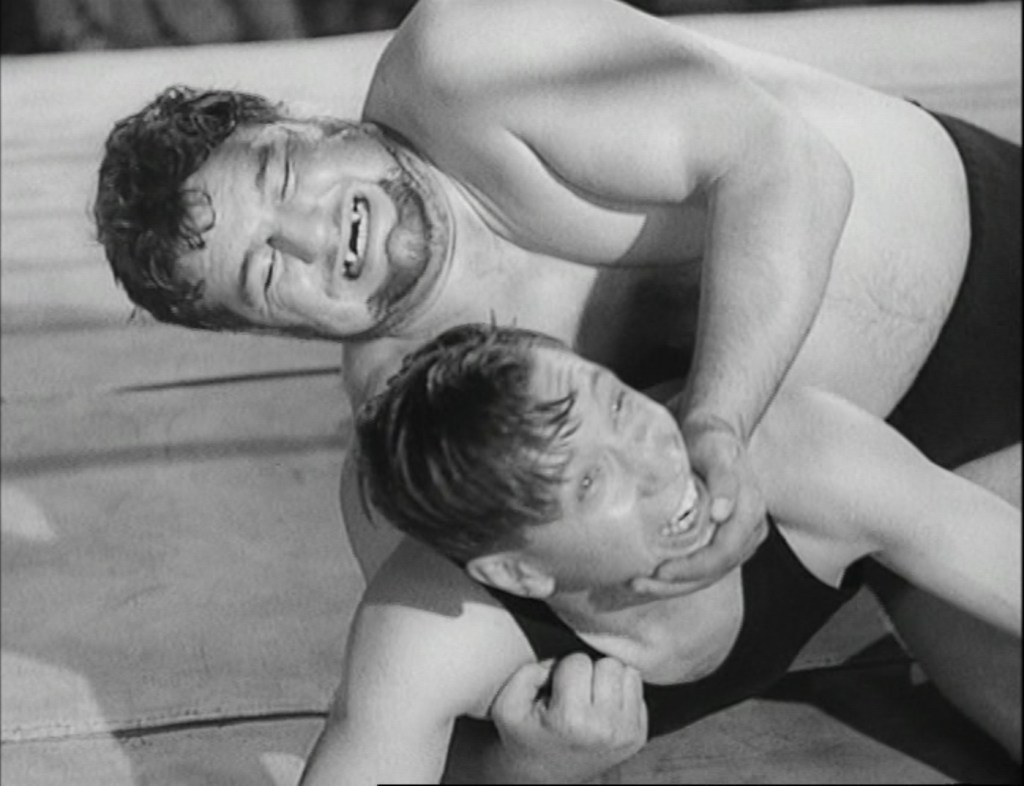
The film takes its title from the beer brewery which the counterfeiting gang uses as a front for their operations. As is common for these 1930s comedies that are primarily showcases for individual stars, Trouble Brewing consists of a series of set pieces which are only loosely strung together by a plot. George and Bill get duped on the racetrack; their subsequent investigations have them dress up as waiters at a private party; join a wrestling match; break into the police inspector’s home (and accidentally kidnap him); and confront the criminal gang in their brewery. At each stage, the script allows Formby plenty of physical comedy. His scenes with Mary and other female characters are opportunities for George to serenade them with his songs, even if they are more cheeky than romantic.

George subjected to a wrestling match in Trouble Brewing

In Trouble Brewing, the line between journalism and policing is blurred to the point that it almost disappears. When George says to his superiors as the paper that he wants to become a detective, the newspaper proprietor harrumphs that being a journalist is pretty much the same thing. Although in reality, printers and journalists had very distinct professional identities, George moves between the basement print room and the editorial offices with relative ease. Mary, who works as the secretary to the newspaper’s editor, appears to know George and Bill and treats them as her direct colleagues.

The police in Trouble Brewing have been ineffective in rounding up the counterfeiting gang, which has been at work for at least six months at the beginning of the film. Yet the two printers and the secretary manage to close the gang down in a matter of days. There are plenty of other British interwar films in which journalists collaborate closely with the police, but Trouble Brewing takes this a step further by focusing on main characters who are not even actual journalists. At the same time it is tacitly assumed that George wants to get promoted and work as a journalist, which he achieves at the end of the film when both the newspaper proprietor and the police inspector are duly impressed with his work in rounding up the criminal gang.

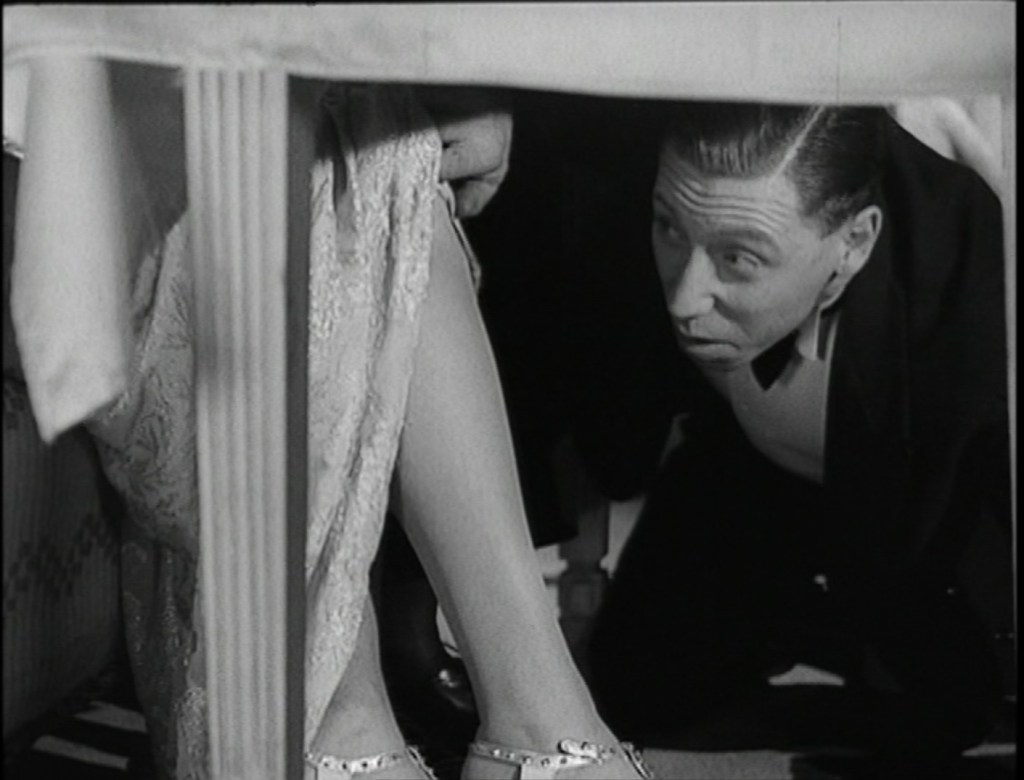
Trouble Brewing gives Formby plenty of opportunity to exploit the sexual innuendo he was known for, not only in his songs but also in the scene when he and Bill serve as waiters at a private house party. The party is thrown by an opera singer, whom George and Bill suspect may be part of the criminal gang. George has gotten the singer to put her fingerprint on a piece of paper, but she put that piece of paper in the top of her stocking. When the woman sits down to speak to a male guest at her party, George creeps under the table in an attempt to get the paper. The woman naturally assumes that her conversation partner is touching her leg under the table. This joke is repeated three separate times, causing the singer to shout at and slap at the various men she sits down with. For modern spectators, it is perhaps clearer that such a joke primarily works for male viewers; female audience members may find little to laugh at here. This indicates that Formby’s primary appeal was to men, whereas Gracie Fields aimed her jokes and songs at a broader audience.

George under the table in Trouble Brewing

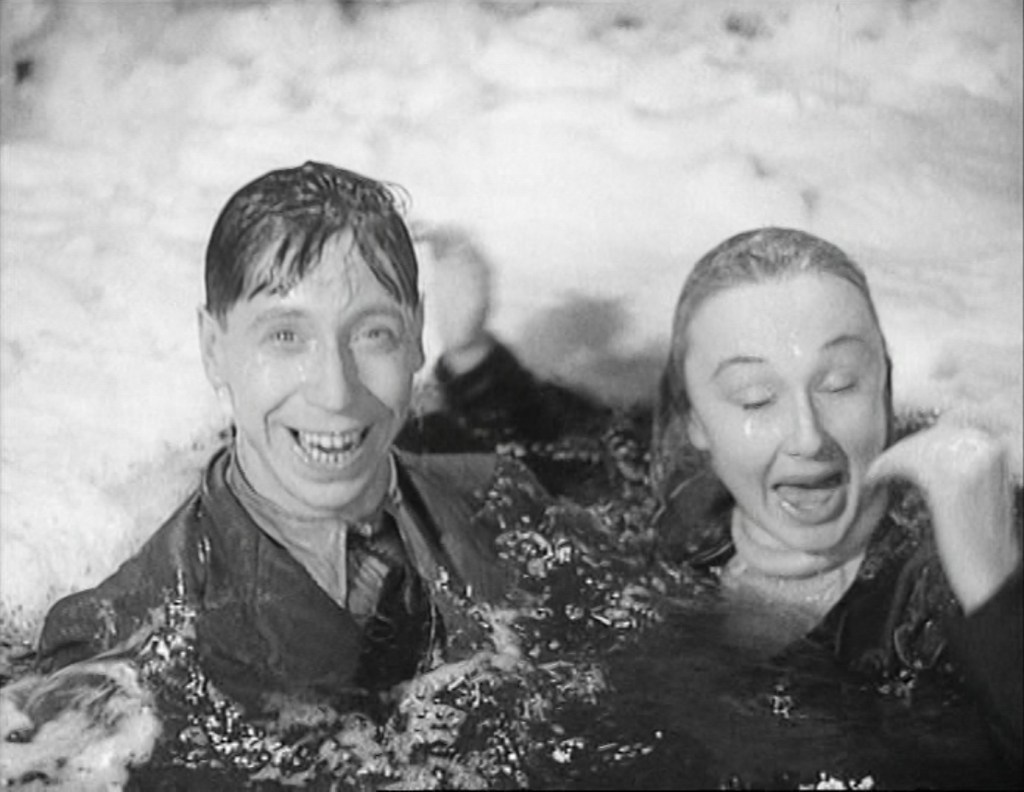
Trouble Brewing ends in the beer brewery where the gang is hiding. Here physical comedy takes over, with actors running up and down stairs, hiding in barrels, and hanging on ropes. The brewery contains several vast vats of beer, which are left uncovered. Bill lands in one and becomes inebriated almost immediately; the same eventually happens with the counterfeiting gang members. The apparently instantaneous effects of alcohol on the men underlines how far the events on screen are removed from reality at this stage of the film. It has developed into slapstick, harking back to earlier cinematic traditions.

Unlike another 1939 film set in a brewery, Cheer Boys Cheer, which makes direct reference to Nazi Germany, Trouble Brewing offered audiences complete escapism. Money laundering and the circulation of counterfeit money were popular tropes in interwar crime fiction, but they were far removed from the real-life horrors of war and fascism. The film expanded on the already-established cinematic narrative that journalists could effectively solve crimes, by presenting three workers as skilled detectives. The film’s happy ending no doubt provided audiences with welcome escapism as the international political situation deteriorated.  

George (George Formby) and Mary (Googie Withers) end up in a beer barrel at the close of Trouble Brewing

Interwar Spooky Stories

Interwar Spooky Stories

With Halloween nearly upon us, it is time for a review of spooky short stories written in interwar Britain. Although Halloween was not celebrated in the modern sense during the interwar period, All Hallows Eve was a longstanding feature of the Church calendar, originating out of pagan Samhain celebrations. Short stories were an immensely popular format in the interwar years, with many short stories published in newspapers and dedicated magazines such as Strand Magazine. Many journalists and authors worked in the genre, which could be lucrative.

In recent years, the British Library publishing arm has re-issued many original stories of the 1920s and 1930s in various edited collections. Spooky short stories of the period often crystallise contemporary fears about technology, alienation, and modernity. They can also address social inequalities in a pointed way. For example, F Tennyson Jesse’s story ‘The Railway Carriage’, published in Strand Magazine in 1931, hinges on the third-class railway carriage as a democratic space that forces together people from wildly different backgrounds.[1]

The story’s protagonist, a young woman named Solange, finds the closed nature of the railway carriage oppressive: ‘she would have given a great deal to be out of that little third-class carriage, to be in a modern corridor train, to be – this, above all – away from her travelling companions.’[2] The design of the train means that Solange cannot change carriages whilst the train is in motion, heightening her feeling of being trapped with two unusual companions. Solange ‘had to stay with them whether she would or no. It was really an outrage, she thought to herself, that such a thing as a non-corridor train should still exist.’[3]

Solange is a modern, somewhat entitled young woman, who by the end of the story has to accept that there are things beyond the rational realm and that she cannot always control the world around her in the way she would like. When the train crashes, Tennyson Jesse introduces a supernatural element to the story and meditates on the justness of capital punishment, a practice that was under much debate during the interwar period. Despite the introduction of a possible ghost, the true horror of the story lies in the very real judicial practices of interwar Britain.

Another story which effectively conveys the terror that the proximity of strangers can bring is E.M. Delafield’s ‘They Don’t Wear Labels.’[4] It also demonstrates how the anonymity of the big city can be exploited, and how patriarchal structures can put women in danger. The story’s protagonist is Mrs Fuller, a boarding house keeper, who takes in a couple, Mr and Mrs Peverelli. Mr Peverelli is very charming, but his wife is sickly. From the moment the couple enter the house, Mr Peverelli plays on sexist stereotypes which Mrs Fuller is very happy to accept. He implies that his wife’s ailments are nervous disorders; Mrs Fuller then tells Mrs Peverelli ‘shed’ a good deal to be thankful for, with her husband in a good job, and always ready to do what would please her.’[5]

When Mrs Peverelli tries to tell Mrs fuller that Mr Peverelli is forcing her to eat and drink things against her will, and that she thinks her husband is trying to poison her, Mrs Fuller naturally rubbishes the suggestion. E.M. Delafield neatly demonstrates the pervasive assumptions about domestic violence: ‘If you really believed it, why – you’d left him. It’s surely the very first thing you’d have done’ huffs Mrs Fuller. ‘You don’t understand’, responds Mrs Peverelli. ‘I love him.’[6]

Shortly thereafter, the Peverelli’s move on, the wife looking ‘worse than ever – sallower and more frightened.’ The true horror of Mr Peverelli’s designs is revealed at the close of the story, when Mrs Fuller realises he has ground up a Christmas bauble and fed the powdered glass to his wife.[7] Murder by ground glass was, incidentally, one of the ways in which Edith Thompson suggested murdering her husband in her letters to her lover Freddie Bywaters. E.M. Delafield had followed the Thompson-Bywaters case closely, and is surely referencing it in this story. Mrs Fuller, and the reader, are confronted by their willingness to believe strangers at face value, and to believe men over women. The horror here is not supernatural, but rather the by-product of an inherently unequal society.

A final female-penned, London-based, spooky short story appeared slightly after the interwar period, at the close of the Second World War. In 1945, Elizabeth Bowen published the (very short) story ‘The Demon Lover’.[8] It effectively uses the bombed-out locales of war-torn London. Bowen’s protagonist, Mrs Drover, is checking up on her Kensington house after an extended stay in the country, away from the Blitz.

Things take a dark turn when Mrs Drover discovers a mysterious letter from a past lover, which warns her that today is ‘our anniversary, and the day we said. (…) I shall rely upon you to keep your promise.’[9] It transpires that Mrs Drover had a soldier lover during the First World War, who went missing. In fear of him, she decides to get a taxi as quickly as possible before the man can come to the house and claim her. Yet rather than a means of escape, the taxi becomes her prison, as she realises too late that the man behind the wheel is the very man she is fleeing from.

As in ‘The Railway Track’, in ‘The Demon Lover’ a means of transport traps a woman rather than give her freedom. The latter story also includes ample reflections on ageing and the compromises made by women: marriage, children and a big house in Kensington versus the excitement of a passionate love affair. Like Mrs Peverelli, Mrs Drover ultimately is unable to escape masculine power. The scariest thing for women turns out to be the patriarchy itself.

All of the stories and books mentioned in this post are available to purchase through the British Library online shop.


[1] F Tennyson Jesse, ‘The Railway Track’, in Blood on the Tracks: Railway Mysteries, edited by Martin Edwards (London: British Library, 2018), pp. 267-286

[2] Ibid., p. 272

[3] Ibid., p. 277

[4] E. M. Delafield, ‘They Don’t Wear Labels’, in Capital Crimes: London Mysteries, edited by Martin Edwards (London: British Library, 2015), pp. 265-273

[5] Ibid., p. 268

[6] Ibid., p. 270

[7] Ibid., p. 273

[8] Elizabeth Bowen, ‘The Demon Lover’, in Into the London Fog: Eerie Tales from the Weird City, edited by Elizabeth Dearnley (London: British Library, 2020), pp. 81-91

[9] Ibid., p. 85

Aerodromes in interwar Britain

So far, this blog has had plenty to say about the increase of car ownership in interwar Britain; the development of public transport; and even the popularity of competitive cycling. It has, however, not yet touched upon that other mode of transport which swiftly developed during the 1920s and 1930s: airplanes.

Like many of the changes that became embedded into British society during the interwar period, it started in the Edwardian period. After the Wright brothers made their pioneering flight in the US in 1903, the first flight in England took place in 1908. As is common with the development of new technologies, its first application was in the military. Germany’s successful use of Zeppelins and Gotha bomber planes during the First World War prompted the British army to expand the activities of the Royal Flying Corps (later to become the RAF) and develop a first aircraft factory in Croydon.[1]

A short-lived RAF base in Hounslow hosted the first ever commercial international flight in 1919, to Le Bourget airport in Paris. Shortly thereafter, the facilities at Croydon developed into the only international airport in Britain, launching flights to Paris, Rotterdam and Cologne. The Hounslow base closed, although after the Second World War Heathrow Airport was developed nearby.

Early flights were not just for passengers, but also for the transport of ‘air mail’, allowing much swifter international communications than had hitherto been possible. The pilots of these commercial flights were often ex-RFC pilots, as they were the only group of people already trained to fly planes.[2]

Although Croydon was the international airport, there were many other airfields in existence throughout the interwar period, including around London. The types of planes used in the interwar period were light and flew relatively low to the ground compared to modern jet planes. They therefore did not need extensive runways to take off and land. A large and level field was usually all that was required. This is visible, for example, in this British Pathé footage from 1927 showing ‘Mousehold Aerodrome’ in Norfolk:

Mousehold was a former RAF base which after the First World War housed a flying club, and eventually developed into Norwich Airport in 1933 (NB the current Norwich Airport is on a different site). Throughout the 1930s, many local airports opened up across Britain as domestic flights were viewed as the modern alternative to rail travel. Once again, the need to expand air travel was framed as a competition with Germany, where passenger numbers were much higher.[3] The general enthusiasm for flight and flying which also expressed itself in literature and other art forms has frequently been referred to as ‘airmindedness.’[4]

In addition to the development of commercial domestic and international flights, aerodromes were also sights of spectacle when they hosted the arrival or take-off of celebrity aviators. Throughout the 1920s especially, there was an appetite for developing new flight routes and setting new speed records. Although Alcock and Brown managed the first successful non-stop transatlantic flight in 1919 (from Newfoundland to Ireland), the man who managed to do the trip as a solo flyer received much more attention. Charles Lindbergh flew from Long Island to Paris in 1927. When he landed in Croydon a week later, an estimated 120,000 people attended the airfield to welcome him.[5]

A few years later, Britain’s own Amy Johnson became an icon of modernity when she flew on her own from England to Australia in 1930 – the first woman to manage that feat. An article in the Daily Mirror at the end of that year lauded 1930 as ‘the most wonderful year in history for women’ partially because of them being ‘outstanding in aerial feats.’[6] Johnson herself savvily used the media to secure an income, as she did not receive any formal sponsorships. She sold the exclusive reporting rights of her flight to Australia to the Daily Mail and continued to use this tactic for subsequent record-breaking attempts.[7]

The development of jet planes after the Second World War shifted aviation from something that was potentially accessible to a large portion of the population, to a technology that required large capital investment and specialist training. Croydon Airport could not accommodate the newer, bigger planes and Heathrow, opened in 1946, took its place as London’s premier airport. Many of the local airports either closed down or became solely used by amateur flying clubs. The war had demonstrated the devastation that bomber planes could cause, tempering previous enthusiasm for air flight. For a brief period, however, Britain had been enamoured by the modern possibilities of going up in the air.


[1] Bob Learmonth, Joanna Bogle, Douglas Cluett, The First Croydon Airport: 1915-1928 (Sutton: Sutton Libraries and Arts Services, 1977), pp. 19-20

[2] Ibid., pp. 40-48

[3] Michael John Law, 1938: Modern Britain – Social Change and Visions of the Future (London: Bloomsbury, 2018), pp. 115-120

[4] Michael McCluskey and Luke Seaber (eds), Aviation in the Literature and Culture of Interwar Britain (London: Palgrave, 2020)

[5] Learmonth, Bogle, Cluett, The First Croydon Airport, p. 72

[6] ‘1930 the most wonderful year in history for women’, Daily Mirror, 29 December 1930, p. 3

[7] Bernhard Rieger, ‘‘Fast couples’: technology, gender and modernity in Britain and Germany during the nineteen-thirties’, Institute of Historical Research, vol 73, no. 193 (2003), 369

Paul Robeson

Paul Robeson

Paul Robeson was born in 1898 in New Jersey. He became an actor, singer, activist and athlete, and was one of the very few prominent black actors to appear in British interwar films. Robeson lived with his wife in London between 1928 and 1939, during which period he studied Swahili and phonetics at SOAS, University of London. In London he appeared on the West End stage as Othello (1930) – the first black man to play the role on the West End stage in a hundred years.

Robeson was a popular actor and singer, and a well-known figure in London society. When, in 1929, he and his wife were denied entry to the Savoy grill room due to their skin colour, the matter was reported in the national press. The Savoy, however, flat-out refused to admit that it operated a colour bar and provided no explanation why the Robeson’s were refused entry.

On British film sets, Robeson also encountered racial prejudices. After appearing alongside his wife Eslanda in the art-house Borderline (1930), Robeson’s first commercial role in British film was 1935’s Sanders of the Rivers, directed by Zoltan Korda. The film was based on a selection of short stories by Edgar Wallace, published in 1911. The Edwardian context in which the source material was written was scarcely updated for the film. Sanders, played by Leslie Banks, is a colonial administrator in Nigeria. He is presented as firm but just, and has a paternalistic attitude towards the tribes which live in ‘his’ part of the Empire. Robeson plays Bosambo, a trusted native who provides Sanders with intelligence. When warring breaks out between the tribes, Basambo helps Sanders restore the peace.

Significant parts of the film were shot on location, which the marketing material claimed lent an air of authenticity to the plot. However, as one viewer has commented, the film appears to have been shot in East Africa rather than Nigeria or elsewhere in West Africa – to the untrained, white, British viewer these two disparate regions apparently looked the same. The film features several African tribes in crowd scenes and performing rituals. Rather than providing an ethnographic account of indigenous culture, these scenes show ‘wild’ Africa as the white colonial gaze imagined it to be.

Robeson distanced himself from the film after it appeared, on the grounds of its sympathetic portrayal of colonialism. Yet he continued to find himself in the bind that the only roles offered to him as a black man were those which also included racist or patronising depictions of African culture. In his next British film, Song of Freedom (1936), Robeson plays a dock worker, Johnny Zinga, who has a powerful voice. This film, at least, allows Robeson to show off his considerable singing talent.

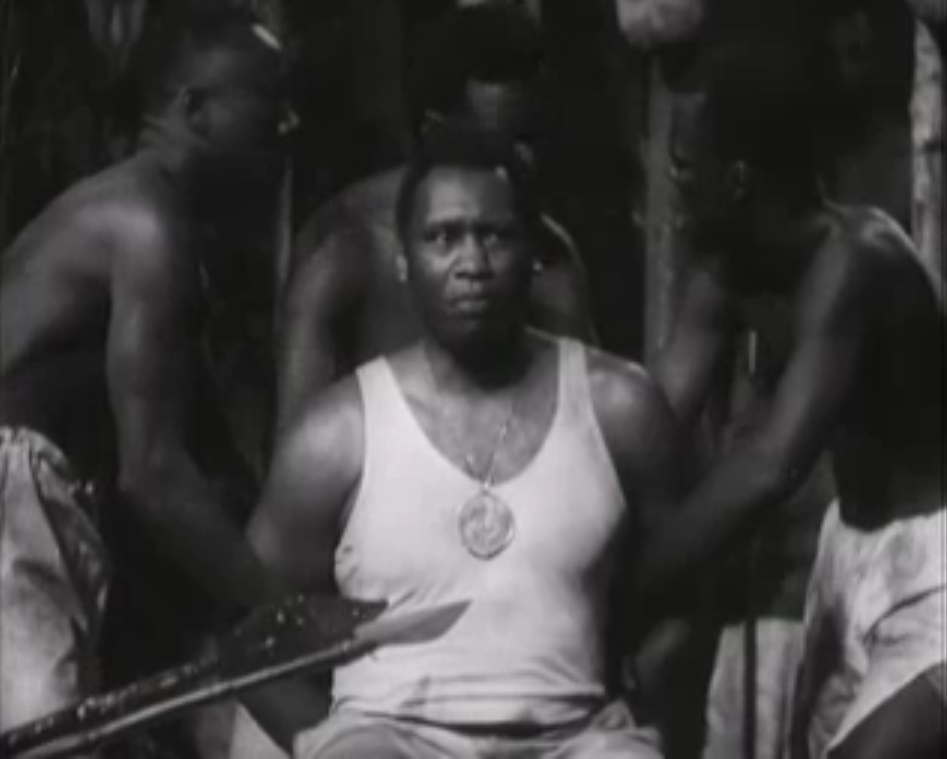
Johnny is catapulted to fame after he is heard singing in his local pub, in the predictable ‘rags to riches’ success story that so many British films of the period included. But Johnny does not simply get famous: he is also discovered to be the rightful king to an African island. Johnny travels to the island and tries to rule it as best as he can, but eventually decides to return home to his old life in the London docks. Life on the (fictitious) African island is depicted as primitive, with Robeson once more asked to don ‘traditional’ native dress for these scenes. It was no doubt titillating to white audiences to see the chest of the 6”3’ Robeson on display for their consumption. Additionally, the suggestion that the one black dockworker in London is also a member of a royal family further undermines the perceived differences between African culture, with its supposed multitude of royal families, and the British Empire, over which one monarch reigns supreme.

Paul Robeson in Song of Freedom (1936)

The following year, Robeson was once again cast in an adaptation of a popular fiction, this time the Victorian novel King Solomon’s Mines by H. Rider Haggard. The novel appeared in 1886 and was one of the first British novels to be set in Africa. In the film, explorer and adventurist Allan Quartermain agrees to help a young Irish woman whose father has gone off into the African wilderness to find the fabled King Solomon’s diamond mines. Robeson plays Umbopa, a native guide to the party.

When Quartermain, Umbopa and the others get captured by a native tribe ruled by the despotic Twala and the witch-doctor Gagool, Umbopa reveals that he is in fact the legitimate heir to the tribe’s throne. Eventually, Quartermain and Umbopa manage to persuade the tribe to overthrow Twala and the party find the entrance to King’s Solomon’s mine, which turns out to exist. They find the missing father inside the mine and manage to escape before the mine is destroyed.

The portrayal of the native tribe in King Solomon’s Mines leans heavily on depictions of mystical rituals and supposed witchcraft. At the same time, their leader is styled a ‘king’ and the title appears hereditary in the manner of European monarchies. Umbopa is, in contrast, calm, educated and righteous. He is, however, treated as exceptional among his peers, a fact further underlined by his royal heritage. The overall depiction of indigenous African tribes in the film leans heavily on stereotypes of barbarianism and primitivism.

Robeson returned to the US at the outbreak of World War Two. His increasingly radical left-wing political views put him under government scrutiny, and he was denied a passport for several years, effectively trapping him in the US. Although he continued to record songs, Robeson stopped acting after 1942. Although he was a high-profile star during the 1930s, the racism pervasive in British society pigeonholed him into roles where he had to repeatedly act out white fantasies of indigenous cultures; and play characters who unquestioningly submitted to white colonial rule.

Mr Smith Wakes Up (1937)

Although the 1930s are primarily remembered for the rise of right-wing politics across Europe, including the increased popularity of the British Union of Fascists (see blog posts here and here), there were of course also activists on the left of the political spectrum. Although the Labour party served in the opposition rather than the Government from 1931 until the outbreak of the Second World War, the 1930s saw the start of some social reforms, particularly in housing and medical care.

In 1937, the Co-op sponsored a short film designed to encourage viewers to question some of the tenets of capitalism and free markets. This information film, Mr Smith Wakes Up, would have been shown in cinemas as part of a mixed programme of features, newsreels and cartoons. Advertisement films from the period were often also lengthy and designed as mini-narratives, making them quite close in appearance to this short film. Mr Smith Wakes Up, however, does not aim to sell goods but rather to influence people’s political thinking.

In Mr Smith Wakes Up, we are introduced to William and Elizabeth, a middle-aged and fairly wealthy couple who live in a nice suburb in a house called ‘Utopia’. Their house is worth a couple of thousand pounds and all the other people in the area are of the ‘better class’ which William defines as them being ‘mostly on the stock exchange.’ The vast majority of houses sold in 1930s Britain were worth less than a thousand pounds, so it would have been immediately clear to the contemporary viewer that William and Elizabeth are well-off. They also still keep a parlour maid and a cook, despite the ever-increasing servant problem significantly raising the cost of keeping servants.

William and Elizabeth are unexpectedly visited by Mr Smith, a friend of their son who had been to Africa. We never learn Mr Smith’s first name or which part of Africa he is from. By his own accord, he has come to the ‘great civilization’ of Britain to learn how it is set up, so that he can take it back to his tribe which he himself describes as ‘very primitive people’. For the remainder of the film, Mr Smith asks William and Elizabeth about how things like housing, medical care and food distribution are arranged in Britain. William consistently takes the position defending capitalism and the free market, whereas Elizabeth acknowledges that there are problems with wealth distribution in the country.

When discussing housing, for example, Mr Smith asks if all people in England own their own homes. William admits that this is not the case, but that the working classes can live in rental homes on ‘nicely planned’ housing estates. His arguments are accompanied by shots of one such an estate. Elizabeth then points out that there is still a housing shortage and that the new estates may lead people to have long and expensive commutes. She also raises the prospect of slums, which were still commonplace in pre-War British cities. The audience is duly presented with shots of slum housing, followed by images of very skinny children being examined by a doctor, when Elizabeth points out that slum living makes people ill.

Later on in the discussion the three actors discuss food distribution, re-armament and the ‘cost of living’. Wages have risen, but so have the costs of food, housing and heating, meaning many people are still struggling to make ends meet. In phrases that will sound very familiar to viewers in the early 2020s, William argues that people need to economise more, while Elizabeth points out that for large, low-income families there is nothing left to economise on.

Unfortunately, there are no opening credits preserved to the film so it is not possible to identify the actor playing Mr Smith, but it is safe to presume he was either born in Britain or one of Britain’s overseas territories in the Caribbean. Like American actor and activist Paul Robeson, who was often forced to portray stereotypical African tribesmen, the character of Mr Smith supposedly comes straight from an African rural tribe. At the same time, he also wears a very smart suit and overcoat when arriving at Utopia, and his English is flawless. Although his skin colour causes some consternation when he first arrives at the house, Mr Smith is accepted because he is able to pass as a gentleman, and he does not criticise any aspect of Britain. He even praises the food available in Britain as superior to African food, which stretches credibility.

At the end of the film, Mr Smith states that a nation should give its people food, health and protection. The preceding discussion has made clear to him that Britain is failing to provide this to all its citizens. His voice is accompanied by idyllic scenes of African tribes working and playing together. He argues that African tribes do not go to war as long as there is sufficient food available; and that if they do go to war, their methods of combat are more equal than those of Western nations. Nonetheless, he remains grateful for what William and Elizabeth have ‘taught’ him, and takes his leave.

After he has gone, Elizabeth looks in on the kitchen. Cook is just packing her bag to go home, and decides to take left-over meat to cook for her husband, as otherwise it will only go to waste. Elizabeth indulgently smiles and lets her take the food, and then tells the parlour maid she can go up to bed even though the washing up has not been completed. From her position of privilege, Elizabeth generously allows her staff these luxuries. William sits in the study pondering whether ‘peace and plenty’ are as adequately provided for in Britain as he had assumed. There is no indication, however, that either will take any further-reaching political action as a result of their conversation. Instead, their actions stay on the personal plane.

Despite the leading role of Mr Smith, and the film’s sympathetic portrayal of ‘African’ culture, it is clear that its target audience is white. Contemporary audiences for Mr Smith Wakes Up were unlikely to have recognised themselves in William and Mary – cinema viewing remained largely an activity for the working- and lower-middle classes, who were more likely to already be sympathetic to the left-of-centre views the film espouses. Although the filmmakers may have wanted to encourage people like William and Mary to re-consider their political views, it is doubtful whether many wealthy people would have seen the film or taken any notice of it. Although Mr Smith Wakes Up gives modern audiences insight into the socio-political debates and concerns of the late 1930s, it possibly was not effective in generating political change at the time it was created.

Mr Smith Wakes Up is available to view on YouTube.

Entertainment venues during the 1939 blackouts

Today we are going to venture to the extremity of the interwar period in Britain – September 1939. Britain declared war on Germany on 3 September 1939. In hindsight, this started what is now commonly referred to as the ‘Phoney War’ – a period that lasted until April 1940 during which little actual military action took place. At the time, of course, Londoners weren’t to know that the declaration on 3 September would not lead to immediate hostilities. Accordingly, the city prepared for the worst and much public activity was suspended. As soon as it became clear that the invasion was not imminent, however, restrictions were also loosened again very quickly. After our collective experience of various levels of restrictions and lockdowns over the past 18 months (at the time of writing), this period of rapid closures and re-openings of venues in 1939 resonates.

When reviewing the newspaper coverage of the first weeks of the war, what is striking is the relative prominence articles give to the closure of entertainment venues – specifically cinemas and theatres. On 1 September, the British government implemented formal blackout regulations to obstruct bombing efforts by enemy troops. Next morning’s Daily Mail article described how streetlights, hotels and even Buckingham Palace where thrown into darkness, but tellingly the headline of the piece is ‘London Cinemas, Theatres, Carry On in Dark.’[i] Whilst many cinemas and theatres understandably opted to close completely at night, some businesses attempted to continue business whilst adhering to blackout measures. It is these venues that the Mail celebrates for their determination to continue business as usual despite the circumstances.

On 7 September the Mail followed this up with an article that reassured readers that managers of theatres and cinemas that had been closed for the previous week, were ‘standing by’ in expectation of an imminent return to business as usual.[ii] The message to the reader is clear; no matter what may lie ahead, Londoners should be able to visit the cinema and theatre at night. After only a week of blackout, the entertainment industries were confident that the Government would exempt them from the regulations. As a sector that did not directly support the war effort, this confidence seems remarkable, but it was justified. On 8 September the Government approved that cinemas, theatres and football pitches in ‘safe zones’ could re-open immediately for business.[iii] Cinemas in London’s suburbs followed on 11 September, and Central London cinemas on 15 September.[iv]

For the Mail, it was clear why these spaces should be allowed to operate: they had a ‘job of assisting to maintain a cheerful Britain.’[v] The article presents the night-time entertainment industry as vital for keeping up the morale at the home front. The re-opening was presented as a return to ‘normality’, and a mark of resilience of Britons in the face of grave danger. The news of the first wave of re-opening was considered so welcome that a second article was included in the same issue, which highlighted the scale of the impact of cinema closures in particular. According to the Mail, cinemas served a million customers a week – the real numbers were in fact much higher.[vi]

When central London cinemas and theatres were finally reopened on 15 September it was front page news for the Mail again, and the article immediately listed which films would be showing where. The article ends with the sage reminder that ‘[i]f you do go to the cinema to-night, don’t forget your gas mask.’[vii]  Despite this possible danger, the Mail assumed its readers would rush to visit the cinema, as implied by the listings provided and the considerable coverage the Mail had given the issue over the previous week. Editors understood films to be an important part of their readers’ lives, even in wartime; and encouraged readers to continue with their lives as normal despite the war.

From reading the Mail coverage over these weeks, it appears that there is support for the Government decision to impose the blackout at the start of September, but also that it was considered unnecessary for that blackout to apply to places of entertainment. It was considered imperative for the public’s morale that they should be allowed to go out at night and enjoy themselves, also to show the enemy forces that the British spirit would not be broken.

Of course, entertainment venues were not immune to bomb damage. Once the Blitz started in earnest in autumn 1940, they did become targets – most famously, when the Café de Paris was hit in March 1941 dozens of people died. But during those first months of the Phoney War, entertainment venues were an important symbol of what was considered important to Londoners.


[i] ‘London Cinemas, Theatres, Carry On in Dark.’  Daily Mail, 2 September 1939, p. 10

[ii] ‘Managers ready for the ‘all clear’’, Daily Mail, 7 September 1939, p. 7

[iii] ‘Cinemas, football, start again to-day’, Daily Mail, 9 September 1939, p. 1

[iv] ‘First Two London Theatre Reopen’, Daily Mail, 12 September 1939, p. 5; ‘Cinemas and theatres are open until 10 to-night’, Daily Mail, 15 September 1939, p. 1 and p. 10

[v] ‘Cinemas, football, start again to-day’, Daily Mail, 9 September 1939, p. 1

[vi] ‘3,000 Cinemas Open Today in the “Safe” Areas’, Daily Mail, 9 September 1939, p. 5

[vii] ‘Cinemas and theatres are open until 10 to-night’, Daily Mail, 15 September 1939, p. 1 and p. 10

The Prince of Wales and the interwar craze for Fair Isle jumpers

The Prince of Wales and the interwar craze for Fair Isle jumpers

A few years ago I had the privilege of visiting Shetland, a group of islands approximately 170 kilometres north of mainland Scotland. This northernmost part of the UK has a strong heritage in textile creation, particularly in knitted lace and Fair Isle jumpers. It’s the latter garments this post will discuss, as the interwar period saw this type of knitwear absolutely explode in popularity in England. What I learnt during my visit to the (excellent) Shetland Museum and Archives in Lerwick was that this sudden popular appeal of Fair Isle knitwear had a big impact on the financial independence of Shetland women.

Fair Isle itself is a small island located to the south of the main Shetland archipelago; in 2020 it had a population of 65 individuals and is only accessible by intermittent ferry and flight services. It is here that a new style of knitting was developed in the 19th century, one characterised by bold use of colour and patterns. The practice was soon adopted across the Shetland islands[1], initially to produce accessories such as caps and stockings. A true Fair Isle garment uses a limited number of colours, usually four or five. Only two colours are used in each row of knitting, which are built up into stars, crosses, zig zags, and other motifs.

The patterns and colours used in Fair Isle knitting make it a time-consuming and expensive way to produce garments. Shetland women (obviously) also produced more standard knitting items such as jumpers and stockings, either for use within their own household or to trade. From the middle of the 19th century until the 1920s, Shetland women were dependent on something called the Truck System, “a trading arrangement which involved payment in kind.” Rather than being able to sell their knitwear to shops and traders for money, instead women were obliged to trade the garments for things like coffee, tea and sugar. Women had little control over how much they would get traded for each garment; and whilst it was no doubt useful to have staple foods for their household, the Truck System meant that women were not able to put aside and save money for longer term investments.

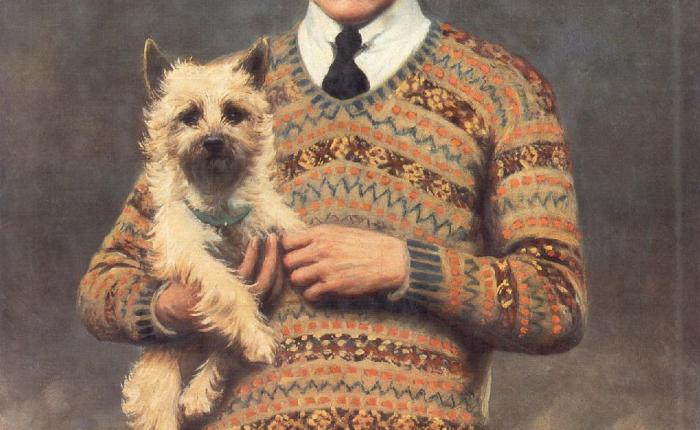
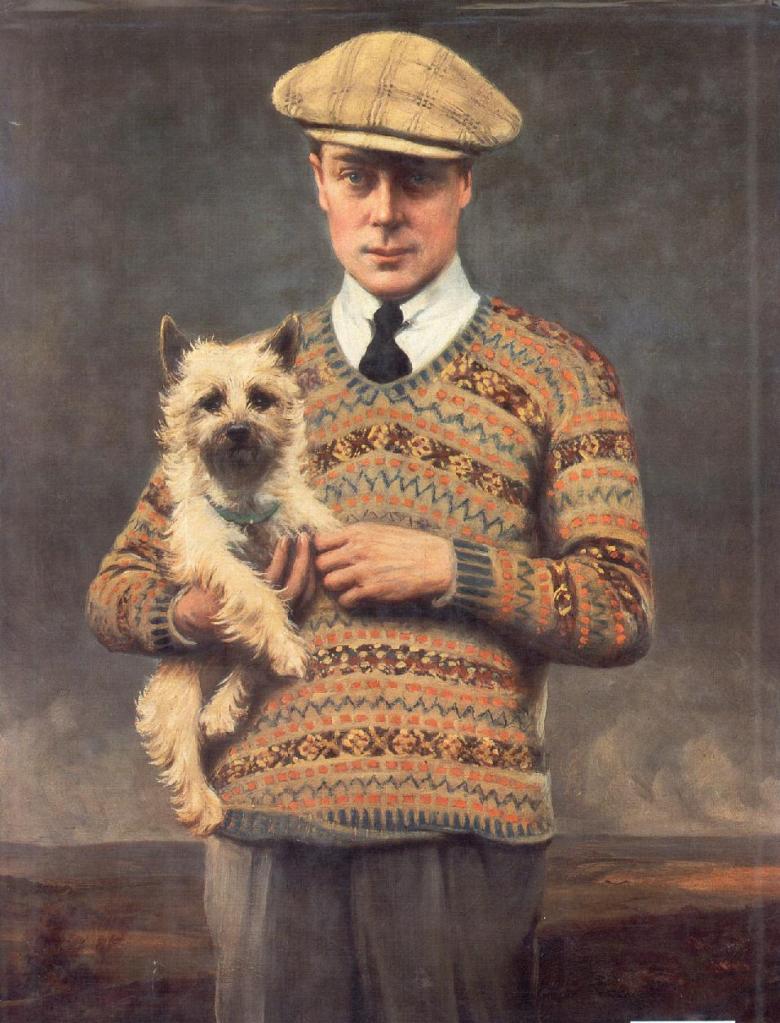
By the end of the First World War, women on Fair Isle and the rest of Shetland had started producing full jumpers in the Fair Isle technique. Then, in a stroke of marketing genius, Shetland hosiery dealer James A Smith gifted a Fair Isle jumper to Edward, Prince of Wales. The Prince of Wales was an immensely popular society figure and bona fide style icon.[2] He decided to wear the Fair Isle jumper whilst sitting for a portrait painted by John St. Helier Lander. In line with the increased importance of mass-communication and consumption of this period, the portrait was reproduced by the Illustrated London News.

Suddenly, Fair Isle jumpers were the must-have fashion item for fashion-conscious socialites. Although jumpers had initially only been made for men, parallel developments in women’s fashion that favoured relaxed fits and dropped waistlines meant that soon, women were also keen to have their own Fair Isle jumpers. This craze for genuine Fair Isle products inevitably had consequences for the women making these garments. Where they had previously been dependent on the Shetland merchants and traders to take their stock, now women were able to bypass the Truck System and liaise directly with wealthy English buyers. As these buyers sat outside the local economy, they naturally paid in cash which allowed the Shetland women greater financial independence. Eventually the Truck System collapsed completely by the Second World War.

Of course, buying a handmade Fair Isle garment from Shetland was still prohibitively expensive for most people. Very quickly, the exclusive garment worn by the Prince of Wales spawned mass-produced knitting patterns which allowed amateur knitters to make their own garments at home. These remained popular into the 1940s, and Fair Isle garments more generally have become a wardrobe staple for period dramas set in this period. Fair Isle jumpers and vests have periodically regained popularity ever since, and there continue to be knitwear designers on Shetland who are evolving the style. The original 1920s jumper that started it all has not been forgotten; you can purchase an exact replica of the Prince of Wales’ jumper from various Shetland merchants, such as here and here.


[1] Although to this day, only garments actually produced on the island of Fair Isle can carry the Fair Isle trademark

[2] He popularised amongst other things: a particular type of collar (still known as the Prince of Wales collar); a particular way of tying ones tie; the Prince of Wales check motif and plus-fours trousers