Aerodromes in interwar Britain

So far, this blog has had plenty to say about the increase of car ownership in interwar Britain; the development of public transport; and even the popularity of competitive cycling. It has, however, not yet touched upon that other mode of transport which swiftly developed during the 1920s and 1930s: airplanes.

Like many of the changes that became embedded into British society during the interwar period, it started in the Edwardian period. After the Wright brothers made their pioneering flight in the US in 1903, the first flight in England took place in 1908. As is common with the development of new technologies, its first application was in the military. Germany’s successful use of Zeppelins and Gotha bomber planes during the First World War prompted the British army to expand the activities of the Royal Flying Corps (later to become the RAF) and develop a first aircraft factory in Croydon.[1]

A short-lived RAF base in Hounslow hosted the first ever commercial international flight in 1919, to Le Bourget airport in Paris. Shortly thereafter, the facilities at Croydon developed into the only international airport in Britain, launching flights to Paris, Rotterdam and Cologne. The Hounslow base closed, although after the Second World War Heathrow Airport was developed nearby.

Early flights were not just for passengers, but also for the transport of ‘air mail’, allowing much swifter international communications than had hitherto been possible. The pilots of these commercial flights were often ex-RFC pilots, as they were the only group of people already trained to fly planes.[2]

Although Croydon was the international airport, there were many other airfields in existence throughout the interwar period, including around London. The types of planes used in the interwar period were light and flew relatively low to the ground compared to modern jet planes. They therefore did not need extensive runways to take off and land. A large and level field was usually all that was required. This is visible, for example, in this British Pathé footage from 1927 showing ‘Mousehold Aerodrome’ in Norfolk:

Mousehold was a former RAF base which after the First World War housed a flying club, and eventually developed into Norwich Airport in 1933 (NB the current Norwich Airport is on a different site). Throughout the 1930s, many local airports opened up across Britain as domestic flights were viewed as the modern alternative to rail travel. Once again, the need to expand air travel was framed as a competition with Germany, where passenger numbers were much higher.[3] The general enthusiasm for flight and flying which also expressed itself in literature and other art forms has frequently been referred to as ‘airmindedness.’[4]

In addition to the development of commercial domestic and international flights, aerodromes were also sights of spectacle when they hosted the arrival or take-off of celebrity aviators. Throughout the 1920s especially, there was an appetite for developing new flight routes and setting new speed records. Although Alcock and Brown managed the first successful non-stop transatlantic flight in 1919 (from Newfoundland to Ireland), the man who managed to do the trip as a solo flyer received much more attention. Charles Lindbergh flew from Long Island to Paris in 1927. When he landed in Croydon a week later, an estimated 120,000 people attended the airfield to welcome him.[5]

A few years later, Britain’s own Amy Johnson became an icon of modernity when she flew on her own from England to Australia in 1930 – the first woman to manage that feat. An article in the Daily Mirror at the end of that year lauded 1930 as ‘the most wonderful year in history for women’ partially because of them being ‘outstanding in aerial feats.’[6] Johnson herself savvily used the media to secure an income, as she did not receive any formal sponsorships. She sold the exclusive reporting rights of her flight to Australia to the Daily Mail and continued to use this tactic for subsequent record-breaking attempts.[7]

The development of jet planes after the Second World War shifted aviation from something that was potentially accessible to a large portion of the population, to a technology that required large capital investment and specialist training. Croydon Airport could not accommodate the newer, bigger planes and Heathrow, opened in 1946, took its place as London’s premier airport. Many of the local airports either closed down or became solely used by amateur flying clubs. The war had demonstrated the devastation that bomber planes could cause, tempering previous enthusiasm for air flight. For a brief period, however, Britain had been enamoured by the modern possibilities of going up in the air.


[1] Bob Learmonth, Joanna Bogle, Douglas Cluett, The First Croydon Airport: 1915-1928 (Sutton: Sutton Libraries and Arts Services, 1977), pp. 19-20

[2] Ibid., pp. 40-48

[3] Michael John Law, 1938: Modern Britain – Social Change and Visions of the Future (London: Bloomsbury, 2018), pp. 115-120

[4] Michael McCluskey and Luke Seaber (eds), Aviation in the Literature and Culture of Interwar Britain (London: Palgrave, 2020)

[5] Learmonth, Bogle, Cluett, The First Croydon Airport, p. 72

[6] ‘1930 the most wonderful year in history for women’, Daily Mirror, 29 December 1930, p. 3

[7] Bernhard Rieger, ‘‘Fast couples’: technology, gender and modernity in Britain and Germany during the nineteen-thirties’, Institute of Historical Research, vol 73, no. 193 (2003), 369

Cinema management

As going to the cinema became Britain’s most popular leisure activity in the 1920s and 1930s, there was increased attention for the business side of managing cinemas. Working in the cinema industry now became a viable career path, albeit mostly for men. Cinemas also increasingly became parts of chains such as Odeon and ABC. These chains set up their own internal training schemes and rotated management staff between cinemas to ensure consistency of service.

The interwar period also saw a big increase of the print market, including the appearance of many trade papers, guides, and ‘self-help’ books. The majority of the population still left school at 14, and there emerged a vibrant culture of self-improvement and lifelong learning. In one of the main trade papers for the cinema sector, Kinematograph Weekly, cinema managers were encouraged to constantly learn from one another and improve their craft. In addition, several handbooks were published in the interwar period which purported to teach the budding cinema manager how to best run a picture palace. Together, these articles and books demonstrate what were considered the most important aspects of the cinemagoing experience at the time.

In 1934, Kinematograph Weekly reprinted a lecture given by a supervisor at ABC, for an audience of assistant managers keen to advance their careers. The lecture demonstrates the wide range of skills managers were expected to have: knowledge of engineering, the ability to retain staff discipline, but also knowledge of accounts and figures and the ability to market the cinema’s films to the public. The speaker claims a manager needs ‘professional integrity beyond reproach, a cool head for emergencies and tact sufficient for the average international diplomat.’[1] Statements like this are clearly designed to make the audience feel they have chosen a challenging and rewarding career, even if its professional standing or pay was nowhere near that of lawyers, doctors, or diplomats.

The lecture also advised that managers should be in the cinema from around 10am, and stay until the end of the final screening. It was considered good practice for managers to be at the front of house in evening dress at the end of the night, to personally wish patrons a good night. It is clear from this article that the role of a manager demanded long hours and knowledge on a wide range of subjects. At the same time, the manager had a clear position of authority in the cinema and did not have to undertake manual labour such as cleaning or carpentry, like the other staff.

Three years after this lecture was published, a guidebook appeared which was sanctioned by the Cinema Exhibitor’s Association (CEA), the professional body for cinema owners. Like the lecture, the author of the book is keen to stress the emotional appeal of the cinema manager’s job, describing it on the book’s opening page as ‘a real man’s job’ with ‘grave responsibility’; a job that is ‘enthralling’, ‘creative’ and requiring continuous learning.[2]

The book continues to provide very detailed information on how to manage the day-to-day operations of a cinema, implying that its intended audience was those who were new to the business and not assistant managers who already had significant experience. A substantial proportion of the book is concerned with advice on staff management. Depending on the size of the cinema, a manager could be in charge of anything between half a dozen and several tens of staff. Both the Kine Weekly article and this handbook advocate daily inspections of staff, to instil discipline and check for cleanliness.[3] The front-of-house staff were expected to adhere to strict rules on appearance: ‘the hair of all uniformed male attendants must be cut short at the back and sides, and their face and hands kept clean.’[4]

There were a handful of female cinema managers in the interwar period, but they were very much considered to be the exception rather than the rule.[5] As noted above, the 1937 guide describes cinema management as ‘a real man’s job’, perhaps restating the supposed masculinity required for the role in response to a small but growing number of female managers. During the Second World War, the CEA had to allow women much more access to cinema work to allow cinemas to continue operating.[6]

Both the handbook and the lecture quoted here are fairly light on what education (if any) is required for cinema managers. Whilst similar books aimed at cinema operators (projectionists) stress that theirs is a skilled role requiring technical expertise, the guidance for managers mainly highlight the variety and responsibility of the role.[7] Provided the aspirant manager felt confident that he had the physical and mental ability to manage a varied job, these sources present the role as an achievable career goal for anyone who wanted to pursue it.

Want to read more about employment in 1930s cinemas? I recently published a more in-depth article on this topic which you can find here.


[1] S. Simpson, ‘The Principles of Kinema Management’ in Kinematograph Weekly, 5 April 1934, p. 41

[2] JH Hutchison, The Complete Kinemanager (London: Kinematograph Publications, 1937), p. 1

[3] Ibid., p. 91

[4] Ibid., p. 83

[5] In 1934, the Ideal cinema in Lambeth was managed by a Miss M.A. Ball, Kinematograph Weekly, 8 February 1934, p. 58; and the Queen’s Hall in Catford was managed by a Miss M Woodroffe from 1916, Kinematograph Weekly, 22 Feburary 1934, p. 36

[6] Rebecca Harrison, ‘The Coming of the Projectionettes: Women’s Work in Film Projection and Changing Modes of Spectatorship in Second World War British Cinemas, Feminist Media Histories, vol. 2, no. 2 (2016), 47-70

[7] W.S. Ibbetson, The Kinema Operator’s Handbook (London : E. & F. N. Spon, 1921), p. 1

Muriel Jaeger – The Question Mark (1926)

Although the interwar period is known for the large volume of crime fiction it produced (examples here, here and here), it also saw the publication of some classic works of science fiction. Aldous Huxley penned Brave New World in 1934, and across the pond Orson Welles’ classic War of the Worlds aired on radio in 1938. Preceding both these high watermarks of science fiction is Muriel Jaeger’s 1926 novel The Question Mark, which has recently been re-published by the British Library in their ‘Science Fiction Classics’ series.

Jaeger is not a household name, and certainly a lot less well-known then her good friend Dorothy L. Sayers. The pair studied at Somerville, Oxford together and were both members of the ‘Mutual Admiration Society’, a group of female students with literary ambitions.[1] The Question Mark was Jaeger’s first novel, and it was published by Virginia and Leonard Woolf at their Hogarth Press.

The protagonist of The Question Mark is Guy Martin, a young-ish bank clerk in London. He is of the lower middle class and resentful about it. Along with his generic name, there are few distinguishing features about Guy – Jaeger deliberately keeps descriptions of him generic. Guy has a lingering dissatisfaction in life, which he tries to quench by attending meetings of the Socialist Club. The Club almost allows him to believe in a future in which class boundaries can be transcended, until Marjorie, the girl he has fallen in love with, throws him over in favour of a Tory.[2]

Marjorie’s rejection leads Guy to sink into a stupor; when he wakes up, he is several hundred years into the future. It is later explained that Guy actually died on the night of Marjorie’s rejection, and is the first corpse to be successfully revived by a Dr Wayland. There is then, no chance of Guy returning to the 1920s, or roaming around time and space in the manner of H.G. Wells’ ‘Time Traveller’. Instead, Guy must make the best of his new life in this future version of London.

At first, naturally, all seems much better in the future: London has turned into a pleasant green landscape of rolling hills, and everyone who works has access to a ‘power box’: a device that acts as a portable power source to ‘Anything you want to make go.’[3] There are ‘areocycles’ for short trips through the air, and silent and impossibly fast planes for travel to the continent.[4] Everything runs so smoothly that workers have very little to do, and education is accessible to everyone.

But of course, these initial impressions are shaken before long. Jaeger’s future society no longer has class divisions in the way a 1920s reader would recognise them. Instead, however, the population is divided between ‘intellectuals’ and ‘normals’. Dr Wayland and his cousin John, who takes Guy under his wing, are both ‘intellectuals’. This means that they do not need to undertake manual labour and are allowed to study and pursue knowledge their entire life.

Dr Wayland, however, married a ‘normal’ woman, Agatha, and as a consequence his children Ena and Terry are also ‘normals’. Because ‘normals’ are denied intellectual development over several generations, they have become highly emotive and impressionable. Ena is twenty years old, but is described as behaving closer to a child in her early teens. She quickly becomes infatuated with Guy, much to the latter’s confusion and disgruntlement.

Towards the end of the book, a religious leader emerges who is able to capture the imagination of thousands of ‘normals’. When this Emmanual predicts the end of the world to be nigh, so many ‘normals’ down tools that the intellectuals have to step in to keep things running. Guy is reminded of a strike in the 1920s:

He remembered how the young assistant-manager at his bank (a post that was practically a sinecure in a certain family) had gone off joyously to take tickets and slam lift-doors on an underground railway along with other numbers of gay young men of the leisured classes who meant to “keep things going until the beggars had had enough of it.” The two situations had a startling similarity in difference.[5]

Jaeger’s point is clear: although traditional social classes are abolished in the future, humanity has still created an artificial boundary that treats one group of people as morally, financially and intellectually superior to the other. When the ‘normals’ refuse to behave according to their allotted tasks, the system does not break down and they are not taken seriously. The religious uprising comes to nothing and things quickly return back to how they were. At the close of the book Guy remains trapped in this future that is fundamentally no better than the past he left behind, ‘heavy with terrible knowledge.’[6]

The Question Mark is no utopia. Instead, Jaeger offers the reader an intellectual exercise in future-building that is quite cynical about humanity’s ability to create a better future for itself. Like all good science fiction, it uses a made-up world to comment on the real one. The Question Mark’s commentary on class differences, social inequality and access to education are just as pertinent in the 2020s as they were when the book was written, nearly a hundred years ago.


[1] Mo Moulton, ‘Introduction’ in Muriel Jaeger, The Question Mark (London: British Library, 2019), p. 9

[2] Muriel Jaeger, The Question Mark, p. 33

[3] Ibid., p. 49

[4] Ibid., pp. 91-2

[5] Ibid., p. 171

[6] Ibid., p. 205

Cycling in interwar Britain

Alongside the expansion of London’s public transport network, and the increased popularity of cars, cycling also held an important place in British interwar culture. Although modern ‘safety’ bikes with pneumatic tyres were first mass-produced in the 1880s, the interwar period saw an ever-greater adoption of bikes not only as a means of transport, but also as a vehicle for recreation and sport. Between 1924 and 1937, over 2 million bicycles were manufactured in Britain.[1]

According to social historian Michael John Law, in the interwar period the ‘bicycle was used for short journeys that would today be made by car, for pleasure trips out of the suburbs into the countryside, for cycling club outings and also for quite long distance commuting.’[2] Although cycling may have been challenging in central London due to the large number of motorised vehicles on the narrow roads, those living in the city’s outskirts could comfortable cycle around their neighbourhoods. Bikes were primarily associated with the working classes, as they were relatively cheap to purchase and, unlike cars and motor bikes, did not demand an ongoing supply of fuel.

Beyond the use of bicycles for day-to-day commuting and navigation of the urban environment, many thousands of people joined cycle clubs during the interwar period – an estimated 100,000 people were members of such clubs by the mid-1930s.[3] These clubs were very popular in London as well as the countryside. As early as 1921, a London rally attracted more than a thousand participants.[4]

Bikes also quickly became popular in organised sporting events. One pioneering cyclist, Mabel Hodgson, organised a number of extremely popular rallies in London, as well as a 106-mile race from London to the Sussex coast.[5] In south London, the still operational Herne Hill Velodrome opened in 1891. There exist various ‘Topical Budget’ and British Pathé films from the 1920s which show races at Herne Hill, including one which involved a competition of already old-fashioned Victorian penny farthings.

As well as providing a human interest piece of the cinema newsreel, these films’ intertitles also boast about the modern cameras which enabled the capture of high-speed pursuits on film: ‘you’ve never seen a picture like this – taken with “Topicals” special camera which makes the thrills, thrillier”’

One noteworthy feature of these cycle competitions is that they were open to men as well as women. One Topical Budget film from 1929 shows an all-female race at Herne Hill. The riders clearly go around the track at great speed and one is shown tightening the bolts on her bike; however, the riders’ femininity is underlined by a shot of two competitors powdering their noses and applying lipstick before the start of the race. The threat of women engaging in a leisure pursuit which potentially does not align with gender expectations is diffused by the immediate visual assertion that these women still wear make-up and fashionable outfits. The high-speed cycling on display in this video also required the riders to wear shorts, providing a further visual pleasure to the (male) spectator.

In addition to the increased number of women participating in amateur cycling clubs, the interwar period also saw the emergence of the first professional female cyclists. Sport historian Neil Carter has identified Marguerite Wilson as a pioneer in this respect: Wilson obtained full-time sponsorship in 1939 and in the same year set a record cycling from Land’s End in Cornwall to John O’Groats in Scotland.[6] Typist Billie Dovey, who in 1938 broke the record of most miles cycled in a year (29,603.4) also received professional sponsorship.[7]

Cycling, then, was popular in interwar Britain and London and people participated in it in a variety of ways: as a means of commuting; as a leisure activity; and as a professional sport. Nonetheless, in popular fiction and film of the period cycling is often passed over in favour of more glamorous means of transport such as cars, trains and planes. As a primarily working-class pastime, interwar cycling was not given the same exposure as other recreations, which has exacerbated the possibility for this piece of history to remain overlooked today.


[1] Neil Carter, ‘Marguerite Wilson and other ‘hardriding…feminine space eaters’: cycling and modern femininity in interwar Britain’, Sport in History, vol 40, no. 4 (2020), 482-504 (486)

[2] Michael John Law, ‘The car indispensable: the hidden influence of the car in inter-war suburban

London’, Journal of Historical Geography, vol. 38 (2012), 424-433 (426)

[3] Carter, ‘Marguerite Wilson’, 486

[4] Ibid.

[5] Neil Carter, Cycling and the British: A Modern History (London: Bloomsbury Academic, 2020), p. 156

[6] Carter, ‘Marguerite Wilson’, 482-495

[7] Ibid., 487

F. Tennyson Jesse – A Pin To See The Peepshow (1934)

The trial and execution of Edith Thompson have been discussed several times on this blog. The 1922 trial was extensively covered in the press of the period. In short, Edith Thompson was tried and executed alongside her lover Frederick Bywaters, for the murder of Edith’s husband Percy. At the time, newspapers judged Edith harshly for her affair with a younger man (she was nine years older than Frederick). Current scholarship is generally of the opinion that Edith probably knew nothing about the planned murder and should not have been found guilty. You can read a fuller account of the case here.

Due to the high profile nature of the case, it is no wonder that contemporary authors drew on the case for inspiration. I’ve previously discussed E.M. Delafield’s 1924 novel Messalina of the Suburbs which was based on the Thompson-Bywaters case. Where Delafield’s interpretation of the case was fairly loose, a novel published a decade later took a more forensic approach to recreate the story.

The extra years which had passed since the case no doubt help F. Tennyson Jesse to gain more perspective when she wrote A Pin To See The Peepshow, a novel frequently referenced as the definitive fictionalisation of the case. Tennyson Jesse was a prolific writer across several genres including novels, plays, poetry and non-fiction.[1] Some of her work is available to read for free online. She had a definite interest in true crime: in 1924 she wrote a non-fiction work Murder and its Motives and throughout her career she contributed to the long-running book series Notable British Trials. One of the volumes she was responsible for was the trial of Sidney Fox, who was found guilty of killing his own mother.

In A Pin To See The Peepshow Edith Thompson is transformed into Julia Almond, a young, somewhat pretty woman who, like Edith Thompson, works in a women’s fashion boutique and ends up marrying to a man she finds dreadfully dull. The strength of the book is that Julia is not necessarily a sympathetic character, the reader does sympathise with her. Like E.M. Delafield before her, Tennyson Jesse leaves no doubt that her fictional heroine had no involvement in the plot to murder her husband.

The novel starts when Julia is a school girl, living in West London with her parents and counting down the days to her adulthood. When she is ordered to mind a class of younger children one day, one of the younger boys, Leonard Carr, has a ‘peepshow’: a cardboard box with a decorative interior that can be seen through a small hole. Julia is enchanted by this portal into another world: a first indication of her romantic nature which is reiterated throughout the book. Leonard Carr, when he grows up, becomes the fictional version of Frederick Bywaters. In Tennyson Jesse’s narrative, Julia and Leonard’s relationship is marked by make-believe from its inception.

During the real Thompson-Bywaters trial, much was made of Edith’s letters to Frederick. He had kept these letters despite the couple’s agreement that they would destroy each other’s epistles – Edith did destroy Frederick’s letters to her. The letters alluded to supposed plots to kill Percy. The prosecution at the time used them as evidence that Edith wanted her husband to die, and that she was manipulating Frederick to commit the act for her. From the novel, it appears that F Tennyson Jesse agreed with scholars such as Lucy Bland that the letters were works of fiction, written by a woman with a vivid imagination.[2] Another feature that Tennyson Jesse awards her heroine, which may not be entirely historically accurate, is that Julia is terribly short-sighted. This gives her a plausible defense when she claims she did not recognise her husband’s killer, as the real Edith Thompson also initially said.

The heart of the case is, of course, extramarital relationship which Edith Thompson deigned to embark on. In Delafield’s novel, the heroine is sexually active at a young age, but also gets sexually abused by a series of men who are in positions of power over her. Tennyson Jesse’s Julia is less obviously interested in men, but the brief affair she has with a young man at the start of the First World War is described as completely natural and nothing to be ashamed about.

Julia’s eventual marriage to family friend Herbert Startling is primarily motivated by her desire to leave her parents’ home, and her inability to afford her own living space. When Leonard Carr re-appears on the scene as a young adult, Tennyson Jesse makes it clear that sexual relations with Leonard are extremely satisfying to Julia, again without judging or moralising about it.

Julia is less obviously a victim than Delafield’s heroine. Throughout A Pin To See A Peepshow, Julia is often in command. She earns more money than Herbert and is largely able to dictate when she allows him to sleep in her bed. Nonetheless, Tennyson Jesse makes clear that ultimately, Julia is too naïve to understand the passions she’s unleashed in Leonard which drive him to his ultimate act. Her subsequent foolish attempt to cover up Leonard’s involvement to make the murder seem like an accident, seals her fate in a patriarchal justice system. Tennyson Jesse’s Julia probably comes close to the real Edith Thompson: a woman not without faults, whose options in life were narrowly determined by her sex and who paid the price for transgressing accepted norms.

A Pin To See The Peepshow was recently re-issued as part of the British Library Women’s Writers series. Copies can be bought here.


[1] Lucy Evans, ‘Preface’, in F. Tennyson Jesse, A Pin To See The Peepshow (London: British Library, 2021), p. viii

[2] Lucy Bland, ‘The Trials and Tribulations of Edith Thompson: The Capital Crime of Sexual Incitement in 1920s England’, Journal of British Studies, Vol. 47, no. 3 (2008), 624-648

Vita Sackville-West: The Edwardians (1930)

Vita Sackville-West: The Edwardians (1930)

During the interwar period, Sackville-West was best known as a prolific and celebrated author in her own right. By 1930, when her best-selling novel The Edwardians appeared, Sackville-West had already published more than a dozen other novels, works of poetry, and non-fiction volumes.[1]

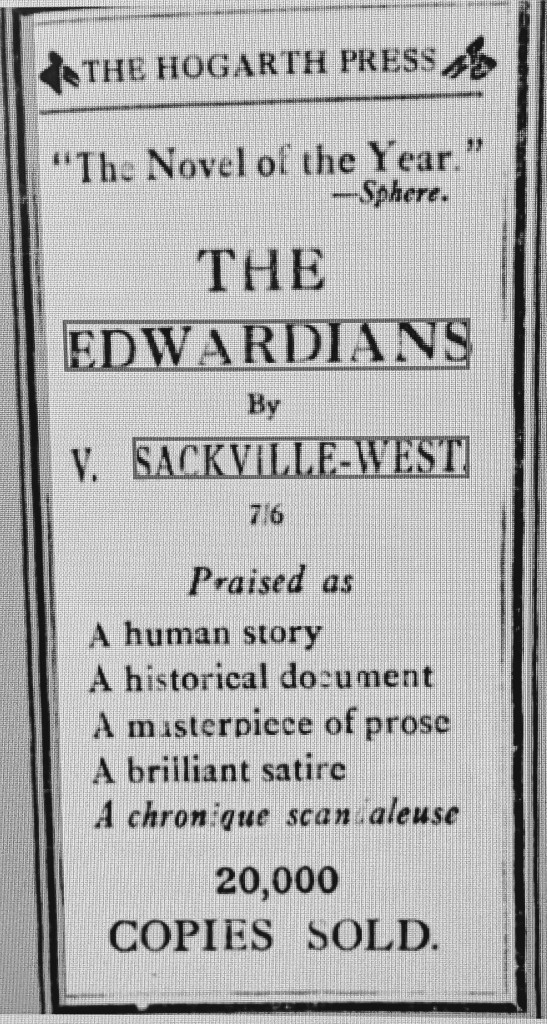
The Edwardians was originally published by the Hogarth Press, the publishing house run by Virginia Woolf and her husband Leonard. The book was a huge commercial success: by July 1930, within two months of its publication, Hogarth Press was already advertising that it had sold 20,000 copies. That the book clearly appealed to a working-class audience is evidenced by the popularity of the cheap sixpenny edition, of which 64,000 copies had sold by 1936.[2]

Advert for The Edwardians, Sheffield Independent, 14 July 1930, p. 3

Sackville-West herself was anything but working class. She grew up at Knole, a medieval palace remodelled into the Sackville family seat in the early 17th century (it is currently managed by the National Trust). Vita had many happy memories of her childhood at Knole, and in The Edwardians she created its fictional equivalent in the Chevron estate, seat of the Duke of Chevron. Chevron is the enduring foundation and backdrop throughout the book’s descriptions of upper-class parties and affairs.

The Edwardians’ main character is Sebastian, the young Duke of Chevron. At the opening of the book, in 1905, Sebastian is nineteen. He loves Chevron and being the head of the estate, but is vaguely dissatisfied with the social life of upper-class Edwardian England. Sebastian’s mother, Lucy, is part of the ‘smart set’: ‘They were all people whose names were familiar to every reader of the society titbits in the papers.’[3] Unlike the matriarchs of the Victorian period, Lucy’s friends think of themselves as less worried about decorum and ‘doing the right thing.’ One of the key themes of The Edwardians is how both the upper and the middle classes still put convention and appearance over personal freedom, despite their insistence that they have done away with Victorian primness.

Sebastian has three key relationships in The Edwardians, which are announced by its chapter headings. In 1905, he meets Anquetil, an explorer who is an outsider to Chevron’s smart set. Anquetil invites Sebastian to come away with him for a few years to see something of real life. Sebastian declines, as he has just fallen in love with Lady Roehampton, a 40-something married woman who is a friend of his mother and one of society’s great beauties. Lucy wholeheartedly approves of this affair, seeing it as a healthy rite of passage for a young man to be introduced to sex.

What is not intended, however, is that Lady Roehampton falls in love with Sebastian. When, after a year and a half, her husband finds out about the affair, he states she must move to the country with him and never see Sebastian again. This creates the first big crisis in the book: Sebastian tells Lady Roehampton that she should get a divorce and come away with him: Lady Roehampton, despite her belief that she is much more modern than her Victorian forebears, shrinks from the idea of divorce and dumps Sebastian instead.

Disgusted by the hypocrisy of the upper classes, Sebastian then pursues a middle-class married woman, Teresa. She is dazzled by the riches and ceremony of Chevron, but when Sebastian makes a pass at her at Christmas she is horrified that he would think she would cheat on her husband. Sebastian is now disillusioned with both the ‘smart set’ and the middle-classes. After a brief affair with a bohemian artist, he resigns himself to marrying a plain but proper daughter of a respectable family. Just before he decides to formalise his engagement, Anquetil shows up again. This time, Sebastian gratefully accepts the offer of escape from his cushioned life.

The Edwardians offers a detailed and, one senses, authentic view of upper-class society in the Edwardian period. Readers are entertained with descriptions of sumptuous parties and Downton Abbey-esque descriptions of the servants’ hall. At the same time, Sackville-West is critical of this lifestyle. For example, she repeatedly stresses that Lucy’s friends, despite their power and influence, are not particularly intelligent. When Teresa is invited to Chevron for Christmas and sits with the other ladies after dinner, ‘she was forced to admit that they did not seem to be saying anything worth saying.’[4] Sackville-West also pokes fun at the group’s own special lingo, ‘deevy’ for ‘divine’ and ‘adding an Italian termination to English words’: ‘lovel-are’ for ‘lovely’ and ‘dinn-are’ for ‘dinner’.[5]

Sackville-West’s critique also touches on more substantial matters: when Sebastian decides to give all his staff a raise of five shillings a week after New Year’s, it leads to critical self-reflection on his own part. He notes that the increase would cost him ‘thirteen hundred pounds a year; very little more than his mother would spend on a single ball; a negligible sum in his yearly budget. He felt ashamed.’[6] When at dinner, Lucy tells the other guests of the raise, Sebastian is harshly criticised by the other lords, who say that he has ‘spoiled the market’ for other landowners and that his staff will only ‘expect more’: ‘They all looked at Sebastian as though he had committed a crime.’[7]

Contemporary reviews of The Edwardians mostly did not note the social commentary of the book. Although the Aberdeen Press and Journal review noted that ‘The Mayfair, Belgravia, and country house lot are shown to us as publicly engaged in whitewashing their own and their neighbour’s private lives’[8], other reviews consistently described the book as primarily ‘entertaining.’[9] Several reviews note that whilst the Victorian period had been extensively revisited by historians and novelists, the Edwardian period had received less attention due to it being overshadowed by the war.[10]

The immediate cultural impact of The Edwardians can be seen in a throwaway comment in the Daily Mirror. In a brief article about Ascot fashion, the journalist writes:

On the cover of Miss Sackville-West’s novel “The Edwardians” there is pictured a group of presumably select persons of that period. The “happy few” look now like a number of charwomen out for a beanfeast. And the question is: Will the belle assemblée at Ascot to-day look like that – a ragbag assortment – in fifty years’ time to those who examine our back numbers? Very likely. But was does it matter? They look nice now.[11]

Already, mere weeks after its publication, The Edwardians was referenced as a text with whom all Daily Mirror readers were expected to be familiar. Whether they enjoyed it for its lavish descriptions of upper-class life, or for its social critique, it is undeniable that the book resonated with many interwar readers.


[1] Kate Williams, ‘Introduction’, in Vita Sackville-West, The Edwardians (London: Vintage, 2016), p. xv

[2] Ibid., p. x

[3] Vita Sackville-West, The Edwardians (London: Vintage, 2016), p. 27

[4] Ibid., p. 193

[5] Ibid., p. 194

[6] Ibid., p. 184

[7] Ibid., p. 205

[8] ‘Book of the Week: A Novel of Edwardian Society’, Aberdeen Press and Journal, 9 June 1930, p. 6

[9] ‘Real Life Raffles’, Daily Mirror, 23 June 1930, p. 20; ‘Woman in the West’, The Western Morning News and Mercury, 10 July 1930, p. 3

[10] ‘Books of the Day’, Birmingham Daily Gazette, 5 June 1930, p. 8; ‘Woman in the West’, The Western Morning News and Mercury, 10 July 1930, p. 3

[11] ‘Ascot Fashions’, Daily Mirror, 18 June 1930, p. 9

Hints and Hobbies (1926)

By 1926, cinemagoing was firmly established in Britain, and it was transforming from a working-class hobby to something rather more respectable. Super cinemas, which offered lounges and tearooms as well as screenings, were designed to attract middle-class women. Film historian Ina Rae Hark has argued that cinemas tried to draw in female customers by “attempting to create a dream home in which the woman could (…) enjoy complete freedom from responsibility for its maintenance.”[1] Like the department stores that appeared in Britain at the end of the nineteenth century, super cinemas gave women a respectable place to go when they were out in town: a female equivalent for male clubland.

Inside the screening room, audiences did not just see a single film, but rather a varied programme of features, cartoons, informational films and advertisements. In 1926, silent film director A.E. Coleby, who had previously directed morality tales such as The Lure of Drink (1915) produced a series called Hints and Hobbies. Twelve episodes of this weekly bulletin survive in the BFI National Archives and are available to view online for UK-based audiences. These amusing films provide insight to the range of topics which were deemed relevant and suitable to a largely female audience.

Each episode of the series is about fifteen minutes long and covers a series of topics for a few minutes each. The very first Hints and Hobbies starts with a ‘Pets Column’ featuring kittens and puppies, showing that a version of the cat video has been a crowd pleaser for over a century. It then moves to a woman demonstrating how you can make a large decorative vase out of cardboard – for the use of dried flowers only one presumes! It is introduced with the title: ‘An Interesting Hobby which can be made to help pay the rent (?)’ It is evidently not going to be the most effective way to earn extra cash, but this does show that the target audience for this segment are women who are not poor but still could do with some more disposable income.

The penultimate sketch included in episode one is clearly aimed at the same audience. Titled ‘If only husbands were like this!’, it shows a married couple at the breakfast table. The woman receives a number of bills for recent clothes purchases: £8 8s for two hats, £10 10s for a ‘costume’, and £21 for an evening dress. This was serious money in 1926, but the fictional husband is unperturbed. ‘Quite alright, darling’, he says, and even says his wife should have treated herself to a second gown. E.M. Delafield’s Provincial Lady, no stranger to the lure of the boutique and the subsequent bank overdraft, would no doubt have appreciated this scene.

Hints and Hobbies also reflected modern concerns of the time, such as road safety. As this blog has noted previously, the interwar period saw a huge increase in car ownership but little in the way of safety regulations. In lieu of driving licenses or instructors, poor driving was rife. The first episode of the series exhorts drivers to be mindful of others when overtaking one another; the second episode asks female drivers specifically to not be ‘Miss Kareless Kornerer’ when taking a left-hand turn.

Along with the household and cooking tips included in each episode, Hints and Hobbies also took the traditionally feminised profession of nursing and used it to teach first aid to a wide audience. Lady Superintendent Mrs Webb from the St John’s Ambulance Brigade was on hand to demonstrate how to dress a wound in the palm of one’s hand, or how to make a splint for a fractured leg. Seven years after many women had trained as nurses during the First World War, these segments taught a new, younger generation of women the principles of emergency care. Mrs Webb appears in her uniform, capably handling the tools of her trade to fix up male patients.

The penultimate surviving episode of Hints and Hobbies veered away from accepted femininity and treated its audiences to something rather more transgressive: jiu-jitsu for women. The alarmist intertitle ‘You never know when the following may happen to you’ is followed by a sequence showing a young woman being attacked by a male loafer, who tries to steal her handbag. Luckily for the victim, a capable female motorist steps out of her car, grabs the man, retrieves the handbag, and ends with throwing the attacker to the ground. When returning the bag to the first woman, she tells her ‘My dear, it behoves every girl to-day to be able to protect herself…If you will come to the address I will give you at 7 o’clock to-night I will give you a few hints.’

It’s no surprise that this particular episode of Hints and Hobbies has been embraced by some LGBTQ viewers as representing an example of ‘lesbian erotica.’ Dressed in short tunics and standing on mattresses, the two women demonstrate several self-defence moves on one another. This no doubt also gave straight male viewers plenty of ‘visual pleasure’ but the casting of the man as the villain rather than hero in this segment, and a final shot of the two women embracing and leaving the room with their arms around one another, give plenty of space for a queer reading.

Little else appears to be known about Hints and Hobbies – who decided which topics to include, which cinemas they were shown at, or why the series did not last. However, even without any additional information the series provides plenty of insight into what the producers thought would entertain and inform their mostly female audiences. The changing gender norms of the period are reflected in the content that veers from tips on how to remove ink stains from aprons to improvising fancy dress for your next flapper party.  

The full Hints and Hobbies series can be viewed for free by UK-based viewers on the BFI Player.


[1] Ina Rae Hark, ed, Exhibition: The Film Reader (London: Routledge, 2001), chapter 12, Ina Rae Hark, ‘The “Theatre Man” and the “Girl in the Box Office”, pp. 143-154 (p. 145)

How to Entertain: A Guide for Hosts and Hostesses (1924)

The interwar period saw great social change: the upper classes were gradually losing their elevated standing whilst at the same time, the middle classes grew both in volume and significance. But upper-class life still had its lustre, and self-help books were a popular means to learn behaviours of other social strata; or at least to have a peek into different lifestyles.

These books, such as 1924’s How to Entertain: A Guide for Hosts and Hostesses, can serve much the same purpose to a modern audience. A guidebook sets out a prescribed and distilled set of behaviours, which are unlikely to have been exhibited as written by the wealthier classes. The book is apparently written for the man or woman who finds themselves in a position of having to ‘entertain’, but has not learnt the rules of entertaining whilst growing up. Probably, the behaviours set out in the book were not even adopted by its readers/students, who may have used the book as inspiration or a reference guide only.

What is left is a volume providing prescriptive detail on how to host a range of entertainments, quite removed from any real-life application of the guidance. The work should not be seen as an accurate reflection of how five o’clock teas or garden parties took place, but rather as an idealised version of how the author (Mary Woodman) wanted the reader to believe such gatherings took place in moneyed households. Like all etiquette books, it serves as much to reaffirm and strengthen social practices as it does to initiate novices into those practices.

The book covers the following possible social functions one may need to host, in this order: dinner parties; luncheon party; five o’clock tea; evening function; wedding; christening; private dance; musical evening; garden party; picnic party; card party; Christmas dinner party; children’s party; week-end visits. The underlying assumption throughout is that hosting happens by married couples only, who own their own home with spare rooms and a sizeable garden, and preferably access to a car. This naturally excluded a large part of British people living in 1924, and any hosting undertaken by this group is disregarded. ‘Hosting’ becomes a formal activity with rules and boundaries, that needs to be studied and learned.

Although the title of the book purports it to be for ‘hosts and hostesses’, the majority of the hosting is presumed to be taken on by the hostess. For example, in the section on the garden party, it states ‘No hostess should attempt a garden party unless the dimensions of her garden are fairly generous and unless there is a lawn big enough for whatever games she decides upon.’[1] Equally, in the section on picnic  parties, it is stated that the hostess ‘must only invite friends with motors, or must be prepared to carry the folk in her [sic] own car, or select a spot easily reached by other means of conveyance.’[2] Despite its title, the book repeatedly reaffirms that social functions are the responsibility of (married) women, who must follow an intricate set of rules to organise them.

No social engagement appears to have had more rules than the formal dinner party, which is given prominence at the book’s opening. This sets it as the gold standard of all social engagements. Right at the start, Woodman warns that ‘The laws of entertaining are sound common-sense laws which have been evolved for the good of all concerned. This being the case, it is highly necessary that they are strictly observed.’[3] Thus advised, the reader takes note that invitations must be sent out at least two weeks in advance;[4] that an even number of men and women should be invited; and that if a single guest cancels, ideally one should then remove or add a guest to retain the gender balance.[5]

When it comes to topics of discussion during the dinner: ‘[s]afe subjects are books, theatres, sports if not taken too far, public men, holidays, and the fashionable doings of the moment. The weather is a poor subject, but it is better than nothing.’[6] In addition to all these niceties, the hostess should serve up an elaborate meal which could include up to nine courses, each with a different type of beverage.[7] Clearly, hosting a party at this scale would be out of the financial reach for most people, and those who could afford it were unlikely to seek recourse to a guidebook to understand how to organise it.

The card party, which had the potential to be a bit sordid, came with strict rules to allow it to be respectable. The first advice is that ‘No hostess would plan a card party unless she had previously attended many similar functions given by her friends. She would then have the opportunity of seeing how things were done in her own particular set.’[8] It is implied that she should find out if her particular set of friends play for money, or not. At an evening card party, at least half the attendees had to be men, to keep things respectable – and the hostess was excluded from the action unless she had to make up a set of four for bridge or whist.[9] In the world of the Guide, a card party was not an opportunity to gamble but rather a staid affair to which even grown-up sons and daughters could be introduced.[10]

How to Entertain: A Guide for Hosts and Hostesses demonstrates the ideal rules of social engagement as presented in 1924. It also shows that there was a market for books explaining how to behave; a reflection of the significant social change that was occurring in Britain at the time. Through social mobility, people were no longer secure in their role in life or the expectations placed upon them. They could turn to books such as this for reassurance or entertainment. The highly prescriptive nature of the book could provide comfort, although it also placed a substantial burden on (married) women by stressing their responsibilities for the social standing of the family.


[1] Mary Woodman, How to Entertain: A Guide for Hosts and Hostesses (London: W. Foulsham & Co Ltd, 1924), p. 57

[2] Ibid., p. 60

[3] Ibid., p. 9

[4] Ibid., p. 10

[5] Ibid., p. 12

[6] Ibid., p. 20

[7] Ibid., p. 25

[8] Ibid., p. 65

[9] Ibid., pp. 65-66

[10] Ibid., p. 66

Women and Public Transport

Public transport became part of daily life in the 19th century, particularly in urbanised areas. Almost from its inception, women were at risk in public transport spaces, and this risk is still present in the 21st century.[1] It is no surprise then that in London of the interwar period, too, there were countless attacks on women in public transport, ranging from relatively minor aggressions to murder. Newspapers of the period did report on such cases, but with a view to stress the human or sensational element of such cases without addressing any structural issues that may have led to violence against women.

In newspaper reports, attacked passengers were almost always young women travelling alone, and the reports stressed how the seemingly random attacks were carried out by strangers. A typical article appeared in the Daily Mirror in December 1929. It describes how a Miss Organ, who was in her mid-twenties, was “suddenly attacked by a youth who followed her into a compartment” on the suburban train from Bromley to Charing Cross.[2] The isolation of the train compartment meant that Miss Organ was quite seriously hurt, and her attacker managed to escape before other passengers could come to her aid.

Train compartments were designed to be like private domestic spaces, so that passengers would feel at ease in them. But their public accessibility made them dangerous, too.[3] The repeated attention on female victims reinforced the notion that travelling was especially dangerous for women, and implied that they were perhaps better off by avoiding using transport on their own, thus limiting women’s freedom to move around the city.

Earlier in the same decade, the Daily Express reported on a ‘mysterious outrage in a Tube train’.[4] Daisy Tyler, a 16-year-old from Barking, had her plait of hair cut loose in a crowded Underground train. Interestingly the hair wasn’t stolen – it was severed to the point that it was only held together by Miss Tyler’s hairclip, and it was only when the clip was removed that Miss Tyler realised what had happened. A ‘close friend’ confided to the Express that Miss Tyler was particularly distressed ‘as she was going to a dance’ that evening.

The article goes on to speculate that women with ‘golden’ hair may be at particular risk of these (attempted) hair robberies, alleging that several instances of women and girls having their hair forcibly cut off had taken place in recent months. Again in the words of Miss Tyler’s ‘friend’, it was ‘extraordinary’ that no-one in the packed Tube had noticed the attack. Anyone who has ever been harassed on a busy train or bus will note that busy carriages can actually create an environment in which it is easier to harass unnoticed, as the mass of commuters’ bodies can hide a lot of activity from view.

Far worse than the fate of Miss Tyler was that of an unnamed, unidentified girl whose body parts were found in a paper parcel on a train running from Waterloo to Windsor in 1922.[5] A ‘girl’s hand, arm, shinbone and foot’ were found wrapped up ‘on the rack of a third-class compartment’ in this suburban train. The parcel was initially handed in as lost property by an unsuspecting passenger before it was opened up by station staff the next day, and its contents were revealed.

Even in this initial report the Daily Mail reporter manages to hint at the horrors that may have led to the girl’s death. The police surgeon concluded that the body was dismembered ‘in the same way as anatomical specimens in a surgical laboratory’. The man who found the parcel was quick to allege that his fellow passenger, who had been sitting below the parcel for part of the journey, had been reading a book ‘which I believe was a work on surgery’. The mystery man supposedly also had a stethoscope in his attaché case. This fellow traveller may have had nothing to do with the case, but the description provided in the article allows the reader to fantasise about the supposed surgeon’s nefarious deeds. The article ends with a paragraph on a ‘bushel of human bones’ found by Scotland Yard in Hampstead, north London (miles away from Waterloo or Windsor) which included ‘a skull with the top sawn off, proving that it had been used for anatomical purposes.’

Like the article on Miss Tyler’s hair, the Daily Mail report is quick to draw a picture of a nebulous but nonetheless threatening presence in London, which is attacking young women (invariably referred to as ‘girls’). London’s transport network provided rapid connections to increasingly far-flung parts of the city. Whilst public transport provided a great benefit to Londoners wishing to travel from one part of the capital to the other, these swift connections could also allow criminals to quickly move around the city. Young women were increasingly using public transport to navigate to and from work, disrupting expected patterns of behaviour and movement. In the narratives of these newspaper articles, these women can expect to put themselves at risk of attack if they choose to use the public transport network.

You can read more about the representation of London’s transport network in interwar newspapers in my book: Interwar London After Dark in British Popular Culture.


[1] See Caroline Criado Perez, Invisible Women: exposing data bias in a world designed for men (London: Vintage, 2020)

[2] ‘Girl Attacked and Robbed in a London Train’, Daily Mirror, 5 December 1929, 3.

[3] Colin Divall, ‘Civilising velocity: Masculinity and the marketing of Britain’s passenger trains, 1921-39’, The Journal of Transport History, 32:2 (2011), 164-191, here 179.

[4] ‘Girl Robbed of Hair’, Daily Express, 20 April 1921, p. 5

[5] ‘Girl’s Limbs in a Parcel,’ Daily Mail, 18 September 1922, p. 7