Featured

Suburban dreams

London underwent massive suburban expansion in the interwar period. The interwar period saw a combination of an increase of Londoners who were looking for suitable living space; an increase in disposable income and a reduction of housing costs; and a greater availability of accessible building plots around the outskirts of the city. These factors led to a veritable suburban ‘boom’ during the 1920s and 1930s, at the end of which London’s size had increased threefold and the population of its suburbs had grown by 2.5 million compared to the start of the century.[1]

The first London suburbs were built by private investors during the nineteenth century, when the introduction of tramcars and other modes of public transport opened up areas further away from the city centre, for residential development. By the end of the nineteenth century the London County Council also ordered the development of suburban estates, to provide healthier living quarters to poorer Londoners.[2] These two types of suburbs – private developments and council estates – continued to co-exist in the Edwardian and interwar periods. Private developments were mostly aimed at the aspirational middle-classes, who would look to mortgage a semi-detached or detached house.

Elsewhere in this blog I have considered how the suburbs were represented on film; how tennis was a key social activity for suburbanites; how an expansion of car ownership changed the entertainment opportunities open to suburban Londoners and how the experience of suburban women was captured in interwar novels. The suburbs, in short, were on the forefront of social changes and the experiences of their inhabitants provided inspiration for artists.

Yet suburbs were also synonymous with boredom and small-mindedness, particularly to the urban intelligentsia.[3] Privately developed suburbs were built by builders and speculators, who bought up cheap land, built houses on them, and then sought to sell these brand new dwellings as quickly as possible. One of the key ways they used to entice Londoners to buy a suburban house was to present suburbia as a rural environment.

‘Most advertisements and brochures were accordingly illustrated with idealised sketches or heavily retouched photographs which skilfully suggested that the house stood quite along in matured surroundings of judiciously placed trees and shrubs, against a background of windblown clouds and gently rolling hills.’[4]    

In London’s north-western corner, new estates serviced by the Metropolitan Railway were quickly badged up as part or ‘Metro-land’. Transport posters presented this new land as a rural idyll with ‘Gorgeous Autumnal Scenery’ and ‘Charming Country Walks’; as well as an excellent place to go fishing. At Radlett, near Watford, a developer promised such aristocratic pursuits as ‘Hunting, Shooting, Beagling and the like….every phase of rural life at Radlett provides the perfect antidote to business worries.’[5] At the same time, it was crucial that suburban estates had quick and easy transport lines into the centre of London. Here, misleading advertisements could be the developer’s friend: brochures and advertisements frequently cited the fastest possible travel time as standard, even if most of the daily trains would take much longer to get to the city.[6]

Because suburbs kept expanding incessantly, any estate that started out as a semi-rural enclave would quickly find itself engulfed by other estates, the ‘rolling hills’ and ‘mature trees’ covered by more semi-detached housing. Most suburban dwellers were exposed to nature primarily through their garden. Because suburban houses were often built in styles to remind people of cottages and other old-fashioned houses, historian Matthew Hollow has argued that ‘the move out to the cottage estate was accompanied by a desire to indulge in new, more family-centred, pastimes. Gardening became a popular family pastime for many.’[7] Gardening also allowed suburban houseowners to express their creativity and compete with their neighbours in popular and wide-spread estate garden shows.[8] Perhaps surprisingly, in the popular imagination the garden became the domain of the male head of the household, retreating to the garden after dinner to tend to his plants. As ever, London Underground’s poster designers had their finger on the pulse with this 1933 poster, showing a city man seamlessly transforming into a suburban gardener mowing his lawn.

One final way in which suburban inhabitants themselves sought to underline the rural character of their neighbourhoods was through their house names. As completely new developments, many privately-built suburban estates did not yet have properly assigned addresses when their first inhabitants moved in – another sign of the speed of suburban development, which outpaced the local authority administration. To ensure their homes could be identified, many suburbanites named their own houses, and names such as ‘Meadowside’, ‘Woodsview’ and ‘Fieldsend’ both highlight the semi-rural nature of the suburban environment, and indicate that for the people living in these houses, the natural surroundings were significant.

Despite its sometimes negative reputation, suburban living was a dream for many working- and middle-class Londoners during the interwar period; a dream encouraged by the sometimes fanciful advertising techniques used by speculative developers. For many, suburban living offered a first chance of home ownership, and access to private green space. The vast suburban developments of the 1920s and 1930s continue to shape London to this day.


[1] Mark Clapson, Suburban Century: Social change and urban growth in England and the United States (Oxford: Berg, 2003), p. 2; Stephen Halliday, Underground to Everywhere (Sutton: Stroud, 2001), p. 113

[2] Peter Hall, Cities of Tomorrow (Oxford: Blackwell, 2002) pp. 21 and 50-52

[3] Alan A. Jackson, Semi-Detached London (London: George Allen & Unwin, 1973), p. 162

[4] Ibid., p. 204

[5] Ibid., p. 205

[6] Ibid., p. 206

[7] Matthew Hollow, ‘Suburban ideals on England’s interwar council estates’, Garden History, vol. 39, no. 2 (2011), 203-217 (213)

[8] Ibid., p. 209
The Lady Vanishes (1938)

FeaturedThe Lady Vanishes (1938)

This is the second of a two-part blog looking at the novel The Wheel Spins, and its film adaptation The Lady Vanishes. You can find the first part here.

Following last week’s analysis of the 1936 novel The Wheel Spins by Ethel Lina White, this week we consider its film adaptation The Lady Vanishes. The film was released in 1938 and directed by Alfred Hitchcock, who by the late 1930s was directing acclaimed and increasingly high-profile films in England. He would move to Hollywood in 1939. The Lady Vanishes includes a number of stylistic flourishes that make it instantly recognisable as a Hitchcock film.

Although there was only two years between the publication of the novel and the release of the film, and the novel is credited as the source material, there are fairly significant differences between the book and the film. The focus on the female experience, present in the book, is watered down in the film in favour of a more traditional positioning of the female protagonist as assistant to the active, male counterpart. The film’s final section deviates completely from the book, and links much more explicitly to Europe’s political situation in the late 1930s.

As with the novel, the film opens not on a train, but in a hotel in a fictional Eastern European country. The female protagonist, here called Iris Henderson, is on a girls’ trip before travelling back to London to be married. Although Iris and her friends have the hotel staff eating out of their hands, they are presented much more sympathetically than Iris and her friends are in the book. Miss Froy, the lady who vanishes, is also staying at the hotel and she and Iris have some interaction before boarding the train; Iris also meets her eventual love interest, Gilbert, in the hotel.

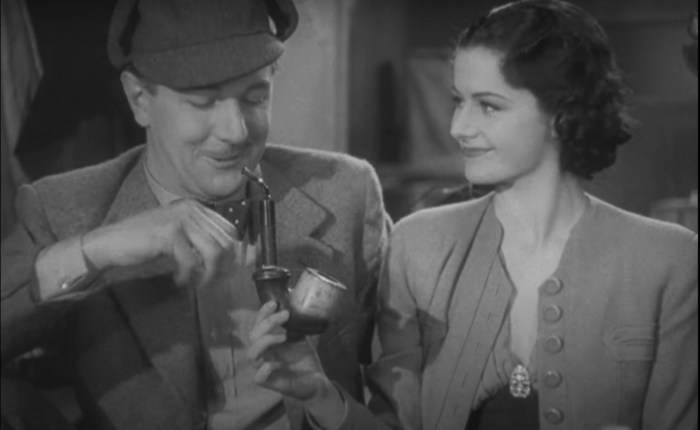
Gilbert (Michael Redgrave) and Iris (Margaret Lockwood) playing Holmes and Watson in The Lady Vanishes

Hitchcock introduced two additional characters, Charters and Caldicott, two men who are determined to get back to England before the end of the Ashes cricket match. This comedy duo proved so popular that they ended up appearing in ten more films, working with a range of directors. To ensure the film does not get too overcrowded, many of the other British characters that appear in the book are not in the film.

Caldicott (Naunton Wayne) and Charters (Basil Radford) in The Lady Vanishes

Once the action moves onto the train, the film largely follows the same trajectory as the novel, although Gilbert takes a much more pro-active role in the hunt for Miss Froy and Iris is increasingly relegated to his assistant. This is made explicit in a scene where he poses as Sherlock Holmes with Iris as his Watson. Gilbert even gets to demonstrate his physical daring when climbing out of the carriage window and into the next carriage from the outside of the train.   

Gilbert (Michael Redgrave) climbing down the side of the train in The Lady Vanishes

Once the pair have located and saved Miss Froy, the action goes in a drastically different direction. The nefarious gang that are trying to kill Miss Froy decouple the two train carriages that contain all the British characters and divert it to a side track into the forest. Once there, the carriages are ambushed by the gang and repeatedly shot at.

It is here that Europe’s political situation has clearly strongly influenced the script. The British characters are debating whether they should get away, fight back, or surrender. One character does not want to fight and instead exits the carriage waving a white handkerchief – he is promptly shot dead by the antagonists. The parallels with Chamberlain’s appeasement approach to Germany could not have been missed by British audiences. Ultimately, with only one bullet left between them, the British passengers manage to get the train running again and are able to get away, but not before Miss Froy has admitted to Iris and Gilbert that she is a spy working for the Foreign Office, and has been given a message for the British government in code. She teaches the code to Gilbert before exiting the train and running into the forest.

This is a significant deviation from the novel, in which Miss Froy is targeted by gangsters because she has unwittingly witnessed something she should not have seen. In the film, Miss Froy is not an innocent bystander who was at the wrong place at the wrong time, but rather part of an international network of spies and informants working for the British state. Rather than being reunited with her family in a celebration of traditional British domestic values, Miss Froy is reunited with Gilbert and Iris as they come off the train. Their triumph is that they have helped the British government gained vital intelligence, with the Foreign Office taking the place of the parental home. In times of political turmoil and with war on the horizon, it is the duty of British citizens not just to help one another, but also to help the State in its mission to suppress international unrest.

The main source of tension in The Wheel Spins, Iris’ concern that she will be locked up in an asylum because no-one believes her, is absent in The Lady Vanishes. Instead, the danger comes not from the British passengers on the train, but from the Europeans who are looking to eliminate a British secret agent. This makes the story much more conventional and in line with many other suspense films of the period. The film is elevated by Hitchcock’s direction and dialogue that balances comedy and drama. The novel and the film stand alongside one another as distinct texts, each using the same plot to foreground different themes.

The Lady Vanishes is available on Youtube.

Featured

Ethel Lina White – The Wheel Spins (1936)

This is the first of a two-part blog looking at the novel The Wheel Spins, and its film adaptation The Lady Vanishes.

Ethel Lina White is one of a mass of interwar authors who were quite prolific, had some commercial success during their lifetime, and whose names have been mostly forgotten by the general public. In the case of White, if it were not for the successful adaptation of two of her novels into films, she may have dropped into obscurity altogether. However, her 1933 novel Someone Must Watch was adapted for the screen in 1946 as the American horror film The Spiral Staircase, and her 1936 novel The Wheel Spins was filmed by Alfred Hitchcock in 1938 under the title The Lady Vanishes.

The plot of the book is relatively straightforward: Iris Carr is a young, wealthy, but bored woman who is travelling back to London by train after a holiday in Eastern Europe. On the first stage of the journey there is another British woman in her carriage, a Miss Froy. Iris has suffered sunstroke just before boarding the train and falls asleep. When she wakes up, Miss Froy has disappeared, and everyone else in the train appears to deny she has ever existed at all. Iris gets increasingly frantic trying to prove that Miss Froy exists, and attempts to enlist the help of the various British passengers on the train.

The Wheel Spins is an unusual entry to the suspense and mystery genre, in that the solution to the problem of what happened to Miss Froy is probably quite clear to the reader at an early stage. Instead, the tension of the novel is much more psychological, centring on whether the protagonist, Iris Carr, will be believed or will be dismissed as mentally unstable. That the fear of women being dismissed as crazy, and potentially locked up, has enduring cultural resonance is in evidence in texts such as the 1963 American novel The Group, where a (sane) character is checked into a mental institution by her husband against her will; or the 2018 Stevan Soderbergh film Unsane, in which the female protagonist also appears to be institutionalised against her will. Throughout The Wheel Spins, the other characters, particularly the men, repeatedly tell Iris that she is making things up. The sunstroke she has suffered has given her ‘delirium’ (p. 107); she is ‘loopy’ (p. 207), in a ‘dangerous mental state’ (p. 227) or ‘deranged’ (p. 230). At various points, the conspiracy against her makes Iris believe that perhaps they are right, and Miss Froy never existed; but then she finds a clue left by the other woman which reinforces her resolve.

The bond between these two women, who have never previously met and have very little in common, stands in contrast to the efforts of the passengers on the train to get Iris to give up her search. At the beginning of the book, Iris is part of a ‘crowd’ of ‘vain, selfish and useless’ people (p. 16). She has no interest in others and actively alienates the other British tourists in the hotel; something that comes back to her later when those same tourists are on the train and she appeals for their help. When Iris meets Miss Froy, she quickly finds her company grating: ‘She’s decent, although she is a crashing bore’ is Iris’ verdict on the other woman (p. 77). Yet when Miss Froy disappears, Iris is relentless in her attempts to find her, despite the obstacles in her way. This suggests a connection between women, helping one another out even if their personalities have little in common.

The other theme running throughout the book is that of British people sticking together against foreigners. Time and again, Iris expects other passengers on the train to help her because they are British, even if she has treated them poorly. When Iris first notices Miss Froy is gone, she goes into the dining carriage of the train to ask for help. It is when she explains to two British men that ‘an English lady’ has gone missing, that they feel compelled to help her (p. 100). Two sisters, the Misses Flood-Porters, can be depended on because they are of aristocratic British stock and will therefore always feel obliged to come through in a crisis. A British vicar, despite being sick, also feels it his duty to come to Iris’ aid. The foreigners on the train are variously described as ‘pallid’, ‘callous’ (p. 70), with ‘grinning faces’ (p. 206) that sneer (p. 211). The kidnapping of Miss Froy is part of a political plot in an unspecified Eastern European country, which is described as ‘feudal, and centuries behind us’ (p. 75). The agents of the ruling party do not blanch at the idea of killing someone like Miss Froy, who has accidentally inserted herself into their affairs. The British characters, in contrast, uphold decency and the rule of law.

Throughout The Wheel Spins, the reader is treated to interludes describing Miss Froy’s parents, an elderly couple who live in the British countryside and are eager for their daughter to come home. These scenes have multiple functions: they reassure the reader that Iris is right and Miss Froy is a real person; they raise the emotional stakes of the story as they highlight how devastated the parents would be if Miss Froy were to come to harm; and they reinforce the notion that the orderly, somewhat boring lifestyle of the Froys is aspirational. Iris has no family and no fixed abode; this is presented as giving her a lack of purpose, rather than freedom. The novel ends with Miss Froy safely arriving at her parents’ house at last; ensuring a restoration of the traditional British family.

The Wheel Spins is not a traditional whodunnit, in that the puzzle of what happened to Miss Froy is resolved halfway through the novel, and the details of who was behind her disappearance are left underdeveloped. Instead, it explores themes of alienation and belonging across a range of different registers.

The Wheel Spins has recently been reissued by British Library Publishing. All page numbers given refer to this 2023 paperback edition.

Holidays in interwar London

FeaturedHolidays in interwar London

With the summer season upon us, many may be planning to head off for a few weeks to relax on holiday. The right to paid holiday these days is enshrined in UK law. The first legal intervention in this area came in 1938 with the Holidays With Pay Act. Rather than setting out an inalienable right to holiday, however, the purpose of the act was to ‘enable wage regulating authorities to make provision for holidays and holiday remuneration for workers whose wages they regulate, and to enable the Minister of Labour to assist voluntary schemes for securing holidays with pay for workers in any industry.’ It was facilitative rather than prescriptive, giving employers a framework for offering paid holiday if they wanted to do so. Even for those covered by the Act, they would only receive one week of paid holiday a year.

Prior to 1938, there was no legal concept of a holiday in Britain. What’s more, the ‘weekend’ for most of the interwar period comprised only Saturday afternoon and Sunday; this 5.5 day work-week had developed in the 19th century. Bank Holiday weekends (where the Monday was a national holiday) could be the only extended break a working person had. The notion that workers should be entitled to extended time off work whilst still receiving pay was not commonly held. At the other end of the social spectrum, the upper classes were generally not in wage-earning roles and therefore had much more freedom over how they used their time.

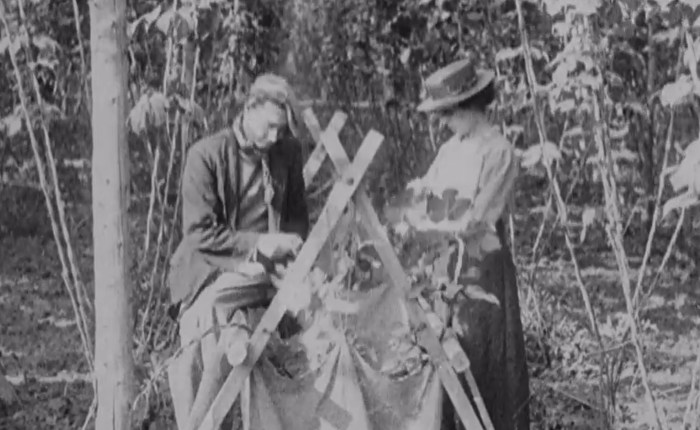
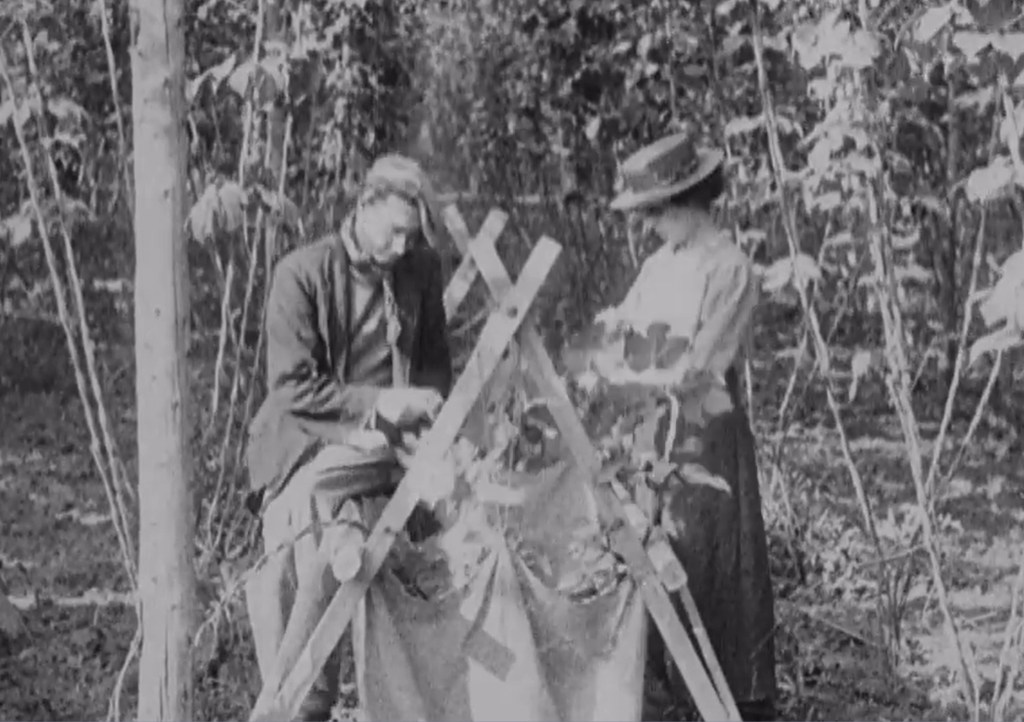
What were the options for breaks, then, for different social groups during the interwar period? At the lower end of the social scale, East End workers could go to Kent in the summer months to go hop-picking. This was not a holiday as such as they would still be required to undertake long hours of manual labour, but it gave an opportunity to leave the city and enjoy the countryside. They would also get paid for their efforts and be given lodgings by the farmers. George Orwell went hop-picking in 1931 during one of his expeditions moonlighting as an iterant worker. He describes the communal aspects of the picking, with whole families coming down and picking together. The 1917 film East is East includes extensive scenes on Kent hop-picking fields as the main character makes her way there for a summer job.

Hop-picking scene from East is East (dir. Henry Edwards, 1917)

Hop-picking was not a holiday, but rather an opportunity to undertake seasonal work and escape the squalor of London during the hottest months. If you had slightly more disposable income, a day-trip could be a welcome activity. The cheapest and most comfortable way to travel would be by charabanc (an early type of motor bus); either by buying a ticket on a scheduled service or by pooling together as a community group and hiring a private coach.[1] The proximity of a range of seaside towns to London made them a popular choice of destination for these trips; then, as now, many seaside towns offered entertainment on the pier and quayside.

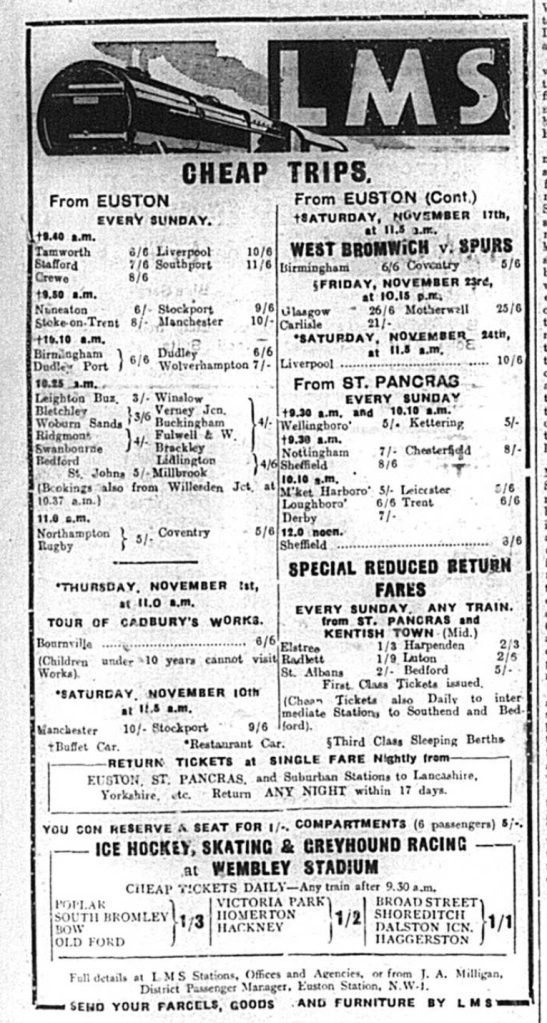
For those able to spend a bit more, travelling by train allowed access to a much larger part of Britain. By the interwar period, Britain’s rail network was mature and there were numerous London terminals from which to board trains. Train operators advertised ‘cheap trips’ in London newspapers. For example, this 1934 advert from the London, Midland and Scottish Railways advertises a range of services for holidaymakers. There are trains leaving to the Midlands and the North every Saturday and Sunday. These are offered with a flexible return ticket, that can be used for 17 days after the initial trip. This implies that travellers are expected to be using the train for a holiday of a week or two. Those travelling to Birmingham and environs can benefit from a tour of the Cadbury chocolate factory at Bournville – an attractive holiday outing which shows the railway collaborating with a large company to offer a package deal. Those who cannot afford to travel far of be away from home long are invited to consider a day-trip to Wembley Stadium for ‘Ice Hockey, Skating & Greyhound Racing’.

LMS advert, The City & East London Observer, 27 October 1934, p. 7

At the top end of the social scale, foreign travel was a possibility. Tourist guides and travel agencies had been available since the 19th century, taking much of the organisation and guesswork out of foreign travel. Commercial flight routes greatly developed during the interwar period, providing a faster way to travel in addition to overland routes and travel by ship. For those who opted for comfort and style over speed, luxury ocean liners and overnight rail journeys through Europe with the Compagnie des Wagon-Lits were good options.

Whether it was to have fish and chips at the seaside or a five-course meal in a dining carriage, throughout the interwar period there was an increased agreement that Londoners should be able to leave the city every now and then and enjoy relaxation and a change of scenery. For many, however, these trips remained limited to single-day outings, as there was little provision for paid holidays and most people could ill afford to take unpaid leave and were at risk of losing their jobs if they did so.


[1] Michael John Law, ‘Charabancs and social class in 1930s Britain’, The  Journal  of  Transport  History, Volume 36, No. 1 (June 2015), 45

Female aviators in interwar Britain

FeaturedFemale aviators in interwar Britain

With the rise in popularity of civil and commercial aviation in the 1920s and 1930s, which has been covered elsewhere in this blog, there was naturally also an increase in the number of people who got a pilot’s license. What is perhaps more surprising to the casual observer is the number of women who became (amateur) pilots. During a time when women were increasingly able to participate in public life, changing social norms made it more acceptable for women to engage with new modes of mobility.

As with the introduction of cars, learning how to fly was mostly open to women from wealthy and privileged backgrounds. Nonetheless, some women from working- and lower-middle class backgrounds were also able to gain a pilot’s license. Unlike today, the training requirements for new pilots were minimal, with some clocking fewer than 10 hours in the cockpit before deciding to set off on long solo adventures. This, too, lowered the threshold to becoming a pilot, although the other big expense required was of course the purchase of a plane.

The most famous female pilot in interwar Britain was Amy Johnson. ‘Amy, Wonderful Amy’ as the song written in her honour called her, became hugely famous when she flew on her own to Australia in May 1930. The journey took her 19.5 days – it was not an outright record but she was the first female pilot to undertake the route as a solo pilot. Johnson had grown up in a middle-class family, attending university and working as a legal secretary before re-training as an engineer and realising her aviation dreams.[1]

‘Amy Johnson, Queen of the Skies’ newsreel

Also in 1930, Mildred Mary Petre (usually known as Mrs Victor Bruce) completed a solo flight to Tokyo in 25 days. Unlike Johnson, Petre’s passion was not solely for flight – she had previously been a record-breaking motor racer. When she undertook her long-distance flight in 1930 she’d only had 40 hours of flight experience.[2] The feats of female pilots caught the popular imagination in 1930, leading the Daily Mirror to enthuse in a bold headline that 1930 was ‘The most wonderful year in the history for women’ and that the year had seen ‘months of triumph over male rivals in almost every sphere.’[3]

Most female pilots either flew as amateurs for private enjoyment, or sought to gain publicity and income by completing record-breaking flights. The commercial airlines were extremely resistant to hiring female pilots. In 1928, amateur pilot Lady Heath was briefly employed by KLM as a pilot on their Amsterdam to London route, but this did not result in a permanent appointment. Lady Heath had grown up in Ireland where she had obtained a degree in science. During the First World War she served as a despatch rider, and in the 1920s she was a champion javelin thrower and one of the founders of England’s Women’s Amateur Athletics Association. Rather than trying to break distance records, Lady Heath focused on height records in her plane, becoming the first pilot to fly a light plane to an altitude of 16,000ft in 1927, and to 23,000ft the following year.

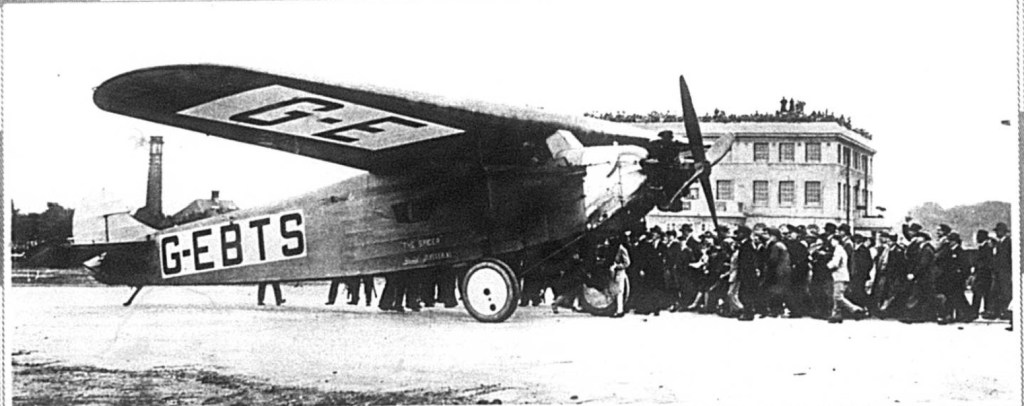
Mary Russell, the Duchess of Bedford, came to flying later in life. As a young woman in the Victorian era she spent a significant part of her life setting up and managing hospitals. She also trained in jiu-jitsu. The Duchess’s interest in flight came late in her life; she took her first flight from Croydon Airport to Woburn in 1926, when she was 60 years old. In 1929, she conducted a record-breaking flight from Lympne Airport to Karachi (India) and back to Croydon. She completed this round-trip in eight days, in her single-engine Fokker plane which she nicknamed ‘The Spider’. Her trip and return in Croydon were widely reported in the press. The following year, she flew The Spider from Lympne to Cape Town in a record breaking 91 hours and 20 minutes of flight time over 10 days. 

Mary Russell arriving back at Croydon Airport after a record-breaking flight,
The Illustrated London News, 17 August 1929

An example of a female pilot from a less moneyed background is Winifred Spooner, who was born in Woolwich. Spooner was the 16th woman in Britain to gain her pilot’s license when she obtained it in 1927. The following year, she was the first female pilot to participate in the prestigious King’s Cup, a long-distance race over the British Isles that was first established in 1922. At this first attempt at the race, Spooner came third. In 1931, she became the first woman in Britain to make a living as a private pilot, working for Sir William Everard MP. This highlights how for someone with more limited financial means such as Spooner, flying could never just be a hobby but had to constitute a source of income if she was to continue with it.

Winifred Spooner (By The Flight magazine archive from Flightglobal, CC BY-SA 4.0, Link)

Unfortunately, many of these illustrious women had their lives cut tragically short. Amy Johnson disappeared over the North Sea in 1941, age 38. Winifred Spooner caught pneumonia whilst flying and died in 1933, when she was just 32. Mary Russell, although living to the ripe old age of 70, disappeared during a solo flight around her family’s private estate in 1937. Lady Heath developed an alcohol dependency and in 1939 fell from the stairs in a double-decker tram; she later died of her injuries. Notwithstanding the glamourous treatment female pilots received in popular culture, in reality their flying exposed them to significant dangers which were generally not foregrounded in press narratives.


[1] Allain Pelletier, High-Flying Women: A world history of female pilots (Yeovil: Haynes Publishing, 2012), p. 101

[2] Ibid. p. 92

[3] ‘1930 the most wonderful year in history for women’, Daily Mirror, 29 December 1930, p. 3

The Flying Fool (1931)

FeaturedThe Flying Fool (1931)

Commercial flying was launched in Britain in the aftermath of the First World War. The war had led to both large investments in the production of aircraft, and the training of pilots in the Royal Flying Corps (later RAF). After the end of the war, these ingredients were repurposed to facilitate the roll-out of passenger flights. Before long, aerodromes were established all over the country. The possibility of flight also led to ‘airmindedness’: the adoption of a new state of mind that foregrounded technological advancement, adventure and opportunity. Flying became a popular topic for writers and other artists.[1]

It is not surprising, then, that an early British ‘talkie’ heavily exploited the action potential of airplanes. The Flying Fool was shot and released in 1931 by British International Pictures (BIP), under the direction of Walter Summers. The popularity of showing airplanes on film is demonstrated by the fact that there were two other films by the same title released in the US in 1925 and 1929 respectively. The British film, despite sharing their title, stands completely separately from these American productions. A copy of the BIP film survives, although it has not been released on DVD nor is it easily accessible online.

The hero of The Flying Fool is Vincent, played by Henry Kendall. Kendall was in the RAF during the First World War and was able to do his own flying in the film.[2] Vincent works for the Home Office in an unspecified role. He is on the trail of an international criminal gang, headed up by Michael Marlow. When an American private detective is found dead in Paris, Vincent travels there to unmask Marlow for once and for all. On the way, a young woman played by Benita Hume gets mixed up with Marlow, and assists Vincent when he is captured by the criminals. The film ends with a spectacular air-race back to London, followed by Vincent flying a plane to chase Marlow, in a car, down the rural roads of Kent.

Imperial Airways (the predecessor of British Airways); Air Union (the predecessor of Air France) and De Havilland, an airplane manufacturer, all collaborated in the film’s production. The Flying Fool was made three years after the opening of Croydon International Airport and the airport was heavily used in the film. Although in the film, the airport is called ‘Staveley’ airport, the press around the film’s release refer to the setting as ‘Croydon airport’ and it would be instantly recognisable as such by anyone who had visited Croydon airport.[3]

In the film’s climax, a plane crashes into the airport’s control tower. To achieve this spectacular stunt, Walter Summers arranged for a replica of the airport’s control tower to be built on the studio lot at Elstree. According to Benita Hume, ‘It looked exactly like the real thing. Mr Summers, the director, is a stickler for realism; he spent three weeks ensuring that observant fans should be unable to find any flaws in his Control Tower set.’[4] In the film, this realism is underlined with a rather pompous explanation of the airport’s technological features, including ‘radiotelephony’, by one of the control tower officers.

Cover image advertising The Flying Fool on ‘Boy’s Cinema’ magazine, October 1931

For plane lovers, The Flying Fool offered much to enjoy. An early press release promised that the film would include shots of the new Handley Page 42 plane ‘Hannibal’, which at that point had not yet been taken into public use.[5] The film also used the Argosy plane ‘City of Liverpool’, which would crash in 1933, and one of Air Union’s ‘Rayon D’Or’ planes. In addition, viewers got the opportunity to see inside Croydon airport’s control tower.

The film’s climax sees Vincent and Marion (played by Hume) in a two-seater plane, flying back from France to London whilst being chased by a pair of crooks in another plane. The criminals shoot revolvers at the heroes, but end up crashing into the control tower. Marlow attempts to escape in his car, a fast and luxurious Bentley. Vincent gets back into his plane and chases Marlow down country lanes in a sequence which received praise at the time ‘as one of the most thrilling [chases] anyone can desire.’[6] Ultimately, Marlow crashes his car down a cliff in a shot that seems surprisingly graphic for the time. Vincent and Marion are reunited at the airport where he proposes to her.

Newsreel footage of the crew plane which crashed in a Brixton back garden

The Flying Fool received much press attention during its production, in part due to an on-set accident which saw a plane carrying a pilot and cameraman crash in a back garden in Brixton. Thankfully no-one died, although both the pilot and cameraman were seriously injured.[7] The publicity paid off; upon its opening at the London Pavilion over the August bank holiday weekend in 1931, The Flying Fool was a ‘phenomenal’ box office success.[8] When the film was released more widely to local theatres over the following months, it continued to have significant box office returns.[9]

Despite the film’s box office success and its spectacular and realistic stunts, The Flying Fool has fallen into obscurity. This is a shame, as it is a reasonably rare example of an interwar British action film which includes daring stunts. It also gives viewers a rare opportunity to see moving images of the original interior of Croydon Airport, which closed in 1959, and of the inside of interwar passenger planes. As such, The Flying Fool is both an entertaining action caper and a historical document of the ‘golden age’ of British flying.


[1] Michael McCluskey and Luke Seaber (eds), Aviation in the Literature and Culture of Interwar Britain (London: Palgrave, 2020)

[2] ‘“The Flying Fool”: Ex-R.A.F. Officer as Star in New British film’, Daily Mirror, 31 July 1931, p. 5

[3] ‘London Trade Shows’, Kinematograph Weekly, 30 July 1931, p. 29

[4] Randolph Carroll Burke, ‘The Sartorial Lure of Benita Hume’, Picturegoer, 9 January 1932, p. 12

[5] ‘Summers’ Stunts: Car to go over cliff’, Kinematograph Weekly, 12 February 1931, p. 34

[6] Thomas H Wisdom, ‘Ignorance of “Speed Kings”’, Picturegoer, 10 September 1932, p. 11

[7] ‘B.I.P Plane Crash: Cameraman and Pilot Injured’, Kinematograph Weekly, 5 February 1931, p. 26

[8] ‘Long Shot’, Kinematograph Weekly, 6 August 1931, p. 18

[9] ‘Long Shot’, Kinematograph Weekly, 14 January 1932, p. 16

Freeman Wills Crofts – The 12.30 from Croydon (1934)

Freeman Wills Crofts – The 12.30 from Croydon (1934)

Freeman Wills Crofts today is not one of the more famous writers of the Golden Age of Detective Fiction. During the 1920s and 1930s, however, he was a prominent and early member of the Detection Club, a select circle of crime authors that included Agatha Christie, Anthony Berkeley, Dorothy L. Sayers and others. T.S Eliot rated Crofts as ‘the finest detective story writer to have emerged during the Twenties.’[1] An engineer by training, Crofts’ detective stories often include modes of transport which he describes in exact detail. In Mystery in the Channel, published in 1931, two dead bodies are found on a yacht in the English Channel. The eventual unravelling of the case by Crofts’ regular police protagonist, Inspector French, hinges on the exact timings several vessels embarked on their journey, their relative speeds, and the weather conditions.

The title of Inspector French’s 1934 outing, The 12.30 from Croydon, would have immediately communicated to a contemporary audience that airplanes, not boats, were the mode of transport under scrutiny this time. Like Christie’s more famous Death in the Clouds, published the following year, Crofts’ murder victim dies whilst up in the air.

The 12.30 from Croydon opens with a delightful chapter told from the perspective of the murder victim’s ten-year-old granddaughter Ruby, who is terribly excited that she will be flying for the first time. Ruby, her father Peter, her grandfather Andrew, and Andrew’s butler Weatherup are all due to fly to Paris because Ruby’s mother Elsie has been in a traffic accident in the French capital. Crofts’ engineer’s eye for detail is evident in this opening chapter, which describes the Imperial Airways plane the family board:

It was just a huge dragonfly with a specially long head, which projected far forward before the wings like an enormous snout. And those four lumps were its motors, two on each wing, set into the front edge of the wing and each with its great propeller twirling in front of it. And there was its name, painted on its head: H, E, N, G, I, S, T; HENGIST.’[2]

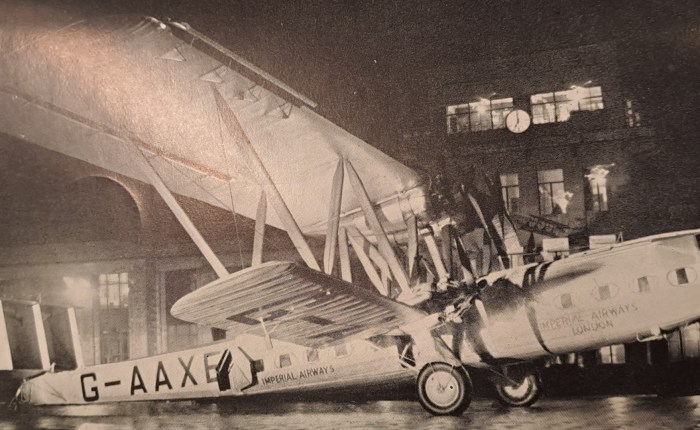
‘Hengist’ was the colloquial name for a real Imperial Airways plane which until 1934 (the year of the book’s publication) flew on the European routes. It was subsequently converted to fly long-distance and as far as Australia, until the plane was destroyed in an accident in 1937. Once up in the air, Ruby and her family are served a ‘four-course lunch followed by coffee, all very nice and comfortably served’.[3] When they land, disaster strikes: Andrew Crowther, Ruby’s grandfather, is found unresponsive and declared dead.

A contemporary photo of the real Hengist plane standing outside Croydon Aerodrome, taken from A Million Miles in the Air,
the memoirs of pilot Gordon P. Olley, published in 1934

After the murder in the opening chapter, Wills Crofts shifts perspective and takes the reader back in time. The 12.30 from Croydon is a ‘psychological crime novel’ – rather than the reader trying to work out who has committed the murder and how, the author takes the reader into the mind of the murderer as he plots out his murder and attempts to escape justice. Andrew Crowther’s murderer, as it turns out, is his nephew Charles Swinburn. Charles is the managing director of the Crowther Electromotor Works, a firm originally set up by Andrew and his business partner Henry Swinburn. Although modest in size, the firm had been flourishing under Andrew’s leadership.

By the early 1930s, however, Charles is finding it impossible to stay afloat in the challenging economic environment following the 1929 Wall Street crash. Having already sunk his personal capital and a bank loan into the business, Charles approaches his uncle for financial help. Andrew, however, is not willing to give more than £1000, when Charles needs at least £6000. Knowing that he is one of the two heirs to Andrew’s estate (alongside Andrew’s daughter Elsie), Charles devises his plan to kill Andrew.

Charles method for murdering Andrew is one also used on occasion in other crime novels of the period. Andrew takes a ‘patent medicine’ against indigestion after lunch each day. Patent medicine were mass-produced pills designed to remedy common ills. Unlike more traditional medicine which was prescribed by a doctor and then mixed up to order by a pharmacist, patent medicines were available in standardized bottles and could be purchased without a doctor’s prescription.

In novels of the 1920s and 1930s they are often treated with disdain and considered to be inferior to the personalised prescriptions that a doctor would give out. However, their wide availability and uniform appearance also made them an ingenious murder weapon. Charles buys a bottle of pills identical to the one Andrew uses, but replaces one of the pills with a pill filled with potassium cyanide, an extremely lethal poison. Like in the Poirot short story ‘Wasps’ Nest’, Charles manages to obtain the poison with the excuse that he needs to eradicate a wasps nest from his garden. When at dinner with Andrew, Charles distracts him and swaps the pill bottles, pocketing Andrew’s bottle and replacing it with the one that contains the one deadly pill. He then books himself onto a Mediterranean cruise to be out of the way when Andrew eventually takes the poisoned pill.

Although the murder plan works and Charles duly inherits half of Andrew’s estate, Charles swiftly finds out that murderers rarely rest easily. First Weatherup reveals that he has seen Charles swap the pill bottles, and starts blackmailing him. Charles swiftly decides to kill Weatherup, too. Then Inspector French arrives and starts asking some awkward questions. The arrest, when it inevitably comes, takes Charles by surprise. It is not until the final chapter of the book that the reader is shown how Inspector French conducted his investigation, and how his powers of deduction led him to correctly identify Charles as the murder. The perfect murder plan conceived by Charles is revealed to have had some rather large holes in it.

Charles is duly condemned to death and executed. There is less moral ambiguity in The 12.30 from Croydon than, for example, Anthony Berkeley’s Malice Aforethought, or even than in Henry Wade’s Heir Presumptive. Although Andrew Crowther is not a hugely sympathetic character, there is no doubt to the reader that Charles’ actions are wrong, and that the policing and justice systems will catch up with him and serve him the expected sentence. The book’s reversed structure allows Wills Crofts to reveal Inspector French’s intellect in the final chapter, transmitting the reassuring fiction to the reader that no matter how well one may think they have planned a crime, the men from Scotland Yard will always ensure that justice is dispensed.


[1] Martin Edwards, The Golden Age of Murder (London: Collins Crime Club, 2016), p. 75

[2] Freeman Wills Crofts, The 12.30 from Croydon (London: British Library, 2016), p. 16

[3] Ibid., p. 19

Interwar Spooky Stories

Interwar Spooky Stories

With Halloween nearly upon us, it is time for a review of spooky short stories written in interwar Britain. Although Halloween was not celebrated in the modern sense during the interwar period, All Hallows Eve was a longstanding feature of the Church calendar, originating out of pagan Samhain celebrations. Short stories were an immensely popular format in the interwar years, with many short stories published in newspapers and dedicated magazines such as Strand Magazine. Many journalists and authors worked in the genre, which could be lucrative.

In recent years, the British Library publishing arm has re-issued many original stories of the 1920s and 1930s in various edited collections. Spooky short stories of the period often crystallise contemporary fears about technology, alienation, and modernity. They can also address social inequalities in a pointed way. For example, F Tennyson Jesse’s story ‘The Railway Carriage’, published in Strand Magazine in 1931, hinges on the third-class railway carriage as a democratic space that forces together people from wildly different backgrounds.[1]

The story’s protagonist, a young woman named Solange, finds the closed nature of the railway carriage oppressive: ‘she would have given a great deal to be out of that little third-class carriage, to be in a modern corridor train, to be – this, above all – away from her travelling companions.’[2] The design of the train means that Solange cannot change carriages whilst the train is in motion, heightening her feeling of being trapped with two unusual companions. Solange ‘had to stay with them whether she would or no. It was really an outrage, she thought to herself, that such a thing as a non-corridor train should still exist.’[3]

Solange is a modern, somewhat entitled young woman, who by the end of the story has to accept that there are things beyond the rational realm and that she cannot always control the world around her in the way she would like. When the train crashes, Tennyson Jesse introduces a supernatural element to the story and meditates on the justness of capital punishment, a practice that was under much debate during the interwar period. Despite the introduction of a possible ghost, the true horror of the story lies in the very real judicial practices of interwar Britain.

Another story which effectively conveys the terror that the proximity of strangers can bring is E.M. Delafield’s ‘They Don’t Wear Labels.’[4] It also demonstrates how the anonymity of the big city can be exploited, and how patriarchal structures can put women in danger. The story’s protagonist is Mrs Fuller, a boarding house keeper, who takes in a couple, Mr and Mrs Peverelli. Mr Peverelli is very charming, but his wife is sickly. From the moment the couple enter the house, Mr Peverelli plays on sexist stereotypes which Mrs Fuller is very happy to accept. He implies that his wife’s ailments are nervous disorders; Mrs Fuller then tells Mrs Peverelli ‘shed’ a good deal to be thankful for, with her husband in a good job, and always ready to do what would please her.’[5]

When Mrs Peverelli tries to tell Mrs fuller that Mr Peverelli is forcing her to eat and drink things against her will, and that she thinks her husband is trying to poison her, Mrs Fuller naturally rubbishes the suggestion. E.M. Delafield neatly demonstrates the pervasive assumptions about domestic violence: ‘If you really believed it, why – you’d left him. It’s surely the very first thing you’d have done’ huffs Mrs Fuller. ‘You don’t understand’, responds Mrs Peverelli. ‘I love him.’[6]

Shortly thereafter, the Peverelli’s move on, the wife looking ‘worse than ever – sallower and more frightened.’ The true horror of Mr Peverelli’s designs is revealed at the close of the story, when Mrs Fuller realises he has ground up a Christmas bauble and fed the powdered glass to his wife.[7] Murder by ground glass was, incidentally, one of the ways in which Edith Thompson suggested murdering her husband in her letters to her lover Freddie Bywaters. E.M. Delafield had followed the Thompson-Bywaters case closely, and is surely referencing it in this story. Mrs Fuller, and the reader, are confronted by their willingness to believe strangers at face value, and to believe men over women. The horror here is not supernatural, but rather the by-product of an inherently unequal society.

A final female-penned, London-based, spooky short story appeared slightly after the interwar period, at the close of the Second World War. In 1945, Elizabeth Bowen published the (very short) story ‘The Demon Lover’.[8] It effectively uses the bombed-out locales of war-torn London. Bowen’s protagonist, Mrs Drover, is checking up on her Kensington house after an extended stay in the country, away from the Blitz.

Things take a dark turn when Mrs Drover discovers a mysterious letter from a past lover, which warns her that today is ‘our anniversary, and the day we said. (…) I shall rely upon you to keep your promise.’[9] It transpires that Mrs Drover had a soldier lover during the First World War, who went missing. In fear of him, she decides to get a taxi as quickly as possible before the man can come to the house and claim her. Yet rather than a means of escape, the taxi becomes her prison, as she realises too late that the man behind the wheel is the very man she is fleeing from.

As in ‘The Railway Track’, in ‘The Demon Lover’ a means of transport traps a woman rather than give her freedom. The latter story also includes ample reflections on ageing and the compromises made by women: marriage, children and a big house in Kensington versus the excitement of a passionate love affair. Like Mrs Peverelli, Mrs Drover ultimately is unable to escape masculine power. The scariest thing for women turns out to be the patriarchy itself.

All of the stories and books mentioned in this post are available to purchase through the British Library online shop.


[1] F Tennyson Jesse, ‘The Railway Track’, in Blood on the Tracks: Railway Mysteries, edited by Martin Edwards (London: British Library, 2018), pp. 267-286

[2] Ibid., p. 272

[3] Ibid., p. 277

[4] E. M. Delafield, ‘They Don’t Wear Labels’, in Capital Crimes: London Mysteries, edited by Martin Edwards (London: British Library, 2015), pp. 265-273

[5] Ibid., p. 268

[6] Ibid., p. 270

[7] Ibid., p. 273

[8] Elizabeth Bowen, ‘The Demon Lover’, in Into the London Fog: Eerie Tales from the Weird City, edited by Elizabeth Dearnley (London: British Library, 2020), pp. 81-91

[9] Ibid., p. 85

The Gaunt Stranger (1938)

<strong>The Gaunt Stranger (1938)</strong>

As has been noted previously on this blog, the work of detective fiction writer Edgard Wallace was often used as source material for British interwar films. Wallace was a prolific writer, so despite his early death in 1932, there were plenty of opportunities to translate his work to the screen for years afterwards. One such crime thriller is 1938’s The Gaunt Stranger. What sets this story apart from most British interwar crime fodder is that, very unusually, the criminal escapes the police at the end of the story.

Like so many interwar texts, The Gaunt Stranger existed in multiple formats and under different titles. Wallace originally published the story as a novel in 1925 under the title The Gaunt Stranger. Shortly after its publication, Wallace adapted it for the stage in collaboration with celebrated acter Gerald Du Maurier under the same name. In 1926 Wallace re-published the novel, now titled The Ringer, with some modifications to the text based on the stage production. The Ringer appears to have been put on stage again in 1929, and was also adapted as a film in Britain in 1928, 1931 and 1952. The second of these films was directed by Walter Forde, who in 1938 directed the story again under the auspices of Michael Balcon at Ealing Studios, but this time under the book’s original title.

The story of The Gaunt Stranger is almost as intricate as its production history. Set over a period of only 48 hours, it centres on lawyer-cum-criminal Maurice Meister, who receives warning that he is to be killed on 17 November, in two days’ time, by the notorious criminal ‘The Ringer’. Everyone in England, including Scotland Yard, believed the Ringer to have been killed two years’ previously in Australia. After the Ringer’s apparent death, Meister took in the Ringer’s sister as his secretary. It is insinuated that his relationship with the woman was more than just professional, and she committed suicide on 17 November the previous year. The Ringer appears to have come back from the dead to avenge his sister.

The Scotland Yard team is made up of DI Alan Wembury, Scottish police surgeon Dr Lomond, and Inspector Bliss, who has recently returned from Australia and who was the man who ostensibly killed the Ringer two years previously. Wembury calls in the help of small-time criminal Sam Hackett, who is one of the few men in England who would be able to recognise the Ringer. Wembury also has an admiration for Meister’s current secretary, Mary Lenley, whose brother Johnnie is also a criminal recently released from Dartmoor. Finally, in the course of the investigation the police identify and question Cora Ann, the Ringer’s American wife.

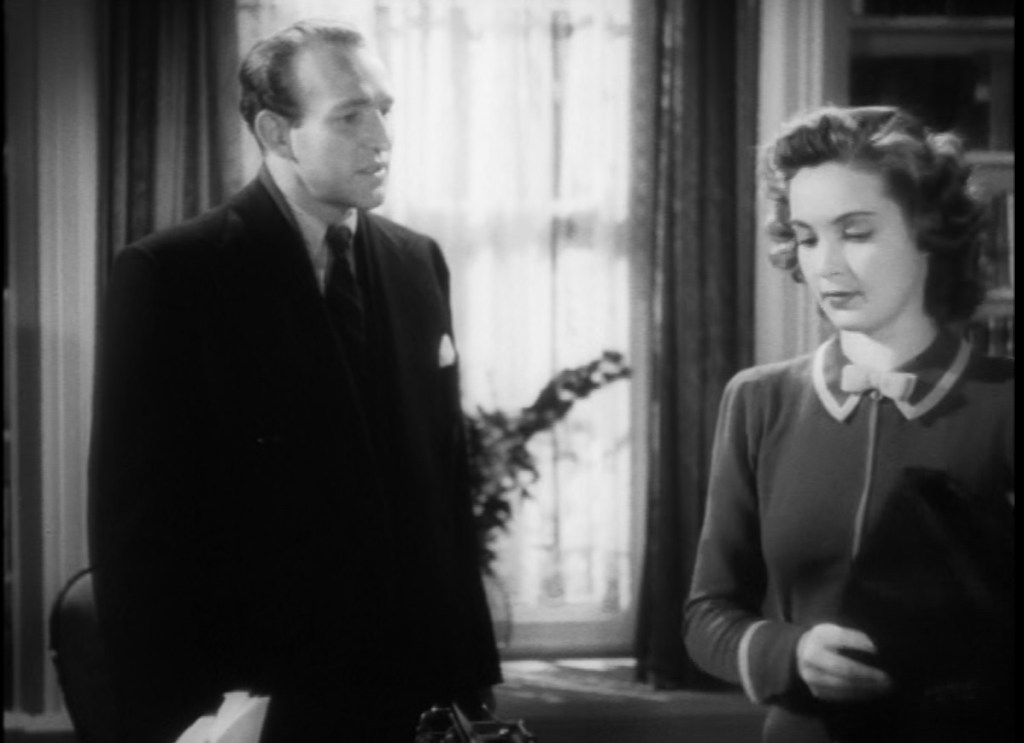
DI Alan Wembury and Mary Lenley in The Gaunt Stranger

With a runtime of only 71 minutes and a comprehensive cast of characters with complicated interrelations, The Gaunt Stranger moves at a rapid pace. Nonetheless, Forde makes effective use of repeated panning shots of empty rooms inside Meister’s house. The film opens with several shots of these empty rooms, ending with a shot of Meister playing his piano. Similar shots are repeated several times during the film, to stress Meister’s solitary living arrangements and highlight his vulnerability. As the 17 November dawns, Scotland Yard effectively imprison Meister in his own house to ensure he stays safe. Little do they know that the danger will not be coming from outside the house.

The closed circle of characters and the physical closure of Meister’s house set The Gaunt Stranger up as a classic murder mystery. What remains unclear until the end, however, is the identity of the Ringer himself. Johnnie, the criminal brother of secretary Mary, is a possible contender. More suspicious is inspector Bliss, who so recently returned from Australia. He acts oddly throughout the film, and seems reluctant to trust Wembury or collaborate fully with the investigation. Wembury does not know Bliss personally, opening up the possibility of him being someone other than who he pretends to be. Cora Ann also behaves oddly, first insisting that her husband is dead, before changing her story and admitting that he is still alive.

Johnnie Lenley and Sam Hackett in The Gaunt Stranger

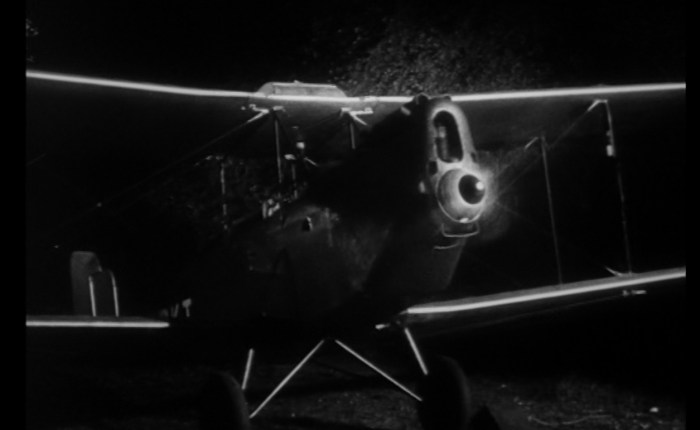
Meister himself is also anything but a sympathetic character. Like other books of the period, Wallace opted to make his victim an unpleasant character, so that the audience is not too concerned whether the murder is prevented or not. More unusually, however, Wallace also arranged for the Ringer, when his identity is eventually revealed, to make a spectacular escape from the police and the country. Once the Ringer’s identity is confirmed, it is clear to the audience in retrospect that Cora Ann has been playing along with her husband throughout the film. Their escape, which involves piloting a plane from a nearby airfield, was clearly planned in advance.

The Ringer and Cora Ann escape in The Gaunt Stranger

The police in The Gaunt Stranger are depicted as organised and capable. They effectively arrest multiple people throughout the film and are not fooled by Meister’s attempts to come across as a respectable lawyer – they are fully aware of his criminal activities. When Sam Hackett, the criminal informer, attempts to steal some of Meister’s silverware, he is apprehended by a Bobby almost immediately. Johnnie, too, is arrested as soon as he tries to break into a house. The film puts some of the police’s technological infrastructure on display, such as telegrams and cars wired with radios. Nevertheless the Ringer’s unscrupulous nature allows him to escape despite the police’s efforts. The Gaunt Stranger is one of the few British interwar films which entertains the possibility of a fallible police force that can be outwitted by master criminals.