
The Gaunt Stranger (1938)

<strong>The Gaunt Stranger (1938)</strong>

As has been noted previously on this blog, the work of detective fiction writer Edgard Wallace was often used as source material for British interwar films. Wallace was a prolific writer, so despite his early death in 1932, there were plenty of opportunities to translate his work to the screen for years afterwards. One such crime thriller is 1938’s The Gaunt Stranger. What sets this story apart from most British interwar crime fodder is that, very unusually, the criminal escapes the police at the end of the story.

Like so many interwar texts, The Gaunt Stranger existed in multiple formats and under different titles. Wallace originally published the story as a novel in 1925 under the title The Gaunt Stranger. Shortly after its publication, Wallace adapted it for the stage in collaboration with celebrated acter Gerald Du Maurier under the same name. In 1926 Wallace re-published the novel, now titled The Ringer, with some modifications to the text based on the stage production. The Ringer appears to have been put on stage again in 1929, and was also adapted as a film in Britain in 1928, 1931 and 1952. The second of these films was directed by Walter Forde, who in 1938 directed the story again under the auspices of Michael Balcon at Ealing Studios, but this time under the book’s original title.

The story of The Gaunt Stranger is almost as intricate as its production history. Set over a period of only 48 hours, it centres on lawyer-cum-criminal Maurice Meister, who receives warning that he is to be killed on 17 November, in two days’ time, by the notorious criminal ‘The Ringer’. Everyone in England, including Scotland Yard, believed the Ringer to have been killed two years’ previously in Australia. After the Ringer’s apparent death, Meister took in the Ringer’s sister as his secretary. It is insinuated that his relationship with the woman was more than just professional, and she committed suicide on 17 November the previous year. The Ringer appears to have come back from the dead to avenge his sister.

The Scotland Yard team is made up of DI Alan Wembury, Scottish police surgeon Dr Lomond, and Inspector Bliss, who has recently returned from Australia and who was the man who ostensibly killed the Ringer two years previously. Wembury calls in the help of small-time criminal Sam Hackett, who is one of the few men in England who would be able to recognise the Ringer. Wembury also has an admiration for Meister’s current secretary, Mary Lenley, whose brother Johnnie is also a criminal recently released from Dartmoor. Finally, in the course of the investigation the police identify and question Cora Ann, the Ringer’s American wife.
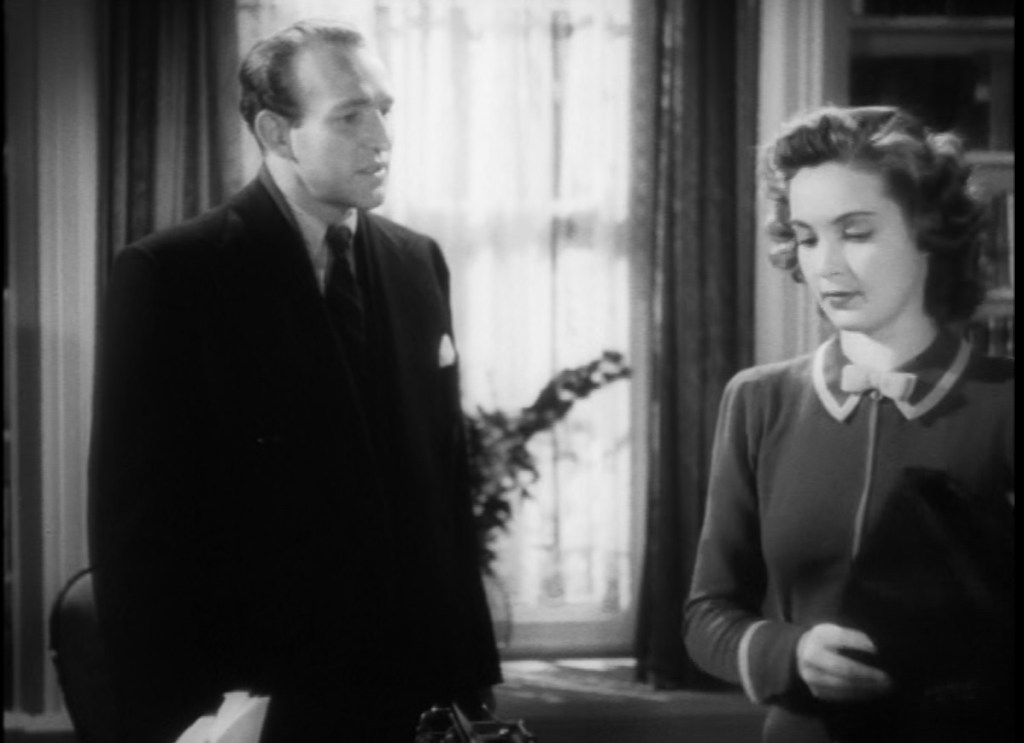
DI Alan Wembury and Mary Lenley in The Gaunt Stranger

With a runtime of only 71 minutes and a comprehensive cast of characters with complicated interrelations, The Gaunt Stranger moves at a rapid pace. Nonetheless, Forde makes effective use of repeated panning shots of empty rooms inside Meister’s house. The film opens with several shots of these empty rooms, ending with a shot of Meister playing his piano. Similar shots are repeated several times during the film, to stress Meister’s solitary living arrangements and highlight his vulnerability. As the 17 November dawns, Scotland Yard effectively imprison Meister in his own house to ensure he stays safe. Little do they know that the danger will not be coming from outside the house.

The closed circle of characters and the physical closure of Meister’s house set The Gaunt Stranger up as a classic murder mystery. What remains unclear until the end, however, is the identity of the Ringer himself. Johnnie, the criminal brother of secretary Mary, is a possible contender. More suspicious is inspector Bliss, who so recently returned from Australia. He acts oddly throughout the film, and seems reluctant to trust Wembury or collaborate fully with the investigation. Wembury does not know Bliss personally, opening up the possibility of him being someone other than who he pretends to be. Cora Ann also behaves oddly, first insisting that her husband is dead, before changing her story and admitting that he is still alive.

Johnnie Lenley and Sam Hackett in The Gaunt Stranger

Meister himself is also anything but a sympathetic character. Like other books of the period, Wallace opted to make his victim an unpleasant character, so that the audience is not too concerned whether the murder is prevented or not. More unusually, however, Wallace also arranged for the Ringer, when his identity is eventually revealed, to make a spectacular escape from the police and the country. Once the Ringer’s identity is confirmed, it is clear to the audience in retrospect that Cora Ann has been playing along with her husband throughout the film. Their escape, which involves piloting a plane from a nearby airfield, was clearly planned in advance.

The Ringer and Cora Ann escape in The Gaunt Stranger

The police in The Gaunt Stranger are depicted as organised and capable. They effectively arrest multiple people throughout the film and are not fooled by Meister’s attempts to come across as a respectable lawyer – they are fully aware of his criminal activities. When Sam Hackett, the criminal informer, attempts to steal some of Meister’s silverware, he is apprehended by a Bobby almost immediately. Johnnie, too, is arrested as soon as he tries to break into a house. The film puts some of the police’s technological infrastructure on display, such as telegrams and cars wired with radios. Nevertheless the Ringer’s unscrupulous nature allows him to escape despite the police’s efforts. The Gaunt Stranger is one of the few British interwar films which entertains the possibility of a fallible police force that can be outwitted by master criminals.

F. Tennyson Jesse – A Pin To See The Peepshow (1934)

The trial and execution of Edith Thompson have been discussed several times on this blog. The 1922 trial was extensively covered in the press of the period. In short, Edith Thompson was tried and executed alongside her lover Frederick Bywaters, for the murder of Edith’s husband Percy. At the time, newspapers judged Edith harshly for her affair with a younger man (she was nine years older than Frederick). Current scholarship is generally of the opinion that Edith probably knew nothing about the planned murder and should not have been found guilty. You can read a fuller account of the case here.

Due to the high profile nature of the case, it is no wonder that contemporary authors drew on the case for inspiration. I’ve previously discussed E.M. Delafield’s 1924 novel Messalina of the Suburbs which was based on the Thompson-Bywaters case. Where Delafield’s interpretation of the case was fairly loose, a novel published a decade later took a more forensic approach to recreate the story.

The extra years which had passed since the case no doubt help F. Tennyson Jesse to gain more perspective when she wrote A Pin To See The Peepshow, a novel frequently referenced as the definitive fictionalisation of the case. Tennyson Jesse was a prolific writer across several genres including novels, plays, poetry and non-fiction.[1] Some of her work is available to read for free online. She had a definite interest in true crime: in 1924 she wrote a non-fiction work Murder and its Motives and throughout her career she contributed to the long-running book series Notable British Trials. One of the volumes she was responsible for was the trial of Sidney Fox, who was found guilty of killing his own mother.

In A Pin To See The Peepshow Edith Thompson is transformed into Julia Almond, a young, somewhat pretty woman who, like Edith Thompson, works in a women’s fashion boutique and ends up marrying to a man she finds dreadfully dull. The strength of the book is that Julia is not necessarily a sympathetic character, the reader does sympathise with her. Like E.M. Delafield before her, Tennyson Jesse leaves no doubt that her fictional heroine had no involvement in the plot to murder her husband.

The novel starts when Julia is a school girl, living in West London with her parents and counting down the days to her adulthood. When she is ordered to mind a class of younger children one day, one of the younger boys, Leonard Carr, has a ‘peepshow’: a cardboard box with a decorative interior that can be seen through a small hole. Julia is enchanted by this portal into another world: a first indication of her romantic nature which is reiterated throughout the book. Leonard Carr, when he grows up, becomes the fictional version of Frederick Bywaters. In Tennyson Jesse’s narrative, Julia and Leonard’s relationship is marked by make-believe from its inception.

During the real Thompson-Bywaters trial, much was made of Edith’s letters to Frederick. He had kept these letters despite the couple’s agreement that they would destroy each other’s epistles – Edith did destroy Frederick’s letters to her. The letters alluded to supposed plots to kill Percy. The prosecution at the time used them as evidence that Edith wanted her husband to die, and that she was manipulating Frederick to commit the act for her. From the novel, it appears that F Tennyson Jesse agreed with scholars such as Lucy Bland that the letters were works of fiction, written by a woman with a vivid imagination.[2] Another feature that Tennyson Jesse awards her heroine, which may not be entirely historically accurate, is that Julia is terribly short-sighted. This gives her a plausible defense when she claims she did not recognise her husband’s killer, as the real Edith Thompson also initially said.

The heart of the case is, of course, extramarital relationship which Edith Thompson deigned to embark on. In Delafield’s novel, the heroine is sexually active at a young age, but also gets sexually abused by a series of men who are in positions of power over her. Tennyson Jesse’s Julia is less obviously interested in men, but the brief affair she has with a young man at the start of the First World War is described as completely natural and nothing to be ashamed about.

Julia’s eventual marriage to family friend Herbert Startling is primarily motivated by her desire to leave her parents’ home, and her inability to afford her own living space. When Leonard Carr re-appears on the scene as a young adult, Tennyson Jesse makes it clear that sexual relations with Leonard are extremely satisfying to Julia, again without judging or moralising about it.

Julia is less obviously a victim than Delafield’s heroine. Throughout A Pin To See A Peepshow, Julia is often in command. She earns more money than Herbert and is largely able to dictate when she allows him to sleep in her bed. Nonetheless, Tennyson Jesse makes clear that ultimately, Julia is too naïve to understand the passions she’s unleashed in Leonard which drive him to his ultimate act. Her subsequent foolish attempt to cover up Leonard’s involvement to make the murder seem like an accident, seals her fate in a patriarchal justice system. Tennyson Jesse’s Julia probably comes close to the real Edith Thompson: a woman not without faults, whose options in life were narrowly determined by her sex and who paid the price for transgressing accepted norms.

A Pin To See The Peepshow was recently re-issued as part of the British Library Women’s Writers series. Copies can be bought here.


[1] Lucy Evans, ‘Preface’, in F. Tennyson Jesse, A Pin To See The Peepshow (London: British Library, 2021), p. viii

[2] Lucy Bland, ‘The Trials and Tribulations of Edith Thompson: The Capital Crime of Sexual Incitement in 1920s England’, Journal of British Studies, Vol. 47, no. 3 (2008), 624-648

Criminal Investigation: A Practical Textbook (1934)

The Metropolitan Police was founded in 1829. From the beginning, its operations were based on ‘uniform patrol of regular beats in full and open public view’ to assuage concerns that any centrally controlled police form would become a state spying apparatus.[1] The introduction of plain-clothes detectives into the force was therefore slow. It was not until 1869 that each division of the Metropolitan Police got its own detectives, and a centralised Criminal Investigation Department (CID) wasn’t formed until 1878.[2]

Once detectives were established as a permanent part of the police force, leaders at the Metropolitan Police and its counterparts across the country and Empire were keen to ensure consistency of practice. To that effect, in 1906 the Crown and Public Prosecutor in Madras published the first English translation of a work by the Austrian Hans Gross.[3] Handbuch für Untersuchungsrichter als System der Kriminalistik, or Criminal Investigation: A Practical Textbook as it became known in England was originally aimed at lawmakers and police officers in colonial areas. A revised edition was published in 1924, and a third edition appeared in 1934. This third edition was edited by Norman Kendal, then Assistant Commissioner for Crime in the Metropolitan Police.

The work, aiming to be ‘a practical textbook of instruction for all engaged in investigating crime’[4], runs to 569 pages. Although police detectives tended to have been slightly better educated than patrolling constables,[5] it seems unlikely that they all read and memorised the detailed instructions of Criminal Investigation. Moreover, the book provided instructions on best practice, but most of its contents were not legally binding. In short, the book likely tells us more about the ideal of police investigation than of its day-to-day reality. Nonetheless, it helps us understand how interwar police officers, magistrates and prosecutors understood crime.

During the interwar period, the police did not just investigate a crime up to the point of charging an individual, but were also responsible for collating evidence for the police courts. This often involved working with experts. No wonder then that nearly 100 pages in the book set out ‘The Expert and how to make use of him (sic)’. Specific items include ‘preservation of parts of a corpse’ and ‘colour-blindness’ (‘more widespread and more important than generally believed’).[6] The section on fingerprints was extensively re-written for the third edition, this area of work ‘having advanced by leaps and bounds even since 1924.’[7]

Beyond the practicalities of running a sound investigation, Criminal Investigation also sets out in detail supposedly common practices of various types of criminal. ‘Wandering Tribes’ receive a chapter all of their own, marking Gypsies and Travellers as particularly likely to engage in criminal behaviour – although it debunks the myth that Gypsies steal children (‘It must also be remembered that gipsies (sic) are very prolific and in consequence have no need to bring up other people’s children’).[8]

Criminals ‘shamming’ various afflictions such as blindness, deafness or even epilepsy was apparently a regular enough occurrence to warrant inclusion here, as were criminal superstitions. The reader is told how fortune tellers who claim to have ‘discovered’ the guilty party through divination, tarot cards, or their intuition can derail an investigation. Women in particular are claimed to put investigators on the wrong foot with their ‘presentiments’.[9] There is no practical advice on how to handle such a situation as an investigator other than, presumably, to roundly ignore any tips received through paranormal means.

The third section of the book deals with the skills investigating officers must possess, such as drawing and modelling of crime scenes; observing footprints; and finding traces of blood. Again there is a suggestion that criminals have their own communal language in a chapter on ciphers, which is given in addition to a short list of criminal slang.

The final section of the book categorises particular offences, including ‘Bodily Injuries and Poisoning’; ‘Theft’; ‘Cheating and Fraud’; ‘Arson’ and ‘Serious Accidents and Boiler Explosions’ (split up between ‘False Theories’ and ‘Admissible Theories’). Murder is not included as a category, as murderers were believed to mostly be ‘crimes of impulse’ and very few serial killers were known (Jack the Ripper being an obvious exception).[10] When speaking of ‘criminals’, police inspectors tended to mean those who were repeat offenders, often sticking to the same type of crime such as burglary.

Criminal Investigation was from the outset designed to be used across the British Empire. However, its origins as a Western European text does make one wonder its usefulness for lawmakers and detectives in, for example, India. There is little to no consideration of cultural differences. The impression created is that criminals, like lawmakers, are a homogenous group who behave the same regardless of their physical location or background. This demonstrates how handbooks like Criminal Investigation fostered the consolidation of the British Empire through their discourse.


[1] Robert Reiner, The Politics of the Police, 3rd edition (Oxford: Oxford University Press, 2000) p. 56

[2] Haia Shpayer‐Makov, ‘Becoming a Police Detective in Victorian and Edwardian London’, Policing and Society, 14:3, (2004) 250-268, (pp. 251-253)

[3] John Adam and J Collyer Adam, Criminal Investigation: A Practical Textbook, 3rd edition, edited by Norman Kendal (London: Sweet & Maxwell, 1934), p. xii

[4] Ibid., p. xiv

[5] Shpayer-Makov, ‘Becoming a Police Detective’, p. 263

[6] Adam and Adam, Criminal Investigation, p. 125

[7] Ibid., p. xii

[8] Ibid., p. 248

[9] Ibid., p. 262

[10] Frederick Porter Wensley, Forty Years of Scotland Yard (New York: Greenwood Press, 1968 [1931]), p. 86

Notorious interwar murders (part 3)

This blog post is the final of a three-part series on notorious interwar murders. You can read part 1 here and part 2 here.

After the Thorne case, the 1930s started with two murder cases which were even more sensational. On 8 April 1930 Sidney Fox was executed for a crime which was considered even more heinous than murdering a pregnant woman and destroying her body: he was convicted for murdering his own mother Rosaline.

Matricide is rare in the United Kingdom, and Fox became notorious.[1] Fox was also the first person condemned to death since 1907 who did not appeal his conviction, which seemed to further prove his guilt.[2] However, like the Thorne case, the Fox conviction has continued to spark debate and recent re-examinations conclude that it is possible Rosaline died of an accident.

Fox and Rosaline lived a nomadic existence, travelling from seaside hotel to seaside hotel, and committing thefts and frauds to obtain money. In spring of 1929, under the instructions of Fox, Rosaline took out a life insurance policy that guarded against accidental death. The policy expired at midnight on 23 October. And on 23 October, in a hotel in Margate, Rosaline’s bedroom apparently caught fire at 11.40pm. Rosaline’s body was discovered inside, making Fox eligible for a life insurance pay-out.

The doctor attending the scene considered that Rosaline had died in the fire, and she was buried without further examination. However, Fox’s behaviour on the night, the fact of the life insurance, as well as the forensic evidence in the room led Scotland Yard to conduct further investigations. After Rosaline’s body was exhumed, Sir Bernard Spilsbury (yes, him again) concluded that she had been strangled before the fire had started.

The oratory power of Spilsbury, combined with the emotional horror of alleged matricide, Fox’s criminal past, and his homosexual inclinations, were enough to convince the jury to convict him. Not surprisingly, the Home Secretary did not use his executive powers to commute the sentence.[3] The Home Secretary usually only reprieved condemned prisoners if ‘popular feeling’ was in favour of the prisoner, which in this case it was decidedly not.[4]

The British public had barely recovered from the excitement of the Fox case when yet another murder case grabbed the headlines. Whereas the 1920s had seen husbands poisoning their wives and later, men killing their girlfriends, Alfred Rouse tried to fake his own death by killing another (still unidentified) man and setting his corpse on fire to make it unrecognisable. Contemporary commentators may have argued that the nefarious influence of Hollywood cinema had led to this spectacular crime!

Like Patrick Mahon, Alfred Rouse was a salesman; and like Mahon, Rouse also had many affairs with women and teenage girls which his wife was unaware of. These affairs often led to the women having Rouse’s children. Rouse always pretended he was single, and even went as far as to illegally marry several of his mistresses, to keep up the pretence that he was fully committed to them. Although he made a good salary with his job, it was not sufficient to secretly support these many women and children. Things came to a head in the summer of 1930, when two of Rouse’s longstanding girlfriends were both expecting marriage, and several of his past partners were demanding child support money from him.

Rouse planned his scheme carefully; he took out a life insurance policy in case of death in a car accident. He then found a man in a pub who claimed to be out of work and with no family or other support network, who also was of roughly the same height and build as Rouse. This was the perfect victim for his purposes. Rouse offered the man a lift to the Midlands on the evening of 5 November – Guy Fawkes night in England during which a lot of bonfires are traditionally lighted. Rouse hoped that the bonfires would provide cover for his plan.

It has never been fully clarified what exactly happened in the car, but Rouse got his companion drunk enough that he fell asleep. According to Rouse, he never found out the man’s name or any personal details about him. Rouse parked his car in a ditch off a country lane, doused it in petrol and set it on fire.

It is possible his plan would have worked, had he not been spotted emerging from the lane by two teenage boys who were walking home from the bonfires. Seeing a man in a suit (but without a hat!) clambering out of a ditch in the middle of the night was unusual enough, but when they found a car ablaze a few meters further they naturally warned the local constable.

By the time the fire was put out, the body was horrifically charred and unrecognisable. The car, however, was identified as belonging to Rouse. This was passed on to the newspapers, as well as an urgent call for the man without a hat to report as a witness to the police. Rouse in the meantime met up with one of his mistresses, who showed him the newspaper articles about his car. Although Rouse claimed the car was not his, the woman was sufficiently suspicious to alert the police. Rouse was arrested as he got off a coach at Hammersmith bus station.

At the trial, the jury once again took less than half an hour to find Rouse guilty. During the trial Rouse claimed that the unknown man’s death was accidental, but shortly before his execution he wrote a full confession to the Daily Sketch. The newspapers, which had played a material part in Rouse’s arrest, were also able to benefit from his execution. For a man like Rouse, the newspaper coverage of the case was not just a threat, but also one final opportunity to bolster his ego.

There are (many) more murder cases that could have been included in this series, from those which got ample newspaper coverage to those which were considered not newsworthy. Those which were sensationally described in the press, however, subsequently filtered into contemporary crime fiction and non-fiction books, and from there into that nebulous concept, the ‘public imagination.’ Newspapers were instrumental not only in helping solve the crimes, but also in building up a shared body of knowledge on what it means to commit a British murder.


[1] Playwright and actor Emlyn Williams refers in his autobiography to an acquaintance, whose own claim to fame was that he had known Sidney Fox. Emlyn Williams, Emlyn: A sequel to George (London: Penguin, 1976)

[2] Colin Evans, The Father of Forensics (Thriplow: Icon, 2007), p. 221

[3] ‘Margate Matricide: Death Sentence to Stand’. Evening Post, 7 April 1930. p. 9

[4] Douglas G Browne and E.V. Tullett, Bernard Spilsbury: His Life and His Cases (London: Harrap, 1951), p. 264

Notorious interwar murders (part 2)

Notorious interwar murders (part 2)

This blog post is the second of a three-part series on notorious interwar murders. You can read part 1 here and part 3 here.

Whereas high-profile murders at the start of the interwar period fit the stereotype of apparently unassuming, suburban citizens calculatedly removing tiresome spouses, from the mid-1920s the cases that occupied the front pages were decidedly less cozy. In 1924, a case that became known as the ‘Crumbles Murder’, stretched the skills of celebrity pathologist Sir Bernard Spilsbury as the remains of the victim were so mutilated.

The Crumbles are a stretch of beach east of Eastbourne, where the remains of 38-year-old Emily Kaye were found in a beachside cottage. Kaye had been in an illicit relationship with the charming and handsome, but married, salesman Patrick Mahon. A few months into the affair Kaye became pregnant; Mahon had not told her that he was already married and led her to believe he would marry her. Kaye told her colleagues that she and Mahon would emigrate to South Africa after the wedding; he asked her to take lodgings in a cottage on the Crumbles, in apparent anticipation of their emigration.

It was here that Mahon murdered Kaye, but the exact details of her death were never established. Mahon severed her head and legs and stowed her body in a trunk in a spare room of the cottage. He then went into Eastbourne and picked up another woman, Ethel Duncan, whom he took back to the cottage for the weekend. Duncan was oblivious to the corpse locked away in the spare room. After Duncan left, Mahon destroyed most of Kaye’s body by burning, boiling and pulverising it.

The murder was discovered by a private investigator who had been hired by Mahon’s wife. When Mahon left a bag at the luggage storage in Waterloo station, the private investigator collected this bag and found it contained a bloodied knife. Scotland Yard quickly arrested Mahon and he admitted that Kaye had died, although he framed it as an accident. When Spilsbury and his Home Office colleagues arrived at the cottage, they had great difficulty identifying any of Kaye’s remains. Her skull was never recovered, which led them to assume that the cause of death had been a skull fracture.

After the Crumbles murder Spilsbury developed a ‘murder bag’ for Scotland Yard officers, a standard kit they could use in crime scenes which included ‘rubber gloves, a hand lens, a tape measure, a straightedge ruler, swabs, sample bags, forceps, scissors, a scalpel, and other instruments that may be called for.’[i] Spilsbury had been appalled by the casual conduct of the Scotland Yard detectives at the crime scene.

Patrick Mahon, Sunday Express, 12 March 1933, p. 13

Mahon was found guilty of murder and executed in September 1924. Mahon’s good looks, replicated in newspapers across the country during the investigation and trial, seemed to make his acts even more discordant. When the diaries of ‘nightclub queen’ Kate Meyrick were serialised in the Sunday Express in 1933, they were accompanied by a photo of Mahon who Meyrick claimed visited her club quite often. At the time of his arrest, she wrote ‘He is a very nice good-looking man (…) [his eyes] were not like the eyes of ordinary people; there was something behind them.’[ii] As befitted a notorious murderer, his execution became another part of his myth: there were persistent rumours that he had tried to jump off the scaffold when the trapdoor opened.

The high profile of the Crumbles murder, accompanied as it was by voluminous press reporting, led to other young men adopting Mahon as an inspiration. One of these men was Norman Thorne, a 25-year-old chicken farmer and occasional teacher. Mere months after Mahon’s execution, Thorne killed his own fiancée, Elsie Cameron. Like Mahon, he dismembered and hid Cameron’s body after her death. When she was reported missing, Cameron spoke to the press on his farm, every inch the distressed lover but only standing a few feet away from where Cameron’s body was buried.

Once witnesses came forward who had seen Elsie Cameron very near Thorpe’s farm on the day of her disappearance (even though he had denied seeing her), Thorne quickly became the main suspect.[iii] He admitted that Cameron had visited him on the farm but claimed she had committed suicide whilst he was away in the village. When he came back, he allegedly was so distressed that he did not know what to do with the body and decided to hide it. The newspaper clippings about Mahon and the Crumbles murder that were found amongst his belongings cemented the police’s view that Thorne was in fact guilty of murder.

The Thorne case caused controversy at the time, particularly as the forensic experts in the case disagreed about whether the evidence pointed towards death by hanging or death by strangulation. Sir Bernard Spilsbury was convinced that Thorne was guilty; but another pathologist, Robert Brontë, opined that the evidence pointed to hanging. As if the spectacle of two disagreeing forensic specialists in court was not enough, Sir Arthur Conan Doyle happened to live near to Thorne’s farm. He added his voice to Thorne’s defenders. Nevertheless, a jury found Thorne guilty after less than thirty minutes of deliberation.[iv] Whilst awaiting his execution, Thorne wrote a letter to his father which was subsequently published in the national press. In it, Thorne complained that he has become a victim of Bernard Spilsbury’s outsized influence on courts and juries.

Although Thorne was executed, the disagreement on the forensic evidence paired with Thorne’s own insistence of his innocence led to the continued concerns that the conviction was unsafe. This has continued into the 21st century, with the case being re-examined for the BBC series ‘Murder, Mystery and My Family’ (2019 – with a conclusion that the conviction was safe); and in the national press as well as in academic articles.


[i] Colin Evans, The Father of Forensics (Thriplow: Icon, 2007), pp. 148-149

[ii] ‘The Private Diary of Mrs Meyrick’, Sunday Express, 12 March 1933, p. 13

[iii] Ian Burney and Neil Pemberton, ‘Bruised Witness: Bernard Spilsbury and the Performance of Early Twentieth-Century English Forensic Pathology’, Medical History, vol. 55 (2011), p. 46

[iv] Ibid., p. 55

Notorious interwar murders (part 1)

This blog post is the first of a three-part series on notorious interwar murders. Read part 2 here and part 3 here.

In Decline of the English Murder, written in 1946, George Orwell marks out the period between 1850 and 1925 as a ‘great period in murder.’[1] With ironic nostalgia, he sketches a picture of the ‘perfect murder’ which is committed by a ‘little man of the professional class (…) living an intensely respectable life somewhere in the suburbs, and preferably in a semi-detached house, which will allow the neighbours to hear suspicious sounds through the wall.’ The motive should be extramarital passion, and the murder should be end point of ‘long and terrible wrestles with his conscience.’ The act should be very well planned bar one detail that trips the murderer up; the weapon of choice is poison.[2]

The features of the imaginary murder case described by Orwell were firmly embedded in British interwar culture, and are also echoed in crime fiction of the period. The murder in Malice Aforethought, for example, plays out almost exactly like Orwell’s ideal murder.[3] The cultural stereotype was based on a series of real-life murder cases which were covered by an increasingly sensationalist press. The main popular newspapers each boosted a circulation of over one million throughout the interwar period, and especially in London and the South East of England, the vast majority of people regularly read newspapers.[4] The large numbers of readers, combined with the newspapers’ increased tendency to report in emotive language, ensured that murder cases became collective experiences which became cemented in popular culture.

The first murder case that became a national obsession actually occurred before the First World War: in 1910, Hawley Harvey Crippen was found guilty of the murder of his wife Cora, and executed. Dr Crippen, an American by birth, tried to escape to America by ocean liner. Thanks to the still relatively new telegraph, however, British authorities were warned by the ship’s captain and they managed to arrest Crippen before he could even disembark. Crippen was a doctor, and the murder of Cora had taken place in a suburban house in Holloway – the first elements of the classic story were already there.[5]

Across 1921 and 1922, another case involving a ‘little man of the professional class’ gave newspaper audiences a new story to get their teeth into. Herbert Rowse Armstrong, a solicitor, became known as the ‘Hay Poisoner’ after the village on the Welsh border where Armstrong lived and committed his murders. Armstrong first killed his wife with arsenic; a murder which was initially undetected. Mrs Armstrong’s death was ascribed to natural causes by the family doctor.

However, Armstrong then tried to poison Oswald Martin, another solicitor practicing in Hay. Martin first became sick after eating a scone at Armstrong’s house. Armstrong then sent chocolates to Martin which his wife ate, after which she also became sick. The pair raised their concerns with the Home Office, which after investigation promptly informed Scotland Yard. Armstrong was arrested at the very end of 1921 and appeared before the Magistrate on 2 January 1922. His wife’s body was exhumed on the same day, and Armstrong was convicted of murder and executed on 31 May 1922.

The Hay Poisoner solidified the stereotype of the ‘respectable’ man killing his wife to escape domestic drudgery or to be able to pursue other women. Later in 1922, however, a woman would turn this narrative on its head. Edith Thompson’s behaviour was so far out of the norm that it likely led to her being convicted of a crime in which she took no active part.

Edith Thompson and her husband, Percy, lived in the kind of suburban house that fit right in with the murderous stereotype. Rather than Percy looking to get rid of Edith, however, Edith was the one to strike up an affair with the younger Freddy Bywaters. The couple exchanged many letters during their courtship, in which they described fantasies of killing Percy. Edith destroyed the letters she got from Freddy; but he kept hers. On 3 October 1922, Edith and Percy were walking home late when Freddy suddenly ran up to them, stabbed Percy, and ran off. Although Edith probably did not know about Freddy’s plans to attack Percy, the letters she had written him were enough to get her arrested alongside Freddy.[6]

It was Edith’s behaviour that was on trial, rather than her actual involvement with the murder. Edith had a job, an affair, no children: ‘she smoked, danced, bet on the horses, and read an inordinate amount of books.’[7] In short, she did not conform to the ideal of the quiet suburban housewife. Freddy, on the other hand, was represented in some parts of the press as ‘a kind of hero.’[8] Young, good-looking Freddy fit a stereotype whereas Edith defied conventions. Although on the basis of the police evidence Freddy was definitely guilty and Edith was probably not, both were executed and in popular opinion Edith was considered to be more guilty than Freddy.

The Thompson-Bywaters case inspired several writers of the interwar period to write up fictionalised accounts of the story. Today, historians have used the case to explore gender bias in the British interwar justice system. Although the case was notorious, it did not solidify into one of those classic English murder cases. The method – stabbing – was generally considered ‘un-British’ and the possibility that other suburban women were having affairs and plotting to murder their husbands was too uncomfortable to contemplate.


[1]George Orwell, Decline of the English Murder (London: Penguin, 2009), p. 15

[2] Ibid., pp. 17-18

[3] Francis Iles, Malice Aforethought (London: Gollancz, 1931)

[4] Political and Economic Planning, Report on the British Press: a survey of its current operations and problems with special reference to national newspapers and their part in public affairs (London: PEP, 1938), p. 239

[5] Modern forensic re-investigation of the Crippen case has suggested that his conviction was not safe.

[6] Lucy Bland, ‘The Trials and Tribulations of Edith Thompson: The Capital Crime of Sexual Incitement in1920s England’, Journal of British Studies, Vol. 47, No. 3 (2008), p. 625

[7] Ibid., p. 628

[8] Ibid., p. 641

Women and Public Transport

Public transport became part of daily life in the 19th century, particularly in urbanised areas. Almost from its inception, women were at risk in public transport spaces, and this risk is still present in the 21st century.[1] It is no surprise then that in London of the interwar period, too, there were countless attacks on women in public transport, ranging from relatively minor aggressions to murder. Newspapers of the period did report on such cases, but with a view to stress the human or sensational element of such cases without addressing any structural issues that may have led to violence against women.

In newspaper reports, attacked passengers were almost always young women travelling alone, and the reports stressed how the seemingly random attacks were carried out by strangers. A typical article appeared in the Daily Mirror in December 1929. It describes how a Miss Organ, who was in her mid-twenties, was “suddenly attacked by a youth who followed her into a compartment” on the suburban train from Bromley to Charing Cross.[2] The isolation of the train compartment meant that Miss Organ was quite seriously hurt, and her attacker managed to escape before other passengers could come to her aid.

Train compartments were designed to be like private domestic spaces, so that passengers would feel at ease in them. But their public accessibility made them dangerous, too.[3] The repeated attention on female victims reinforced the notion that travelling was especially dangerous for women, and implied that they were perhaps better off by avoiding using transport on their own, thus limiting women’s freedom to move around the city.

Earlier in the same decade, the Daily Express reported on a ‘mysterious outrage in a Tube train’.[4] Daisy Tyler, a 16-year-old from Barking, had her plait of hair cut loose in a crowded Underground train. Interestingly the hair wasn’t stolen – it was severed to the point that it was only held together by Miss Tyler’s hairclip, and it was only when the clip was removed that Miss Tyler realised what had happened. A ‘close friend’ confided to the Express that Miss Tyler was particularly distressed ‘as she was going to a dance’ that evening.

The article goes on to speculate that women with ‘golden’ hair may be at particular risk of these (attempted) hair robberies, alleging that several instances of women and girls having their hair forcibly cut off had taken place in recent months. Again in the words of Miss Tyler’s ‘friend’, it was ‘extraordinary’ that no-one in the packed Tube had noticed the attack. Anyone who has ever been harassed on a busy train or bus will note that busy carriages can actually create an environment in which it is easier to harass unnoticed, as the mass of commuters’ bodies can hide a lot of activity from view.

Far worse than the fate of Miss Tyler was that of an unnamed, unidentified girl whose body parts were found in a paper parcel on a train running from Waterloo to Windsor in 1922.[5] A ‘girl’s hand, arm, shinbone and foot’ were found wrapped up ‘on the rack of a third-class compartment’ in this suburban train. The parcel was initially handed in as lost property by an unsuspecting passenger before it was opened up by station staff the next day, and its contents were revealed.

Even in this initial report the Daily Mail reporter manages to hint at the horrors that may have led to the girl’s death. The police surgeon concluded that the body was dismembered ‘in the same way as anatomical specimens in a surgical laboratory’. The man who found the parcel was quick to allege that his fellow passenger, who had been sitting below the parcel for part of the journey, had been reading a book ‘which I believe was a work on surgery’. The mystery man supposedly also had a stethoscope in his attaché case. This fellow traveller may have had nothing to do with the case, but the description provided in the article allows the reader to fantasise about the supposed surgeon’s nefarious deeds. The article ends with a paragraph on a ‘bushel of human bones’ found by Scotland Yard in Hampstead, north London (miles away from Waterloo or Windsor) which included ‘a skull with the top sawn off, proving that it had been used for anatomical purposes.’

Like the article on Miss Tyler’s hair, the Daily Mail report is quick to draw a picture of a nebulous but nonetheless threatening presence in London, which is attacking young women (invariably referred to as ‘girls’). London’s transport network provided rapid connections to increasingly far-flung parts of the city. Whilst public transport provided a great benefit to Londoners wishing to travel from one part of the capital to the other, these swift connections could also allow criminals to quickly move around the city. Young women were increasingly using public transport to navigate to and from work, disrupting expected patterns of behaviour and movement. In the narratives of these newspaper articles, these women can expect to put themselves at risk of attack if they choose to use the public transport network.

You can read more about the representation of London’s transport network in interwar newspapers in my book: Interwar London After Dark in British Popular Culture.


[1] See Caroline Criado Perez, Invisible Women: exposing data bias in a world designed for men (London: Vintage, 2020)

[2] ‘Girl Attacked and Robbed in a London Train’, Daily Mirror, 5 December 1929, 3.

[3] Colin Divall, ‘Civilising velocity: Masculinity and the marketing of Britain’s passenger trains, 1921-39’, The Journal of Transport History, 32:2 (2011), 164-191, here 179.

[4] ‘Girl Robbed of Hair’, Daily Express, 20 April 1921, p. 5

[5] ‘Girl’s Limbs in a Parcel,’ Daily Mail, 18 September 1922, p. 7

Anthony Berkeley – Trial and Error (1937)

Crime novelist Anthony Berkeley (born Anthony Berkeley Cox in 1893) was one of the key crime writers of the interwar period, producing books both as Anthony Berkeley and as Francis Iles. Many of his books innovated the crime genre, such as The Poisoned Chocolates Case (1929) in which the members of an amateur crime detective club each put forward unique and plausible solutions to the same crime.[1] In Before the Fact (1932, written as Francis Iles) the female protagonist becomes gradually convinced that her husband is planning to murder her.

Berkeley’s main sleuth was Roger Sheringham, an amateur detective and author. It was common, indeed expected, for interwar crime writers to have a regular detective character, and Berkeley wrote ten novels starring Sheringham. His crime novels that do not include Sheringham, however, allowed him more flexibility in terms of plot development. This is also true of Trial and Error, which Berkeley wrote in the mid-1930s. Trial and Error does feature other characters from the Berkeley crime universe, such as the bumbling Ambrose Chitterwick who also stars in The Poisoned Chocolates Case and The Piccadilly Murder (1929).

The plot of Trial and Error is as typically convoluted and rewarding as can be expected from Berkeley, including a twist in the very final sentence of the book. Like other crime novels by Berkeley and his fellow writers, the plot is based on a historical crime, in this instance a case from 1864.[2] In Trial and Error, Lawrence Todhunter is told he is going to die of an aortic aneurysm at some point soon – as long as he does not exert himself, he may live another year, but anything that increases his heartrate may kill him.

Todhunter asks his friends a seemingly hypothetical question – what would they advise a man who has only a few months left to live, to do? The unanimous response is that such a man should kill someone – after all, the death penalty would form no deterrent. Although Todhunter at first entertains thoughts of killing Hitler or Mussolini (the latter of which was seen as a bigger threat in 1937)[3]; he eventually decides to kill an ‘ordinary’ person who makes the lives of those around them miserable. He finds his victim in Miss Jean Norwood, a stage actress who seduces married men and then financially drains them.

The selection of Miss Norwood as the victim and her eventual successful murder takes up less than the first half of Trial and Error. The second half of the book is concerned with the aftermath – and this is where it copies the historical case. After the murder Todhunter decides to go on a world tour, expecting to peacefully die somewhere en route. Several weeks into his trip, however, he is horrified to find out that another man has been arrested for the murder of Jean Norwood. Todhunter speeds back to England to prove his guilt – but he has been so thorough in hiding his tracks that there is no material evidence to convict him, and the police do not believe his confession.

With the other man tried and found guilty, Todhunter has very little time to prevent the execution of an innocent man (the time between conviction and execution was traditionally only three weeks). Together with his friends, he comes up with a plan. One of his friends, a civil servant, sues Todhunter for the murder under civil law. Whilst the police controlled who would be prosecuted in a criminal court, anyone could bring a case to anyone else a civil court. Todhunter actively works with the prosecution’s legal team to make the case against him as strong as possible. They also ensure that the case gets plenty of press attention, which in turn leads to political debate. The execution of the previously convicted man is paused until Todhunter’s case is completed. At the end of the book, Todhunter is victorious – he gets found guilty of the murder and sentences to death, whilst the other man walks free.  

In Trial and Error, Todhunter’s impending aneurism not only provides the catalyst for the plot, but it is also an effective tool to ratchet up the tension throughout the narrative. During the trial, Todhunter is increasingly worried he may die before he is convicted, and his friends shelter him away from the media circus to keep him alive. The tight timelines of the criminal court case and execution also put the pressure on Todhunter, which of course in turn makes him more likely to suffer his aneurism.

But beyond the race to save a condemned man, Trial and Error raises some questions about the British justice system. The man who is originally convicted is innocent – the police have been able to provide motive and circumstantial evidence and the jury has made its decision based on that. When Todhunter returns to Britain and makes a full confession, the police are unwilling to believe him.[4] A miscarriage of justice is a very real possibility in this scenario. Because Todhunter is initially unable to provide any material evidence to back up his confession, he is disbelieved. Technical advances in policing have made physical evidence so important that even a genuine confession holds no weight.

Like other Berkeley books, such as The Poisoned Chocolates Case and Before the Fact, there is no direct connection between those who commit murder and those who get punished for it. Whereas other crime novelists such as Dorothy L. Sayers and Agatha Christie often ensured that their criminals were either killed or arrested at the end of the novel, Berkeley’s books are much more ambiguous. This critical stance at the British justice system is perhaps one of the reasons why Trial and Error has only been transferred to the screen once, in a 1958 BBC miniseries. Berkeley’s satire still raises uncomfortable questions about the robustness of Western justice systems.


[1] Martin Edwards, The Golden Age of Murder (London: HarperCollins, 2015), pp. 85-86

[2] Ibid., p. 360

[3] Anthony Berkeley, Trial and Error (London: Acturus, 2012), pp. 12-13

[4] Ibid., pp. 125-129

Henry Wade – Heir Presumptive (1935)

In the Golden Age of crime fiction, many authors were tempted by the ‘perfect murder’. In Dorothy L. Sayers’ Unnatural Death, Lord Peter Wimsey ruefully states that the perfect murder would never be considered a murder, and would therefore necessarily go undetected. In 1936, six writers of the Detection Club each wrote a short story containing the ‘perfect crime’. Each story was then followed by an analysis of a retired CID inspector, who unpicked whether the crime would be detected in real life, or not.[1] The inspector concludes that in each case, the police would eventually identify the killer – not surprisingly, he probably felt that to admit otherwise was to invite readers to have a go at replicating the ‘perfect murder’!

This is how it ends up in most interwar crime stories – no matter how ingenious the plot, usually the killer gets caught and either brought to justice, or given the option to take the ‘honourable way out’ and commit suicide. Not so, however, in Henry Wade’s Heir Presumptive. In this inverted murder story, the murder central to the book is judged to be an accident.

Henry Wade was one of the original members of the Detection Club. An ex-soldier, he turned to crime fiction writing after the Great War. Unlike most other crime writers of the period, he was genuinely part of the landed gentry – his real name was Henry Lancelot Aubrey-Fletcher.[2] Wade used his insider knowledge of entailed estates to concoct the plot of Heir Presumptive, which features a family tree so intricate that a diagram is provided on the first page of the book (and to which this reader, for one, grateful referred back to multiple times).

The main character of the book is Eustace Hendel, a 35-year-old member of the secondary branch of descendants of the 1st Baron Barradys. The Baron’s title and estate are being passed down the male line and Eustace is far removed from them. He trained as a doctor, but after meeting ‘a rich widow’ who then ‘conveniently died’ (through natural means) Hendel came into an inheritance that allowed him to live as a man of independent means.[3] At the opening of the book, these means have nearly run out, debts are racking up, and Hendel is on the look-out for a way to continue his lifestyle without having to work. He also has a relationship with Jill, an actress who makes it clear that she will not stick around if Eustace can’t afford her.

When Hendel reads in the paper that the son and grandson of the current Baron Barradys have both died in a mysterious swimming accident, he makes sure to attend the funeral, in the hope of mending relationships with his wealthy family. Hendel re-acquaints himself with his cousin David, who is now unexpectedly the next heir to the family name and estate. David’s only son is a 20-year-old invalid who is expected to die soon. However, David is young enough to remarry, and there is a general expectation that he will do so now that he is next in line for the inheritance.

It is at this point that Eustace formulates his plan. After David and his invalid son, he believes he himself is the next male heir. If he kills David and the son dies as expected, then he would become the next Baron, and inherit the sizable estate attached to that title. And even until the current Baron dies, being next in line to inherit would be sufficient to secure loans and favours.

It is clear at this point in the book, about six chapters in, that Eustace Hendel is not a sympathetic character. He is greedy, lazy, and openly contemplating murdering his next of kin for his own benefit. Wade surprises, then, by allowing Hendel to execute the perfect murder. David invites him up to his lodge in Scotland, to go deerstalking. On the final day of the trip, David and Eustace go off without assistance to a remote part of the estate. After Eustace shoots a stag, he asks if he can also be the one to cut its throat to allow it to bleed out quickly. Feigning a slip, Eustace instead plunges the knife into David’s femoral artery.[4] After that, the remote spot and lack of onlookers make it easy for Eustace to ensure David bleeds to death before help can be found.

Although there is of course an investigation by the Scottish authorities, who are presented as more thorough and less obliging than their English counterparts, in the end, they decide not to pursue a criminal investigation. Although Wade allows Eustace to get away with the perfect murder from the perspective of a prosecution, he does not get the enjoy the expected benefits of his deed. The current Baron starts exploring options to cut Eustace out of the line of succession altogether, based on the general unfavourable impression he has of him.

In order to change the line of succession, the Baron needs the agreement of the current heir, David’s sick son Desmond. Eustace starts visiting Desmond and, under increasing pressure of Jill and various moneylenders, starts planning a second murder. Before he has time to execute it, however, Desmond dies. It is here that the reader starts to realise that Wade has been stringing them on all along. Although the focus has been almost exclusively on Eustace Hendel, it turns out he has been nothing but a pawn in someone else’s plan.

All along, the real mastermind has been David’s brother-in-law, lawyer Henry Carr. Henry orchestrated the swimming accident of the original heirs; Henry killed Desmond; and, after offering legal advice to Eustace, Henry frames Eustace for Desmond’s murder and then kills Eustace himself, making it look like a suicide. As if this isn’t enough, Eustace finds out just before he dies that whilst he is due to inherit the title of Baron, the estate and money are not passing through the male line and will instead be inherited by Henry’s wife (who is completely oblivious as to her husband’s murdering schemes).

For the final few pages of the book, after Eustace has died, the perspective switches to that of Henry Carr. We move from a world of country houses and independent incomes to suburbia – Carr travels by Underground to Waterloo as a seasoned commuter. ‘It was past the hour of the daily rush return from work, though the third-class carriages were fairly full; he himself never travelled first-class on ordinary occasions, but this was one on which he thought the luxury was justified.’[5] The motive for his murdering was to allow his wife to move out of the ‘semi-detached villa’ and to be able to afford the school fees for the children – middle-class aspirations if ever there were some.[6]

In the end, then, it is not the lazy, good-for-nothing playboy who is the threat to the upper classes, but rather the ambitious professional man who stops at nothing to give his wife and children a better future. Heir Presumptive is a cynical book, perhaps reflecting Wade’s ‘pessimism about the state of Britain’.[7] Eustace, Henry, even Jill – all are grasping for more than they have, without wanting to work for it. But whilst Eustace manages to orchestrate the perfect murder, he is too naïve to see the trap he walks into himself. Henry Carr, for all his cleverness, also has to reckon with justice – the final line of the book announces that ‘In the hall stood Chief-Inspector Darnell, accompanied by a uniformed police officer.’[8] Ultimately, Wade reassures the reader that no matter how clever the crime, justice will eventually be served.


[1] Published as Six Against the Yard (London: Selwyn & Blount, 1936). See Martin Edwards, The Golden Age of Murder (London: Collins Crime Club, 2016), pp. 285-6

[2] Edwards, The Golden Age of Murder, p. 194

[3] Henry Wade, Heir Presumptive (London: Remploy, 1980), p. 3

[4] Ibid., p. 77

[5] Ibid., p. 203

[6] Ibid. pp. 203-7

[7] Edwards, The Golden Age of Murder, p. 197

[8] Wade, Heir Presumptive, p. 209