The Lady Vanishes (1938)

FeaturedThe Lady Vanishes (1938)

This is the second of a two-part blog looking at the novel The Wheel Spins, and its film adaptation The Lady Vanishes. You can find the first part here.

Following last week’s analysis of the 1936 novel The Wheel Spins by Ethel Lina White, this week we consider its film adaptation The Lady Vanishes. The film was released in 1938 and directed by Alfred Hitchcock, who by the late 1930s was directing acclaimed and increasingly high-profile films in England. He would move to Hollywood in 1939. The Lady Vanishes includes a number of stylistic flourishes that make it instantly recognisable as a Hitchcock film.

Although there was only two years between the publication of the novel and the release of the film, and the novel is credited as the source material, there are fairly significant differences between the book and the film. The focus on the female experience, present in the book, is watered down in the film in favour of a more traditional positioning of the female protagonist as assistant to the active, male counterpart. The film’s final section deviates completely from the book, and links much more explicitly to Europe’s political situation in the late 1930s.

As with the novel, the film opens not on a train, but in a hotel in a fictional Eastern European country. The female protagonist, here called Iris Henderson, is on a girls’ trip before travelling back to London to be married. Although Iris and her friends have the hotel staff eating out of their hands, they are presented much more sympathetically than Iris and her friends are in the book. Miss Froy, the lady who vanishes, is also staying at the hotel and she and Iris have some interaction before boarding the train; Iris also meets her eventual love interest, Gilbert, in the hotel.

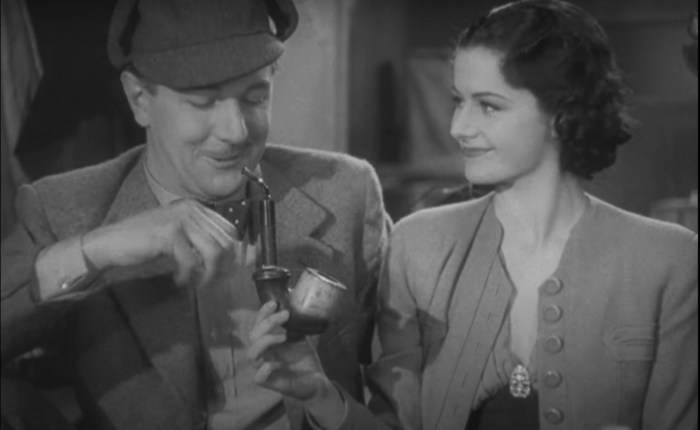
Gilbert (Michael Redgrave) and Iris (Margaret Lockwood) playing Holmes and Watson in The Lady Vanishes

Hitchcock introduced two additional characters, Charters and Caldicott, two men who are determined to get back to England before the end of the Ashes cricket match. This comedy duo proved so popular that they ended up appearing in ten more films, working with a range of directors. To ensure the film does not get too overcrowded, many of the other British characters that appear in the book are not in the film.

Caldicott (Naunton Wayne) and Charters (Basil Radford) in The Lady Vanishes

Once the action moves onto the train, the film largely follows the same trajectory as the novel, although Gilbert takes a much more pro-active role in the hunt for Miss Froy and Iris is increasingly relegated to his assistant. This is made explicit in a scene where he poses as Sherlock Holmes with Iris as his Watson. Gilbert even gets to demonstrate his physical daring when climbing out of the carriage window and into the next carriage from the outside of the train.   

Gilbert (Michael Redgrave) climbing down the side of the train in The Lady Vanishes

Once the pair have located and saved Miss Froy, the action goes in a drastically different direction. The nefarious gang that are trying to kill Miss Froy decouple the two train carriages that contain all the British characters and divert it to a side track into the forest. Once there, the carriages are ambushed by the gang and repeatedly shot at.

It is here that Europe’s political situation has clearly strongly influenced the script. The British characters are debating whether they should get away, fight back, or surrender. One character does not want to fight and instead exits the carriage waving a white handkerchief – he is promptly shot dead by the antagonists. The parallels with Chamberlain’s appeasement approach to Germany could not have been missed by British audiences. Ultimately, with only one bullet left between them, the British passengers manage to get the train running again and are able to get away, but not before Miss Froy has admitted to Iris and Gilbert that she is a spy working for the Foreign Office, and has been given a message for the British government in code. She teaches the code to Gilbert before exiting the train and running into the forest.

This is a significant deviation from the novel, in which Miss Froy is targeted by gangsters because she has unwittingly witnessed something she should not have seen. In the film, Miss Froy is not an innocent bystander who was at the wrong place at the wrong time, but rather part of an international network of spies and informants working for the British state. Rather than being reunited with her family in a celebration of traditional British domestic values, Miss Froy is reunited with Gilbert and Iris as they come off the train. Their triumph is that they have helped the British government gained vital intelligence, with the Foreign Office taking the place of the parental home. In times of political turmoil and with war on the horizon, it is the duty of British citizens not just to help one another, but also to help the State in its mission to suppress international unrest.

The main source of tension in The Wheel Spins, Iris’ concern that she will be locked up in an asylum because no-one believes her, is absent in The Lady Vanishes. Instead, the danger comes not from the British passengers on the train, but from the Europeans who are looking to eliminate a British secret agent. This makes the story much more conventional and in line with many other suspense films of the period. The film is elevated by Hitchcock’s direction and dialogue that balances comedy and drama. The novel and the film stand alongside one another as distinct texts, each using the same plot to foreground different themes.

The Lady Vanishes is available on Youtube.

Featured

Ethel Lina White – The Wheel Spins (1936)

This is the first of a two-part blog looking at the novel The Wheel Spins, and its film adaptation The Lady Vanishes.

Ethel Lina White is one of a mass of interwar authors who were quite prolific, had some commercial success during their lifetime, and whose names have been mostly forgotten by the general public. In the case of White, if it were not for the successful adaptation of two of her novels into films, she may have dropped into obscurity altogether. However, her 1933 novel Someone Must Watch was adapted for the screen in 1946 as the American horror film The Spiral Staircase, and her 1936 novel The Wheel Spins was filmed by Alfred Hitchcock in 1938 under the title The Lady Vanishes.

The plot of the book is relatively straightforward: Iris Carr is a young, wealthy, but bored woman who is travelling back to London by train after a holiday in Eastern Europe. On the first stage of the journey there is another British woman in her carriage, a Miss Froy. Iris has suffered sunstroke just before boarding the train and falls asleep. When she wakes up, Miss Froy has disappeared, and everyone else in the train appears to deny she has ever existed at all. Iris gets increasingly frantic trying to prove that Miss Froy exists, and attempts to enlist the help of the various British passengers on the train.

The Wheel Spins is an unusual entry to the suspense and mystery genre, in that the solution to the problem of what happened to Miss Froy is probably quite clear to the reader at an early stage. Instead, the tension of the novel is much more psychological, centring on whether the protagonist, Iris Carr, will be believed or will be dismissed as mentally unstable. That the fear of women being dismissed as crazy, and potentially locked up, has enduring cultural resonance is in evidence in texts such as the 1963 American novel The Group, where a (sane) character is checked into a mental institution by her husband against her will; or the 2018 Stevan Soderbergh film Unsane, in which the female protagonist also appears to be institutionalised against her will. Throughout The Wheel Spins, the other characters, particularly the men, repeatedly tell Iris that she is making things up. The sunstroke she has suffered has given her ‘delirium’ (p. 107); she is ‘loopy’ (p. 207), in a ‘dangerous mental state’ (p. 227) or ‘deranged’ (p. 230). At various points, the conspiracy against her makes Iris believe that perhaps they are right, and Miss Froy never existed; but then she finds a clue left by the other woman which reinforces her resolve.

The bond between these two women, who have never previously met and have very little in common, stands in contrast to the efforts of the passengers on the train to get Iris to give up her search. At the beginning of the book, Iris is part of a ‘crowd’ of ‘vain, selfish and useless’ people (p. 16). She has no interest in others and actively alienates the other British tourists in the hotel; something that comes back to her later when those same tourists are on the train and she appeals for their help. When Iris meets Miss Froy, she quickly finds her company grating: ‘She’s decent, although she is a crashing bore’ is Iris’ verdict on the other woman (p. 77). Yet when Miss Froy disappears, Iris is relentless in her attempts to find her, despite the obstacles in her way. This suggests a connection between women, helping one another out even if their personalities have little in common.

The other theme running throughout the book is that of British people sticking together against foreigners. Time and again, Iris expects other passengers on the train to help her because they are British, even if she has treated them poorly. When Iris first notices Miss Froy is gone, she goes into the dining carriage of the train to ask for help. It is when she explains to two British men that ‘an English lady’ has gone missing, that they feel compelled to help her (p. 100). Two sisters, the Misses Flood-Porters, can be depended on because they are of aristocratic British stock and will therefore always feel obliged to come through in a crisis. A British vicar, despite being sick, also feels it his duty to come to Iris’ aid. The foreigners on the train are variously described as ‘pallid’, ‘callous’ (p. 70), with ‘grinning faces’ (p. 206) that sneer (p. 211). The kidnapping of Miss Froy is part of a political plot in an unspecified Eastern European country, which is described as ‘feudal, and centuries behind us’ (p. 75). The agents of the ruling party do not blanch at the idea of killing someone like Miss Froy, who has accidentally inserted herself into their affairs. The British characters, in contrast, uphold decency and the rule of law.

Throughout The Wheel Spins, the reader is treated to interludes describing Miss Froy’s parents, an elderly couple who live in the British countryside and are eager for their daughter to come home. These scenes have multiple functions: they reassure the reader that Iris is right and Miss Froy is a real person; they raise the emotional stakes of the story as they highlight how devastated the parents would be if Miss Froy were to come to harm; and they reinforce the notion that the orderly, somewhat boring lifestyle of the Froys is aspirational. Iris has no family and no fixed abode; this is presented as giving her a lack of purpose, rather than freedom. The novel ends with Miss Froy safely arriving at her parents’ house at last; ensuring a restoration of the traditional British family.

The Wheel Spins is not a traditional whodunnit, in that the puzzle of what happened to Miss Froy is resolved halfway through the novel, and the details of who was behind her disappearance are left underdeveloped. Instead, it explores themes of alienation and belonging across a range of different registers.

The Wheel Spins has recently been reissued by British Library Publishing. All page numbers given refer to this 2023 paperback edition.

Madeleine Carroll

FeaturedMadeleine Carroll

Madeleine Carroll is known as the original ‘Hitchcock blonde.’ She blazed a trail for British female actors into Hollywood, where she had a successful career from the mid-1930s. Prior to her move, though, she made over twenty films in Britain. Carroll starred in some major titles opposite the likes of Brian Aherne, Miles Mander, and Ivor Novello. She was one of the most popular British film stars of the period.[1] This film success led to her being the world’s highest-paid actress by the end of the 1930s.

Unlike most other major stars of the period, and indeed, unlike most of the British population at the time, Madeleine Carroll attended university and obtained a bachelor’s degree in French from the University of Birmingham in 1926. Her mother was French, and after completing her degree Madeleine worked as a French teacher in Hove, on the English south coast. A career in school teaching was an extremely common route for women graduates in the interwar period.[2] However, during her time in Birmingham, Carroll had also engaged in the university’s drama club.

Shortly after graduating, she gave up the teaching job and pursued an acting career, starting off in a touring company and landing a first film role shortly thereafter. Her first proper leading role in a film was in the 1928 feature The First Born, directed by Miles Mander who also played the male lead. Carroll was cast as the female lead, playing wife to Mander’s character Sir Hugo Boycott. The script was co-written by Alma Reville, Alfred Hitchcock’s wife.

The First Born is a melodrama that provided a meaty role for Carroll. It is a marital drama about betrayal, illegitimate children, and deception. It opened the doors for other leading roles, such as in the 1929 film Atlantic. This was one of the earliest film adaptations of the Titanic disaster, and released as a very early sound film with French and German versions released simultaneously. It includes a particularly haunting scene at the very end of the film, when the audience can hear (but not see) the drowning of the hundreds of second- and third-class passengers who did not make it into the lifeboats.

After these two heavy, dramatic roles, Carroll starred in a Victor Saville-directed spy film, The W Plan, in which Brian Aherne played the lead. She followed this up with a supporting role in the Basil Dean-directed moral drama Escape!, a part in the Maurice Elvey-directed comedy School for Scandal and the female lead part in the drama The Kissing Cup Race, directed by Castleton Knight. As is clear from this list, Carroll was in constant demand during the late 1920s and early 1930s, and she was able to work with some of the biggest British directors of the period and work in a range of film genres.

She worked with Miles Mander again in 1931’s Fascination, this time playing the ‘other woman’ who tries to break up a happy couple. In 1933, she made another war film with Victor Saville, I Was a Spy, in which she played a nurse at the front who finds herself emotionally compromised whilst passing information back to the British authorities. Her co-star was Conrad Veidt, one of the biggest stars in British and German cinema of the time. In 1935 Saville directed her again, this time in the costume drama The Dictator. Set in 18th-century Denmark, Carroll plays Queen Caroline Mathilde, with Emlyn Williams starring as her husband, the King. It dealt with the real-life scandal of an affair between the Queen and the royal doctor, a story which was given an outing on the big screen as recently as 2012.

After The Dictator, Carroll made the film for which she is probably still most famous, and the one that launched her into international stardom: The 39 Steps, directed by Alfred Hitchcock. Playing opposite Robert Donat as Hannay, Carroll stars as Pamela. Hannay is the classic Hitchcock hero – a man falsely accused who must simultaneously go on the run and try to clear his name. He meets Pamela on the train up to Scotland as he is fleeing London, and immediately coerces her into helping him. Although initially unwilling, Pamela eventually believes Hannay’s claims to innocence.

Although her part in The 39 Steps is the one for which Carroll is most likely to be remembered, she was already a fully established film star when she made the film. It was Donat who was the less experienced, with only 5 film credits to his name prior to The 39 Steps. The film was well-received upon its release and also marked the start of a first career peak for Hitchcock, who went on to direct The Lady Vanishes and Rebecca in the following few years.

After The 39 Steps, Carroll moved to Hollywood and worked for Paramount studios. She continued to make films at the same rate, starring in 10 films before the outbreak of the Second World War – the last of which, My Son, My Son! again saw her star opposite Brian Aherne. During the war she used her language skills to facilitate between the US Army and the French Resistance. After her sister was killed in the London Blitz, Carroll stopped acting and worked as a war nurse in Italy during the later stages of the war. After the war, she only returned to the screen a handful of times, after which Madeleine Carroll opted for an early retirement and spent most of her time with her family in the south of Europe.


[1] Jeffrey Richards (ed.), The Unknown 1930s: An alternative history of the British cinema, 1929-1939 (London: I.B. Tauris, 1998), p. 18

[2] Mo Moulton, The Mutual Appreciation Society: How Dorothy L. Sayers and her Oxford circle remade the world for women (London: Corsair, 2020), p. 70

Featured

The Faithful Heart (1932)

This blog has previously discussed some of the films of Victor Saville, who is mainly remembered for his collaborations with musical comedy star Jessie Matthews. Yet before that collaboration started, Saville had directed over a dozen other films, some of them silent films in the1920s.

In 1932 he directed The Faithful Heart, a melodrama based on a stage play, like so many of the films of the period were. The male lead was played by Herbert Marshall, a famous stage and film star who later in the same year would play husband to Marlene Dietrich in Blonde Venus. The female lead in The Faithful Heart is played by Marshall’s real-life spouse at the time (he ended up marrying five times) Edna Best. Best also had a significant stage career and in this film plays a dual role as both mother and daughter.

The plot of The Faithful Heart is reasonably simple. In 1899, young sailor Waverley Ango lands in Southampton port and takes a liking to a local barmaid, Grace, who he calls ‘Blackie’. After some persuasion Grace falls in love with Waverley and the pair spend about a week together before Waverley is called up to go to Africa. Despite his promises that he will return to Southampton as soon as possible, Grace knows that his heart is in Africa and she will not see him again.

Then, about a third of the way into the film, the action moves to 1919, with Waverley established in an army career and returning from the front with decorations. He is engaged to Diana, a wealthy and sophisticated woman. Then a young woman called Blackie shows up, who tells him she is Grace’s daughter and that Grace died in childbirth. Waverley understands that he is Blackie’s father, and he feels responsible for helping her. Diana, however, persuades Blackie to emigrate to Canada to join her aunt. When Waverley finds out Blackie is about to travel to Canada, Diana tells him he must choose between them. The film ends with Waverley and Blackie boarding the ship to Canada together.

Under the terms of the BBFC censorship code at the time, films were not allowed to show sexual liaisons. As a result, many films use proxies to insinuated sexual interaction has taken place. In 1929’s Piccadilly, for example, we see a woman giving a man her house key, the two of them entering the house together, and then a close-up shot of the woman reclining on a bed with her hair loose. In Blackmail (also 1929), Hitchcock has two people enter a four-poster bed with the curtains drawn, with the implication that a sexual assault takes place in the bed, unseen by the viewer.

The Faithful Heart is a lot less explicit, to the point that one is left wondering when this baby was conceived. On their first date together, Grace tells Waverley that she has no expectations of him, and she kisses him first. However, we also see that on subsequent nights they go to the theatre every night, and they lodge in a house shared by Blackie’s aunt, cousin and an older male member of the family – hardly an environment that provides a lot of privacy. Yet the audience is asked to accept that the relationship was consummated. This then leads to an insinuated portrayal of extramarital sex, which is not roundly condemned by the film. It partially justifies this by making it clear that Grace and Waverley love each other, and possibly would have married if circumstances had allowed them. Crucially, the film’s ending, with Waverley choosing to ditch Diana in favour of looking after Blackie, re-confirms his commitment to the memory of Grace who is presented as his ‘true’ life partner.

The film’s message of staying true and committed to your first love is particularly ironic in light of the private lives of both Marshall and Best. Marshall, as mentioned above, married five times during his life; Best had a total of three marriages. They had both already been divorced once by the time The Faithful Heart was made. Best’s divorce came through 2 weeks before she married Marshall; Marshall’s own divorce was finalised only 3 days before his marriage to Best. This implies that they both left their first marriages legally intact long after they had decided to live separately from their first spouses. The same pattern repeats for their next marriages, with Best actually marrying her third husband on the day the divorce with Marshall came through.

Clearly, the reality was that it was not that uncommon, particularly in showbiz circles, to have multiple significant relationships in life, and there was no moral imperative to stay with one’s first partner. In The Faithful Heart, Diana, Waverley’s fiancée, also largely acts reasonably. She is not shocked or upset that he has a child from a previous relationship. However, quite understandably, she does want to be sure that he is no longer emotionally committed to Grace. The film gets away with positioning Diana as the ‘bad’ character because throughout the film, she uses her family to try and manipulate Waverley to do things he does not want to do, like live in a luxurious flat or accept an allowance from her father. This builds the pair up as fundamentally incompatible, which is reaffirmed when Diana asks Waverley to give up Blackie – something that goes against his core values.

A final note on the soundtrack, which is unusual in the first part of the film, set in 1899. This section includes many shots of boats and ships in Southampton dock, and much of the soundtrack consists of a male choir singing sea shanties. One particular sequence, when Waverley is waking up with a hangover, is scored by a very whisper-y and somewhat unnerving rendition of ‘Drunken Sailor’. Unlike during the silent film era, when each cinema had its own musicians and the scoring of a film would differ from venue to venue and even from screening to screening, with sound films directors could make creative decisions about the soundtrack as well. Victor Saville had a somewhat unusual approach to the music for this first section of the film, which makes it memorable and showcases Saville’s talent for musical direction which would become much more prominent in his later work.

The Faithful Heart ultimately purports to be a morality tale, but the incident that gets the plot underway has to be fudged because it does not align with what was considered morally acceptable to show on film at the time. It does not necessarily walk this tightrope successfully, leaving audiences to significantly suspend their disbelief while watching this film.

The Faithful Heart is available to watch for free on BFI Player, for viewers based in the UK.

The Passing of the Third Floor Back (1935)

FeaturedThe Passing of the Third Floor Back (1935)

Although rather awkwardly titled and largely forgotten today, the 1935 film The Passing of the Third Floor Back was very popular in Britain upon its release. It draws together two features of the interwar British film industry that have been discussed across various previous posts on this blog. Like, for example, Pygmalion and The Lodger it is based on existing source material. In this instance, this was a short story and play both written by popular writer Jerome K. Jerome before the First World War. The film also draws on high-profile European talent in its director, Berthold Viertel, and its star, Conrad Veidt. This highlights the ongoing international nature of the British film industry between the wars.

Conrad Veidt was a hugely popular and famous German actor with a long career in silent cinema, most notably with lead roles in such classics as The Cabinet of Dr Caligari (1920) and Anders als die Anderen (1919), the latter being a landmark of LGBTQ+ silent cinema. In 1933, Veidt left Germany in light of Hitler’s recent assumption of power; as well as him having politically opposing views to the nazi’s, Veidt’s wife was Jewish.[1] Veidt established himself in Britain and made twelve films for British studios until the outbreak of the Second World War. Film historian Sue Harper considers The Passing of the Third Floor Back ‘the apotheosis of [Veidt’s] acting career.’[2]

The film’s director, Berthold Viertel, was an Austrian émigré filmmaker and friend of Veidt’s. After making The Passing of the Third Floor Back, Viertel only made one more film, 1936’s Rhodes of Africa. Like Veidt, Viertel’s political sympathies were left-of-centre, which comes through clearly in their version of The Passing of the Third Floor Back. The short story and play on which the film were based did not foreground class issues in the same way, indicating that these were specifically scripted in for the film. Incidentally, the script of the film was co-written by Alma Reville, Hitchcock’s wife and frequent scriptwriter.

The film’s rather awkward title refers to the room Conrad Veidt’s character, an unnamed Stranger, takes in the boarding house of Mrs Sharpe. At the opening of the film, we see Stasia, the young housemaid, try and grow a flower in the house’s kitchen. She gets scolded by the stern Mrs Sharpe, and frequent allusions are made by both Mrs Sharpe and the other boarding house guests to Stasia’s background as a young ‘delinquent’. Then the Stranger arrives at the door, asking for a room. Mrs Sharpe leads him up to the back of the top floor, presenting him with a tiny room overlooking rooftops. Although Mrs Sharpe is expecting the Stranger to haggle and argue, he instead compliments the room and placidly accepts her terms.

The rest of the film takes place over three days only. On the evening of the Stranger’s arrival, two of the other boarders are due to get engaged. Young and pretty Vivian is entering into this engagement with the odious Mr Wright because it will save her family from financial ruin. In reality, Vivian is in love with a young architect who also lives in the house. During evening dinner, the Stranger stares intently at Vivian, and she decides not to go through with the engagement. Throughout the rest of the evening, the Stranger keeps using this ‘mesmerising’ stare to mentally force people to act in accordance with their true desires. Another boarder, keen to amuse everyone with superficial show tunes on the piano, is convinced to play classical music instead. A conversation the Stranger has with the architect leads the latter to admit that he too is in love with Vivian.

Conrad Veidt as the Stranger, using his ‘mesmerising’ power

The next day is a Bank Holiday Monday, and the Stranger generously offers to take the whole boarding house party out on a steamer to Margate. Mrs Sharpe allows Stasia to come along, and for the first time the servant girl is accepted as a full member of the house party. On the boat, everyone enjoys themselves. The Stranger has a conversation with Miss Kite, one of the lodgers who is ‘the wrong side of thirty’ and very insecure about her looks. When Stasia falls off the steamer, Miss Kite jumps into the water without hesitation to save her. Her conversation with the Stranger has (temporarily) allowed her to stop worrying about her appearance. Miss Kite’s heroic deed earns her the appreciation of the pianist.

Stasia moments before she falls off the steamer in The Passing of the Third Floor Back

Although everyone seems improved by the Stranger’s gentle attentions and insistence on good manners, one man is not impressed. Wright, who got spurned by Vivian, is a rich man who profits off slum housing. Having lost Vivian, he makes it clear to the Stranger that evening that he will do everything he can to swing the pendulum of change the other way. He explicitly addresses how the Stranger has influenced everyone to ‘do good’, and how he will remind everyone of their baser emotions. Indeed, the next morning, Wright’s influence leads to quarrels and frustrations across the house. People appear to have forgotten what kindness and politeness can do to make everyone’s life more pleasant.

Wright confronts the Stranger in The Passing of the Third Floor Back

At the end of that day, a burglar kills Wright. Initially, the house blame Stasia; then the Stranger. Their mob mentality, once its revealed they were wrongfully accusing their peers, provides a wake-up call to the Stranger’s kindness. He leaves the house, satisfied that he has now made a lasting impact on the lodgers’ worldviews.

Throughout, the Stranger is quite clearly analogous to a Christ-like figure, advocating kindness in every action. Wright appears to be set up as a sort of Lucifer, and the discussion between Wright and the Stranger tantalisingly suggests that Wright ‘recognises’ the Stranger and the two have been at odds before. Yet the film grounds these Christian analogies in practical class-based discussions, particularly by making Wright a profiteering landlord. Although the religious undertones make The Passing of the Third Floor Back a somewhat dated and unfamiliar viewing experience for modern audiences, its social commentary (unfortunately) still feels very relevant.

The Passing of the Third Floor Back can be viewed on YouTube; the short story on which the film is based can be read here.


[1] Sue Harper, ‘Thinking Forward and Up: The British films of Conrad Veidt’, in The Unknown 1930s: An alternative history of the British cinema, 1929-1939, ed. Jeffrey Richards (London: IB Tauris, 2000), 121-137 (p. 122)

[2] Ibid., p. 132

Film Star Cigarette Cards (1934)

FeaturedFilm Star Cigarette Cards (1934)

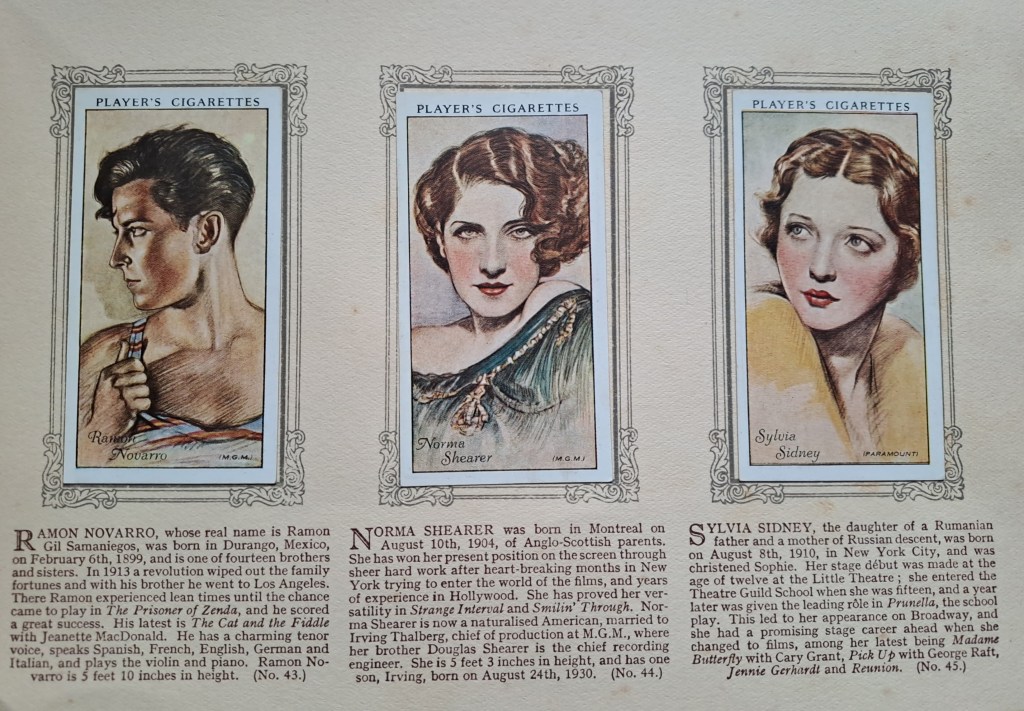
A recent trip to an antique shop delivered a great find: a complete album of film star cigarette cards, collected and collated some time in early 1934. Cigarette brands regularly put out series of cigarette cards, which young people could collect and paste into dedicated albums. In 1934, John Player & Sons, a branch of the Imperial Tobacco Company, published a 50-card series of portrait drawings of film stars. The reverse of each card had some information about the actor. All cards could be pasted into an album; the information that appeared on the reverse of each card was reprinted on the album pages.

My copy was put together by John MacLaren, who lived in Addison Gardens (between Shepherd’s Bush and Kensington Olympia) in West London. We can assume that John was a big film fan as the album is complete, all the cards are inserted into the album neatly, and he handled the album carefully. Nearly 90 years after its composition, it is still in excellent shape with very little wear and tear. The album reveals aspects of 1930s British film fan culture to us: which stars were included, what biographical information was included on them, and which stars were left out?

The first thing to note is that this album is all about the ‘film stars’: there is virtually no mention of directors or producers anywhere in the album. An exception is the entry given for Greta Garbo, which notes that producer Joseph Stiller, upon being given a Hollywood contract, took Garbo ‘along with him’ to the US. The entry for Jessie Matthews, however, makes no mention of Victor Saville, even though she had regularly worked with him by 1934. Similarly, under Marlene Dietrich’s picture there is no mention of Joseph von Sternberg, even though the pair had successfully collaborated several times at this point. Film fan culture in the interwar period was all about the ‘stars’ which appeared on the screen: although retrospectively directors like Hitchcock, Korda and Asquith are recognised as masters of the form, in the interwar period audiences would have been unlikely to seek out a film on the strength of its director alone.

The focus on ‘stars’ rather than ‘actors’ also means that the album mostly contains young, good-looking actors, although a few British ‘character actors’ are included. There are 30 female actors and 20 male actors included; although images of female stars were generally considered more commercially attractive, the album shows that male actors were by no means unimportant and could have considerable ‘sex-appeal’.

Some of the text descriptions, particularly those of male actors, include their height. This was clearly deemed to be important information for the film fan. The description of Johnny Weissmuller thus reads ‘The Olympic Swimming Champion, who stands 6 feet 3 inches in height, made his screen début in short sports films, and because of his magnificent physique was given the title role in Tarzan the Ape Man.’ Even if one had never seen a Johnny Weissmuller film, this description is graphic enough to let the imagination run wild. The drawing of actor Ramon Novarro (5 feet 10 inches) shows him in a vest top which he is tugging slightly to reveal his chest. His Mexican heritage no doubt played a part in this exoticized depiction: virtually all other male stars are shown wearing a suit.

Ramon Novarro in the cigarette card album

Out of the 50 actors included in the album, 29 are American, 11 are British, and the remaining 10 are from other countries – mainly European, but it also includes two Mexicans, a Canadian, and one star born in China to white expat parents (Sari Maritza ‘Her father was English, her mother Viennese’). ‘Talkie’ films were well-established by 1934, and the album shows that although the transition from silent to sound film had limited the international opportunities for non-native English speakers, it had not completely removed them. The aforementioned Garbo and Dietrich were celebrated for their European appearance and demeanour – and both had a powerful male industry figure supporting them. The range of actors included in the album also shows the popularity of Hollywood films in Britain, despite the British government’s attempts to boost the domestic film industry. American stars continued to exert their influence over British fans.

Johnny Weissmuller appearing alongside Mexican actor Raquel Torres and
British actor, producer and race-horse owner Tom Walls

Another reason for the popularity of film stars can be found in many of the narratives that accompany the pictures. Although they are only a short paragraph each, a significant number of them present the careers of film stars as being reached almost by accident. American star Jack Holt, for example, is described as having been ‘in turn a civil engineer, a prospector, a mail carrier in Alaska, a cow-puncher [a cowboy], and finally an actor.’ Madeleine Carroll first worked as a school teacher before taking to the stage; Frederic March was a bank clerk; and Robert Montgomery worked ‘in a mill, then on an oil tanker, and finally became prop man in a touring company.’ The implication is that it is possible to move from a blue-collar or white-collar job into film stardom, and that such a move may be open to the film fan collecting the cigarette cards. This reiteration of the humble origins of many stars, and the supposed open entry to film acting, was an important part of the film industry’s myth-making that constantly held out the possibility to fans that they too could join their favourite stars on the silver screen.

We have no way of knowing whether John Maclaren, the owner of this particular album, had any aspirations to become an actor. Nonetheless, the survival of this album and the care John took in pasting in the cards demonstrates how important film fandom was for him, as it was for thousands of other (young) people in Britain at the time. The cigarette cards gave film fans another accessible way to connect with their favourite actors, in addition to going to the cinema and reading fan magazines. It stands as a testament to (commercial) fan culture in interwar Britain.

Murder in Soho (1939)

Murder in Soho (1939)

On the eve of the Second World War, Associated British Picture Corporation produced Murder in Soho, a gangster flick starring American actor Jack La Rue (not his real name, obviously). The presence of Italian-American La Rue, with his cleft chin and strong jawline, brings Hollywood glamour to what is otherwise a crime film with an extremely thin plot. Murder in Soho appears to be a solitary British outing for the actor, although he did take the opportunity to get married whilst visiting London for the film’s shooting.

Like the almost contemporaneous They Drive By Night, Murder in Soho works hard to incorporate American slang into its dialogue, presumably to appeal to younger audiences. They Drive By Night, however, was produced by the British arm of American studio Warner Brothers. Murder in Soho comes from a British production company that was Hitchcock’s home for many of his silent films including Blackmail (1929); Murder! (1930)and The Skin Game (1931). Alongside these British thriller/crime films, ABPC (which previously operated as British International Pictures) also produced musical films such as Harmony Heaven (1930) and Over She Goes (1937). They did not have a strong background in producing American-style crime films – and it shows.

The plot of Murder in Soho is extremely thin. La Rue plays nightclub owner Steve Marco, who runs the ‘Cotton Club’ in Soho. He has just hired a new singer for the club, Ruby Lane. Steve is interested in Ruby as he thinks she has ‘class’. He doesn’t know, however, that Ruby is married (but separated from) Steve’s British associate Joe Lane. When Joe betrays Steve and steals £2000 off him, Steve kills Joe. Soon police inspector Hammond comes asking questions. He recruits Ruby to work with him and reveal Steve’s criminal activities. Also in the mix, although largely superfluous to the plot, are a journalist called Roy Barnes who frequently visits the club and falls in love with Ruby; Steve’s ex Myrtle who he has dumped in favour of Ruby; and performing duo ‘Green and Matthews’ who also work at the club.

The ‘Cotton Club’ in Murder in Soho

Murder in Soho contains all the popular elements of a 1930s crime film: a nightclub; an international criminal gang; a singer; a police inspector; a journalist. Yet these elements are not fused together with a compelling plot or livened up by any original ingredient. Indeed, the film’s insistence to try and introduce Americanisms into the narrative detracts even more from the action. Steve and his henchmen speak in thick Italian-American accents. The character ‘Lefty’ in particular, who is the young comedy sidekick, litters his dialogue with references to ‘dames’ and ‘cops’. The name of the club obviously refers to the famous Harlem nightclub – but there were no British Cotton Clubs and the name does not have the resonance in Britain as it would do in the United States. Steve employs Black bartenders in his club – again a practice which was much more common in the States than it was in Britain. Compared to depictions of nightclubs in other British films of the 1930s, the Cotton Club in Murder in Soho feels more like a replica of a Hollywood set than of anything resembling British nightlife.

Gun-toting American gangsters in Murder in Soho

The very opening of Murder in Soho also presents a version of Soho that was much more deliberately criminal and seedy than what is usually presented in British films. Familiar shots of the neon lights of Piccadilly Circus are interspersed with a close-up shot of a roulette table; a shot of an underground dive bar; and a shot of two prostitutes propositioning a man in an alleyway. Unlike the majority of British films of the period, which worked to preserve an image of London and Londoners as ultimately adhering to the law and to a high moral code, Murder in Soho explicitly positions Soho as a criminal space. Granted, the main criminal element in the film is foreign, but Joe Lane is British, as is Myrtle, Steve’s scorned ex who ends up killing him. Soho here is a lot seedier than the Soho portrayed in, for example, Piccadilly (1929).

Rather surprisingly, then, Murder in Soho also contains plenty of comic notes, and a few secondary characters who are only included to provide comedy relief. Most notably, the performing duo Green and Matthews, which weave throughout the narrative. Lola Matthews is portrayed by Googie Withers, who this early on in her career already had made a name for herself as an excellent comic actress. As Lola she patters on non-stop, innocently flirting with every man and completely oblivious that her dance partner Nick Green is besotted with her. A frequent club visitor whose role is simply credited as ‘Drunk’ provides diversion in scenes when he tries to eat with chop sticks or enters the dancefloor for a solo performance. These interludes do undercut the drama and suspense that the film attempts to create at other points.

Murder in Soho is a late-interwar curiosity – a film that tries to appeal to British audiences by inserting American glamour; a film that tries to be both serious and funny at the same time; and that ends up feeling like a painting-by-numbers effort that adds up to less than the sum of its parts.

Fascination (1931)

Fascination (1931)

Three years after his directorial debut, the silent film The First Born (1928), Miles Mander tried his hand on two sound films. The first, The Woman Between, was an adaptation of his own stage play ‘Conflict’. The second, Fascination, was based on another writer’s script. Unlike some actor-directors, like Tom Walls, Mander decided to restrict his duties to directing only and did not appear in either film.

Fascination’s main attraction for modern audiences is the starring role of future ‘Hitchcock Blonde’ Madeleine Carroll, appearing here four years before her famous role in The 39 Steps opposite Robert Donat. According to the DVD sleeve notes, only one 35mm copy of Fascination survives in Britain, of which the sound and image quality leave something to be desired. It is, however, eminently watchable, not only for Carroll’s performance, but also as an interesting counterpoint to The Divorce of Lady X which was released seven years later. Both films deal with marital fidelity, but whereas the later film treats infidelity as a comic subject and accepts its existence as a matter of course, Fascination is much more moralistic on the subject.

Madeleine Carroll as Gwenda Farrell in Fascination

Fascination opens with a scene in a children’s playroom, where a little boy and girl are playing with a toy train set. They are Larry and Vera, the protagonists of the film. Mander’s directorial style comes across immediately in the close-up shots of various toys, which give an emotive impression of the room from a child’s perspective. He shuns any establishing shot of the space. In foreshadowing of Larry and Vera’s later troubles, the toy train runs of the rails and Larry, in trying to fix it, breaks the tracks altogether. However, the children quickly make up and a third boy, who had been playing in a corner, orders that they should be ‘married’; a mock ceremony ensues.

The film then briefly moves to Larry and Vera’s courtship as young adults (Larry is ‘in his last term at Oxford’ studying to be an architect) before moving on to a time three years into their marriage, when the main action of the film begins. Vera and Larry have been established as a devoted couple, who laugh and play together and commit to a series of ten ‘commandments’ of marriage, which include ‘telling the other everything that matters’ rather than the more traditional expectation for the wife to obey the husband.

Vera and Larry courting in Fascination

Three years into the marriage, there are no children yet (more on that later) but Larry has established himself as an up-and-coming architect/interior designer and Vera is a content housewife. Larry has received a request to do the interior design of an apartment for a famous stage actress, Gwenda Farrell, who is currently starring in the hit play ‘Fascination’. Gwenda, of course, is played by Madeleine Carroll. Reeling from a recent break-up, Gwenda is taken by Larry and he is smitten by her. The reasons for his attraction to Gwenda are never explained; the audience is asked to assume that it is inevitable for a happily married man like Larry to fall in love with another women based on her looks and glamour alone.

After an initial meeting in a cafeteria, ostensibly to discuss the business of the flat, it is Larry who suggests that they go out on the river for the rest of the day and have a picnic. Once outside, he starts flirting with Gwenda and she calls him a ‘silly boy’ and tells him not to ‘spoil things’. However, she immediately follows this up with an invitation to supper in her flat – and as if the audience needs reminding, Mander here inserts a shot of a sign in the adjacent pond which announces ‘Danger’.

Although Larry is clearly an active and willing participant in the affair, it is no surprise that Gwenda is presented as the primary guilty party, as she reciprocates his attention and moves the relationship along. At the night of the supper (where we can assume the relationship is consummated), Vera is starting to get upset with Larry’s frequent absences from home. Her suspicions are confirmed when Gwenda sends Larry an intimate letter which Vera reads. But even here Vera has not done anything illicit or objectionable: Larry has eye trouble and asks Vera to read his letters out to him, even encouraging her to open the one marked ‘Personal’. Vera does not reveal to Larry what she has read and burns the letter without him being any the wiser.

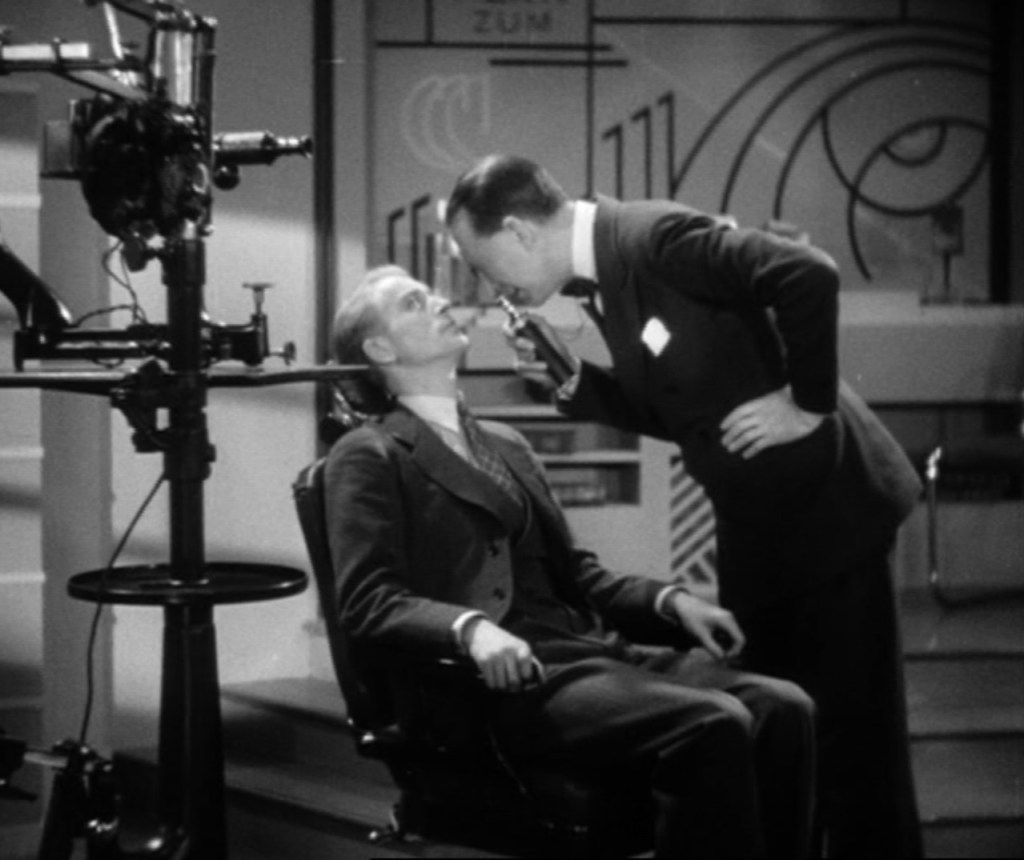
Larry visiting a very modernist optician in Fascination

Although Larry by this point is starting to feel very conflicted about his affair and wants to end it, Gwenda ostensibly still has too much of a hold on him to enable him to break things off. Thankfully for him, his wife has found a solution. Vera writes to Gwenda under false pretences and invites the other woman to her marital home. Here, rather than having an argument, Vera explains that she loves Larry and wants to protect her marriage, so she is happy to silently consent to his affair with Gwenda. In Vera’s reasoning, if she were to cause a big fuss, Larry would be driven into Gwenda’s arms more.

Before Gwenda has a chance to respond to this proposal, Larry comes home – Vera hides Gwenda quickly behind a curtain. Larry confesses his affair to Vera, begs her forgiveness and offers to write to Gwenda immediately to break off the relationship. Gwenda decides to reveal herself and explains to Larry that Vera, in her generosity, had agreed to him continuing the affair just to keep her marriage intact. She insists on ending her relationship with Larry now that she has met Vera.

Vera warmly says goodbye to Gwenda in Fascination

Fascination ends with the contrast of Gwenda, smoking alone in her dressing room and forcing herself to get ready for yet another night’s performance; and Vera and Larry, cuddled together in a chair where Vera reveals to him that she is pregnant.

Larry and Vera happily reunited at the end of Fascination

Unlike in The Divorce of Lady X, then, divorce is an impossible outcome in Fascination. If Vera had opted to divorce Larry, she would have had to stand the shame and exposure of the divorce court, with a famous actor cited as co-respondent in the case. Clearly, for a respectable middle-class woman this was not really a route to contemplate, even without the added complexity of pregnancy or children. Her willingness to allow the affair to continue, then, is perhaps less magnanimous than the film presents, and more pragmatically her only option.

Yet, by perpetuating the narrative that single women ‘steal’ husbands away from faithful wives; and faithful wives should accept this and allow husbands to come back in their own time, Fascination clearly sides with patriarchal norms. Vera’s ostensible agency is in fact non-existent- something also stressed by a scene where she visits Larry’s office to ask him for household money. Fascination presents marriage as the route to a woman’s happiness, and independence and professional success as poor substitutes. Despite the increasingly progressive position of women in British society by the early 1930s, this film demonstrates that cultural texts often still expounded traditional viewpoints.

Sabotage (1936)

As noted elsewhere on the pages of this blog, Alfred Hitchcock started out as a director during Britain’s silent film period. He continued making films in Britain during the 1930s, before making his move to Hollywood around 1940. In 1936, he directed Sabotage, a Gaumont production based on the Joseph Conrad novel The Secret Agent. (Rather confusingly, in the same year Hitchcock also directed a film called Secret Agent which in turn was based on a novel titled Ashenden.)

By the mid-1930s, the tense European political situation was reflected in a spate of British films about spies and international criminal networks. Although Conrad’s source novel was published in 1907, and its plot is set in the 1880s, Hitchcock had little difficulty in adapting the storyline for a contemporary audience which was, again, concerned about German expansionism.

In Sabotage, a couple called Mr and Mrs Verloc run a cinema in central London. Mr Verloc is of unidentified Eastern European origin, whereas Mrs Verloc appears to be British. With them lives Stevie, Mrs Verloc’s teenage brother. Mr Verloc hides a secret from his wife – he is part of an international terrorist gang which is planning a series of attacks to disrupt British society. Scotland Yard have their eye on Mr Verloc, and undercover agent Ted Spencer is keeping a close eye on the cinema from a vegetable stall across the road.

Mr Verloc’s gang plan to blow up Piccadilly Circus underground station with a bomb hidden in a film reel tin. As Verloc suspects he’s being watched, he sends Stevie to drop off the package at the station’s cloakroom. Stevie, however, gets waylaid on the way to the station and the bomb goes off while he is still on the bus, killing him and all the passengers. When Mrs Verloc realises that her husband is responsible for her brother’s death, and he starts threatening her too, she kills him with a large kitchen knife. Ted Spencer, who by now has fallen for Mrs Verloc, shields her from arrest at the film’s end.

The sequence of Stevie travelling to Piccadilly Circus with the bomb is the most-discussed – and indeed, often the only discussed – part of Sabotage. Stevie is unaware of the real contents of the parcel he is carrying, he simply knows he needs to leave it in the luggage collection point in Piccadilly Circus station by 1.30pm. The audience knows that the bomb will go off at 1.45pm. Sabotage heightens the tension by a series of close-ups alternating between the parcel of explosives, Stevie, and various clocks which he sees on shop fronts along the way. As the clocks inch closer to 1.45pm, the individual shorts become shorter and shorter, culminating in an extreme close-up of the hand on a clock moving to 1.45pm. The bus spectacularly explodes, and Stevie and all the other passengers are killed in the blast.

Critics of Sabotage have pointed out that the rationale for Mr Verloc’s criminal gang is not defined. At the start of the film, the gang causes a mass electrical failure in London which causes widespread disruption. Their planned bombing of Piccadilly Circus would not just cause great material damage and loss of life – Piccadilly Circus was the symbolic centre of London, England, and the British Empire. When its underground station was completed in 1928, it was hailed as a feat of engineering. London Underground even produced a poster depicting the station’s tunnel network as the ‘stomach’ and digestive system of London. The motivation of the criminal gang, then, is to disrupt society, to cause unrest without providing a clear enemy against which people can direct their anger. The threat of destabilisation was keenly felt in 1930s Britain, as people watched great social change in Germany, Italy and elsewhere unfold. Many films of the period feature shady and undefined foreign criminal networks, including Laburnum Grove (1936), Midnight Menace (1937), and Bulldog Jack (1935).

The cinema is extensively used as a location in Sabotage. Mr and Mrs Verloc live in a flat situated behind the auditorium. To enter the flat, one has to go through the auditorium, and characters are frequently shown to pass through here whilst patrons enjoy the screening, apparently undisturbed. During his investigations, Ted Spencer is able to approach the flat unseen because the cinema audience is engrossed in a farcical comedy film. Spencer then enters the space behind the screen, in which there is a connecting window to the Verlocs’ living room. Spencer uses this window to eavesdrop on Verloc’s conversation, without the cinema audience being any the wiser.

After Stevie’s death, Mr Verloc tries to justify and explain himself to Mrs Verloc. Following this conversation, Mrs Verloc walks out of the flat and into the cinema auditorium, where a children’s showing of Disney’s Who Killed Cock Robin? is in progress. The children’s laughter prompts Mrs Verloc to first grimace in despair, before she turns to the screen and sits down to watch the show. Despite the centrality of its cinema location, this is the only time any of Sabotage’s main characters actually takes the position as audience member.

Engrossed in the cartoon, Mrs Verloc starts to laugh through her grief. She is unable to process the enormity of her emotions and uses the film as a welcome distraction. The distraction is all too brief: the cartoon bird gets shot, which plunges Mrs Verloc back in despair. This breaks the spell of the cinema for her, and she gets up and walks back through the auditorium with determination to see things out with her husband. Soon after returning upstairs, Mrs Verloc stabs her husband to death. After the spectacle of the bus explosion, the killing of Mr Verloc is understated. Mrs Verloc picks up a knife to carve dinner. She then pauses to look at it for a minute whilst an idea seemingly dawns on her. When Mr Verloc stands next to her to speak to her, she turns around and sticks the large knife in his abdomen. It is a murder which originates from a deep despair, rather than from anger or a desire for revenge.

Immediately after the murder, one of Verloc’s associates sets the flat on fire. Ted Spencer meets Mrs Verloc outside; although she confesses the murder to him and wants to give herself up to the police, Spencer tells his superiors that Verloc died in the blaze. Because Mr Verloc was a foreigner set to disrupt British society, and he stooped so low to use a child as an unwitting assistant to his plans, Mrs Verloc is allowed to go unpunished for her crime. Her insistence that she should give herself up to the police only serves to set her out as even more deserving. One perspective on Sabotage is that it argues that as long as British citizens are willing to make personal sacrifices, they can collaborate with the police to successfully neutralise foreign threats; and it is their duty to do so.

The Secret Agent by Joseph Conrad can be read for free via Project Gutenberg.