Muriel Jaeger – The Question Mark (1926)

Although the interwar period is known for the large volume of crime fiction it produced (examples here, here and here), it also saw the publication of some classic works of science fiction. Aldous Huxley penned Brave New World in 1934, and across the pond Orson Welles’ classic War of the Worlds aired on radio in 1938. Preceding both these high watermarks of science fiction is Muriel Jaeger’s 1926 novel The Question Mark, which has recently been re-published by the British Library in their ‘Science Fiction Classics’ series.

Jaeger is not a household name, and certainly a lot less well-known then her good friend Dorothy L. Sayers. The pair studied at Somerville, Oxford together and were both members of the ‘Mutual Admiration Society’, a group of female students with literary ambitions.[1] The Question Mark was Jaeger’s first novel, and it was published by Virginia and Leonard Woolf at their Hogarth Press.

The protagonist of The Question Mark is Guy Martin, a young-ish bank clerk in London. He is of the lower middle class and resentful about it. Along with his generic name, there are few distinguishing features about Guy – Jaeger deliberately keeps descriptions of him generic. Guy has a lingering dissatisfaction in life, which he tries to quench by attending meetings of the Socialist Club. The Club almost allows him to believe in a future in which class boundaries can be transcended, until Marjorie, the girl he has fallen in love with, throws him over in favour of a Tory.[2]

Marjorie’s rejection leads Guy to sink into a stupor; when he wakes up, he is several hundred years into the future. It is later explained that Guy actually died on the night of Marjorie’s rejection, and is the first corpse to be successfully revived by a Dr Wayland. There is then, no chance of Guy returning to the 1920s, or roaming around time and space in the manner of H.G. Wells’ ‘Time Traveller’. Instead, Guy must make the best of his new life in this future version of London.

At first, naturally, all seems much better in the future: London has turned into a pleasant green landscape of rolling hills, and everyone who works has access to a ‘power box’: a device that acts as a portable power source to ‘Anything you want to make go.’[3] There are ‘areocycles’ for short trips through the air, and silent and impossibly fast planes for travel to the continent.[4] Everything runs so smoothly that workers have very little to do, and education is accessible to everyone.

But of course, these initial impressions are shaken before long. Jaeger’s future society no longer has class divisions in the way a 1920s reader would recognise them. Instead, however, the population is divided between ‘intellectuals’ and ‘normals’. Dr Wayland and his cousin John, who takes Guy under his wing, are both ‘intellectuals’. This means that they do not need to undertake manual labour and are allowed to study and pursue knowledge their entire life.

Dr Wayland, however, married a ‘normal’ woman, Agatha, and as a consequence his children Ena and Terry are also ‘normals’. Because ‘normals’ are denied intellectual development over several generations, they have become highly emotive and impressionable. Ena is twenty years old, but is described as behaving closer to a child in her early teens. She quickly becomes infatuated with Guy, much to the latter’s confusion and disgruntlement.

Towards the end of the book, a religious leader emerges who is able to capture the imagination of thousands of ‘normals’. When this Emmanual predicts the end of the world to be nigh, so many ‘normals’ down tools that the intellectuals have to step in to keep things running. Guy is reminded of a strike in the 1920s:

He remembered how the young assistant-manager at his bank (a post that was practically a sinecure in a certain family) had gone off joyously to take tickets and slam lift-doors on an underground railway along with other numbers of gay young men of the leisured classes who meant to “keep things going until the beggars had had enough of it.” The two situations had a startling similarity in difference.[5]

Jaeger’s point is clear: although traditional social classes are abolished in the future, humanity has still created an artificial boundary that treats one group of people as morally, financially and intellectually superior to the other. When the ‘normals’ refuse to behave according to their allotted tasks, the system does not break down and they are not taken seriously. The religious uprising comes to nothing and things quickly return back to how they were. At the close of the book Guy remains trapped in this future that is fundamentally no better than the past he left behind, ‘heavy with terrible knowledge.’[6]

The Question Mark is no utopia. Instead, Jaeger offers the reader an intellectual exercise in future-building that is quite cynical about humanity’s ability to create a better future for itself. Like all good science fiction, it uses a made-up world to comment on the real one. The Question Mark’s commentary on class differences, social inequality and access to education are just as pertinent in the 2020s as they were when the book was written, nearly a hundred years ago.


[1] Mo Moulton, ‘Introduction’ in Muriel Jaeger, The Question Mark (London: British Library, 2019), p. 9

[2] Muriel Jaeger, The Question Mark, p. 33

[3] Ibid., p. 49

[4] Ibid., pp. 91-2

[5] Ibid., p. 171

[6] Ibid., p. 205
Cycling in interwar Britain

Alongside the expansion of London’s public transport network, and the increased popularity of cars, cycling also held an important place in British interwar culture. Although modern ‘safety’ bikes with pneumatic tyres were first mass-produced in the 1880s, the interwar period saw an ever-greater adoption of bikes not only as a means of transport, but also as a vehicle for recreation and sport. Between 1924 and 1937, over 2 million bicycles were manufactured in Britain.[1]

According to social historian Michael John Law, in the interwar period the ‘bicycle was used for short journeys that would today be made by car, for pleasure trips out of the suburbs into the countryside, for cycling club outings and also for quite long distance commuting.’[2] Although cycling may have been challenging in central London due to the large number of motorised vehicles on the narrow roads, those living in the city’s outskirts could comfortable cycle around their neighbourhoods. Bikes were primarily associated with the working classes, as they were relatively cheap to purchase and, unlike cars and motor bikes, did not demand an ongoing supply of fuel.

Beyond the use of bicycles for day-to-day commuting and navigation of the urban environment, many thousands of people joined cycle clubs during the interwar period – an estimated 100,000 people were members of such clubs by the mid-1930s.[3] These clubs were very popular in London as well as the countryside. As early as 1921, a London rally attracted more than a thousand participants.[4]

Bikes also quickly became popular in organised sporting events. One pioneering cyclist, Mabel Hodgson, organised a number of extremely popular rallies in London, as well as a 106-mile race from London to the Sussex coast.[5] In south London, the still operational Herne Hill Velodrome opened in 1891. There exist various ‘Topical Budget’ and British Pathé films from the 1920s which show races at Herne Hill, including one which involved a competition of already old-fashioned Victorian penny farthings.

As well as providing a human interest piece of the cinema newsreel, these films’ intertitles also boast about the modern cameras which enabled the capture of high-speed pursuits on film: ‘you’ve never seen a picture like this – taken with “Topicals” special camera which makes the thrills, thrillier”’

One noteworthy feature of these cycle competitions is that they were open to men as well as women. One Topical Budget film from 1929 shows an all-female race at Herne Hill. The riders clearly go around the track at great speed and one is shown tightening the bolts on her bike; however, the riders’ femininity is underlined by a shot of two competitors powdering their noses and applying lipstick before the start of the race. The threat of women engaging in a leisure pursuit which potentially does not align with gender expectations is diffused by the immediate visual assertion that these women still wear make-up and fashionable outfits. The high-speed cycling on display in this video also required the riders to wear shorts, providing a further visual pleasure to the (male) spectator.

In addition to the increased number of women participating in amateur cycling clubs, the interwar period also saw the emergence of the first professional female cyclists. Sport historian Neil Carter has identified Marguerite Wilson as a pioneer in this respect: Wilson obtained full-time sponsorship in 1939 and in the same year set a record cycling from Land’s End in Cornwall to John O’Groats in Scotland.[6] Typist Billie Dovey, who in 1938 broke the record of most miles cycled in a year (29,603.4) also received professional sponsorship.[7]

Cycling, then, was popular in interwar Britain and London and people participated in it in a variety of ways: as a means of commuting; as a leisure activity; and as a professional sport. Nonetheless, in popular fiction and film of the period cycling is often passed over in favour of more glamorous means of transport such as cars, trains and planes. As a primarily working-class pastime, interwar cycling was not given the same exposure as other recreations, which has exacerbated the possibility for this piece of history to remain overlooked today.


[1] Neil Carter, ‘Marguerite Wilson and other ‘hardriding…feminine space eaters’: cycling and modern femininity in interwar Britain’, Sport in History, vol 40, no. 4 (2020), 482-504 (486)

[2] Michael John Law, ‘The car indispensable: the hidden influence of the car in inter-war suburban

London’, Journal of Historical Geography, vol. 38 (2012), 424-433 (426)

[3] Carter, ‘Marguerite Wilson’, 486

[4] Ibid.

[5] Neil Carter, Cycling and the British: A Modern History (London: Bloomsbury Academic, 2020), p. 156

[6] Carter, ‘Marguerite Wilson’, 482-495

[7] Ibid., 487

Newspaper wars

Although this blog focuses on the period between the First and Second World War, the interwar period was not without its conflicts. One of the social changes which took place in the first half of the 1930s has retrospectively been dubbed the ‘newspaper wars’ which was fought between popular newspaper titles.

A host of daily newspapers aimed at the lower-middle classes were launched in Britain at the turn of the twentieth century. The Daily Mail arrived in 1896, followed by the Daily Express in 1900, the Daily Mirror in 1903 and the Daily Herald in 1912. These newspapers represented a completely new type of written press. Existing papers such as The Times and the Daily Telegraph were aimed at upper class, male readers. They contained columns of densely printed text without illustrations. Advertising mostly consisted of personal adverts which took up the entire front page. There were no big headlines, and reporting included lengthy verbatim reports of parliamentary discussions.

The new popular papers founded at the start of the twentieth century disrupted this model. Partially due to educational reform, general literacy levels increased, and there was now room in the market for newspapers aimed at a wider readership. However, whereas broadsheet papers were aimed at men who could afford to spend hours reading a paper over breakfast or in their members club, the new newspapers recognised that their readership likely could only snatch a few minutes at a time to read their paper. Moreover, the newspaper bosses realised that their readership was more interested in snappy articles and the new invention of the ‘human interest’ story than in long and precise reports about complicated subjects.

From the beginning, popular papers therefore printed shorter articles, more images, and more headlines. The Express was the first to adopt an ‘American’ lay-out which meant that it printed news on the front page, as opposed to the ubiquitous personal adverts –  a practice eventually adopted by all national newspapers. These papers generally cost only one pence per issue, to keep them affordable to the working classes and lower-middle classes. This did mean that the papers’ main revenue source was advertising. In order to attract the most lucrative advertising deals, each paper had to ensure its circulation was constantly growing. It was particularly coveted to increase the number of subscribers as they provided a more stable source of income than those who bought a paper only occasionally.

Throughout the Edwardian period and the 1920s the popular papers were able to increase their circulation by targeting people who did not yet subscribe to any paper at all. By the early 1930s, however, market saturation had been reached, and newspapers had to change their tactics. The only way to continue growing their circulation was by actively persuading readers to switch papers. The fight for new subscribers became so heated that this period has later been dubbed the ‘newspaper wars’.

Newspapers used different tactics to persuade more readers to subscribe to them. One was to ensure that they offered a clear political identity. The Daily Herald had been, from its foundation, an outspoken left-wing newspaper, and from 1922 it was formally affiliated with the Trade Union Congress (TUC), the overarching body of trade unions. By 1933 the Herald’s circulation had grown larger than it had ever been, to two million copies a day, and it started to form a real threat to the other popular papers, which had mostly supported a conservative agenda.

The owners of the Daily Mirror, therefore, relaunched the Mirror in 1934 as a left-leaning paper, but without formal affiliation to the TUC. This enabled the Mirror to present itself as the paper of choice for the non-radical, non-unionised working classes. It also differentiated itself clearly from the Mail and Express who continued to support the Conservative party.

Whilst the Express did not differentiate itself through its political stance, it did radically change its layout in 1933, in a bid to attract more readers. A new editorial team introduced clearer headlines and wider spacing, which made the paper easier to read. Their biggest innovation was to no longer print articles strictly across one column, top to bottom. Instead they adopted the ‘jigsaw’ approach which is familiar to newspaper readers today: articles cut across multiple columns and readers read horizontally across rather than only vertically. Up until that point, every national newspaper in Britain had rigidly stuck to printing their articles vertically.

A third tactic employed by newspapers to gain more readers was the liberal use of stunts and insurance schemes. The latter allowed newspaper subscribers to buy insurance through their newspaper, which would then be paid out to their relatives in case of illness, accident or death. Newspapers in turn were able to print stories of how they had helped widows and children of deceased readers which made them seem magnanimous. Insurance schemes were available prior to the newspaper wars, but they did become a feature of the inter-paper competition. Newspaper insurance schemes are a central part of the plot of the 1932 comedy film Let Me Explain, Dear.

Arguably, the Express came out on top after the newspaper wars, as it was the best-selling newspaper in Britain from the mid-1930s until the late 1940s. This was not only due to their improved lay-out, but also due to their policy of adopting an optimistic editorial line, perhaps best summarised in their infamous August 1939 front page headline ‘No War This Year’.[1] This editorial policy set them apart from the Mail, which traditionally took a more alarmist approach. The (falsely) reassuring tone of the Express ultimately resonated more with a reading public that could still vividly remember the last War.


[1] Marianne Hicks, ‘No War This Year: Selkirk Panton and the editorial policy of the Daily Express, 1938–39’, Media History, 2008, 14:2, 167-183

F. Tennyson Jesse – A Pin To See The Peepshow (1934)

The trial and execution of Edith Thompson have been discussed several times on this blog. The 1922 trial was extensively covered in the press of the period. In short, Edith Thompson was tried and executed alongside her lover Frederick Bywaters, for the murder of Edith’s husband Percy. At the time, newspapers judged Edith harshly for her affair with a younger man (she was nine years older than Frederick). Current scholarship is generally of the opinion that Edith probably knew nothing about the planned murder and should not have been found guilty. You can read a fuller account of the case here.

Due to the high profile nature of the case, it is no wonder that contemporary authors drew on the case for inspiration. I’ve previously discussed E.M. Delafield’s 1924 novel Messalina of the Suburbs which was based on the Thompson-Bywaters case. Where Delafield’s interpretation of the case was fairly loose, a novel published a decade later took a more forensic approach to recreate the story.

The extra years which had passed since the case no doubt help F. Tennyson Jesse to gain more perspective when she wrote A Pin To See The Peepshow, a novel frequently referenced as the definitive fictionalisation of the case. Tennyson Jesse was a prolific writer across several genres including novels, plays, poetry and non-fiction.[1] Some of her work is available to read for free online. She had a definite interest in true crime: in 1924 she wrote a non-fiction work Murder and its Motives and throughout her career she contributed to the long-running book series Notable British Trials. One of the volumes she was responsible for was the trial of Sidney Fox, who was found guilty of killing his own mother.

In A Pin To See The Peepshow Edith Thompson is transformed into Julia Almond, a young, somewhat pretty woman who, like Edith Thompson, works in a women’s fashion boutique and ends up marrying to a man she finds dreadfully dull. The strength of the book is that Julia is not necessarily a sympathetic character, the reader does sympathise with her. Like E.M. Delafield before her, Tennyson Jesse leaves no doubt that her fictional heroine had no involvement in the plot to murder her husband.

The novel starts when Julia is a school girl, living in West London with her parents and counting down the days to her adulthood. When she is ordered to mind a class of younger children one day, one of the younger boys, Leonard Carr, has a ‘peepshow’: a cardboard box with a decorative interior that can be seen through a small hole. Julia is enchanted by this portal into another world: a first indication of her romantic nature which is reiterated throughout the book. Leonard Carr, when he grows up, becomes the fictional version of Frederick Bywaters. In Tennyson Jesse’s narrative, Julia and Leonard’s relationship is marked by make-believe from its inception.

During the real Thompson-Bywaters trial, much was made of Edith’s letters to Frederick. He had kept these letters despite the couple’s agreement that they would destroy each other’s epistles – Edith did destroy Frederick’s letters to her. The letters alluded to supposed plots to kill Percy. The prosecution at the time used them as evidence that Edith wanted her husband to die, and that she was manipulating Frederick to commit the act for her. From the novel, it appears that F Tennyson Jesse agreed with scholars such as Lucy Bland that the letters were works of fiction, written by a woman with a vivid imagination.[2] Another feature that Tennyson Jesse awards her heroine, which may not be entirely historically accurate, is that Julia is terribly short-sighted. This gives her a plausible defense when she claims she did not recognise her husband’s killer, as the real Edith Thompson also initially said.

The heart of the case is, of course, extramarital relationship which Edith Thompson deigned to embark on. In Delafield’s novel, the heroine is sexually active at a young age, but also gets sexually abused by a series of men who are in positions of power over her. Tennyson Jesse’s Julia is less obviously interested in men, but the brief affair she has with a young man at the start of the First World War is described as completely natural and nothing to be ashamed about.

Julia’s eventual marriage to family friend Herbert Startling is primarily motivated by her desire to leave her parents’ home, and her inability to afford her own living space. When Leonard Carr re-appears on the scene as a young adult, Tennyson Jesse makes it clear that sexual relations with Leonard are extremely satisfying to Julia, again without judging or moralising about it.

Julia is less obviously a victim than Delafield’s heroine. Throughout A Pin To See A Peepshow, Julia is often in command. She earns more money than Herbert and is largely able to dictate when she allows him to sleep in her bed. Nonetheless, Tennyson Jesse makes clear that ultimately, Julia is too naïve to understand the passions she’s unleashed in Leonard which drive him to his ultimate act. Her subsequent foolish attempt to cover up Leonard’s involvement to make the murder seem like an accident, seals her fate in a patriarchal justice system. Tennyson Jesse’s Julia probably comes close to the real Edith Thompson: a woman not without faults, whose options in life were narrowly determined by her sex and who paid the price for transgressing accepted norms.

A Pin To See The Peepshow was recently re-issued as part of the British Library Women’s Writers series. Copies can be bought here.


[1] Lucy Evans, ‘Preface’, in F. Tennyson Jesse, A Pin To See The Peepshow (London: British Library, 2021), p. viii

[2] Lucy Bland, ‘The Trials and Tribulations of Edith Thompson: The Capital Crime of Sexual Incitement in 1920s England’, Journal of British Studies, Vol. 47, no. 3 (2008), 624-648

Films by the GPO: Night Mail (1936) and N or NW (1938)

Films by the GPO: Night Mail (1936) and N or NW (1938)

One of the features of interwar Britain is its rapid modernisation and the expansion of its infrastructure. This extended to the General Post Office (GPO) which looked after the expanding telephone network as well as paper mail delivery and the sending of telegrams. Although telephones rapidly became more widely used during the interwar period, placing phone calls outside one’s own exchange district, or outside of working hours, could still be a very costly affair. Writing letters remained very popular, and of course most business affairs were also conducted by writing. With the introduction of long-distance commercial flights in the 1920s, it became possible to send and receive letters to all corners of the Empire much more quickly than before.

In 1933, the GPO established its own film unit, to produce documentaries and propaganda films about the GPO’s work. Britain already had an Empire Marketing Board which produced films to favour the Empire, so the establishment of a specific unit for the GPO was a small step. The GPO film unit was headed up by pioneering director John Grierson.

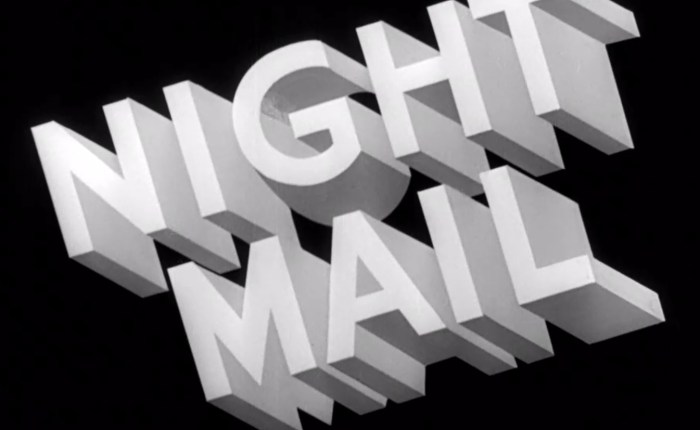
In 1936 the GPO produced a documentary short about the postal train which travelled from London to Scotland every night. Night Mail has become a documentary classic, mixing art with fly-on-the wall footage of the postal service in action. WH Auden wrote a poem for the documentary, which features as its voice over, and the music was written by Benjamin Britten.

In its runtime of just over 23 minutes, Night Mail shows real postal workers in the business of running the nightly postal train from Euston up to the highlands. On its route, it passes railway workers, passengers on other trains, and farmers. The infrastructure of the railway line is intimately connected with the vast infrastructure of the postal service, which ensures that any letter is delivered to the correct address in record time. Cutting through the country from south to north, the postal train is depicted as cutting through all layers and sections of British society. A high-tech control room, which was in constant connection with station managers up and down the line, ensured that the whole system kept running smoothly.

The control room in Night Mail

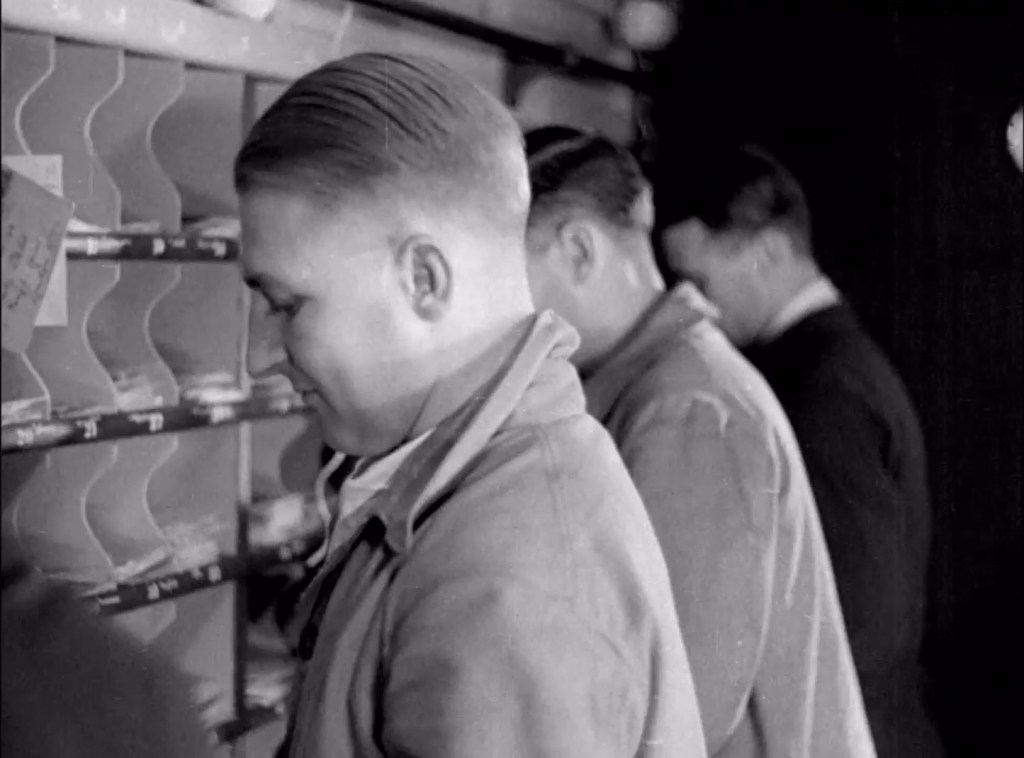
The rural scenes the train passes are juxtaposed with the ingenious systems the GPO had devised to ensure maximum efficiency. Postal workers up and down the line hung bags of post from poles, destined for towns further up north. These bags which were picked up by the train as it sped past through a specially designed system. At the same time, workers on the train chucked out bags of mail for postal workers to pick up and distribute. Inside the carriages, dozens of men sorted individual items of post into pigeonholes at high speed.

Postal workers sorting post on the train in Night Mail

Where Night Mail presents the successful running of the postal delivery system as a collective endeavour which uses the latest technology to benefit the whole country, a film made by the GPO film unit a few years later focuses on the personal side of sending post. N or NW was made in 1938, several years after the first introduction of lettered postcode districts in central London. Postcodes in central London are based on compass points, so N for north London, SE for South East and so on.

Map of postal districts in N or NW

In N or NW we are introduced to Jack and Evelyn, a young couple who have recently had an argument. Evelyn is writing a letter to Jack, which she relates to us in voiceover. Jack has been ‘simply beastly’ to her: he got angry with her for going to a party with a male friend. Evelyn demands that Jack sends her a written apology by return post, otherwise the relationship is ‘ruined’.

Upon receiving this missive, Jack is eager to apologise and he quickly pens his response. However, when it comes to addressing the letter, he cannot remember if the postcode for Evelyn’s home in Islington is N or NW. He eventually plumps on NW. We then return to Evelyn, who has waited in vain for Jack’s letter to arrive and is now writing him another one, in which she encloses the ring he gave her. But! Just as Evelyn is about to leave the house to post this final rebuttal, the postman arrives with Jack’s apology.

Evelyn and Jack go out picnicking the water in the countryside, their relationship restored. It is revealed that the post office corrected the address on Jack’s letter, changing the postcode from NW to N. A postman informs the audience that writing addresses clearly and without errors will ensure prompt delivery. However, the film implies that even if you do make a mistake in the address, the GPO is there to correct your mistakes and avert disaster.

Watch N or NW

N or NW has an experimental formalism belied by its thin and sentimental storyline. The film is full over superimpositions, characters speaking to camera and other surprising shots, all set over an upbeat jazz soundtrack. Like Night Mail, it paid attention to its form as well as its message. The films combine instruction with visual innovation. Despite their different perspectives, both presented the postal service as kind, community-based and highly efficient and reliable.

Night Mail can be viewed for free on BFI Player by people in the UK.

The Wrecker (1929) and The Flying Scotsman (1929)

During the silent film period, which in Britain lasted until roughly 1930, film production was a very international affair. Because the majority of the film’s plot was communicated to audiences with gesture, movement and facial expressions as opposed to dialogue, directors could relatively easily make films outside their own national context. One such director was the Hungarian Géza von Bolváry. Von Bolváry started his film directing career in Germany where he worked for most of the 1920s. In 1928, however, British International Pictures invited him to spend a year at the London studios. During this year he directed three silent films: Bright Eyes and The Vagabond Queen (both starring Betty Balfour), and The Wrecker.

The Wrecker was based on a 1924 play by the same name, which was also turned into a novel published in 1928. It is a prime example of the kind of cross-medial adaptations on which many interwar films are based. It is also one of several interwar British films which foreground public transport as a prime site of action.

The hero of The Wrecker is Roger ‘Lucky’ Doyle, the nephew of a train company magnate. A nefarious criminal, known only as ‘The Wrecker’, is repeatedly facilitating train crashes on Lucky’s uncle’s trainlines. Together with Mary, his uncle’s secretary (played by Benita Hume), Lucky attempts to uncover the Wrecker’s true identity. Eventually, with the help of the Wrecker’s female accomplice Beryl, Lucky finds out that his uncle’s business rival Ambrose Barney is behind the train crashes. Barney runs a company of long-distance charabancs, and the public’s panic about train crashes is boosting his own business. Lucky publicly denounces Barney, and of course wins Mary’s affections as well.

The Wrecker’s main selling point, both when it was released and today, is that Southern Railway allowed the studio to use its real rolling stock. Von Bolváry staged one spectacular train crash on a disused railway line, which is shown near the start of The Wrecker. The use of the real trains (as opposed to models) heightens the veracity of the crash scene and counteracts the sometimes somewhat overblown silent screen acting. The spectacle of the train crash was a draw for contemporary audiences. The value of the train crash sequence is underlined by the fact that its footage was reused for the Walter Forde-directed The Ghost Train which was released two years later.

The train crash in The Wrecker (1929)

Shortly after The Wrecker was released, cinema audiences could enjoy another train-based film with spectacular stunts. The Flying Scotsman, directed by Castleton Knight, was also released in 1929. This short feature is about an engine driver, Bob, who is working his last day on the London to Edinburgh line. A disgruntled ex-employee makes it onto the train with the intention of causing an accident. Bob’s daughter and a younger train colleague work together to avert the disaster.

Pauline Johnson, who played Barney’s accomplice Beryl in The Wrecker, takes the role of the leading lady in The Flying Scotsman, which sees her walking on the outside of an LNER train while it is in full motion. Johnson did the stunt herself, and like the crash scene in The Wrecker, the authenticity of the action creates a high-impact scene.

Pauline Johnson clambering down the side of a moving training in The Flying Scotsman (1929)

High-speed rail travel was not a novelty in interwar Britain. Trains had been running ever faster since their introduction in the early 19th century, and rail travel was popular for long-distance journeys and holiday travel. Although newspapers occasionally reported on the risks passengers faced on public transport, those risks were mainly due to other passengers, not technical faults. The almost simultaneous production of The Wrecker and The Flying Scotsman did not respond to a wider social anxiety about the safety of rail transport. Rather, it is likely that the technological advancements at the end of the silent era allowed directors to move their cameras more freely, which in turn enabled them to capture stunts and high-speed transport more effectively.

With the introduction and rapid expansion of sound film from 1930, cameras once again became static as they had to be connected to microphones and be kept still to avoid the recording of ambient noise. Filming actors clambering down the side of moving trains was no longer possible. By 1935 the climax of the action-comedy Bulldog Jack sees Jack Buchanan clamber over the top of a moving Tube, in an attempt to stop the rogue driver from crashing the train. Shots of characters inside the Tube are interspersed with shots taken from the front of the train and from platforms, and shots of Buchanan clambering horizontally across a ledge. The rapid editing gives the viewer the illusion that Buchanan is really on top of the train, but there is no doubt that the stunt is not real.

Although the introduction of sound film allowed for different types of storytelling on the screen, it also caused the loss of some visual capabilities which took decades to recover. The introduction of sound made film plots more dependent on dialogue, which also reduced the possibility of actors and directors working across national boundaries.

Bulldog Jack can be viewed on YouTube.

Criminal Investigation: A Practical Textbook (1934)

The Metropolitan Police was founded in 1829. From the beginning, its operations were based on ‘uniform patrol of regular beats in full and open public view’ to assuage concerns that any centrally controlled police form would become a state spying apparatus.[1] The introduction of plain-clothes detectives into the force was therefore slow. It was not until 1869 that each division of the Metropolitan Police got its own detectives, and a centralised Criminal Investigation Department (CID) wasn’t formed until 1878.[2]

Once detectives were established as a permanent part of the police force, leaders at the Metropolitan Police and its counterparts across the country and Empire were keen to ensure consistency of practice. To that effect, in 1906 the Crown and Public Prosecutor in Madras published the first English translation of a work by the Austrian Hans Gross.[3] Handbuch für Untersuchungsrichter als System der Kriminalistik, or Criminal Investigation: A Practical Textbook as it became known in England was originally aimed at lawmakers and police officers in colonial areas. A revised edition was published in 1924, and a third edition appeared in 1934. This third edition was edited by Norman Kendal, then Assistant Commissioner for Crime in the Metropolitan Police.

The work, aiming to be ‘a practical textbook of instruction for all engaged in investigating crime’[4], runs to 569 pages. Although police detectives tended to have been slightly better educated than patrolling constables,[5] it seems unlikely that they all read and memorised the detailed instructions of Criminal Investigation. Moreover, the book provided instructions on best practice, but most of its contents were not legally binding. In short, the book likely tells us more about the ideal of police investigation than of its day-to-day reality. Nonetheless, it helps us understand how interwar police officers, magistrates and prosecutors understood crime.

During the interwar period, the police did not just investigate a crime up to the point of charging an individual, but were also responsible for collating evidence for the police courts. This often involved working with experts. No wonder then that nearly 100 pages in the book set out ‘The Expert and how to make use of him (sic)’. Specific items include ‘preservation of parts of a corpse’ and ‘colour-blindness’ (‘more widespread and more important than generally believed’).[6] The section on fingerprints was extensively re-written for the third edition, this area of work ‘having advanced by leaps and bounds even since 1924.’[7]

Beyond the practicalities of running a sound investigation, Criminal Investigation also sets out in detail supposedly common practices of various types of criminal. ‘Wandering Tribes’ receive a chapter all of their own, marking Gypsies and Travellers as particularly likely to engage in criminal behaviour – although it debunks the myth that Gypsies steal children (‘It must also be remembered that gipsies (sic) are very prolific and in consequence have no need to bring up other people’s children’).[8]

Criminals ‘shamming’ various afflictions such as blindness, deafness or even epilepsy was apparently a regular enough occurrence to warrant inclusion here, as were criminal superstitions. The reader is told how fortune tellers who claim to have ‘discovered’ the guilty party through divination, tarot cards, or their intuition can derail an investigation. Women in particular are claimed to put investigators on the wrong foot with their ‘presentiments’.[9] There is no practical advice on how to handle such a situation as an investigator other than, presumably, to roundly ignore any tips received through paranormal means.

The third section of the book deals with the skills investigating officers must possess, such as drawing and modelling of crime scenes; observing footprints; and finding traces of blood. Again there is a suggestion that criminals have their own communal language in a chapter on ciphers, which is given in addition to a short list of criminal slang.

The final section of the book categorises particular offences, including ‘Bodily Injuries and Poisoning’; ‘Theft’; ‘Cheating and Fraud’; ‘Arson’ and ‘Serious Accidents and Boiler Explosions’ (split up between ‘False Theories’ and ‘Admissible Theories’). Murder is not included as a category, as murderers were believed to mostly be ‘crimes of impulse’ and very few serial killers were known (Jack the Ripper being an obvious exception).[10] When speaking of ‘criminals’, police inspectors tended to mean those who were repeat offenders, often sticking to the same type of crime such as burglary.

Criminal Investigation was from the outset designed to be used across the British Empire. However, its origins as a Western European text does make one wonder its usefulness for lawmakers and detectives in, for example, India. There is little to no consideration of cultural differences. The impression created is that criminals, like lawmakers, are a homogenous group who behave the same regardless of their physical location or background. This demonstrates how handbooks like Criminal Investigation fostered the consolidation of the British Empire through their discourse.


[1] Robert Reiner, The Politics of the Police, 3rd edition (Oxford: Oxford University Press, 2000) p. 56

[2] Haia Shpayer‐Makov, ‘Becoming a Police Detective in Victorian and Edwardian London’, Policing and Society, 14:3, (2004) 250-268, (pp. 251-253)

[3] John Adam and J Collyer Adam, Criminal Investigation: A Practical Textbook, 3rd edition, edited by Norman Kendal (London: Sweet & Maxwell, 1934), p. xii

[4] Ibid., p. xiv

[5] Shpayer-Makov, ‘Becoming a Police Detective’, p. 263

[6] Adam and Adam, Criminal Investigation, p. 125

[7] Ibid., p. xii

[8] Ibid., p. 248

[9] Ibid., p. 262

[10] Frederick Porter Wensley, Forty Years of Scotland Yard (New York: Greenwood Press, 1968 [1931]), p. 86

Vita Sackville-West: The Edwardians (1930)

Vita Sackville-West: The Edwardians (1930)

During the interwar period, Sackville-West was best known as a prolific and celebrated author in her own right. By 1930, when her best-selling novel The Edwardians appeared, Sackville-West had already published more than a dozen other novels, works of poetry, and non-fiction volumes.[1]

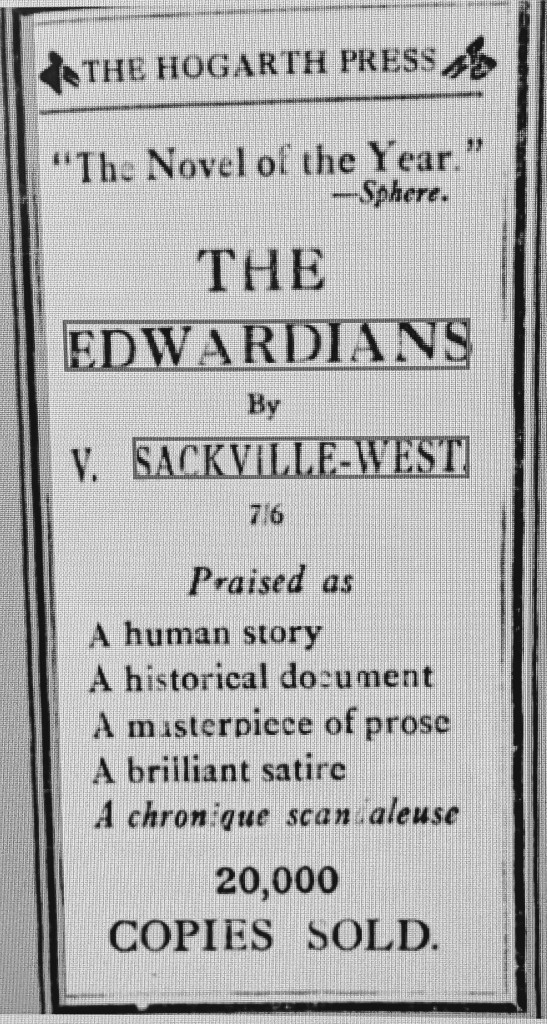
The Edwardians was originally published by the Hogarth Press, the publishing house run by Virginia Woolf and her husband Leonard. The book was a huge commercial success: by July 1930, within two months of its publication, Hogarth Press was already advertising that it had sold 20,000 copies. That the book clearly appealed to a working-class audience is evidenced by the popularity of the cheap sixpenny edition, of which 64,000 copies had sold by 1936.[2]

Advert for The Edwardians, Sheffield Independent, 14 July 1930, p. 3

Sackville-West herself was anything but working class. She grew up at Knole, a medieval palace remodelled into the Sackville family seat in the early 17th century (it is currently managed by the National Trust). Vita had many happy memories of her childhood at Knole, and in The Edwardians she created its fictional equivalent in the Chevron estate, seat of the Duke of Chevron. Chevron is the enduring foundation and backdrop throughout the book’s descriptions of upper-class parties and affairs.

The Edwardians’ main character is Sebastian, the young Duke of Chevron. At the opening of the book, in 1905, Sebastian is nineteen. He loves Chevron and being the head of the estate, but is vaguely dissatisfied with the social life of upper-class Edwardian England. Sebastian’s mother, Lucy, is part of the ‘smart set’: ‘They were all people whose names were familiar to every reader of the society titbits in the papers.’[3] Unlike the matriarchs of the Victorian period, Lucy’s friends think of themselves as less worried about decorum and ‘doing the right thing.’ One of the key themes of The Edwardians is how both the upper and the middle classes still put convention and appearance over personal freedom, despite their insistence that they have done away with Victorian primness.

Sebastian has three key relationships in The Edwardians, which are announced by its chapter headings. In 1905, he meets Anquetil, an explorer who is an outsider to Chevron’s smart set. Anquetil invites Sebastian to come away with him for a few years to see something of real life. Sebastian declines, as he has just fallen in love with Lady Roehampton, a 40-something married woman who is a friend of his mother and one of society’s great beauties. Lucy wholeheartedly approves of this affair, seeing it as a healthy rite of passage for a young man to be introduced to sex.

What is not intended, however, is that Lady Roehampton falls in love with Sebastian. When, after a year and a half, her husband finds out about the affair, he states she must move to the country with him and never see Sebastian again. This creates the first big crisis in the book: Sebastian tells Lady Roehampton that she should get a divorce and come away with him: Lady Roehampton, despite her belief that she is much more modern than her Victorian forebears, shrinks from the idea of divorce and dumps Sebastian instead.

Disgusted by the hypocrisy of the upper classes, Sebastian then pursues a middle-class married woman, Teresa. She is dazzled by the riches and ceremony of Chevron, but when Sebastian makes a pass at her at Christmas she is horrified that he would think she would cheat on her husband. Sebastian is now disillusioned with both the ‘smart set’ and the middle-classes. After a brief affair with a bohemian artist, he resigns himself to marrying a plain but proper daughter of a respectable family. Just before he decides to formalise his engagement, Anquetil shows up again. This time, Sebastian gratefully accepts the offer of escape from his cushioned life.

The Edwardians offers a detailed and, one senses, authentic view of upper-class society in the Edwardian period. Readers are entertained with descriptions of sumptuous parties and Downton Abbey-esque descriptions of the servants’ hall. At the same time, Sackville-West is critical of this lifestyle. For example, she repeatedly stresses that Lucy’s friends, despite their power and influence, are not particularly intelligent. When Teresa is invited to Chevron for Christmas and sits with the other ladies after dinner, ‘she was forced to admit that they did not seem to be saying anything worth saying.’[4] Sackville-West also pokes fun at the group’s own special lingo, ‘deevy’ for ‘divine’ and ‘adding an Italian termination to English words’: ‘lovel-are’ for ‘lovely’ and ‘dinn-are’ for ‘dinner’.[5]

Sackville-West’s critique also touches on more substantial matters: when Sebastian decides to give all his staff a raise of five shillings a week after New Year’s, it leads to critical self-reflection on his own part. He notes that the increase would cost him ‘thirteen hundred pounds a year; very little more than his mother would spend on a single ball; a negligible sum in his yearly budget. He felt ashamed.’[6] When at dinner, Lucy tells the other guests of the raise, Sebastian is harshly criticised by the other lords, who say that he has ‘spoiled the market’ for other landowners and that his staff will only ‘expect more’: ‘They all looked at Sebastian as though he had committed a crime.’[7]

Contemporary reviews of The Edwardians mostly did not note the social commentary of the book. Although the Aberdeen Press and Journal review noted that ‘The Mayfair, Belgravia, and country house lot are shown to us as publicly engaged in whitewashing their own and their neighbour’s private lives’[8], other reviews consistently described the book as primarily ‘entertaining.’[9] Several reviews note that whilst the Victorian period had been extensively revisited by historians and novelists, the Edwardian period had received less attention due to it being overshadowed by the war.[10]

The immediate cultural impact of The Edwardians can be seen in a throwaway comment in the Daily Mirror. In a brief article about Ascot fashion, the journalist writes:

On the cover of Miss Sackville-West’s novel “The Edwardians” there is pictured a group of presumably select persons of that period. The “happy few” look now like a number of charwomen out for a beanfeast. And the question is: Will the belle assemblée at Ascot to-day look like that – a ragbag assortment – in fifty years’ time to those who examine our back numbers? Very likely. But was does it matter? They look nice now.[11]

Already, mere weeks after its publication, The Edwardians was referenced as a text with whom all Daily Mirror readers were expected to be familiar. Whether they enjoyed it for its lavish descriptions of upper-class life, or for its social critique, it is undeniable that the book resonated with many interwar readers.


[1] Kate Williams, ‘Introduction’, in Vita Sackville-West, The Edwardians (London: Vintage, 2016), p. xv

[2] Ibid., p. x

[3] Vita Sackville-West, The Edwardians (London: Vintage, 2016), p. 27

[4] Ibid., p. 193

[5] Ibid., p. 194

[6] Ibid., p. 184

[7] Ibid., p. 205

[8] ‘Book of the Week: A Novel of Edwardian Society’, Aberdeen Press and Journal, 9 June 1930, p. 6

[9] ‘Real Life Raffles’, Daily Mirror, 23 June 1930, p. 20; ‘Woman in the West’, The Western Morning News and Mercury, 10 July 1930, p. 3

[10] ‘Books of the Day’, Birmingham Daily Gazette, 5 June 1930, p. 8; ‘Woman in the West’, The Western Morning News and Mercury, 10 July 1930, p. 3

[11] ‘Ascot Fashions’, Daily Mirror, 18 June 1930, p. 9

Looking on the Bright Side (1932)

Looking on the Bright Side (1932)

By 1932, Gracie Fields was already a huge star. Although she’d only appeared in one film, 1931’s Sally in Our Alley, she had been a major stage star and popular singer since the mid-1920s. After the big success of her first film, it was quickly followed up with a second one which showcases both Field’s singing talent and her comic wit.

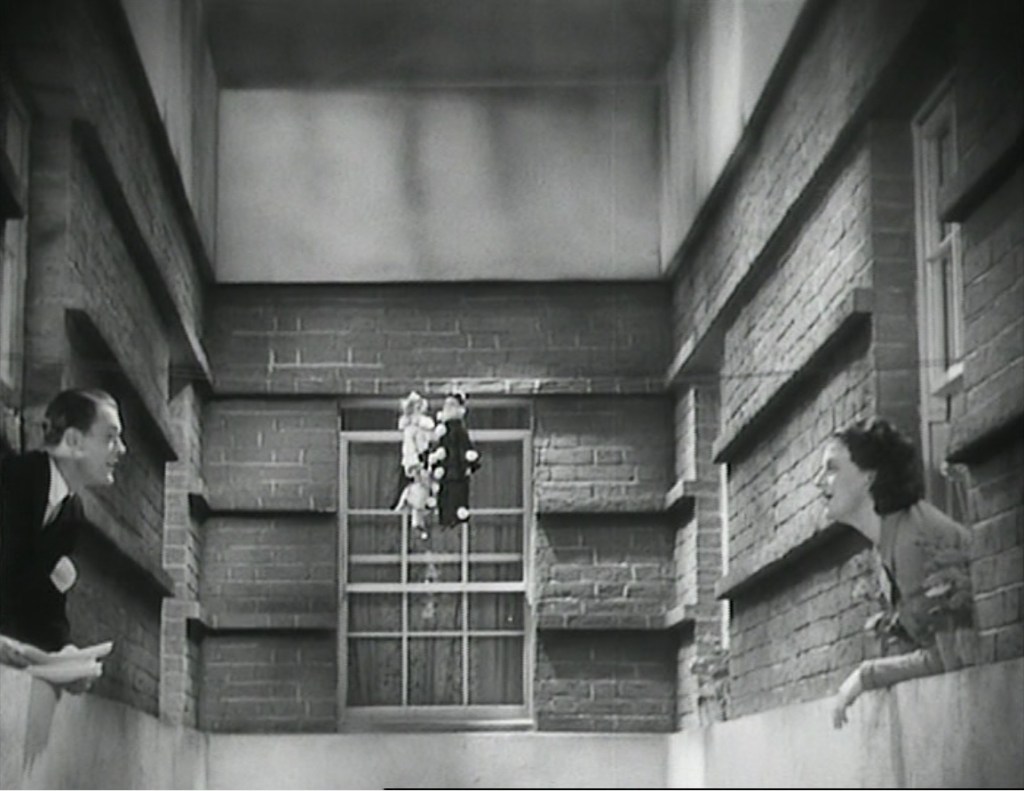
In Looking on the Bright Side Fields plays Gracie, first in a series of film roles in which her character have her name, to provide the illusion that she is essentially playing herself. Gracie is a manicurist who lives in a flat in a modern housing estate in London. Her boyfriend, Laurie, is a hairdresser in the same beauty parlour, and lives in a flat opposite Gracie. He is also a budding songwriter who is looking for his big break.

Directors Basil Dean and Graham Cutts make the most of the stage set with its symmetrical staircases running up the front of the building. During the film’s opening, all inhabitants of the estate sing along to Laurie’s newest song in a scene reminiscent of stage musicals. Laurie’s song is the titular ‘Looking on the Bright Side’ which reflects the particular brand of working-class optimism on which much of Fields’ stage persona traded.

Gracie and Laurie in their adjacent flats in Looking on the Bright Side

In the beauty parlour, where Laurie and Gracie work as a team on actress Josie Joy. When the couple tell Josie about Laurie’s new song, she offers to introduce them to her manager, Oscar Schultz. Gracie is sceptical but Laurie enthusiastically jumps at the chance to further his career. When Laurie’s song is a success with Schultz, Laurie gives up his hairdressing job and is swept off his feet by the attentions of Josie Joy.

Laurie doing Miss Josie Joy’s hair in Looking on the Bright Side

Gracie is left behind on the estate. She loses her job when the arrogant Josie Joy comes in for a manicure and Gracie is unable to treat her civilly. After briefly taking a job as a female police officer – a section of the film mostly used to showcase Fields’ comic talent – Laurie sees the error of his ways and he and Gracie reunite for a big singalong at the estate.

Fields’ celebrity persona was inextricably linked with her own, working-class Lancashire roots. She retained her strong northern accent throughout her career, and her films celebrate working-class community over individual fame and riches. The class conflict in Looking on the Bright Side is introduced when Laurie is first invited to play his songs for Oscar Schultz. When Laurie and Gracie arrive at Schultz’ suite at the Dorchester Hotel, a busy cocktail party is in full swing. The women present call each other ‘darling’ and use expressions like ‘it’s a scream!’ – expressions which the down-to-earth Gracie would never use.

After Laurie and Gracie perform their song, Schultz singles out Gracie and tries to persuade her to agree to a role in his next musical production. Although Schultz’ intentions appear to be honourable, his way of cornering Gracie and persuading her to drink another cocktail put her off, and she declines his offer. Laurie, in the meantime, is sitting at the piano surrounded by women and does not want to leave the party with Gracie. Instead he stays out till 3.30am, much to Gracie’s dismay.

Laurie’s dreams to make it big in showbusiness are portrayed as naïve and, to a certain extent, wrong. This is partly because his talent as a songwriter is limited; without Gracie, he struggles to write good songs and eventually Schultz sacks him. Gracie, on the other hand, is genuinely talented but is not interested in pursuing fame. Instead, she prioritises the community of the estate over individual ambition.

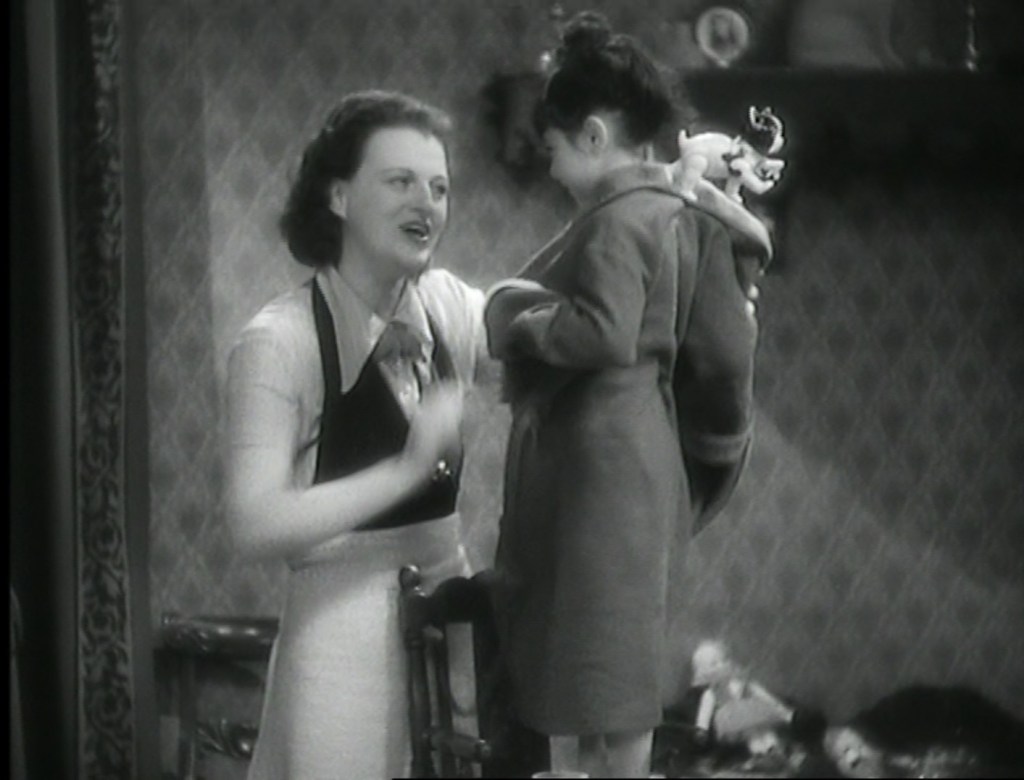
The sense of community is not only shown in the estate-wide singalongs that bookend the film, but also in Gracie’s relationship with her neighbour Hetty and Hetty’s young daughter Bettina. No explanation is given for Bettina’s absent father. Hetty works as a police officer and Gracie frequently looks after Bettina when Hetty is on duty. The very warm and natural relationship between Fields and the child actor provides a strong counterpoint to the vacuous lovemaking between Laurie and Miss Joy.

Fields acting with Bettina Montahners in Looking on the Bright Side

The section in which Gracie signs up with the Metropolitan Police has little relevance to the plot. Female police officers were still relatively rare in 1932, and they were certainly not regularly portrayed on screen. Predicably, the rigid enforcement of rules within the corps is used to set up some physical slapstick comedy situations for Fields. Although Fields quickly decides to leave the Police force, it is not the notion of female police officers which is rejected, but rather the idea that Fields herself would be suitable in such a controlled environment.

Looking on the Bright Side takes a reasonably meta approach to the business of song writing and song-selling, as the film itself was clearly a vehicle for selling records and sheet music of the songs it includes. At the same time, it obfuscates its own part in commercial song writing by presenting other careers and industries as more valuable and viable.