New Year’s Eve 1922

New Year’s Eve 1922

As is tradition on this blog, for the final post of the year we cast our minds back to exactly one hundred years ago and have a look at how New Year’s Eve was celebrated in London that night. After some rain earlier in the day, the evening of Sunday 31 December was cold and a bit windy but dry: no doubt a relief to Londoners keen to let their hair down.[1] According to the Manchester Guardian pre-midnight celebrations were ‘more subdued’ than in previous years owing to 31 December being a Sunday! Due to a special licensing hour dispensation, hotels could stay open till 2am.[2]

Well-heeled Londoners were excited to ring in the new year with elaborate parties in hotels and restaurants. Hotels spared no cost in their interior decoration: the dining room of the Berkeley Hotel ‘was transformed into a lighted vineyard’ and at Claridge’s guests walked through an Italy-inspired landscape.[3] At the Savoy Hotel, a large amount of Christmas crackers were pulled during an ‘elaborate banquet’ – 25,000 crackers according to the Daily Express, but 35,000 according to the Mirror.[4] Some venues put on performances: at the Metropole Hotel midnight was marked by ‘a dainty little girl dressed as Cupid [appearing] from a huge cracker, which was pulled by Father Christmas.’[5] At the Piccadilly Hotel grill room a female singer appeared out of the top of a huge champagne bottle at midnight to sign Auld Lang Syne.[6]
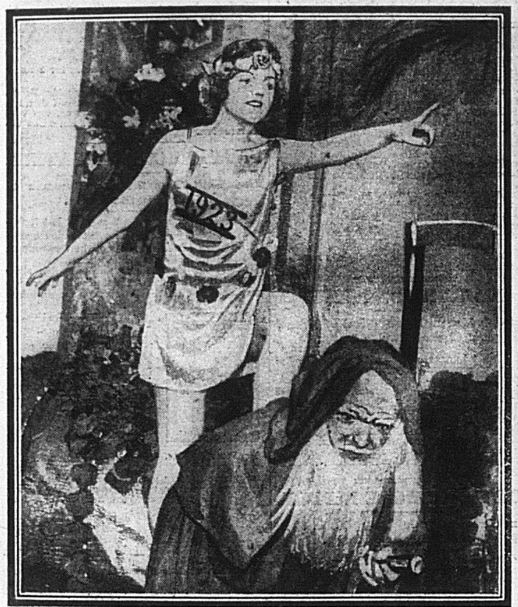
A young woman, representing 1923, banishing old 1922 in an unspecified performance. Image: Daily Mirror, 1 January 1923, front page

For those who could not afford to be in the hotels, the streets of London provided a suitable party venue. The steps of St Paul’s Cathedral were one of the traditional sites of celebration, and crowds started gathering there hours in advance.[7] The Daily Express reporters, always ready with more evocative language then their colleagues at rival papers, described the crowds in the West End as follows:

They were “grown ups” who surged in dense masses through the streets, but the joy of childhood – Christmas party childhood – was rampant. Every one wore a paper hat, and nearly every one was blowing a toy trumpet. Street corners were impromptu ballrooms.[8]

Aside from the evening celebrations, the New Year also meant the publication of the annual honours list, announcing which luminaries had been bestowed honorary titles. In 1923, the prominent and popular Home Office pathologist, Bernard Spilsbury, was knighted and could henceforth call himself Sir Bernard Spilsbury.[9]

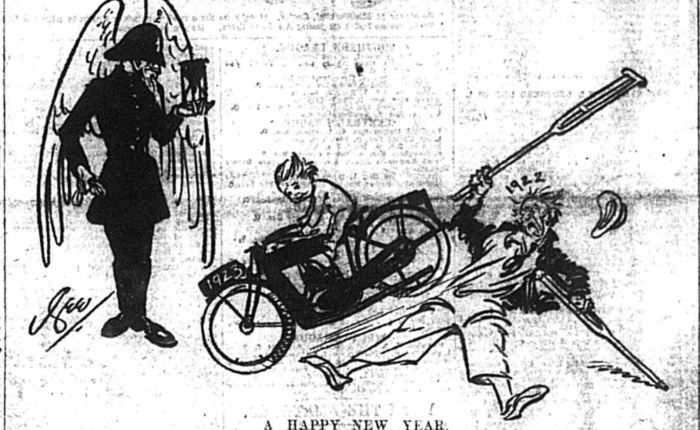
Cartoon in News of the World of 31 December 1922 reflecting the growing concerns on the dangers of motorized traffic, which would come to a head in the early 1930s.

The beginning of the new year also meant the start of winter sales in all the big department stores. The growing importance of consumerism, and the increase in disposable income, are marked by the prominent articles appearing in the popular press about the sales. ‘Thousands of women will to-day celebrate the coming of 1923 by “raiding” the great London stores in the breathless but happy hunt for bargains’ predicted the Daily Mirror.[10] In an article that essentially sums up the offers at each of the great stores, readers are advised that whilst buying ‘indiscriminately’ is never a good idea, one can’t go wrong with staples such as ‘gloves, shoes, underclothes etc’.[11]

The Sunday papers on 31 December had already carried large adverts for each of the store, preparing shoppers to the bargains that could be had. Like the Daily Mirror article, these were almost exclusively aimed at the female readership. It was clearly understood that shopping in a sale was the kind of frivolous activity that only women would engage in. At Dickins & Jones, a clearance of ‘model gowns’ (ie. those used for display purposes) meant that prices started at 7 ½ guineas – a guinea being 1 pound and 1 shilling.[12] On the same page, competitor Marshall & Snelgrove advertised a fur coat for 89 guineas; it had previously been between 125 and 179 guineas so this discount was indeed a ‘wonderful bargain’ although it was clearly out of reach for the vast majority of the population.[13]

By the time the Evening Standard appeared in the afternoon, it was able to report on the ‘bargain day scenes’ in breathless and rather sexist tones. ‘The occasion had much more significance for the ladies than the mere advent of the New Year, and (…) they stormed the whole of the shopping centres in their myriads.’[14] Some of the items on offer according to this article were velour coats with mole collar and cuff trimmings at 4 ½ guineas, and a knitted woollen gown at 27 shillings and sixpence; clearly the readership of the Evening Standard had less to spend than the readers of the Observer.

Elsewhere, the Evening Standard reported on the continued imprisonment of Edith Thompson and Freddie Bywaters, who would be executed on 9 January for the murder of Edith’s husband. Other papers noted the republic of Ireland’s recent independence, which was officially finalised in December 1922.[15] All was not well in the remainder of the Union either, with Scottish hunger marchers protesting in London on the first day of 1923.[16] Although the New Year’s Eve parties and January sales gathered the most prominent coverage, it is clear that below the celebratory surface troubles were brewing as Britain continued to deal with the fall-out of the Great War.


[1] ‘Week-end Weather’, The Observer, 31 December 1922, p. 14

[2] ‘New Year Revels in London’, Manchester Guardian, 1 January 1923, p. 7

[3] ‘At the Hotels’, Daily Express, 1 January 1923, front page

[4] Ibid.; ‘1923 Danced In by Merry Throngs’, Daily Mirror, 1 January 1923, p. 3

[5] ‘1923 Danced In’, Daily Mirror

[6] ‘New Year Revels in London’, Manchester Guardian

[7] Ibid.

[8] ‘Great Crowds in the Streets’, Daily Express, 1 January 1923, front page

[9] ‘New Years Honours’, Daily Express, 1 January 1923, p. 7

[10] ‘Sales Carnival Begins To-Day’, Daily Mirror, 1 January 1923, p. 2

[11] Ibid.

[12] ‘Dickins & Jones’ advert, The Observer, 31 December 1922, p. 9

[13] ‘Marshall & Snelgrove’ advert, The Observer, 31 December 1922, p. 9

[14] ‘Bargain Day Scenes,’ Evening Standard, 1 January 1923, front page

[15] ‘Politics at Home and Abroad’, Daily Telegraph, 1 January 1923, p. 4

[16] ‘Hunger Marchers’ Complaints’, Evening Standard, 1 January 1923, p. 8

Father Christmases of London

Father Christmases of London

After last week’s slightly political piece, this week we’re launching into proper festive content. Again we’re turning our attention to Picture Post, the weekly photojournalism magazine launched in October 1938. In it’s first December, Picture Post ran an article on the ‘Father Christmases of London.’ The reportage gives an insight in this enduring seasonal job and the backgrounds of the men who took it on.

The piece appeared in the Picture Post of 17 December 1938 and ran across four pages. It is an article of two parts; the bottom third of the pages is taken up by an article setting out the cultural and historical background of Santa Claus in detail. It recalls the original Catholic Saint Nicholas, and how the worship of this saint diverged across different countries over time. It notes that ‘Protestantism has rooted out St. Nicholas Day from the English ecclesiastical calendar’[1] but that Santa Claus got imported back from the US after the tradition was started there by Dutch settlers. The article even covers localised European customs such as the Krampus, the origin of Christmas trees and of Santa Claus’s traditional dress.

Alongside this thorough exploration of the origins of Santa Claus, Picture Post presents portraits of ten men who are playing Santa across various department stores in London in the winter of 1938. Each man is shown both in their Santa outfit, and as their ‘normal selves’. The article shows how important and well-known the tradition of live Santa’s was to London’s luxury shopping market.

The background of these men puts them in one of two camps: half of them work or have worked in the department stores in which they act as Santa; the other half are actors, models or other types of entertainers. In the case of the first group, playing Santa appears to be a nice break from their day job for the month of December, after which they move back to their regular duties in January. George Dixon, for example, ordinarily worked in the wallpaper department at Barker’s, a large department store in Kensington. He had acted as the store’s Santa every year since his appointment as salesperson. It is likely Dixon was chosen for the role because he had a background as an actor in travelling troops.

George Dixon as Father Christmas for Barker’s in Kensington

Henry Tapsell, who acted as Santa in the Thomas Wallis department store in Holborn, did not have an acting background. He was a porter in the furniture department of the shop, a job which appears to have been one in a line of various manual labour roles. He started playing Father Christmas at the tender age of 26, finding it ‘a pleasant relaxation after shifting furniture for eleven months.’ At the other end of the age range, Alfred Hibbard, who played Santa in the Clapham store of Arding & Hobbs, was already retired. Prior to his retirement he worked in the shop as a porter. He took up the Father Christmas role after his retirement, probably to supplement his pension payments. Harrods’ Santa was also a member of staff: Herbert Heslam, who had worked in the calico, cotton and rayon department for twelve years.

It obviously made financial sense for some department stores to use existing staff for this December engagement. These men were often long-term employees so proven to be reliable, and apparently they could be spared on the shop floor despite a likely Christmas rush. Their regular roles demonstrate that department stores regularly employed male staff, but that they were often placed in furniture and home furnishing departments which required more heavy lifting and manual handling.

Other shops went down a different route, hiring freelance actors and models for this seasonal employment. Selfridge’s, for example, opted in 1938 to hire actor and model Charles Mackenzie. Mackenzie, an Australian who had made it over to Britain after fighting as an Anzac in the First World War, estimated he had appeared in up to 200 feature films. Sydney Kempster, who played Santa at Gamage’s department store in Holborn, was also a film extra. Although he was less prolific, he had some high-profile credits to his name such as a small role in Victor Saville’s Sailing Along and the ensemble film O-Kay for Sound. According to the article, ‘in the old days of silent films’, Kempster also ran a cinema.

Charles Mackenzie as Santa for Selfridge’s

A similarly enterprising attitude was taken by Stanley Ross, who played Father Christmas at Whiteley’s in Bayswater. Prior to the First World War Ross was a producer of silent films, producing two films with the famous actor Lupino Lane. Ross also acted in films. The most varied showman playing Santa in 1938 was Hamilton Harvey, who took up the red mantle for Derry & Tom’s in Kensington. Harvey was a conjuror, ventriloquist, musician and composer with his own music hall act. According to the Picture Post article he played eight different instruments – it is not recorded whether he incorporated any of them in his Santa Claus act.

This Father Christmas article is typical of the things Picture Post printed in its early years. It combines fairly in-depth historical detail with contemporary reportage on a human interest topic. One can imagine the editorial pitch meeting in which a reporter suggests finding out who is behind the fake moustaches and beards of London’s Santa’s. The 1930s still saw a high number of large department stores in the capital, each willing to invest in a real, permanent Father Christmas for December to draw in the crowds.

At the same time the men taking up the elaborate robes in these opulent surroundings were largely of working-class backgrounds. For some, playing the role was a welcome break from a physically demanding job on the shop floor. For others, it represented a quasi-steady gig in an uncertain free-lance career in the developing entertainment industry. The Picture Post article not only gives an insight into Christmas traditions of the late 1930s, but also into consumer culture and working conditions of the time.


[1] ‘These are the Father Christmases of London’, Picture Post, 17 December 1938, pp. 34-37

Christmas in hard times

I was looking over copies of Picture Post magazine in the hope of finding some nice Christmas-related content to write about. I did find something fun, which I’ll expand on in next week’s blog post, but during my search I also came across an opinion piece which seemed to speak in some way to the climate in which we are celebrating Christmas in 2022.

Picture Post was founded in October 1938 as a weekly news photography magazine. Each issue contained mostly short articles accompanied by extensive photo reportages. The types of items covered ranged from science and biology (the development of a kangaroo embryo) to international politics and society and celebrity news (like the article on Gracie Fields I’ve written about before). Each week there was also an opinion piece by Edward Hulton, the publisher of Picture Post.

Within a year of it’s launch, Britain was at war. During December 1939, the editors of Picture Post attempted to strike a balance between delivering war news – such as a weekly recap of developments – with the kind of feel-good content the magazine was also associated with. On 9 December 1939 Hulton used his regular page to encourage readers to ‘Spend at Christmas!’.[1] Readers would be helping the war effort, he argues, not by saving their money but rather by spending it freely to boost the economy. Additionally, going all-out at Christmas would ‘not only [be] an escape from the horrors of war, but [also] a remembrance of nobler ideals.’[2]

The main area in which money should be spent, according to Hulton, was women’s fashion. In this ‘silk stockings economics’ model, people spend on consumer goods that require rapid replacement (although under our current fast fashion model, the rapidity with which silk stockings wore out in the 1930s is probably relative). This, in turn, generates economic activity which is good for the country as a whole. Additionally, retaining a focus on the production of fashion at a national level would, Hulton argued, allow Britain to collaborate at an economic level with France. Paris was still the undisputed fashion capital of the western world, and ‘[t]here is no reason why London and Paris should not go hand in hand as arbiters of style.’[3]

Conscious that his male readership may find all this concern about women’s fashion to be a tad frivolous, Hulton hastens to add, almost as an afterthought, that the British motoring industry should continue to export to raise funds for the production and purchase of armaments. But for Hulton, celebrating Christmas and buying luxury goods is a matter of principle, too. He ends his article with the following bold statement:

And if we are merry at Christmas, we shall be showing the Nazis that we are winning the war of nerves, and maintaining the gallant spirit which has overcome adversities which are no novelty to this very windswept isle.[4]

The idea of British pluck is here repurposed to make it a moral obligation for people to celebrate Christmas as normally as possible, despite the country being in a state of war. Granted, December 1939 was in the middle of the ‘Phoney War’ during which there was limited fighting and the anticipated air raids on British cities had not yet materialised.

Hulton turns national pride into a capitalist function, arguing that to spend money on perishable and luxury goods demonstrates a commitment to British values in the face of Nazism. It should be noted that Hulton, and the editorial staff of Picture Post, were politically left-wing and continually highlighted the plight of Jewish people and refugees throughout the Second World War. His reference to the ‘gallant spirit’ of the British was not one that was specifically linked to one political party over the other.

In 2022, millions of people in Britain are facing economic hardship in the run-up to Christmas, often unable to afford basic necessities such as food and fuel. Average spend on Christmas gifts is expected to drop across almost all categories, particularly more expensive goods such as electronics and clothing. Although there is a foreign ruler whose criminal actions have impacted on the economy, much of the current situation is created by successive British governments.

The argument that people should carry on as normal in the face of adversity as an act of national defiance certainly does not hold any weight in the current context. Equally, encouragement to spend on consumer goods to boost the economy, which may have had more resonance during more recent economic crises, become irrelevant when people have no additional money to spend. Consumers no longer have the ability to boost the domestic economy, leaving us to face a Christmas worse than one that took place during the Second World War.


[1] Edward Hulton, ‘Spend at Christmas!’, Picture Post, 9 December 1939, p. 45

[2] Ibid.

[3] Ibid.

[4] Ibid.

Radclyffe Hall

Radclyffe Hall

Radclyffe Hall – which, really, was her given name (in full, Marguerite Antonia Radclyffe Hall) – is probably one of interwar Britain’s most famous LGBTQI+ people. She took the name John later in life, but her novels were published under the name ‘Radclyffe Hall’, which is how she remains best known.

Hall’s most famous work is the 1928 novel The Well of Loneliness, which was subjected to an obscenity trial in the UK after vigorous campaigning by the Sunday Express. As was fairly common at the time, English copies of the Well of Loneliness were subsequently printed in Paris; increased mobility between the two capitals including via airplanes ensured that some copies of the work continued in circulation in Britain.

Hall was also born in a family of means, with both her parents inheriting money from their parents. Hall’s father set her up with an independent income which allowed Hall to shun the conventional route of work and marriage and allowed her to develop her literary ambitions. She initially published poetry – five volumes between 1906 and 1915. From an early age Hall adopted a masculine style of dress, including wearing trousers, tailored jackets, and hats.

During a part of the 1920s, Hall lived in Kensington with her partner, Una, Lady Troubridge. They were together from 1916 until Hall’s death. London’s somewhat unruly nightlife during the interwar period allowed for the existence of LGBT-friendly spaces. From the mid-1920s Hall started to publish works of fiction. Her third book, Adam’s Breed, which was written in the Kensington flat, became a prize-winning bestseller. The commercial success of Adam’s Breed arguably partially caused the vocal backlash to Hall’s next work, The Well of Loneliness. Had she been less famous, there would have perhaps been less concern about the content of the work.

The plot of The Well of Loneliness centres on Stephen Gordon, an upper-class English woman who considers herself a ‘sexual invert’ (ie. she is a lesbian). The book chronicles Stephen’s childhood, an early love affair with an older woman, Stephen’s career as a novelist in both London and Paris, and her experiences as an ambulance driver in World War One. During the war, she meets and falls in love with fellow ambulance driver Mary, and the pair set up a household together after the war.

Although the book is far from sexually explicit, there is one reference to Stephen and Mary going to bed together; and throughout, Stephen insists that ‘sexual inversion’ is not unnatural. Stephen’s (and by extension, Hall’s) views on lesbianism closely echo those of 19th-century lesbian Anne Lister, by some considered to one of Britain’s first ‘modern lesbians.’

Due to the success of Adam’s Breed, The Well of Loneliness was reviewed by journalists upon its publication; early reviews were measured.[1] However, James Douglas, the editor of the Sunday Express who earlier in the decade had found much fault with convicted murderer Edith Thompson, took it upon himself to publish a front-page take-down of the book on 19 August 1928. His editorial included the statement that ‘he would rather give “a healthy boy or a healthy girl” poison than let them read The Well of Loneliness.’[2]

Hall’s publisher protested that the intervention of the Sunday Express gave the book more publicity and sensationalised it, and many other journalists and writers defended the work. Nevertheless, an obscenity trial started on 9 November 1928 and included expert witness testimony to confirm that one could not ‘become gay’ by reading a book about a gay relationship. The magistrate, Sir Chartres Biron, concluded that the novel’s literary merit counted against it: ‘the more palatable the poison the more insidious’.[3] He ordered that all copies of the book were destroyed, and The Well of Loneliness was not published again in Britain until 1959.

Hall attended the trial, although she was not on the stand as the trial was against her publisher rather than herself as a person. Her masculine appearance, widely reported in the press, ‘crystallised a particular vision of the mannish lesbian’ for the remainder of the interwar period.[4] A similar obscenity trial in the US had the opposite outcome to the British one, ‘finding that discussion of homosexuality was not in itself obscene.’ Hall only published one more novel during her lifetime, The Master of the House, which was poorly received. During the 1930s Hall and Troubridge moved out of London to the coastal town of Rye. Hall was diagnosed with cancer during the Second World War and died in 1943. She is buried in Highgate Cemetery in London, alongside other writers and artists such as George Eliot, Elizabeth Siddal and Anna Mahler.


[1] Christopher Hilliard, ‘“Is It a Book That You Would Even Wish Your Wife or Your Servants to Read?” Obscenity Law and the Politics of Reading in Modern England’, American Historical Review, June 2013, p. 666

[2] Ibid.

[3] Merl Storr, ‘Palatable Poison: Critical Perspectives on The Well of Loneliness’, review, Sexualities, Vol 6, no. 2, 2003, p. 264

[4] Emma Liggins, Odd Women? Spinsters, lesbians and widows in British women’s fiction, 1850s–1930s (Manchester: Manchester University Press, 2014), p. 163

100th Blog Post!

<strong>100th Blog Post!</strong>

A special edition of the blog this week, as we have reached 100 posts! Here’s a look behind the scenes.

Basics

A new blog post appears every Wednesday, at 9.30am UK time.

On average, blog posts are about 1,050 words long. This means that there are now over 100,000 words written on this blog!

There are currently five different categories of posts: Fiction; Film; Newspapers; People; and Everything Else. Some posts are in more than one category if they cross over.

Film is by far the biggest category, betraying both my background in that subject and my commitment from the start of the blog to regularly highlight underappreciated British interwar films. Fiction is so far the smallest category, but it’s catching up rapidly.

There are also tags at the bottom of each post, which allow for more fine-grained categorisation. The most commonly used tags are Women; Journalism; and Police. Do use the tags to easily find more blogs about a particular topic.

Most popular posts

In the past two years(ish) of running this blog, one post has received way more attention than any others. The most popular post by a long way is Friday Night is Amami Night – this was one of the first blogs to appear and it remains consistently popular with readers.

Other evergreen posts are:

Car ownership and regulation in interwar London
W. Lusty & Sons Ltd – Furniture Makers; and
The Prince of Wales and the interwar craze for Fair Isle jumpers

Hidden gems

With a new post coming out every week, naturally some get more attention than others. Here are some posts that you may have missed:

Woman: Her Health and Beauty (1919): a deep dive through an early interwar exercise book for women. I try my best to include items and texts from the early interwar period (pre-1925) to give a rounded view of the period.

Mr Smith Wakes Up (1937): a short film addressing racism and colonial attitudes in interwar Britain. It’s definitely reflective of the period and not perfect by a long shot, but it’s also an all-too rare example of Black Britons being given a voice on screen in the 1930s.

1927: More Women Die Young: A good example of the mad populist newspaper articles that were absolutely everywhere during the 1920s and 1930s (and still are today, of course). The Daily Mail argued that being single as a woman would drastically shorten your lifespan.

Alfred Hitchcock’s Downhill (1927): One of the earlier films of one of the best-known film directors of the 20th century. Welsh heartthrob Ivor Novello stars as a young man whose life is ruined after taking responsibility for an unwanted pregnancy that he did not cause.

The Love Test (1935): One of my all-time favourite interwar films. Set in a chemical lab, it showcases (competent!) female scientists.

Readership

Predictably, the vast majority of the blog’s readers are based in the UK. This is followed by some distance by readers from the US, the Netherlands, Canada and China. However, I’m very pleased to say there are also readers in Vanuatu, Peru, Slovakia, Uruguay, Trinidad & Tobago, Pakistan, American Samoa, Taiwan, Denmark and many, many more. In fact, there have so far been readers of over 60 countries and territories!

I’m delighted that the blog has such a far reach, which is increasing week by week. I hope that it contributes in some way to make 1920s and 1930s British history more accessible to anyone with an interest in the topic.

Winifred Holtby – South Riding (1936)

Journalist, author, feminist and activist Winifred Holtby was a distinctive voice in interwar Britain’s press. In her journalism pieces she often challenged social inequalities and advocated for change. Aside from her journalistic output, Holtby also wrote seven novels. The most famous of these is South Riding, which was published posthumously after Holtby’s death at the age of 37. Vera Brittain, Holtby’s close friend and an accomplished author in her own right, edited the manuscript of South Riding and got it ready for publication.[1] The book met with critical success upon its publication, and was turned into a Victor Saville-directed film in 1938. The story’s enduring resonance is evidenced by the BBC adaptation which appeared as recently as 2011.

The scope and order of South Riding are ambitious: the novel opens with a list of characters no shorter than 6 pages in length. The story is set in the fictional South Riding of Yorkshire. A facsimile of a hand-drawn map by Holtby in the front of the Virago edition of the book shows that she imagined the Riding to be located in the triangle between York, Scarborough and the northern border of Lincolnshire.

South Riding is a novel concerned with local government. Across its 500 or so pages, the novel is divided into eight ‘books’, each named after a sub-committee of South Riding Council. Through ‘Education’; ‘Highways and Bridges’; ‘Public Health’ and others, Holtby weaves a tale of modernity and tradition, and the deep interconnectedness of rural communities.

In a book with such a vast range of characters, the closest thing South Riding has to a protagonist is Miss Sarah Burton, M.A. (Leeds), B.Litt (Oxon), the thirty-something new headmistress of the local girls school, whose return to the county of her upbringing kicks off the book’s narrative. Sarah has decidedly modern ideas about education and life in general. Her modernising spirit runs up against the traditions of the South Riding Aldermen, who sit on the Council and have been used to running things their own way.

These Aldermen also reflect a changing society, however: Anthony Snaith is a rich business owner and Mrs Beddows is the Riding’s first female Alderman. Holtby famously modelled Beddows on her own mother, Alice, who was the first woman Alderman in the East Riding of Yorkshire. Alice Holtby initially opposed the publication of South Riding, worried as she was to the damage it may do to local political relations.

The central relationship in South Riding is between Sarah Burton and Robert Carne, a gentleman farmer who occupies the local ‘Big House’, Maythorpe Hall, with his teenage daughter Midge. In an echo of Victorian Gothic literature, Carne’s wife is alive but insane and permanently locked up in an institution. The prohibitive medical costs for her care have led Carne to the brink of financial destitution. Maythorpe Hall is falling apart around him. Divorce is not an option for him, not because it is legally impossible but because he finds it morally unpardonable.

The emotional and intellectual connection between Sarah and Carne builds up throughout the novel. One of the key scenes of South Riding occurs when the pair find themselves staying over in the same hotel. Under the chapter heading ‘Two in a Hotel Find Themselves Temporarily Insane’, Holtby pens what was a decidedly modern and transgressive scene for mid-1930s Britain. A pleasant dinner turns into a night of dancing, and several drinks build the intimacy between the couple. As the evening draws to a close, Sarah invites Carne to visit her in her bedroom, room number ‘five hundred and seventeen.’[2] For a woman to invite a man to her bedroom was of course already frowned upon, but to do so to a married man broke all the rules of propriety. Equally, Carne’s grateful and enthusiastic response did not match behaviour expected of a gentleman.

Throughout the scene, Sarah remains calm and steadfast. Whilst awaiting Carne’s arrival in her room, she smiles at herself. When he asks her if she is really sure she wants to go ahead with it, she confirms ‘I know now I have never been sure of anything before in my life.’[3] The only reason the relationship does not get consummated is because Carne has an acute attack of a recurring heart problem. This rather disturbs the mood and the couple do not get a chance to be alone again for the night after that. Morally and emotionally, however, both Sarah and Carne were committed to an affair which neither of them believed to be wrong, despite it going against the generally espoused conservative values of the time.

South Riding conveys the effect of modern ideas on a traditional community, both for better and for worse. At the same time, it treats the local community and the Council with a deep respect. Everyone in the South Riding needs one another eventually, and progress, however difficult, does penetrate the region through the diligent work of the local representatives.


[1] Shirley Williams, ‘Preface, in Winifred Holtby, South Riding (London: Virago Press, 2010), p. x

[2] Winifred Holtby, South Riding, p. 367

[3] Ibid., p. 368

Football in interwar Britain

<strong>Football in interwar Britain</strong>

Following on from last week’s post about The Arsenal Stadium Mystery, in the run-up to Qatar 2022 this week we’ll look at football in interwar Britain more generally. Football was invented in England, and it remains the most popular spectator sport in the country today. During the interwar period, the sport itself as well as the spectator culture around it were frequently represented in popular media.

First, the basics. League football was (and is) governed in England by the Football Association (FA), which was formed in 1863. In the 19th century, the FA unified football rules to a single set that applied across the country and started running various leagues including the FA Cup. In 1923 a new dedicated stadium was built at Wembley as part of the Empire Exhibition. The stadium was inaugurated by that year’s FA Cup final.

League matches usually took place on Saturday afternoons, after the 5 ½ workday week was finished. From the start, football had primarily been a working-class sport, with some spectator groups building a reputation for unruliness or even violence. The FA cup was keen to improve football’s image during the interwar period, and argued that playing and watching football increased a sense of community. They even went as far as arguing that football would ‘prove helpful in the present unsettled condition of industrial affairs of the country’ during the 1926 General Strike.[1]

Another aspect of the FA’s attempts to make football more socially acceptable during the interwar period was to attract middle-class spectators. One strategy for lowering the barrier of attendance at games for middle-class spectators was to create segregated pricing: certain sections of seats would be more expensive than others, thus creating an automatic division between middle-class and working-class spectators. This concept was very familiar to anyone travelling by train in interwar Britain, as trains retained first, second and third-class carriages. Cinemas used the same strategy during the 1920s to also increase middle-class attendance and thus become more respectable.

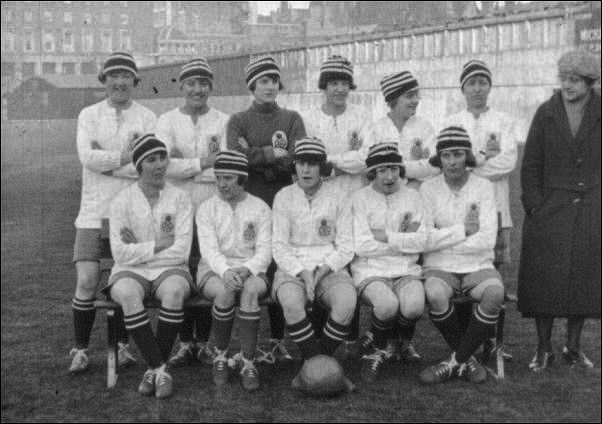
Attendance of women at football matches was also a sure sign of increased respectability. By the time The Arsenal Stadium Mystery was written at the close of the interwar period, it was believable that two young, unmarried women would attend an Arsenal match together. Yet at the start of the interwar period, women’s participation in football had been much more comprehensive. Women had been playing football since the end of the 19th century, but the sport’s popularity increased significantly during the First World War. During the war, many young working-class women worked in munitions factories, which often set up their own football teams to give workers a chance to exercise, let off steam and bond with co-workers.[2]

By the time the war was over, women’s football had become established and also increasingly popular. Its growth as a viable sport was cut short, however, by the FA’s decision to ban women’s teams from playing matches on any FA-affiliated pitches.[3] The decision was allegedly influenced by jealousy at the crowds women’s matches were drawing, and the associated income this represented to women’s clubs. The decision did not completely end women’s football in Britain, as evidenced by this British Pathé clip from 1925 of a match at Herne Hill. It did, however, severely hamper the development of women’s football in Britain.

Off the pitch, thousands of people turned out to watch their favourite team win or lose, each week. Apart from the thrill of the game, spectatorship also brought in additional pleasures. One activity that has been indelibly linked to both football and British culture is betting. As sports historian Mike Huggins has argued: ‘Betting combined excitement, sociability and the prospect of becoming temporarily better off. (…) [A]cross the classes, across the country, and across age and gender, betting was increasingly ubiquitous and socially acceptable’ during the interwar period.[4]

Exactly how socially acceptable betting was is evidenced in the plot of the 1938 film Penny Paradise, starring popular actor Edmund Gwenn. In this film, Gwenn’s character Joe Higgins, a tug-boat driver, believes he has won the ‘penny pools’, a newspaper competition that asks readers to accurately predict the outcomes to all the league’s football matches. Joe gets all the scores right, but he doesn’t realise that his friend Pat forgot to post his scores to the newspaper office on time. The film good-naturedly chronicles Joe’s initial belief that he has become a rich man, and then the subsequent realisation that he has missed out. By the late 1930s, betting constructions like penny pools were evidently so widely understood and accepted that they could form the basis of a gentle comedy film.

Football in interwar Britain then was as pervasive as it today, whether that was as a sport to participate in at an amateur level; a game to watch every Saturday; an activity that allowed you to bet and dream of a better future; or something that you saw on newsreels when you went to the cinema.[5] Like many elements of interwar popular culture, it responded to changing gender roles and class divisions, whilst never losing its ability to draw people together.


[1] Joe Maguire, ‘The Emergence of Football Spectating as a Social Problem 1880 – 1985: A Figurational and Developmental Perspective’, Sociology of Sport Journal, vol. 3, (1986), 217-244 (p. 230)

[2] Lisa Jenkel, ‘The F.A.’s ban of women’s football 1921 in the contemporary press – a historical discourse analysis’, Sport in History, vol. 41, no. 2 (2021), 239-259 (pp. 243-44)

[3] Ibid., p. 240

[4] Mike Huggins, ‘Betting, Sport and the British, 1918-1939’, Journal of Social History, vol. 41, no. 2 (2007), 283-306 (p. 285)

[5] Mike Huggins, ‘‘And Now, Something for the Ladies’: representations of women’s sport in cinema newsreels 1918–1939’, Women’s History Review, vol. 16, no. 5 (2007), 681-700

Leonard Gribble – The Arsenal Stadium Mystery (1939)

Ahead of the 2022 World Cup starting in Qatar, there will be a couple of weeks of football-related content on the blog. Football was a popular sport for working-class spectators in interwar Britain, alongside (greyhound) racing and motor sports. Some historians even credit the popularity of football with bringing diverse social and ethnic groups togethers as neighbours went to support their local teams.[1] By the end of the interwar period, football clubs at the top end of the league were almost completely populated by professional footballers; but there were also still plenty of amateur clubs which delivered players of a high calibre. League matches were usually played on a Saturday afternoon, as most workers finished their weekly shifts at lunchtime on Saturday.

At the close of the 1930s, the Daily Express decided to capitalise on the increased popularity of professional football by commissioning author Leonard Gribble to write a serialised murder mystery which featured the real-life players and staff of Arsenal Football Club.[2] After serialisation, The Arsenal Stadium Mystery was published as a book and a film version was made almost immediately; both appearing shortly before the outbreak of the Second World War.

The plot of The Arsenal Stadium Mystery is fairly straightforward: Arsenal play an amateur team, the Trojans. During the match, one of the Trojan players, Doyce, collapses on the field and dies shortly afterwards. Scotland Yard are called in and conclude Doyce was poisoned; Inspector Slade methodically works through the possible suspects until the case is resolved. Although a number of Arsenal players appear as characters in the book (and the Arsenal manager, George Allinson, even got a speaking part in the film adaptation) they are naturally not implicated in the murder or its resolution.

The police investigation concentrates solely on the Trojan players and staff. The conceit of the football game provides the type of ‘closed circle’ which interwar detective fictions liked to use: a very limited number of suspects, a tightly controlled window in which the murder must have taken place; and limited ways in which the weapon could be disposed of.

Aside from the murder story, The Arsenal Stadium Mystery provides the modern reader with plenty of insight into 1930s professional football practices. Gribble was clearly given access to the Arsenal club players and grounds in the writing of the book – the parts of the stadium to which the public do not usually have access are described in detail. The rapid professionalisation of football is reflected in the vigorous training practices of the players: ‘The game to-day is faster than it has ever been (…) Only the fit can survive.’[3] Arsenal also apparently already had a youth academy set up, dubbed a ‘nursery’, to train up promising young players.[4]

When it comes to the game itself, Gribble provides a diagram reflecting the starting positions of both teams. Both Arsenal and Trojans are shown to play with five forwards, three midfielders and two defenders[5]; a formation that was much more common in the early days of professional football than it is today. The author also provides an almost play-by-play account of the match, in sections of the story clearly written with football-mad Daily Express readers in mind.

As well as details about the actual gameplay, Gribble pays substantial attention to convey the culture of football fandom. For example, he spends several pages describing the convivial atmosphere in the streets and train stations around the stadium after the match is over:

‘In the trains the corridors and entrance platforms are choked (…) The air is full of expunged breath, smoke, human smells, and heat. But there is plenty of laughter, plenty of Cockney chaff. Whatever happens, however great the discomfort, the crowd keeps its good-temper. This herded homegoing is just part of the afternoon’s entertainment.’[6]

Needless to say, this ‘entertainment’ is described as an innately masculine past-time. It would not be possible for women to enter this crush of human bodies. When Inspector Slade of Scotland Yard enters the story, he too enters in a social pact with the football players which excludes women. During his investigation, he questions one of the Trojan players, Morring, in front of a woman friend, Jill. Morring implies in guarded language that his fiancée, Pat Laruce, had had an affair with the victim, Doyce. Slade:

‘‘I take it you told him to be careful or next time he’d have more painful reason to regret his – um – interference?’ The two men grinned, while the girl looked from one to the other, wide-eyed, unable to appreciate a humour that was essentially masculine.’[7]

Phrases like this make it clear enough that Gribble was writing for a male audience; he also made the main female character, Pat Laruce, extremely unlikeable. Not only is Pat revealed as having cheated on her fiancé Morring, Gribble also portrays her as an extremely calculating woman who uses fake emotional outbursts to control men’s behaviour. He describes her as follows: ‘The daughter of a chorus girl who had married a publican after burning her fingers with a scion of the aristocracy, she [Pat] had imbibed her mother’s outlook on life.’[8]

Pat works as a model for advertisements; a job that entails her offering up her physical appearance for (male) consumption. Pat’s independence and modernity are unequivocally rejected by Gribble, and presented as intergenerational faults that are passed on from mother to daughter. There are several points in the book at which Pat is described as confused that her emotional manipulations are not working on men as she expects them to. Her friend Jill, by contrast, is presented as pure and innocent (as in the quote above which implies her complete ignorance about sex), and therefore a much more suitable life partner.

The Arsenal Stadium Mystery reveals much about the practicalities of professional football in 1930s Britain, as well as delivering a reasonably competent murder mystery story. It also carries its sexist gender views on its sleeve, by using the medium of football to promote a misogynist worldview in which professional sport is equated with male sociability.

The film version of The Arsenal Stadium Mystery (starring the real 1939 Arsenal squad) can be viewed for free on YouTube.


[1] Benjamin Lammers, ‘The Birth of the East Ender: Neighborhood and Local Identity in Interwar East London’, Journal of Social History, Vol. 39, No. 2, (2005), pp. 331-344 (pp. 338-9)

[2] Martin Edwards, ‘Introduction’, in Leonard Gribble, The Arsenal Stadium Mystery, (London: British Library, 2018), p. 7

[3] Gribble, The Arsenal Stadium Mystery, p. 123

[4] Ibid., p. 119

[5] Ibid., p. 19

[6] Ibid., p. 38

[7] Ibid., p. 171

[8] Ibid., p. 106

Trouble Brewing (1939)

<strong><em>Trouble Brewing</em> (1939)</strong>

Lancashire singer and comedian George Formby was an extremely popular entertainer during the interwar period. He had an instantly recognisable brand: catch-phrases such as ‘Turned out nice again!’; songs full of gentle innuendo and always accompanying himself with his banjolele (a cross between a ukulele and a banjo).

Supported by his wife Beryl as his manager, Formby made a series of comedy films in the second half of the 1930s, at the rate of two a year. These were often directed by Anthony Kimmins, a writer and director who also worked with that other Lancashire star, Gracie Fields. Kimmins and Formby’s sixth collaboration was Trouble Brewing, which was released in July 1939 and could serve as an antidote to the ever-increasing concerns about impending war in Europe.

In Trouble Brewing, Formby plays George Gullip, a newspaper printer at a fictional daily tabloid. George wants to be a detective, and has developed a type of ink which is impossible to rub off, to help him take fingerprints. The police are on the track of a gang which is distributing counterfeit money. When George and his friend Bill are duped by the gang, they team up with secretary Mary to unmask the gang once and for all.

George (George Formby), left, and Bill (Gus McNaughton), right, at work in the print room in Trouble Brewing

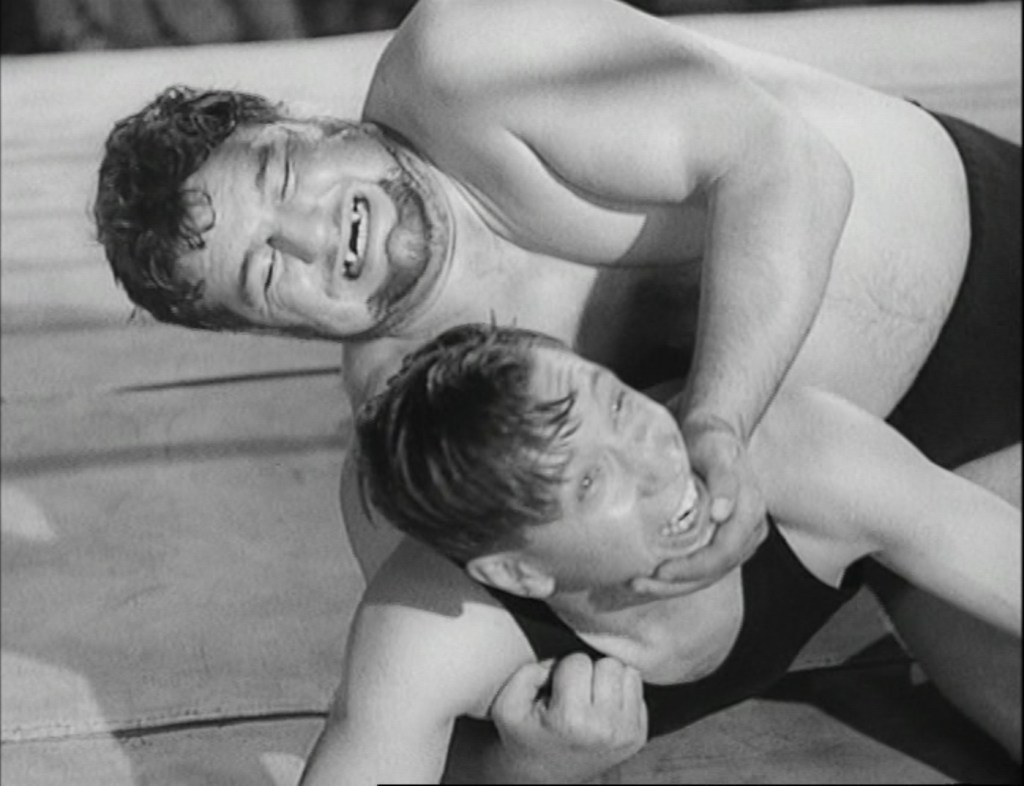
The film takes its title from the beer brewery which the counterfeiting gang uses as a front for their operations. As is common for these 1930s comedies that are primarily showcases for individual stars, Trouble Brewing consists of a series of set pieces which are only loosely strung together by a plot. George and Bill get duped on the racetrack; their subsequent investigations have them dress up as waiters at a private party; join a wrestling match; break into the police inspector’s home (and accidentally kidnap him); and confront the criminal gang in their brewery. At each stage, the script allows Formby plenty of physical comedy. His scenes with Mary and other female characters are opportunities for George to serenade them with his songs, even if they are more cheeky than romantic.

George subjected to a wrestling match in Trouble Brewing

In Trouble Brewing, the line between journalism and policing is blurred to the point that it almost disappears. When George says to his superiors as the paper that he wants to become a detective, the newspaper proprietor harrumphs that being a journalist is pretty much the same thing. Although in reality, printers and journalists had very distinct professional identities, George moves between the basement print room and the editorial offices with relative ease. Mary, who works as the secretary to the newspaper’s editor, appears to know George and Bill and treats them as her direct colleagues.

The police in Trouble Brewing have been ineffective in rounding up the counterfeiting gang, which has been at work for at least six months at the beginning of the film. Yet the two printers and the secretary manage to close the gang down in a matter of days. There are plenty of other British interwar films in which journalists collaborate closely with the police, but Trouble Brewing takes this a step further by focusing on main characters who are not even actual journalists. At the same time it is tacitly assumed that George wants to get promoted and work as a journalist, which he achieves at the end of the film when both the newspaper proprietor and the police inspector are duly impressed with his work in rounding up the criminal gang.

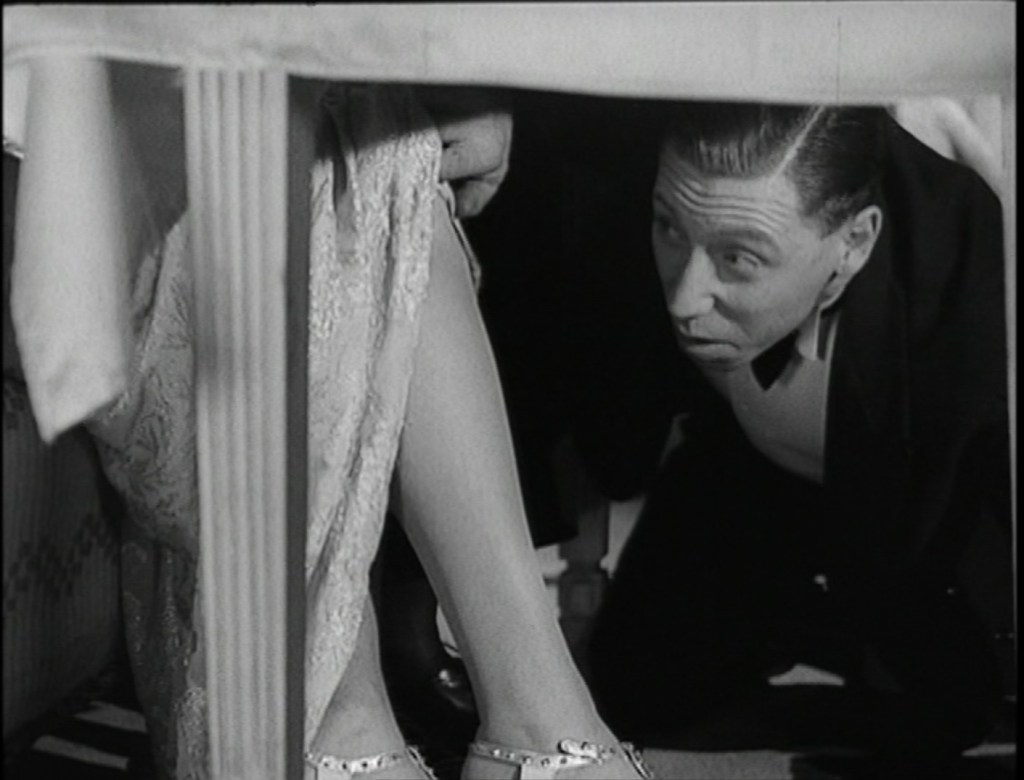
Trouble Brewing gives Formby plenty of opportunity to exploit the sexual innuendo he was known for, not only in his songs but also in the scene when he and Bill serve as waiters at a private house party. The party is thrown by an opera singer, whom George and Bill suspect may be part of the criminal gang. George has gotten the singer to put her fingerprint on a piece of paper, but she put that piece of paper in the top of her stocking. When the woman sits down to speak to a male guest at her party, George creeps under the table in an attempt to get the paper. The woman naturally assumes that her conversation partner is touching her leg under the table. This joke is repeated three separate times, causing the singer to shout at and slap at the various men she sits down with. For modern spectators, it is perhaps clearer that such a joke primarily works for male viewers; female audience members may find little to laugh at here. This indicates that Formby’s primary appeal was to men, whereas Gracie Fields aimed her jokes and songs at a broader audience.

George under the table in Trouble Brewing

Trouble Brewing ends in the beer brewery where the gang is hiding. Here physical comedy takes over, with actors running up and down stairs, hiding in barrels, and hanging on ropes. The brewery contains several vast vats of beer, which are left uncovered. Bill lands in one and becomes inebriated almost immediately; the same eventually happens with the counterfeiting gang members. The apparently instantaneous effects of alcohol on the men underlines how far the events on screen are removed from reality at this stage of the film. It has developed into slapstick, harking back to earlier cinematic traditions.

Unlike another 1939 film set in a brewery, Cheer Boys Cheer, which makes direct reference to Nazi Germany, Trouble Brewing offered audiences complete escapism. Money laundering and the circulation of counterfeit money were popular tropes in interwar crime fiction, but they were far removed from the real-life horrors of war and fascism. The film expanded on the already-established cinematic narrative that journalists could effectively solve crimes, by presenting three workers as skilled detectives. The film’s happy ending no doubt provided audiences with welcome escapism as the international political situation deteriorated.  

George (George Formby) and Mary (Googie Withers) end up in a beer barrel at the close of Trouble Brewing