The Flying Fool (1931)

The Flying Fool (1931)

Commercial flying was launched in Britain in the aftermath of the First World War. The war had led to both large investments in the production of aircraft, and the training of pilots in the Royal Flying Corps (later RAF). After the end of the war, these ingredients were repurposed to facilitate the roll-out of passenger flights. Before long, aerodromes were established all over the country. The possibility of flight also led to ‘airmindedness’: the adoption of a new state of mind that foregrounded technological advancement, adventure and opportunity. Flying became a popular topic for writers and other artists.[1]

It is not surprising, then, that an early British ‘talkie’ heavily exploited the action potential of airplanes. The Flying Fool was shot and released in 1931 by British International Pictures (BIP), under the direction of Walter Summers. The popularity of showing airplanes on film is demonstrated by the fact that there were two other films by the same title released in the US in 1925 and 1929 respectively. The British film, despite sharing their title, stands completely separately from these American productions. A copy of the BIP film survives, although it has not been released on DVD nor is it easily accessible online.

The hero of The Flying Fool is Vincent, played by Henry Kendall. Kendall was in the RAF during the First World War and was able to do his own flying in the film.[2] Vincent works for the Home Office in an unspecified role. He is on the trail of an international criminal gang, headed up by Michael Marlow. When an American private detective is found dead in Paris, Vincent travels there to unmask Marlow for once and for all. On the way, a young woman played by Benita Hume gets mixed up with Marlow, and assists Vincent when he is captured by the criminals. The film ends with a spectacular air-race back to London, followed by Vincent flying a plane to chase Marlow, in a car, down the rural roads of Kent.

Imperial Airways (the predecessor of British Airways); Air Union (the predecessor of Air France) and De Havilland, an airplane manufacturer, all collaborated in the film’s production. The Flying Fool was made three years after the opening of Croydon International Airport and the airport was heavily used in the film. Although in the film, the airport is called ‘Staveley’ airport, the press around the film’s release refer to the setting as ‘Croydon airport’ and it would be instantly recognisable as such by anyone who had visited Croydon airport.[3]

In the film’s climax, a plane crashes into the airport’s control tower. To achieve this spectacular stunt, Walter Summers arranged for a replica of the airport’s control tower to be built on the studio lot at Elstree. According to Benita Hume, ‘It looked exactly like the real thing. Mr Summers, the director, is a stickler for realism; he spent three weeks ensuring that observant fans should be unable to find any flaws in his Control Tower set.’[4] In the film, this realism is underlined with a rather pompous explanation of the airport’s technological features, including ‘radiotelephony’, by one of the control tower officers.

Cover image advertising The Flying Fool on ‘Boy’s Cinema’ magazine, October 1931

For plane lovers, The Flying Fool offered much to enjoy. An early press release promised that the film would include shots of the new Handley Page 42 plane ‘Hannibal’, which at that point had not yet been taken into public use.[5] The film also used the Argosy plane ‘City of Liverpool’, which would crash in 1933, and one of Air Union’s ‘Rayon D’Or’ planes. In addition, viewers got the opportunity to see inside Croydon airport’s control tower.

The film’s climax sees Vincent and Marion (played by Hume) in a two-seater plane, flying back from France to London whilst being chased by a pair of crooks in another plane. The criminals shoot revolvers at the heroes, but end up crashing into the control tower. Marlow attempts to escape in his car, a fast and luxurious Bentley. Vincent gets back into his plane and chases Marlow down country lanes in a sequence which received praise at the time ‘as one of the most thrilling [chases] anyone can desire.’[6] Ultimately, Marlow crashes his car down a cliff in a shot that seems surprisingly graphic for the time. Vincent and Marion are reunited at the airport where he proposes to her.

Newsreel footage of the crew plane which crashed in a Brixton back garden

The Flying Fool received much press attention during its production, in part due to an on-set accident which saw a plane carrying a pilot and cameraman crash in a back garden in Brixton. Thankfully no-one died, although both the pilot and cameraman were seriously injured.[7] The publicity paid off; upon its opening at the London Pavilion over the August bank holiday weekend in 1931, The Flying Fool was a ‘phenomenal’ box office success.[8] When the film was released more widely to local theatres over the following months, it continued to have significant box office returns.[9]

Despite the film’s box office success and its spectacular and realistic stunts, The Flying Fool has fallen into obscurity. This is a shame, as it is a reasonably rare example of an interwar British action film which includes daring stunts. It also gives viewers a rare opportunity to see moving images of the original interior of Croydon Airport, which closed in 1959, and of the inside of interwar passenger planes. As such, The Flying Fool is both an entertaining action caper and a historical document of the ‘golden age’ of British flying.


[1] Michael McCluskey and Luke Seaber (eds), Aviation in the Literature and Culture of Interwar Britain (London: Palgrave, 2020)

[2] ‘“The Flying Fool”: Ex-R.A.F. Officer as Star in New British film’, Daily Mirror, 31 July 1931, p. 5

[3] ‘London Trade Shows’, Kinematograph Weekly, 30 July 1931, p. 29

[4] Randolph Carroll Burke, ‘The Sartorial Lure of Benita Hume’, Picturegoer, 9 January 1932, p. 12

[5] ‘Summers’ Stunts: Car to go over cliff’, Kinematograph Weekly, 12 February 1931, p. 34

[6] Thomas H Wisdom, ‘Ignorance of “Speed Kings”’, Picturegoer, 10 September 1932, p. 11

[7] ‘B.I.P Plane Crash: Cameraman and Pilot Injured’, Kinematograph Weekly, 5 February 1931, p. 26

[8] ‘Long Shot’, Kinematograph Weekly, 6 August 1931, p. 18

[9] ‘Long Shot’, Kinematograph Weekly, 14 January 1932, p. 16
Out in the London Casino (1938)

Out in the London Casino (1938)

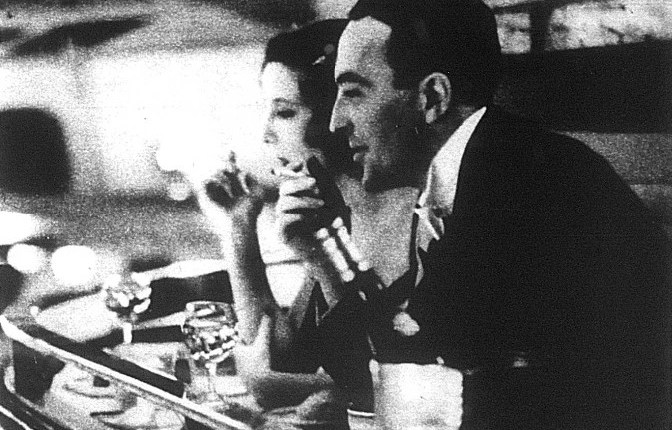
Although films of interwar Britain occasionally had interest in illicit gambling activities (for example, this one), and illegal gambling clubs certainly existed in real life, the London Casino was not, in fact, a casino. Originally it opened as the Prince Edward Theatre on Old Compton Street in 1930, with the intention of putting on Ziegfeld Follies-style revues. This, however, proved commercially unsuccessful. According to a 1938 Picture Post article, the theatre then became the regular host of trade shows for talking films, as it was fully wired for sound films.[1] Trade shows allowed cinema managers and buyers from cinema chains to view films before they hit the market, and decide which films to purchase for exhibition in their own cinemas.

Showing trade films was not necessarily a profitable occupation, however, particularly as the theatre was not being used for anything else. Around 1935, therefore, two investors decided to work together to refurbish the theatre to the tune of (then) £25,000.[2] They renamed the venue the London Casino, and came up with a concept which was entirely new for the British capital at that time. All the theatre seats were stripped out and replaced by rows of dinner tables – in the stalls as well as on the dress circles. The seats nearest to the stage were removed entirely to create a dancefloor. Big staircases led down from the circles to this dancefloor. The space below the stage was converted into kitchens. Going forward, Casino guests would be able to ‘eat and drink inside a London theatre a full-size dinner.’

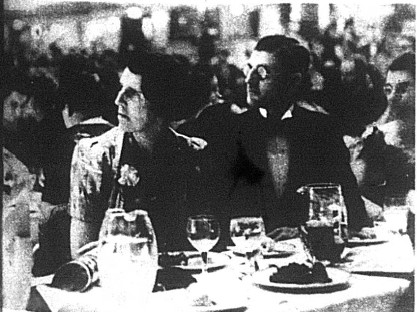
London Casino guests sit in tiered rows of dining tables, as shown in Picture Post

The Casino operated two shifts, one for dinner and one for supper. According to an early advert for the Casino, guests were served a five-course meal during their stay. During the meal, they could watch a show on the stage. After the show and dinner were over, guests could take the dancefloor – as long as they were dressed appropriately. ‘Evening Dress Optional but Essential for Dancing’ states the advert; and the Picture Post article notes that for seats on the balcony you did not have to wear evening dress. The advert suggests that all patrons paid the same price of 15s and 6d during the week and 17s 6d on Saturdays. By the time the Picture Post article was published, however, it was noted that some guests paid only 7s 6d, or less than half price. Presumably these were the balcony seats, right at the top of the theatre, which were ‘viewing only’.

Either way, the London Casino was a high-end night out; guests were only allowed to stay for 3 or 3.5 hours on weekdays, as their ‘slot’ only lasted so long. For comparison, West End cinema seats could only cost 1s 6d during this period, and suburban cinemas would be even cheaper. To spend 15s 6d a head on an evening’s entertainment would have been out of reach for many Londoners. Nonetheless, the Casino boasted of weekly revenues between £6000 and £7000, which would be ‘more money than any other entertainment in London.’[3] Clearly, by the end of the 1930s, there was sufficient disposable income at the top end of British society to sustain an innovative high-end club such as this.

In terms of the shows that patrons were treated to, the ample photography provided with the Picture Post article reveals a heavy reliance on ‘female beauty.’ Indeed, one can presume that the opportunity to publish photographs of scantily clad young women was one of the reasons why the editors of Picture Post decided to publish this article. Through the images in the weekly magazine a whole additional audience, who would not ordinarily be able to visit the Casino in person, were able to enjoy the ‘personal attractions of the dancers and show-girls.’[4]

A dance episode called ‘The Butterfly Hunt’ shows three young, thin, white women; two in bikini tops and gauzy skirts, the third appearing almost nude except for a bra and knickers. Dancer Maurice Brooke performed a stunt which required him to have one woman sitting on his neck and another (again in underwear) being swung round by him. Other scenes included ‘A Slave Market in Algeria’ (female slaves wearing minimal beaded outfits) and ‘The Bird of Night’ (women wearing skin-coloured, skin-tight outfits that make them appear nude). The final page of the article includes a photo of four showgirls backstage playing cards – they wear slinky dressing gowns and show their legs. The caption gives their names, as if to shrink the gap between them and the reader.

Although the Picture Post article exploits the female bodies for the visual pleasure of their readership, the article also cleverly juxtaposes these photos with an equal amount of photographs of audience-members viewing the stage. The article contains six photographs of audience members, most of them medium close-ups showing two or three patrons gazing intently towards what we presume is the stage. There is only one photograph of the guests dancing on the dancefloor after the show. It is implied that passive spectatorship, or ‘ogling’, is the main reason most people visit the Casino. The active participation in the dancing is secondary.

The article’s conclusion confidently states that the Casino ‘appears to have established itself as a permanent feature of London’s night life.’[5] The reality was different. The outbreak of the Second World War put an end to all performances, and by 1942 the theatre was repurposed as an entertainment venue for troops on leave. After the war, the theatre reverted back to being a cinema screening room, this time for ‘Cinerama’ films – films projected across three adjacent screens for a wide-screen effect. In the mid-70s the venue was once again converted back to a theatre, and it has been in business as the Prince Edward Theatre ever since.


[1] ‘A Night Out in London’, Picture Post, 10 December 1938, p. 21

[2] Ibid.

[3] Ibid., p. 24

[4] Ibid., p. 21

[5] Ibid. p. 24

Rose Macaulay – Keeping Up Appearances (1928)

Author and journalist Rose Macaulay has largely receded from the collective memory. Nevertheless, she published 24 novels, three volumes of poetry and 18 works of non-fiction during her lifetime. Born in 1881, her literary career started during the Edwardian period. The interwar decades were prolific for her though: she published 12 novels in the 1920s and 1930s. The 1920s were also the decade in which Macaulay found widespread commercial success for the first time.[1] Some of these interwar works have been republished since their first appearance, including her 1928 work Keeping Up Appearances which was re-issued by the British Library in 2022 as part of their Women Writers series.[2]

Not to be confused with the popular 1990s BBC sitcom, Keeping Up Appearances is about two half-sisters, Daisy and Daphne. Daisy is 30, Daphne is 25. Daisy is awkward in social situations and considers herself a coward; Daphne is cool, confident and ‘good fun’. The girls’ father was an upper-middle class intellectual; Daisy’s mother is a lower-middle class woman from East Sheen who had Daisy as a result of a youthful fling. She has since married a labourer and had three more children, who are now adults. Daisy is embarrassed about her mother, whom she considers uncultured. For reasons that will become clear in a moment, we do not find out anything about Daphne’s mother.

At the opening of the novel both women are on holiday with a middle-class family, the Folyots, to act as au-pairs to the family’s younger children, Cary and Charles. The Folyots also have an adult son, Raymond, who is a biologist. Daisy is hopelessly in love with Raymond, who in turn seems only charmed by the cooler Daphne. Mrs Folyot is involved in myriad political causes, including the sheltering of ‘White’ Russians who fled the country after the bolshevist revolution; and the support of independence and self-governance of such varied groups as Basque Spaniards, Estonians and Indians. Although Mrs Folyot’s activities mostly serve as a (comical) backdrop to the novel’s main activities, they remind the modern reader of the huge political turmoil underway across Europe in the interwar period. They also highlight the longstanding nature of some debates that remain unresolved today: both Catalan and Scottish independence get a name-check.

About one hundred pages into the novel, Macaulay reveals the central deceit which sets Keeping Up Appearances apart from many other novels concerned with the emotional life of 20-something women: Daphne and Daisy are one and the same person. Daphne Daisy Simpson, as is the woman’s full name, considers ‘Daisy’ to be the self she is when she is alone, or with her birth family. Daisy is lower-middle class and has to work hard as a journalist and novelist to make some independent income. Daphne is the funnier, cleverer, and younger persona she has adopted when she is around more sophisticated friends, such as the Folyots.

When Raymond proposes to ‘Daphne’, it sets the two personas on a collision course. Daisy’s family understandably are confused why Daisy does not want to introduce her fiancé to them; Daisy has to work extremely hard to prevent Raymond from seeing her ‘real’ self, which she is sure he will not like. The lies pile up and become impossible to all keep hidden. First Raymond finds out that Daphne works as a journalist and writer, under the pen name Marjorie Wynne. He is puzzled why Daphne has not been open about it, but lets it slide. Then Daisy struggles to continue the pretence that she is interested in Raymond’s work: Daphne has always happily escorted Raymond on endless jaunts around the cold and muddy countryside, but Daisy increasingly snaps at Raymond when she is freezing on a heath. Finally, inevitably, Daisy’s mother and aunt visit the Folyot’s unannounced, and all of Daisy’s lies come out.

The book’s preoccupation with ‘real’ selves versus ‘presented’ selves is cleverly mirrored in its discussion of the popular press. Both Daisy and her half-brother Edward work for the Daily Wire, a fictional popular daily along the lines of the Daily Express. But whilst Edward is a reporter, constantly churning out peppy headlines like ‘West End Flat Mystery Surprise – Dead Girl Sensation – Amazing Revelations’; Daisy as Marjorie Wynne is condemned to the women’s pages.[3] Throughout the book, she is asked to write articles on topics such as ‘can a woman run a baby and a business at the same time’[4], ‘modern married life’[5] and ‘should flappers vote?’[6] When Daisy tries to return a sarcastic article under the latter headline, she is promptly told to rectify it to fit with the newspaper’s expected tone. ‘The remuneration was good, so Daisy (…) wrote the article on these lines.’[7]

It is understood by Daisy throughout, as it would have been by Macaulay herself, that women journalists are almost always pigeonholed into providing content relating to ‘the women question’ only. Whereas Edward is mobile during his working day, dashing to and fro to get interviews and eye-witness accounts, Daisy types all her work in her flat. It is, however, the only way she sees that allows her to make an independent income.

By the end of Keeping Up Appearances, Daisy’s second novel (written under the pseudonym Marjorie Wynne) becomes a modest commercial success. Daisy’s regard for her own writing is extremely low; she considers her novels to be middle-brow at best. However, their commercial success gives her financial independence at the novel’s close.[8] They also give her the tantalising opportunity to shed both Daisy and Daphne and adopt Marjorie Wynne as yet another persona in which to navigate the world.

Although Keeping Up Appearances ends on a happy note of sorts for Daphne Daisy, it makes clear that all people, including men, continue to be trapped between behavioural expectations and their true desires. Throughout the novel Macaulay gives the reader glimpses of the ‘secret life’ of the other characters, including Raymond. Everyone behaves differently when unobserved, and despite the loosening of rigid social conventions after the First World War, there remained plenty of conventions to follow in order to ensure financial and romantic success.


[1] Sarah Lonsdale, Rebel Women Between the Wars (Manchester: Manchester University Press, 2020), p. 45

[2] Rose Macaulay, Keeping Up Appearances (London: British Library, 2022)

[3] Ibid., p. 49

[4] Ibid., p. 64

[5] Ibid., p. 157

[6] Ibid., p. 137

[7] Ibid., p. 138

[8] Ibid., p. 247

Stanley Lupino

Stanley Lupino

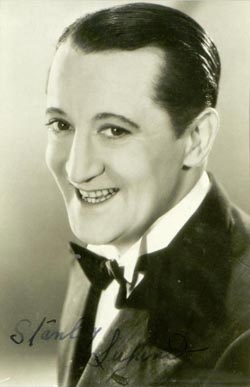
As the recent social media noise around ‘nepo babies’ highlighted, there are many instances of intergenerational celebrity today. There were also cases of this in interwar Britain, although it was less widespread. Actor Stanley Lupino, for example, was the son of actor George Lupino. Two of George’s brothers were music hall performers; one of them played Nana the Dog for the premiere of Peter Pan in 1904. Stanley and his brother Barry were both actors too. One generation down, Stanley’s daughter Ida Lupino became a famous Hollywood actor, writer and producer. One of Stanley’s nephews, Henry, took on the stage name Lupino Lane and developed a successful stage and film career, which included the introduction of the popular song and dance, the ‘Lambeth Walk.’

Stanley’s career stayed firmly in Britain; he was born in London in 1893 and died there in 1942. Like many other actors discussed in the pages of these blogs, he started his career on stage and only transitioned to films in the 1930s, when the introduction of sound film made the medium suitable for his comedy work. He started his pre-War stage career as an acrobat, then played pantomime and music hall. From the 1920s, he got involved with writing and producing musical comedy shows, being particularly connected with the Drury Lane theatre. He also extensively performed on radio after the founding of the BBC in 1922.

Lupino’s film career has by some scholars been regarded as exemplary of the general poor state of British films in the 1930s.[1] Whereas George Formby, Gracie Fields and even the Aldwych farces have received plenty of critical attention, until Stanley Lupino’s films were re-issued on DVD in the 2010s they were largely ignored. Yet, Lupino’s singing, dancing and comedy timing make his film work still eminently watchable. Over the course of the 1930s he acted in 13 films, of which he (co)wrote 12 of them. His considerable star power on the stage allowed him to script films which suited his comic talents.

The storylines of Lupino’s films are thin, aiming to provide predictable feel-good entertainment to a mass audience. (Indeed, one author has called them ‘absurd, naïve and unoriginal’[2]). In Facing the Music (1933) for example, Lupino aims to impress an aspiring opera singer by staging a fake jewel robbery during a performance. Of course, this goes wrong and the jewels are really stolen, requiring Lupino to recover them. In Cheer Up! (1936) Lupino is one half of an out-of-work song writing duo who are trying to obtain financial backing for their next venture. When their prospective funder turns out to also have no money, misunderstandings and comedy ensue.

Clip from Cheer Up! (1936)

Unlike Formby and Fields, Lupino did not play characters called ‘Stanley’ or other variations on his name. Instead, his characters have completely separate names and personality traits each film, widening the distance between the man and the character. Yet each of the fictional characters he portrays are charming, funny men looking to win the heart of a female love interest.

As noted above, in Cheer Up! Lupino plays one of a duo, alongside comedy actor Roddy Hughes. The pair weren’t a regular double-act, however. In Over She Goes (1937), Lupino appears alongside another comedy actor, Laddie Cliff in what would be the latter’s final film appearance. The plot of Over She Goes is classic Lupino fare: when Lupino’s character Tommy Teacher inherits an aristocratic title and moves himself and his friend into the accompanying stately home. Whilst the pair are trying to woo two young women, one of Tommy’s previous girlfriends appears who attempts to capitalise on his new wealth.

Over She Goes started its life as a stage production, penned by Lupino himself. The play’s success made it an attractive candidate for film adaptation for the Associated British Picture Corporation at Elstree Studios. The film was directed by Graham Cutts, who was also at the helm for other comedy pictures that decade like Gracie Field’s Looking on the Bright Side, and an adaptation of the enormously popular Jerome K. Jerome short story Three Men in a Boat.

Over She Goes contains some catchy song-and-dance numbers, transferred over from the stage show, which were able to be marketed and sold separately as records. The combination of male comic actors, attractive young women, and a high-society backdrop including large houses and hunting parties, makes the film great escapist entertainment in the vein of big Hollywood productions, whilst also retaining a specific British context which domestic audiences could relate to.

The finale song of Over She Goes

Stanley Lupino died relatively young, five days before his 49th birthday, during the Second World War. The was had put an end to his film production in any case, making his total film output a reflecting of the 1930s, from 1931 through to 1939. He is a good example of a ‘mid-tier’ film star of the period – less recognisable and lasting as Gracie Fields or George Formby, but successful enough to be able to steer and influence his career.


[1] Richard Dacre, ‘Traditions of British Comedy’, in The British Cinema Book, ed. Robert Murphy (London: BFI, 2009), p. 106

[2] Adrian Wright, Cheer Up! British Musical Films, 1929-1945 (Woodbridge: Boydell Press, 2000), p. 152

The Passing of the Third Floor Back (1935)

The Passing of the Third Floor Back (1935)

Although rather awkwardly titled and largely forgotten today, the 1935 film The Passing of the Third Floor Back was very popular in Britain upon its release. It draws together two features of the interwar British film industry that have been discussed across various previous posts on this blog. Like, for example, Pygmalion and The Lodger it is based on existing source material. In this instance, this was a short story and play both written by popular writer Jerome K. Jerome before the First World War. The film also draws on high-profile European talent in its director, Berthold Viertel, and its star, Conrad Veidt. This highlights the ongoing international nature of the British film industry between the wars.

Conrad Veidt was a hugely popular and famous German actor with a long career in silent cinema, most notably with lead roles in such classics as The Cabinet of Dr Caligari (1920) and Anders als die Anderen (1919), the latter being a landmark of LGBTQ+ silent cinema. In 1933, Veidt left Germany in light of Hitler’s recent assumption of power; as well as him having politically opposing views to the nazi’s, Veidt’s wife was Jewish.[1] Veidt established himself in Britain and made twelve films for British studios until the outbreak of the Second World War. Film historian Sue Harper considers The Passing of the Third Floor Back ‘the apotheosis of [Veidt’s] acting career.’[2]

The film’s director, Berthold Viertel, was an Austrian émigré filmmaker and friend of Veidt’s. After making The Passing of the Third Floor Back, Viertel only made one more film, 1936’s Rhodes of Africa. Like Veidt, Viertel’s political sympathies were left-of-centre, which comes through clearly in their version of The Passing of the Third Floor Back. The short story and play on which the film were based did not foreground class issues in the same way, indicating that these were specifically scripted in for the film. Incidentally, the script of the film was co-written by Alma Reville, Hitchcock’s wife and frequent scriptwriter.

The film’s rather awkward title refers to the room Conrad Veidt’s character, an unnamed Stranger, takes in the boarding house of Mrs Sharpe. At the opening of the film, we see Stasia, the young housemaid, try and grow a flower in the house’s kitchen. She gets scolded by the stern Mrs Sharpe, and frequent allusions are made by both Mrs Sharpe and the other boarding house guests to Stasia’s background as a young ‘delinquent’. Then the Stranger arrives at the door, asking for a room. Mrs Sharpe leads him up to the back of the top floor, presenting him with a tiny room overlooking rooftops. Although Mrs Sharpe is expecting the Stranger to haggle and argue, he instead compliments the room and placidly accepts her terms.

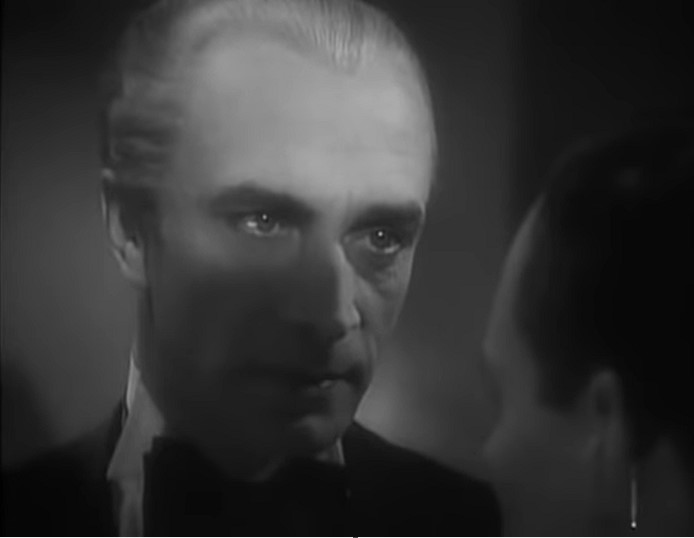
The rest of the film takes place over three days only. On the evening of the Stranger’s arrival, two of the other boarders are due to get engaged. Young and pretty Vivian is entering into this engagement with the odious Mr Wright because it will save her family from financial ruin. In reality, Vivian is in love with a young architect who also lives in the house. During evening dinner, the Stranger stares intently at Vivian, and she decides not to go through with the engagement. Throughout the rest of the evening, the Stranger keeps using this ‘mesmerising’ stare to mentally force people to act in accordance with their true desires. Another boarder, keen to amuse everyone with superficial show tunes on the piano, is convinced to play classical music instead. A conversation the Stranger has with the architect leads the latter to admit that he too is in love with Vivian.

Conrad Veidt as the Stranger, using his ‘mesmerising’ power

The next day is a Bank Holiday Monday, and the Stranger generously offers to take the whole boarding house party out on a steamer to Margate. Mrs Sharpe allows Stasia to come along, and for the first time the servant girl is accepted as a full member of the house party. On the boat, everyone enjoys themselves. The Stranger has a conversation with Miss Kite, one of the lodgers who is ‘the wrong side of thirty’ and very insecure about her looks. When Stasia falls off the steamer, Miss Kite jumps into the water without hesitation to save her. Her conversation with the Stranger has (temporarily) allowed her to stop worrying about her appearance. Miss Kite’s heroic deed earns her the appreciation of the pianist.

Stasia moments before she falls off the steamer in The Passing of the Third Floor Back

Although everyone seems improved by the Stranger’s gentle attentions and insistence on good manners, one man is not impressed. Wright, who got spurned by Vivian, is a rich man who profits off slum housing. Having lost Vivian, he makes it clear to the Stranger that evening that he will do everything he can to swing the pendulum of change the other way. He explicitly addresses how the Stranger has influenced everyone to ‘do good’, and how he will remind everyone of their baser emotions. Indeed, the next morning, Wright’s influence leads to quarrels and frustrations across the house. People appear to have forgotten what kindness and politeness can do to make everyone’s life more pleasant.

Wright confronts the Stranger in The Passing of the Third Floor Back

At the end of that day, a burglar kills Wright. Initially, the house blame Stasia; then the Stranger. Their mob mentality, once its revealed they were wrongfully accusing their peers, provides a wake-up call to the Stranger’s kindness. He leaves the house, satisfied that he has now made a lasting impact on the lodgers’ worldviews.

Throughout, the Stranger is quite clearly analogous to a Christ-like figure, advocating kindness in every action. Wright appears to be set up as a sort of Lucifer, and the discussion between Wright and the Stranger tantalisingly suggests that Wright ‘recognises’ the Stranger and the two have been at odds before. Yet the film grounds these Christian analogies in practical class-based discussions, particularly by making Wright a profiteering landlord. Although the religious undertones make The Passing of the Third Floor Back a somewhat dated and unfamiliar viewing experience for modern audiences, its social commentary (unfortunately) still feels very relevant.

The Passing of the Third Floor Back can be viewed on YouTube; the short story on which the film is based can be read here.


[1] Sue Harper, ‘Thinking Forward and Up: The British films of Conrad Veidt’, in The Unknown 1930s: An alternative history of the British cinema, 1929-1939, ed. Jeffrey Richards (London: IB Tauris, 2000), 121-137 (p. 122)

[2] Ibid., p. 132

Film Star Cigarette Cards (1934)

Film Star Cigarette Cards (1934)

A recent trip to an antique shop delivered a great find: a complete album of film star cigarette cards, collected and collated some time in early 1934. Cigarette brands regularly put out series of cigarette cards, which young people could collect and paste into dedicated albums. In 1934, John Player & Sons, a branch of the Imperial Tobacco Company, published a 50-card series of portrait drawings of film stars. The reverse of each card had some information about the actor. All cards could be pasted into an album; the information that appeared on the reverse of each card was reprinted on the album pages.

My copy was put together by John MacLaren, who lived in Addison Gardens (between Shepherd’s Bush and Kensington Olympia) in West London. We can assume that John was a big film fan as the album is complete, all the cards are inserted into the album neatly, and he handled the album carefully. Nearly 90 years after its composition, it is still in excellent shape with very little wear and tear. The album reveals aspects of 1930s British film fan culture to us: which stars were included, what biographical information was included on them, and which stars were left out?

The first thing to note is that this album is all about the ‘film stars’: there is virtually no mention of directors or producers anywhere in the album. An exception is the entry given for Greta Garbo, which notes that producer Joseph Stiller, upon being given a Hollywood contract, took Garbo ‘along with him’ to the US. The entry for Jessie Matthews, however, makes no mention of Victor Saville, even though she had regularly worked with him by 1934. Similarly, under Marlene Dietrich’s picture there is no mention of Joseph von Sternberg, even though the pair had successfully collaborated several times at this point. Film fan culture in the interwar period was all about the ‘stars’ which appeared on the screen: although retrospectively directors like Hitchcock, Korda and Asquith are recognised as masters of the form, in the interwar period audiences would have been unlikely to seek out a film on the strength of its director alone.

The focus on ‘stars’ rather than ‘actors’ also means that the album mostly contains young, good-looking actors, although a few British ‘character actors’ are included. There are 30 female actors and 20 male actors included; although images of female stars were generally considered more commercially attractive, the album shows that male actors were by no means unimportant and could have considerable ‘sex-appeal’.

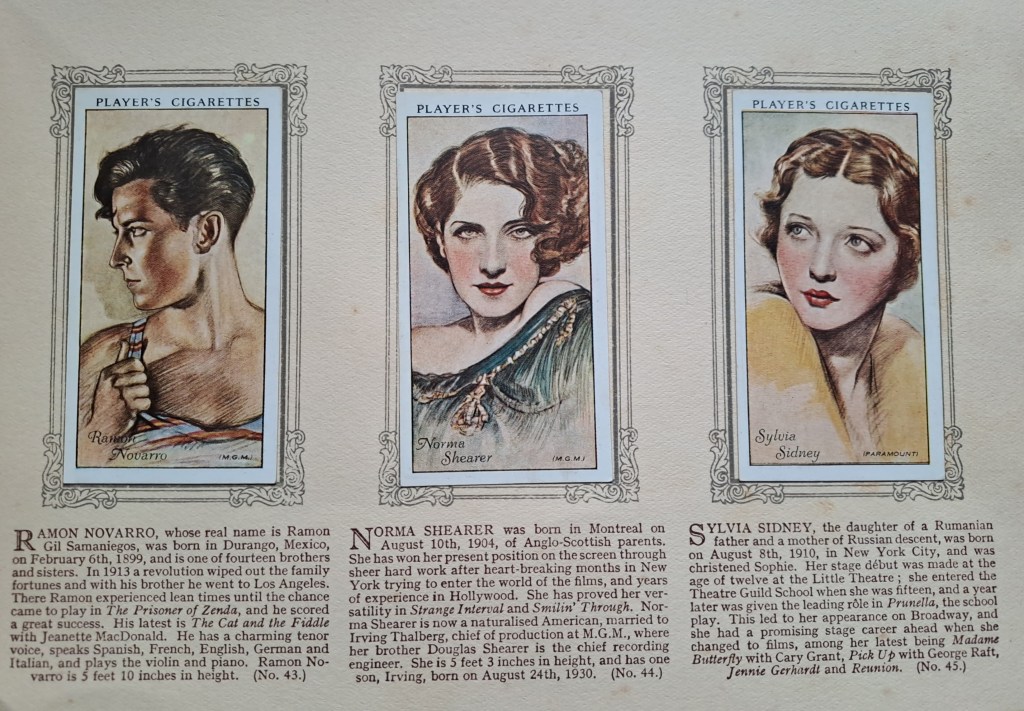
Some of the text descriptions, particularly those of male actors, include their height. This was clearly deemed to be important information for the film fan. The description of Johnny Weissmuller thus reads ‘The Olympic Swimming Champion, who stands 6 feet 3 inches in height, made his screen début in short sports films, and because of his magnificent physique was given the title role in Tarzan the Ape Man.’ Even if one had never seen a Johnny Weissmuller film, this description is graphic enough to let the imagination run wild. The drawing of actor Ramon Novarro (5 feet 10 inches) shows him in a vest top which he is tugging slightly to reveal his chest. His Mexican heritage no doubt played a part in this exoticized depiction: virtually all other male stars are shown wearing a suit.

Ramon Novarro in the cigarette card album

Out of the 50 actors included in the album, 29 are American, 11 are British, and the remaining 10 are from other countries – mainly European, but it also includes two Mexicans, a Canadian, and one star born in China to white expat parents (Sari Maritza ‘Her father was English, her mother Viennese’). ‘Talkie’ films were well-established by 1934, and the album shows that although the transition from silent to sound film had limited the international opportunities for non-native English speakers, it had not completely removed them. The aforementioned Garbo and Dietrich were celebrated for their European appearance and demeanour – and both had a powerful male industry figure supporting them. The range of actors included in the album also shows the popularity of Hollywood films in Britain, despite the British government’s attempts to boost the domestic film industry. American stars continued to exert their influence over British fans.

Johnny Weissmuller appearing alongside Mexican actor Raquel Torres and
British actor, producer and race-horse owner Tom Walls

Another reason for the popularity of film stars can be found in many of the narratives that accompany the pictures. Although they are only a short paragraph each, a significant number of them present the careers of film stars as being reached almost by accident. American star Jack Holt, for example, is described as having been ‘in turn a civil engineer, a prospector, a mail carrier in Alaska, a cow-puncher [a cowboy], and finally an actor.’ Madeleine Carroll first worked as a school teacher before taking to the stage; Frederic March was a bank clerk; and Robert Montgomery worked ‘in a mill, then on an oil tanker, and finally became prop man in a touring company.’ The implication is that it is possible to move from a blue-collar or white-collar job into film stardom, and that such a move may be open to the film fan collecting the cigarette cards. This reiteration of the humble origins of many stars, and the supposed open entry to film acting, was an important part of the film industry’s myth-making that constantly held out the possibility to fans that they too could join their favourite stars on the silver screen.

We have no way of knowing whether John Maclaren, the owner of this particular album, had any aspirations to become an actor. Nonetheless, the survival of this album and the care John took in pasting in the cards demonstrates how important film fandom was for him, as it was for thousands of other (young) people in Britain at the time. The cigarette cards gave film fans another accessible way to connect with their favourite actors, in addition to going to the cinema and reading fan magazines. It stands as a testament to (commercial) fan culture in interwar Britain.

Freeman Wills Crofts – The 12.30 from Croydon (1934)

Freeman Wills Crofts – The 12.30 from Croydon (1934)

Freeman Wills Crofts today is not one of the more famous writers of the Golden Age of Detective Fiction. During the 1920s and 1930s, however, he was a prominent and early member of the Detection Club, a select circle of crime authors that included Agatha Christie, Anthony Berkeley, Dorothy L. Sayers and others. T.S Eliot rated Crofts as ‘the finest detective story writer to have emerged during the Twenties.’[1] An engineer by training, Crofts’ detective stories often include modes of transport which he describes in exact detail. In Mystery in the Channel, published in 1931, two dead bodies are found on a yacht in the English Channel. The eventual unravelling of the case by Crofts’ regular police protagonist, Inspector French, hinges on the exact timings several vessels embarked on their journey, their relative speeds, and the weather conditions.

The title of Inspector French’s 1934 outing, The 12.30 from Croydon, would have immediately communicated to a contemporary audience that airplanes, not boats, were the mode of transport under scrutiny this time. Like Christie’s more famous Death in the Clouds, published the following year, Crofts’ murder victim dies whilst up in the air.

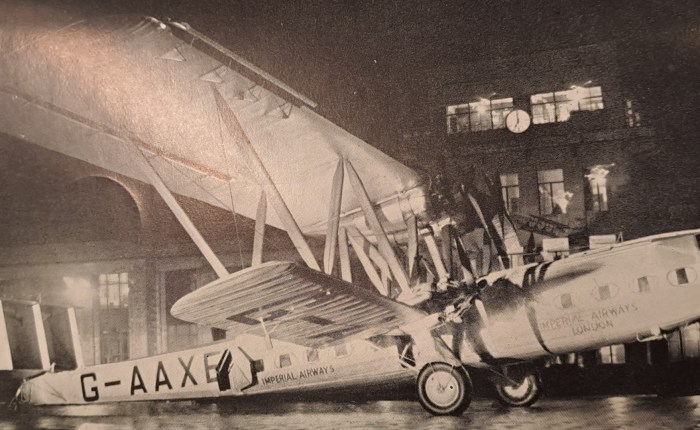
The 12.30 from Croydon opens with a delightful chapter told from the perspective of the murder victim’s ten-year-old granddaughter Ruby, who is terribly excited that she will be flying for the first time. Ruby, her father Peter, her grandfather Andrew, and Andrew’s butler Weatherup are all due to fly to Paris because Ruby’s mother Elsie has been in a traffic accident in the French capital. Crofts’ engineer’s eye for detail is evident in this opening chapter, which describes the Imperial Airways plane the family board:

It was just a huge dragonfly with a specially long head, which projected far forward before the wings like an enormous snout. And those four lumps were its motors, two on each wing, set into the front edge of the wing and each with its great propeller twirling in front of it. And there was its name, painted on its head: H, E, N, G, I, S, T; HENGIST.’[2]

‘Hengist’ was the colloquial name for a real Imperial Airways plane which until 1934 (the year of the book’s publication) flew on the European routes. It was subsequently converted to fly long-distance and as far as Australia, until the plane was destroyed in an accident in 1937. Once up in the air, Ruby and her family are served a ‘four-course lunch followed by coffee, all very nice and comfortably served’.[3] When they land, disaster strikes: Andrew Crowther, Ruby’s grandfather, is found unresponsive and declared dead.

A contemporary photo of the real Hengist plane standing outside Croydon Aerodrome, taken from A Million Miles in the Air,
the memoirs of pilot Gordon P. Olley, published in 1934

After the murder in the opening chapter, Wills Crofts shifts perspective and takes the reader back in time. The 12.30 from Croydon is a ‘psychological crime novel’ – rather than the reader trying to work out who has committed the murder and how, the author takes the reader into the mind of the murderer as he plots out his murder and attempts to escape justice. Andrew Crowther’s murderer, as it turns out, is his nephew Charles Swinburn. Charles is the managing director of the Crowther Electromotor Works, a firm originally set up by Andrew and his business partner Henry Swinburn. Although modest in size, the firm had been flourishing under Andrew’s leadership.

By the early 1930s, however, Charles is finding it impossible to stay afloat in the challenging economic environment following the 1929 Wall Street crash. Having already sunk his personal capital and a bank loan into the business, Charles approaches his uncle for financial help. Andrew, however, is not willing to give more than £1000, when Charles needs at least £6000. Knowing that he is one of the two heirs to Andrew’s estate (alongside Andrew’s daughter Elsie), Charles devises his plan to kill Andrew.

Charles method for murdering Andrew is one also used on occasion in other crime novels of the period. Andrew takes a ‘patent medicine’ against indigestion after lunch each day. Patent medicine were mass-produced pills designed to remedy common ills. Unlike more traditional medicine which was prescribed by a doctor and then mixed up to order by a pharmacist, patent medicines were available in standardized bottles and could be purchased without a doctor’s prescription.

In novels of the 1920s and 1930s they are often treated with disdain and considered to be inferior to the personalised prescriptions that a doctor would give out. However, their wide availability and uniform appearance also made them an ingenious murder weapon. Charles buys a bottle of pills identical to the one Andrew uses, but replaces one of the pills with a pill filled with potassium cyanide, an extremely lethal poison. Like in the Poirot short story ‘Wasps’ Nest’, Charles manages to obtain the poison with the excuse that he needs to eradicate a wasps nest from his garden. When at dinner with Andrew, Charles distracts him and swaps the pill bottles, pocketing Andrew’s bottle and replacing it with the one that contains the one deadly pill. He then books himself onto a Mediterranean cruise to be out of the way when Andrew eventually takes the poisoned pill.

Although the murder plan works and Charles duly inherits half of Andrew’s estate, Charles swiftly finds out that murderers rarely rest easily. First Weatherup reveals that he has seen Charles swap the pill bottles, and starts blackmailing him. Charles swiftly decides to kill Weatherup, too. Then Inspector French arrives and starts asking some awkward questions. The arrest, when it inevitably comes, takes Charles by surprise. It is not until the final chapter of the book that the reader is shown how Inspector French conducted his investigation, and how his powers of deduction led him to correctly identify Charles as the murder. The perfect murder plan conceived by Charles is revealed to have had some rather large holes in it.

Charles is duly condemned to death and executed. There is less moral ambiguity in The 12.30 from Croydon than, for example, Anthony Berkeley’s Malice Aforethought, or even than in Henry Wade’s Heir Presumptive. Although Andrew Crowther is not a hugely sympathetic character, there is no doubt to the reader that Charles’ actions are wrong, and that the policing and justice systems will catch up with him and serve him the expected sentence. The book’s reversed structure allows Wills Crofts to reveal Inspector French’s intellect in the final chapter, transmitting the reassuring fiction to the reader that no matter how well one may think they have planned a crime, the men from Scotland Yard will always ensure that justice is dispensed.


[1] Martin Edwards, The Golden Age of Murder (London: Collins Crime Club, 2016), p. 75

[2] Freeman Wills Crofts, The 12.30 from Croydon (London: British Library, 2016), p. 16

[3] Ibid., p. 19

The Monkey Club

The Monkey Club

Picture Post, the left-wing photojournalism magazine launched in October 1938, has a proud track record of political journalism, including comprehensive reporting on the plight of Jewish people under Nazi rule. In amongst this serious political reportage, however, the weekly magazine also provided plenty of lighter content, such as an article in an early issue about the so-called ‘Monkey Club’, a club where ‘debutantes learn to be housewives.’

The five-page spread appeared in the issue of 10 December 1938, early on in the Post’s existence. The Monkey Club was a slightly odd hybrid between a member’s club and an educational establishment. One would become a member either by being put forward by two existing members, or by serving probation – by 1938 there were apparently eighty members in total. The club had been founded in 1923 and lasted at least until the early 1950s. According to the Club’s founder, Marion Ellison, she wanted to ‘supply a social and educational club for society girls, who at eighteen may not wish to enter a University, but who do not want to idle away their days.’[1]

Debutantes were daughters of prominent families who were presented at Court during their first ‘season’ and subsequently attended the annual round of balls and parties. The ‘season’ was a long-established London tradition and once upon a time the primary way for young wealthy people to meet their marriage partners. By the late 1930s, however, social change had been such that debutantes could not necessarily expect the same lives as their mothers and grandmothers, and some of them undoubtedly also wished to have a profession.

The Monkey Club’s varied offering demonstrates the transitional space in which it operated. It offered residential lodgings for about 30 of its members, providing young women who wanted to live independently a more socially elevated alternative to lodging in a Bloomsbury boarding house.[2] The club also provided five main strands of educational activity: ‘General Education, Music, Secretarial Training, Domestic Science, and Dressmaking.’[3] The five categories had different purposes, depending on what the debutante needed.

Should she need to learn a job to earn her own living, clearly the secretarial training would be very useful. It is a sign of significant social change that a sizeable sub-section of the Club membership was ‘training for careers’ – even a generation earlier the notion of a debutante taking a secretarial course would have raised eyebrows.[4] But by the late 1930s, ‘debs’ could not necessarily expect to marry into wealth and live out the rest of their days as matriarchs. Secretarial work, on the other hand, was in constant and increasing demand and provided a respectable route into paid employment for young women, at least until such a moment that they got married.

The ‘Domestic Science’ training, which Picture Post called ‘probably the highlight of the club’, also demonstrates how society had changed.[5] Although the debutantes come from wealthy families, they can clearly no longer expect to run households with a lot of staff. The Monkeys are not taught how to manage servants, but rather how to undertake household tasks themselves. From ironing shirts to cleaning windows, the Monkeys are given instructions on how to undertake each part of household management. ‘Every debutante wants to be a good housewife’ enthuses the Post.[6]

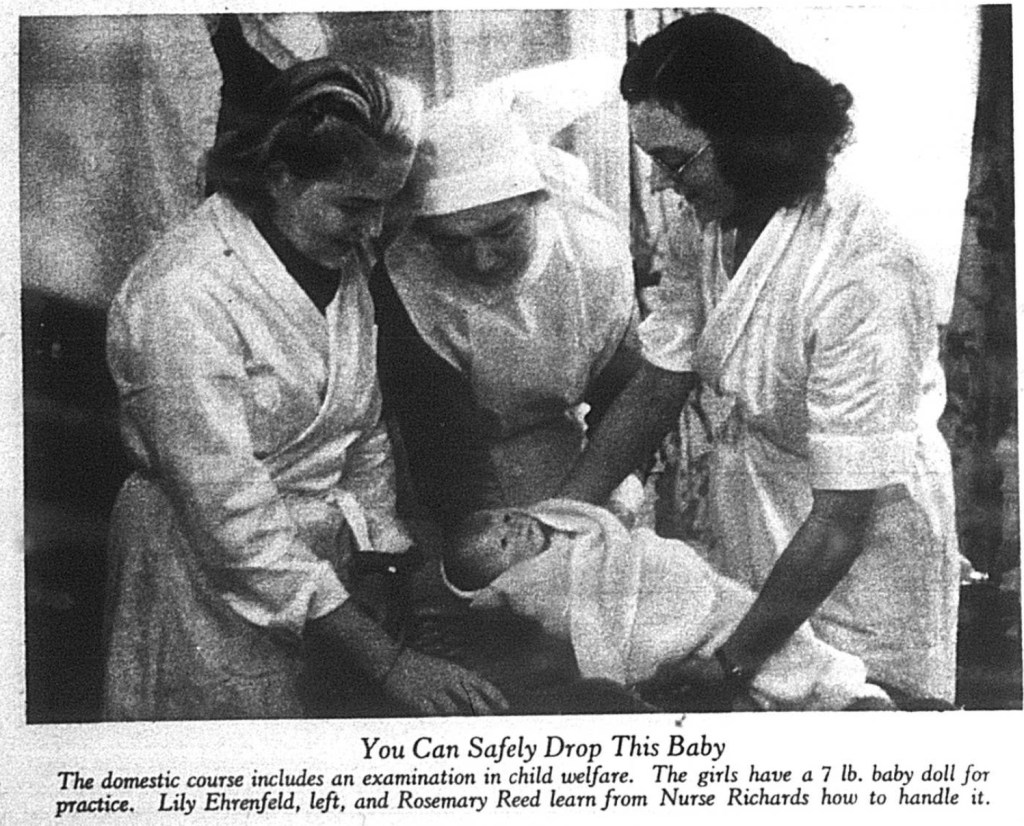
The club building even contains a complete flat, where members who are about to get married take ‘Bride’s Course’. The flat gives them a trial at running a complete household, including planning and executing dinner parties. Says the Post: ‘The “Bride’s Course” is no romantic interlude. The brides are thoroughly prepared to cope with all emergencies, even to leaky pipes and broken armchairs.’[7] Clearly, most of the debutantes were expecting to be quite hands-on in their household management after marriage, reflecting the replacement of servants with labour-saving devices as the job market changed. Another area for change was that of childrearing. Like with the household, debutantes would be expected to be hands-on in the raising of their children. To that end, the Monkey Club had a ‘perfect 7lbs “baby” with moveable head and limbs’ – a realistic model which the club members were taught to bathe and dress in the ‘correct’ way.[8]

Other parts of the ‘educational’ curriculum serve to a more traditional conception of a debutante’s life. The music and art education mostly built on what club members had learnt at the inevitable ‘finishing school abroad’: in-depth teaching on music history and theory to allow members to ‘know how to listen and enjoy good music.’[9] Also popular are classes on ‘dancing, stage technique and elocution’ – skills that have less practical use and are more designed to enhance the pupil’s appearance and effectiveness at social engagements.

The Monkey Club clearly fulfilled a function during a time of significant social change. As class barriers were broken down, the old system of sending debutantes to finishing schools and expect almost everyone else to either be a housewife or learn a trade no longer worked. In this ambiguous space, the Monkey Club bridged the old and the new, providing debutantes with a familiar space from which they could navigate their own way through a changing society.


[1] ‘This is the Monkey Club’, Picture Post, 10 December 1938, p. 33

[2] Chiara Briganti and Kathy Mezei (eds), Living with Strangers: Bedsits and Boarding Houses in Modern British Life, Literature and Film (London: Bloomsbury Academic, 2018)

[3] ‘This is the Monkey Club’, Picture Post, 10 December 1938, p. 33

[4] Ibid., p. 34

[5] Ibid, pp. 35-6

[6] Ibid., p. 36

[7] Ibid.

[8] Ibid.

[9] Ibid., p. 35

Dorothy L. Sayers

Dorothy L. Sayers

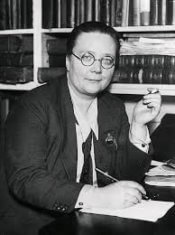
Agatha Christie is undoubtedly the most famous author of the ‘Golden Age of Crime Fiction’ (or indeed the most famous crime author of all time). She did not stand alone, however, but rather was part of a closely connected network of crime writers who worked in Britain and the rest of the Empire between the two wars. Some of the more illustrious authors organised themselves in the Detection Club, a group which was founded in the 1930s and still exists today. One of the founding members of the Detection Club was Dorothy L. Sayers, another female crime fiction writer who obtained widespread recognition during the 1920s and 1930s.

Sayers was born in 1893 in Oxford to a well-to-do couple; her father was a reverend and chaplain to Christ Church Cathedral in the city. Sayers herself studied at Somerville, the all-female College of the University of Oxford. She was there from 1912 to 1915, leaving before the arrival of Vera Brittain and, later, Winifred Holtby.[1] At Sommerville Sayers would also meet Muriel Jaeger, who eventually established her own literary career. Sayers would later draw heavily on her experiences at Somerville for the crime novel Gaudy Night, which appeared in 1935.[2]

After completing her degree, Sayers moved to London and briefly took up a teaching post: teaching was one of the career paths young women were strongly encouraged to enter into, with its associations of helping, caring and other supposedly typical feminine traits.[3] After the teaching stint, she briefly returned to Oxford and then travelled to France, only to eventually return again to London and take up a job as a copywriter.[4] She never lost sight of her literary ambitions and some time in 1920 she started to come up with the amateur detective who would become her most famous character: Lord Peter Wimsey.

Eventually, Sayers published eleven Wimsey novels as well as a series of short stories in which he featured. It can be argued that in Wimsey, Sayers created an ideal man, and part of the fun of the Wimsey stories lies in the interplay between their plots and Sayers’ private life. Wimsey is an aristocrat, the second son of the Dowager Duchess of Denver. He has a private income, a very steady butler named Bunter, an MA from Oxford and an interest in collecting rare books. He also appears to work for the British government on occasion, as he is sent across Europe to undertake diplomatic missions to try and avoid war. He is close friends with detective Charles Parker of the Metropolitan Police, who later in the series marries Wimsey’s sister. Wimsey’s intellect, financial independence, links with the police and elevated status in society make him the ideal amateur sleuth, as he has the means and ability to enter almost any situation.

In Strong Poison, the fifth Wimsey novel, Sayers started to really draw on her own life for the book’s plot. Although all the Wimsey novels contain intricately plotted crime puzzles which adhere to the rules of ‘fair play’, its in the interpersonal relationships of the characters where the clues are to Sayers’ private life. In the early 1920s, Sayers had a relationship with fellow writer John Cournos, which came to an end when Cournos wanted to sleep together outside of the marriage, which Sayers did not want.[5] In Strong Poison, Sayers introduces Harriet Vane, a clear alter-ego for herself. Vane is a crime fiction author who is on trial for the murder of her partner; in this fictional relationship the question of sex outside of marriage was also paramount. The victim in Strong Poison is clearly meant to be a stand-in for Cournos, and Sayers no doubt got great satisfaction from giving the character an extremely painful death from arsenic poisoning.

Wimsey falls in love with Harriet Vane in Strong Poison, and throughout the remainder of the Wimsey series their relationship takes on increased importance until, in the aforementioned Gaudy Night, Harriet feels that Peter is ready to enter into marriage on equal terms. In Sayers’ real life, no such happy ending was forthcoming. Shortly after the end of her relationship with Cournos, she met Bill White, a man who later turned out to be already married. By the time Sayers found that out, however, she had already agreed to a sexual relationship with him and she found herself pregnant in 1923. Sayers never even told her parents about her pregnancy, so convinced was she that they would not be able to accept it. Amazingly, though, Bill White’s wife came to her aid. Sayers gave birth to her son, John Anthony, in complete secret during a brief leave of absence from her copywriting job. Bill White’s wife, Beatrice, made arrangements for the birth. John Anthony grew up in a foster home run by Sayers’ cousin; during her lifetime Sayers only revealed his existence to five people and never told her parents they had a grandchild.[6]  

Aside from the Wimsey novels and stories, Sayers was a prolific reviewer of crime fiction and also contributed to several volumes written by a group of Detection Club members. The last full Wimsey novel, Busman’s Honeymoon, appeared in 1937. After this, Sayers mostly turned her attention to religious work, such as a translation of Dante’s Divine Comedy. [7] She remained a key member of the Detection Club until her death in 1957.[8] Her books remain in print and have been adapted for the screen several times.


[1] Francesca Wade, Square Haunting (London: Faber & Faber, 2020), pp. 96-101

[2] Mo Moulton, The Mutual Admiration Society: ow Dorothy L. Sayers and Her Oxford Circle Remade the World for Women (New York: Basic Books, 2019)

[3] Wade, Square Haunting, p. 107

[4] Martin Edwards, The Golden Age of Murder, (London: Collins Crime Club, 2016), p. 18

[5] Ibid., pp. 19-20

[6] Wade, Square Haunting, pp. 128-132

[7] Edwards, The Golden Age of Murder, p. 404

[8] Ibid., p. 410