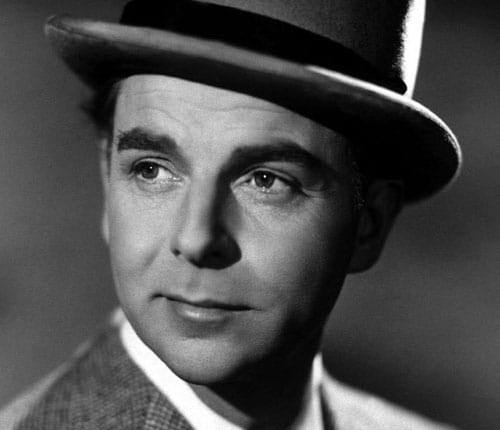
Emlyn Williams

Emlyn Williams

George Emlyn Williams was born in the tiny Welsh village of Pen-y-ffordd in 1905. As a Welshman with dark colouring and an unusual name, Williams appeared very different from popular interwar actors such as Laurence Olivier and Brian Aherne, both of whom performed in West End theatre at the same time. Unlike that other famous Welshman of the period, Ivor Novello, Williams steered clear of musical theatre and nightclubs in favour of writing and performing in plays exploring murder and criminal psychology.

After attending grammar school and undertaking some schooling in France on a scholarship, Williams won a scholarship to Oxford, where he became involved with the Oxford University Dramatic Society (OUDS). Williams was supposed to graduate in 1926, but instead of studying for his exams he wrote a play, Full Moon, which was put on at the Oxford Playhouse under the management of J.B. Fagan. Williams decided to move to London without completing his degree when Fagan offered him a small walk-on part in the production And So To Bed, in which Edmund Gwenn and Yvonne Arnaud appeared as the principal players.[1]

This modest role marked the start of a long West End career, in which Williams combined acting with writing and directing, regularly casting himself as the lead for his own productions. In his autobiography, Williams presents the years from 1926 to 1935 as ones in which he finds his feet both professionally and in his personal life. After numerous failures and some mild successes, the book ends with the first West End performance of his play Night Must Fall, which Williams credits as his ‘first solid success’[2] – it ran for a year and a half before transferring to Broadway for another 64 performances.

Night Must Fall is based on a notorious murder case of the interwar period, the ‘Crumbles Murder’ case of 1924. Patrick Mahon, a charming Richmond-based salesman, struck up an extramarital affair with typist Emily Kaye. Kaye fell pregnant, and Mahon led her to believe that they would travel to South Africa to start a new life together. Instead, he murdered her in a cottage on the Sussex coast and dismembered and destroyed her body so thoroughly that very little of it was found during the police investigation. What particularly spoke to the public’s imagination is that, less than 48 hours after the murder, Mahon picked up another woman and spent a few days at the cottage with her, whilst Kaye’s partly-dismembered body was in the next room.[3]

Williams combined this story with the equally notorious murder perpetrated by Sidney Fox, who in 1929 killed his own mother by strangling her and subsequently set her hotel room on fire to cover his tracks. In Night Must Fall, Dan, a charming man (modelled on Patrick Mahon) strikes up a friendship with a rich but cranky old lady and her niece Olivia. Whilst the niece suspects that Dan is a murderer, she still falls in love with him and helps him stay out of the hands of the police. Eventually, Dan murders the old lady and steals her money – although Olivia wants to help Dan escape, the play ends with him being arrested.

In his autobiography, Williams states that he had initially been interested in adapting the story of Fritz Haarman, a German serial killer who murdered at least 27 boys and young men in Hanover, in 1924. Williams was bisexual and identified with Haarman’s young victims: poor or homeless men, in some instances selling sex for money, lured back to Haarman’s flat with promises of food and shelter. ‘Yes, it could have happened to me’, acknowledges Williams. Although the story is clearly close to his heart, British theatre censorship laws absolutely precluded the depiction of a homosexual, paedophilic murderer.[4]

Alongside this career as theatre author and actor exploring the darker side of life, Williams also appeared in films. One of his first appearances was as the comic best friend to the protagonist in the Oxford comedy Men of Tomorrow (1932). Although the film was a commercial failure, it did bring Williams exposure and he was voted the most popular British actor by the readers of Film Weekly, ahead of Leslie Howard and Jack Hulbert.[5] This in turn landed Williams with a contract at Gaumont-British, where he wrote as well as acted. His first gig with them was writing the dialogue, and starring in, Friday the Thirteenth (1933). He subsequently worked on the Jessie Matthews vehicle Evergreen and supplied dialogue for the 1934 Hitchcock film The Man Who Knew Too Much.

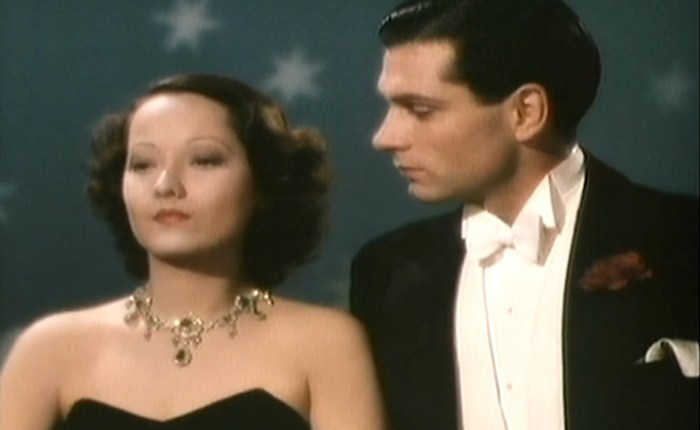
Although his contract with Gaumont was not renewed beyond 1935, Williams stayed active in film for the remainder of the interwar period, and beyond. As well as adapting Night Must Fall for the screen, he also acted in a range of genres such as the comedy Night Alone and the thriller They Drive By Night (both 1938). In 1936, he was cast as Caligula in Joseph von Sternberg’s unfinished I, Claudius, opposite other such greats at Charles Laughton, Flora Robson, and Merle Oberon.

Later in his career, Williams toured with an innovative one-man theatre show called Emlyn Williams as Charles Dickens, in which he delivered parts of Dickens’ novels in a manner similar to how Dickens himself toured in the 19th century. He remained interested in murder, and wrote a book about the Moors murders in 1968. Williams continued to be active as a writer and actor until close to his death in 1987.


[1] Emlyn Williams, Emlyn: A sequel to George (London: Penguin, 1976), p. 13

[2] Ibid., p. 449

[3] Colin Evans, The father of forensics: the groundbreaking cases of Sir Bernard Spilsbury and the beginnings of modern CSI (Thriplow: Icon, 2007), pp. 140-147

[4] Williams, Emlyn, pp. 213-221

[5] Ibid., 319
Careers for Girls (1927)

The interwar decades were a fertile period for non-fiction books that provided advice and guidance on how to self-improve your life. As well as health and fitness books and books on how to take up new hobbies or learn DIY skills, publishers also put out a steady stream of books that purported to help readers establish a new career. In 1927, George Allen & Unwin publishers produced Careers for Girls, a practical guide written by one Eleanor Page.

Careers for Girls was part of a series of self-help books. The book’s opening sentence immediately set out its purpose:

This work has been compiled to assist girls who have to earn a livelihood to choose a sphere of work suited to their individual gifts and temperaments, and by which they may earn a happy and comfortable living; and for the more favoured girls anxious to develop any talent they may be endowed with, so that they may take their rightful place in the scheme of things.

Immediately the book distinguishes between two types of ‘girls’ (really, young women): those who have to earn a living, and those who have some private income to rely on but have a drive to make a contribution to society, based on their skills and talents. Almost all the career paths covered in Careers for Girls are registered professions, which require formal schooling and certification, which in turn require financial investment to pay for classes and examination fees.

Although most of the roles described in Careers for Girls don’t appear to be particularly exclusive to a modern reader, in the interwar period compulsory schooling stopped at 14. Secondary schools charged tuition fees; the only way for a child of a working-class family to attend was through obtaining a scholarship. Only 14% of all teenagers went on to a secondary school; and only a fraction of those went on to University.[1]

Whilst women were allowed to attend university and could now even obtain a degree, the overall proportion of female students remained very low.[2] So when Careers for Girls advised that to become a librarian, you could complete on-the-job training as long as you had a secondary school diploma, this career would not be accessible to 86% of the population.[3] To become a musician was even more difficult: a qualification at either a University or the Royal College of Music/Royal College of Art would be expected.[4] When the book’s opening therefore distinguishes two types of ‘girls’, it wholly ignores the vast majority of young women for which the pursuit of a skilled profession was completely out of reach.

The rest of Careers for Girls is divided up in chapters, each of which covers a different area of work. Teaching and nursing – two roles traditionally associated with women – make an appearance, as do accounting, civil service, journalism, social service and many others. By 1927, Britain suffered from a surplus of women, as the impact of the Great War, and the thousands of young men who had died on the front, continued to be felt.

Guides like Careers for Girls gave young women ideas to an alternative to domestic married life. The pursuit of a career rather than marriage would have been a necessity to many. Tellingly, a number of the advertised professions, such as nursing and teaching, generally came with room and board. These roles provided a solution to the single woman who had no family members with whom she could, or wanted to, live.

Careers for Girls also gives estimated salary expectations for all posts. One of the more lucrative careers included is the top rung of the Civil Service, the “Administrative Class”. In order to obtain a position here, a woman had to meet the standard criteria for all Civil Service positions, namely be a British subject with a British father, unmarried, at least 5 feet tall and of certified good health.[5] “In the highest branch of the Service – the Administrative Class – candidates must be twenty-two to twenty-four years of age. The standard of education for examination is equal to that for a University Degree.” After meeting all these criteria (and remaining single, as the Civil Service operated a Marriage Bar), Careers for Girls stated that a woman could enjoy an annual salary of up to £550. However, in reality, Administrative Class posts in the Civil Service were only theoretically open to women – no women actually penetrated to this level of work.[6]

The jobs that appeared to give the young woman the chance of the highest salary, without requiring extensive or expensive training, were those in the distinctly modern fields of media and advertising. Eleanor Page claims that ‘Good positions, with salaries from £500 to £2,000 a year, are open to the woman advertising expert. (…) a university degree or large amount of capital are not required.’[7] Both marketing and press firms ‘prefer to take girls from school and train them to their own methods’, making formal qualifications a hindrance rather than a help.[8]

Similarly, it is telling which careers appear to be not for ‘girls’: glaringly absent are, for example, doctor or surgeon – although Elizabeth Garrett Anderson qualified as both in 1865. Women can train to become secretaries, but not board members; chief assistant librarian but not head librarian; a staff manager, but not the head of the business. Ultimately, Careers for Girls provided a small sub-section of British women with suggestions for professions that were acceptable for them to pursue within the prevailing social norms of the period. The book likely allowed some women to plan out a career trajectory, but for many more its advice would have been so far removed from their day-to-day experience that it was no help whatsoever.


[1] Deirdre Beddoe, Back to Home and Duty: Women Between the Wars 1918-1939 (London: Pandora, 1989), p. 34

[2] Francesca Wade, Square Haunting: Five women, freedom and London between the wars (London: Faber & Faber, 2020), pp. 93-94

[3] Eleanor Page, Careers for Girls (London: George Allen & Unwin Ltd, 1927), p. 85

[4] Ibid., p. 81

[5] Ibid., p. 38

[6] Beddoe, Back to Home and Duty, p. 83

[7] Page, Careers for Girls, p. 14

[8] Ibid., p. 73 and p. 14

The Divorce of Lady X (1938)

The Divorce of Lady X (1938)

Just as the end of the 1920s saw the introduction of sound film in British cinema, by the time the 1930s drew to a close, a new innovation was introduced: Technicolor – or more correctly, three-strip Technicolor. Earlier versions of ‘two-colour Technicolor’ had been used in Hollywood since the First World War, for example for segments of Carl Laemmle’s 1925 The Phantom of the Opera starring Lon Chaney. Three-strip Technicolor gave more realistic colour images, and is the process which is famously used in The Wizard of Oz (1939).

Technicolor required financial investment, so it took some years to bring it to Britain. The first British Technicolor film was Wings of the Morning, made in 1937. It was followed hot on its heels by a film of Britain’s most lavish film producer, Alexander Korda. A Hungarian by birth, Korda moved in Britain in the early 1930s, when he’d already worked in Hollywood and various European film industries. In 1933, he had a huge success on both sides of the Atlantic with The Private Life of Henry VIII, a lavish period piece that depicted Henry Tudor belching and stuffing his face with food at regular intervals. The role of Anne Boleyn is played by Merle Oberon, in one of her first substantial screen roles.

Korda cast her again as the female lead in The Scarlet Pimpernel in 1934, and also in The Private Life of Don Juan in the same year. By 1939, the pair were married, although the marriage only lasted to the end of the Second World War. During their courtship, they made The Divorce of Lady X (1938), in which Oberon stars opposite Laurence Olivier. This comedy, with its frank discussion of divorce and extramarital relations, shows how ‘propriety’ became less important in Britain towards the end of the interwar period.

The Divorce of Lady X is a re-make of a 1933 film, Counsel’s Opinion, which Korda also produced. Both films are based on a play by Gilbert Wakefield. The 1933 film, whilst favourably received upon its release, is no longer extant. The Divorce of Lady X, by contrast, was syndicated for TV release in the US in the 1940s, and is widely available on DVD and online.

The story of The Divorce of Lady X centres on that favourite trope of British interwar cinema: a man and a woman, who are not married, are forced to spend a night together in a (hotel) room. Nothing untoward happens, but everyone assumes the couple must be having an affair. A similar trope is used in Night Alone, as well as numerous Aldwych farces, such as A Cuckoo in the Nest, Rookery Nook, and Lady in Danger. In The Divorce of Lady X, Leslie Steele, a young socialite, and Everard Logan, a divorce lawyer, are thrown together due to an impenetrable fog, which leaves them both stuck in the same central-London hotel. Leslie talks Logan into sharing his suite with her – her sleeping in bed, him on a mattress in the adjacent sitting room.

Laurence Olivier as Everard Logan, getting ready for an
uncomfortable night on the floor in The Divorce of Lady X

During the course of the evening Logan incorrectly assumes Leslie is married. The next day, a member of his club, Lord Meere, comes to Logan’s office and asks him to arrange for a divorce from Lady Meere, as the latter spent the previous night in the same central-London hotel, with a man in her room. Logan assumes that Leslie, who has not given him her last name, is Lady Meere, and that he unwittingly has become both the barrister and the co-respondent in Lord Meere’s divorce suit.[1]

Logan continues to court Leslie, telling her he does not care that his career will be ruined, as long as she will marry him after she’s obtained her divorce from Lord Meere. Leslie continues to play along, although she herself has also fallen in love with Logan. Eventually, Leslie meets the real Lady Meere, and the two women concoct a plan to reveal the truth to Logan. Logan is initially embarrassed by being taken for a ride and he storms off to France, but Leslie follows him onto the boat and manages to change his mind.

Leslie (Merle Oberon) nursing a sick Logan (Laurence Olivier) on the boat to France

Right from the outset of the film, it is made clear that Logan has had multiple affairs – when Leslie comments that his pyjamas are hideous and he should dump the woman who buys them for him, he shoots back ‘we parted six months ago!’. At the same time, he rings up another woman to apologise for not being able to see her that evening, due to the fog. Although Leslie is not explicitly shown to have any lovers of her own, she is very confident and flirts with Logan in a way that makes it unlikely that he is her first love interest. The real Lady Meere, moreover, is repeatedly quoted as having had four husbands and several ‘episodes’ with other men, and at the end of the film it is made clear that she is cheating on Lord Meere. Crucially, none of this is depicted as wrong or objectionable; although all characters admit that four divorces is perhaps a bit much, Lady Meere is also shown to be a sympathetic and attractive woman. When Logan admits to his assistant that he (as he thinks) has fallen in love with a married woman, it is a matter of amusement rather than embarrassment, and divorce is depicted as largely normalised.

Lady Meere (Binnie Barnes) and Leslie (Merle Oberon)
plotting on how to break the truth to Logan (Laurence Olivier)

This representation of marriages as likely not lasting nor monogamous clearly presents a challenge when the central relationship of the film must also fulfil narrative convention. For the audience to be invested in the relationship between Leslie and Logan they must believe that it will end in a happily ever after, not a marriage that will quickly dissolve because one or both parties are conducting affairs.

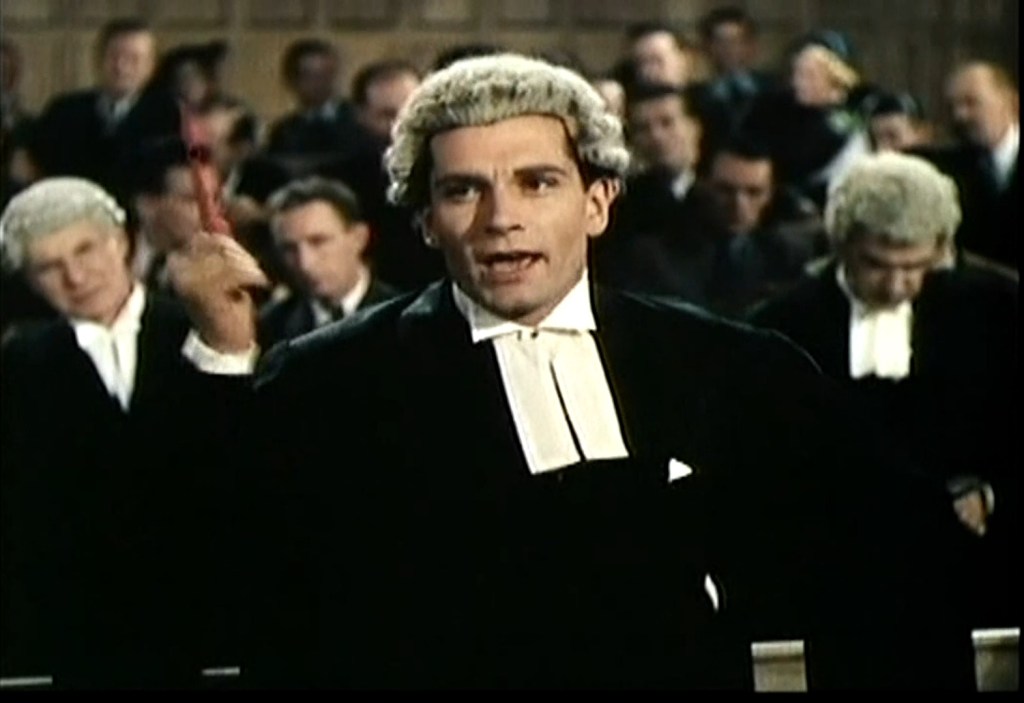
To resolve this, The Divorce of Lady X uses the trope of the woman-as-saviour: Leslie, for all her modern manners, is essentially a respectable girl. When she first meets Logan, he is extremely cynical about women, due to his experience in the divorce court. This cynicism reaches a high point during a withering closing-arguments monologue in one of his divorce cases, which Leslie witnesses from the public gallery. ‘Modern woman has disowned womanhood, and refuses man’s obligation!’ he thunders. ‘She demands freedom, but won’t accept responsibility! She insists upon time to “develop her personality”, and she spends it in cogitating on which part of her body to paint next.’

Laurence Olivier as Everard Logan, spouting against Modern Woman in court

Little wonder that Leslie is not impressed after hearing that speech! But no fear – her steadfast conviction that she is the one to save and reform Logan is rewarded in the end. When she follows him onto the boat to France at the film’s close, the choppy waters give her a chance to mother and nurture Logan. Her triumph is crowned by a final scene in the divorce court, in which Logan’s speech is the opposite of his earlier outburst. Appearing now as the defence of the woman accused of divorce, rather than as counsel for the husband, Logan gushes that his client is ‘a woman – that unique and perfect achievement of the human species (…) especially evolved for the comfort and solace of man.’ The message is clear: Leslie has managed to persuade Logan that married life is, after all, best. The open discussion of, and jokes about, divorce that form the backbone of The Divorce of Lady X point towards the ‘permissive society’ of post-War Britain; but its resolution of the protagonists’ story in a traditional marriage shows that in the 1930s the stability of conservative traditions still held sway.

The Divorce of Lady X can be viewed on the PBS website.


[1] In British divorce law, a co-respondent is a person cited in a divorce case as having committed adultery with the respondent ie. the half of the couple not initiating the divorce.

Co-operette (1938)

Co-operette (1938)

The Co-operative Wholesale Society (CWS), now the Co-operative Group, has had a presence in Britain since 1863. From its foundation, it set itself apart from other grocers with the notion of ‘dividend’: members who purchased goods from the business would also get a share of the profits – the more goods purchased, the bigger the dividend returned. In the interwar period, the CWS was a wholesaler supplying goods to a range of local co-operative grocers, particularly in the north of England.

In 1938, CWS produced Co-operette, a substantial advertising film for the company’s products. A version of the film is available to watch for free on the BFI player, (for those based in the UK). The BFI copy of the film lasts around 15 minutes, and appears to be incomplete. Nevertheless, the available footage gives a great insight into British advertising films of the late 1930s. A film like this would be shown as part of a cinema screening, which at the time usually comprised of a combination of feature films, educational films, cartoons, trailers, and advertisements.

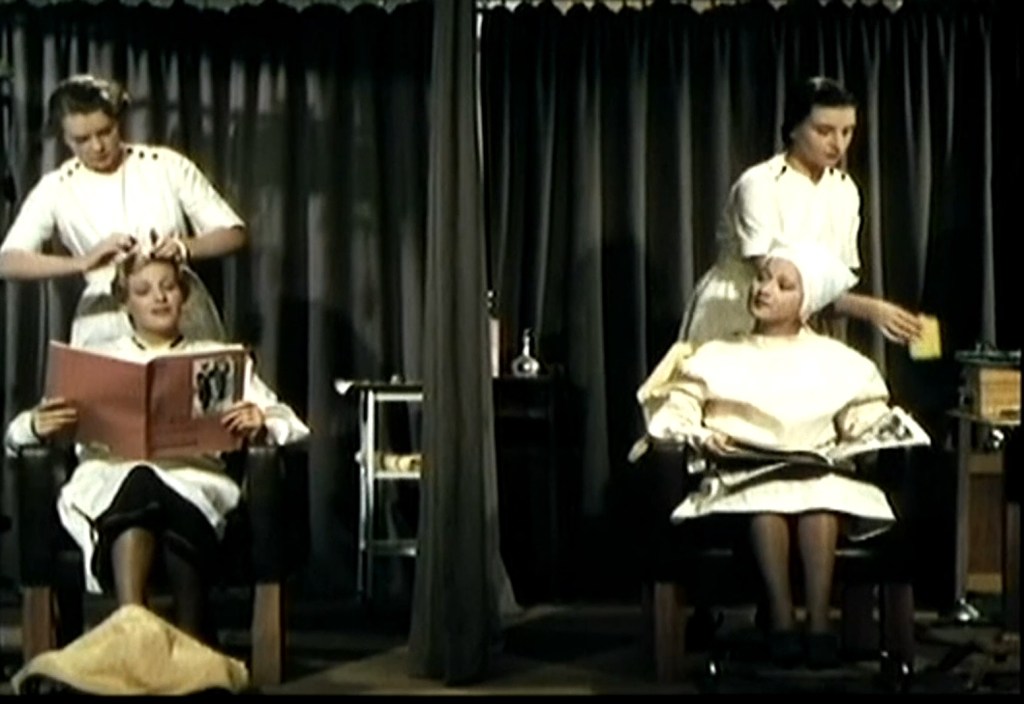
Like a shampoo commercial produced two years’ previously, Co-operette is framed around the deceit of being ‘on set’ whilst the advert is being filmed. The first shot after the opening credits is of a shooting script, which describes the opening credits we have just seen, and the announcer we are about to see – although the shot ‘close up of shooting script’ does not appear.

Close-up of the shooting script in Co-operette (1938)

The announcer tells the audience who will be featured in the film: comedian Stanley Holloway, band leader Debroy Somers and his band, comedian Harold Walters, and the ‘Six Co-operettes’: a dancing troupe of young women in skimpy outfits. (The fact that the famous and popular Stanley Holloway barely features is an indication that this may not be the full film). The next sequence moves us on to a film set, where Debroy Somers and his band are set up on a sound stage, ready to be recorded. In the set’s lobby, a Co-operette walks past whilst chatting to a man dressed in native American costume, to heighten the effect that this is an active film set on which multiple productions are being shot. Harold Walters plays Sam Small, a character in fact developed by Stanley Holloway who by 1938 would have been very familiar to audiences. Throughout the fifteen minutes, Sam Small serves as the comic relief character who creates confusion on the set.

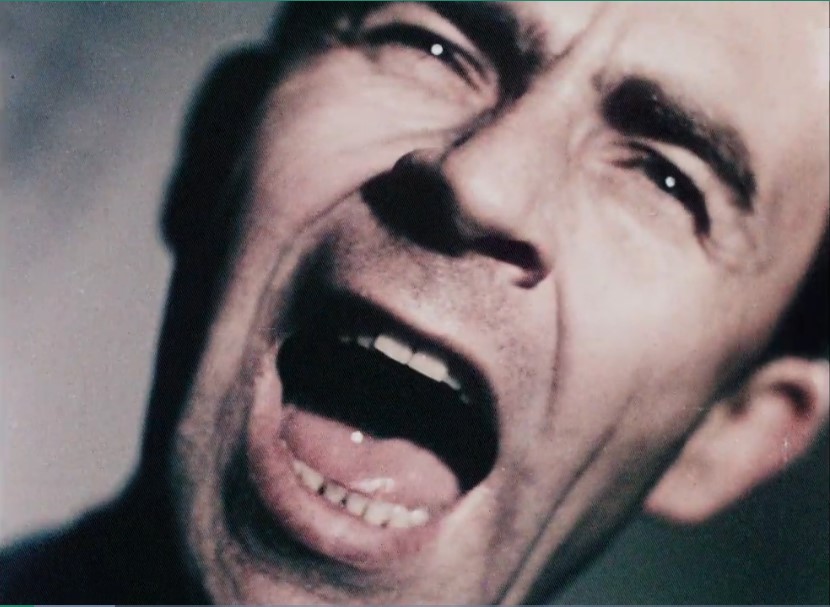
When filming of Debroy Somers and his band is about to get started, Co-operette serves up a series of close-ups of crew members on the set shouting for ‘QUIET!’

This over-emphasis on the need for absolute silence on the set make the inevitable disruptions of the hapless Sam Small onto the set’s operations even more impactful. The close-up shots are sharply angled, lending an unexpectedly expressionist air to proceedings which is not repeated at any other point in the film.

As Debroy Somers and his band get going for their first song – on a beach set with some women in swimwear decorously arranged in the foreground – the band’s trio of singers start a Co-op-themed song to the tune of ‘Heads, Shoulders, Knees and Toes’:

There is a Co-op in the town
And there, my true love sits her down
And well she knows each penny she could spend
Will go towards her dividend

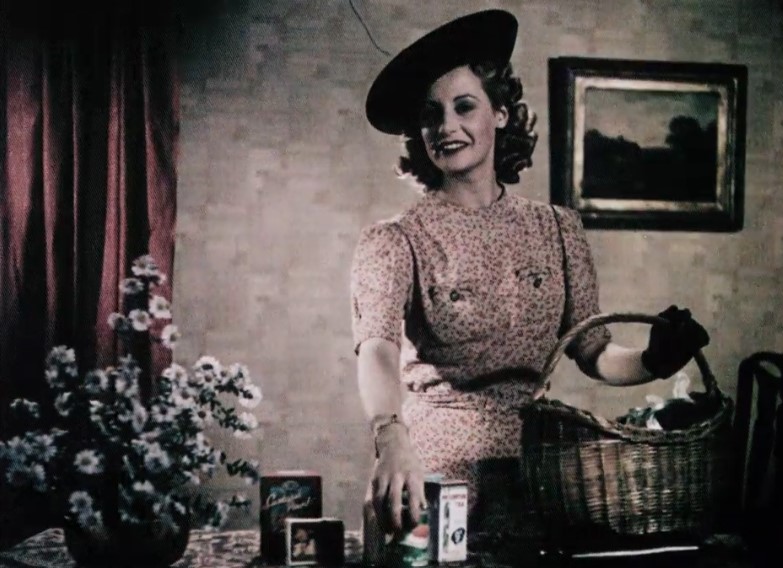
At this point the scene changes to a shot of a young, fashionably dressed housewife, who is pointedly unpacking her CWS-bought groceries, taking care to position the labels carefully towards the camera.

A housewife unpacking Co-op goods in Co-operette (1938)

This song seamlessly blends into the next one, in which the singers describe the various customer types of the Co-op in catchy rhymes accompanied by visual representations of these customers: a retired couple (“Charles and Jane live all alone/in a four-room flat they call their home”); a young man buying his wedding suit (“Lovely fit/I must admit”); a young woman who cleverly saves money on day-to-day purchases so she can still dress fashionably (“She knows the way to shop/where value is the top”); a young married couple of whom the husband always tries to eat everything in the larder immediately after the wife has done her Saturday shop at the Co-op.

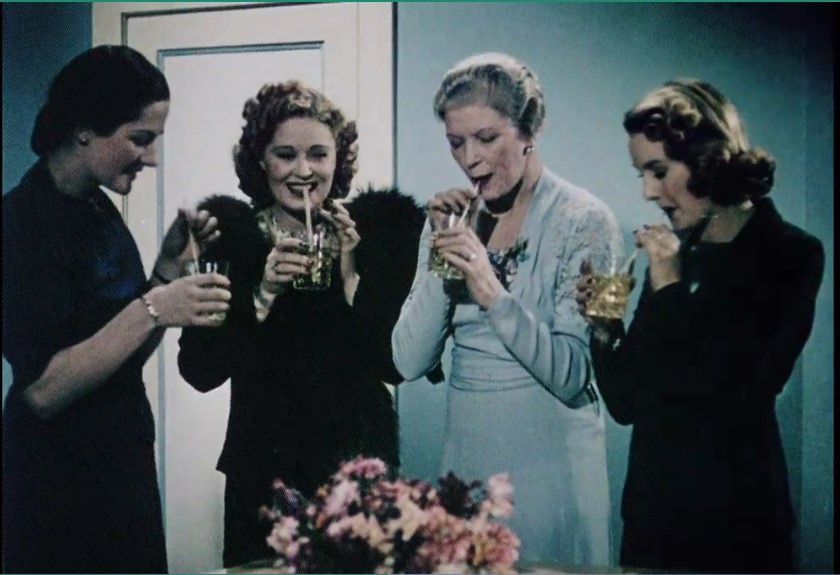
Despite the inclusion of the young groom, women are firmly established as the Co-ops main customer base. They are pithily categorised and visualised as ‘maid’, ‘widow’, ‘flaunty extravagant queen’ and ‘housewife that’s thrifty’. These four women are then shown to harmoniously share a pitcher of lemonade, drinking ‘to the health of CWS.’

From left to right: ‘housewife that’s thrifty’; ‘flaunty extravagant queen’; widow; maid

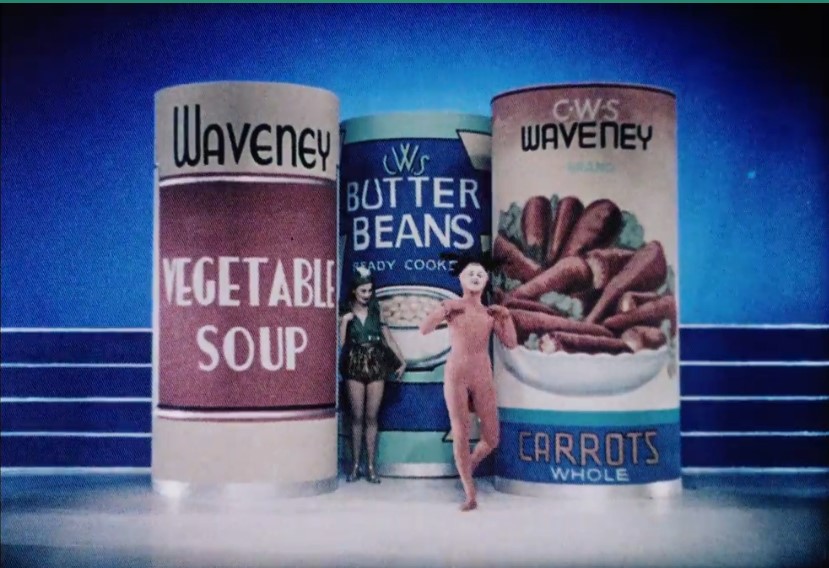
This section takes up about half of the fifteen-minute video. It is followed by a dance sequence of the six ‘Co-operettes’, after which the most surreal part of the film is launched: the ‘Carrot and Onion dance’. Against a set of three larger-than-life tins (Vegetable Soup, Butter Beans, and Carrots) two female dancers emerge. One is dressed in an orange suit that covers her entire body with a green head-dress; the other in a green, short-skirted dress.

Onion and Carrot emerging for their dance

As Carrot and Onion they dance a graceful pas-de-deux in which they overcome the difficulty of Onion’s smelly leaves. Their performance is followed by more work by the Co-operettes, this time tap-dancing. The final minutes of the film include more comic relief by Harold Walters, and a final song by the Debroy Somers band:

In every town there is a store
You pay much less, you get much more
For CWS has goods galore
For you, fair maid

Remember, remember
From January to December
There are always goods in store
For you, fair maid

The film ends with a title card reading that ‘All the goods featured in this film are CWS products’ – but hardly any goods are featured with any prominence. The first housewife featured is shown unpacking products, and there are some shots of a full larder, but in either case it is not possible for the audience to easily identify what the products are. The only packages that are really clear are the three enlarged cans used as the set for the ‘Carrot and Onion’ dance. No foodstuffs are mentioned by name in any of the songs.

Instead, the focus of the whole film is about the customers who shop at Co-op, and how the organisation caters to what the film presents as the full range of different women. In what is an early example of customer segmentation, women are primarily distinguished by their marital status (unmarried, married, widowed). However, whilst the film may be presumed to target women as the primary shoppers, the repeated display of the ‘Co-operette’ dancing troupe instead suggests a male target audience. During these dance sequences, the deceit and comedy of the sound stage set is dropped in favour of a more straightforward attempt at Hollywood glamour.

Co-operette shows how a British firm used cinematic conventions to create an advertising film that was much more about selling a concept than about selling specific items. The overall effectiveness of the film is, perhaps, somewhat reduced by its attempt to provide comedy, catchy songs, stage performance, and the Carrot and Onion dance which appears to be in a genre all of its own. Despite the overt messaging in the film implying that only women are the CWS’ customers, the film’s varied format indicates that it tries to appeal to all audience groups in the cinema, including men and children.

Co-operette can be viewed for free on BFI Player, for readers based in the UK.

Alastair Sim

Alastair Sim

Alastair Sim was born in 1900 in Edinburgh. After an aborted university education and active duty during the Great War, he trained as an elocution teacher and took up a lectureship in that subject at the University of Edinburgh in 1925. Elocution and drama teaching was his route into an acting career, of which his parents were not supportive. In 1930 Sim moved down to London, where his acting career took off.

After several years of stage roles, Sim made his film debut in 1935, with no fewer than five film credits to his name in that year alone. All were mostly low-budget comedies or crime films, in which Sim played smaller parts. Throughout his career he mostly played supporting roles, with the notable exception of Scrooge (1951) in which he played the titular character. It’s still considered one of the best portrayals of Scrooge on film.

As the 1930s continued, Sim got more substantial film roles in higher-profile films. His lanky frame (he was just over 6 feet tall) and distinctive voice made him instantly recognisable to audiences. In 1936 Sim starred opposite George Formby in the Monty Banks-directed Keep Your Seats, Please!. In the same year he was also directed by Monty Banks in the comedy The Man in the Mirror, although his name was misspelt as Alistair in the film’s credits.

In 1937-38, Sim starred opposite Jessie Matthews three times, in Gangway (1937); Sailing Along (1938) and Climbing High (1938). In Gangway, Matthews plays a journalist who gets caught up in a trans-Atlantic criminal plot. Sim is Detective Taggett, who is attempting to arrest the criminals. In Sailing Along, Matthews plays a precocious young woman and aspiring dancer who is brought up on a tug-boat. Sim here is the supporting character Sylvester, a confused and slightly simple-minded man who helps Matthews in her career aspirations. By the time of Climbing High, Sim was sufficiently famous that his name was included on the film’s poster. He again plays a supporting comedy relief character in this film.

Sim was only seven years older than Matthews, but in none of the three films is there the slightest inkling that he may be a suitable romantic partner for her characters. In fact, throughout the films Sim made in the interwar period, he plays characters who don’t have any romantic entanglements with co-stars. This was no doubt partly to do with his appearance, which did not meet conventional beauty standards of the period. Even in his thirties, he looked older than his years, and appeared somewhat ageless. His persistent casting in comedy roles further diminished his romantic appeal.

It is surprising, then, that in the 1937 crime film The Squeaker, Alistair Sim plays a character who has a settled domestic life, just when you least expect it. In The Squeaker Sim is Joshua Collie, a crime reporter for a popular newspaper. Journalists featured regularly in British interwar films, and were usually portrayed on the move, gathering news on the street; or pushing against deadlines in the newspaper offices.

Collie, on the other hand, is shown inside his comfortable living room, where he smokes a pipe after dinner like a suburban family man. He is not particularly interested in chasing down news, even though his friend, Scotland Yard inspector Barrabal, is feeding him plenty of information about the big criminal case he is working on. Collie reluctantly follows Barrabal’s leads only when his editor threatens to sack him for neglecting his duties. Alastair Sim played against the expected stereotype of the crime reporter, by making Collie a bit lazy and committed to his creature comforts. This enabled him to position himself again as a comedy character, even in a serious crime film which was based on a hard-boiled Edgar Wallace novel.

At the tail end of the interwar period Sim starred opposite Gordon Harker, another prolific interwar actor of comedy roles, in Inspector Hornleigh (1939). Sim played Sergeant Bingham, assistant to Harker in the titular role of Hornleigh. The pair are asked to investigate a murder in this comedy. The film was successful enough to spawn two sequels: Inspector Hornleigh on Holiday (also 1939) and Inspector Hornleigh Goes to It (1941).

Sim’s acting career lasted until his death in 1976. In the 1950s, as well as his interpretation of Scrooge, Sim also starred as the headmistress in the original St Trinian’s films, The Belles of St. Trinian’s (1954); and Blue Murder at St. Trinian’s (1957). Although his most commercially successful roles date from the second half of his career, he built up his screen persona and fame throughout the interwar period.

Olympia, 7 June 1934

This post is the second in a loose series of posts about fascism in interwar London. The first post explored the popularity of the British Union of Fascists in the East End.  

The British Union of Fascists (BUF) was founded by Oswald Mosley in 1932. Within a few years, the party had gained thousands of members, and by 1934 Mosley felt confident enough to stage several large-scale public speeches. In April of that year, the BUF hosted a largely successful rally in the (Royal) Albert Hall. The next event in the series took place on 7 June at Olympia, a Victorian events venue that could hold up to 15,000 people.

The event attracted many people who were not members of the BUF but were interested to hear Mosley’s ideas, or curious about this new political movement. In the run-up to the event, left-wing publications such as the Daily Worker encouraged readers to attend the event and set up counter protests against fascism. Mosley set the event up as a spectacle, using standard-bearers and spotlights and many BUF members in attendance in full uniform.[1]

The exact events which took place in the hall on 7 June 1934 were subsequently disagreed on by attendees from different political persuasions. It is established that at various points during Mosley’s speech, individual audience members heckled and challenged him. In those instances, a much larger group of BUF members, acting as ‘stewards’, would physically accost the interrupter and remove them from the hall. The extent of violence used against these interrupters was disputed, as was the total number of victims, and whether the hecklers formed part of an orchestrated attempt of the extreme left-wing to interrupt the meeting.

Both the political left and the BUF released pamphlets following the meeting, each presenting their own version of events. The left-wing pamphlet, called Fascists at Olympia: A record of eye-witnesses and victims, was published under the pen-name ‘Vindicator’ by publisher Victor Gollancz, a British Jew who openly supported left-wing politics. The pamphlet was distributed for free with the aim of raising awareness of the BUF’s methods.

Fascists at Olympia contains named statements of people who were present at the Olympia meeting; statements of those who claimed they were beaten up by BUF stewards, and statements of doctors who claimed to have helped the wounded in make-shift sickrooms set up in the vicinity of the hall. A statement in the pamphlet’s opening was subsequently used by the BUF to discredit it:

Several of the documents in this book, in their original form, contain references to the attitude of the police. These have been deliberately omitted, as the object of this pamphlet is to call attention to the actions of Blackshirts, and it is not desired to complicate the issue.[2]

During the Olympia meeting, the police were not present in the hall as it was a closed gathering in a private venue, and therefore they had no jurisdiction to enter it.[3] Police officers were present on the roads adjacent to the hall but came under criticism for not interfering with or challenging the violence perpetrated by BUF stewards. The compilers of Fascists at Olympia apparently did not want to risk that anti-fascist sentiment would be considered the same as anti-police sentiment, or anti-establishment feelings more generally.

This agenda is also clear across many of the witness statements included in the pamphlet, which repeatedly present fascism as ‘not English’:

‘I could not help shuddering at the thought of this vile bitterness, copied from foreign lands, being brought into the centre of England.’[4]

‘I witnessed other scenes of great brutality such as I had never thought to see in England.’[5]

‘For that [use of violence] I can see, as an ordinary Englishman concerned for fair play and decency no possible justification.’[6]

‘I can only say it was a deeply shocking scene for an Englishman to see in London. The Blackshirts behaved like bullies and cads.’[7]

‘I fail to see the necessity for this brutality, which is so foreign to the British race.’[8]

‘I belong to no political party, but what I saw and heard on the evening of June 7th made me think that the behaviour of the opposition, those reds to whom Mosley refers as the scum of the ghettoes, were far more in the English tradition than the Blackshirts with their flags and uniforms.’[9]

By 1934, Hitler’s violence in Germany and Mussolini’s hard rule in Italy were well-known in Britain, and Fascists at Olympia worked hard to persuade its reader that this type of political movement was a threat to the British (English) way of life. Terms like ‘fair play’ were still considered foundational concepts that separated the (white, upper and middle-class) English from other, less civilised and more violent people. The authority of the British police was similarly built on notions of ‘decency’ and temperance, and was another way in which England could consider itself more enlightened than other countries.[10]

The emphasis on fascism as ‘not English’, were used by the BUF in their counter-pamphlet about the Olympia meeting. Red Violence and Blue Lies: An Answer to “Fascists at Olympia” was published by the BUF’s own press. On its opening page, it horrifically states: ‘English men and women?’ ‘Who are the “English men and women” who break up Fascists’ meetings?’[11] This rhetorical statement is followed by a list of names, supposedly the names of those arrested by the police for disrupting the meeting – all the names are of Jewish provenance. The author(s) do not need to spell this antisemitism out more explicitly; the reader is expected to conclude that these names do not represent ‘English’ people.

The BUF pamphlet goes on to sketch a wide-spread left-wing conspiracy to silence Mosley’s party. The left-wing press’s exhortations to their readers to visit Olympia and stage a counter-protest, ahead of 7 June, are presented as evidence of this conspiracy. Throughout the pamphlet this argument is subtly built up and alluded to, until it is made manifest at the pamphlet’s end in a way that draws together antisemitism, suspicion of the state, and fear of socialism:

At Olympia [the ‘Red Terror’] was renewed with large organised and powerful financial support from quarters which are well known. Alien finance and Red terror join hands to fight the movement of “Britain First,” with the tacit and even open approval of the Old Parties of the State, who unite to oppose the new force that threatens them with ultimate destruction at the polls.

With the hindsight offered by history, we know that the BUF lost support throughout the 1930s and that fascism did not become the dominant ideology in 20th century Britain. In the debates following ‘Olympia’, this was far from evident, however: as Martin Pugh has demonstrated, MPs in the House of Commons did not roundly condemn the BUF’s conduct during the meeting, and allegations of a left-wing plot were also aired there.[12] The pamphlets published by both the BUF and the political left in the immediate wake of the event demonstrate how both sides sought to influence popular discourse about the meeting.


[1] Julie Gottlieb, ‘The Marketing of Megalomania: Celebrity, Consumption and the Development of Political Technology in the British Union of Fascists’, Journal of Contemporary History, (2006), Vol. 41, No. 1, 47

[2] Vindicator, Fascists at Olympia: A record of eye-witnesses and victims (London: Victor Gollancz, 1934), n. p.

[3] Martin Pugh, ‘The British Union of Fascists and the Olympia Debate’, The Historical Journal, (1998), Vol. 41, No. 2, 541

[4] Vindicator, Fascists at Olympia, p. 11

[5] Ibid.

[6] Ibid., p. 14

[7] Ibid. p. 9

[8] Ibid. p. 20

[9] Ibid., p. 37

[10] Clive Emsley, The English Police: A Political and Social History, 2nd edition (Harlow: Pearson Education Ltd, 1996), pp. 144-145

[11] Various authors, Red Violence and Blue Lies: An Answer to “Fascists at Olympia” (London: BUF Publications, 1934), p. 5

[12] Pugh, ‘The British Union of Fascists and the Olympia Debate’, 532-533

Sabotage (1936)

As noted elsewhere on the pages of this blog, Alfred Hitchcock started out as a director during Britain’s silent film period. He continued making films in Britain during the 1930s, before making his move to Hollywood around 1940. In 1936, he directed Sabotage, a Gaumont production based on the Joseph Conrad novel The Secret Agent. (Rather confusingly, in the same year Hitchcock also directed a film called Secret Agent which in turn was based on a novel titled Ashenden.)

By the mid-1930s, the tense European political situation was reflected in a spate of British films about spies and international criminal networks. Although Conrad’s source novel was published in 1907, and its plot is set in the 1880s, Hitchcock had little difficulty in adapting the storyline for a contemporary audience which was, again, concerned about German expansionism.

In Sabotage, a couple called Mr and Mrs Verloc run a cinema in central London. Mr Verloc is of unidentified Eastern European origin, whereas Mrs Verloc appears to be British. With them lives Stevie, Mrs Verloc’s teenage brother. Mr Verloc hides a secret from his wife – he is part of an international terrorist gang which is planning a series of attacks to disrupt British society. Scotland Yard have their eye on Mr Verloc, and undercover agent Ted Spencer is keeping a close eye on the cinema from a vegetable stall across the road.

Mr Verloc’s gang plan to blow up Piccadilly Circus underground station with a bomb hidden in a film reel tin. As Verloc suspects he’s being watched, he sends Stevie to drop off the package at the station’s cloakroom. Stevie, however, gets waylaid on the way to the station and the bomb goes off while he is still on the bus, killing him and all the passengers. When Mrs Verloc realises that her husband is responsible for her brother’s death, and he starts threatening her too, she kills him with a large kitchen knife. Ted Spencer, who by now has fallen for Mrs Verloc, shields her from arrest at the film’s end.

The sequence of Stevie travelling to Piccadilly Circus with the bomb is the most-discussed – and indeed, often the only discussed – part of Sabotage. Stevie is unaware of the real contents of the parcel he is carrying, he simply knows he needs to leave it in the luggage collection point in Piccadilly Circus station by 1.30pm. The audience knows that the bomb will go off at 1.45pm. Sabotage heightens the tension by a series of close-ups alternating between the parcel of explosives, Stevie, and various clocks which he sees on shop fronts along the way. As the clocks inch closer to 1.45pm, the individual shorts become shorter and shorter, culminating in an extreme close-up of the hand on a clock moving to 1.45pm. The bus spectacularly explodes, and Stevie and all the other passengers are killed in the blast.

Critics of Sabotage have pointed out that the rationale for Mr Verloc’s criminal gang is not defined. At the start of the film, the gang causes a mass electrical failure in London which causes widespread disruption. Their planned bombing of Piccadilly Circus would not just cause great material damage and loss of life – Piccadilly Circus was the symbolic centre of London, England, and the British Empire. When its underground station was completed in 1928, it was hailed as a feat of engineering. London Underground even produced a poster depicting the station’s tunnel network as the ‘stomach’ and digestive system of London. The motivation of the criminal gang, then, is to disrupt society, to cause unrest without providing a clear enemy against which people can direct their anger. The threat of destabilisation was keenly felt in 1930s Britain, as people watched great social change in Germany, Italy and elsewhere unfold. Many films of the period feature shady and undefined foreign criminal networks, including Laburnum Grove (1936), Midnight Menace (1937), and Bulldog Jack (1935).

The cinema is extensively used as a location in Sabotage. Mr and Mrs Verloc live in a flat situated behind the auditorium. To enter the flat, one has to go through the auditorium, and characters are frequently shown to pass through here whilst patrons enjoy the screening, apparently undisturbed. During his investigations, Ted Spencer is able to approach the flat unseen because the cinema audience is engrossed in a farcical comedy film. Spencer then enters the space behind the screen, in which there is a connecting window to the Verlocs’ living room. Spencer uses this window to eavesdrop on Verloc’s conversation, without the cinema audience being any the wiser.

After Stevie’s death, Mr Verloc tries to justify and explain himself to Mrs Verloc. Following this conversation, Mrs Verloc walks out of the flat and into the cinema auditorium, where a children’s showing of Disney’s Who Killed Cock Robin? is in progress. The children’s laughter prompts Mrs Verloc to first grimace in despair, before she turns to the screen and sits down to watch the show. Despite the centrality of its cinema location, this is the only time any of Sabotage’s main characters actually takes the position as audience member.

Engrossed in the cartoon, Mrs Verloc starts to laugh through her grief. She is unable to process the enormity of her emotions and uses the film as a welcome distraction. The distraction is all too brief: the cartoon bird gets shot, which plunges Mrs Verloc back in despair. This breaks the spell of the cinema for her, and she gets up and walks back through the auditorium with determination to see things out with her husband. Soon after returning upstairs, Mrs Verloc stabs her husband to death. After the spectacle of the bus explosion, the killing of Mr Verloc is understated. Mrs Verloc picks up a knife to carve dinner. She then pauses to look at it for a minute whilst an idea seemingly dawns on her. When Mr Verloc stands next to her to speak to her, she turns around and sticks the large knife in his abdomen. It is a murder which originates from a deep despair, rather than from anger or a desire for revenge.

Immediately after the murder, one of Verloc’s associates sets the flat on fire. Ted Spencer meets Mrs Verloc outside; although she confesses the murder to him and wants to give herself up to the police, Spencer tells his superiors that Verloc died in the blaze. Because Mr Verloc was a foreigner set to disrupt British society, and he stooped so low to use a child as an unwitting assistant to his plans, Mrs Verloc is allowed to go unpunished for her crime. Her insistence that she should give herself up to the police only serves to set her out as even more deserving. One perspective on Sabotage is that it argues that as long as British citizens are willing to make personal sacrifices, they can collaborate with the police to successfully neutralise foreign threats; and it is their duty to do so.

The Secret Agent by Joseph Conrad can be read for free via Project Gutenberg.

New Year’s Eve 1921

New Year’s Eve 1921

For this last blog post of the year we’re travelling back in time 100 years, to have a look at how London spent New Year’s Eve in 1921.

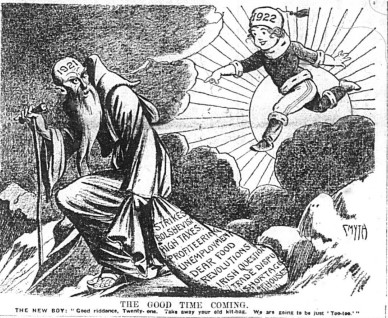
In 1921, 31 December fell on a Saturday, so the Sunday papers had the privilege of welcoming in the new year. The News of the World posted this cartoon on its front page, under the banner ‘A Happy New Year to All of Our Readers’.

Cartoon printed on the front page of News of the World, 1 January 1922

1921 appears to have been considered a year well worth saying goodbye to: the old man representing the past year carries a sack containing, amongst other things, ‘Bolshevism’; ‘Revolutions’ and ‘Shortage of Houses’. These, along with ‘Profiteering’ and ‘Unemployment’, indicate that the impact of the Great War on British society had continued to reverberate. The custom of depicting the previous year as an old person and the new year as a youngster was common, as evidenced by the following report in the Daily Telegraph:

Never has a New Year been welcomed with more public rejoicing and festivity in London than that upon which we have just entered. (…) all the great London hotels and restaurants were crowded with guests, for whom elaborate programmes of feast and entertainment had been arranged, including in most cases some novel and exhilarating means of marking at midnight the death of the Old and the birth of the New Year.[1]

Probably the most extravagant party was held in the Savoy, which catered for either 1600 or 1750 guests (numbers given by the Daily Telegraph and Evening Standard respectively). The distinguished guests, which included Lord Curzon, watched as a recording of Big Ben, projected on a screen, counted down the minutes to midnight.[2] Another notable entertainment was given in the Hotel Victoria, where a miniature airplane carrying a little girl appeared to descend out of the ceiling.[3]

Crowds were not just found inside hotels and restaurants, but also in the churchyard of St Paul’s Cathedral: ‘The crowd which gathered from East and West within the shadow of St Paul’s Cathedral on Saturday night to sing “Auld Lang Syne” was a record one.’[4] This ‘record’ size crowd was unlikely to have only contained ‘London Scots’ as the Daily Telegraph article supposed: the crowd as so great as to make it ‘almost impossible to move.’[5]

Whilst the parties in the hotels and restaurants were only accessible to the wealthy, the poor were not forgotten. The Daily Telegraph reported that some 18,000 deserving children in various East London boroughs had been treated to a special meal earlier in the day.[6]

The Observer looked beyond the London festivities and reminded readers that half the world welcomes the New Year before Britain does, with festivities starting in a ‘small group of islands which belong to New Zealand.’[7] The article also points out that those countries using the ‘inaccurate Julian calendar’ would not be celebrating the New Year until a few weeks later. The article expresses the hope that the newly founded League of Nations may eventually ‘bring about international uniformity in the matter of the calendar and thus ensure a simultaneous celebration of the birth of the New Year among the nations of the Earth.’[8]

In contrast to these reports of parties and celebrations, the Manchester Guardian instead reported on ‘The Old Year’s Violent Passing.’[9] Whilst Londoners were celebrating, other parts of the country experienced forceful gales which particularly affected those living near the sea and rivers and which lead to ‘Wrecks, Heavy Damage, and Loss of Life.’

The other New Year’s tradition was (and is) the publication of the New Year’s honours list, which was reported in full by the Manchester Guardian and The Times but ignored by the more popular papers. Sir J.M. Barrie, who had been made baronet in 1913, was made a member of the Order of Merit in 1922; Gerald du Maurier received his knighthood.[10]

By the time the afternoon of 2 January rolled around, news about the New Year parties already had to make way for developments in what would become one of the most notorious murder cases of the interwar period. The Evening Standard announced a ‘Solicitor’s Sensational Arrest’ on its front page.[11] Over the weekend, whilst everyone had been distracted by the gale force winds and the parties, police in Hay, near the Welsh border, had arrested Herbert Rowse Armstrong, who ran one of the two local law practices.

Armstrong was arrested for the attempted murder of Oswald Norman Martin, a solicitor at the rival firm. By the time the Evening Standard appeared in the stands, the body of Armstrong’s late wife had been exhumed. Upon re-examination it was concluded that she, too, had been poisoned. Armstrong was eventually convicted of her murder and executed – the only solicitor in British history to be hanged for murder. The arrest of the ‘Hay Poisoner’ ensured that 1922 started with the familiar thrill of, as George Orwell would have it, a good old-fashioned English murder.


[1] ‘New Year’s Eve’, The Daily Telegraph, 2 January 1922, p. 6

[2] Ibid., and ‘A Londoner’s Diary’, Evening Standard, 2 January 1922, p. 4

[3] ‘Revels Greet 1922,’ Daily Mail, 2 January 1922, p. 4

[4] ‘Revels Greet 1922’, Daily Mail, 2 January 1922, p. 4

[5] ‘New Year’s Eve’, The Daily Telegraph, 2 January 1922, p. 6

[6] Ibid.

[7] These islands are Tonga, Samoa and Kiribati. ‘The Journey of the New Year’, The Observer, 1 January 1922, p. 9

[8] Ibid.

[9] ‘The Old Year’s Violent Passing’, Manchester Guardian, 2 January 1922, p. 7

[10] ‘New Year Honours,’ Manchester Guardian, 2 January 1922, p. 7

[11] ‘Solicitor’s Sensational Arrest’, Evening Standard, 2 January 1922, p.1

Edmund Gwenn

Edmund Gwenn

British actor Edmund Gwenn is internationally best-known for his role as Kris Kringle (‘Santa’) in the 1947 Christmas classic Miracle on 34th Street. This role earned Gwenn his only Oscar win (although he was nominated once more in 1950). Prior to his move to Hollywood at the start of World War II, Gwenn was a prolific stage and screen actor in interwar London. His instantly recognisable demeanour and voice made him a reliable choice for both leading and supporting roles.

Gwenn was born in 1877 and started his acting career on the late-Victorian and Edwardian stage, specialising in supporting roles of plays written by contemporary playwrights such as J.M. Barrie and John Galsworthy. He was a successful stage actor and did not make the transition to film acting until the start of the interwar period, when films were settling into the length and narrative types that we still recognise today.

Gwenn starred in only two feature-length silent films (Unmarried, opposite Gerald du Maurier, in 1920; and The Skin Game in 1921) before giving films a rest again until talkies became the norm in the early 1930s. Gwenn likely recognised that his power as an actor required him to be able to use dialogue as a means of expression. Once sound film work was available, he took to it with a vengeance, making no fewer than 36 films in the 1930s. No mean feat for an actor who was already 53 when the decade started.

In this film work, as in his stage roles, Gwenn continued to be associated with contemporary English writers. His first foray into sound film was a remake of The Skin Game, released ten years after the silent version in 1931. Both films were based on a Galsworthy play; the 1931 version was directed by Alfred Hitchcock.[1] Gwenn stars as Hornblower, a nouveau-riche industrialist who is looking to buy a piece of land from genteel landowner Hillcrist, to build industrial works. The conflict between ‘old England’ which values rural landscape, tranquillity and honour; and the new, industrial outlook which favours trade, progress and money, is at the heart of the film. The emotions between the two men and their families run so high that Hillcrist’s wife decides to reveal a damning secret about Hornblower’s daughter-in-law, as a result of which the young woman commits suicide. Hornblower, crushed with grief, decides to leave the area. Hillcrist’s victory is hollow, however, as he contemplates the moral depths to which his family has stooped to defend their way of life.

Gwenn played a man from a different social background a couple of years later in The Good Companions, a 1933 adaptation of a popular J.B. Priestley novel.[2] This Victor Saville-directed film remains a popular example of a British interwar comedy, and also stars Jessie Matthews and John Gielgud. In The Good Companions, Gwenn plays Jess Oakroyd, a Northern labourer who gets fired for speaking up against a malicious manager. Oakroyd decides to travel ‘south’ in search of work. In the Midlands, he stumbles across a faltering theatre troupe called the Dinky Doos. Simultaneously with Oakroyd’s arrival in the midlands, the film also follows teacher Inigo Jollifant and Miss Elizabeth Trant, who reach the Midlands from the East and West of England respectively. The three travellers join the Dinky Doos and help to make the troupe a success. The Good Companions was well-received by critics, who praised it as a ‘British’ picture at a time when the British film industry had been under considerable domestic pressure to prove it could stand up to the influence of Hollywood.[3]

Gwenn used his non-threatening appearance to great effect in 1936’s Laburnum Grove (directed by Carol Reed), which has been discussed in detail elsewhere in this blog. In this film, Gwenn plays Radfern, a seemingly innocent and typical suburban husband who is secretly involved in an international crime network. The film is, again, based on J.B. Priestley source material. Reed directed Gwenn again in 1938, as the working-class lead of Penny Paradise. This comedy-drama is set in Liverpool, and Gwenn plays Joe Higgins, a tug-boat captain who religiously enters the ‘penny pools’ – a postage betting system in which players try to guess the correct football scores for the entire league. Miraculously, Higgins guesses all the scores correctly, and he believes himself a rich man. However, his friend Pat, who was supposed to have posted in Higgins’ winning score, forgot to post it on time. Higgins gives up his job and throws a large party for the entire community before Pat has the courage to tell him what has happened.

Penny Paradise is a fairly typical 1930s British comedy, with the expected happy ending and moral lessons for the main characters. Gwenn rounded out the decade with a very different part, in what has commonly been called the ‘first Ealing Comedy’. Cheer Boys Cheer, produced by Michael Balcon and directed by Walter Forde, was released in 1939. It follows the plight of a small beer brewery which is up against a big, capitalist brewing corporation. The conviviality of the workers at the small brewery models how Balcon planned to run his new studio. Gwenn plays Edward Ironside, the head of the industrial brewer. The film’s most striking scene (to a modern audience) is a brief shot of Ironside reading Hitler’s Mein Kampf. In this last role of the decade, just before his move across the Atlantic, Gwenn came full circle with his performance as Hornblower in The Skin Game: that of an industrialist intent on undermining traditional British values. The changes which Britain underwent in the 1930s, however, meant that whilst at the beginning of the 1930s it was the life of the landed gentry that was worth protecting, by the end of the decade it was the working-class community spirit that was held up as the British ideal.

Gwenn continued to act almost up to his death at the age of 81, in 1959. His later roles increasingly included incidental parts in TV series. Whilst his later, American career may have brought him international and lasting fame and recognition, his frequent appearances in British films of the 1930s made him a key contributor to the interwar cultural landscape.


[1] Jeffrey Richards, The Age of the Dream Palace (London: IB Tauris, 2010) p. 316

[2] Laurence Napper, British Cinema and Middlebrow Culture in the Interwar Years (Exeter: University of Exeter Press, 2009), p. 81

[3] Ibid., p. 123