The Lodger (1927 and 1932)

This post is the second of a two-part mini series about Marie Belloc Lowndes’ story The Lodger. The first post considers the short story and novel Lowndes wrote. This post discusses two film adaptations of the book made in interwar Britain.

Marie Belloc Lowndes novel The Lodger, which appeared in 1913, was twice adapted for the screen during the British interwar period. The first, silent, adaptation was directed by Hitchcock in 1927; a sound remake directed by Maurice Elvey appeared five years later. Building on last week’s post which considered the differences between the short story version of The Lodger and the novelisation, this post unpicks the differences between the novel and the films.

The main difference between the novel and the screen adaptations is the identity of the Lodger. In the novel, there is no doubt that the lodger, Mr Sleuth, is responsible for a series of murders of women across London. The book’s tension is generated by the concern of Mr Sleuth’s landlady, Mrs Bunting, that the police are going to find out her lodger is a murderer, and how that will impact her own position. In both film versions of the story, the lodger is ultimately revealed to be a ‘good’ character, who is trailing the murderer in an attempt to stop him. Whilst Mrs Bunting in both films is equally as suspicious of her lodger, because he keeps leaving the house on nights that murders are committed, he is ultimately revealed to have honourable reasons for this.

Hitchcock has publicly claimed that this softer ending was foisted on him, and that he preferred the book’s ending. One presumes that the sound remake followed the same template for the sake of appeasing audiences familiar with the first film. Whilst the change makes the story feel a lot less sinister, it also aligns it more with expected film plots in which the main male character is revealed as a hero and suitable love interest for the female character.

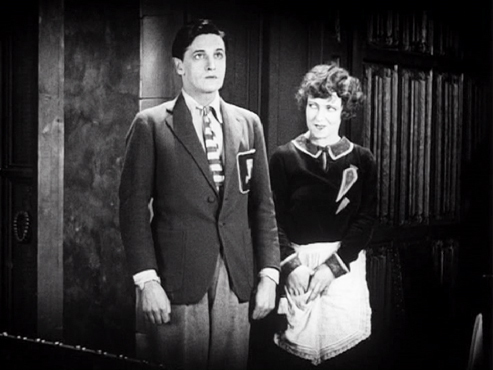
This female character, Daisy (Mr Bunting’s daughter), is much more fleshed out in both films than she is in the book. The role is played by June Tripp in the first film, and by Elizabeth Allan in the second film. In the novel, Daisy is only present in the house every now and then, and she only meets Mr Sleuth face to face right at the book’s end. Generally, Daisy comes across as a bit dim and easily led. In a reflection of women’s increased participation in the workforce during the interwar years, Daisy has a job in both films. In the 1927 version, she is a mannequin for clothes – it is a job, but still one in which she is expected to be passive and decorative. In the 1932 film her job has changed to that of a telephone operator; in that capacity she overhears one of the murders as the victim desperately tries to ring for help.

In the films, Daisy plays a much more material part in the story, and her relationship with the Lodger is more substantial. In both films, she meets him at several points throughout the story and is on friendly terms with him. The fact that the lodger is played by film star and heartthrob Ivor Novello in both productions helps to present him as a viable love interest for Daisy. In the 1932 film, Daisy goes so far as to reject her original boyfriend in favour of the lodger. Again, these changes, which introduce a conventional young romance into the story, make the source material conform more closely to cinematic genre conventions.

Daisy’s original boyfriend, Joe Chandler in the book, also transforms between films. In the Hitchcock version, Joe is a police officer tasked with hunting down the murder, as he is in the novel. Like in the novel, Joe is oblivious to the possibility that the lodger is the murderer he is after – although of course unlike in the book, in the film the lodger is revealed to be innocent. Hitchcock also used the motif of the police officer who is blind to the guilt of those closest to him in his 1929 film Blackmail, so he perhaps appreciated the irony Lowndes built into the novel.

For the later film, Joe Chandler became John Martin, who is not a police officer but rather a tabloid reporter. By 1932 tabloid journalists had become much more socially visible as circulation figures of newspapers rapidly increased. In films, journalists were often presented as pseudo-detectives, collaborating with the police to investigate crimes. Perhaps it was felt that to change the Joe/John character from a police officer to a journalist was not too much of a change. John Martin is a ruthless reporter; at the start of the film, when Daisy witnesses a murder across the telephone line, he passes a picture of her on to his news desk without her consent. To her horror, Daisy finds the portrait printed on the paper’s front page the next day. John excuses this behaviour as he considers it his duty to present his bosses with all the scoops he gets. John’s inconsiderate behaviour paves the way for Daisy to ditch him for the lodger at the end of the film.

A final significant change between the novel and the 1932 film, specifically, is the identity of the lodger. In the book, Mr Sleuth is presented as a British gentleman, albeit one with possibly some foreign blood in him. In the Elvey film, the character is called Angeloff, and Novello plays him with a thick Ruritanian accent. The film’s resolution reveals that Angeloff has been on the trail of the murderer for many years, and that they have both travelled from a foreign country to Britain. Whereas the novel codes the criminal as domestic, the film explicitly presents him as a foreigner, who has wreaked havoc in Britain. The audience can rest assured that such horrific crimes would not be committed by a fellow citizen.

The Lodger enjoyed considerable popularity for decades after its release. However, throughout those years the story, which was originally closely modelled on the Jack the Ripper murders, developed to increasingly deviate from the original to reflect the changing times. The main element of the story, however – a man roaming around the streets at night killing young women – sadly remains relatable to audiences even to this day.

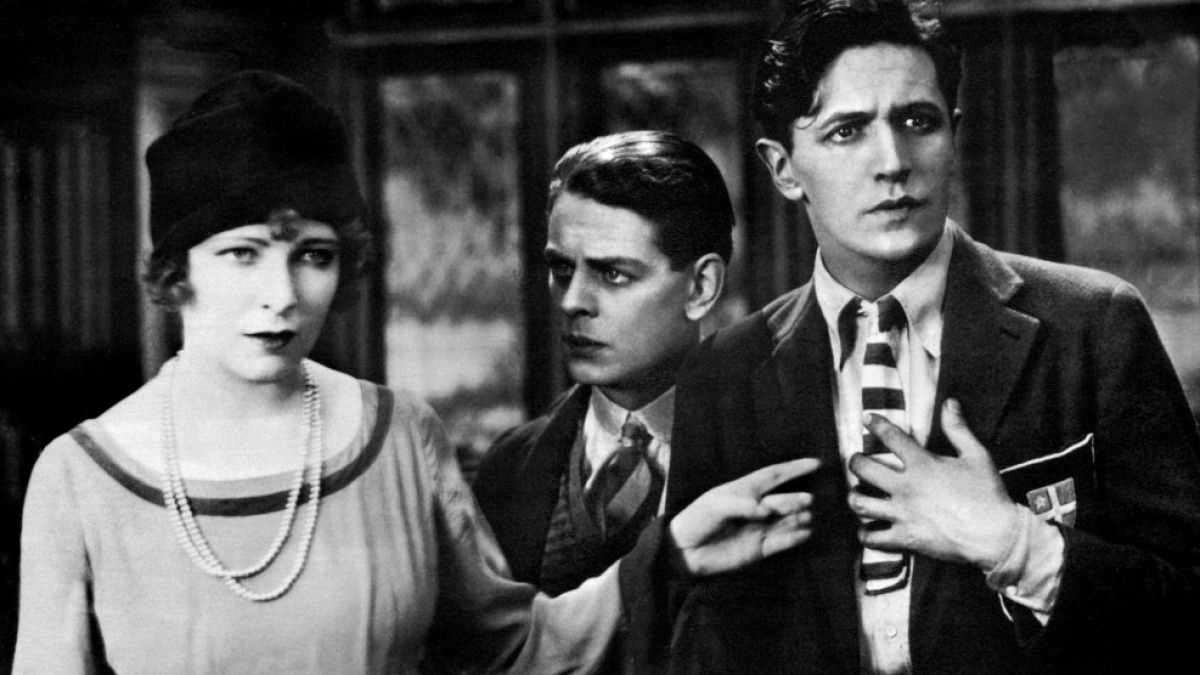
Alfred Hitchcock’s Downhill (1927)

Alfred Hitchcock’s Downhill (1927)

Before he became (one of) the greatest directors of the 20th century, Alfred Hitchcock started out his film directing career in London in the 1920s. After a few jobs as assistant director, he landed his first gig as principal director on 1923’s The Pleasure Garden. Four years later he made Downhill, a melodrama which has been described as only of interest to Hitchcock ‘completists’. In addition to providing an insight into the development of Hitchcock’s craft, this film also reveals cultural assumptions underpinning interwar London society.

Downhill stars the popular actor and entertainer Ivor Novello (who co-wrote the play on which the film is based) as Roddy Berwick, the son of a wealthy family who excels at his public school and has a glittering future ahead of him. Roddy’s best friend, Tim, comes from a less affluent background. Tim has a liaison with Mabel, who works at the local sweetshop; this affair results in Mabel falling pregnant. Mabel tells the schoolmaster that it’s Roddy, not Tim, who is the father; Roddy promptly gets expelled from school and disowned by his father.

Beginner's Guide to Alfred Hitchcock: Downhill (1927) — Talk Film Society
Mabel accuses Roddy

This starts Roddy’s downward trajectory in life. He first works as an actor and marries a glamorous actress who fleeces him for all his money before throwing him over. Roddy moves Paris, where he works as a gigolo. Eventually he ends up very ill in Marseille, where a few sailors manage to take him back to London. At the end of the film Roddy straggles back into his father’s house, to find that his father has found out that it was Tim who made Mabel pregnant, and has been desperate for Roddy to forgive him for his rash decisions. After his travails in the darker side of life, Roddy is restored in his rightful position.

One of the main themes of Downhill, as is clear from the plot description, is intergenerational conflict. When Roddy comes home from school a week early, his father immediately believes that the school must have been right in expelling him, and he does not even wait to hear Roddy’s explanations. The father’s rejection is so definitive that Roddy immediately leaves home and is unable to come back until he is almost at death’s door. Prior to this, the school and headmaster, who took their places as surrogate home environment and father figure, have also rejected Roddy.

The established institutions of society, school and the patriarchal father figure, turn their backs on Roddy. The older male generation here can be interpreted as a proxy for the generation of older politicians who sent off thousands of young British men to the trenches in France and Belgium in 1914. The War is not explicitly mentioned in Downhill, but its themes echo the sentiment that the older generation abandoned and unfairly sacrificed the younger one. When, at the end of the film, Roddy’s father asks Roddy for his forgiveness, it is not too much of a stretch to imagine him as a stand-in for the political establishment, asking the younger generation to forgive them for the War – a request that must, of course, remain limited to the realms of fiction.

The second theme running through Downhill, and this is perhaps one where Hitchcock’s hand is more readily recognised, is that apart from Roddy’s mother, all the women in the film prey on him and exploit him. Roddy’s mother, incidentally, only appears briefly at the beginning and end of the film and is completely irrelevant to the plot – it is only his father’s approval that matters to Roddy. Each stage of Roddy’s downfall is marked by a different woman. First there is Mabel, played by Annette Benson; she is depicted as a pretty one-dimensional ‘loose woman’ with make-up, a short skirt, and an apparently insatiable desire to flirt. She pro-actively asks Tim to come and see her in her shop on Wednesday afternoon. When he brings Roddy along, Mabel appears to consider this an opportunity rather than a barrier.

Silent Era : Home Video Reviews
Mabel flirts with Roddy

As soon as she has figured out that Roddy has more money than Tim, and is unlikely to allow himself to be seduced by her, she apparently hatches her plan. The film leaves it up to the viewer to decide whether Mabel is actually pregnant or not (although not sufficient time appears to have passed for her to be sure of it); it is pretty clear she accuses Roddy because she knows she can get more money out of him than out of Tim. Roddy does not dispute the claim out of a sense of honour and loyalty – he knows Tim’s future will be ruined if the truth comes out.

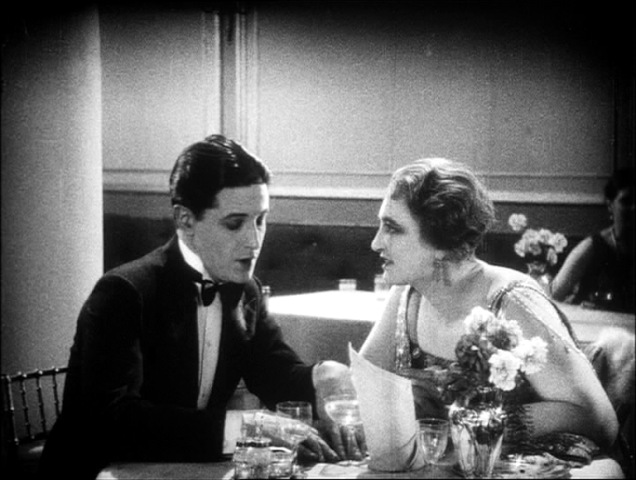
The second woman Roddy meets, and one he falls completely in love with, is the actress Julia Fotheringale. She is already in a relationship with Archie, but her expensive tastes is clothes and luxury goods are starting to become a problem. When Roddy unexpectedly inherits a large sum of money, Julie agrees to marry him. Once she’s spent his fortune, she abandons him again. Both Mabel and Julia are only interested in the money that Roddy can provide them with; they are both shown to be calculating and cold. Once Roddy’s money has completely run out he starts to work as a dancer-for-hire in Paris. His body is now the property, and it is control of the madams who run the nightclub.

1000 Frames of Downhill (1927) - frame 731 - The Alfred Hitchcock Wiki
Roddy as a gigolo in a Parisian nightclub

Downhill’s resolution provides an indication of what the audiences were encouraged to think really mattered: yes, Roddy’s father acknowledges he was wrong, but ultimately Roddy seeks his approval and wants to restore his place in the family unit. Roddy’s sense of honour, which leads him to keep Tim’s secret, is one of the central guiding principles for his behaviour. When he is nearly dying in Marseille, the knowledge that he has kept Tim’s secret for him is a comfort to Roddy. Paris, as usual, is shown to be a den of immorality. Ultimately, values traditionally associated with British upper class men are presented as desirable and admirable.

Downhill is available to view on Youtube.

The Love Test (1935)

Following World War I, the British economy was in crisis, and Britain’s status as a world-leading power was challenged as a result. This decline was also reflected in the nation’s film industry, with British film production grinding almost to a halt in the mid-1920s.[1]The British government decided to intervene in this state of affairs with the 1927 Cinematograph Films Act. This piece of legislation stipulated that a percentage of films distributed and exhibited in Britain had to be made in Britain. The quota was set to gradually increase over the first ten years of the Act’s existence, ensuring that an ever-greater number of British films would be made, distributed and seen by audiences.[2]

The Government decided to implement this quota not only to ensure more jobs in the British film industry, but also because as cultural products, films could reflect appropriately British values to audiences. The popularity of Hollywood films raised fears that British audiences, particularly young people, were being ‘Americanised’. Unfortunately, the implementation of the Cinematograph Films Act did not work out as intended. Hollywood studios moved onto British soil and started producing ‘British’ pictures as cheaply as possible. These films became known as ‘quota quickies’, made on a shoestring budget. Hollywood studios did not want these films to seriously compete with their prestige productions; they simply existed to fulfil the quotas set out by law.[3]

Rather than building a sustainable and influential British film industry, the 1927 Act encouraged the production of a lot of poor-quality films which harmed rather than helped the reputation of British film. The effects of the Act were not all bad; a lot of British film personnel were able to cut their teeth on the sets of quota quickies, which allowed them to get a lot of experience in a short space of time. The scripts of these films were not carefully crafted or edited; the objective was to get something produced as quickly and cheaply as possible. The speed and quantity at which the films were made provides opportunities for these films to reveal the everyday cultural narratives and assumptions circulating in interwar Britain.

Most of these pictures disappeared as quickly as they came; there was little incentive to preserve products generally seen as low-quality. Some, however, remain accessible to us today: for example, The Love Test directed by Michael Powell in 1935. Powell went on to have a long and illustrious career in the British film industry, which may partly explain why The Love Test has been preserved when similar films by other directors were not. He made this film for the British arm of the Fox Film Company. Googie Withers appears in one of her very first screen roles, and the male lead is played by South African actor Louis Hayward who had a reasonably successful career both before and after The Love Test.

It is not just the cast and crew that makes The Love Test more remarkable than most quota quickies. The film’s treatment of gender roles is also one that appears unusual for a 1930s production; although Steve Chibnall points out that none of the contemporary reviews comment on this aspect.[4] The Love Test focuses on the male and female staff of a chemistry lab, who are trying to invent non-flammable celluloid – certainly a product close to the film industry’s heart. Mary, the female lead, is a studious and talented lab worker on track to be promoted to a managerial position. Some of the male staff of the lab, led by the misogynist Thompson, are threatened by her professional success. His solution: one of them must seduce Mary, so that she will be distracted from her work.

Lab worker John (Louis Hayward) takes up the challenge; initially he finds it impossible to get Mary to focus on anything other than her career. She firmly tells him she has ‘eliminated sex.’ However, with the encouragement of her neighbour Kathleen, Mary starts to take an interest in her appearance. About halfway through The Love Test Mary has a make-over montage in the manner used by teen and romance films for decades since. With her new hair, make-up and glamourous clothes, Mary and John’s second date is much more successful. Mary’s new appearance also makes John see her as a real romantic prospect, and he stops trying to distract Mary from her career. Mary’s new appearance, combined with her professional skills, ensure her promotion in the lab. However, it is John who eventually finds the way to make celluloid non-flammable.

In many ways The Love Test offers a strikingly feminist narrative: there is no suggestion in the film that Mary should not be working, that lab work is not appropriate for women, or that she is anything other than excellent at her job. On the other hand, Mary is not able to access a romantic relationship until she changes her appearance and interests to encompass more traditionally ‘feminine’ traits. The film presents her post-metamorphosis appearance as more desirable and aspirational than the version of her that was not interested in clothes, make-up or men. The Love Test balances the acceptance of the inevitable emancipation of young women in interwar Britain with the counter-narrative that being sexually desirable to a man is still the most rewarding achievement.


[1] Steve Chibnall, Quota Quickies: The Birth of the British ‘B’ Film (London: BFI, 2007), p. 1

[2] Laurence Napper, British Cinema and Middlebrow Culture in the Interwar Years (Exeter: Exeter University Press, 2009), p. 28

[3] Chibnall, Quota Quickies, p. 4

[4] Ibid., p. 226

Break the News (1938)

Break the News is a British film of the end of the interwar period that displays some of the ambition of the film industry at that time. The film is a remake of a 1936 French film called Le Mort en Fuite (Death on the Run). Break the News was directed by Frenchman René Clair who cast his compatriot Maurice Chevalier in one of the lead roles. The other male lead was played by Jack Buchanan, a British actor who enjoyed fame both on stage and on film. The main female role was fulfilled by June Knight, a Hollywood starlet who had come over to Europe. Buchanan also produced the film under his short-lived production vehicle Jack Buchanan Productions.

Although Clair is mostly remembered for his post-war films, he started directing in France in the mid-1920s. Break the News was his second picture in the UK, after he directed Robert Donat in the supernatural comedy The Ghost Goes West in 1936. The casting of Break the News demonstrates the high aspirations Buchanan and Clair had for the film. Buchanan had considerable star power in interwar Britain, and Chevalier was a recognised Hollywood star.[1]

The film’s plot is as internationally mobile as its stars. The action starts on the West End, where Teddy and François, played by Buchanan and Chevalier, are in the chorus of a musical comedy show. The show’s lead star is Grace Gatwick, played by Knight. Teddy and François long to have the same level of fame as Grace, so they come up with a cunning plan. After staging a face argument in their lodgings, they make it appear that François has killed Teddy, and make sure that he conspicuously tries to dump the ‘body’ in the Thames. Teddy goes off to the south of France to enjoy a holiday; the plan is that the ‘murder’ will generate a lot of newspaper publicity; François will get arrested and Teddy will dramatically return from France during the trial to ensure François gets acquitted. Both men will get famous and then they will be able to put on their own stage production.

Unfortunately, and obviously, the plan goes awry. Firstly, the anticipated media storm after the ‘murder’ does not materialise, so whilst François eventually gets arrested, the men do not get famous. Secondly, whilst in France Teddy is mistaken for a revolutionary leader of a (fictional) Balkan country, and gets kidnapped and taken back to this Ruritania. He only very narrowly manages to get out and return to Britain just in time before François is executed. This being a musical comedy, of course all is well at the end, and with the help of Grace the men do get their names in lights on the theatre façade.

The plot of Break the News, and indeed the film’s title, place great importance on the operation of the written press. The newspapers are presented as the only vehicle that can give Teddy and François the fame they long for. Fame is not dependent on talent on stage, but rather on who is able to get and keep the attention of the journalists. Grace’s character functions to demonstrate this; early on in the film she manages to create a media storm by reporting that her little dog has gone missing; and then another one when the dog is found. Once the story breaks of a ‘murder’ within her show’s production, she makes sure to put herself in front of journalists and spin the story in a way that puts herself at the centre of it.

Teddy and François also assume that a murder case will most definitely hit the front pages. Much of the comedy in the first part of the film is derived from the way the men stage the ‘murder’, starting with a phoney argument on stage in front of the whole company; moving on to a loud argument in their lodging; and finishing with François taking a black cab to Limehouse to drop a heavy, corpse-shaped parcel in the river. But what the men do not take into account is that the press are not interested in murder per se. Grace is able to generate publicity on anything because the press consider her to be interesting. François and Teddy are never interesting to journalists, no matter what they do. Whereas the men assume that the press can make someone famous, they find that in order for the press to pay attention to you, you must already be interesting or relevant yourself.

The power of the newspaper press is underscored through the implicit assumption that if the press were to write about the murder story, then Teddy and François would become instantly famous. As is often the case in interwar films, ‘the press’ is treated as a homogenous entity, and it is taken for granted that a story is either covered by all papers, or by none. Break the News shows journalists to be operating in a pack, indistinguishable from one another as they all try to get a quote from Grace. Once a story is covered, the next assumption is that the newspapers’ reach is such that the details of the story would become generally known.

The comedy of Break the News relies in a large part on the audience understanding and accepting these beliefs about how the written press operates. It is funny that the murder gets no attention from the papers, because, like Teddy and François, we assume that it would attract column inches. Whilst Break the News pokes fun at these assumptions, the jokes only work because we share the same underlying beliefs that the film’s plot is built on. In that way, Break the News gives insight in the position of the written press in interwar British society.


[1] Andrew Spicer, ‘Jack Buchanan and British Musical Comedy of the 1930s’ in Ian Concrich and Estella Trincknell (eds), Film’s Musical Moments (Edinburgh: Edinburgh University Press, 2006)

The King and Queen go to the Movies

The King and Queen go to the Movies

The 1920s were a turbulent time for Britain, both at home and abroad. The decade saw the beginning of the end of the British Empire, as Ireland and Egypt gained a level of independence in 1922. Throughout the 1920s popular support for independence grew in India, with Ghandi’s Non-Cooperation Movement founded in 1920. At home, as in the rest of Europe, ideological and extremist political factions gained support. The British imperial identity was clearly under threat during this period.

The Royal Family, as the figureheads of this imperial identity, worked hard to reaffirm conservative values and traditions and bolster a sense of national cohesion. They used cinema as one of the ways in which to promote the Empire and their own role in maintaining it. In the 1920s the King, Queen and Prince of Wales interacted with cinema both as consumers and as subjects of films. By engaging with cinema, the Royal Family both shared in a common activity which appeared to bind them together with the general public; and set themselves apart as extraordinary figures whose importance enabled them to appear on the silver screen.

The Prince of Wales was a subject of films that were made of his various Tours of the Empire which he undertook in the 1920s. He visited New Zealand in 1921, India in 1921-22, South America in 1924 and South Africa in 1925. These tours were routinely filmed, and the films were screened in British cinemas. At their initial release the films usually premiered at the Marble Arch Pavilion and the Stoll Picture Theatre on the Kingsway, before being distributed more widely. On 12 May 1925 more than half of The Times’ regular ‘The Film World’ column is taken up by a detailed description of Part 1 of the Prince’s Tour of Africa film, which gives an indication of the importance these films held at least for the Empire-minded Times.[1]

These Tour films placed the Prince of Wales as inextricably connected with the Empire, in the popular imagination. For the general public, the Prince was frequently visible as visiting all the corners of the Empire, reasserting his Royal authority over citizens across the globe. The images and intertitles of the films show how the texts consciously stress the coherence and common experience of Empire. In the newsreel summary of the Prince’s Tour of South America, when he visits a group of war veterans, the intertitle confidently states that ‘There are few cities under the sun that cannot raise a muster of British ex-servicemen.’ Empire here is emblematised in the image of the war veteran, who risked his life and health in order to maintain the integrity of said Empire.

Apart from the Prince of Wales’ tours, the Royal Family was also subject of a number of feature length films. In 1922 Cecil Hepworth produced Through Three Reigns, a compilation film which consists of footage of the Royal Family between 1897 and 1911, as well as extracts from actualities and other early cinema footage. Hepworth updated his efforts in 1929 with Royal Remembrances, which was also a compilation of footage of the Royal Family but this time the most recent footage was of 1929.

On 25 September 1922 the King and Queen asked for a special ‘command’ performance of Through Three Reigns at Balmoral Castle. This event was widely reported in the press.[2] The Royal couple invited 200 guests, including their tenants and servants, to attend the screening where they effectively watched their own family history. Shown in conjunction with Through Three Reigns – and different newspapers give different weight to this – was Nanook of the North, the ground-breaking Inuit documentary made by Brit Robert Flaherty. In one evening, the King and Queen watched a film that reasserts the significance of the Royal Family, and a film which demonstrates the technological and geographical advancements of the British Empire. This was the third of such ‘command’ performances that year – at an earlier screening at Windsor Castle the King and Queen had asked for the Prince of Wales Tour of India film.

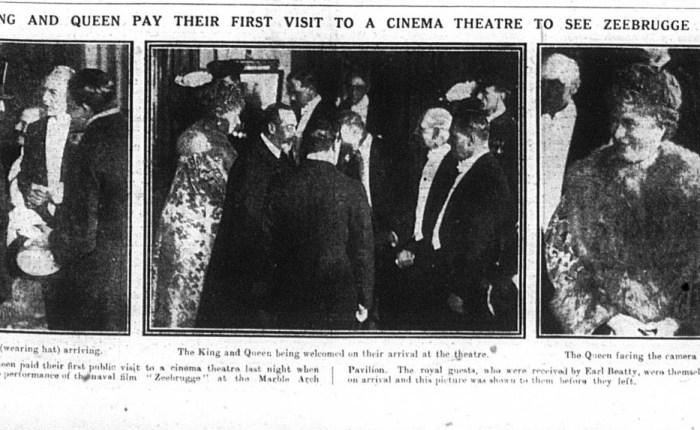
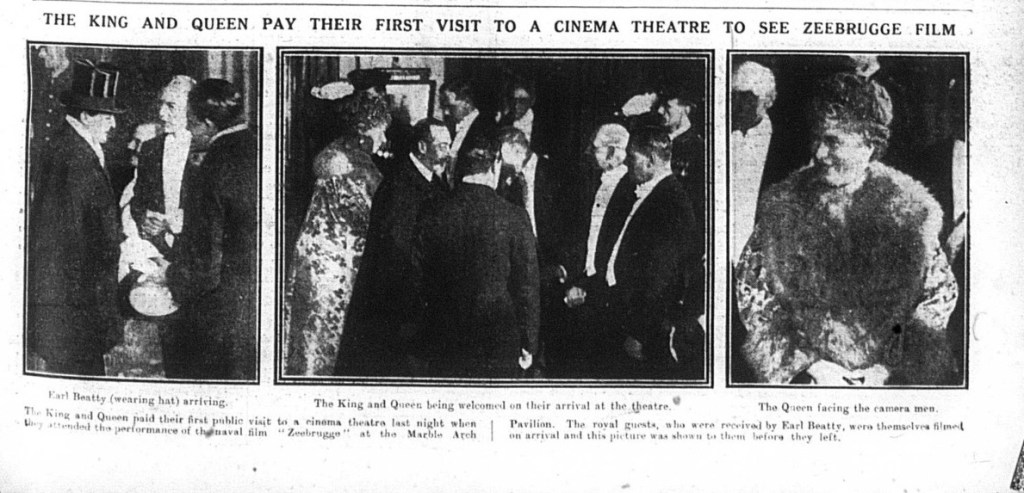
The King and Queen’s first public visit to a cinema came two years later, in November 1924 on the eve of Armistice Day. The occasion was a charity screening to raise money for the newly formed British Legion. The royal couple saw the non-fiction film Zeebrugge, which told the story of the British army’s attempt to close off the Belgian port of Zeebrugge during World War One. Again the event was covered extensively in the press.[3] Crowds cheered the Royal Couple as they arrived at the Marble Arch Pavilion and were shown to the Royal Box which was constructed for the occasion. Three commanders who had received Victoria Crosses for their bravery during the Zeebrugge Raid were also in the audience.

Photos in the Daily Mirror of the Royal visit to the cinema. Daily Mirror, 11 November 1924, front page

The Daily Telegraph gave a detailed report of all the aristocrats who attended the screening. The cinema space, normally open to audiences of all backgrounds, on this occasion became a much more exclusive space. It seems that the King and Queen could endorse cinema, as long as cinema related to serious and inoffensive topics –and the films they viewed were British productions, of course. The Royal’s support of cinema underscored the Royal Family’s values: of course the King and Queen saw films like everyone else, but only those that promoted the national identity of their country, and those that would not cause offence to any of their subjects.

During the visit to the Marble Arch the Royal Family also became the subject of a novel technological experiment: their arrival at the cinema was filmed, and while they were watching Zeebrugge the film was developed, and played back to the audience at the end of the evening. The Royals became subject of a film which they later consumed as an audience. This circularity was also demonstrated in the private Royal screenings in 1922: one of the topics that the Royal family could watch without risk of controversy was – the Royal family.

By the end of the 20s, film had become a recognised medium to promote empire, either directly through ‘educational films’ or indirectly by using cinema screenings to raise money for charities with Royal patronage. In this decade, the Royal family had gotten involved in the cinema business, and started using it as a means of increasing their popularity and profile, and of reaffirming discourse on empire and nationalism. Although the cinema could be a democratic space, the Royal Family’s interactions with it were carefully constructed. This way, they cleared the way for later generations of Royals to use popular entertainment to maintain the ‘common-sense’ status quo of monarchy.

Through Three Reigns is available to watch for free on the BFI Player (UK only)


[1] ‘The Film World’, The Times, 12 May 1925, p. 14

[2] ‘The King Sees Himself’, Daily Express, 26 September 1922, p. 7; ‘Royal Family Film’, Daily Mail, 26 September 1922, p.6; ‘Films at Balmoral Castle’, Daily Telegraph, 26 September 1922, p. 12; ‘Royal Ballroom Cinema’, Daily Mirror, 26 September 1922, p. 2

[3] ‘King and Queen at the Cinema Theatre’, Daily Telegraph, 11 November 1924, p. 11; ‘King and Queen See Zeebrugge Film’, Daily Mirror, 11 November 1924, p. 3; ‘The King & Queen Filmed’, Daily Mail, 11 November 1924, p. 7

A Cup of Kindness (1934)

A Cup of Kindness (1934)

Following the blog a few weeks ago about British comedy actor Ralph Lynn, today we will look in more detail at one of the Aldwych film comedies, A Cup of Kindness (1934). This film was based on a stage production which was first performed in 1929. The film uses the location of a fictional London suburb to make fun of class aspirations in interwar Britain.

Advert for A Cup of Kindness at the New Gallery Kinema in Regent Street, Daily Sketch, 27 July 1934

A Cup of Kindness is the story of two neighbouring families, the Tutts and the Ramsbottoms. The parents of both families despise one another, but the children, Betty Ramsbottom and Charlie Tutt, are secretly dating and intending to marry. Once they reveal their relationship to their parents, hostilities between the families intensify. Charlie, played by Lynn in his characteristic bumbling way, starts to doubt whether it is such a good idea for him and Betty to marry. After the customary argument between the lovers, they are reconciled at the end of the film, and a truce of sorts develops between both sets of parents.

Although A Cup of Kindness presents itself as a timeless story,[i] both in its opening title and through an odd dream sequence in the second half of the film, where we see the prehistoric Tutt and Ramsbottom ancestors fighting with one another in front of their respective caves, its setting in a suburban development is very specific to the interwar period.

As noted previously on this blog, London’s suburbs expanded rapidly during the interwar period, and along with this stereotypes developed about the aspiring middle classes who lived in the suburbs. A Cup of Kindness, for all its broad comedy, adds further nuance to this stereotype through the subtle signifiers of class difference evident in the Tutts and Ramsbottoms. The modern viewer is required to pay close attention to these signs in order to decode them, but for interwar audiences they were likely much more familiar and easier to interpret.

The film opens with Mr Ramsbottom (Robertson Hare) walking from the train station to his house in the evening. Just before he reaches the family home, he passes the Tutt residence, where Mr Tutt (Tom Walls) is standing outside in the garden. The first signifier of difference is in the men’s dress: Ramsbottom is wearing a regular suit and a bowler hat; Tutt is wearing evening dress. Ramsbottom has clearly come from some sort of clerical job; his dress is the functional uniform of the white-collar worker. Tutt, on the other hand, is dressed for dinner; a custom usually observed by the upper classes. As he is already at home and had time to change, we can infer that he does not need to head the hours of the office worker.

The families’ houses, too, imply difference. The Tutt family home is detached, with a driveway and a portico. The Ramsbottom house on the other hand is semi-detached only, overall smaller in size and with a smaller garden. As the film continues, we find that the Ramsbottoms also have their slightly senile uncle Nicholas living upstairs; and they keep a day-servant as well as a day nurse for Nicholas. The Tutts, on the other hand, have no staff. They have, however, managed to send their son Stanley to Oxford, and are keeping their son Charlie despite him being apparently unable to hold down a job.

The outward signifiers then appear to show that Mr and Mrs Tutt are wealthier and of higher social standing than Mr and Mrs Ramsbottom. There is a line that the latter utters, however, that gives a clue as to what really matters in the social pecking order of suburbia, and it’s not money. During a particularly heated exchange, Mrs Ramsbottom snaps that Mrs Tutt “once was a barmaid.” The implications are clear. Not only are the Tutts not ‘really’ upper class, Mrs Tutt is not even respectably middle class. That one line by Mrs Ramsbottom reveals that in her opinion, its breeding rather than money that determines who comes out on top in the social pecking order.

Yet despite their apparently humble origins, Mr and Mrs Tutt are able to present a wealthy front in the suburban street, by spending their money on just the things that give the impression of riches. This reflects contemporary anxiety about the suburbs, which gave many more people who had previously been unable to enter the housing market, the opportunity to own their own home. This democratisation also facilitated the mixing of people who would previously not have been in each other’s orbit. People moved to the suburbs from all over London and you could end up living next to people were from slightly different socio-economic backgrounds than yourself.

The relationship between Charlie and Betty is an example of this: both sets of parents think that their child can do ‘better’: the Ramsbottoms think Betty should pursue someone more respectable and dependable than Charlie, and the Tutts think Charlie is lowering himself by settling for Betty. Their proximity in the suburban neighbourhood has allowed this pair to get to know one another despite their different family backgrounds. Whereas inner-city areas such as the East End developed an increasingly cohesive common identity between the wars,[ii] the suburbs’ lack of history or character encouraged more prominent attention to the individual or familial identity as opposed to the collective one. A Cup of Kindness demonstrates this tendency towards individual expression through consumer goods and social cues as timeless, when it is in fact specifically rooted in the historical period in which the story was written.


[i] Indeed its writer, Ben Travers, referred to it as ‘Romeo and Juliet (…) of the suburbs’; Ben Travers, A-Sitting on a Gate (London: WH Allen, 1972), p. 108

[ii] Benjamin J Lammers, ‘The Birth of the East Ender: Neighborhood and Local Identity in Interwar East London’, Journal of Social History , Winter, 2005, Vol. 39, No. 2, Kith and Kin: Interpersonal Relationships and Cultural Practices (Winter, 2005), pp. 331-344

The Squeaker (1937)

Today’s post is going to discuss another Edgar Wallace adaptation, as so many of his works were turned into films in interwar Britain. The Squeaker, also known as Murder on Diamond Row in the US, was made in 1937. The novel on which it is based was published ten years’ prior, in 1927. Wallace himself died in 1932 so although he is credited as a co-writer on the film, he had no active involvement in its production.

The Squeaker is directed by William K Howard, and American who came to Britain in 1937 to work for the – then already famous – producer Alexander Korda. The Squeaker was their first collaboration. The American link may be the reason why this film got more exposure in the US than most British interwar products; according to the film’s IMDb page, The Squeaker got broadcast on a number of regional US TV stations in a six-month period in 1948-1949, as part of a syndicated broadcast package.

The story of The Squeaker has all the elements of a British interwar crime story. There are criminals, police officers, journalists, and nightclub performers. Larry Graeme is a small-time jewellery thief. He sells his stolen goods on to a mysterious man known as ‘the Squeaker’. The Squeaker extorts his criminal suppliers; he offers a bad price for their goods but if they refuse him, he betrays them to the police. Larry is in love with the beautiful nightclub performer Tamara. Scotland Yard are after the Squeaker and the hard-drinking, gruff Inspector Barrabal goes undercover to investigate. Barrabal is friends with the journalist Joshua Collie, a crime reporter.

When Larry steals some valuable pearls and refuses to sell them on to the Squeaker, the latter makes sure Larry gets arrested. Larry escapes; the film’s climax takes place at a society party thrown by the affable businessman Sutton. Larry dies at the party; Barrabal gets accused of being the murderer. He however has realised that Sutton is the Squeaker and Larry’s killer, and the film ends in Sutton’s arrest and confession.

Contemporary reviewers have found the original novel uneven, hard to follow and poorly paced. Nevertheless, there have been no fewer than four film adaptations of the story. The first was made in Britain in 1930 and directed by Wallace himself. This version appears to stay close to the source material. A German film was made in the following year; and the Germans had another stab at it in 1963. (The popularity of Edgar Wallace adaptations in Germany is perhaps material for another post.)

The 1937 adaptation under consideration here is the only one who makes changes to the original novel. The biggest change is the addition of Tamara the nightclub dancer, whose character does not appear in either the source material or any of the other adaptations. In the film, Tamara’s nightclub performances are shown several times and at length. The inclusion of female nightclub dancers in films was a common trope in interwar British films, and they gave audiences an opportunity to enjoy the spectacle of the female body.

By introducing a nightclub dancer as a character, The Squeaker also opens up the nightclub space as one of the main sites of action in the film. The fictional club in the film is called the ‘Leopard Club’, and it is presented as a popular and high-end entertainment venue. However, the club is also the space where Larry can meet with Tamara. The film does not show the criminal Larry as being able to navigate any other public space, but in the nightclub he blends in with ease. In fact, the doormen of the club are shown to know Larry and greet him warmly when he arrives. The implication is clear: although the nightclub can be a fun space of entertainment and spectacle, it is also assumed to be a space on the margins of acceptable society, where criminals mix with non-criminal people.

Inspector Barrabal also moves in and out of the nightclub throughout the film, and easily builds rapport with Tamara. He is present at the club at the same time as Larry but makes no moves to arrest him; the nightclub’s status as a space almost outside of conventional frameworks, where everyone can mingle, is further underscored. The film later reveals that the inspector and the criminal know one another pretty well; they are sufficiently close that Barrabal can visit Larry in his apartment. The detective inspector is shown as someone who has to be able to build relationships of trust with anyone, and who plays the ‘long game’ in order to uncover a criminal plot.

Barrabal’s relationship with the journalist Joshua Collie does not quite have the same power dynamic as real-life 1930s journalists would liked audiences to have believed. Whereas real-life reporters liked to present themselves as indispensable to the police, because they could give them tips on live investigations, in The Squeaker the flow of information goes in the other direction.

Collie is unlike most cinematic journalists: rather than the stereotypical hard-nosed, ambitious hack, he is a fairly lazy man who rates his domestic comforts more highly than any professional success. In the film, Collie nearly gets fired by his editor because he is not chasing the Squeaker story as hard as reporters at other newspapers. However, Barrabal feeds him inside information from the investigation which allows Collie to impress his editor and save his job.

The purpose of Collie to Barrabal is not made very clear, yet Collie remains part of the action and is present at the film’s climax when Larry gets killed. There is a sense that by 1937, the crime reporter was considered such a staple part of the detective story that Collie’s character exists almost by default. He is there to complete the set of expected elements in the crime story; but his character is much less heroic or instrumental to the resolution of criminal cases than 1930s journalists liked to imagine themselves.

The 1937 film of The Squeaker does not feel uneven or poorly paced like readers have found the original novel. It is, however, difficult to find anything particularly objectionable in The Squeaker, but equally there are no original elements that make the film memorable.  There is a sense that by the late 1930s, British crime films were becoming so formulaic that filmmakers did not even question whether all the characters and elements were strictly necessary to the plot.

The Dark Eyes Of London (1939)

The Dark Eyes Of London (1939)

One of the more popular genres of literature in interwar London was crime fiction, and one writer became synonymous with London crime stories of this period: Edgar Wallace. Wallace was a born and bred Londoner who worked as a journalist before becoming a full-time fiction writer. At the end of his life he moved to Hollywood to write for the talking pictures. Wallace wrote over 175 books, a number of which were adapted for the screen.[i]

The consumption of written fiction experienced a boom in interwar Britain due to a convergence of several factors. Levels of literacy increased as a consequence of the 1918 Education Act which raised the school leaving age to 14. Penguin books costing sixpence each were first printed in 1935. Improved working conditions and legislation generally led to people having more leisure time in which to read; and reading became a common activity on the daily commute.

Wallace published the novel The Dark Eyes of London in 1924. In the story, Inspector Holt of Scotland Yard is approached by a young lady, Diana. Diana suspects that her wealthy father has been murdered for his life insurance money, on the orders of a criminal who pretends to run a charity home for the blind. The story was turned into a film in 1939, under the direction of the experienced Walter Summers. Although Wallace is credited as a co-writer, he passed away in 1932, so  had no active involvement in the film’s production

The film version of The Dark Eyes of London is notably heavier on the horror elements than the original story. The murders of the old men are undertaken by one of the criminal’s henchmen, Jake, who is ‘disfigured’ and appears as a semi-Frankenstein’s Monster. The film was released in the US under the title The Human Monster, to further underscore the body-horror elements. In the UK it was awarded a rare ‘H’ certificate by the BBFC which restricted its audience to those aged 16 and above. Most notably, the criminal mastermind is played by legendary horror actor Bela Lugosi, in a rare appearance in a British feature.

The Dark Eyes of London was shot at Welwyn Studios, a small studio in the new Garden City which was explicitly designated for the production of thrillers and second features (ie features shown as part of a cinema programme but not expected to be the main attraction).[ii] Walter Summers was no stranger to bringing the horror atmosphere to film.[iii] In short, The Dark Eyes of London had all the ingredients to become a British exponent of the pulp horror genre; and the finished product leans into this heavily.

Its genre tropes serve to obscure the underlying xenophobia and ableism on which the film’s story is reliant. Lugosi’s character is called Dr Orloff; a name clearly intended to signal an unspecified Eastern European descent. In Wallace’s original story the equivalent character is called John Dearborn. Like many British interwar films, the criminal element is marked as foreign, reflecting increased anti-foreign sentiments that circulated in the run-up to the Second World War. The threat Orloff brings to the British nation is signalled right from the film’s opening, when his eyes are superimposed over a shot of Tower Bridge. At the end of the film the foreign threat is neutralised and the union of the British couple, Inspector Holt and Diana, is celebrated.

The opening of The Dark Eyes of London

The treatment of disability in The Dark Eyes of London is even more explicitly problematic. Two types of disability are shown in the film: Jake, Dr Orloff’s henchman, has unspecified ‘deformity’; and Dr Orloff himself pretends to be blind. Jake’s appearance is intended to horrify the audience, with fake teeth, rolled-back eyes and a hunchback. He is also mute and his level of intelligence is left unspecified. He is possibly the ‘Human Monster’ to which the US title of the film refers – he certainly features prominently on the film’s poster.[iv] Jake is the one who commits the murders on Orloff’s direction; he is presented as having no free will and no understanding of right or wrong. At the film’s climax Jake turns on his master and kills Orloff before conveniently dying himself.

Introduction of Jake in The Dark Eyes of London

There are clear echoes of Frankenstein and his Monster here, but without the nuanced consideration of free will and agency of that novel, The Dark Eyes of London simply reduces Jake to a spectacle. His appearance bears no relation to real-life disability. The other characters variously treat Jake like a servant, animal, or child, reinforcing a narrative that those with a physical appearance that deviates from the norm do not need to be treated like equals.

The depiction of blindness in The Dark Eyes of London is markedly different. Orloff pretends to be blind to escape suspicion from the police, as blind people are assumed to be severely limited in their mobility and therefore unable to conduct criminal activity. The film’s plot heavily leans on the use of braille as a way of transferring covert and criminal messages. This is presumably the reason why Wallace chose for his criminal mastermind to be running a home for the blind. The blind are depicted as being separate from the rest of society, in their own community that cannot be penetrated and that may be devious. Although Orloff’s pretend-blindness is condemned because he uses it to evade criminal investigation, it is not treated as morally objectionable.  

Had it not been for Lugosi, who continues to have a dedicated fanbase, The Dark Eyes of London would likely have been forgotten. It uses horror genre tropes which allows the audience to put it in the same bracket as other B horror films from both sides of the Atlantic. However, these generic conventions hide underlying assumptions about which kind of people are the heroes (white, British, able-bodied) and which kind are villains (foreign, disabled). Some of these generic elements were specifically introduced in the film adaptation of the story, reflecting both the increasingly anti-foreign sentiments in the late-1930s and problematic visual cues used in cinema of the period, more generally.

The Dark Eyes of London is available in full on YouTube.


[i] According to Jeffrey Richards, 33 of Wallace’s books were turned into films in the 1930s alone. Jeffrey Richards, Age of the Dream Palace: Cinema and Society in 1930s Britain (London: IB Tauris, 2010), p. 254

[ii] Steve Chibnall, Quota Quickies; The Birth of the British ‘B’ Film (London: BFI, 2007), pp. 26-27

[iii] Ibid., p. 100.

[iv] Bela Lugosi is not pictured on the US poster at all despite having top billing.

Pygmalion

George Bernard Shaw’s play Pygmalion technically originated prior to the Great War, but it continued to appear on the West End throughout the interwar period. Indeed, its impact has lasted throughout the twentieth century and into the twenty-first. Shaw’s play continues to be regularly performed in London. The various film adaptations have made the story familiar to generations: the 1964 version My Fair Lady with Audrey Hepburn is probably the best-known, but more recent films such as She’s All That (1999) and The Duff (2015) have used the same source material to transplant the story into a modern setting.

The story of Pygmalion, in turn, is based on the Greek myth about a sculptor of the same name, who makes a sculpture of a woman so beautiful that he falls in love with it. Aphrodite, goddess of love, is moved by Pygmalion’s devotion and decides to turn the statue into a real woman, so they can live happily ever after.

Shaw’s play dispenses with the mythical elements. In his story, Professor Higgins who has an interest in phonetics, meets the cockney flower girl Eliza. Higgins places a bet with his friend Colonel Pickering, that he (Higgins) can change Eliza’s speech so thoroughly that he will be able to introduce her into high society as a duchess. Higgins and Eliza embark on a rigorous training regime, during the course of which affection develops between them. The original play does not end with Higgins and Eliza in a romantic relationship – however, subsequent productions and film adaptations have made changes to increase the story’s appeal.

Pygmalion shows the international nature of British cultural life in this period. Shaw himself was Irish; although Ireland was still part of Britain when the play debuted, he was removed from the core of the Empire. Pygmalion’s first production was in Vienna in 1912; it was also performed in the US before it reached the West End. Consequently, there was a lot of ‘buzz’ around the play when it arrived in His Majesty’s Theatre in 1914. Newspapers covered the first performance extensively with text and pictures, as the play had already built up a reputation. Of particular interest to the tabloids was the line ‘Not bloody likely’ which is uttered by Eliza during the play. That a female actor would say the word ‘bloody’ on stage was considered extremely transgressive; the papers were not even willing to print the word but rather referred to it as ‘b—-‘.

Despite the ostensibly extremely British setting of the story, which for a substantial part hinges on Eliza’s Cockney slang and the peculiarities of class identities in British society, the production continued to have international appeal. This is also evident from the film adaptions. As the story is so dependent on pronunciation, it would have made little sense to attempt to adapt it as a silent film. However, once sound films became the norm in the 1930s, the first country to adapt Pygmalion for the screen was Germany.

Rather incredibly, the second feature length film version was made in the Netherlands in 1937; it moves the plot to Amsterdam and introduces a romantic ending for Higgins and Eliza. The first Dutch sound film was only made in 1934, years after the first sound films were made in Britain, Germany and the US. That Dutch filmmakers were willing to invest into a production of Pygmalion, which included paying a substantial sum for the rights to the story, indicates that the producers were confident the film would be a hit with the domestic audience.

In 1938 the first British film version of Pygmalion appears; co-directed by Anthony Asquith and actor Leslie Howard, the latter also fulfilling the role of Professor Higgins. Wendy Hiller stars as Eliza. This version introduces some of the elements modern audiences are most likely to be familiar with from subsequent adaptations, for example Eliza’s speech exercises ‘the rain in Spain stays mainly in the plain’ and ‘In Hertford, Hereford, and Hampshire, hurricanes hardly ever happen.’ The ‘not bloody likely’ line was also retained, but by 1938 it caused notably less controversy than it had done two decades prior.

The casting of Howard, who was mid-forties at the time, as Professor Higgins, changed the dynamic of the story’s central relationship considerably. In the original productions, Higgins was an older man who was primarily interested in Eliza as a research object. When she emancipates herself throughout the story and asserts her rights as an individual, it takes Higgins by surprise as he has not previously considered her as an equal. Howard, who was a successful film star on both sides of the Atlantic, plays Higgins as an absent-minded but romantic hero, who comes to realise he loves Eliza. Although the ending of the film is somewhat open, it can be interpreted that Eliza ends up choosing Higgins over her (other) love interest, Freddie. Shaw hated Howard’s interpretation of the role; he was insistent that Eliza should not end up marrying Higgins.[1]

However, audiences favoured the ending and it was retained for the musical adaptation of the play, My Fair Lady, which was first produced on Broadway in 1956 and then, as noted above, turned into a successful film in 1964. The original story which promoted female emancipation and independence was turned into a more conventional romantic tale, in which the woman stays with the man who has provided for her rather than making her own way. Pygmalion shows both the changing social norms of interwar Britain which allowed the production to thrive despite (or because of) the female lead uttering a swear word; and the enduring attachment to patriarchal values which over time reduced and removed the story’s more radical ideas.

The 1938 film version of Pygmalion is in the public domain and available to view for free via the Internet Archive.


[1] Jeffrey Richards, The Age of the Dream Palace: Cinema and Society in 1930s Britain (London: IB Tauris, 2010), p. 237