Co-operette (1938)

Co-operette (1938)

The Co-operative Wholesale Society (CWS), now the Co-operative Group, has had a presence in Britain since 1863. From its foundation, it set itself apart from other grocers with the notion of ‘dividend’: members who purchased goods from the business would also get a share of the profits – the more goods purchased, the bigger the dividend returned. In the interwar period, the CWS was a wholesaler supplying goods to a range of local co-operative grocers, particularly in the north of England.

In 1938, CWS produced Co-operette, a substantial advertising film for the company’s products. A version of the film is available to watch for free on the BFI player, (for those based in the UK). The BFI copy of the film lasts around 15 minutes, and appears to be incomplete. Nevertheless, the available footage gives a great insight into British advertising films of the late 1930s. A film like this would be shown as part of a cinema screening, which at the time usually comprised of a combination of feature films, educational films, cartoons, trailers, and advertisements.

Like a shampoo commercial produced two years’ previously, Co-operette is framed around the deceit of being ‘on set’ whilst the advert is being filmed. The first shot after the opening credits is of a shooting script, which describes the opening credits we have just seen, and the announcer we are about to see – although the shot ‘close up of shooting script’ does not appear.

Close-up of the shooting script in Co-operette (1938)

The announcer tells the audience who will be featured in the film: comedian Stanley Holloway, band leader Debroy Somers and his band, comedian Harold Walters, and the ‘Six Co-operettes’: a dancing troupe of young women in skimpy outfits. (The fact that the famous and popular Stanley Holloway barely features is an indication that this may not be the full film). The next sequence moves us on to a film set, where Debroy Somers and his band are set up on a sound stage, ready to be recorded. In the set’s lobby, a Co-operette walks past whilst chatting to a man dressed in native American costume, to heighten the effect that this is an active film set on which multiple productions are being shot. Harold Walters plays Sam Small, a character in fact developed by Stanley Holloway who by 1938 would have been very familiar to audiences. Throughout the fifteen minutes, Sam Small serves as the comic relief character who creates confusion on the set.

When filming of Debroy Somers and his band is about to get started, Co-operette serves up a series of close-ups of crew members on the set shouting for ‘QUIET!’
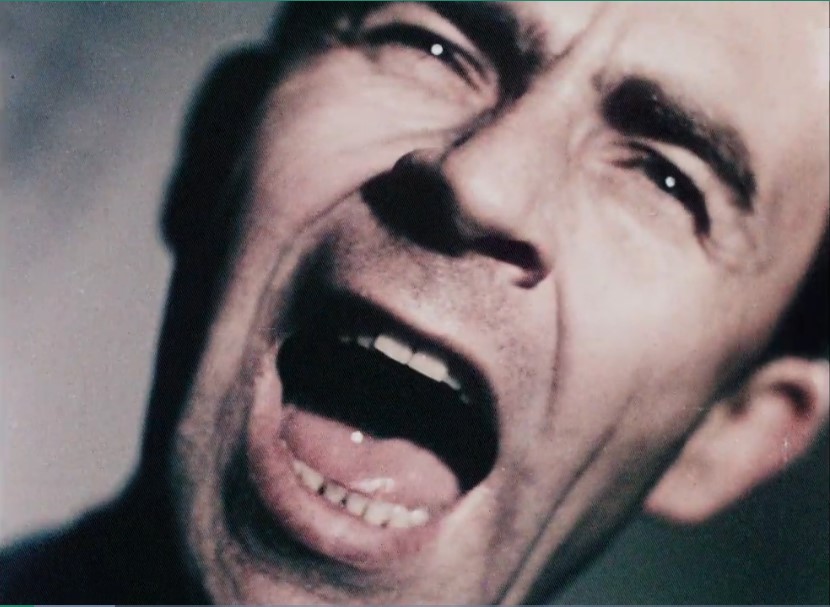
This over-emphasis on the need for absolute silence on the set make the inevitable disruptions of the hapless Sam Small onto the set’s operations even more impactful. The close-up shots are sharply angled, lending an unexpectedly expressionist air to proceedings which is not repeated at any other point in the film.

As Debroy Somers and his band get going for their first song – on a beach set with some women in swimwear decorously arranged in the foreground – the band’s trio of singers start a Co-op-themed song to the tune of ‘Heads, Shoulders, Knees and Toes’:

There is a Co-op in the town
And there, my true love sits her down
And well she knows each penny she could spend
Will go towards her dividend

At this point the scene changes to a shot of a young, fashionably dressed housewife, who is pointedly unpacking her CWS-bought groceries, taking care to position the labels carefully towards the camera.
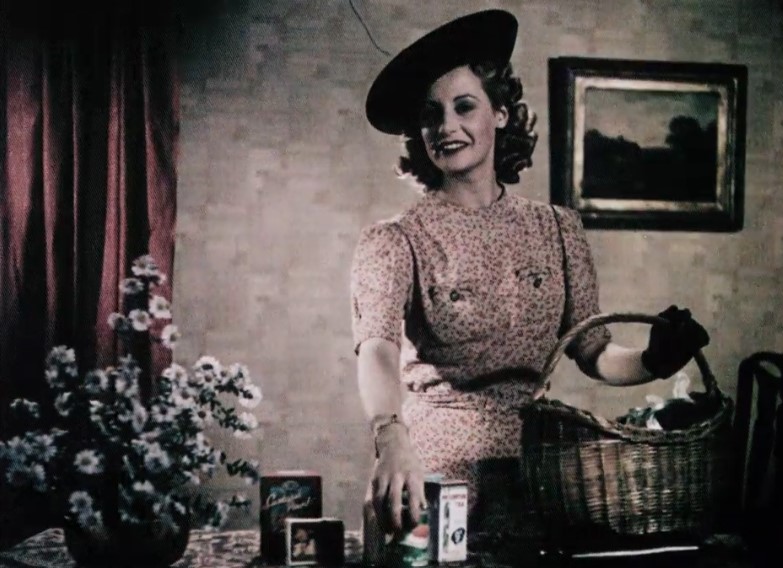
A housewife unpacking Co-op goods in Co-operette (1938)

This song seamlessly blends into the next one, in which the singers describe the various customer types of the Co-op in catchy rhymes accompanied by visual representations of these customers: a retired couple (“Charles and Jane live all alone/in a four-room flat they call their home”); a young man buying his wedding suit (“Lovely fit/I must admit”); a young woman who cleverly saves money on day-to-day purchases so she can still dress fashionably (“She knows the way to shop/where value is the top”); a young married couple of whom the husband always tries to eat everything in the larder immediately after the wife has done her Saturday shop at the Co-op.

Despite the inclusion of the young groom, women are firmly established as the Co-ops main customer base. They are pithily categorised and visualised as ‘maid’, ‘widow’, ‘flaunty extravagant queen’ and ‘housewife that’s thrifty’. These four women are then shown to harmoniously share a pitcher of lemonade, drinking ‘to the health of CWS.’
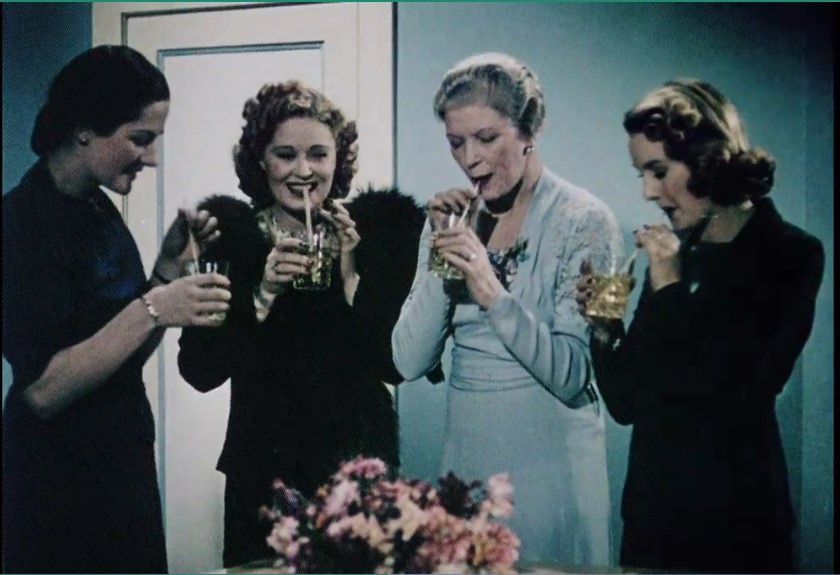
From left to right: ‘housewife that’s thrifty’; ‘flaunty extravagant queen’; widow; maid

This section takes up about half of the fifteen-minute video. It is followed by a dance sequence of the six ‘Co-operettes’, after which the most surreal part of the film is launched: the ‘Carrot and Onion dance’. Against a set of three larger-than-life tins (Vegetable Soup, Butter Beans, and Carrots) two female dancers emerge. One is dressed in an orange suit that covers her entire body with a green head-dress; the other in a green, short-skirted dress.
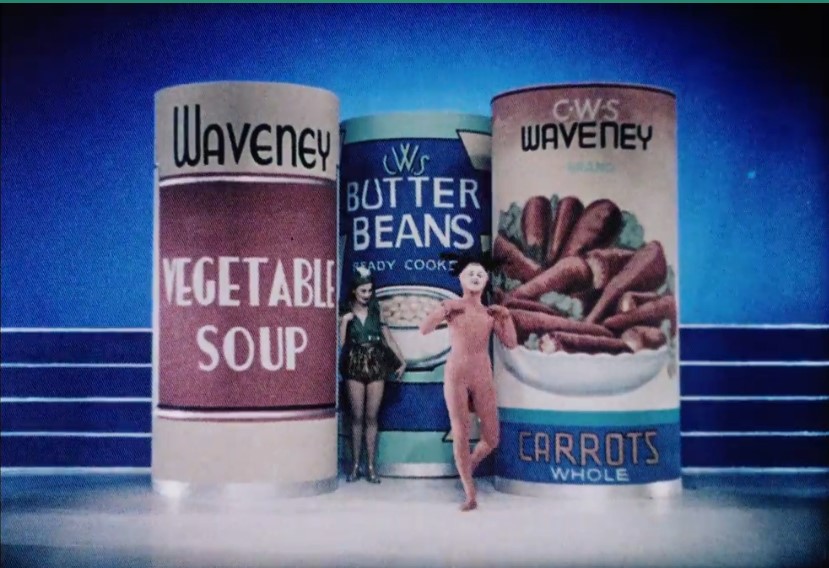
Onion and Carrot emerging for their dance

As Carrot and Onion they dance a graceful pas-de-deux in which they overcome the difficulty of Onion’s smelly leaves. Their performance is followed by more work by the Co-operettes, this time tap-dancing. The final minutes of the film include more comic relief by Harold Walters, and a final song by the Debroy Somers band:

In every town there is a store
You pay much less, you get much more
For CWS has goods galore
For you, fair maid

Remember, remember
From January to December
There are always goods in store
For you, fair maid

The film ends with a title card reading that ‘All the goods featured in this film are CWS products’ – but hardly any goods are featured with any prominence. The first housewife featured is shown unpacking products, and there are some shots of a full larder, but in either case it is not possible for the audience to easily identify what the products are. The only packages that are really clear are the three enlarged cans used as the set for the ‘Carrot and Onion’ dance. No foodstuffs are mentioned by name in any of the songs.

Instead, the focus of the whole film is about the customers who shop at Co-op, and how the organisation caters to what the film presents as the full range of different women. In what is an early example of customer segmentation, women are primarily distinguished by their marital status (unmarried, married, widowed). However, whilst the film may be presumed to target women as the primary shoppers, the repeated display of the ‘Co-operette’ dancing troupe instead suggests a male target audience. During these dance sequences, the deceit and comedy of the sound stage set is dropped in favour of a more straightforward attempt at Hollywood glamour.

Co-operette shows how a British firm used cinematic conventions to create an advertising film that was much more about selling a concept than about selling specific items. The overall effectiveness of the film is, perhaps, somewhat reduced by its attempt to provide comedy, catchy songs, stage performance, and the Carrot and Onion dance which appears to be in a genre all of its own. Despite the overt messaging in the film implying that only women are the CWS’ customers, the film’s varied format indicates that it tries to appeal to all audience groups in the cinema, including men and children.

Co-operette can be viewed for free on BFI Player, for readers based in the UK.

Alastair Sim

Alastair Sim

Alastair Sim was born in 1900 in Edinburgh. After an aborted university education and active duty during the Great War, he trained as an elocution teacher and took up a lectureship in that subject at the University of Edinburgh in 1925. Elocution and drama teaching was his route into an acting career, of which his parents were not supportive. In 1930 Sim moved down to London, where his acting career took off.

After several years of stage roles, Sim made his film debut in 1935, with no fewer than five film credits to his name in that year alone. All were mostly low-budget comedies or crime films, in which Sim played smaller parts. Throughout his career he mostly played supporting roles, with the notable exception of Scrooge (1951) in which he played the titular character. It’s still considered one of the best portrayals of Scrooge on film.

As the 1930s continued, Sim got more substantial film roles in higher-profile films. His lanky frame (he was just over 6 feet tall) and distinctive voice made him instantly recognisable to audiences. In 1936 Sim starred opposite George Formby in the Monty Banks-directed Keep Your Seats, Please!. In the same year he was also directed by Monty Banks in the comedy The Man in the Mirror, although his name was misspelt as Alistair in the film’s credits.

In 1937-38, Sim starred opposite Jessie Matthews three times, in Gangway (1937); Sailing Along (1938) and Climbing High (1938). In Gangway, Matthews plays a journalist who gets caught up in a trans-Atlantic criminal plot. Sim is Detective Taggett, who is attempting to arrest the criminals. In Sailing Along, Matthews plays a precocious young woman and aspiring dancer who is brought up on a tug-boat. Sim here is the supporting character Sylvester, a confused and slightly simple-minded man who helps Matthews in her career aspirations. By the time of Climbing High, Sim was sufficiently famous that his name was included on the film’s poster. He again plays a supporting comedy relief character in this film.

Sim was only seven years older than Matthews, but in none of the three films is there the slightest inkling that he may be a suitable romantic partner for her characters. In fact, throughout the films Sim made in the interwar period, he plays characters who don’t have any romantic entanglements with co-stars. This was no doubt partly to do with his appearance, which did not meet conventional beauty standards of the period. Even in his thirties, he looked older than his years, and appeared somewhat ageless. His persistent casting in comedy roles further diminished his romantic appeal.

It is surprising, then, that in the 1937 crime film The Squeaker, Alistair Sim plays a character who has a settled domestic life, just when you least expect it. In The Squeaker Sim is Joshua Collie, a crime reporter for a popular newspaper. Journalists featured regularly in British interwar films, and were usually portrayed on the move, gathering news on the street; or pushing against deadlines in the newspaper offices.

Collie, on the other hand, is shown inside his comfortable living room, where he smokes a pipe after dinner like a suburban family man. He is not particularly interested in chasing down news, even though his friend, Scotland Yard inspector Barrabal, is feeding him plenty of information about the big criminal case he is working on. Collie reluctantly follows Barrabal’s leads only when his editor threatens to sack him for neglecting his duties. Alastair Sim played against the expected stereotype of the crime reporter, by making Collie a bit lazy and committed to his creature comforts. This enabled him to position himself again as a comedy character, even in a serious crime film which was based on a hard-boiled Edgar Wallace novel.

At the tail end of the interwar period Sim starred opposite Gordon Harker, another prolific interwar actor of comedy roles, in Inspector Hornleigh (1939). Sim played Sergeant Bingham, assistant to Harker in the titular role of Hornleigh. The pair are asked to investigate a murder in this comedy. The film was successful enough to spawn two sequels: Inspector Hornleigh on Holiday (also 1939) and Inspector Hornleigh Goes to It (1941).

Sim’s acting career lasted until his death in 1976. In the 1950s, as well as his interpretation of Scrooge, Sim also starred as the headmistress in the original St Trinian’s films, The Belles of St. Trinian’s (1954); and Blue Murder at St. Trinian’s (1957). Although his most commercially successful roles date from the second half of his career, he built up his screen persona and fame throughout the interwar period.

Olympia, 7 June 1934

This post is the second in a loose series of posts about fascism in interwar London. The first post explored the popularity of the British Union of Fascists in the East End.  

The British Union of Fascists (BUF) was founded by Oswald Mosley in 1932. Within a few years, the party had gained thousands of members, and by 1934 Mosley felt confident enough to stage several large-scale public speeches. In April of that year, the BUF hosted a largely successful rally in the (Royal) Albert Hall. The next event in the series took place on 7 June at Olympia, a Victorian events venue that could hold up to 15,000 people.

The event attracted many people who were not members of the BUF but were interested to hear Mosley’s ideas, or curious about this new political movement. In the run-up to the event, left-wing publications such as the Daily Worker encouraged readers to attend the event and set up counter protests against fascism. Mosley set the event up as a spectacle, using standard-bearers and spotlights and many BUF members in attendance in full uniform.[1]

The exact events which took place in the hall on 7 June 1934 were subsequently disagreed on by attendees from different political persuasions. It is established that at various points during Mosley’s speech, individual audience members heckled and challenged him. In those instances, a much larger group of BUF members, acting as ‘stewards’, would physically accost the interrupter and remove them from the hall. The extent of violence used against these interrupters was disputed, as was the total number of victims, and whether the hecklers formed part of an orchestrated attempt of the extreme left-wing to interrupt the meeting.

Both the political left and the BUF released pamphlets following the meeting, each presenting their own version of events. The left-wing pamphlet, called Fascists at Olympia: A record of eye-witnesses and victims, was published under the pen-name ‘Vindicator’ by publisher Victor Gollancz, a British Jew who openly supported left-wing politics. The pamphlet was distributed for free with the aim of raising awareness of the BUF’s methods.

Fascists at Olympia contains named statements of people who were present at the Olympia meeting; statements of those who claimed they were beaten up by BUF stewards, and statements of doctors who claimed to have helped the wounded in make-shift sickrooms set up in the vicinity of the hall. A statement in the pamphlet’s opening was subsequently used by the BUF to discredit it:

Several of the documents in this book, in their original form, contain references to the attitude of the police. These have been deliberately omitted, as the object of this pamphlet is to call attention to the actions of Blackshirts, and it is not desired to complicate the issue.[2]

During the Olympia meeting, the police were not present in the hall as it was a closed gathering in a private venue, and therefore they had no jurisdiction to enter it.[3] Police officers were present on the roads adjacent to the hall but came under criticism for not interfering with or challenging the violence perpetrated by BUF stewards. The compilers of Fascists at Olympia apparently did not want to risk that anti-fascist sentiment would be considered the same as anti-police sentiment, or anti-establishment feelings more generally.

This agenda is also clear across many of the witness statements included in the pamphlet, which repeatedly present fascism as ‘not English’:

‘I could not help shuddering at the thought of this vile bitterness, copied from foreign lands, being brought into the centre of England.’[4]

‘I witnessed other scenes of great brutality such as I had never thought to see in England.’[5]

‘For that [use of violence] I can see, as an ordinary Englishman concerned for fair play and decency no possible justification.’[6]

‘I can only say it was a deeply shocking scene for an Englishman to see in London. The Blackshirts behaved like bullies and cads.’[7]

‘I fail to see the necessity for this brutality, which is so foreign to the British race.’[8]

‘I belong to no political party, but what I saw and heard on the evening of June 7th made me think that the behaviour of the opposition, those reds to whom Mosley refers as the scum of the ghettoes, were far more in the English tradition than the Blackshirts with their flags and uniforms.’[9]

By 1934, Hitler’s violence in Germany and Mussolini’s hard rule in Italy were well-known in Britain, and Fascists at Olympia worked hard to persuade its reader that this type of political movement was a threat to the British (English) way of life. Terms like ‘fair play’ were still considered foundational concepts that separated the (white, upper and middle-class) English from other, less civilised and more violent people. The authority of the British police was similarly built on notions of ‘decency’ and temperance, and was another way in which England could consider itself more enlightened than other countries.[10]

The emphasis on fascism as ‘not English’, were used by the BUF in their counter-pamphlet about the Olympia meeting. Red Violence and Blue Lies: An Answer to “Fascists at Olympia” was published by the BUF’s own press. On its opening page, it horrifically states: ‘English men and women?’ ‘Who are the “English men and women” who break up Fascists’ meetings?’[11] This rhetorical statement is followed by a list of names, supposedly the names of those arrested by the police for disrupting the meeting – all the names are of Jewish provenance. The author(s) do not need to spell this antisemitism out more explicitly; the reader is expected to conclude that these names do not represent ‘English’ people.

The BUF pamphlet goes on to sketch a wide-spread left-wing conspiracy to silence Mosley’s party. The left-wing press’s exhortations to their readers to visit Olympia and stage a counter-protest, ahead of 7 June, are presented as evidence of this conspiracy. Throughout the pamphlet this argument is subtly built up and alluded to, until it is made manifest at the pamphlet’s end in a way that draws together antisemitism, suspicion of the state, and fear of socialism:

At Olympia [the ‘Red Terror’] was renewed with large organised and powerful financial support from quarters which are well known. Alien finance and Red terror join hands to fight the movement of “Britain First,” with the tacit and even open approval of the Old Parties of the State, who unite to oppose the new force that threatens them with ultimate destruction at the polls.

With the hindsight offered by history, we know that the BUF lost support throughout the 1930s and that fascism did not become the dominant ideology in 20th century Britain. In the debates following ‘Olympia’, this was far from evident, however: as Martin Pugh has demonstrated, MPs in the House of Commons did not roundly condemn the BUF’s conduct during the meeting, and allegations of a left-wing plot were also aired there.[12] The pamphlets published by both the BUF and the political left in the immediate wake of the event demonstrate how both sides sought to influence popular discourse about the meeting.


[1] Julie Gottlieb, ‘The Marketing of Megalomania: Celebrity, Consumption and the Development of Political Technology in the British Union of Fascists’, Journal of Contemporary History, (2006), Vol. 41, No. 1, 47

[2] Vindicator, Fascists at Olympia: A record of eye-witnesses and victims (London: Victor Gollancz, 1934), n. p.

[3] Martin Pugh, ‘The British Union of Fascists and the Olympia Debate’, The Historical Journal, (1998), Vol. 41, No. 2, 541

[4] Vindicator, Fascists at Olympia, p. 11

[5] Ibid.

[6] Ibid., p. 14

[7] Ibid. p. 9

[8] Ibid. p. 20

[9] Ibid., p. 37

[10] Clive Emsley, The English Police: A Political and Social History, 2nd edition (Harlow: Pearson Education Ltd, 1996), pp. 144-145

[11] Various authors, Red Violence and Blue Lies: An Answer to “Fascists at Olympia” (London: BUF Publications, 1934), p. 5

[12] Pugh, ‘The British Union of Fascists and the Olympia Debate’, 532-533

Sabotage (1936)

As noted elsewhere on the pages of this blog, Alfred Hitchcock started out as a director during Britain’s silent film period. He continued making films in Britain during the 1930s, before making his move to Hollywood around 1940. In 1936, he directed Sabotage, a Gaumont production based on the Joseph Conrad novel The Secret Agent. (Rather confusingly, in the same year Hitchcock also directed a film called Secret Agent which in turn was based on a novel titled Ashenden.)

By the mid-1930s, the tense European political situation was reflected in a spate of British films about spies and international criminal networks. Although Conrad’s source novel was published in 1907, and its plot is set in the 1880s, Hitchcock had little difficulty in adapting the storyline for a contemporary audience which was, again, concerned about German expansionism.

In Sabotage, a couple called Mr and Mrs Verloc run a cinema in central London. Mr Verloc is of unidentified Eastern European origin, whereas Mrs Verloc appears to be British. With them lives Stevie, Mrs Verloc’s teenage brother. Mr Verloc hides a secret from his wife – he is part of an international terrorist gang which is planning a series of attacks to disrupt British society. Scotland Yard have their eye on Mr Verloc, and undercover agent Ted Spencer is keeping a close eye on the cinema from a vegetable stall across the road.

Mr Verloc’s gang plan to blow up Piccadilly Circus underground station with a bomb hidden in a film reel tin. As Verloc suspects he’s being watched, he sends Stevie to drop off the package at the station’s cloakroom. Stevie, however, gets waylaid on the way to the station and the bomb goes off while he is still on the bus, killing him and all the passengers. When Mrs Verloc realises that her husband is responsible for her brother’s death, and he starts threatening her too, she kills him with a large kitchen knife. Ted Spencer, who by now has fallen for Mrs Verloc, shields her from arrest at the film’s end.

The sequence of Stevie travelling to Piccadilly Circus with the bomb is the most-discussed – and indeed, often the only discussed – part of Sabotage. Stevie is unaware of the real contents of the parcel he is carrying, he simply knows he needs to leave it in the luggage collection point in Piccadilly Circus station by 1.30pm. The audience knows that the bomb will go off at 1.45pm. Sabotage heightens the tension by a series of close-ups alternating between the parcel of explosives, Stevie, and various clocks which he sees on shop fronts along the way. As the clocks inch closer to 1.45pm, the individual shorts become shorter and shorter, culminating in an extreme close-up of the hand on a clock moving to 1.45pm. The bus spectacularly explodes, and Stevie and all the other passengers are killed in the blast.

Critics of Sabotage have pointed out that the rationale for Mr Verloc’s criminal gang is not defined. At the start of the film, the gang causes a mass electrical failure in London which causes widespread disruption. Their planned bombing of Piccadilly Circus would not just cause great material damage and loss of life – Piccadilly Circus was the symbolic centre of London, England, and the British Empire. When its underground station was completed in 1928, it was hailed as a feat of engineering. London Underground even produced a poster depicting the station’s tunnel network as the ‘stomach’ and digestive system of London. The motivation of the criminal gang, then, is to disrupt society, to cause unrest without providing a clear enemy against which people can direct their anger. The threat of destabilisation was keenly felt in 1930s Britain, as people watched great social change in Germany, Italy and elsewhere unfold. Many films of the period feature shady and undefined foreign criminal networks, including Laburnum Grove (1936), Midnight Menace (1937), and Bulldog Jack (1935).

The cinema is extensively used as a location in Sabotage. Mr and Mrs Verloc live in a flat situated behind the auditorium. To enter the flat, one has to go through the auditorium, and characters are frequently shown to pass through here whilst patrons enjoy the screening, apparently undisturbed. During his investigations, Ted Spencer is able to approach the flat unseen because the cinema audience is engrossed in a farcical comedy film. Spencer then enters the space behind the screen, in which there is a connecting window to the Verlocs’ living room. Spencer uses this window to eavesdrop on Verloc’s conversation, without the cinema audience being any the wiser.

After Stevie’s death, Mr Verloc tries to justify and explain himself to Mrs Verloc. Following this conversation, Mrs Verloc walks out of the flat and into the cinema auditorium, where a children’s showing of Disney’s Who Killed Cock Robin? is in progress. The children’s laughter prompts Mrs Verloc to first grimace in despair, before she turns to the screen and sits down to watch the show. Despite the centrality of its cinema location, this is the only time any of Sabotage’s main characters actually takes the position as audience member.

Engrossed in the cartoon, Mrs Verloc starts to laugh through her grief. She is unable to process the enormity of her emotions and uses the film as a welcome distraction. The distraction is all too brief: the cartoon bird gets shot, which plunges Mrs Verloc back in despair. This breaks the spell of the cinema for her, and she gets up and walks back through the auditorium with determination to see things out with her husband. Soon after returning upstairs, Mrs Verloc stabs her husband to death. After the spectacle of the bus explosion, the killing of Mr Verloc is understated. Mrs Verloc picks up a knife to carve dinner. She then pauses to look at it for a minute whilst an idea seemingly dawns on her. When Mr Verloc stands next to her to speak to her, she turns around and sticks the large knife in his abdomen. It is a murder which originates from a deep despair, rather than from anger or a desire for revenge.

Immediately after the murder, one of Verloc’s associates sets the flat on fire. Ted Spencer meets Mrs Verloc outside; although she confesses the murder to him and wants to give herself up to the police, Spencer tells his superiors that Verloc died in the blaze. Because Mr Verloc was a foreigner set to disrupt British society, and he stooped so low to use a child as an unwitting assistant to his plans, Mrs Verloc is allowed to go unpunished for her crime. Her insistence that she should give herself up to the police only serves to set her out as even more deserving. One perspective on Sabotage is that it argues that as long as British citizens are willing to make personal sacrifices, they can collaborate with the police to successfully neutralise foreign threats; and it is their duty to do so.

The Secret Agent by Joseph Conrad can be read for free via Project Gutenberg.