This is the second of a two-part blog looking at the novel The Wheel Spins, and its film adaptation The Lady Vanishes. You can find the first part here.
Following last week’s analysis of the 1936 novel The Wheel Spins by Ethel Lina White, this week we consider its film adaptation The Lady Vanishes. The film was released in 1938 and directed by Alfred Hitchcock, who by the late 1930s was directing acclaimed and increasingly high-profile films in England. He would move to Hollywood in 1939. The Lady Vanishes includes a number of stylistic flourishes that make it instantly recognisable as a Hitchcock film.
Although there was only two years between the publication of the novel and the release of the film, and the novel is credited as the source material, there are fairly significant differences between the book and the film. The focus on the female experience, present in the book, is watered down in the film in favour of a more traditional positioning of the female protagonist as assistant to the active, male counterpart. The film’s final section deviates completely from the book, and links much more explicitly to Europe’s political situation in the late 1930s.
As with the novel, the film opens not on a train, but in a hotel in a fictional Eastern European country. The female protagonist, here called Iris Henderson, is on a girls’ trip before travelling back to London to be married. Although Iris and her friends have the hotel staff eating out of their hands, they are presented much more sympathetically than Iris and her friends are in the book. Miss Froy, the lady who vanishes, is also staying at the hotel and she and Iris have some interaction before boarding the train; Iris also meets her eventual love interest, Gilbert, in the hotel.

Hitchcock introduced two additional characters, Charters and Caldicott, two men who are determined to get back to England before the end of the Ashes cricket match. This comedy duo proved so popular that they ended up appearing in ten more films, working with a range of directors. To ensure the film does not get too overcrowded, many of the other British characters that appear in the book are not in the film.

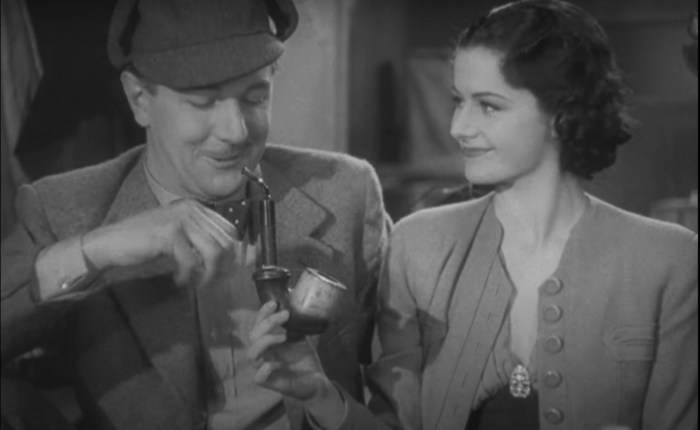
Once the action moves onto the train, the film largely follows the same trajectory as the novel, although Gilbert takes a much more pro-active role in the hunt for Miss Froy and Iris is increasingly relegated to his assistant. This is made explicit in a scene where he poses as Sherlock Holmes with Iris as his Watson. Gilbert even gets to demonstrate his physical daring when climbing out of the carriage window and into the next carriage from the outside of the train.

Once the pair have located and saved Miss Froy, the action goes in a drastically different direction. The nefarious gang that are trying to kill Miss Froy decouple the two train carriages that contain all the British characters and divert it to a side track into the forest. Once there, the carriages are ambushed by the gang and repeatedly shot at.
It is here that Europe’s political situation has clearly strongly influenced the script. The British characters are debating whether they should get away, fight back, or surrender. One character does not want to fight and instead exits the carriage waving a white handkerchief – he is promptly shot dead by the antagonists. The parallels with Chamberlain’s appeasement approach to Germany could not have been missed by British audiences. Ultimately, with only one bullet left between them, the British passengers manage to get the train running again and are able to get away, but not before Miss Froy has admitted to Iris and Gilbert that she is a spy working for the Foreign Office, and has been given a message for the British government in code. She teaches the code to Gilbert before exiting the train and running into the forest.
This is a significant deviation from the novel, in which Miss Froy is targeted by gangsters because she has unwittingly witnessed something she should not have seen. In the film, Miss Froy is not an innocent bystander who was at the wrong place at the wrong time, but rather part of an international network of spies and informants working for the British state. Rather than being reunited with her family in a celebration of traditional British domestic values, Miss Froy is reunited with Gilbert and Iris as they come off the train. Their triumph is that they have helped the British government gained vital intelligence, with the Foreign Office taking the place of the parental home. In times of political turmoil and with war on the horizon, it is the duty of British citizens not just to help one another, but also to help the State in its mission to suppress international unrest.
The main source of tension in The Wheel Spins, Iris’ concern that she will be locked up in an asylum because no-one believes her, is absent in The Lady Vanishes. Instead, the danger comes not from the British passengers on the train, but from the Europeans who are looking to eliminate a British secret agent. This makes the story much more conventional and in line with many other suspense films of the period. The film is elevated by Hitchcock’s direction and dialogue that balances comedy and drama. The novel and the film stand alongside one another as distinct texts, each using the same plot to foreground different themes.
The Lady Vanishes is available on Youtube.







 Interwar London
