Diary of a Provincial Lady (1930-1940)

E.M. Delafield wrote four instalments of the Diary of a Provincial Lady, which were published in book-form in 1930; 1932; 1934 and 1940. The book started out as a weekly serial in Time and Tide magazine. As the title suggests, the books are fictionalised diary entries by an unnamed, upper-class woman who lives in Devon with her husband Robert and children Robin and Vicky. The books get a lot of their comic mileage out of the Provincial Lady’s attempts to keep her family afloat and keep up appearances whilst feeling decidedly out of her depth.

The characters are loosely based on Delafield and her own family, and the Provincial Lady becomes a writer like Delafield. In the first instalment the Provincial Lady writes a book which is well received, and which leads the character to become increasingly invested in her writing career.

Whilst a large part of the books is set in rural Devonshire, at choice moments the Provincial Lady visits London. This increasingly happens in the second instalment, The Provincial Lady Goes Further, when the protagonist rents a small flat in London as a base for her to focus on her writing. Throughout the books, London is presented in a very specific manner. It is not ever negative; there is no sense of the ‘country’ being superior over the city. Rather, London offers the Provincial Lady different opportunities and activities that broaden her horizons.

From the start, the Provincial Lady’s London life is largely coordinated by her friend Rose (or ‘dear Rose’ as she’s often referred to) whom the Provincial Lady knows from her ‘Hampstead days’, which were evidentially before her marriage to Robert. Rose remains unmarried and lives in a flat in London when not travelling abroad. From the outset, the Provincial Lady’s trips to stay with Rose in London are marked by recurring activities: shopping; attending beauty salons; visiting the theatre; and attending ‘Literary Parties’.

Early on in the first novel, Rose takes the Provincial Lady to a ‘Literary Club dinner’:

‘Am much struck by various young men who have defiantly put on flannel shirts and no ties, and brushed their hair up on end. They are mostly accompanied by red-headed young women who wear printed crêpe frocks and beads.’[1]

This passage immediately encapsulates both the appeal of London to the Provincial Lady, where she can mix with a wider range of people than in Devon; and the distance between her own life and that of the ‘literary crowds’ in London. The gentle mocking of London’s literary society continues throughout the novels even when the Provincial Lady herself becomes a successful author; her continued base in Devon ensures that she never feels fully part of the ‘smart set’. Indeed this is made explicit in The Provincial Lady Goes Further, when she attends another literary party where a friend gives her the details on other attendees:

‘Emma gives me rapid outline of many rather lurid careers, leading me to conclusion that literary ability and domestic success not usually compatible. (Query: Will this invalidate my chances?’[2]

The diaries are self-aware about the stereotypes that existed about both London and writers. Delafield on the one hand gives credence to the belief that writers must be based in London, by giving her character a Bloomsbury flat to write from. On the other hand, she challenges the notion that writers must be eccentric or have unconventional personal lives in order to be successful. Indeed, later on in The Provincial Lady Goes Further she finds that the constant stream of Literary Parties is keeping her from doing any writing at all. Because the Provincial Lady is always able – indeed, required – to return to Devon to deal with domestic concerns, she never gets sucked into the fast and bright life in London. Literary circles are shown to be fun but also shallow and self-centred.

Not everything about London is presented as trivial, however; the capital also allows the Provincial Lady to engage with culture in a way not available to her in Devon. Rose frequently takes her to theatre shows, although these also become an opportunity to show off one’s sophistication:

‘We go to see Charles Laughton in Payment Deferred, and am confirmed in previous opinion that he is the most intelligent actor I have ever seen in my life. Rose says, On the English stage, in cosmopolitan manner, and I say ‘Yes, yes’, very thoughtfully’[3]

London is also a place where the Provincial Lady can nurture a part of herself that gets neglected in Devon. Almost every time the Provincial Lady visits the capital, she makes sure to go to a hairdresser or beauty parlour, and to buy some new clothes. These visits are accompanied by apprehension and guilt at the expense, but ultimately they increase the Provincial Lady’s confidence. After a ‘very, very painful’ time at a beauty parlour:

‘Eventually emerge more or less unrecognisable, and greatly improved.’[4]

Similarly, after a visit to the hairdresser’s:

‘Undergo permanent wave, with customary interludes of feeling that nothing on earth can be worth it, and eventual conviction that it was. (…) am told that I look fifteen years younger – which leaves me wondering what on earth I could have looked like before, and how long I have been looking it.’[5]

In London, the Provincial Lady can spend time and money on her appearance, without being stopped by the thought that this is frivolous or a waste of money. When she’s in Devon, she is scrupulously careful with money and puts household and family expenses before her own. In London, she reclaims some of her own identity separate from her roles as wife and mother. This culminates in her taking out the rent on a flat in Doughy Street, Bloomsbury, under the encouragement of Rose.

This becomes her ‘room of ones own’ where she can write; although in true Provincial Lady fashion the diaries make more of the domestic and social concerns that the flat commits her to, than the writing she is able to produce in it. Yet throughout the series the Provincial Lady gains increasing literary success, quietly and committedly working away at something that gives her more space and time for herself.

By the end of the third book, there is not so much difference between her life and that of ‘dear Rose’, who she initially held in such awe and admiration. They can both hold their own at Literary Parties, they both travel and have acquaintances all over the world. London has given the Provincial Lady the opportunities to build this life for herself; the city allows her to assert her own identity as an individual and to meet a much wider range of people than she sees in Devon. For the Provincial Lady, it is not a matter of town versus country, but rather of balancing both.


[1] E.M. Delafield, Diary of a Provincial Lady (London: Penguin, 2013), p. 27

[2] Ibid., p. 186

[3] Ibid, pp. 138-139

[4] Ibid., p. 51

[5] Ibid. p. 140

Grace Blackaller

Grace Blackaller

Grace Blackaller was born in 1909 and murdered on 9 April 1925. She was a sixteen-year-old amateur dancer who loved going to the cinema. Her murderer was her boyfriend, Ernest Rhodes, aged nineteen. Grace’s murder provided tabloid fodder for about two weeks in April 1925 and has since been completely forgotten.[1] The murder of women by their partners sadly remains so commonplace that it is still treated as ‘normal’. In Grace’s case, newspapers were also quick to suggest her own behaviour was somehow at fault.

The newspaper reports immediately after the murder, which are reasonably sympathetic to Grace, hint at a family set-up that is not straightforward. Grace lived in a lodging in Nevern Square, a few minutes from Earls’ Court tube station; according to her landlady she had lived there for four years so since they age of 12.[2] Her mother, however, lived on Challoner Street, which is on the other side of Warwick Road near West Kensington tube. Both locations are about a 15- minute walk apart.

It was on the corner of Challoner Street that Grace was attacked on that Thursday evening. She managed to get to her mother’s doorstep where ‘Her mother found her on the doorstep of her flat with a wound in her throat. Miss Blackaller could only mumble “a man attacked me” and died in hospital without revealing the secret of her murderer’s identity or any detail of the attack.”[3]

The mystery of the attack was sufficient for a number of tabloids to give the story front-page news, and to include a picture of Grace with the reports as well. Grace’s landlady told the Daily Mirror that Grace was working as a dressmaker and a dance teacher, and although ‘she went out a great deal at night to dances and things’ this was ‘like most girls these days’ and Grace had ‘never seen (…) with a boy.’[4] The Express printed a similar line, that ‘Miss Blackaller was not known to be on friendly terms with any particular man.’[5] In these initial reports, when it is assumed that the attack was conducted by a random stranger, Grace’s behaviour is represented as normal for the period and no moral judgements are made about her.

Grace Blackaller,
Daily Mirror, 11 April 1925, front page

The newspapers only changed their tune about Grace when the story developed further, and a murderer came forward. Press reports no longer presented Grace as a wholesome girl who had fallen victim to a random attack when it became apparent that Grace had been killed by her boyfriend, Ernest. Ernest turned himself in to the police on 11 April, when he read in the newspaper that Grace had died – he claimed that he had thought he only injured her.[6]

According to his account, on the 9th of April the couple went to the Blue Hall Cinema in Ravenscourt Park. They got back to West Kensington at about 11pm, and Ernest walked Grace home. Ernest thought his girlfriend had been stringing him along, and he suspected her of seeing other boys. When she did not take his concerns seriously, he took a razor from his pocket and slashed her throat while they were kissing.

This revelation changed the press’s coverage of the case. Sympathy for the ‘pretty young dancer who was fond of gaiety’ gave way to concerns about young girls’ ‘double lives.’[7]  At the final day of the inquest, the coroner read out a letter he had received from a concerned citizen. According to the coroner, the letter expressed ‘common-sense views,’ including the notion that girl murder victims ‘were forward minxes and made advances to young men, stayed out late at night, frequented cinemas and dance places, and had evidently been allowed to run loose.’[8] Suddenly, the previous reports that Grace’s interests in dancing and cinema were normal for girls her age, were inverted to suggest that the fact that these habits were normal was an indication of a moral and social problem.

The text of the letter was uncritically reprinted in several daily newspapers. The Director of the Liverpool Women’s Patrol stated publicly that she agreed with the letter-writer’s assessment of young girls’ lives.[9] The coroner’s decision to read out this letter during the inquest demonstrates that it was accepted that he would have an opinion on the moral aspects of the case as well as on forensic facts.

The opinion of a single member of the public was presented by the coroner as the belief of the general public, and its subsequent endorsement by the conservative press cemented it as the commonly held view. According to a contemporary journalism trade journal, voicing concerns about the modern girl sold newspapers in the interwar period the way a sensational murder sold them before the First World War. [10] In the reporting on Grace Blakaller, the popular press had managed to combine both ingredients into a successful multi-part story which reaffirmed that it was safer for a woman to stay at home and not have romantic relationships.

To further demonstrate how deeply the narrative that Grace was at fault for her own plight was embedded, these were Ernest Rhodes’ lawyer’s comments when Rhodes was committed for trial: ‘without eliminating the question of provocation, (…) my defence will be – and I shall call on the highest medical evidence to support it – that he [Rhodes] did not know the nature and quality of the act or that, if he did know, he did not know he was doing wrong.’[11]

In other words, the first line of defence was that Grace provoked Ernest, which, it was implied, would diminish his culpability. The second line was that Rhodes did not know that running a razor across someone’s throat could lead to that person dying; and the third line was that Rhodes did not realise that committing an act of violence was wrong. It was this final argument that would be successful; Rhodes was committed to an asylum rather than prison and was released for good behaviour in 1933.

Again, the press reporting partially paved the way for this, as Rhodes was described as ‘a boy with rather a lot of peculiarities’ who was ‘constantly talking about Norman Thorne’ – a young man who had killed his girlfriend in December 1924 and who was awaiting his execution in April 1925.[12] Obsession with a killer was presented as a sign of insanity which, in combination with the narrative that had been constructed around Grace’s ‘provocative’ lifestyle, allowed Rhodes’ legal counsel to mount a successful defence. The daily press was instrumental in influencing the public’s opinion about this case which limited public sympathy for Grace and painted her as culpable for her own murder.

You can read more about Grace Blackaller in my book, Interwar London after Dark in British Popular Culture.


[1] Except by amateur historians and true crime enthusiasts who have pored over the story on internet fora

[2] ‘Murdered Girl: Woman’s Story’, Daily Mirror, 11 April 1925, p. 15

[3] ‘Dance Girl Murdered in London’, Daily Express, 11 April 1925, p. 1

[4] ‘Murdered Girl: Woman’s Story’

[5] ‘Girl Murdered in London’, Daily Express, 11 April 1925, p. 7

[6] ‘Dead Girl Dancer: Story of Youth’s Written Confession’, Daily Mirror, 14 April 1925, p. 2

[7] ‘Murdered Girl: Woman’s Story’; ‘Double-Life Girls’, Daily Express, 23 April 1925, p. 2

[8] ‘Dancing Girl’s Death’, The Times, 23 April 1925, p. 14; ‘Dead Dancer: Boy For Trial’, Daily Mirror, 23 April 1925, p. 21; ‘Double-Life Girls’.

[9] ‘Girls’ Double Lives’, Daily Mirror, 24 April 1925, p. 2

[10] Newspaper World, April 1927, as quoted in Adrian Bingham, Gender, Modernity, and the Popular Press in Inter-War Britain (Oxford: Oxford University Press, 2004), p. 48

[11] ‘Dance Girl Drama’, Daily Mirror, 29 April 1925, p. 2

[12] Ibid.

Jessie Matthews

Jessie Matthews

Jessie Matthews was one of the biggest British screen stars of the 1930s. She achieved success not only in Britain, but also in the US, even though she never made a Hollywood film.[1] Matthews starred in a whopping fourteen films between 1931 and 1938; yet most contemporary articles foreground her private life over her film career. The BFI article linked to above references her ‘generally loveless marriages’; many sources refer to the details surrounding her second marriage to co-star and director Sonnie Hale.

Such interest in Matthew’s romantic life, with its undertones of tragedy and disapproval, undermine her considerable professional success. Matthews was not only an actress, but also a singer and dancer; her films showcase her considerable talent and the hard work she put in to master her craft.

Matthews was a commercial success almost from the start of her film career, but her establishment as a real star originated from the beginning of her collaboration with director Victor Saville. Saville and Matthews first worked together on The Good Companions; followed by Friday the Thirteenth (both 1933); Evergreen (1934); First a Girl (1935); and It’s Love Again (1936).

The Good Companions was based on a J. B. Priestley novel[2]; the text, as Lawrence Napper has argued, seeks to “express ‘modernity’ (…) without a retreat either away from the popular audience or into cultural pessimism.”[3] In other words, it seeks to create a balance between literary intellectualism and popular entertainment. By casting Matthews in a prominent role in the film, Saville picked an actor who herself embodied this duality. Matthews was born in a large, working-class family in Soho but much-commented-on elocution lessons allowed her to shape an upper-middle-class star persona.[4]

After The Good Companions, in which Matthews plays an ambitious actress from a humble background, Saville continued to cast Matthews in similar roles. The seemingly upper-class actress repeatedly played aspiring stage stars from common backgrounds:

  • In Friday the Thirteenth, as related in the post about that film, she’s an aspiring stage star caught in a bus crash.
  • In Evergreen Matthews is the daughter of a famous turn-of-the-century music hall star, who decides to impersonate her mother to achieve fame and success.
  • In First a Girl – an adaptation of the German film Viktor und Viktoria (1933) – she is an aspiring stage star who pretends to be a female impersonator to achieve fame and success.
  • In It’s Love Again she’s an aspiring stage star who pretends to be a socialite to achieve fame and success.

It was not unusual for 1930s actors on either side of the Atlantic to have such a defined star persona and to appear in a number of films along the same formula. In fact, in this respect Matthews had much in common with the other big British female star of the time, Gracie Fields. Although one of Fields’ key characteristics was her strong Northern accent, which was diametrically opposed to Matthew’s ‘plummy’ pronunciation, Fields also starred in a number of films in which she is a performer from a humble background who ends up achieving great success. As a female film viewer the message you received remained the same, regardless of whether you identified more with Matthews or Fields: being a stage performer was a desirable and exciting career through which you could find romantic love.

However, whereas Fields’ films were grounded in a very British, very working-class environment, with a strong emphasis on community, collaboration and staying positive in the face of adversity; Matthews’ films on the other hand presented the viewer with a glamourous and consumerist fantasy.[5] The sets are bright and light, with smooth floors that are perfect for impromptu dance performances. In Evergreen, Matthews’ character and her would-be love interest stay in a modern mansion in which she can showcase the latest luxury homeware whilst waltzing across the rooms.

To the modern viewer, the Matthews/Saville musicals feel akin to Hollywood films of the same period. Although the films are (mostly) set in Britain, they express a cosmopolitan outlook. They contain handsome, worldly men; art deco architecture; cocktails; and trips to the French Riviera. Contemporary audiences were already familiar with this fantasy world through the American films also available at the British box office. Matthews’ films brought that glamour to a British setting, suggesting that the same level of sophistication and modernity was also within reach on this side of the Atlantic. Although intellectual circles in interwar Britain retained a stubborn anti-Americanism, the popular success of Matthews as a film star indicates that the mass audience had no such qualms.

Today, however, Gracie Fields has remained relatively prominent in the public imagination, whereas Matthews is largely forgotten. Fields body of work evokes supposedly fundamental British qualities which appear to reflect the ‘good old days’ of community, common sense and national pride. Matthew’s oeuvre, on the other hand, shows only how much 1930s British culture was also about international cultural exchange and a dissolution of national identity. In the current times, which seem to be a near-constant quest of what it means to be ‘British’, it is Field who provides the more appealing answer to most; but the films of Jessie Matthews show that even a hundred years ago, being British was as much about having an international outlook as it was about celebrating local culture.

Jessie Matthew’s films are available on DVD from Network On Air.


[1] Jeffrey Richards, The Age of the Dream Palace: Cinema and Society in 1930s Britain (London: IB Tauris, 2010), p. 207

[2] For more on J.B. Priestley see the post on Laburnum Grove (1933)

[3] Lawrence Napper, British Cinema and Middlebrow Culture in the Interwar Years (Exeter: University of Exeter Press, 2009), p. 83

[4] Richards, The Age of the Dream Palace, pp. 208-209

[5] Sarah Street, ‘‘Got to Dance my Way to Heaven’: Jessie Matthews, art deco and the British musical of the 1930s’, in Studies in European Cinema vol 2. no. 1 (2005), 19-30

1927: More Women Die Young

1927: More Women Die Young

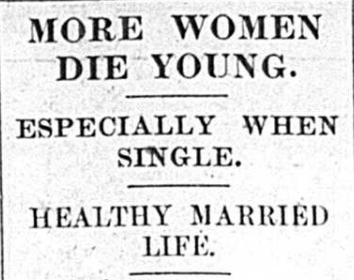
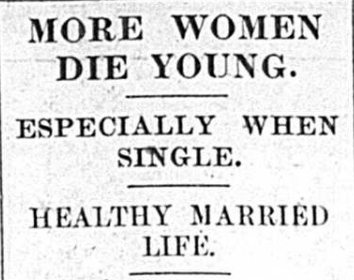
On 22 September 1927 the Daily Mail printed the following article on page 9 of the London edition:

More Women Die Young

Especially When Single

Healthy Married Life

A remarkable fact revealed in a report by the
Government actuary, Sir Alfred W. Watson, on the
expectation of life as shown by statistics, is that the
death rate is increasing for single women between 18 and 27.[i]

The article goes on to note that life expectancy for both men and women has gone up; that both sexes between the ages of 30 and 60 are showing considerably increased levels of ‘vitality’; and that married women between the ages of 18 and 27 are ‘healthier than ever’.

Despite this apparent abundance of good news, the article’s main concern is that for the subset of single women between 18 and 27, a ‘deterioration’ in life expectancy is observed. The article does not only note this trend, but also presents an expert opinion as to what may be the cause of this.

The article’s final paragraph quotes Dr Ethel Browning, an accomplished scientist who was in the process of writing a book on common illnesses and how to prevent them.[ii] Browning is quoted in the Daily Mail as follows:

Probably the increased rates of mortality among
young unmarried women are due to the fact that
so many more of them are now doing really hard work
and closely confined in offices. At night, instead of getting
fresh air, they go to dances or spend their time in cinemas,
with a continuation of the same evil tendencies.[iii]

On the face of it, this article is unremarkable. The article was a one-off, not part of a special series or campaign. It was wedged in on the page between an article about a man who was wrongfully convicted of being drunk and disorderly; and a report on a deadly fire in a school in Winnipeg, Canada. Page 9 of the Daily Mail was reserved for general news items which were not the lead stories of the day. Yet the article is based on a number of tacit underlying assumptions which are highly political. A close reading of a seemingly throwaway article such as this, can demonstrate the agenda of national popular newspapers in the interwar period.

The article makes it clear that the part of the survey that readers should be most interested in is that young, unmarried women appear statistically more likely to die at a younger age, than in previous decades. This implies that the death of a young, unmarried woman deserves more attention and concern than the death of other members of society. The article’s headline explicitly ties marriage to health, underscoring the desirability for women to follow this conventional route.

The report does not actually specify by how much the life expectancy of young single women has declined; it merely states that this is the only group for which a decline has been identified. At the end of the article, Dr Browning is addressed by her title, but no additional information is given about her credentials or area of expertise.[iv] Her title provides her with sufficient authority that her subsequent argument about the detrimental effects of office work, dancing and cinema-going to women’s health are presented as fact. The choice to quote a female scientist sets up a dynamic between a (presumed) older, learned woman criticising the behaviour of younger, more frivolous women.

The Daily Mail editorial team could have chosen to highlight any of the positive aspects of the statistical survey, such as the increased life expectancy for boys and girls. Instead, the article taps into concerns about young women’s behaviour which were amplified regularly through the pages of the Mail and other newspapers in this period. During 1927 and 1928 concerns about ‘flappers’ were particularly fraught as the Representation of the People Act 1928 extended voting rights to women from the age of 21.[v] Articles such as the one under consideration here, helped to subtly reinforce the narrative that young women were irresponsible in their lifestyle choices.

Dr Browning’s comments about office work potentially contributing to earlier deaths for women can be interpreted as a rejection of women’s entrance into the workplace. One could reason that if women were not working in ‘closely confined’ offices but instead spent their time home-making (as they would do when they were married) then women would be healthier. The second part of the quote focuses on leisure activities which, it is implied, women participate in through choice – as they could instead choose to ‘get fresh air’. The supposed ill health of the women therefore becomes their own responsibility; if they chose to have healthier leisure pursuits when single, and endeavoured to get married as soon as possible, they would be healthier and live longer.

This short analysis demonstrates how, through day-to-day reporting, popular newspapers such as the Daily Mail promoted conservative values and stoked concerns that social change was having detrimental effects, in this case implying that fertile young women were dying. Although an article such as this may not seem political, its structure, its language and its cavalier approach providing evidence for statements all work together to reinforce ‘common-sense’ assumptions to its readers. When replicated across hundreds of articles in the daily popular press, these tacit assumptions went a long way to influence how newspaper readers thought about the world around them.


[i] ‘More Women Die Young’, Daily Mail, 22 September 1927, p. 9

[ii] Bartrip, P. W. J. “Browning [née Chadwick], Ethel (1891–1969), toxicologist and factory inspector.” Oxford Dictionary of National Biography. 23 Sep. 2004; Accessed 19 Dec. 2020. https://www.oxforddnb.com/view/10.1093/ref:odnb/9780198614128.001.0001/odnb-9780198614128-e-57854

[iii] ‘More Women Die Young’, Daily Mail, 22 September 1927, p. 9

[iv] Ether Browning is primarily remembered as an industrial toxicologist.

[v] Adrian Bingham, Gender, Modernity, and the Popular Press in Inter-War Britain (Oxford: Oxford University Press, 2004), p. 16