Dorothy L. Sayers – Murder Must Advertise (1933)

Dorothy L. Sayers – Murder Must Advertise (1933)

Dorothy L. Sayers is readily regarded as one of the most prominent contributors to the ‘Golden Age of Crime Fiction’: a period that spans nearly all of the interwar period. It marked not only a huge increase in the popularity of crime stories in Britain, but also saw innovations in the genre, for example the unreliable narrator in Agatha Christie’s The Murder of Roger Ackroyd (1926) and a crime with half a dozen possible solutions in Anthony Berkeley’s The Poisoned Chocolates Case (1929).

Sayers’ main contribution to the genre were the eleven novels she wrote around amateur sleuth Lord Peter Wimsey; the debonair younger brother of the Duke of Denver who combines a passion for antiquarian book-collecting with his hobby of crime detection. The first Wimsey novel, Whose Body? appeared in 1922 in the US and in Britain a year later. Sayers’ continued writing Wimsey novels until Busman’s Honeymoon in 1937, after which she turned her attention to writing scholarly works on theology.[1]

The eight Wimsey novel out of a total of eleven, Murder Must Advertise, appeared in 1933. In this book, Wimsey goes undercover to work as a copywriter at a fictional advertising firm, Pym’s Publicity. He is invited to do this by the manager, Mr Pym himself, after a suspicious death on the firm’s premises: one of the staffers has fallen to his death from a spiral staircase. Sayers drew on inspiration from her own time working as a copywriter in the early 1920s for S.H. Benson; the Benson office even had a steep spiral staircase like the one that appears in Murder Must Advertise.[2]

Sayers’ real-life work experience lend the novel’s descriptions of the office life in an advertising firm an authentic air. The novel’s opening sees all the firm’s office staff gathered in the typists’ room, to surreptitiously organise a sweep on the horse races. There are pages of rapid, overlapping dialogue of staff discussing the sweep and the arrival of the new colleague. When they hear one of the managers approach,

‘the scene dislimned as by magic. (…) Mr Willis (…) picked a paper out at random and frowned furiously at it (…) Mr Garrett, unable to get rid of his coffee-cup, smiled vaguely and tried to look as though he had picked it up by accident and didn’t know it was there (…) Miss Rossiter, clutching Mr Armstrong’s carbons in her hand, was able to look businesslike, and did so.’[3]

It is a scene still familiar from modern office-based comedies and dramas such as Mad Men (2007-2015) and The Devil Wears Prada (2006). Throughout the book, the copywriting staff spend most of their time chatting and trying to come up with new slogans, interspersed with bursts of extreme stress when an advert needs to be reworked close to the printing deadline. A key scene in the novel sees the Morning Star newspaper ring the office at 6.15pm because they have noticed an unintentionally rude image in one of the adverts due to be printed that evening.[4] The resolution to the murder investigation ultimately also lies in the adverts: Wimsey finds out that a drug racket uses advertisements to communicate with one another.

Because of Wimsey’s aristocratic background, he does not normally engage in paid work in any of the books. Alongside the murder mystery, Murder Must Advertise gives the reader the opportunity to glimpse the world of advertising in 1930s Britain. The subject matter gives Sayers’ ample opportunity to poke fun at the public. During his time at Pym’s, Wimsey accidentally comes up with a wildly successful campaign for (fictional) Whifflet cigarettes:

‘It was in that moment, (…) that [Wimsey] conceived that magnificent idea that everybody remembers and talks about today – the scheme that achieved renown as ‘Whiffling Round Britain’ (…) It is not necessary to go into details. You have probably Whiffled yourself.’[5]

Essentially, the campaign is a coupon scheme; coupons collected on cigarette packets could be traded for hotel stays, train tickets, holiday outings et cetera. Sayers’ describes the scheme as growing beyond the initial campaign to

‘Whifflet wedding[s] with Whifflet cake[s] (…) a Whifflet house, whose Wihfflet furniture included a handsome presentation smoking cabinet, free from advertising matter and crammed with unnecessary gadgets. After this, it was only a step to a Whifflet Baby.’[6]

At the time the novel was published, this type of all-encompassing branding had also been embraced by the British Union of Fascists, as discussed in a previous post. Advertising and marketing in general had taken an enormous flight during these decades, in no small part due to the increased circulation of daily newspapers.

Sayers herself is sceptical of the industry – the novel ends with a paragraph of fictional advertising slogans and the closing line ‘Advertise, or go under.’[7] Although Sayers apparently enjoyed her time working at S. H. Benson in 1923,[8] when Murder Must Advertise was published ten years later she appears to have been more critical of the industry. Nonetheless, Murder Must Advertise provides a comic look into what was a growing industry in interwar Britain, written by someone with first-hand knowledge of its operations.

A 1973 TV adaptation of Murder Must Advertise can be found on YouTube.


[1] Francesca Wade, Square Haunting: Five Women, Freedom and London Between the Wars (London: Faber & Faber, 2020), pp. 329-331

[2] Martin Edwards, The Golden Age of Murder (London: Collins Crime Club, 2016), p. 13

[3] Dorothy L. Sayers, Murder Must Advertise (London: New English Library, 2003 [1933]), p. 6

[4] Ibid., pp. 135-145

[5] Ibid., p. 288

[6] Ibid., p. 289

[7] Ibid., p. 388

[8] Wade, Square Haunting, p. 125

Night Work for ‘Phone Girls (1929)

An ubiquitous feature of books and films in the interwar period is the use of telephones, and therefore the presence of phone exchange operators. Throughout the 1920s and 1930s, most phone calls in England were put through manual switchboards, which were owned by the Post Office and were mostly operated by young women. These operators would ask the caller which number they wanted to connect to, and then connect the wires on the switchboard to place the call. Switchboard operating became a ‘female’ job, because, in the words of the Science Museum: ‘The job of a switchboard operator took concentration, good interpersonal skills and quick hands. The Post Office, which ran the telephone service in the UK, soon realised that women and girls were much more skilled and reliable than the messenger boys who had first taken on the job.’

Switchboard operating fell into the same category as other jobs which were presumed to require nimble hands, such as hand-colouring films and working in confectionary and biscuit factories.[1] The operators were usually young because it was still the convention that women gave up paid work upon their marriage. There are plenty of anecdotes about regular callers getting to know ‘their’ switchboard operator. The romantic and dramatic potential of the job was effectively used by Maurice Elvey in his 1932 film The Lodger (The Phantom Fiend) in which a young female operator overhears a murder down the line.

In 1929, switchboard operators found themselves at the heart of a debate in which modernity and progress clashed with perceived notions of the suitability of female labour. The Daily Telegraph ran an article on 6 July of that year headlined ‘Night Work for ‘Phone Girls’ – note both the novelty of shortening the word ‘telephone’ and the referral to working women as ‘girls’, as was common practice. The article reports that the Postmaster General proposed to extend the shifts of female operators from 8pm to 10.30pm or 11pm. This would necessitate the hiring of more operators as an individual’s working hours would not increase, but rather a shift pattern would be introduced.

According to the article, the current convention to end women operator’s days at 8pm was maintained at the recommendation of ‘Parliamentary committees’ which were opposed to the employment of girls late at night. The Postmaster General however was of the opinion ‘that social conditions as they affect the employment of women have so changed in recent years’ that this rule could now be abandoned. The increased mobility of women in the immediate post-War period, as well as better access to public transport, had made women much more mobile after dark, and it was becoming commonplace for women to travel around at night.

Curiously, there is also reference to a ‘medical argument’ against women working at night. Although this argument is not spelled out, on suspects there would be concerns that night-work negatively impacts women’s health and may in turn affect their ability to have children. This argument is countered by the Postmaster General through reference to the extensive work women undertook during the Great War, which did not compromise their health.

So far for the social arguments against women working late at night – but the proposal to extend their shifts in the telephone exchange also touched on a recurring debate about jobs for men versus jobs for women. While the women’s roles were ending at 8pm, the evening shift in the exchanges was undertaken by part-time male operators, whose work was apparently ‘subject to a disproportionate number of complaints’. This appears to be the key reason the Post Office was proposing a change; they wanted to improve the service to their customers.

The part-time nature of these men’s contracts is pivotal: the Post Office stresses that for these men, the ‘post office pay is not intended to form their principal means of livelihood.’ [emphasis mine] If the proposal was for women to replace full-time male breadwinners, there would have been considerable opposition to it, even if it would improve the evening telephone service. During the interwar period, the narrative of the male head of household working to provide for his family was much supported.[2] It was regularly argued that women should not be ‘taking’ any roles that should go to male workers. The careful phrasing of the Postmaster General implies that the loss of labour would not be a hardship to any of these men; but it seems likely that for some of them, at least, the Post Office role was their primary income, and a redundancy would be keenly felt.

As this article demonstrates, an apparently simple desire to improve the telephone service for customers was enmeshed in wider debates and concerns that echoed throughout the interwar period. The attentive and powerful press industry could help or hinder an organisation’s ambitions by being either supportive or obstructive. During this period, heads of organisations such as the Post Office had to be acutely sensitive to the political environment even for innovations which may have appeared as strictly internal affairs.

You can see switchboard operators at work here at the International switchboard in London


[1] Miriam Glucksmann, Women Assemble: Women Workers and the New Industries in Inter-War Britain (London: Routledge, 1990)

[2] Christine Grandy, Heroes and Happy Endings: Class, Gender, and Nation in Popular Film and Fiction in Interwar Britain (Manchester: Manchester University Press, 2014)

“The most suppressed novel ever published in England”

When we think of banned books in interwar Britain, it’s likely that two examples spring to mind: D.H. Lawrence’s Lady Chatterley’s Lover (1928) and Radclyffe Halls’ The Well of Loneliness (1928). Lawrence’s book, however, was not actually banned in Britain at the time of its publication. Rather, the book’s frank treatment of extramarital sex meant that Lawrence was not able to find a commercial publisher for it. Instead the book was printed in limited runs for private subscribers; and later, a censored, abridged version of the novel was circulated more widely. Chatterley’s reputation as ‘banned’ actually stems from the 1960 obscenity trial that was started when Penguin decided to print the full, unabridged version of the novel for the mass market.[1] Penguin won the landmark case from the government and the book has been available in its full form ever since.

The Well of Loneliness did get banned, but not until after it was released on the market. The book was published in July 1928; an obscenity trial was convened in November of the same year. The book’s description of lesbian (sexual) relationships was judged obscene and likely to corrupt readers’ minds; it was subsequently withdrawn from the British market but remained available through copies printed in Paris. The novel was re-printed in 1949 without incurring a further trial and it has been in print ever since.

There was, however, a third book at the end of the 1920s which fell victim to an obscenity trial. Unlike the two more famous examples cited above, Norah C James’s novel Sleeveless Errand was suppressed before it was even properly published. The book was printed and distributed to reviewers and bookshops in February 1929. The reviewer of the Morning Post was so alarmed by the novel’s contents, that he alerted the Home Office, who promptly moved to confiscate all distributed copies. The police went as far as visiting reviewers who had received a copy of the book, at home, and demand they hand their copies over.[2] This decisive action meant that not a single copy of the book remained in circulation in Britain when a magistrate officially confirmed its status as ‘obscene’ in March 1929.[3]

Like The Well of Loneliness, Sleeveless Errand was subsequently published in English through a French publishing house; but it has never been re-published by an British press. The copy in the British Library is one of the ‘French’ copies, the preface of which draws parallels with Hemingway’s Fiesta: The Sun Also Rises, which had been published in 1926 and was not considered obscene despite dealing with similar themes as Sleeveless Errand.

For all the noise around the novel’s supposed obscenity, what exactly is it about its contents that was considered so objectionable? Sleeveless Errand follows Paula and Bill, two young Londoners, over the period of around 36 hours. At the start of the novel, Paula is dumped by her lover Philip. They are not married, but have clearly had regular sex, which the novel does not condemn. After the break-up, Paula goes to a Lyons Corner House where she contemplates suicide. Bill happens to be put on the same table as her; he’s just walked in to his wife and his best friend in bed together, so he is also feeling very depressed.

The pair meet each other in their mutual low moods and Paula takes Bill to some of her regular night haunts, where they meet a group of Paula’s friends who drink and swear liberally. Eventually, Bill stays the night in Paula’s flat and they tell each other about their childhoods. The next morning Paula settles a will and the couple hire a car, with the plan to drive off a cliff near Brighton. On the way south they run into various other delays, which lead them to postpone the suicide until the next morning.

At night in their hotel, Paula gives Bill a firm talking-to and tells him he should go back to his wife and make amends; in Paula’s view, Bill’s wife’s infidelity is not an insurmountable hurdle as he still loves her. Bill agrees to go back and patch up his marriage. The novel ends with Paula driving up to the intended cliff-top and very calmly and deliberately driving the car off the cliff at sunrise.

Newspaper articles reporting on the magistrate court hearing that banned Sleeveless Errand drew attention to the novel’s language: ‘Specifically, the prosecution protested that the book took the name of God or Christ in vain over 60 times, as in the line, “For Christ’s sake give me a drink.”’[4] Ostensibly then, it is the novel’s language that led to its suppression. One may also consider the liberal discussions about sex, including Paula’s explicit affair at the novel’s opening and her views on monogamy: “It doesn’t necessarily mean the end of the world because a woman has intercourse with a man who’s not her husband.”[5]

Additionally, descriptions of the activities Paula and her friends get up to in nightclubs are decidedly seedy: “By now, nearly all the couples were sitting about the room embracing. Rathbone was what Hudson called “dry cleaning” a large good-looking girl whose name was Letty. She was the Haunt whore.”[6] According to Christine Grandy, heroes in interwar fiction “were distinguished by their fulfilment of the independent male breadwinner role, while the deviancy of the villain’s character lay in his inability or unwillingness to work for his wealth.”[7] None of the characters in Sleeveless Errand come anywhere near this hero template; Paula and her friends all appear to be independently wealthy and happy to drink their days away, and Bill has decided to abandon his breadwinner duties.

But Sleeveless Errand goes one step further. Not only do none of the characters conform to the pervasive discourse present in interwar fiction that presented contributing members of society as ‘good’; it argues that the post-War generation is fundamentally unable to contribute to society and that suicide is the moral choice. Throughout the novel, Paula repeatedly refers to the condition of her generation, those who came of age immediately after the end of the First World War.

[M]y generation of women is rotten to the core. Freedom came too quickly for us. We weren’t ready for it. We had no reserves with which to meet the deadly disappointment after the War of finding ourselves workless, and husbandless and useless.[8]

This is the horror at the core of Sleeveless Errand. Rather than celebrating the end of the war and the upward mobility allowed by modernity, white-collar jobs, suburbs and automobiles, instead it maintains that the war has ruined the mental health of the young women. Those women, who are pivotal to the continuation of British culture by settling into their roles as wives and mothers, are ‘rotten’ and unable to fulfil their duties to society. Instead, Paula uses that symbol of modernity and progress, the automobile, to engage in the most subversive act of all. It is the rational, considered approach to suicide, which Paula commits to calmly and unwaveringly, that emblematizes the book’s dangerous potential. At a time when suicide was usually recorded as occurring ‘while of unsound mind’, Sleeveless Errand dares to raise the possibility that the act can be a well-thought out, even responsible, choice. Allowing women to entertain that possibility could have affected the foundations of interwar British society beyond repair. Seen in that light, the Home Office’s swift and decisive oppression of the work becomes understandable.


[1] Christopher Hilliard, ‘“Is It a Book That You Would Even Wish Your Wife or Your Servants to Read?” Obscenity Law and the Politics of Reading in Modern England’, American Historical Review 118:3 (2013), 653-678, https://doi.org/10.1093/ahr/118.3.653

[2] Bill Harrison, ‘Censors, critics, and the suppression of Norah James’s Sleeveless Errand.’ Atenea, 3:1-2 (2013) 23-41 (25)

[3] Ibid., 26

[4] Ibid.

[5] Norah C James, Sleeveless Errand (Paris: Henry Babon & Jack Kahane, 1929), p. 54

[6] Ibid., p. 66

[7] Christine Grandy, Heroes and Happy Endings: class, gender, and nation in popular film and fiction in interwar Britain (Manchester: Manchester University Press, 2016), p. 3

[8] James, Sleeveless Errand, pp. 204-5

Benita Hume

Benita Hume

Benita Hume was born Benita Humm in London in 1906. Although she’s largely forgotten today, and there is little information available about her online, she was an incredibly prolific actress in interwar British films. Like some of the other actors discussed on this blog, she made the move to Hollywood in the mid-1930s. At the eve of World War Two Hume married British-actor-in-America Ronald Colman and she largely retired from acting, meaning that she spent the bulk of her acting career in the British film industry.

Hume started out on the stage but very quickly moved into film, landing her first, small, part in the 1925 Jack Buchanan vehicle The Happy Ending. There followed a tiny uncredited part in Hitchcock’s Easy Virtue. In 1928 Hume starred in The Constant Nymph, an adaptation of an immensely popular interwar novel. This Adrian Brunel-directed drama, with Ivor Novello as the romantic lead, was a box-office success.

Although Hume does not play one of the leading roles, the film definitely raised her credentials. After The Constant Nymph, Hume was never out of work again and usually made around four films a year. Her dark colouring and aristocratic features led her to be cast as the wealthy socialite as much as the love interest; her characters were usually thoroughly modern women. In 1929, she starred opposite Jameson Thomasin the sci-fi film High Treason. Although Hume’s character Evelyn Seymour is romantically involved with Thomas’ character Michael Dean, she still leads a revolution of women against him when she realises his actions may unleash a world war. Evelyn Seymour is not the kind of love interest who defers her judgement to a man.

Later in the same year, Hume played an extremely capable secretary in Géza von Bolváry’s The Wrecker. In this film, the heir to a train company, ‘Lucky’ Doyle, is trying to figure out who is after a series of deadly train crashes. Hume is the company secretary, Mary, who is (of course) also Doyle’s love interest. The film’s climax sees Mary travelling solo on a train that is due to be ‘wrecked’. Doyle manages to prevent the disaster from occurring, after which he and Mary team up to unmask the Wrecker for once and for all.

Hume made the transition sound film apparently without issue. She used her stage career to good advantage: in 1930 she appeared in the original Broadway cast of Symphony in Two Flats, written by and starring Ivor Novello. Novello and Hume also took on the leading roles in the British film adaptation of the same play, which was released in the same year (a separate ‘American’ version of the film was made in which Hume’s role was fulfilled by American actress Jacqueline Logan).

A couple of years later, Hume appeared opposite Leslie Howard in Service for Ladies. Howard at this point had already transitioned his career to Hollywood and was allegedly in Britain for a brief holiday when Alexander Korda persuaded him to spend a few days filming this light-hearted comedy. Here, Hume is not the love interest but rather the wealthy foreign socialite Countess Ricardi, who does her best to seduce Howard’s Max Tracey and distract him from the real object of his affection.

In 1934, Hume played a lead part in the British production Jew Süss, which, unlike the notorious 1940 Nazi-sanctioned film of the same name, was made with a view to be a sympathetic portrayal of the Jewish people. In the same year, she starred opposite Douglas Fairbanks in another Alexander Korda film, The Private Life of Don Juan. It was to be Fairbanks’last film. Korda intended Don Juan to have the same success as his Private Life of Henry VIII which he’d made the year before, but unfortunately Don Juan flopped badly at the box office.

As the 1930s continued, Hume’s portfolio increasingly included American as well as British film productions. In Britain, although she was continually cast as either the female lead or the second most substantial female part, she never really had a career-defining role, nor was she ever nominated for any major prizes. Some of the films she appeared in were cheap productions that are no longer available for viewing, which is no doubt partially why Hume’s name is largely forgotten today. She was, however, a household name in the interwar period, and her considerable acting talent is on display in the range of films in which she took leading parts.

The British 1934 film Jew Süss can be viewed on YouTube.

Glamour Girls

We’re going to have a closer look today at two articles that appeared in early issues of Picture Post. Picture Post was a weekly photojournalism magazine that was launched in Britain in 1938. Its pages contained a huge breath of articles and reportage, which covered topics from word politics to science and nature to fashion and entertainment. Due to the timing of its launch, and the fact that its founder and editor was the Jewish journalist Stefan Lorant, the first issues contain frequent criticism and condemnation of Nazi Germany. This political content was balanced with pieces on ‘lighter’ topics.

In November 1938 and May 1939, Picture Post ran two pieces on ‘Glamour Girls’. Together, these pieces give an insight into the position of young female stage performers in London at the end of the interwar period. By the end of the 1930s, ‘glamour girl’ was the name for the young women who danced on the stage as part of troupes – they were more commonly referred to as ‘chorus girls’ in the earlier part of the interwar period. The adoption of the term ‘glamour girl’ is symptomatic of the continued Americanization of British popular culture throughout the 1920s and 1930s – indeed, one of the Picture Post articles follows an American dance troupe in London.

The row of young, thin, white chorus girls who are all dressed alike and dance in perfect unison was a very recognizable feature of modern urban entertainment during the interwar period. The phenomenon has most famously been critiqued by Siegfried Kracauer in his essay ‘The Mass Ornament’ which originally appeared as a series of articles in the Frankfurter Zeitung in 1927. Kracauer, too, centres his analysis around an American troupe, the Tiller Girls – but British chorus girl troupes quickly sprang up to emulate the American original. Chorus girls appear in myriad British films of this period, from Friday the Thirteenth (1933) to The Show Goes On (1937).

But what of the glamour girl in news reportage? The first Picture Post article under consideration was published in the issue of 22 October 1938 and is entitled ‘A Glamour Girl’s Day’. This piece purports to give insight into the day-to-day life of a group of American dancers who were performing at the Dorchester hotel at that time. Why the show’s impresario, Mr Chester Hale, did not recruit British girls when he had to put on ‘the snappiest cabaret show’ possible, is not made clear. Chester Hale himself appears to have been an American; and it’s implied that American girls are better qualified for ‘snappy’ shows.

The piece both observes the dancers as a foreign species and reassures the readers that they are completely harmless; and it also does not neglect to draw attention to the girls’ physical features. The captions to some of the photos give a good indication of the article’s overall tone:

Hard-working, ambitious, well-educated, carefully chaperoned is the first-class glamour girl of to-day. Wanda Cochran has studied philosophy and public-speaking. Is studying now at the R.A.D.A. (…) Doris Call, a blue-eyed blonde from Virginia, is also studying at the R.A.D.A. She has six sisters, two brothers.

The piece makes much of the fact that the girls are very young – some of them are reported to be only 16. A few have brought their mothers and siblings with them for company; according to one of the mothers, she thinks dancing in a cabaret is much safer for a girl than going to high school (in America). The article runs the reader through a typical day for the troupe during their run at the Dorchester, and repeatedly stresses that the girls engage in wholesome activities such as learning about London and British history; educating their siblings; and improving their dancing and singing skills. It is also emphasised that they usually go home after they finish their shows at 1am – they very much do not go to nightclubs with young men.

Slipped in between the descriptions of the girls’ physiques (average weight 8 st 8 lbs; average height 5 ft 6 in) is the following:

Mr Hale gets a lump sum per week from the Dorchester. Out of that he pays the girls and their fares, and provides the dresses (…) the dresses have run him into a good many hundred pounds. The girls pay their own living expenses. Most of them stay in flats with various accompanying members of their family.

As the dancers have to pay for their own accommodation in central London, as well as their food and regular clothes and expenses, one suspects that they did not actually have any money left over to save. It is also not specified whether the fares for the ‘various accompanying members of their family’ were covered by the Dorchester. What the young women get out of the experience is the ‘glamour’ of their costumes, and the opportunity to learn more about British history and British culture; which covers up a precarious employment position that required them to temporarily relocate; work late hours; and forego traditional schooling.

The conditions of employment also receive attention in the second Picture Post article, printed on 6 May 1939 under the title ‘The Making of a Glamour Girl.’ Although this piece appeared only 6 months after the previous article, the tone differs markedly. The status of the glamour girl appears to have rapidly deteriorated; no longer does the article attempt to stress the career aspirations of glamour girls. Instead, the piece confidently states that ‘Few of them [glamour girls] have any stage ambitions, the majority realise their limitations and are content to be just glamorous.’

Indeed, the low requirements for the role are presented as a selling point:

To be a good Glamour Girl, a girl must possess four qualities. She must have good looks and a figure to match, she must be able to walk gracefully in time to music, she must know how to wear clothes, and she must be tall. No girl who has these attributes need starve or spend her days tapping on a typewriter, stage managers will only be too eager for her services.

The role of the glamour girl (now capitalized) is no longer presented as one that requires hard physical work or any skill, but instead is reduced purely to physical requirements. It is presented as an ideal job for a ‘fun’ girl who wants to make easy money; the jobs are alleged to pay at least £5 a week. The implication that this is a good wage is belied by the statement also included in the article, that many glamour girls work as fashion models and mannequins during the day. The apparent need to work two jobs, alongside the short ‘shelf life’ of the glamour girl (the article estimates the average girl’s stage career to last 3 or 4 years) do not signal this as a financially sound or stable career path. Through these articles, girls and young women were not encouraged to consider long-term benefits of education or jobs that could be done at any age, but instead were directed to consider a job in which one had to work relatively few hours and wear nice clothes, as desirable.

Of course, it would be amiss to imply that these articles were primarily aimed at aspiring glamour girls; both articles were clearly (also) an excuse to print photographs of slender young women in revealing outfits. The 1939 article is accompanied by a dozen photographs, nine of which show the performers in bathing suits or other similarly revealing performance outfits. The 1938 article mostly shows the girls dressed in everyday clothes, but allows the reader a glimpse ‘backstage’ with photos of the girls putting on make-up and putting on their shoes. Both articles present the reader with a fantasy of young, happy, untroubled dancers and only hint at the financial precarity these roles perpetuated.

The Love Test (1935)

Following World War I, the British economy was in crisis, and Britain’s status as a world-leading power was challenged as a result. This decline was also reflected in the nation’s film industry, with British film production grinding almost to a halt in the mid-1920s.[1]The British government decided to intervene in this state of affairs with the 1927 Cinematograph Films Act. This piece of legislation stipulated that a percentage of films distributed and exhibited in Britain had to be made in Britain. The quota was set to gradually increase over the first ten years of the Act’s existence, ensuring that an ever-greater number of British films would be made, distributed and seen by audiences.[2]

The Government decided to implement this quota not only to ensure more jobs in the British film industry, but also because as cultural products, films could reflect appropriately British values to audiences. The popularity of Hollywood films raised fears that British audiences, particularly young people, were being ‘Americanised’. Unfortunately, the implementation of the Cinematograph Films Act did not work out as intended. Hollywood studios moved onto British soil and started producing ‘British’ pictures as cheaply as possible. These films became known as ‘quota quickies’, made on a shoestring budget. Hollywood studios did not want these films to seriously compete with their prestige productions; they simply existed to fulfil the quotas set out by law.[3]

Rather than building a sustainable and influential British film industry, the 1927 Act encouraged the production of a lot of poor-quality films which harmed rather than helped the reputation of British film. The effects of the Act were not all bad; a lot of British film personnel were able to cut their teeth on the sets of quota quickies, which allowed them to get a lot of experience in a short space of time. The scripts of these films were not carefully crafted or edited; the objective was to get something produced as quickly and cheaply as possible. The speed and quantity at which the films were made provides opportunities for these films to reveal the everyday cultural narratives and assumptions circulating in interwar Britain.

Most of these pictures disappeared as quickly as they came; there was little incentive to preserve products generally seen as low-quality. Some, however, remain accessible to us today: for example, The Love Test directed by Michael Powell in 1935. Powell went on to have a long and illustrious career in the British film industry, which may partly explain why The Love Test has been preserved when similar films by other directors were not. He made this film for the British arm of the Fox Film Company. Googie Withers appears in one of her very first screen roles, and the male lead is played by South African actor Louis Hayward who had a reasonably successful career both before and after The Love Test.

It is not just the cast and crew that makes The Love Test more remarkable than most quota quickies. The film’s treatment of gender roles is also one that appears unusual for a 1930s production; although Steve Chibnall points out that none of the contemporary reviews comment on this aspect.[4] The Love Test focuses on the male and female staff of a chemistry lab, who are trying to invent non-flammable celluloid – certainly a product close to the film industry’s heart. Mary, the female lead, is a studious and talented lab worker on track to be promoted to a managerial position. Some of the male staff of the lab, led by the misogynist Thompson, are threatened by her professional success. His solution: one of them must seduce Mary, so that she will be distracted from her work.

Lab worker John (Louis Hayward) takes up the challenge; initially he finds it impossible to get Mary to focus on anything other than her career. She firmly tells him she has ‘eliminated sex.’ However, with the encouragement of her neighbour Kathleen, Mary starts to take an interest in her appearance. About halfway through The Love Test Mary has a make-over montage in the manner used by teen and romance films for decades since. With her new hair, make-up and glamourous clothes, Mary and John’s second date is much more successful. Mary’s new appearance also makes John see her as a real romantic prospect, and he stops trying to distract Mary from her career. Mary’s new appearance, combined with her professional skills, ensure her promotion in the lab. However, it is John who eventually finds the way to make celluloid non-flammable.

In many ways The Love Test offers a strikingly feminist narrative: there is no suggestion in the film that Mary should not be working, that lab work is not appropriate for women, or that she is anything other than excellent at her job. On the other hand, Mary is not able to access a romantic relationship until she changes her appearance and interests to encompass more traditionally ‘feminine’ traits. The film presents her post-metamorphosis appearance as more desirable and aspirational than the version of her that was not interested in clothes, make-up or men. The Love Test balances the acceptance of the inevitable emancipation of young women in interwar Britain with the counter-narrative that being sexually desirable to a man is still the most rewarding achievement.


[1] Steve Chibnall, Quota Quickies: The Birth of the British ‘B’ Film (London: BFI, 2007), p. 1

[2] Laurence Napper, British Cinema and Middlebrow Culture in the Interwar Years (Exeter: Exeter University Press, 2009), p. 28

[3] Chibnall, Quota Quickies, p. 4

[4] Ibid., p. 226

The Prince of Wales and the interwar craze for Fair Isle jumpers

The Prince of Wales and the interwar craze for Fair Isle jumpers

A few years ago I had the privilege of visiting Shetland, a group of islands approximately 170 kilometres north of mainland Scotland. This northernmost part of the UK has a strong heritage in textile creation, particularly in knitted lace and Fair Isle jumpers. It’s the latter garments this post will discuss, as the interwar period saw this type of knitwear absolutely explode in popularity in England. What I learnt during my visit to the (excellent) Shetland Museum and Archives in Lerwick was that this sudden popular appeal of Fair Isle knitwear had a big impact on the financial independence of Shetland women.

Fair Isle itself is a small island located to the south of the main Shetland archipelago; in 2020 it had a population of 65 individuals and is only accessible by intermittent ferry and flight services. It is here that a new style of knitting was developed in the 19th century, one characterised by bold use of colour and patterns. The practice was soon adopted across the Shetland islands[1], initially to produce accessories such as caps and stockings. A true Fair Isle garment uses a limited number of colours, usually four or five. Only two colours are used in each row of knitting, which are built up into stars, crosses, zig zags, and other motifs.

The patterns and colours used in Fair Isle knitting make it a time-consuming and expensive way to produce garments. Shetland women (obviously) also produced more standard knitting items such as jumpers and stockings, either for use within their own household or to trade. From the middle of the 19th century until the 1920s, Shetland women were dependent on something called the Truck System, “a trading arrangement which involved payment in kind.” Rather than being able to sell their knitwear to shops and traders for money, instead women were obliged to trade the garments for things like coffee, tea and sugar. Women had little control over how much they would get traded for each garment; and whilst it was no doubt useful to have staple foods for their household, the Truck System meant that women were not able to put aside and save money for longer term investments.

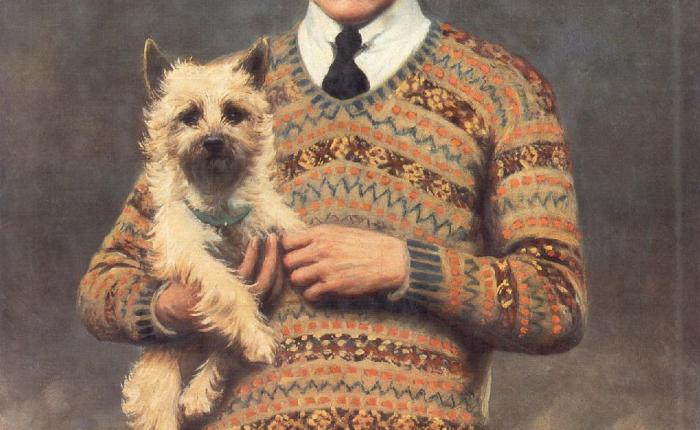
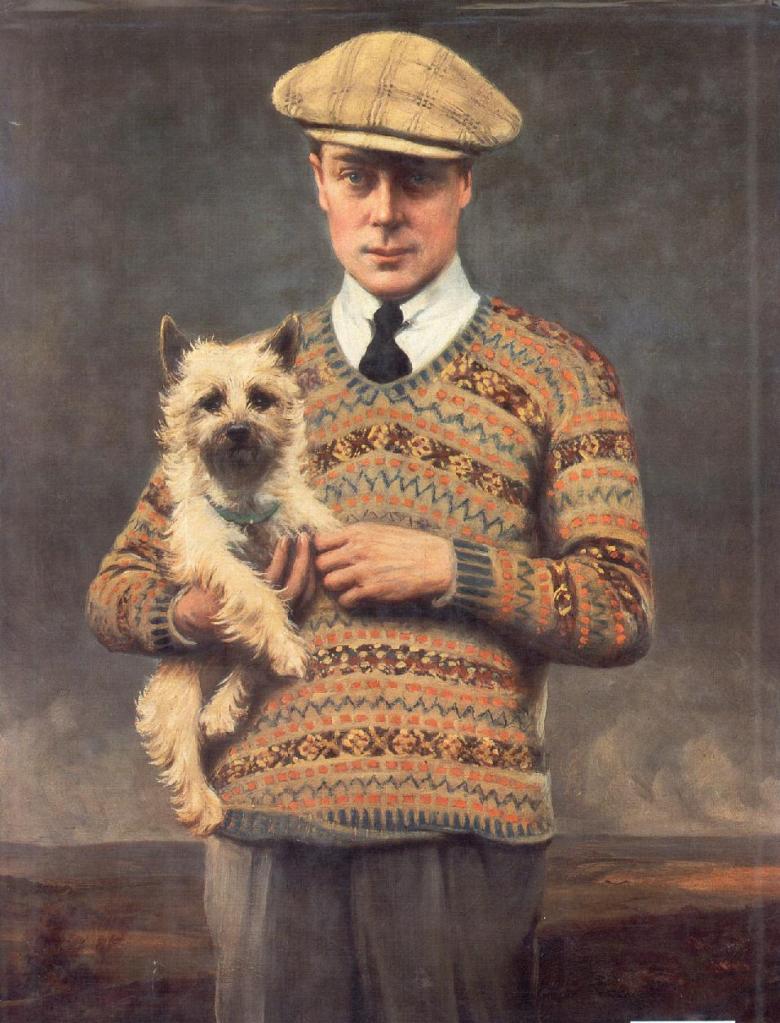
By the end of the First World War, women on Fair Isle and the rest of Shetland had started producing full jumpers in the Fair Isle technique. Then, in a stroke of marketing genius, Shetland hosiery dealer James A Smith gifted a Fair Isle jumper to Edward, Prince of Wales. The Prince of Wales was an immensely popular society figure and bona fide style icon.[2] He decided to wear the Fair Isle jumper whilst sitting for a portrait painted by John St. Helier Lander. In line with the increased importance of mass-communication and consumption of this period, the portrait was reproduced by the Illustrated London News.

Suddenly, Fair Isle jumpers were the must-have fashion item for fashion-conscious socialites. Although jumpers had initially only been made for men, parallel developments in women’s fashion that favoured relaxed fits and dropped waistlines meant that soon, women were also keen to have their own Fair Isle jumpers. This craze for genuine Fair Isle products inevitably had consequences for the women making these garments. Where they had previously been dependent on the Shetland merchants and traders to take their stock, now women were able to bypass the Truck System and liaise directly with wealthy English buyers. As these buyers sat outside the local economy, they naturally paid in cash which allowed the Shetland women greater financial independence. Eventually the Truck System collapsed completely by the Second World War.

Of course, buying a handmade Fair Isle garment from Shetland was still prohibitively expensive for most people. Very quickly, the exclusive garment worn by the Prince of Wales spawned mass-produced knitting patterns which allowed amateur knitters to make their own garments at home. These remained popular into the 1940s, and Fair Isle garments more generally have become a wardrobe staple for period dramas set in this period. Fair Isle jumpers and vests have periodically regained popularity ever since, and there continue to be knitwear designers on Shetland who are evolving the style. The original 1920s jumper that started it all has not been forgotten; you can purchase an exact replica of the Prince of Wales’ jumper from various Shetland merchants, such as here and here.


[1] Although to this day, only garments actually produced on the island of Fair Isle can carry the Fair Isle trademark

[2] He popularised amongst other things: a particular type of collar (still known as the Prince of Wales collar); a particular way of tying ones tie; the Prince of Wales check motif and plus-fours trousers

J. Lyons and Co – Trocadero and Corner Houses

J. Lyons and Co – Trocadero and Corner Houses

A key pleasure for Londoners in the interwar period was going out for tea or a meal. ‘French-style’ restaurants had appeared in London in the final decades of the nineteenth century. Whilst these original restaurants remained popular, the interwar period saw a democratisation of the dining-out experience. A wider range of outlets catered to people of different backgrounds and with different amounts of disposable income. As more and more Londoners, including women, increased their earnings and got more leisure time, they were able to experience (temporary) luxury in one of the many restaurants, cafes, and teashops in the capital. The player that left one of the biggest marks on the hospitality industry in London between the wars was J. Lyons and Co.

Like other restaurants, Lyons started its business in the late nineteenth century: with a teashop in Piccadilly in 1894, and the opening of the Trocadero Restaurant on Shaftesbury Avenue two years later.[i] The teashop turned into a chain of shops in 1909. Three of these teashops were Corner Houses, big, multi-storey hospitality spaces which offered affordable snacks and drinks to a mass audience. The Corner Houses on Coventry Street in Soho and the Strand were opened in 1909 and 1915 respectively, but the third Corner House, on the corner of Oxford Street and Tottenham Court Road, opened in 1928.[ii] This attests to the continuing success and popularity of the Corner Houses throughout the interwar period.

Corner Houses worked on economies of scale: they had hundreds of seats each, employed hundreds of staff, and aimed to get as many covers a day as possible. You can get a sense of the bustle of a Lyons Corner House in Alfred Hitchcock’s Blackmail (1929). Near the start of the film, the heroine, Alice, and her boyfriend Frank, visit a Corner House after work. As soon as they walk into the building there is a crush of people around them; they struggle to get into the lift. Once they enter the spacious dining room, all the tables are taken. They are hurried along with every step, and only stay at the restaurant for a short while before leaving again. It is no coincidence that Alice has picked this location to meet her lover, ‘The Artist’ – the crowded room provides a perfect cover for a secret rendez-vous, and the Corner House is a democratic space that anyone can enter without difficulty. In real life, the Corner Houses also functioned as meeting spaces for marginalised groups, most notably for queer men.[iii]

Lyons operated a very different policy at the Trocadero restaurant. In some respects the Corner Houses and the Trocadero were very similar; both served hot meals, both catered to huge numbers of customers every day, and both sought to transport their diners to exotic locales through their interior decoration and design choices.[iv] But whereas the Corner Houses were explicitly marketed to a mass audience, the Trocadero restaurant had strict rules about who could enter the space and where they were allowed to go.

An internal “Memo to Superintendents and Reception Clerks” stipulated a number of rules on the handling of “Strange Ladies” – female customers not known to the staff. These rules were clearly intended to prevent prostitutes from entering the space and soliciting; the Trocadero was on the site of what used to be the ‘Argyll Subscription Rooms’, an entertainment venue notorious for the number of prostitutes that frequented it. In its efforts to distance itself from the site’s previous occupiers, the management of the Trocadero were asked to treat all “Strange Ladies” as potential disruptors:

For Luncheons. Strange Ladies to be placed at small tables round the Restaurant, the object being that in case of misbehaviour we can screen the table off.

For Dinners. Strange Ladies either in couples or alone are to be put at the small tables round the Blue Saloon Wall (When Saloon is closed round the Restaurant) the object being that in case of misbehaviour we can screen the table off.

For Suppers. Strange ladies are to be given the small tables in the Restaurant round the Wall, the object being that in case of misbehaviour we can screen the table off.

Grill Rooms. Strange Ladies either alone or in couples are to be placed at small tables round the small room, or (in the event of this being closed or full) at small tables in the Larger Room, the object being that in case of misbehaviour we can screen the table off.[v]

Clearly, the Trocadero restaurant was not intending to be an open and public space for female customers, who were rather expected to visit a Corner House instead. The gendered differences between the Trocadero and Corner Houses also extended to the waiting staff: all waiters at the Trocadero were male, whereas the Corner Houses had exclusively female waitresses, who came to be known as ‘Nippies’.

It was conventional in London that waiting staff in restaurants were male and waiting staff in teashops were female.[vi] Male waiting staff were perceived as similar to the butler or footman in a grand house; by attending a restaurant the (male) customer could experience something akin to what a gentleman in a country estate would experience. In the teashops, on the other hand, the female staff were appreciated for their speed, efficiency, and decorative function.

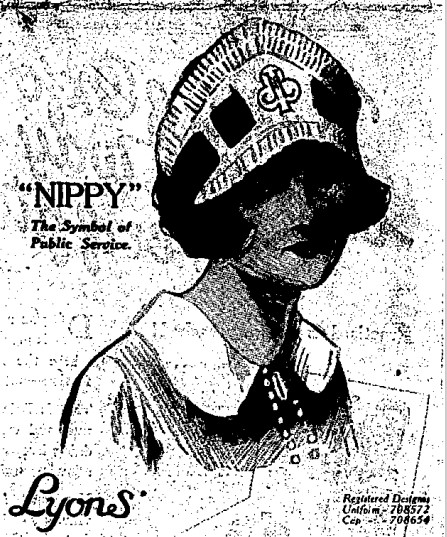
The Nippy grew into a cultural phenomenon in and of itself, to the point that she became a fictional character that both represented the Lyons brand and a host of positive feminine values. Internal guidance to female waiting staff placed a lot of emphasis on physical presentation: Nippies were required to have their hair “neat and tidy”; “teeth well cared for”; “cap correctly worn” and “no conspicuous use of make-up”.[vii] Lyons deliberately crafted this aspirational persona for its female staff and encouraged them to take pride in their femininity.[viii] In advertising for the brand, Nippy became the ‘Symbol of Public Service’.

Advert on front page of Daily Express, 14 April 1925

J. Lyons & Co. had a huge influence on the interwar London dining-out scene; there are countless references to its restaurants and Corner Shops in memoirs and fictional representations of this period. As this piece has shown, Lyons catered to two very different audiences through its restaurants and tea shops respectively. It is in the interwar period that these venues first reached their mass appeal, and the Nippy became established as a cultural reference point. For women, the choice was between conforming to a symbol of feminine perfection or risking being labelled as a prostitute. The venues lasted well beyond this period: the last Corner House closed in 1977 and the Trocadero remained active as an entertainment venue until 2011.


[i] Judith Walkowitz, Nights Out: Life in Cosmopolitan London (New Haven: Yale University Press, 2012), p. 197

[ii] Ibid., p. 198

[iii] Matt Houlbrook, ‘The Man with the Powder Puff’ in Interwar London’ The Historical Journal, Vol. 50, No. 1 (Mar., 2007), 145-171 (149)

[iv] Walkowitz, Nights Out, pp. 198-199

[v] London Metropolitan Archives: ACC 3527/186 – Rules and regulations for Trocadero Restaurant staff (indexed)

[vi] Rosalind Eyben, ‘The Moustache Makes Him More of a Man’: Waiters’ Masculinity Struggles, 1890–1910’, History Workshop Journal 87 (2009), 188-210 (197)

[vii] London Metropolitan Archives: ACC/3527/201/A ‘The Perfect Nippy’

[viii] Walkowitz, Nights Out, p. 205

All-Night Card Clubs

On 8 March 1927 the Daily Express ran a sensational exposé on its front page:

“London’s All Night Card Clubs – Women who play from tea-time to breakfast”

The story ran nearly the full length of the front page. It noted that an advertisement had been appearing in respectable broadsheet The Times, which read:

BEAUCHAMP CLUB
56 Beauchamp Place, S.W. 3 (Sloane 3340)
Mrs Hands has regular games of straight poker daily, at 3 and 9pm. Bridge lessons given

Poker clubs such as this one functioned as private member clubs, where members paid an annual fee to attend. The legislation of private member clubs had been drawn up with the classic Pall Mall club for upper-class men in mind. In the interwar period, however, club legislation and licensing were increasingly exploited by entrepreneurs to facilitate transgressive behaviour. Nightclubs of the period operated under the same legislation; they were nominally private member clubs, which allowed them to evade a level of external scrutiny. However, where the old clubs in ‘Clubland’ often had (and still have) extensive vetting procedures for new members, nightclubs and poker clubs usually allowed anyone to join as long as they paid their annual fee. The poker clubs were perfectly legal, but clearly they were stretching the intentions of club legislation beyond its originally intended purpose.

The Daily Express held the Beauchamp Club up as an example of a supposed sudden influx of private member clubs that catered to poker players. The members of these clubs were alleged to be mainly women, playing into persistent fears of the potential corrupting effect of modern society on women. The article states confidently that: “Women gamblers are patronising these clubs in increasing numbers. They begin in the afternoon, break off for dinner, and then sit down to another long session, which often lasts till dawn.” The question that this may raise in the reader’s mind is – what happens to these women’s families whilst they are spending time at the poker table? At a time when a married woman’s primary role was to support and look after her family, a woman who spends hours at the poker table was presumably neglecting her responsibilities towards her husband and children.

Mrs Hand, the owner of the Beauchamp Club, is quoted as saying “Women will always gamble”; this is presented as a simple fact of life, that all the readers of the article can agree on. Players are described as attending the club after the theatre shows finish, then playing until breakfast, and returning at 3pm for the next round. It is implied that women are particularly susceptible to this addictive behaviour. What is more, Mrs Hand’s earning model banks on it; on top of the club’s annual fee, she charges players for each hour they spend at the table.

The location of the club and the fact that the advert had been placed in The Times – the stalwart of the upper classes – implied that the club members were of a high social standing. The Daily Express was aimed at a lower-middle class audience; this story allowed the Express reader to feel indignation at the wealthy Londoners who were supposedly spending all day gambling their money away. Mrs Hand is quoted as explaining that club members “play for four-shilling rises (…) That means you would have to be most unlucky to lose as much as £10 in a sitting.” Ten pounds was a substantial amount of money for most people; Mrs Hand’s comments only highlight how removed she is from the average person in her understanding of the value of money.

The Express article traces the reason for the sudden increase in poker clubs specifically to a few key court cases of previous years. In 1921 the owner of the Cleveland Club was charged with allowing illegal gambling activity in his club because it contained a poker room. The Express notes that in that instance, “The stakes were low, and play was never continued for more than half an hour after midnight”. Nevertheless, the club owner pleaded guilty and paid a fine.

However, a similar case that was brought to trial not long after was put to a jury, which delivered a verdict of ‘not guilty’ on the basis that poker required a level of skill and was therefore not a form of gambling. According to the Express, the police have since stopped taking action against poker clubs as the jury’s verdict set a precedent. The debate on whether poker is a sport or a form of gambling continues to this day, with both sports and betting companies arguing for their respective positions. A variation of poker called ‘Match Poker’, which removes the random element of which cards a player is dealt. This version of poker is now recognised as a sport, but more commonly played versions such as Texas Hold’em are a mainstay in casinos, and players are required to be at least 18 years old (in the UK) to play.

It is clear where the Express stands on the matter of prosecution, even if the clubs are currently primarily frequented by those who can afford to lose some of their wealth. It argues that complaints keep arising of “women and young men losing much more money than they could afford in poker clubs, and of other evils arising out of this form of gambling.” The article’s final sentence notes that publicly advertising these clubs, as The Times is allowing to do, gives opportunity to professional gamblers to swindle others out of their money.

It is unlikely that many Express readers themselves had been affected by poker clubs, but it was a pretty safe topic to gain their audience’s approval, as it put people of a different social class in the firing line. The article did not spark a bigger inquiry into poker clubs and the Express did not pursue the story. For the paper, private poker clubs were a way to generate indignation towards women, the upper classes, The Times, and the government and police who were not taking any action against these clubs.