Featured

The Bow Cinema Murder – Aftermath

This is the eleventh and final part in the investigation into the 1934 ‘Bow Cinema Murder’. You can read all entries in the series here.

After John Stockwell’s execution on 14 November 1934, the Bow Cinema murder case had formally come to a close – but its impact on the people caught up in it lasted beyond the execution. Most significantly, Maisie Hoard continued to recuperate from the substantial injuries that Stockwell had inflicted on her. The psychological damage was naturally also serious. On the day of the execution an interview with Maisie appeared on the front page of the Daily Mirror, under the headline ‘Life Ruined by Murder’. Still in hospital at this stage, Maisie revealed that she would have a scar in her face for the rest of her life. She also pointed out that, as a new cinema manager had been appointed to the Eastern Palace Cinema, she was now effectively homeless:

I have now no home – nothing. I have nowhere to go, for I have no mother, brother or sister. My husband was uninsured – so I have no money. I do not ask for charity. All I want is work. Will someone give me a job as housekeeper?[1]

In the end, Maisie did not have to work as a housekeeper, or at least not for long. By 1939 she had remarried to a Henry White and moved to Ashford in Kent.

The other woman whose life had been most affected by John Stockwell was his girlfriend, Violet Roake. As noted in the previous instalment of this series, she had also gone public and was interviewed in the Daily Herald, reframing her story as a romance novel. Violet was only 18 in 1934 and although she had anticipated marrying John Stockwell before he committed his crime, she clearly had enough opportunity to find another life partner. It is possible that her reputation in the East End was irrevocably tainted though; while her brother and sister stay local, Violet marries a Navy officer and moves to Portsmouth. The couple married in 1939 and had a son in the same year, and a daughter ten years later. Violet lived until 1991. Her husband, Joseph Brimley, survived her and lived until 1995.

For Fred ‘Nutty’ Sharpe, the Chief Inspector who investigated the case, the Bow Cinema murder investigation was significant enough to warrant a full chapter in the memoirs he published in 1938. Sharpe retired from the CID in 1937. In his book, Sharpe of the Flying Squad, he calls Stockwell ‘the calmest, most coldblooded individual I have ever met and he wasn’t the least bit nervous.’[2] Throughout the chapter Sharpe uses superlatives to stress the violence of the murder: it was ‘one of the most savage [murders] a man has ever committed’ and the attack had been committed with ‘utmost violence.’[3] He juxtaposes this with his descriptions of Stockwell as’ completely unmoved and in entire possession of his nerve.’[4]

Sharpe’s descriptions reinforce the newspaper reporting that had taken place during the case, which also largely described Stockwell as calm and weirdly devoid of emotion. Despite this, though, John Stockwell never entered the popular imagination as a notorious calculating killer. There are plenty of well-known murder cases from the interwar period, but this is not one of them. For a case that was considered at the time to be extremely brutal, and a killer who was unusually young and unemotional, it may seem surprising that this case did not gain the same notoriety as others.

It is not because this case was satisfactorily solved – most of the best-known interwar murders were resolved at the time and their convictions are largely considered sound. Like many of the other famous cases, celebrity pathologist Sir Bernard Spilsbury worked on this case, and it received extensive press reporting. It raised concerns about the callousness of youth, and whether it was appropriate to execute a 19-year old.

I suspect that it is the combination of victim and killer that has made this murder less appealing than others of the same period. Unlike many of the most famous interwar murders, there was no love or domestic angle to this case. There were no betrayed husbands or deserting wives; Stockwell hadn’t murdered a girlfriend like Patrick Mahon or Norman Thorne, or tried to fake his own death due to having too many girlfriends, like Alfred Rouse. He also had not been convicted of killing his own mother, like Sidney Fox. Instead, he was a man killing another, unrelated man, for financial gain. Most years during the interwar period, a handful of men got executed for similar crimes, yet the cases are largely forgotten. Instead, the interwar years are remembered for their colourful domestic dramas, with cases like Edith Thompson’s being so well-known she has a dedicated website.

As this series has demonstrated, the killing of a man by another man can be no less interesting than a murder case involving a jilted lover; and it can reveal much about the attitudes towards masculinity, class, money, and local communities.


[1] ‘Life Ruined by Murderer’, Daily Mirror, 14 November 1934, front page

[2] Frederick Sharpe, Sharpe of the Flying Squad (London: John Long, 1938), p. 126

[3] Ibid., pp. 126-7

[4] Ibid., p. 131
The Bow Cinema Murder – the East End family

FeaturedThe Bow Cinema Murder – the East End family

This is the fourth in a 11-part investigation into the 1934 ‘Bow Cinema Murder’. You can read all entries in the series here. 

When John Stockwell decided to attack and rob his employer, he was living as a lodger with a local East End family. He had met Eliza Roake, the head of the family, through the charitable activities she undertook for her Church. After John lost his place in the Salvation Army Boys Home after being convicted of theft, Ellen took him in. After the events of 7 August 1934, their association with John drew this poor but respectable family into a police investigation and a tabloid press sensation.

Ellen Eliza Roake was born Ellen Hoare in 1876; when she was 26, she married Henry George Roake who was five years her junior. The couple had five surviving children: Nellie, born in 1903; William, born in 1906; Eva, born in 1909; Frederick, born in 1913; and Violet, born in 1915. In addition, there were at least two other sons who did not survive past early childhood. All the children were born in Bromley-by-Bow, where Ellen and Henry settled after their marriage. Henry worked as a railway porter in nearby Liverpool Street Station.

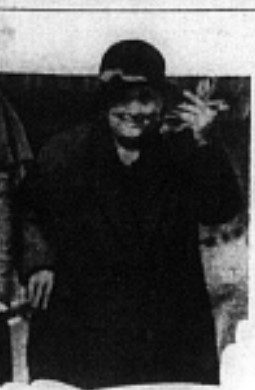
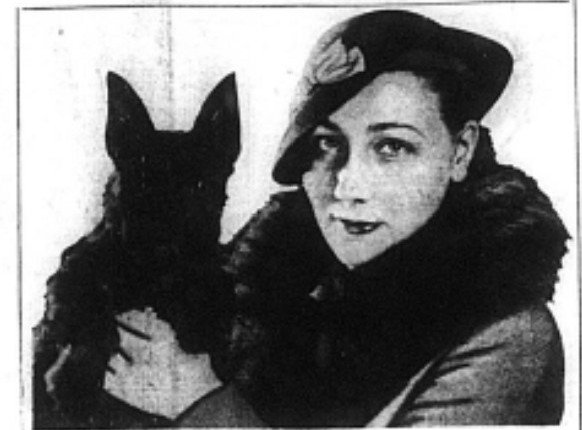
Ellen Roake. This photo appeared in the Daily Herald on 12 Sept 1934

In 1926, Henry passed away; five years later, William and Eva both married and moved out of the family home on Empson Street in Bromley. The space that was freed up by their departure is perhaps one of the reasons why Ellen felt able to invite John Stockwell to move into the family home in early 1932.

The Empson Street house was considered small even at that time; the police inspector investigating the murder of Dudley Hoard commented on the house’s small size in one of his reports. There was only one bedroom, which Ellen shared with Nellie and Violet. Beyond the bedroom, there were no other rooms on the house’s first floor. The ground floor consisted of a sitting room, kitchen and scullery. John and Frederick had to make up their beds in the sitting room floor every night. The toilet was attached to the back of the house and needed to be accessed through the garden.

Nellie Roake, who was around 30 at the time of the murder, worked as a ‘chocolate finisher’ in Millwall, an adjacent neighbourhood. The manufacture of chocolates and sweets was an industry that typically employed women, who were believed to be better suited to the detailed work. In addition to her job, Nellie also took care of part of the household chores including cooking meals. She was engaged to William Hilsdon, a labourer who lived around the corner from the Roakes with his parents. William was also born in Bromley; also had a number of siblings; and his parents were also working-class. Although he and Nellie moved in together (with William’s mother) some time in the late 1930s, they did not get married until 1953, after Ellen Roake passed away. There does not appear to have been any bad blood between Ellen and William, however; on the night before the murder on Dudley Hoard in 1934, William spent the evening at the Roake’s house playing cards with the family until nearly midnight.

Unlike his elder sister, Frederick Roake appears to have provided less support to the family. At the time of the murder, he was unemployed due to a knee injury for which he was receiving outpatient treatment at St Andrew’s hospital, where Maisie and Dudley were also taken after the attack. Beyond that, Frederick seems to have spent considerable time loafing around the neighbourhood; he was able to immediately go over to the cinema once news of the attack broke. Frederick and John were not friendly; after John’s arrest, Frederick reported that he usually did not have ‘a lot to say’ to the other man. Despite sharing a bed together every night, the pair appear to have tried to avoid one another as much as possible. Frederick had a girlfriend, Henrietta, who was also born locally. They married in 1938 and stayed in the East End, where Frederick ended up working as a transporter of goods on horse cart.

Violet Roake was the youngest of the family, and the one most closely involved with John Stockwell. They were of the same age, and had been going out from around 1931, when they were both 16. Violet worked as a biscuit packer in a Bethnal Green factory; for many young working class women, light factory work had replaced domestic service as the career of choice. Every morning, John walked Violet to the bus stop around 7.30am. Her shifts started at 8am and finished at 6pm. Because John’s hours at the cinema did not finish until 11pm, most days the only time they had together was that half hour in the morning. The exception was Tuesday, when John was off work and they could do something in the evening. If they were at home, it was likely that there were other people around, and the small size of the house would have afforded them no privacy.

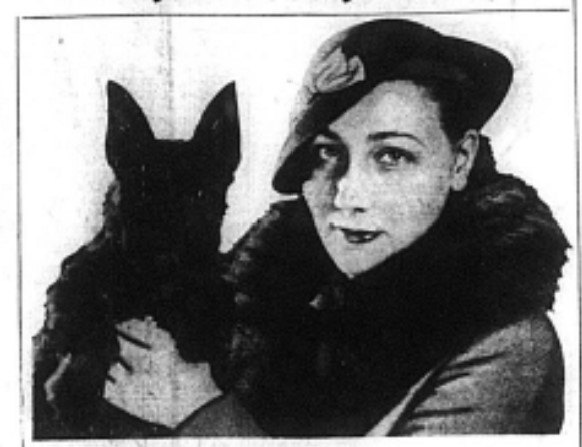
Violet Roake. This photo appeared in the Daily Herald on 14 November 1934

Until the murder, Violet had assumed that she and John would be getting married some day. She eventually married a naval officer in 1939 and moved down to Portsmouth with him. They had a son in 1939 and a daughter in 1949. Unlike most other participants in this story, Violet left the East End definitively when she was in her early twenties. It is possible that her association with a murderer, however unwitting, left a lasting mark on her reputation in the local area.

The Roakes were a typical East End family, with blue collar jobs, little money, a small living space, and a lot of family and friendship ties to the local area. Despite their small house, Ellen invited John to live with them when he became homeless, which speaks to her civic-mindedness. If it had not been for their involuntary involvement in the story of the Bow Cinema murder, they would have been absorbed in history without a trace. The case no doubt had a lasting impact on Violet in particular, whose expectations for her life were radically changed as a result of the case. As part of the fall-out, the family were exposed to police investigators, which came onto the scene within minutes of the crime being discovered. The next blog post will unpick who got involved in the police investigation, and how they approached the East End community in which the crime had taken place.

The Woman from China (1931)

FeaturedThe Woman from China (1931)

As has been covered on this blog before, in 1927 the British Government adopted the Cinematograph Films Act, a legal measure which prescribed a minimum volume of British-made films which each exhibitor had to show. It was no longer possible for a cinema to solely show Hollywood films. The intention of the Act was to boost the British film industry; its unintended consequence was that American studios set up cheap studio contracts in Britain and started churning out low-quality films which became known as ‘quota quickies’.[1]

Shortly after the Act was passed, Britain started transitioning to sound film, with the earliest ‘talkies’ with continuous sound appearing in 1929/1930. The transition was rapid, with sound film becoming the norm within just a few years. Yet for the ‘quota quickie’ industry, sound film could be an expensive business. It was generally the aim of American studios to shoot their British films as cheaply as possible, often for as little as £1 per foot of film.[2] Shooting sound film required additional technology such as microphones, and also forced on-set shooting in the early years, as location shooting was too noisy and complicated. It is not surprising, then, that quota quickie producers continued to make silent films into the early 1930s.

One of these is The Woman from China, which was made in 1930. According to Steve Chibnall, the film was produced in a rush. Under the 1927 Act, the ‘quota year’ ran from 1 April to 31 March, meaning that by 31 March each year exhibitors had to be able to evidence that they had shown the appropriate proportion of British films in the preceding twelve months. In January 1930, the major American studio MGM commissioned two British producers to create a film by the end of March that year. The result was The Woman from China, for which shooting and editing was completed within four weeks, with a half-finished script.

The final scenes were shot five days before the scheduled trade show, and director Dryhurst was obliged to double as editor with the help of one young assistant. The two worked ninety hours without sleep to meet the deadline, although the first of the two shows as lacking the final reel.[3]  

Considering those circumstances, The Woman from China can be considered a fairly accomplished film from a technical perspective, although it perpetuates many obvious and damaging stereotypes in its narrative, staging and costuming. The plot is one familiar from films of this period: a young secretary and a naval officer are engaged, but their relationship is thwarted by a mysterious British woman who has recently arrived from China, and who is in love with the naval officer. The ‘woman from China’ is being blackmailed by a Chinese Svengali, Chung-Li, who in turn wants to marry the secretary. The Chinese man directs his henchmen to kidnap both the officer and the secretary, and proceeds to emotionally torture them until they can break free. The ‘woman from China’ has a change of heart and sacrifices herself to save the naval officer; the Chinese man and his henchmen are killed; and the original couple are able to get away unscathed.

Frances Cuyler and Tony Wylde as the protagonists in The Woman from China

There was already an established history of racist depictions of Chinese characters in popular culture in Britain. The most successful proponent of this was pulp writer Sax Rohmer, who started his ‘Fu Manchu’ series of books just before the First World War. In these books, a Chinese evil mastermind is working to reinstate China as a superior power. Fu Manchu is associated with Limehouse, which at that time was London’s Chinatown. The Woman from China acknowledges its debt to these earlier pulp novels by a character noting that Laloe Berchmans, the woman who has made a deal with Chung-Li, is ‘like a character from an Edgar Wallace novel.’

Julie Suedo as ‘the Woman from China’ and Tony Wylde in The Woman from China

Chung-Li is played by white British actor Gibb McLaughlin in yellowface. The second most prominent Chinese character, an anonymous ‘Chinaman’, is played by Japanese actor Kiyoshi Takase. The Woman from China incorporates such racist tropes as Chung-Li having pointedly filed fingernails; leering after the secretary; and working to increase China’s power in the world. (I’ve deliberately not included any stills from the film featuring McLaughlin in this post as his costume and appearance throughout is offensive).

Chung-Li proposes his deal to the woman under his control

Although The Woman from China may appear to be a good example of a 1930s British film that is best forgotten about, it also allows us to explore the conditions of film production during this volatile period of the British film industry; contemporary portrayals of race; and a late example of a British silent film which includes on-location shooting. Its preservation allows us to appreciate the full range of British film output of this period, and to engage with the challenging legacy of racial discrimination which was pervasive in Britain during the interwar years.

Readers based in the UK can watch The Woman from China for free on the BFI Player.


[1] Steve Chibnall, Quota Quickies: The Birth of the British ‘B’ Film (London: BFI, 2007), p. 4

[2] Ibid., p. xii

[3] Ibid., p. 19

Featured

Suburban dreams

London underwent massive suburban expansion in the interwar period. The interwar period saw a combination of an increase of Londoners who were looking for suitable living space; an increase in disposable income and a reduction of housing costs; and a greater availability of accessible building plots around the outskirts of the city. These factors led to a veritable suburban ‘boom’ during the 1920s and 1930s, at the end of which London’s size had increased threefold and the population of its suburbs had grown by 2.5 million compared to the start of the century.[1]

The first London suburbs were built by private investors during the nineteenth century, when the introduction of tramcars and other modes of public transport opened up areas further away from the city centre, for residential development. By the end of the nineteenth century the London County Council also ordered the development of suburban estates, to provide healthier living quarters to poorer Londoners.[2] These two types of suburbs – private developments and council estates – continued to co-exist in the Edwardian and interwar periods. Private developments were mostly aimed at the aspirational middle-classes, who would look to mortgage a semi-detached or detached house.

Elsewhere in this blog I have considered how the suburbs were represented on film; how tennis was a key social activity for suburbanites; how an expansion of car ownership changed the entertainment opportunities open to suburban Londoners and how the experience of suburban women was captured in interwar novels. The suburbs, in short, were on the forefront of social changes and the experiences of their inhabitants provided inspiration for artists.

Yet suburbs were also synonymous with boredom and small-mindedness, particularly to the urban intelligentsia.[3] Privately developed suburbs were built by builders and speculators, who bought up cheap land, built houses on them, and then sought to sell these brand new dwellings as quickly as possible. One of the key ways they used to entice Londoners to buy a suburban house was to present suburbia as a rural environment.

‘Most advertisements and brochures were accordingly illustrated with idealised sketches or heavily retouched photographs which skilfully suggested that the house stood quite along in matured surroundings of judiciously placed trees and shrubs, against a background of windblown clouds and gently rolling hills.’[4]    

In London’s north-western corner, new estates serviced by the Metropolitan Railway were quickly badged up as part or ‘Metro-land’. Transport posters presented this new land as a rural idyll with ‘Gorgeous Autumnal Scenery’ and ‘Charming Country Walks’; as well as an excellent place to go fishing. At Radlett, near Watford, a developer promised such aristocratic pursuits as ‘Hunting, Shooting, Beagling and the like….every phase of rural life at Radlett provides the perfect antidote to business worries.’[5] At the same time, it was crucial that suburban estates had quick and easy transport lines into the centre of London. Here, misleading advertisements could be the developer’s friend: brochures and advertisements frequently cited the fastest possible travel time as standard, even if most of the daily trains would take much longer to get to the city.[6]

Because suburbs kept expanding incessantly, any estate that started out as a semi-rural enclave would quickly find itself engulfed by other estates, the ‘rolling hills’ and ‘mature trees’ covered by more semi-detached housing. Most suburban dwellers were exposed to nature primarily through their garden. Because suburban houses were often built in styles to remind people of cottages and other old-fashioned houses, historian Matthew Hollow has argued that ‘the move out to the cottage estate was accompanied by a desire to indulge in new, more family-centred, pastimes. Gardening became a popular family pastime for many.’[7] Gardening also allowed suburban houseowners to express their creativity and compete with their neighbours in popular and wide-spread estate garden shows.[8] Perhaps surprisingly, in the popular imagination the garden became the domain of the male head of the household, retreating to the garden after dinner to tend to his plants. As ever, London Underground’s poster designers had their finger on the pulse with this 1933 poster, showing a city man seamlessly transforming into a suburban gardener mowing his lawn.

One final way in which suburban inhabitants themselves sought to underline the rural character of their neighbourhoods was through their house names. As completely new developments, many privately-built suburban estates did not yet have properly assigned addresses when their first inhabitants moved in – another sign of the speed of suburban development, which outpaced the local authority administration. To ensure their homes could be identified, many suburbanites named their own houses, and names such as ‘Meadowside’, ‘Woodsview’ and ‘Fieldsend’ both highlight the semi-rural nature of the suburban environment, and indicate that for the people living in these houses, the natural surroundings were significant.

Despite its sometimes negative reputation, suburban living was a dream for many working- and middle-class Londoners during the interwar period; a dream encouraged by the sometimes fanciful advertising techniques used by speculative developers. For many, suburban living offered a first chance of home ownership, and access to private green space. The vast suburban developments of the 1920s and 1930s continue to shape London to this day.


[1] Mark Clapson, Suburban Century: Social change and urban growth in England and the United States (Oxford: Berg, 2003), p. 2; Stephen Halliday, Underground to Everywhere (Sutton: Stroud, 2001), p. 113

[2] Peter Hall, Cities of Tomorrow (Oxford: Blackwell, 2002) pp. 21 and 50-52

[3] Alan A. Jackson, Semi-Detached London (London: George Allen & Unwin, 1973), p. 162

[4] Ibid., p. 204

[5] Ibid., p. 205

[6] Ibid., p. 206

[7] Matthew Hollow, ‘Suburban ideals on England’s interwar council estates’, Garden History, vol. 39, no. 2 (2011), 203-217 (213)

[8] Ibid., p. 209

The Lady Vanishes (1938)

FeaturedThe Lady Vanishes (1938)

This is the second of a two-part blog looking at the novel The Wheel Spins, and its film adaptation The Lady Vanishes. You can find the first part here.

Following last week’s analysis of the 1936 novel The Wheel Spins by Ethel Lina White, this week we consider its film adaptation The Lady Vanishes. The film was released in 1938 and directed by Alfred Hitchcock, who by the late 1930s was directing acclaimed and increasingly high-profile films in England. He would move to Hollywood in 1939. The Lady Vanishes includes a number of stylistic flourishes that make it instantly recognisable as a Hitchcock film.

Although there was only two years between the publication of the novel and the release of the film, and the novel is credited as the source material, there are fairly significant differences between the book and the film. The focus on the female experience, present in the book, is watered down in the film in favour of a more traditional positioning of the female protagonist as assistant to the active, male counterpart. The film’s final section deviates completely from the book, and links much more explicitly to Europe’s political situation in the late 1930s.

As with the novel, the film opens not on a train, but in a hotel in a fictional Eastern European country. The female protagonist, here called Iris Henderson, is on a girls’ trip before travelling back to London to be married. Although Iris and her friends have the hotel staff eating out of their hands, they are presented much more sympathetically than Iris and her friends are in the book. Miss Froy, the lady who vanishes, is also staying at the hotel and she and Iris have some interaction before boarding the train; Iris also meets her eventual love interest, Gilbert, in the hotel.

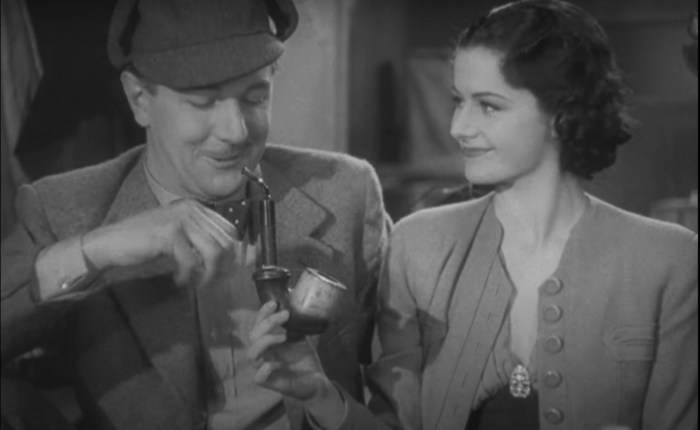
Gilbert (Michael Redgrave) and Iris (Margaret Lockwood) playing Holmes and Watson in The Lady Vanishes

Hitchcock introduced two additional characters, Charters and Caldicott, two men who are determined to get back to England before the end of the Ashes cricket match. This comedy duo proved so popular that they ended up appearing in ten more films, working with a range of directors. To ensure the film does not get too overcrowded, many of the other British characters that appear in the book are not in the film.

Caldicott (Naunton Wayne) and Charters (Basil Radford) in The Lady Vanishes

Once the action moves onto the train, the film largely follows the same trajectory as the novel, although Gilbert takes a much more pro-active role in the hunt for Miss Froy and Iris is increasingly relegated to his assistant. This is made explicit in a scene where he poses as Sherlock Holmes with Iris as his Watson. Gilbert even gets to demonstrate his physical daring when climbing out of the carriage window and into the next carriage from the outside of the train.   

Gilbert (Michael Redgrave) climbing down the side of the train in The Lady Vanishes

Once the pair have located and saved Miss Froy, the action goes in a drastically different direction. The nefarious gang that are trying to kill Miss Froy decouple the two train carriages that contain all the British characters and divert it to a side track into the forest. Once there, the carriages are ambushed by the gang and repeatedly shot at.

It is here that Europe’s political situation has clearly strongly influenced the script. The British characters are debating whether they should get away, fight back, or surrender. One character does not want to fight and instead exits the carriage waving a white handkerchief – he is promptly shot dead by the antagonists. The parallels with Chamberlain’s appeasement approach to Germany could not have been missed by British audiences. Ultimately, with only one bullet left between them, the British passengers manage to get the train running again and are able to get away, but not before Miss Froy has admitted to Iris and Gilbert that she is a spy working for the Foreign Office, and has been given a message for the British government in code. She teaches the code to Gilbert before exiting the train and running into the forest.

This is a significant deviation from the novel, in which Miss Froy is targeted by gangsters because she has unwittingly witnessed something she should not have seen. In the film, Miss Froy is not an innocent bystander who was at the wrong place at the wrong time, but rather part of an international network of spies and informants working for the British state. Rather than being reunited with her family in a celebration of traditional British domestic values, Miss Froy is reunited with Gilbert and Iris as they come off the train. Their triumph is that they have helped the British government gained vital intelligence, with the Foreign Office taking the place of the parental home. In times of political turmoil and with war on the horizon, it is the duty of British citizens not just to help one another, but also to help the State in its mission to suppress international unrest.

The main source of tension in The Wheel Spins, Iris’ concern that she will be locked up in an asylum because no-one believes her, is absent in The Lady Vanishes. Instead, the danger comes not from the British passengers on the train, but from the Europeans who are looking to eliminate a British secret agent. This makes the story much more conventional and in line with many other suspense films of the period. The film is elevated by Hitchcock’s direction and dialogue that balances comedy and drama. The novel and the film stand alongside one another as distinct texts, each using the same plot to foreground different themes.

The Lady Vanishes is available on Youtube.

Featured

Ethel Lina White – The Wheel Spins (1936)

This is the first of a two-part blog looking at the novel The Wheel Spins, and its film adaptation The Lady Vanishes.

Ethel Lina White is one of a mass of interwar authors who were quite prolific, had some commercial success during their lifetime, and whose names have been mostly forgotten by the general public. In the case of White, if it were not for the successful adaptation of two of her novels into films, she may have dropped into obscurity altogether. However, her 1933 novel Someone Must Watch was adapted for the screen in 1946 as the American horror film The Spiral Staircase, and her 1936 novel The Wheel Spins was filmed by Alfred Hitchcock in 1938 under the title The Lady Vanishes.

The plot of the book is relatively straightforward: Iris Carr is a young, wealthy, but bored woman who is travelling back to London by train after a holiday in Eastern Europe. On the first stage of the journey there is another British woman in her carriage, a Miss Froy. Iris has suffered sunstroke just before boarding the train and falls asleep. When she wakes up, Miss Froy has disappeared, and everyone else in the train appears to deny she has ever existed at all. Iris gets increasingly frantic trying to prove that Miss Froy exists, and attempts to enlist the help of the various British passengers on the train.

The Wheel Spins is an unusual entry to the suspense and mystery genre, in that the solution to the problem of what happened to Miss Froy is probably quite clear to the reader at an early stage. Instead, the tension of the novel is much more psychological, centring on whether the protagonist, Iris Carr, will be believed or will be dismissed as mentally unstable. That the fear of women being dismissed as crazy, and potentially locked up, has enduring cultural resonance is in evidence in texts such as the 1963 American novel The Group, where a (sane) character is checked into a mental institution by her husband against her will; or the 2018 Stevan Soderbergh film Unsane, in which the female protagonist also appears to be institutionalised against her will. Throughout The Wheel Spins, the other characters, particularly the men, repeatedly tell Iris that she is making things up. The sunstroke she has suffered has given her ‘delirium’ (p. 107); she is ‘loopy’ (p. 207), in a ‘dangerous mental state’ (p. 227) or ‘deranged’ (p. 230). At various points, the conspiracy against her makes Iris believe that perhaps they are right, and Miss Froy never existed; but then she finds a clue left by the other woman which reinforces her resolve.

The bond between these two women, who have never previously met and have very little in common, stands in contrast to the efforts of the passengers on the train to get Iris to give up her search. At the beginning of the book, Iris is part of a ‘crowd’ of ‘vain, selfish and useless’ people (p. 16). She has no interest in others and actively alienates the other British tourists in the hotel; something that comes back to her later when those same tourists are on the train and she appeals for their help. When Iris meets Miss Froy, she quickly finds her company grating: ‘She’s decent, although she is a crashing bore’ is Iris’ verdict on the other woman (p. 77). Yet when Miss Froy disappears, Iris is relentless in her attempts to find her, despite the obstacles in her way. This suggests a connection between women, helping one another out even if their personalities have little in common.

The other theme running throughout the book is that of British people sticking together against foreigners. Time and again, Iris expects other passengers on the train to help her because they are British, even if she has treated them poorly. When Iris first notices Miss Froy is gone, she goes into the dining carriage of the train to ask for help. It is when she explains to two British men that ‘an English lady’ has gone missing, that they feel compelled to help her (p. 100). Two sisters, the Misses Flood-Porters, can be depended on because they are of aristocratic British stock and will therefore always feel obliged to come through in a crisis. A British vicar, despite being sick, also feels it his duty to come to Iris’ aid. The foreigners on the train are variously described as ‘pallid’, ‘callous’ (p. 70), with ‘grinning faces’ (p. 206) that sneer (p. 211). The kidnapping of Miss Froy is part of a political plot in an unspecified Eastern European country, which is described as ‘feudal, and centuries behind us’ (p. 75). The agents of the ruling party do not blanch at the idea of killing someone like Miss Froy, who has accidentally inserted herself into their affairs. The British characters, in contrast, uphold decency and the rule of law.

Throughout The Wheel Spins, the reader is treated to interludes describing Miss Froy’s parents, an elderly couple who live in the British countryside and are eager for their daughter to come home. These scenes have multiple functions: they reassure the reader that Iris is right and Miss Froy is a real person; they raise the emotional stakes of the story as they highlight how devastated the parents would be if Miss Froy were to come to harm; and they reinforce the notion that the orderly, somewhat boring lifestyle of the Froys is aspirational. Iris has no family and no fixed abode; this is presented as giving her a lack of purpose, rather than freedom. The novel ends with Miss Froy safely arriving at her parents’ house at last; ensuring a restoration of the traditional British family.

The Wheel Spins is not a traditional whodunnit, in that the puzzle of what happened to Miss Froy is resolved halfway through the novel, and the details of who was behind her disappearance are left underdeveloped. Instead, it explores themes of alienation and belonging across a range of different registers.

The Wheel Spins has recently been reissued by British Library Publishing. All page numbers given refer to this 2023 paperback edition.

Service for Ladies (1932)

FeaturedService for Ladies (1932)

Sir Alexander Korda was one of the most prominent film producers in Britain in the 1930s. Together with his brothers Zoltan and Vincent, who both also worked in the industry, Alexander permanently changed the British film industry. The brothers were born in Hungary in the final years of the 19th century, and Alexander Korda started his film career in that country immediately after the end of the First World War. He then worked as a film producer and director in Germany and Austria in the 1920s, as well as directing some films in Hollywood as the industry transitioned to sound film. From 1930 onwards, Korda was based in London, and he directed his first British feature in 1932. Service for Ladies, or Reserved for Ladies as the film was also known, came a year before Korda’s monster hit The Private Life of Henry VIII. The success of the latter has somewhat overshadowed the earlier film, although it is increasingly shown and discussed again.Service for Ladies is based on a book by Hungarian writer Ernest Vajda, which had previously been translated to the screen in a 1927 silent film also called Service for Ladies, and starring Hollywood legend Adolphe Menjou in the main role. The New York Times noted upon its release that this film’s success largely depended on ‘Mr. Menjou’s ability to hold attention with his role.’ There was some nervousness, then, when Korda decided to cast Leslie Howard as Menjou’s replacement in the sound film. Howard’s father was also Hungarian-Jewish, which gave him a connection with Korda. Howard, however, specialised in playing ‘perfect English gentlemen’, and the role in Service for Ladies required him to convincingly play a head waiter in a London restaurant. Howard and Korda duly conducted field research in London’s real hotel restaurants before shooting.Service for Ladies is a light, romantic comedy centring on the tried-and-tested trope of identity mix-ups, in this case with a side-serving of class anxieties. As Max Tracey, Howard is the exceptional head waiter in a high-end London hotel; he ensures dinners are delivered to perfection, and regular guests depend on his advice. With some of the married female guests, such as the Countess Ricardi (played by Benita Hume), Max’s attentive service covers rather more than just the dinner service. Despite his excellent reputation, Max never forgets the inferior social position he holds in relation to the hotel guests.When he sees the daughter of a wealthy South-African businessman, Sylvia Robertson, who is staying in the hotel, Max falls head over heels in love. The first few times he interacts with Sylvia, it is outside the hotel and she does not know Max is a waiter. He hides the truth from her, and joins her and her father on a skiing trip to the Alps. Once at the hotel, the king of an unidentified European nation also visits on holiday, supposedly ‘incognito.’ Max is on friendly terms with the king because the latter frequently visits the hotel in which Max works. Max’s previous caginess about his identity and source of wealth, coupled with his apparently intimate relationship with the king, make everyone in the hotel (including Sylvia) assume Max is the heir to the throne and the king is objecting to a potential match with Sylvia.

Sylvia (Elizabeth Allan), Max (Leslie Howard), and a gigantic snowman in Service for Ladies

At this point, misunderstandings between the couple pile up. Sylvia gets engaged to another suitor to spite Max and forces Max to arrange her engagement party in his hotel. Eventually, after intervention by the king and Sylvia’s father, all complications are resolved, and the happy couple are reunited.

The scenes in the London hotel restaurant, towards the start of the film, give the viewer a sense of the energy, tact and precision required by real-life waiters to ensure all high-profile, demanding guests had all their needs fulfilled. Hotels were about being seen as much as they were places to stay, and the film shows guests asking Max for the latest gossip on their fellow diners, which he discreetly provides. Yet at the heart of the film is the perceived lower status of hospitality work. Despite Max’s role as head waiter, the fact that he works in service is a great source of embarrassment to him, even towards Sylvia whose family is ‘new money’ and not aristocratic.

Once the action moves to the Alps, audiences are treated to some lovely vintage knitwear and a brief appearance of a young Merle Oberon (who would go on to marry Alexander Korda towards the end of the decade). Whilst all the young people in the hotel, including Sylvia, go out for skiing trips every day, Max constantly excuses himself; his different upbringing means he has not learnt to ski like the others have. As a guest in the hotel, Max becomes the subject of gossip, rather than being in control of it like he is when he is at work. Like the guests in the London hotel, the people in the ski resort favour wild assumptions about Max’s background over more pedestrian explanations.

Service for Ladies is a comedy that has withstood the test of time, and is still funny and watchable today – not a negligible feat given the quality of some British films of the 1930s. Although its premise is fantastic and its ending like that of a fairy-tale, at its core the film does reflect the class anxieties that existed in 1930s Britain. By casting the man, rather than the woman, as the potential ‘social climber’, Service for Ladies gives a different perspective than most interwar texts.


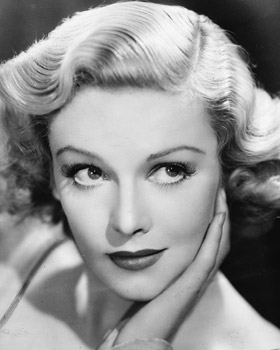
Madeleine Carroll

FeaturedMadeleine Carroll

Madeleine Carroll is known as the original ‘Hitchcock blonde.’ She blazed a trail for British female actors into Hollywood, where she had a successful career from the mid-1930s. Prior to her move, though, she made over twenty films in Britain. Carroll starred in some major titles opposite the likes of Brian Aherne, Miles Mander, and Ivor Novello. She was one of the most popular British film stars of the period.[1] This film success led to her being the world’s highest-paid actress by the end of the 1930s.

Unlike most other major stars of the period, and indeed, unlike most of the British population at the time, Madeleine Carroll attended university and obtained a bachelor’s degree in French from the University of Birmingham in 1926. Her mother was French, and after completing her degree Madeleine worked as a French teacher in Hove, on the English south coast. A career in school teaching was an extremely common route for women graduates in the interwar period.[2] However, during her time in Birmingham, Carroll had also engaged in the university’s drama club.

Shortly after graduating, she gave up the teaching job and pursued an acting career, starting off in a touring company and landing a first film role shortly thereafter. Her first proper leading role in a film was in the 1928 feature The First Born, directed by Miles Mander who also played the male lead. Carroll was cast as the female lead, playing wife to Mander’s character Sir Hugo Boycott. The script was co-written by Alma Reville, Alfred Hitchcock’s wife.

The First Born is a melodrama that provided a meaty role for Carroll. It is a marital drama about betrayal, illegitimate children, and deception. It opened the doors for other leading roles, such as in the 1929 film Atlantic. This was one of the earliest film adaptations of the Titanic disaster, and released as a very early sound film with French and German versions released simultaneously. It includes a particularly haunting scene at the very end of the film, when the audience can hear (but not see) the drowning of the hundreds of second- and third-class passengers who did not make it into the lifeboats.

After these two heavy, dramatic roles, Carroll starred in a Victor Saville-directed spy film, The W Plan, in which Brian Aherne played the lead. She followed this up with a supporting role in the Basil Dean-directed moral drama Escape!, a part in the Maurice Elvey-directed comedy School for Scandal and the female lead part in the drama The Kissing Cup Race, directed by Castleton Knight. As is clear from this list, Carroll was in constant demand during the late 1920s and early 1930s, and she was able to work with some of the biggest British directors of the period and work in a range of film genres.

She worked with Miles Mander again in 1931’s Fascination, this time playing the ‘other woman’ who tries to break up a happy couple. In 1933, she made another war film with Victor Saville, I Was a Spy, in which she played a nurse at the front who finds herself emotionally compromised whilst passing information back to the British authorities. Her co-star was Conrad Veidt, one of the biggest stars in British and German cinema of the time. In 1935 Saville directed her again, this time in the costume drama The Dictator. Set in 18th-century Denmark, Carroll plays Queen Caroline Mathilde, with Emlyn Williams starring as her husband, the King. It dealt with the real-life scandal of an affair between the Queen and the royal doctor, a story which was given an outing on the big screen as recently as 2012.

After The Dictator, Carroll made the film for which she is probably still most famous, and the one that launched her into international stardom: The 39 Steps, directed by Alfred Hitchcock. Playing opposite Robert Donat as Hannay, Carroll stars as Pamela. Hannay is the classic Hitchcock hero – a man falsely accused who must simultaneously go on the run and try to clear his name. He meets Pamela on the train up to Scotland as he is fleeing London, and immediately coerces her into helping him. Although initially unwilling, Pamela eventually believes Hannay’s claims to innocence.

Although her part in The 39 Steps is the one for which Carroll is most likely to be remembered, she was already a fully established film star when she made the film. It was Donat who was the less experienced, with only 5 film credits to his name prior to The 39 Steps. The film was well-received upon its release and also marked the start of a first career peak for Hitchcock, who went on to direct The Lady Vanishes and Rebecca in the following few years.

After The 39 Steps, Carroll moved to Hollywood and worked for Paramount studios. She continued to make films at the same rate, starring in 10 films before the outbreak of the Second World War – the last of which, My Son, My Son! again saw her star opposite Brian Aherne. During the war she used her language skills to facilitate between the US Army and the French Resistance. After her sister was killed in the London Blitz, Carroll stopped acting and worked as a war nurse in Italy during the later stages of the war. After the war, she only returned to the screen a handful of times, after which Madeleine Carroll opted for an early retirement and spent most of her time with her family in the south of Europe.


[1] Jeffrey Richards (ed.), The Unknown 1930s: An alternative history of the British cinema, 1929-1939 (London: I.B. Tauris, 1998), p. 18

[2] Mo Moulton, The Mutual Appreciation Society: How Dorothy L. Sayers and her Oxford circle remade the world for women (London: Corsair, 2020), p. 70

Tennis in interwar Britain

FeaturedTennis in interwar Britain

Early summer is upon us and that means, in London, that the Championships of the All English Lawn Tennis and Croquet Club, aka. Wimbledon, is in full swing. The tournament was founded in 1877 and was as significant and popular a sporting event in the interwar period as it is today. As this newsreel footage from the 1928 Men Singles Final (won by René Lacoste) shows, although the players wore shirts and long trousers, the quality and pace of the game were well-developed.

Tennis originated as a lawn sport played at country houses by the upper classes. By the interwar period, however, the game had popularised and, to a certain extent, democratised.[i] Although it never reached the mass appeal of football, public tennis courts became increasingly available and numbered around 800 in London at the start of the 1930s. Suburban tennis clubs also facilitated access to the sport.[ii] And, unlike other sports, tennis was equally accessible for women as it was for men. The spectator crowd at Wimbledon in the footage embedded above is mixed. Female professional tennis players of the period, such as the French Suzanne Lenglen and the American Helen Wills, attained great fame. At the amateur level, tennis clubs were considered appropriate spaces for middle-class men and women to mix and potentially find a life partner.[iii]

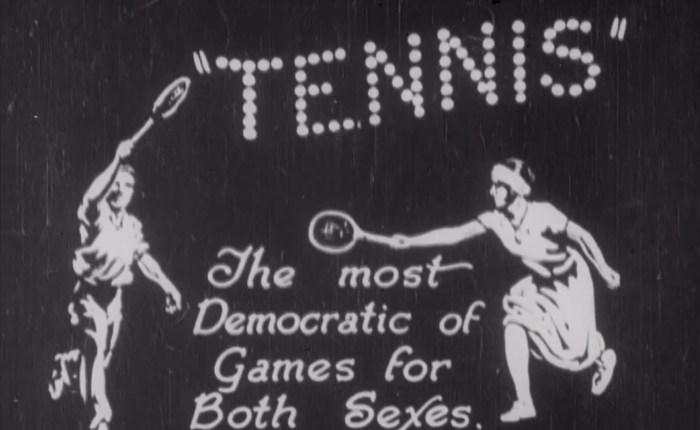
The 1924 instructional film ‘Tennis: The Most Democratic of Games for Both Sexes’ foregrounds the equal access women and men had to the game in its title. The twelve minute silent film opens with an intertitle warning the viewer that ‘If you really wish to play tennis, Don’t aimlessly knock a ball about for practice – Get taught early – Faults – like trouble – come easily.’ This insistence on hands-on teaching seems to rather undermine the purpose of the film! The opening shot is of a family group in a garden setting, with one of the women removing frames from tennis rackets and handing them out to various children. All are dressed in light-coloured clothing and mostly in short sleeves, implying that it is a summer’s day. The children then move to a tennis court elsewhere in the garden, where they demonstrate some basic techniques.

The film then introduces two professional (male) tennis players, Charles Read and Charles Hierons. In the next, most substantial, segment of the film, Read and Hierons demonstrate various tennis techniques. Here the film makes liberal use of slow-motion to allow the viewer to understand the players’ movements. Slow-motion was not often used in films of this period (in fact, comedy films tended to speed up action rather than slow it down) but its use here is seamless and sensible. The demonstration shots are interspersed with intertitles providing more explanation. Read and Hierons appear to be playing on an inner-city court, perhaps one of the public tennis courts so recently introduced in London at this time.

After this extensive segment, some shots of Helen Wills in action at a championship are included, presumably to demonstrate the ‘democratic’ nature of the sport. The film ends with a segment of a young girl, identified as ‘Betty’, playing against an unseen opponent in a private court. The focus is on her ‘beautiful footwork’, with some of the shots focusing only on her legs below the knees. This adds an odd tone of potential titillation to this supposedly instructional film, further problematised by Betty’s young age.

Throughout the interwar period, professional tennis continued to receive regular attention in newsreels, even if Britain’s successes on the international tennis stage were limited.[iv] Despite the sport’s democratisation, it continued to be endorsed by the upper classes too, culminating in the Duke of York (later King George VI) playing in the men’s doubles at the 1926 Wimbledon tournament. Although the Duke was of course not a professional player, he was able to enter because his doubles partner, Wing Commander Sir Louis Greig, qualified for Wimbledon because he was the RAF tennis champion. The couple was soundly defeated in the first round: 6-1, 6-3, 6-2.


[i] Joyce Kay, ‘Grass Roots: the Development of Tennis in Britain, 1918-1978’, The International Journal of the History of Sport, vol. 29, issue 18 (2012), p. 2534

[ii] John H. Goldthorpe, ‘Class and status in interwar England: Current issues in the light of a historical case’, The British Journal of Sociology, vol. 72, no. 2 (2021), p. 246

[iii] Ibid.

[iv] Robert J. Lake and Simon J. Eaves, ‘Defeat, Decline and Disconnect: A Critical Analysis of Attempted Reform in British Tennis during the Inter-war Period’, Sport in History, vol. 37, issue 1 (2017)