Service for Ladies (1932)

FeaturedService for Ladies (1932)

Sir Alexander Korda was one of the most prominent film producers in Britain in the 1930s. Together with his brothers Zoltan and Vincent, who both also worked in the industry, Alexander permanently changed the British film industry. The brothers were born in Hungary in the final years of the 19th century, and Alexander Korda started his film career in that country immediately after the end of the First World War. He then worked as a film producer and director in Germany and Austria in the 1920s, as well as directing some films in Hollywood as the industry transitioned to sound film. From 1930 onwards, Korda was based in London, and he directed his first British feature in 1932. Service for Ladies, or Reserved for Ladies as the film was also known, came a year before Korda’s monster hit The Private Life of Henry VIII. The success of the latter has somewhat overshadowed the earlier film, although it is increasingly shown and discussed again.Service for Ladies is based on a book by Hungarian writer Ernest Vajda, which had previously been translated to the screen in a 1927 silent film also called Service for Ladies, and starring Hollywood legend Adolphe Menjou in the main role. The New York Times noted upon its release that this film’s success largely depended on ‘Mr. Menjou’s ability to hold attention with his role.’ There was some nervousness, then, when Korda decided to cast Leslie Howard as Menjou’s replacement in the sound film. Howard’s father was also Hungarian-Jewish, which gave him a connection with Korda. Howard, however, specialised in playing ‘perfect English gentlemen’, and the role in Service for Ladies required him to convincingly play a head waiter in a London restaurant. Howard and Korda duly conducted field research in London’s real hotel restaurants before shooting.Service for Ladies is a light, romantic comedy centring on the tried-and-tested trope of identity mix-ups, in this case with a side-serving of class anxieties. As Max Tracey, Howard is the exceptional head waiter in a high-end London hotel; he ensures dinners are delivered to perfection, and regular guests depend on his advice. With some of the married female guests, such as the Countess Ricardi (played by Benita Hume), Max’s attentive service covers rather more than just the dinner service. Despite his excellent reputation, Max never forgets the inferior social position he holds in relation to the hotel guests.When he sees the daughter of a wealthy South-African businessman, Sylvia Robertson, who is staying in the hotel, Max falls head over heels in love. The first few times he interacts with Sylvia, it is outside the hotel and she does not know Max is a waiter. He hides the truth from her, and joins her and her father on a skiing trip to the Alps. Once at the hotel, the king of an unidentified European nation also visits on holiday, supposedly ‘incognito.’ Max is on friendly terms with the king because the latter frequently visits the hotel in which Max works. Max’s previous caginess about his identity and source of wealth, coupled with his apparently intimate relationship with the king, make everyone in the hotel (including Sylvia) assume Max is the heir to the throne and the king is objecting to a potential match with Sylvia.

Sylvia (Elizabeth Allan), Max (Leslie Howard), and a gigantic snowman in Service for Ladies

At this point, misunderstandings between the couple pile up. Sylvia gets engaged to another suitor to spite Max and forces Max to arrange her engagement party in his hotel. Eventually, after intervention by the king and Sylvia’s father, all complications are resolved, and the happy couple are reunited.

The scenes in the London hotel restaurant, towards the start of the film, give the viewer a sense of the energy, tact and precision required by real-life waiters to ensure all high-profile, demanding guests had all their needs fulfilled. Hotels were about being seen as much as they were places to stay, and the film shows guests asking Max for the latest gossip on their fellow diners, which he discreetly provides. Yet at the heart of the film is the perceived lower status of hospitality work. Despite Max’s role as head waiter, the fact that he works in service is a great source of embarrassment to him, even towards Sylvia whose family is ‘new money’ and not aristocratic.

Once the action moves to the Alps, audiences are treated to some lovely vintage knitwear and a brief appearance of a young Merle Oberon (who would go on to marry Alexander Korda towards the end of the decade). Whilst all the young people in the hotel, including Sylvia, go out for skiing trips every day, Max constantly excuses himself; his different upbringing means he has not learnt to ski like the others have. As a guest in the hotel, Max becomes the subject of gossip, rather than being in control of it like he is when he is at work. Like the guests in the London hotel, the people in the ski resort favour wild assumptions about Max’s background over more pedestrian explanations.

Service for Ladies is a comedy that has withstood the test of time, and is still funny and watchable today – not a negligible feat given the quality of some British films of the 1930s. Although its premise is fantastic and its ending like that of a fairy-tale, at its core the film does reflect the class anxieties that existed in 1930s Britain. By casting the man, rather than the woman, as the potential ‘social climber’, Service for Ladies gives a different perspective than most interwar texts.


Julian Swift – The Chronicles of a Gigolo (1929)

Julian Swift – The Chronicles of a Gigolo (1929)

Today I am discussing a rather obscure melodramatic novel from 1929, which has not been re-issued since its first publication. The Chronicles of a Gigolo, written by actor and writer Arthur Applin under the pseudonym Julian Swift, is a roman-à-clef about the seedier side of London’s 1920s nightlife. The protagonist, Percy/Julian, is a gigolo – in interwar London a gigolo was a man whom women could pay to take them to nightclubs, dance with them, and generally entertain them. Undoubtedly that could also lead to paid-for sex, but in the Chronicles, Julian’s evenings with his clients end when he bids them goodnight in the hotel lobby or taxi.

The Chronicles of a Gigolo is a fairly sappy novel with a thin plot. Percy is an orphaned young man in training to become a lawyer, which he does not enjoy. One day he stumbled across the 43 club run by Mrs Meyrick in Gerrard Street.[1] He goes in and enjoys the crowd of professional dancers he finds there. He decides to ditch his legal training and become a gigolo, adopting the name Julian. Initially Julian is very successful; many rich women take him out to high-end clubs and pay him handsomely for his time. Julian falls in love with Babs, a young dancer who wants to go on the revue stage. Julian and Babs spend some months in France, living off his savings. Then Babs gets offered a role in a West End revue and she returns to London. Julian eventually follows her back to England but finds he has lost many of his clients in his absence. His relationship with Babs runs to ground and he struggles to support himself, behaving increasingly erratically. By the end of the novel, Babs has married her producer and has a child with him, whilst Julian has descended into poverty and illness. It is strongly implied he dies at the end of the novel.

Despite the broad-brush arc of a man rising from poverty to riches and then falling back into poverty again, Chronicles of a Gigolo gives a detailed account of the intricacies of London’s nightlife, as it was written by a real-life professional dancer. The book name-checks real-life clubs and places them in a hierarchy. Mrs Meyrick’s 43 club is the one Julian likes the best; he describes it as a “jolly room”.[2] Of the girls in the 43, he says “They looked jolly and laughed just as Mrs Meyrick had done and I soon discovered they were enjoying themselves, and I’d never seen girls enjoying themselves before.”[3] For Julian, the 43 is a democratic space, where everyone can be themselves:

Of course, at Mrs Meyrick’s and places like that, clothes don’t matter because people go mostly for fun and there are often more men than girls, and it’s the men who pay the girls to dance with them so the girls only dance with a boy pro. when they want to enjoy themselves.[4]

The downside of the 43, from a professional point of view, is that he is not able to make any money there. For that, he has to visit the more high-end clubs where his clients want to be seen. He mentions entertaining wives of MPs and aristocratic women. They go, for example, to the Orange-tree club on the Old Brompton Road:

The Orange-tree Club wasn’t a bit like the Forty Three. A long room with lots of pillars and little tables round it where everybody was in evening dress looking respectable and bored.[5]

[The 43] was full and everyone enjoying themselves – not a bit like the Orange-tree. I mean everyone there was very decorous and unnatural as if they were afraid if they let themselves go they would be peculiar, which if course they were.[6]

Yet despite the upper-class clubs being perceived as boring and artificial by Julian, they also hold an appeal for him. This becomes clear when one of his clients asks him to take her to the Kit-Cat Club on the Haymarket:

She suggested I should take her to the Kit-Cat. I did my best to hide my excitement – the Kit-Cat being one of the places I wanted to get into.[7]

This sentence lays bare the peculiar power dynamic between Julian and his clients. They ask him to ‘take them out’; yet he needs their wealth and social standing to be allowed into the venues where they want to go. The Chronicles of a Gigolo pays close attention to the artificiality of dressing up and ‘faking it until you make it’; Julian strongly advocates dressing as if you have money, to attract money. Yet no matter how much he dresses up, a venue such as the Kit-Cat remains too exclusive for him unless he is accompanied by a truly upper-class woman.

Advert for the Kit-Cat Club in Daily Telegraph, 21 December 1927

As the novel progresses, Julian’s career struggles are reflected in the struggles of the nightclubs themselves. Police raids on clubs become more frequent as the narrative progresses. Initially the raids are presented as a rite of passage for the customer and a badge of honour for a club:

Chez Victors Club was the jolliest place. It was getting quite high-class so they raided it. I was there and they took my name and address and I felt important.[8]

If a club has a high-profile clientele they are initially less likely to be raided, as the police and Home Office would not want to cause a big scandal.[9] Later on, rebranding a venue from a nightclub to a restaurant could help keep the police at bay.[10] This tactic, however, spelled bad news for the gigolo, who aimed to keep his entertaining costs as low as possible in order to maximise his profits.

It’s getting more difficult to earn a living as a professional dancer because the restaurants are taking the place of these clubs, and at a restaurant you must eat and drink a lot before you dance.[11]

More time spent eating and drinking meant less time for dancing, and it also required a bigger financial outlay to pay for the inevitable champagne and oysters. When Mrs Meyrick was sent to prison for bribing police officers in 1929, that further hastened the end of the brief golden age of nightclubs and gigolos. For Julian, the Home Office’s drive to close down nightclubs is misplaced: he describes it as “bigotry.”[12] Nevertheless, it is an unstoppable tide.

By the end of the novel, the free-spirited Babs has settled down for a conventional marriage with child; other professional dancers have found steady jobs, for example in Lyons restaurants.[13] Julian is unable and unwilling to trade in the wild democracy of the dancefloor of the 43 for a more respectable life. As the nightclubs disappear from London, so must he; but not before celebrating the brief window of possibility that nightclubs offered to those willing to seek adventure.


[1] For more on Mrs Meyrick and the 43, see Judith Walkowitz, Nights Out: Life in Cosmopolitan London (New Haven: Yale University Press, 2012), pp. 210-211

[2] Julian Swift, The Chronicles of a Gigolo (London: T Werner Laurie, 1929), p. 9

[3] Ibid., p. 10

[4] Ibid., p. 20

[5] Ibid., p. 28

[6] Ibid., p. 32

[7] Ibid., p. 34

[8] Ibid., p. 42

[9] Ibid., p. 43

[10] Ibid., p. 78

[11] Ibid. p. 206

[12] Ibid., p. 213

[13] Ibid., p. 242

J. Lyons and Co – Trocadero and Corner Houses

J. Lyons and Co – Trocadero and Corner Houses

A key pleasure for Londoners in the interwar period was going out for tea or a meal. ‘French-style’ restaurants had appeared in London in the final decades of the nineteenth century. Whilst these original restaurants remained popular, the interwar period saw a democratisation of the dining-out experience. A wider range of outlets catered to people of different backgrounds and with different amounts of disposable income. As more and more Londoners, including women, increased their earnings and got more leisure time, they were able to experience (temporary) luxury in one of the many restaurants, cafes, and teashops in the capital. The player that left one of the biggest marks on the hospitality industry in London between the wars was J. Lyons and Co.

Like other restaurants, Lyons started its business in the late nineteenth century: with a teashop in Piccadilly in 1894, and the opening of the Trocadero Restaurant on Shaftesbury Avenue two years later.[i] The teashop turned into a chain of shops in 1909. Three of these teashops were Corner Houses, big, multi-storey hospitality spaces which offered affordable snacks and drinks to a mass audience. The Corner Houses on Coventry Street in Soho and the Strand were opened in 1909 and 1915 respectively, but the third Corner House, on the corner of Oxford Street and Tottenham Court Road, opened in 1928.[ii] This attests to the continuing success and popularity of the Corner Houses throughout the interwar period.

Corner Houses worked on economies of scale: they had hundreds of seats each, employed hundreds of staff, and aimed to get as many covers a day as possible. You can get a sense of the bustle of a Lyons Corner House in Alfred Hitchcock’s Blackmail (1929). Near the start of the film, the heroine, Alice, and her boyfriend Frank, visit a Corner House after work. As soon as they walk into the building there is a crush of people around them; they struggle to get into the lift. Once they enter the spacious dining room, all the tables are taken. They are hurried along with every step, and only stay at the restaurant for a short while before leaving again. It is no coincidence that Alice has picked this location to meet her lover, ‘The Artist’ – the crowded room provides a perfect cover for a secret rendez-vous, and the Corner House is a democratic space that anyone can enter without difficulty. In real life, the Corner Houses also functioned as meeting spaces for marginalised groups, most notably for queer men.[iii]

Lyons operated a very different policy at the Trocadero restaurant. In some respects the Corner Houses and the Trocadero were very similar; both served hot meals, both catered to huge numbers of customers every day, and both sought to transport their diners to exotic locales through their interior decoration and design choices.[iv] But whereas the Corner Houses were explicitly marketed to a mass audience, the Trocadero restaurant had strict rules about who could enter the space and where they were allowed to go.

An internal “Memo to Superintendents and Reception Clerks” stipulated a number of rules on the handling of “Strange Ladies” – female customers not known to the staff. These rules were clearly intended to prevent prostitutes from entering the space and soliciting; the Trocadero was on the site of what used to be the ‘Argyll Subscription Rooms’, an entertainment venue notorious for the number of prostitutes that frequented it. In its efforts to distance itself from the site’s previous occupiers, the management of the Trocadero were asked to treat all “Strange Ladies” as potential disruptors:

For Luncheons. Strange Ladies to be placed at small tables round the Restaurant, the object being that in case of misbehaviour we can screen the table off.

For Dinners. Strange Ladies either in couples or alone are to be put at the small tables round the Blue Saloon Wall (When Saloon is closed round the Restaurant) the object being that in case of misbehaviour we can screen the table off.

For Suppers. Strange ladies are to be given the small tables in the Restaurant round the Wall, the object being that in case of misbehaviour we can screen the table off.

Grill Rooms. Strange Ladies either alone or in couples are to be placed at small tables round the small room, or (in the event of this being closed or full) at small tables in the Larger Room, the object being that in case of misbehaviour we can screen the table off.[v]

Clearly, the Trocadero restaurant was not intending to be an open and public space for female customers, who were rather expected to visit a Corner House instead. The gendered differences between the Trocadero and Corner Houses also extended to the waiting staff: all waiters at the Trocadero were male, whereas the Corner Houses had exclusively female waitresses, who came to be known as ‘Nippies’.

It was conventional in London that waiting staff in restaurants were male and waiting staff in teashops were female.[vi] Male waiting staff were perceived as similar to the butler or footman in a grand house; by attending a restaurant the (male) customer could experience something akin to what a gentleman in a country estate would experience. In the teashops, on the other hand, the female staff were appreciated for their speed, efficiency, and decorative function.

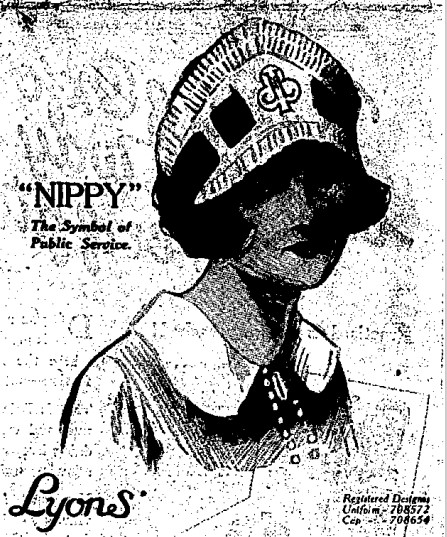
The Nippy grew into a cultural phenomenon in and of itself, to the point that she became a fictional character that both represented the Lyons brand and a host of positive feminine values. Internal guidance to female waiting staff placed a lot of emphasis on physical presentation: Nippies were required to have their hair “neat and tidy”; “teeth well cared for”; “cap correctly worn” and “no conspicuous use of make-up”.[vii] Lyons deliberately crafted this aspirational persona for its female staff and encouraged them to take pride in their femininity.[viii] In advertising for the brand, Nippy became the ‘Symbol of Public Service’.

Advert on front page of Daily Express, 14 April 1925

J. Lyons & Co. had a huge influence on the interwar London dining-out scene; there are countless references to its restaurants and Corner Shops in memoirs and fictional representations of this period. As this piece has shown, Lyons catered to two very different audiences through its restaurants and tea shops respectively. It is in the interwar period that these venues first reached their mass appeal, and the Nippy became established as a cultural reference point. For women, the choice was between conforming to a symbol of feminine perfection or risking being labelled as a prostitute. The venues lasted well beyond this period: the last Corner House closed in 1977 and the Trocadero remained active as an entertainment venue until 2011.


[i] Judith Walkowitz, Nights Out: Life in Cosmopolitan London (New Haven: Yale University Press, 2012), p. 197

[ii] Ibid., p. 198

[iii] Matt Houlbrook, ‘The Man with the Powder Puff’ in Interwar London’ The Historical Journal, Vol. 50, No. 1 (Mar., 2007), 145-171 (149)

[iv] Walkowitz, Nights Out, pp. 198-199

[v] London Metropolitan Archives: ACC 3527/186 – Rules and regulations for Trocadero Restaurant staff (indexed)

[vi] Rosalind Eyben, ‘The Moustache Makes Him More of a Man’: Waiters’ Masculinity Struggles, 1890–1910’, History Workshop Journal 87 (2009), 188-210 (197)

[vii] London Metropolitan Archives: ACC/3527/201/A ‘The Perfect Nippy’

[viii] Walkowitz, Nights Out, p. 205