The Abdication Crisis

As the UK getting used to a new monarch on the throne, let’s cast our minds back to the events of 1936, when an abdication crisis ultimately resulted in the confirmation of Prince Albert, the second son of King George V, as King George VI.

Prior to 1936, and throughout the 1920s, George V’s eldest son Edward, Prince of Wales, was an enormously popular figure. This blog has previously touched on his popularity as a newsreel subject and his ability to kick off new fashion trends. Edward was often seen in London’s nightlife and also travelled a great deal, both for work and for pleasure. He had the reputation of a playboy and remained unmarried in 1936, when he was already 42 years of age. His brother George, by contrast, was a year younger than him but had married at 28 and fathered two children (Elizabeth and Margaret) by the time he was 35.

As is customary in Britain, George V reigned until his death and the eldest child [at the time, the eldest son] is declared monarch immediately afterwards. A formal coronation ceremony follows some months later. When George V passed away in January 1936 after a long period of declining ill-health, Edward was duly proclaimed King. The abdication crisis ensued when, in the autumn of 1936, Edward declared his intention to marry the American divorcée Wallis Simpson.

Wallis’ nationality was already something that spoke against her in a country that was, at the time, concerned and suspicious of American cultural influences through popular culture. The popularity of Hollywood films and dance bands was blamed for a host of cultural ills. But Wallis’ past relationships were the real obstacle to the match. Edward had first met her as early as 1931 and she did not file for a divorce from Mr Simpson until October 1936, making it abundantly clear that her relationship with Edward had started during her marriage.

Although one of the key reasons that the Church of England was created was famously to allow Henry VIII to divorce Catherine of Aragon, divorce was a significant social taboo in interwar Britain. Divorce laws were eased in the 1920s but the social stigma on divorce was still significant – and not helped by the gleeful reporting of high-profile divorce cases in a tabloid press keen to increase its readership. The key objection which Prime Minister Stanley Baldwin therefore proposed against Edward’s marriage to Wallis was that ‘the people’ would not accept her as Queen. After several months of legal tussle between Edward and the government, it became clear that a marriage between Edward and Wallis would not be accepted as long as he was on the throne. In December 1936, Edward formally abdicated and his brother Albert was proclaimed King, styling himself as George VI. Edward was never officially coronated; his coronation had been planned for May 1937; a date eventually used for the coronation of George VI instead.

One of the aspects of the abdication crisis that is difficult for a modern audience to comprehend is how absolutely the British newspapers refused to print anything about it until early December 1936. As this blog has frequently noted, newspapers were extremely popular and influential during the interwar period, and in the mid-1930s popular newspapers in particular were constantly trying to increase their circulation figures. A royal scandal of this magnitude would appear to be excellent content to draw in readers. However, the respect for the monarchy was such that newspaper proprietors, who were fully aware of Edward’s relationship with Wallis, agreed a media blackout.

Such a thing would of course be completely impossible in our current digital media landscape, but even back in 1936 London newsvendors sold international publications, and journalists in other countries had no scruples about reporting the story. American outlets in particular splashed on the story, which from their perspective could be told as a fairy tale of an American commoner falling in love with the (future) King of Britain. The overwhelming power of the British press, however, ensured that its refusal to print the details for months meant that the majority of the British public remained equally unaware. The media blackout during the crisis exemplifies the power of newspaper proprietors during the interwar period, and the very close relationships between the newspapers and the corridors of power – although it must be pointed out that this blackout was voluntary and press-driven, and not imposed by the government or the Royal household.

Shortly after Edward’s abdication, Britain was introduced to Mass Observation, an (eventually) influential research organisation which aimed to understand modern society by asking ‘normal’ people to share their observations on everyday life and historical events.1 After its founding in January 1937, its first published work included a collection of ordinary peoples’ views on the Abdication Crisis. Mass Observation in a way seems to react against the media blackout initially surrounding the abdication. While powerful newspaper proprietors decided to withhold the news from the public, Mass Observation gave the public at large an opportunity to respond to the crisis and give their opinions on it.

The abdication crisis was a pivotal cultural moment in interwar Britain, one that laid bare some of the machinations of the powerful news media and its close links with those in power; but which also facilitated the emergence of a more democratic way of understanding everyday culture. Although Edward’s decision to choose marriage over a royal appointment was a personal one, it had significant social ramifications.

  1. Frank Mort, ‘Love in a Cold Climate: Letters, Public Opinion and Monarchy in the 1936 Abdication Crisis’, Twentieth Century British History, Vol. 25, no. 1 (2014), p. 32
The Prince of Wales and the interwar craze for Fair Isle jumpers

The Prince of Wales and the interwar craze for Fair Isle jumpers

A few years ago I had the privilege of visiting Shetland, a group of islands approximately 170 kilometres north of mainland Scotland. This northernmost part of the UK has a strong heritage in textile creation, particularly in knitted lace and Fair Isle jumpers. It’s the latter garments this post will discuss, as the interwar period saw this type of knitwear absolutely explode in popularity in England. What I learnt during my visit to the (excellent) Shetland Museum and Archives in Lerwick was that this sudden popular appeal of Fair Isle knitwear had a big impact on the financial independence of Shetland women.

Fair Isle itself is a small island located to the south of the main Shetland archipelago; in 2020 it had a population of 65 individuals and is only accessible by intermittent ferry and flight services. It is here that a new style of knitting was developed in the 19th century, one characterised by bold use of colour and patterns. The practice was soon adopted across the Shetland islands[1], initially to produce accessories such as caps and stockings. A true Fair Isle garment uses a limited number of colours, usually four or five. Only two colours are used in each row of knitting, which are built up into stars, crosses, zig zags, and other motifs.

The patterns and colours used in Fair Isle knitting make it a time-consuming and expensive way to produce garments. Shetland women (obviously) also produced more standard knitting items such as jumpers and stockings, either for use within their own household or to trade. From the middle of the 19th century until the 1920s, Shetland women were dependent on something called the Truck System, “a trading arrangement which involved payment in kind.” Rather than being able to sell their knitwear to shops and traders for money, instead women were obliged to trade the garments for things like coffee, tea and sugar. Women had little control over how much they would get traded for each garment; and whilst it was no doubt useful to have staple foods for their household, the Truck System meant that women were not able to put aside and save money for longer term investments.

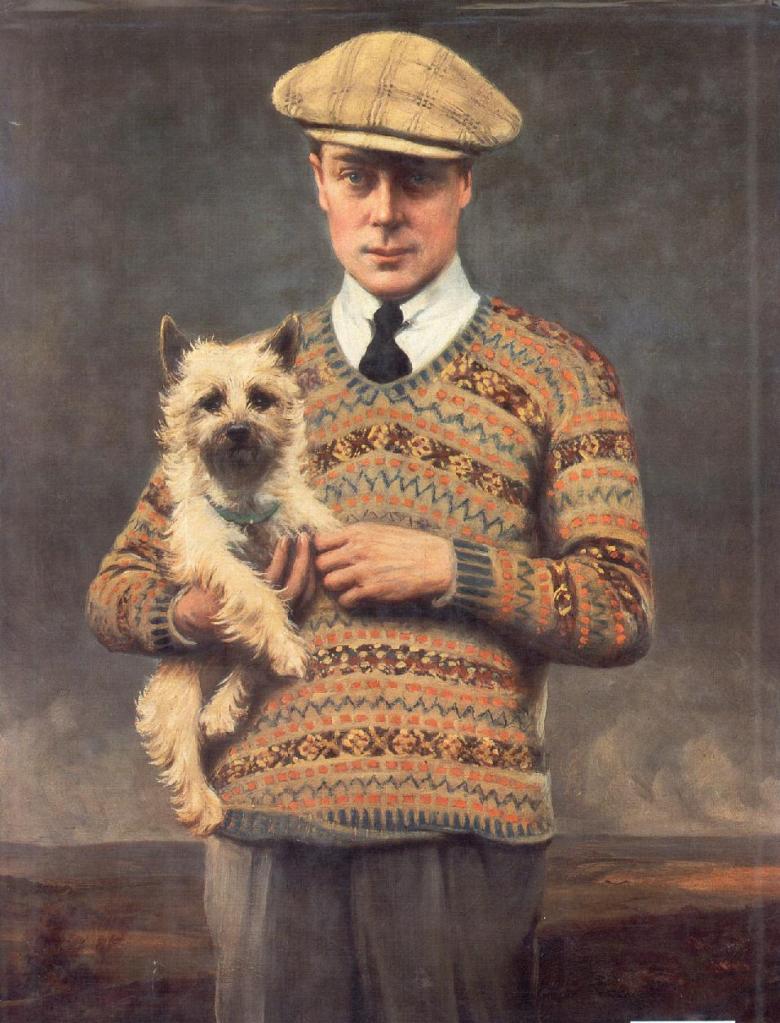
By the end of the First World War, women on Fair Isle and the rest of Shetland had started producing full jumpers in the Fair Isle technique. Then, in a stroke of marketing genius, Shetland hosiery dealer James A Smith gifted a Fair Isle jumper to Edward, Prince of Wales. The Prince of Wales was an immensely popular society figure and bona fide style icon.[2] He decided to wear the Fair Isle jumper whilst sitting for a portrait painted by John St. Helier Lander. In line with the increased importance of mass-communication and consumption of this period, the portrait was reproduced by the Illustrated London News.

Suddenly, Fair Isle jumpers were the must-have fashion item for fashion-conscious socialites. Although jumpers had initially only been made for men, parallel developments in women’s fashion that favoured relaxed fits and dropped waistlines meant that soon, women were also keen to have their own Fair Isle jumpers. This craze for genuine Fair Isle products inevitably had consequences for the women making these garments. Where they had previously been dependent on the Shetland merchants and traders to take their stock, now women were able to bypass the Truck System and liaise directly with wealthy English buyers. As these buyers sat outside the local economy, they naturally paid in cash which allowed the Shetland women greater financial independence. Eventually the Truck System collapsed completely by the Second World War.

Of course, buying a handmade Fair Isle garment from Shetland was still prohibitively expensive for most people. Very quickly, the exclusive garment worn by the Prince of Wales spawned mass-produced knitting patterns which allowed amateur knitters to make their own garments at home. These remained popular into the 1940s, and Fair Isle garments more generally have become a wardrobe staple for period dramas set in this period. Fair Isle jumpers and vests have periodically regained popularity ever since, and there continue to be knitwear designers on Shetland who are evolving the style. The original 1920s jumper that started it all has not been forgotten; you can purchase an exact replica of the Prince of Wales’ jumper from various Shetland merchants, such as here and here.


[1] Although to this day, only garments actually produced on the island of Fair Isle can carry the Fair Isle trademark

[2] He popularised amongst other things: a particular type of collar (still known as the Prince of Wales collar); a particular way of tying ones tie; the Prince of Wales check motif and plus-fours trousers

The King and Queen go to the Movies

The King and Queen go to the Movies

The 1920s were a turbulent time for Britain, both at home and abroad. The decade saw the beginning of the end of the British Empire, as Ireland and Egypt gained a level of independence in 1922. Throughout the 1920s popular support for independence grew in India, with Ghandi’s Non-Cooperation Movement founded in 1920. At home, as in the rest of Europe, ideological and extremist political factions gained support. The British imperial identity was clearly under threat during this period.

The Royal Family, as the figureheads of this imperial identity, worked hard to reaffirm conservative values and traditions and bolster a sense of national cohesion. They used cinema as one of the ways in which to promote the Empire and their own role in maintaining it. In the 1920s the King, Queen and Prince of Wales interacted with cinema both as consumers and as subjects of films. By engaging with cinema, the Royal Family both shared in a common activity which appeared to bind them together with the general public; and set themselves apart as extraordinary figures whose importance enabled them to appear on the silver screen.

The Prince of Wales was a subject of films that were made of his various Tours of the Empire which he undertook in the 1920s. He visited New Zealand in 1921, India in 1921-22, South America in 1924 and South Africa in 1925. These tours were routinely filmed, and the films were screened in British cinemas. At their initial release the films usually premiered at the Marble Arch Pavilion and the Stoll Picture Theatre on the Kingsway, before being distributed more widely. On 12 May 1925 more than half of The Times’ regular ‘The Film World’ column is taken up by a detailed description of Part 1 of the Prince’s Tour of Africa film, which gives an indication of the importance these films held at least for the Empire-minded Times.[1]

These Tour films placed the Prince of Wales as inextricably connected with the Empire, in the popular imagination. For the general public, the Prince was frequently visible as visiting all the corners of the Empire, reasserting his Royal authority over citizens across the globe. The images and intertitles of the films show how the texts consciously stress the coherence and common experience of Empire. In the newsreel summary of the Prince’s Tour of South America, when he visits a group of war veterans, the intertitle confidently states that ‘There are few cities under the sun that cannot raise a muster of British ex-servicemen.’ Empire here is emblematised in the image of the war veteran, who risked his life and health in order to maintain the integrity of said Empire.

Apart from the Prince of Wales’ tours, the Royal Family was also subject of a number of feature length films. In 1922 Cecil Hepworth produced Through Three Reigns, a compilation film which consists of footage of the Royal Family between 1897 and 1911, as well as extracts from actualities and other early cinema footage. Hepworth updated his efforts in 1929 with Royal Remembrances, which was also a compilation of footage of the Royal Family but this time the most recent footage was of 1929.

On 25 September 1922 the King and Queen asked for a special ‘command’ performance of Through Three Reigns at Balmoral Castle. This event was widely reported in the press.[2] The Royal couple invited 200 guests, including their tenants and servants, to attend the screening where they effectively watched their own family history. Shown in conjunction with Through Three Reigns – and different newspapers give different weight to this – was Nanook of the North, the ground-breaking Inuit documentary made by Brit Robert Flaherty. In one evening, the King and Queen watched a film that reasserts the significance of the Royal Family, and a film which demonstrates the technological and geographical advancements of the British Empire. This was the third of such ‘command’ performances that year – at an earlier screening at Windsor Castle the King and Queen had asked for the Prince of Wales Tour of India film.

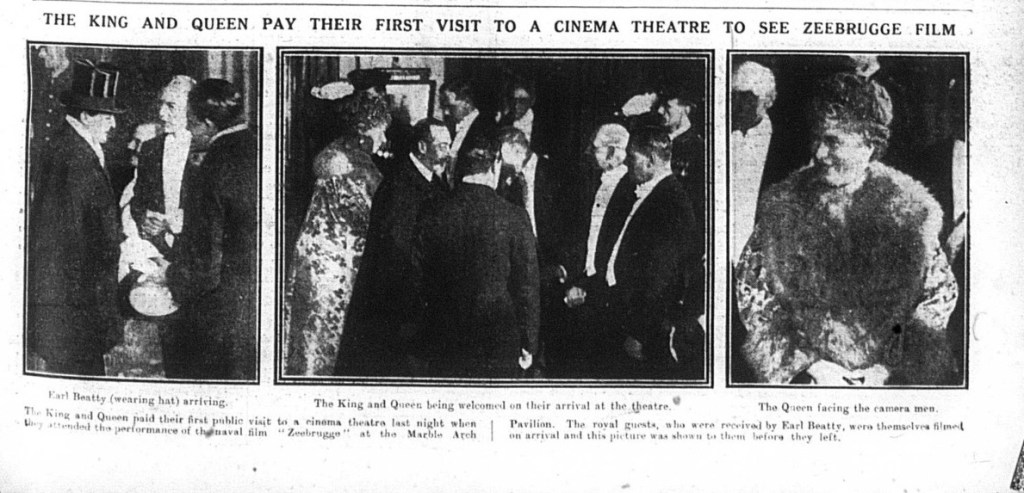
The King and Queen’s first public visit to a cinema came two years later, in November 1924 on the eve of Armistice Day. The occasion was a charity screening to raise money for the newly formed British Legion. The royal couple saw the non-fiction film Zeebrugge, which told the story of the British army’s attempt to close off the Belgian port of Zeebrugge during World War One. Again the event was covered extensively in the press.[3] Crowds cheered the Royal Couple as they arrived at the Marble Arch Pavilion and were shown to the Royal Box which was constructed for the occasion. Three commanders who had received Victoria Crosses for their bravery during the Zeebrugge Raid were also in the audience.

Photos in the Daily Mirror of the Royal visit to the cinema. Daily Mirror, 11 November 1924, front page

The Daily Telegraph gave a detailed report of all the aristocrats who attended the screening. The cinema space, normally open to audiences of all backgrounds, on this occasion became a much more exclusive space. It seems that the King and Queen could endorse cinema, as long as cinema related to serious and inoffensive topics –and the films they viewed were British productions, of course. The Royal’s support of cinema underscored the Royal Family’s values: of course the King and Queen saw films like everyone else, but only those that promoted the national identity of their country, and those that would not cause offence to any of their subjects.

During the visit to the Marble Arch the Royal Family also became the subject of a novel technological experiment: their arrival at the cinema was filmed, and while they were watching Zeebrugge the film was developed, and played back to the audience at the end of the evening. The Royals became subject of a film which they later consumed as an audience. This circularity was also demonstrated in the private Royal screenings in 1922: one of the topics that the Royal family could watch without risk of controversy was – the Royal family.

By the end of the 20s, film had become a recognised medium to promote empire, either directly through ‘educational films’ or indirectly by using cinema screenings to raise money for charities with Royal patronage. In this decade, the Royal family had gotten involved in the cinema business, and started using it as a means of increasing their popularity and profile, and of reaffirming discourse on empire and nationalism. Although the cinema could be a democratic space, the Royal Family’s interactions with it were carefully constructed. This way, they cleared the way for later generations of Royals to use popular entertainment to maintain the ‘common-sense’ status quo of monarchy.

Through Three Reigns is available to watch for free on the BFI Player (UK only)


[1] ‘The Film World’, The Times, 12 May 1925, p. 14

[2] ‘The King Sees Himself’, Daily Express, 26 September 1922, p. 7; ‘Royal Family Film’, Daily Mail, 26 September 1922, p.6; ‘Films at Balmoral Castle’, Daily Telegraph, 26 September 1922, p. 12; ‘Royal Ballroom Cinema’, Daily Mirror, 26 September 1922, p. 2

[3] ‘King and Queen at the Cinema Theatre’, Daily Telegraph, 11 November 1924, p. 11; ‘King and Queen See Zeebrugge Film’, Daily Mirror, 11 November 1924, p. 3; ‘The King & Queen Filmed’, Daily Mail, 11 November 1924, p. 7