Night Alone (1938)

Night Alone (1938)

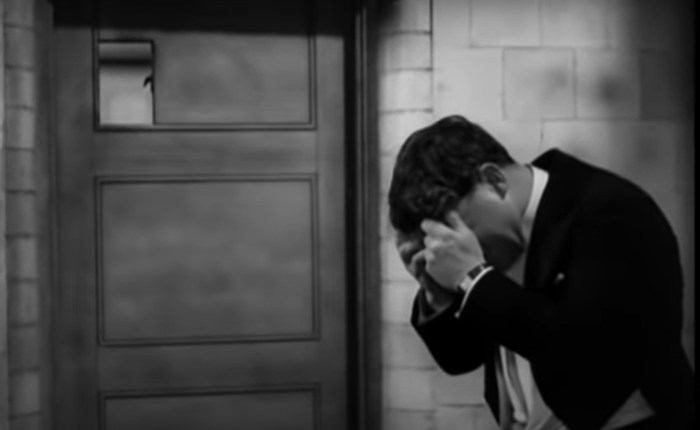
The 69 comedies produced in Britain in 1938 include two George Formby vehicles (I see Ice! and It’s in the Air), Break the News starring Jack Buchanan and Maurice Chevalier, and the marital comedy Night Alone. With a modest run-time of one hour and 16 minutes, the film nevertheless manages to combine a comedy about misunderstandings between husband and wife with a sub-plot involving the international smuggling of fraudulent banknotes.

By the tail end of the 1930s, the British film industry was steadily producing upwards of 150 films a year, and the majority of them were comedies. Comedy is more culturally specific than crime or melodrama, and cheaper to produce. Despite their increased output, British film studios could not usually hope to compete with high-budget Hollywood productions.

Welsh actor Emlyn Williams (who in the same year starred in the hard-boiled They Drive By Night) plays Charles Seaton, a solicitor who for seven years has been happily married to Barbara (Lesley Brook). Whilst on route to visit Barbara’s sister Vi, and see Vi’s daughter in a school play, Charles is unexpectedly detained by urgent business. This means the couple have to spend a night apart for the first time in seven years: Charles in a hotel and Barbara at Vi’s house. Despite Charles’ best intentions to stay in his room for a quiet night in, when he meets his old friend Tommy, he is persuaded to go to a nightclub in Villiers Street. Vi, at the same time, needles Barbara to the point that she starts doubting Charles’ loyalty.

A fair portion of the film is set in the nightclub that Charles, Tommy and two of Tommy’s friends, Gloria and Celia, visit. By 1938, the perceived threat of nightclubs to society had mellowed to the point that the film can joke about the club’s dubious legal status. When Tommy first tries to persuade Charles that he should come out, Charles tries to get out of it by arguing that he is not a member of the nightclub. ‘All you have to do is put a bob in a slot machine and you’re a member for life!’ scoffs Tommy. Towards the end of the film, when Tommy has to give an account of the party’s movements to a police officer, he immediately gives a fake name and address, on the assumption that he is part of a regular nightclub raid and will be let off with a warning.  

Tommy is presented as a bit dim-witted, but ultimately harmless and fun; he certainly knows how to behave in the nightclub. Charles inability to do the same, and his awkwardness in the pub, is played up for its comedic value. After his initial refusal to dance, he sits at the table with Celia, who appears to be in league with the nightclub staff. She first gestures over the cigarette seller. Charles agrees to buy a cigar, but baulks when he’s told it will cost 10 shillings. He then feels obliged to buy a packet of cigarettes instead, even though that is still overpriced at 4 shillings. Celia then waves the girl who sells chocolates, over. Charles again feels that decency compels him to buy some chocolates for Celia, even though they cost 25s and the girl does not give him any change.

Later in the evening, Charles shares a few dances with Gloria, with whom he gets on much better than with Celia. In his nervousness, Charles keeps drinking until he passes out. The other three manage to get him out of the club and into Gloria’s apartment, which is nearby. Celia and Tommy head out again, and Gloria is about to settle in on the couch when her American boyfriend unexpectedly shows up. He has just arrived by plane from Paris with a suitcase of forged banknotes, and the police are hot on his heels. Gloria and he escape the flat, leaving the drunk Charles snoring on the bed. When the police raid the flat shortly afterwards, they arrest Charles as an accomplice to the smuggling and put him in a cell for the rest of the night. The next morning, Charles has to try his hardest to get back to the hotel before Barbara and Vi come back. He manages to do so with seconds to spare and Barbara believes him when he says he’s not left the hotel all night: marital bliss is restored.

Charles has several dances with Gloria and the pair share light-hearted jokes (sample: Charles: ‘I’m not as young as I look’; Gloria: ‘You don’t look young at all’). It is not until Charles thinks he’s about to be arrested for forgery that he is concerned about Barbara finding out what has happened during the night. Night Alone presents Charles initial devotion to his wife and his quiet life as unnatural and comic. In line with other popular comedies of the time, such as the Aldwych farce A Cuckoo in the Nest, the narrative suggests that there is nothing wrong with spending a night in another woman’s flat, as long as your wife doesn’t find out about it.

Barbara, for her part, is admired by one of the other parents at the school play. Vi encourages her to enjoy a little flirtation on the grounds that Charles is bound to be doing the same. The ‘flirtation’ goes no further than an awkward, stilted conversation between Barbara and the man. Her refusal to engage with the man is part of her virtue as a wife, as is her blind belief that Charles would never do anything untoward. Barbara is constantly compared to Vi, whose cynicism and jokes about sex mark her out as coarse, in the same way Tommy is shown to be unreliable compared to Charles. Vi and Tommy are a lot of fun to watch but Night Alone makes it clear that the reward of a stable marriage with trust and companionship is worth more than short-term fun and entertainment.

They Drive By Night (1938)

Towards the end of the interwar period, Warner Brothers’ British arm produced the thriller They Drive by Night, directed by Arthur Woods. This should not be confused with the 1940 American film of the same title, starring George Raft and Ida Lupino; although both films make reference to the long-distance lorry driving community, which is what their titles also refer to. Woods was still only in his early thirties when he directed They Drive By Night, but he’d already had a long career in the industry as a director (Radio Parade of 1935; Music Hath Charms) and screenwriter (Red Wagon; I Spy). They Drive By Night is a thriller, different from the majority of Woods’ work which was in musical comedy. Woods died in 1944 in active combat after joining the RAF at the outbreak of the Second World War.

The hero of They Drive By Night is ‘Shorty’ Matthews, played by Emlyn Williams. A the start of the film Shorty has just been released from prison, and he goes to look up Alice, an old flame who works as a dance hostess. When he arrives at her lodgings, Alice is dead in her room. Shorty panics and goes on the run, by posing as a long-distance lorry driver. With the help of Molly, one of Alice’s friends and colleagues, he keeps out of the hands of the police and is eventually able to track down Alice’s real killer. The killer is an older man with an obsession for the ‘criminal mind’, who used to often dance with Alice at the dance hall.

Although They Drive By Night is based on a British novel and set in England, the influence of the American producers on the film is marked. It is a prime example of the kind of film that met the criteria of a ‘British’ film under the 1927 Cinematograph Films Act, without actually conveying the British cultural values the Act also aimed to promote. For example, the characters use Americanisms and slang throughout the film. When Shorty first gets out of prison, he meets a woman in a bar: she is ostentatiously chewing gum, and her hair is dyed platinum blonde. This was hardly the type of womanhood thought to reflect British values, but Shorty and the barman look after the woman appreciatively.

They Drive By Night’s overall narrative also espoused values that are not typical of British films of the period. The main characters are a convicted criminal and a dance hostess turned lorry girl. As Julia Laite has explored, the lorry driving community caused concern in 1930s Britain as some young women hitched rides from drivers. It was suggested that this type of hitchhiking sometimes involved an exchange of sexual favours, which in turn led to the spread of venereal diseases amongst the lorry driving community.[1] This in turn could lead, it was feared, to unsafe road situations when lorry drivers were ill, thus neatly linking the whole matter to ongoing road safety debates.

In They Drive By Night, however, there is no suggestion that Molly sleeps with the lorry drivers that help her, and the general practice of girls hitching rides is not condemned. When one of them tries to take advantage of her, she fights him off. This driver is presented as a ‘bad sort’ and not representative of the whole lorry driving community – a second driver whom Shorty spends some time with is shown to be faithful to his wife at home. Overall, the lorry driver scene is presented as a more positive male environment than Shorty’s criminal network back in London; but ultimately the film presents a heterosexual coupling as the only truly appropriate outcome for Shorty.

The police play only a minor part in They Drive By Night, and they are not instrumental to the capture of Alice’s killer. Unlike other thrillers of the late 1930s such as The Squeaker or The Dark Eyes of London, the police inspector in They Drive By Night is not one of the protagonists who leads on the resolution of the case. Indeed, they do not feature in the film’s climax, in which Shorty and Molly are at home with the killer and he nearly succeeds in murdering Molly, at all. They Drive By Night skips over the killer’s arrest and trial – the parts of the process in which the police would be involved – straight to the day of his execution.

The police primarily feature as a plot device that gives urgency to Shorty’s actions as the police chase him. Shorty’s criminal record is no impediment to his status as the film’s hero, but throughout the film characters encourage him to ‘go straight’. First the owner of his regular bar tells Shorty not to go back to his old criminal habits. Then Molly’s steadfast support of Shorty whilst he is on the run for the police persuades him to say goodbye to his criminal life for good and turn himself in voluntarily. Only then is he able to outwit the killer and save Molly’s life as a traditional hero would. The eighteen months Shorty has done in prison for his earlier crimes are sufficient to wipe these off his slate and allow him a fresh start; arguably a philosophy more reflective of American culture than British values. Molly, too, is presented as a suitable romantic partner despite her past as a lorry girl and her work as a dance hostess; two roles which were regularly connected with loose morals.

They Drive By Night seems to represent a transitional point in British interwar cinema, where American values had influenced British culture so much that they started to permeate British films. Despite the best efforts of the legislators, they were not able to stem the tide of American cultural influence on the domestic film industry. This influence went beyond hairstyles and mannerisms to a fundamental re-appraisal of morality and social values.

They Drive By Night is available to view on Youtube.


[1] Julia Laite, ‘Immoral Traffic: Mobility, Health, Labor, and the “Lorry Girl” in Mid-Twentieth-Century Britain’, Journal of British Studies (2013) 52:3, pp. 693-721 (693-4)

“The most suppressed novel ever published in England”

When we think of banned books in interwar Britain, it’s likely that two examples spring to mind: D.H. Lawrence’s Lady Chatterley’s Lover (1928) and Radclyffe Halls’ The Well of Loneliness (1928). Lawrence’s book, however, was not actually banned in Britain at the time of its publication. Rather, the book’s frank treatment of extramarital sex meant that Lawrence was not able to find a commercial publisher for it. Instead the book was printed in limited runs for private subscribers; and later, a censored, abridged version of the novel was circulated more widely. Chatterley’s reputation as ‘banned’ actually stems from the 1960 obscenity trial that was started when Penguin decided to print the full, unabridged version of the novel for the mass market.[1] Penguin won the landmark case from the government and the book has been available in its full form ever since.

The Well of Loneliness did get banned, but not until after it was released on the market. The book was published in July 1928; an obscenity trial was convened in November of the same year. The book’s description of lesbian (sexual) relationships was judged obscene and likely to corrupt readers’ minds; it was subsequently withdrawn from the British market but remained available through copies printed in Paris. The novel was re-printed in 1949 without incurring a further trial and it has been in print ever since.

There was, however, a third book at the end of the 1920s which fell victim to an obscenity trial. Unlike the two more famous examples cited above, Norah C James’s novel Sleeveless Errand was suppressed before it was even properly published. The book was printed and distributed to reviewers and bookshops in February 1929. The reviewer of the Morning Post was so alarmed by the novel’s contents, that he alerted the Home Office, who promptly moved to confiscate all distributed copies. The police went as far as visiting reviewers who had received a copy of the book, at home, and demand they hand their copies over.[2] This decisive action meant that not a single copy of the book remained in circulation in Britain when a magistrate officially confirmed its status as ‘obscene’ in March 1929.[3]

Like The Well of Loneliness, Sleeveless Errand was subsequently published in English through a French publishing house; but it has never been re-published by an British press. The copy in the British Library is one of the ‘French’ copies, the preface of which draws parallels with Hemingway’s Fiesta: The Sun Also Rises, which had been published in 1926 and was not considered obscene despite dealing with similar themes as Sleeveless Errand.

For all the noise around the novel’s supposed obscenity, what exactly is it about its contents that was considered so objectionable? Sleeveless Errand follows Paula and Bill, two young Londoners, over the period of around 36 hours. At the start of the novel, Paula is dumped by her lover Philip. They are not married, but have clearly had regular sex, which the novel does not condemn. After the break-up, Paula goes to a Lyons Corner House where she contemplates suicide. Bill happens to be put on the same table as her; he’s just walked in to his wife and his best friend in bed together, so he is also feeling very depressed.

The pair meet each other in their mutual low moods and Paula takes Bill to some of her regular night haunts, where they meet a group of Paula’s friends who drink and swear liberally. Eventually, Bill stays the night in Paula’s flat and they tell each other about their childhoods. The next morning Paula settles a will and the couple hire a car, with the plan to drive off a cliff near Brighton. On the way south they run into various other delays, which lead them to postpone the suicide until the next morning.

At night in their hotel, Paula gives Bill a firm talking-to and tells him he should go back to his wife and make amends; in Paula’s view, Bill’s wife’s infidelity is not an insurmountable hurdle as he still loves her. Bill agrees to go back and patch up his marriage. The novel ends with Paula driving up to the intended cliff-top and very calmly and deliberately driving the car off the cliff at sunrise.

Newspaper articles reporting on the magistrate court hearing that banned Sleeveless Errand drew attention to the novel’s language: ‘Specifically, the prosecution protested that the book took the name of God or Christ in vain over 60 times, as in the line, “For Christ’s sake give me a drink.”’[4] Ostensibly then, it is the novel’s language that led to its suppression. One may also consider the liberal discussions about sex, including Paula’s explicit affair at the novel’s opening and her views on monogamy: “It doesn’t necessarily mean the end of the world because a woman has intercourse with a man who’s not her husband.”[5]

Additionally, descriptions of the activities Paula and her friends get up to in nightclubs are decidedly seedy: “By now, nearly all the couples were sitting about the room embracing. Rathbone was what Hudson called “dry cleaning” a large good-looking girl whose name was Letty. She was the Haunt whore.”[6] According to Christine Grandy, heroes in interwar fiction “were distinguished by their fulfilment of the independent male breadwinner role, while the deviancy of the villain’s character lay in his inability or unwillingness to work for his wealth.”[7] None of the characters in Sleeveless Errand come anywhere near this hero template; Paula and her friends all appear to be independently wealthy and happy to drink their days away, and Bill has decided to abandon his breadwinner duties.

But Sleeveless Errand goes one step further. Not only do none of the characters conform to the pervasive discourse present in interwar fiction that presented contributing members of society as ‘good’; it argues that the post-War generation is fundamentally unable to contribute to society and that suicide is the moral choice. Throughout the novel, Paula repeatedly refers to the condition of her generation, those who came of age immediately after the end of the First World War.

[M]y generation of women is rotten to the core. Freedom came too quickly for us. We weren’t ready for it. We had no reserves with which to meet the deadly disappointment after the War of finding ourselves workless, and husbandless and useless.[8]

This is the horror at the core of Sleeveless Errand. Rather than celebrating the end of the war and the upward mobility allowed by modernity, white-collar jobs, suburbs and automobiles, instead it maintains that the war has ruined the mental health of the young women. Those women, who are pivotal to the continuation of British culture by settling into their roles as wives and mothers, are ‘rotten’ and unable to fulfil their duties to society. Instead, Paula uses that symbol of modernity and progress, the automobile, to engage in the most subversive act of all. It is the rational, considered approach to suicide, which Paula commits to calmly and unwaveringly, that emblematizes the book’s dangerous potential. At a time when suicide was usually recorded as occurring ‘while of unsound mind’, Sleeveless Errand dares to raise the possibility that the act can be a well-thought out, even responsible, choice. Allowing women to entertain that possibility could have affected the foundations of interwar British society beyond repair. Seen in that light, the Home Office’s swift and decisive oppression of the work becomes understandable.


[1] Christopher Hilliard, ‘“Is It a Book That You Would Even Wish Your Wife or Your Servants to Read?” Obscenity Law and the Politics of Reading in Modern England’, American Historical Review 118:3 (2013), 653-678, https://doi.org/10.1093/ahr/118.3.653

[2] Bill Harrison, ‘Censors, critics, and the suppression of Norah James’s Sleeveless Errand.’ Atenea, 3:1-2 (2013) 23-41 (25)

[3] Ibid., 26

[4] Ibid.

[5] Norah C James, Sleeveless Errand (Paris: Henry Babon & Jack Kahane, 1929), p. 54

[6] Ibid., p. 66

[7] Christine Grandy, Heroes and Happy Endings: class, gender, and nation in popular film and fiction in interwar Britain (Manchester: Manchester University Press, 2016), p. 3

[8] James, Sleeveless Errand, pp. 204-5

The Lodger (1927 and 1932)

This post is the second of a two-part mini series about Marie Belloc Lowndes’ story The Lodger. The first post considers the short story and novel Lowndes wrote. This post discusses two film adaptations of the book made in interwar Britain.

Marie Belloc Lowndes novel The Lodger, which appeared in 1913, was twice adapted for the screen during the British interwar period. The first, silent, adaptation was directed by Hitchcock in 1927; a sound remake directed by Maurice Elvey appeared five years later. Building on last week’s post which considered the differences between the short story version of The Lodger and the novelisation, this post unpicks the differences between the novel and the films.

The main difference between the novel and the screen adaptations is the identity of the Lodger. In the novel, there is no doubt that the lodger, Mr Sleuth, is responsible for a series of murders of women across London. The book’s tension is generated by the concern of Mr Sleuth’s landlady, Mrs Bunting, that the police are going to find out her lodger is a murderer, and how that will impact her own position. In both film versions of the story, the lodger is ultimately revealed to be a ‘good’ character, who is trailing the murderer in an attempt to stop him. Whilst Mrs Bunting in both films is equally as suspicious of her lodger, because he keeps leaving the house on nights that murders are committed, he is ultimately revealed to have honourable reasons for this.

Hitchcock has publicly claimed that this softer ending was foisted on him, and that he preferred the book’s ending. One presumes that the sound remake followed the same template for the sake of appeasing audiences familiar with the first film. Whilst the change makes the story feel a lot less sinister, it also aligns it more with expected film plots in which the main male character is revealed as a hero and suitable love interest for the female character.

This female character, Daisy (Mr Bunting’s daughter), is much more fleshed out in both films than she is in the book. The role is played by June Tripp in the first film, and by Elizabeth Allan in the second film. In the novel, Daisy is only present in the house every now and then, and she only meets Mr Sleuth face to face right at the book’s end. Generally, Daisy comes across as a bit dim and easily led. In a reflection of women’s increased participation in the workforce during the interwar years, Daisy has a job in both films. In the 1927 version, she is a mannequin for clothes – it is a job, but still one in which she is expected to be passive and decorative. In the 1932 film her job has changed to that of a telephone operator; in that capacity she overhears one of the murders as the victim desperately tries to ring for help.

In the films, Daisy plays a much more material part in the story, and her relationship with the Lodger is more substantial. In both films, she meets him at several points throughout the story and is on friendly terms with him. The fact that the lodger is played by film star and heartthrob Ivor Novello in both productions helps to present him as a viable love interest for Daisy. In the 1932 film, Daisy goes so far as to reject her original boyfriend in favour of the lodger. Again, these changes, which introduce a conventional young romance into the story, make the source material conform more closely to cinematic genre conventions.

Daisy’s original boyfriend, Joe Chandler in the book, also transforms between films. In the Hitchcock version, Joe is a police officer tasked with hunting down the murder, as he is in the novel. Like in the novel, Joe is oblivious to the possibility that the lodger is the murderer he is after – although of course unlike in the book, in the film the lodger is revealed to be innocent. Hitchcock also used the motif of the police officer who is blind to the guilt of those closest to him in his 1929 film Blackmail, so he perhaps appreciated the irony Lowndes built into the novel.

For the later film, Joe Chandler became John Martin, who is not a police officer but rather a tabloid reporter. By 1932 tabloid journalists had become much more socially visible as circulation figures of newspapers rapidly increased. In films, journalists were often presented as pseudo-detectives, collaborating with the police to investigate crimes. Perhaps it was felt that to change the Joe/John character from a police officer to a journalist was not too much of a change. John Martin is a ruthless reporter; at the start of the film, when Daisy witnesses a murder across the telephone line, he passes a picture of her on to his news desk without her consent. To her horror, Daisy finds the portrait printed on the paper’s front page the next day. John excuses this behaviour as he considers it his duty to present his bosses with all the scoops he gets. John’s inconsiderate behaviour paves the way for Daisy to ditch him for the lodger at the end of the film.

A final significant change between the novel and the 1932 film, specifically, is the identity of the lodger. In the book, Mr Sleuth is presented as a British gentleman, albeit one with possibly some foreign blood in him. In the Elvey film, the character is called Angeloff, and Novello plays him with a thick Ruritanian accent. The film’s resolution reveals that Angeloff has been on the trail of the murderer for many years, and that they have both travelled from a foreign country to Britain. Whereas the novel codes the criminal as domestic, the film explicitly presents him as a foreigner, who has wreaked havoc in Britain. The audience can rest assured that such horrific crimes would not be committed by a fellow citizen.

The Lodger enjoyed considerable popularity for decades after its release. However, throughout those years the story, which was originally closely modelled on the Jack the Ripper murders, developed to increasingly deviate from the original to reflect the changing times. The main element of the story, however – a man roaming around the streets at night killing young women – sadly remains relatable to audiences even to this day.

The Lodger (1911 and 1913) – Marie Belloc Lowndes

This post is the first of a two-part mini series about Marie Belloc Lowndes story The Lodger. This first post considers the short story and novel Lowndes wrote. The next post discusses two film adaptations of the book made in interwar Britain.

Today’s post discusses two texts which were written before the Great War, but which had a great cultural impact in interwar Britain due to their popularity. The writer Marie Belloc Lowndes published her short story ‘The Lodger’ in McClure’s Magazine in 1911.[1] She then expanded the story out into a full-length novel which was published by Methuen in 1913.

The Lodger’s main character is Mrs Bunting, a retired domestic servant who lives with her husband just off the Marylebone Road. Mr and Mrs Bunting are very poor at the start of the story, until a mysterious lodger, Mr Sleuth, rents a room with them. Mr Sleuth pays handsomely, but before long Mrs Bunting gets suspicious that he may be responsible for a spate of murders in the capital. Young women are found murdered at night, and these discoveries seem to coincide with Mr Sleuth going for night-time walks.

After a few weeks, Mr Bunting’s daughter Daisy comes to stay with the family, and Mrs Bunting gets increasingly concerned that Mr Sleuth will harm Daisy if he meets her. In the book-length version of the story, there is a fifth character: Joe Chandler, a young and ambitious police officer who is a friend of the family and who is courting Daisy. As the murders start piling up, Joe often pops into the house to give the Buntings updates on the police investigation, but he never once suspects that Mr Sleuth is the killer.

The short story puts the reader in the middle of events, and then relates the arrival of Mr Sleuth into the Bunting’s house through Mrs Bunting’s internal recollections. Daisy visits the house only very briefly in this version of the story. The novelisation presents the action chronologically, and allows much more time for Mrs Bunting’s suspicions and fears to develop. It also expands on Mr Bunting’s thirst for news, which is presented almost as an addiction.

At the start of the book, when the Buntings find themselves in extreme poverty, Mr Bunting is described as buying a paper with one of his last pennies ‘[w]ith an eagerness which was mingled with shame.’[2] Throughout the book he keeps buying papers, rushing out as soon as the newspaper boys come down the street, and sometimes not even waiting to go back inside before reading them. Yet despite Mr Bunting reading every column of newsprint on the case, he does not suspect Mr Sleuth to be the murderer until he physically bumps into him on a late-night stroll and finds his coat covered in blood. In The Lodger, the newspapers sensationalise the case and function as a potentially harmful distraction for the masses, rather than aiding with the resolution of the case.

The police, also, don’t have any grasp on who the murderer may be. This theme is brought out more in the novel rather than the short story. In this expanded version, the character of Joe Chandler frequently provides the Buntings and the readers with updates on the police’s investigation. There are a few moments in the novel where accurate eye-witness accounts of Mr Sleuth are dismissed by the police. When Mrs Bunting attends the inquest of one of the murders, there is one witness who accurately describes Mr Sleuth, but he is ignored. When he tells the coroner that the murderer left the scene carrying a bag such as the one the reader knows Mr Sleuth to possess, ‘not a single reporter at the long, ink-stained table had put down that last remark of Mr. Cannot. In fact, not one of them had heard it.’[3]

When Joe Chandler follows up on a possible sighting of the murderer, ‘on one evening he described at immense length the eccentric-looking gent who had given the barmaid a sovereign, picturing Mr. Sleuth with such awful accuracy that both Bunting and Mrs. Bunting secretly and separately turned sick when they listened to him, he never showed the slightest interest in their lodger.’[4] It is Mrs Bunting, rather than the police or the reporters, who susses out very quickly that it is her lodger who is committing these crimes. Initially, she does not alert the police because her mind refuses to accept her suspicions. Later on, however, her reluctance to alert the police originates from the perceived shame that it will bring on her household. Bunting has the same fears once he gets suspicious about the lodger:

‘But Londoners of Bunting’s class have an uneasy fear of the law. To his mind it would be ruin for him and for his Ellen to be mixed up publicly in such a terrible affair. No one concerned in the business would give them and their future a thought, but it would track them to their dying day, and, above all, it would make it quite impossible for them ever to get again into a good joint situation.’[5]

Instead, Lowndes allows the Buntings to get rid of the lodger without having to report him, in an ending that is near-identical in both the short story and the novel. Daisy ends up staying with the Buntings for her 18th birthday. Mr Sleuth invites her and Mrs Bunting to come to see the waxworks in Madame Tussaud’s. Inside, a private party which includes the Head Commissioner of the Police, is just exiting the building. As they pass the Buntings and Mr Sleuth, the Commissioner is telling his guests that the police know the murderer is someone who previously committed murders elsewhere in Britain, and who had escaped a lunatic asylum just before the London murders started.

The Commissioner makes it clear he would recognise the man if he saw him again; yet when he crosses paths with Mr Sleuth on his way out of Madame Tussaud’s the Commissioner ‘passed by Mr Sleuth unconcernedly, unaware.’[6] The lodger, however, is furious; he believes Mrs Bunting tried to trap him. With an excuse, he hurries out of the Madame Tussaud emergency exit and is never seen by the Buntings again.

The Lodger was clearly inspired by the Jack the Ripper murders which took place in 1888; and whilst its ending echoes the apparent disappearance of Jack the Ripper; and it allows the Buntings to continue their lives in peace, it does leave a murderer out on the streets, ready to strike again. Throughout the story and book, Lowndes spends virtually no time at all discussing the lodger’s victims; her concern is with how the strain of secrets and suspicion affects the Buntings’ marriage. With Mr Sleuth’s exit from the scene (and, in the book, the engagement of Daisy and Joe), their troubles are resolved.

Yet no thought is spared for the women navigating the streets at night. Although the identities of these women are not made explicit, it is suggested by Mrs Bunting that they are not ‘proper’ (in the short story, she refers to one of them as a ‘hussy’, although this reference is removed in the novel[7]). The implication is that respectable people like the Buntings should look out for themselves and do not need to have qualms about protecting those less fortunate. The Lodger provides a female-centred exploration of the strains of retaining respectability at all cost, written at a time when social status was imperative to many people.

The Lodger (novel) can be read for free at Project Gutenberg.


[1] Marie Belloc Lowndes, ‘The Lodger’, reprinted in Into the London Fog: Eerie Tales from the Weird City, ed. Elizabeth Dearnley (London: British Library, 2020), pp. 199-239

[2] Marie Belloc Lowndes, The Lodger, (London: Methuen, 1913), chapter 1, accessed online: https://www.gutenberg.org/files/2014/2014-h/2014-h.htm

[3] Ibid., chapter 19

[4] Ibid., chapter 24

[5] Ibid.

[6] Lowndes, ‘The Lodger’, p. 237

[7] Lowndes, ‘The Lodger’, p. 215

Death in a Taxi

The hansom cab has been a mainstay of the London streets since the 17th century.[1] The black horse-drawn carriages were largely replaced by motorised vehicles by the end of the First World War. The designs of the motorcar taxis were based on the hansom cab that preceded it, which meant that the driver was seated in the open air, or under a canvas roof, and was physically separated from the passengers. This design ensured that the passenger(s) continued to enjoy privacy during their trip and did not have to share it in close proximity to a stranger. It also assuaged any class anxieties about wealthier passengers having to share a space with a driver from a lower socio-economic background.

Taxis occupy a unique position in the transport landscape: they are open to all users who can afford them but provide a private transport experience; they are also essentially urban and predominantly found in big cities. Both these features as well as the separation of passenger and driver all stress the anonymity of the taxi experience. There were no records of who used taxis beyond what a driver could remember of his customers.

It was presumably for these reasons that for some people, the London taxi was the chosen site for murder or suicide. Tabloids reported on a number of such cases in the first half of the 1920s. In November 1923 the Daily Mirror printed the headline ‘Dead Woman in Cab’.[2] The article described that at the end of the afternoon the previous day, a young man had come into a police station in Knightsbridge and said to the officer on duty ‘the woman is in the cab outside’. In the taxi the police found the body of Ethel Howard, with a wound to the throat and a razor lying next to the body.

Daily Mirror, 16 November 1923, p. 2

At first glance this could be a case of either suicide or murder. The man who reported the death remained unnamed in the article but was described as a ‘portrait painter’. This immediately sought to evoke images of bohemia in the newspaper reader’s mind. The romance and mystery of the case was brought crashing down to earth in the follow up article printed the next day, which reported on the magistrate’s inquest on the case.[3]

The ‘portrait painter’ was in fact the 24-year-old butcher’s assistant George William Iggulden. Iggulden and Ethel Howard had been engaged to be married on 16 November. Instead, Iggulden murdered his fiancée the night before the wedding. The Mirror called this ‘the irony of fate’, although the reader may conclude that this was not so much fate as George Iggulden using desperate measures to get out of his commitment. In the taxi, he found a confined space where Ethel would not be able to escape from, and where he was sure not to be interrupted. In this second newspaper article, Iggulden is reported not just to have said ‘the woman is in the cab outside’ but also ‘I did it with a razor’. He was duly remanded to stand trial for murder.

The party who is curiously absent in all this is the taxi driver. The only oblique reference to their presence is in the second article, which described that Iggulden ‘asked to be driven to the nearest police station’ rather than to Chelsea, halfway through the drive. The police are not reported to have spoken to the driver or gotten their statement, and there is no consideration as to what the impact of a murder being committed several feet away from them may have had.

A taxi driver did have a more active role in proceedings in a case in 1925. On 23 April of that year, the Daily Express reported on a ‘Mystery of A Taxicab’.[4] On 21 April, a Sunday, Major Frank Montague Noel Newton had engaged a cab to take him from his club to his hotel. Immediately it is clear to the reader that this passenger is a man of substance, who comfortably moves around the West End. Upon passing the Hotel Metropole (now known as the Corinthia Hotel) just off Trafalgar Square, the driver heard a noise ‘as though someone was knocking on the window with a stick’. The driver was evidentially located outside the cab, with a window separating him and his passenger.

Daily Express, 23 April 1925, p. 9

The driver didn’t notice anything out of the ordinary when he turned to look through the window, so he drove on to Major Newton’s hotel. Once he arrived there, he engaged the help of the hotel porter to try and rouse Major Newton, who appeared to be asleep. Then the men realised that there was a revolver on the floor of the cab, and that the noise the driver had heard was Major Newton shooting himself.

One must make allowances for the noise cars in the 1920s generated, but it still seems extraordinary that a driver would not identify a shot fired within such close proximity. However, the story repeated itself a year later:

On arriving at Charing Cross Station about midnight on Monday the driver of a taxicab found his fare shot dead. The man hailed the driver on Cromwell Road and nothing occurred during the journey to attract attention. When he did not alight at Charing Cross, the driver got down from his seat and found the man lying dead. A revolver was on the floor.[5]

Evidently, for these men, the mobile and anonymous nature of the taxi provided a suitable space for them to commit suicide. They knew they would not be disturbed for the duration of the trip, and that they would be found by a stranger. The man who was driving to Charing Cross was reported to be a Swede visiting London. Like Major Newton, he did not have a fixed address in the city; the locations of their deaths underscore this sense of fluidity and lack of permanency.

For the drivers, finding a dead body in their vehicle appears to have been something they were expected to handle in the course of their employment. They remain anonymous in the reports, their taxis indistinguishable from the rest of the fleet that swarmed London’s streets. It is this anonymity which made their taxis such appealing sites for illicit and illegal behaviour in interwar London.


[1] George N Georgano, A History of the London Taxicab (Newton Abbot: David and Charles, 1972), p. 110

[2] ‘Dead Woman in Cab’, Daily Mirror, 16 November 1923, p. 2

[3] ‘Dead Girl in Taxi’, Daily Mirror, 17 November 1923, p. 2

[4] ‘Mystery of a Taxicab’, Daily Express, 23 April 1925, p. 9

[5] ‘Shot Dead in Taxi’, Daily Mirror, 3 November 1926, p. 2

Comparing two nightclub raids

In the interwar period, London’s nightlife developed rapidly, in a grateful response to the lifting of blackouts and other restrictions imposed during the Great War by the Defence of the Realm Act (DORA). Nightclubs in particular, over restaurants, dance halls or cinemas, have captured the imagination and become emblematic of interwar London’s night-time culture. Nightclubs as such were not illegal, but many of them operated on the border of illegality by serving alcohol past permitted hours; not operating a sufficiently strict membership system; or allowing ‘indecent’ behaviour. As Judith Walkowitz has demonstrated, the appeal of the nightclub was largely that they were spaces that allowed people who would not normally come across one another, to mix freely.[1]  

The policing and controlling of nightclubs was a topic of public interest from the mid-1920s onwards. Due to the clubs’ restricted access, surveillance could only be done by undercover police officers. In order not to draw attention to themselves, these constables had to partake in the club’s activities during their observations. The image of the police officer spending his shift dancing and drinking champagne caused public discomfort, particularly as repeated observations were often deemed necessary before a club could be raided.[2] As nightclub owners got more suspect of single men entering clubs, the Metropolitan police started using undercover female officers as well. Female police officers were still a relative novelty; a male and female officer posing as a couple and entering a club together were less likely to raise suspicions.[3]

Nightclub raids were gratefully covered by newspapers; the reports reveal that the social background of the people attending a club to a large extent shaped how cases were dealt with. In March 1932 for example, the Daily Express covered a hearing at Marlborough Street Police Court relating to the Burlington Club, which had been observed and then raided in January.[4] The charge against the club’s owner and secretary was that of selling alcohol outside of licensing hours; this was the most common charge used against nightclub owners. Despite this illegal activity, the newspaper article takes every opportunity to stress the respectability of the club.

It starts with the description of the police constable who had conducted observations in the club: he is described as ‘debonair’ and having ‘beautifully curly hair and a public school voice.’ The inference is that in the only police officers who were able to successfully blend in with the clientele of the club were those who appeared to be of a high social class. The club itself is described as ‘extensive and well-furnished’ and the police inspector leading the investigation admitted that those present in the club during the raid were ‘reputable people of position’: “You could not put the place down as one of the usual dens”.

In deference to these visitors’ reputations, none of them were charged or even named in the newspaper reports; not even the club visitor who was found by the police to be ‘very drunk’ and emptying half a bottle of champagne over the head and neck of his female companion. The police had also found clear evidence that alcohol had been served at the club beyond permitted hours and not in accompaniment of the substantial meal that was required by law.

Very different was the newspaper reporting on the raid of the Caravan Club in 1934. The Caravan was a gay club in Endell Street, Soho, which was raided within months of its opening. The opening of the Bow Street police court hearing warranted reports across two pages in the Evening Standard of 28 August, against the one column given to the raid on the Burlington Club in the Express two years’ prior.[5]

Unlike the common charge of selling alcohol after hours, which was only laid against the proprietors of a club, in the case of the Caravan Club the charges were those of keeping a place for the purpose of exhibiting ‘lewd’ and ‘obscene’ behaviour; and aiding and abetting such premises. The aiding and abetting aspect applied to all the visitors of the Club – a total of 103 individuals were put in front of the magistrate.

The first part of the Evening Standard report deals almost exclusively with the huge crowd that gathered around Bow Street to see all those charged as they entered the court. The reporter specifically states that ‘Most of the onlookers were market porters’.[6] This evokes an image of a crowd of men who look and behave within the bounds of masculinity as it was accepted at the time. As becomes clear of the remainder of the report, the ‘indecent behaviour’ witnessed at the Caravan Club mostly centred around men behaving in ways that were considered improper and not masculine. The reporter also notes that the crowd of market porters cheered and jeered at each of the defendants as they entered the court, further underscoring that those present at the club had behaved in ways that elicited public ridicule.

Although the language of the report is circumspect when it comes to describing the activities within the club, they are still reported in much greater detail than those that took place inside the Burlington Club. Men were seen dancing with men; men were dressed up as women; a male performer was half-naked; and the ‘conversation in the club was a lot on sex matters’.[7] Interestingly there were no allegations made of alcohol being served without a license; it appears that the club’s proprietors had been observing that particular rule. After the evidence was given, one of the counsels for the defence described the club as a ‘horrible place’.

As is evident from the comparison of these two newspaper reports, the moral judgement of what went on inside a nightclub weighed heavier than the legal argument. The language of the newspaper reports underscores the tacit assumption that wealthy, educated people should be allowed privacy even if they break the law, whereas men engaging in transgressive behaviour can be jeered and shouted at.

Serving alcohol outside of permitted hours was a clear offense, but if the club served ‘reputable’ people then the proprietors were simply fined. However, if the club allowed the display of ‘indecent’ behaviour, particularly behaviour that challenged what was considered appropriate for men, the punishments were much more severe. In the case of the Caravan Club, custodial sentences rather than fines were meted out, with the longest sentence given to the club’s proprietor who had to undertake 20 months of hard labour. Interwar nightclubs may have allowed their visitors to engage in transgressive behaviours but if they threatened to challenge accepted norms too much, institutions of authority were swift to move against them.


[1] Judith Walkowitz, Nights Out: Life in Cosmopolitan London (New Haven: Yale University Press, 2012), pp. 209-252

[2] Heather Shore, ‘Constable dances with instructress’: the police and the Queen of Nightclubs in inter-war London’, Social History, 2013 Vol. 38, No. 2, 183–202, p. 200

[3] Louise A. Jackson, ‘Lady Cops’ and ‘Decoy Doras’: Gender, Surveillance

and the Construction of Urban Knowledge 1919–59, The London Journal, 2002, 27:1, 63-83, p. 77

[4] ’72 People in Raided Club’, Daily Express, 11 March 1932, p. 7

[5] ‘Crowd of 500 in Club Case Scenes at Bow-street’, Evening Standard, 28 August 1934, p. 1; ‘Constable Tells of Scenes in Raided Club’, Evening Standard, 28 August 1934, p. 2

[6] ‘Crowd of 500 in Club Case Scenes at Bow-street’, Evening Standard, 28 August 1934, p. 1

[7] ‘Constable Tells of Scenes in Raided Club’, Evening Standard, 28 August 1934, p. 2

Freeman Wills Crofts – Inspector French and the Box Office Murders (1929)

The British interwar period is often referred to as the ‘Golden Age’ of British crime fiction. Some of the authors of this period, most notably Agatha Christie, remain popular. Many others have sunk to relative obscurity, although in recent years publishers are re-issuing works that have previously fallen out of print. Irish author Freeman Wills Crofts is one of the crime writers who had a successful career during the interwar period, but who is less of a household name today.

Crofts was a prolific writer, producing 34 novels, 3 short story collections and a handful of plays and works of non-fiction. Like many other writers of his generation, he created a crime-solving protagonist whom he could use for multiple books: Inspector French of Scotland Yard CID. French first appeared in the 1924 novel Inspector French’s Greatest Case. Five years later, Crofts wrote Inspector French and the Box Office Murders, which we’ll explore here.

In this book, Inspector French is called upon for help by a cinema box office attendant, Thurza Darke, who believes one of her colleagues at another cinema was murdered. The book’s opening chapter, in which French interviews Darke, immediately gives insight in what was considered a typical set of circumstances for cinema box office staff. It is certainly true that the box office was usually staffed exclusively by women, in contrast to other parts of the cinema. Film historian Ina Rae Hark has persuasively argued that this is due to the cashier’s role to draw in patrons – in many cinemas, particularly in the US, the ticket seller would be enclosed in the glass box of the ticket office, which was often out on the pavement or immediately adjacent to it.[1]

In The Box Office Murders, Thurza is described as:

a pretty blonde of about five-and-twenty, with a good manner and something of a presence. Well but plainly dressed in some light summery material, she looked what she evidently was, an ordinary, pleasant, healthy young woman of the lower middle classes.[2]

We then find out Thurza is an orphan from Birkenhead; lives in a boarding house in Clapham; is good friends with a fellow boarder who works as a typist for a lawyer; travels to work by Tube; and attends evening arithmetic classes, where she met the box office girl who since got murdered. In a few short pages Crofts presents the reader with the outline of the typical life of a young woman working in the city and looking to better herself – although Thurza’s lack of family is undoubtedly added to avoid French having to deal with noisy family members when Thurza later gets murdered.

As French finds out, a criminal gang is operating in London who first get cinema box office girls in debt, and then get them to use the cinema box office takings to launder stolen money. Cinema box offices were considered vulnerable to theft. Contemporary cinema manager’s guide and industry publications often stressed that staff could be tempted to steal from the till, and suggested tactics to minimise this risk. For example, box office staff should not be encouraged to mix too much with other staff in the cinema, lest the (male) attendants could convince the female box office attendant to dip her hand in the till.[3]

After Thurza is killed by the gang, French recruits yet another box office attendant, Molly Moran, to help him entrap the gang members. French has identified that Molly has already fallen into the gang’s clutches. Before he approaches her directly, he first speaks to her manager as well as the managers of some other potential victims:

But as he had foreseen, the managers were not helpful. None of them had noticed anything abnormal or suspicious in the conduct of the girl in his company’s employment nor had there been any irregularity about her cash.[4]

Each of the girls lives in a boarding house, like Thurza Darke. When French goes to speak to the landladies, they have noticed that the girls were in ‘evident trouble’, but they did not know what it was: they ‘did not think it was financial (…) none of the girls had shown a difficulty in meeting her bill’.[5] The picture Crofts paints is one of a mass of young women who live in the city on their own; have no-one to look out for their best interests; and are vulnerable to exploitation and attack. Their relationships at work are surface-level and transactional: as long as the tills check out, their managers are not concerned. At home, they live with strangers, and the relationship is again primarily based on a financial transaction: if they can meet their rent, the landladies aren’t concerned either.

What underpins Inspector French and the Box Office Murders, then, is a discomfort with the independent lives young women were living in interwar London. Crofts, through French, primarily frames this independence as a vulnerability. The implication is that girls who lived at home with their parents, and who had people (men) to look out for their safety, would be better off.

This theme comes across particularly strongly at the end of the novel, when Molly Moran ends up kidnapped by the gang and French has to save her. Molly, who was introduced as having ‘a stubborn little chin [which] showed she had no lack of character’[6], by the end of the book is longingly waiting for French to save her.[7] When he does, and kisses her on the mouth in relief of finding her alive, she ‘instead of indignantly protesting against his conduct and demanding a commission of inquiry into the whole circumstances, smiled up into his face’.[8] It is all well and good for girls to be stubborn as long as they do not use their character to interfere with maverick police inspectors.

Inspector French and the Box Office Murders gives an insight into the anxieties that were provoked by one of the country’s most popular leisure activities depending on young women living and working independently. The book reveals the assumptions made about the type of woman who worked at the cinema box office. Whilst the criminal plot is fantastical, the concerns about young women challenging social norms were all too real.

Inspector French and the Box Office Murders and other Freeman Wills Crofts novels can be purchased in a variety of formats.


[1] Ina Rae Hark, ‘The “Theatre Man” and “The Girl in the Box Office”, in Film Exhibition Reader, ed. by Ina Rae Hark (2002), pp. 143-159 (p. 148)

[2] Freeman Wills Crofts, Inspector French and the Box Office Murders, (London: HarperCollins, 2017), p. 2

[3] JH Hutchison, The Complete Kinemanager, (London: Kinematograph Publications, 1937), pp.86-87

[4] Crofts, Box Office Murders, p. 99

[5] Ibid.

[6] Ibid., p. 100

[7] Ibid., p. 208

[8] Ibid., p. 228

The Squeaker (1937)

Today’s post is going to discuss another Edgar Wallace adaptation, as so many of his works were turned into films in interwar Britain. The Squeaker, also known as Murder on Diamond Row in the US, was made in 1937. The novel on which it is based was published ten years’ prior, in 1927. Wallace himself died in 1932 so although he is credited as a co-writer on the film, he had no active involvement in its production.

The Squeaker is directed by William K Howard, and American who came to Britain in 1937 to work for the – then already famous – producer Alexander Korda. The Squeaker was their first collaboration. The American link may be the reason why this film got more exposure in the US than most British interwar products; according to the film’s IMDb page, The Squeaker got broadcast on a number of regional US TV stations in a six-month period in 1948-1949, as part of a syndicated broadcast package.

The story of The Squeaker has all the elements of a British interwar crime story. There are criminals, police officers, journalists, and nightclub performers. Larry Graeme is a small-time jewellery thief. He sells his stolen goods on to a mysterious man known as ‘the Squeaker’. The Squeaker extorts his criminal suppliers; he offers a bad price for their goods but if they refuse him, he betrays them to the police. Larry is in love with the beautiful nightclub performer Tamara. Scotland Yard are after the Squeaker and the hard-drinking, gruff Inspector Barrabal goes undercover to investigate. Barrabal is friends with the journalist Joshua Collie, a crime reporter.

When Larry steals some valuable pearls and refuses to sell them on to the Squeaker, the latter makes sure Larry gets arrested. Larry escapes; the film’s climax takes place at a society party thrown by the affable businessman Sutton. Larry dies at the party; Barrabal gets accused of being the murderer. He however has realised that Sutton is the Squeaker and Larry’s killer, and the film ends in Sutton’s arrest and confession.

Contemporary reviewers have found the original novel uneven, hard to follow and poorly paced. Nevertheless, there have been no fewer than four film adaptations of the story. The first was made in Britain in 1930 and directed by Wallace himself. This version appears to stay close to the source material. A German film was made in the following year; and the Germans had another stab at it in 1963. (The popularity of Edgar Wallace adaptations in Germany is perhaps material for another post.)

The 1937 adaptation under consideration here is the only one who makes changes to the original novel. The biggest change is the addition of Tamara the nightclub dancer, whose character does not appear in either the source material or any of the other adaptations. In the film, Tamara’s nightclub performances are shown several times and at length. The inclusion of female nightclub dancers in films was a common trope in interwar British films, and they gave audiences an opportunity to enjoy the spectacle of the female body.

By introducing a nightclub dancer as a character, The Squeaker also opens up the nightclub space as one of the main sites of action in the film. The fictional club in the film is called the ‘Leopard Club’, and it is presented as a popular and high-end entertainment venue. However, the club is also the space where Larry can meet with Tamara. The film does not show the criminal Larry as being able to navigate any other public space, but in the nightclub he blends in with ease. In fact, the doormen of the club are shown to know Larry and greet him warmly when he arrives. The implication is clear: although the nightclub can be a fun space of entertainment and spectacle, it is also assumed to be a space on the margins of acceptable society, where criminals mix with non-criminal people.

Inspector Barrabal also moves in and out of the nightclub throughout the film, and easily builds rapport with Tamara. He is present at the club at the same time as Larry but makes no moves to arrest him; the nightclub’s status as a space almost outside of conventional frameworks, where everyone can mingle, is further underscored. The film later reveals that the inspector and the criminal know one another pretty well; they are sufficiently close that Barrabal can visit Larry in his apartment. The detective inspector is shown as someone who has to be able to build relationships of trust with anyone, and who plays the ‘long game’ in order to uncover a criminal plot.

Barrabal’s relationship with the journalist Joshua Collie does not quite have the same power dynamic as real-life 1930s journalists would liked audiences to have believed. Whereas real-life reporters liked to present themselves as indispensable to the police, because they could give them tips on live investigations, in The Squeaker the flow of information goes in the other direction.

Collie is unlike most cinematic journalists: rather than the stereotypical hard-nosed, ambitious hack, he is a fairly lazy man who rates his domestic comforts more highly than any professional success. In the film, Collie nearly gets fired by his editor because he is not chasing the Squeaker story as hard as reporters at other newspapers. However, Barrabal feeds him inside information from the investigation which allows Collie to impress his editor and save his job.

The purpose of Collie to Barrabal is not made very clear, yet Collie remains part of the action and is present at the film’s climax when Larry gets killed. There is a sense that by 1937, the crime reporter was considered such a staple part of the detective story that Collie’s character exists almost by default. He is there to complete the set of expected elements in the crime story; but his character is much less heroic or instrumental to the resolution of criminal cases than 1930s journalists liked to imagine themselves.

The 1937 film of The Squeaker does not feel uneven or poorly paced like readers have found the original novel. It is, however, difficult to find anything particularly objectionable in The Squeaker, but equally there are no original elements that make the film memorable.  There is a sense that by the late 1930s, British crime films were becoming so formulaic that filmmakers did not even question whether all the characters and elements were strictly necessary to the plot.