Featured

The Bow Cinema Murder – Execution

This is the tenth part in the investigation into the 1934 ‘Bow Cinema Murder’. You can read all entries in the series here.

On 14 November 1934, just over three months after an intruder had repeatedly hit Dudley Hoard over the head with a hatchet to access the safe of the Eastern Palace Cinema, which he managed, John Frederick Stockwell was executed for the murder in Pentonville Prison. Because John had pled guilty to the charges, the death sentence was automatically passed under the provisions of the Capital Punishment Amendment Act 1868.

This Act set out that executions had to take place within prison walls; until 1868 executions in Britain had been public events. It also described the administrative provisions around the execution, proscribing the presence of ‘The Sheriff charged with the Execution, and the Gaoler, Chaplain, and Surgeon of the Prison, and such other Officers of the Prison as the Sheriff requires’. Although not explicitly spelt out in the Act, the method of execution was hanging.

The archival documents relating to the execution of John Stockwell show the extent to which capital punishment was part of the administrative business of state. Although there were relatively few executions in Britain during the interwar period (never more than 21 in a year, and some years as few as 3 across the whole country), the process was supported by proformas and other formal documentation.

On the day of Stockwell’s trial, the Governor of HMP Pentonville put in a formal request to the Prison Commission for a list of available executioners and records of their “conduct and efficiency”.[1] Two days later, on 24 October, the High Sheriff of the County of London formally fixed the time and date of the execution as 9am on 14 November (subject to appeal). On 12 November the Home Office formally notified the Prison Commission that Stockwell’s appeal was not upheld.

The day before the execution, Violet Roake visited her former boyfriend in prison one last time. She sold her story to the Daily Herald, who gave her a front-page article on 14 November in which she related her goodbye to John. The article claimed that Stockwell had been quite calm on the eve of his arrest, and had explained that he had committed the violent attack because he wanted to offer Violet a better life and future. The article further claimed that Stockwell accepted the consequences of his actions. The tone of the article was romantic, bordering on soppy. Violet was quoted as saying that Stockwell had looked ‘so well and handsome’ and that the prison wardens were ‘taking him away from [her]’.[2]

The article caused a stir in HMP Pentonville, and caused the Governor to write to the prison office and dispute some of the assertions made in the article, particularly around allegations made by Violet that she had struggled to get approval to visit John. Of course, by the time most people read the article, the execution had already taken place; it was an attempt to capitalise on the ‘human interest’ of what was framed as a tragic love story, not any serious protest against Stockwell’s execution.

The executioner was Mr R Barter of 25 Wellington Road, Hertfordshire. His assistant was Mr R Wilson of 15 Barnard Road, Manchester. Executions were always conducted by two men; due to the low numbers of executions each year, executioners usually had day-jobs and were called up as appropriate. As part of the proceedings, the Governor confirmed that the executioners were ‘respectable and of appropriate demeanour’; would not ‘lecture, interview or otherwise discuss the execution and thus discredit their office; and would not ‘create a public scandal through their (mis)performance of the execution.’[3] Just over ten years’ prior, the execution of Edith Thompson was rumoured to have gone badly wrong; clearly the Home Office were keen to avoid any scandals. The executioners’ responsibility to keep all details of the execution to themselves further worked to create an aura of mystery around capital punishment.

In the formal Notice of Execution completed the day after the execution, it was noted that John Stockwell had died of a broken neck, specifically because of a fracture between his 5th and 6th vertebrae. It was much preferred that prisoners died of a broken neck rather than of asphyxiation – the latter took longer and would be more uncomfortable for the prisoner. The British government prided itself on what it considered to be a most efficient and therefore superior system of capital punishment.

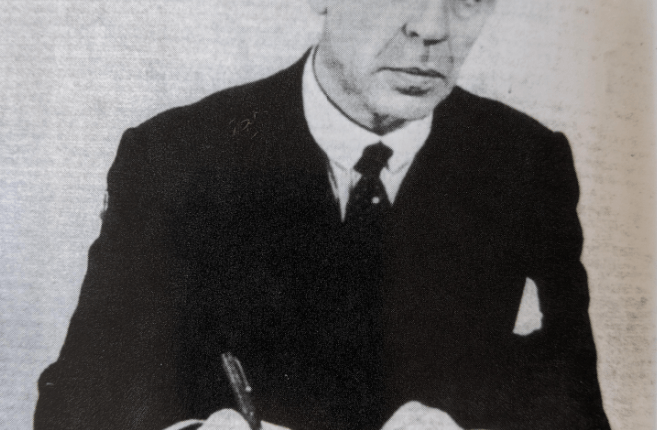
In line with the provisions made in the Capital Punishment Amendments Act, an autopsy was conducted on Stockwell’s body; this was undertaken by Bernard Spilsbury, who had also co-operated in the autopsy on Dudley Hoard’s body. Stockwell was then buried in the grounds of Pentonville Prison. At Scotland Yard, Detective Inspector Frederick Sharpe made his final report on the case, putting forward nine of the officers who had worked with him for rewards. All officers involved in the case received a commendation. Frederick Sharpe retired from the police in July 1937.


[1] PCOM 9/333 ‘STOCKWELL, John Frederick: convicted at Central Criminal Court (CCC) on 22 October 1934’, National Archives

[2] ‘Smile Recalled Many Times We Kissed’, Daily Herald, 14 November 1934, p. 2

[3] PCOM 9/333

Featured

The Bow Cinema Murder – The Manhunt

This is the seventh in a 11-part investigation into the 1934 ‘Bow Cinema Murder’. You can read all entries in the series here. 

The murder on Dudley Hoard took place on Tuesday 7 August 1934. For John Stockwell, the cinema attendant who had committed the crime, Tuesday was his regular day off work. The police and his colleagues where therefore not surprised that John did not show his face around the Eastern Palace Cinema on that day. Instead, it later transpired that John that day found somewhere to stash the money he had stolen; took a brief trip to the Essex seaside; and in the evening took his girlfriend Violet to a West End cinema.

On Wednesday morning, John was still behaving like everything was normal. He knew, however, that the police were still investigating the crime scene, and he was not keen to return to the cinema. So on the morning of 8 August, he pretended to leave for work as usual, but instead took a train from Liverpool Street to Lowestoft, on the Suffolk coast. He made sure to buy a return ticket; John may have read some of the popular crime stories in which culprits often buy return tickets to avoid raising suspicion. John had no intention of coming back to London any time soon, however. He had packed most of his meagre belongings in a small suitcase, which he had managed to carry out of the house unnoticed.

Back in London, the fact that John did not show up for his regular shift at the cinema immediately raised the suspicions of the police. They started questioning the other cinema employees about Stockwell, and also questioned the family with which John was lodging. In the evening, police officers were stationed at the small house where John lived, in case he decided to return for the evening.

John had no such plans, however. He had taken a room in Lowestoft with a Mrs Alice Alberta Tripp, a short-sighted housewife. He gave his name as Jack Barnard, and claimed he wanted to stay in Lowestoft for a month’s holiday. ‘Jack’ paid 35 shillings for the first week without any protest. The first day in Lowestoft passed without incident, but by 10 August Scotland Yard had circulated a photo of John Stockwell to all the major newspapers; descriptions to all police stations; and had even arranged for an announcement to be broadcast on the BBC. They were using all modern media and technology at their disposal to circulate John’s description. It was unusual for the police to coordinate such an intense campaign, but the murder of Dudley Hoard was considered especially violent and heinous.

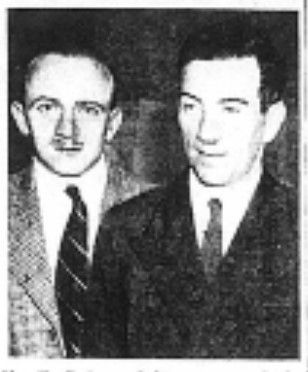
Mrs Alberta Tripp, left, with a friend

The popular newspapers were grateful for the copy provided by the police, and in that second week of August the hunt for the Bow Cinema Murderer dominated the front pages of all the tabloids. In Lowestoft, John Stockwell read the Sketch newspaper with his breakfast, and then told Mrs Tripp he was going to go to nearby Yarmouth for the day. After he’d left, Mrs Tripp went to see her daughter, who ran a newsagents across the road. Mrs Tripp’s daughter showed her John’s picture in the newspaper. After Mrs Tripp had returned home to pick up her glasses, she had a good look at the photograph, and realised that her lodger was the man wanted by the police in connection with a violent murder. Lacking a phone, Mrs Tripp asked her next-door neighbour to ring the police for her. When they arrived, they were able to confiscate the clothes that John had left behind; but the wanted man himself had eluded them.

Later that day, John Stockwell walked into the Metropolitan Hotel in Yarmouth, and asked for a room. When he signed the hotel register, he wrote that his name was J.F. Smith, and that he was from Luton, Hertfordshire. The hotel receptionist, Kenneth Margetson Dodman, thought he recognised ‘Mr Smith’ from the description given in the newspaper. Additionally, he noticed that ‘Smith’ had made a mistake when he was signing in: Luton was in Bedfordshire, not Hertfordshire – something that anyone from Luton would surely know. Keeping his wits about him, Dodman put ‘Mr Smith’ in a room and then rang the police. John Stockwell was arrested by a local police officer at the hotel around 6.30pm. The manhunt which had gripped the nation was finally over.

Kenneth Dodman (left), the receptionist at the Metropolitan Hotel in Great Yarmouth

At Great Yarmouth police station, ‘Mr Smith’ admitted that he was John Stockwell, and also that he had murdered Dudley Hoard. The local police chief put a call through to Scotland Yard, and Chief Inspector Fred Sharpe drove up to Yarmouth that very evening to collect his suspect. On the way back to London on 11 August, Stockwell told Sharpe how he’d committed the crime, where he had hidden the money, and how he had spent the days between 7 and 11 August. Sharpe, not wanting to put Stockwell off, decided not to take any notes in the car. Instead he listened, and wrote up Stockwell’s confession from memory as soon as he got back to the station.

The Metropolitan Hotel in Yarmouth, where John Stockwell was arrested

This decision would later cause some headaches: because Sharpe had not properly cautioned Stockwell, and had not given him the opportunity to check his statement, the information Stockwell had provided in the car could not be admissible in court. For now, though, the police were relieved that they had gotten their man. When Sharpe’s car arrived back at Bow Road police station just before 9pm on 11 August, a great crowd had gathered, keen to catch a glimpse of the Bow Cinema murderer, who until so recently had been living in their midst.  

The Bow Cinema Murder – Forensic Evidence

FeaturedThe Bow Cinema Murder – Forensic Evidence

This is the sixth in a 11-part investigation into the 1934 ‘Bow Cinema Murder’. You can read all entries in the series here. 

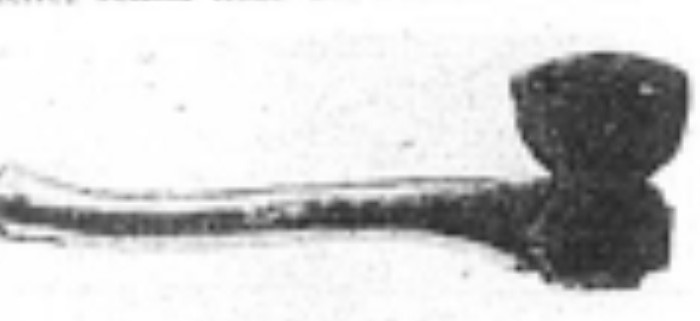
Once the police were on site at the Eastern Palace Cinema, they started gathering forensic evidence. This was partially to aid the investigation, but also to start building an evidence base to use if and when the case would go to court. The items which were recovered from the crime scene included a piece of flooring; human hair and samples of bloodstains. After a thorough search of the cinema, the police also recovered the murder weapon: a small axe, or hatchet. This was also handed over for investigation. Forensic investigations were undertaken by the same specialists who also did the post-mortems of the victims of crime: forensic pathologists.

The pathologist initially appointed to the Bow Cinema Murder case was Dr Francis Temple Grey, a retired Royal Navy surgeon and previously employed as pathologist for the Ministry of Pensions. He was in his late 40s in 1934 and had a deep scientific interest in biochemistry. On 8 August, the day after the murder, he presided over the autopsy of Dudley Hoard at Poplar Mortuary. The post-mortem was also attended by Donald Summers, the police surgeon who had attended Hoard immediately after the attack; Dr Normal Brown, who had treated Dudley in St Andrew’s Hospital; and the most famous pathologist in Britain, Sir Bernard Spilsbury.

Dr Temple Grey (left), pathologist assigned to the Bow Cinema Murder

Bernard Spilsbury was a Home Office pathologist and a celebrity. He had made his name during the notorious murder trial of Dr Crippen, where Spilsbury’s expert evidence nailed Crippen’s conviction. Spilsbury was also responsible for the conviction of a host of other notorious killers, from George Smith, the ‘Brides in the Bath murderer’, in 1915; to Patrick Mahon in 1924. Spilsbury was a workaholic and a brilliant orator, which made him successful both as a pathologist and as an expert witness. His reputation remained untarnished during his lifetime, although in recent years some of his assertions, including those on which basis Crippen was convicted, have been refuted.

In 1934 though, Bernard Spilsbury was considered the best pathologist to have on a case. He was specifically asked to attend the postmortem of Dudley Hoard, and undertake forensic examinations, by Norman Kendall, the Assistant Commissioner for Crime at the Metropolitan Police. As Kendall later wrote to the Director of Public Prosecutions, Tindal Atkinson, he considered Temple Grey a ‘notoriously untrustworthy witness’ when it came to giving evidence in court.[1] Kendall was worried that, if the case were to go to court, Grey would potentially make incorrect or unclear statements that may confuse the jury and jeopardize a conviction. To avoid having to call Grey to the stand, Kendall wanted to make sure that Spilsbury was involved in every step of the forensic investigation, so that he could act as a witness instead. Throughout the investigation, the police continued to worry that they had not built a sufficiently strong case, and be on the look-out for anything that may undermine a ‘guilty’ verdict.

There’s no record of how Temple Grey felt about having Sir Bernard Spilsbury watching over his every move. His report of Dudley’s autopsy noted that Dudley had suffered from nine cuts, six fractures, and three brain injuries. It seemed that Dudley got hit on his head from behind; fell onto the carpet; then got up again; and moved with his assailant out of his flat and up the stairs to the cinema balcony, where he eventually collapsed. There were copious amounts of blood on the floors and walls of the flat and cinema which marked out this trajectory. The pathologist took a photo of Dudley’s skull, and drew a diagram to indicate where the cuts and fractures had been found.

When examining the axe, it was found that it mostly contained blood on the back and left-hand side, implying that Dudley and Maisie had been hit with the blunt back of the axe head. Hairs of both Maisie and Dudley were found on the axe; his below hers, which showed that he had been attacked first. It provided irrefutable proof that the axe had been the weapon used in the attack; that both Dudley and Maisie had been attacked with the same weapon and therefore presumably by the same person; and that Maisie’s initial statement on how the attack had panned out matched the evidence. It did not, however, bring the police any closer to catching their killer.

The murder weapon, a small hatchet

DNA was of course completely unknown during the 1930s, so there was no possibility to match any of the blood found in the cinema to either the victims or the perpetrator. Fingerprints were known, and had first been used to successfully convict two murderers in 1905. That case, the murder of a shopkeeper and his wife in Deptford, bore some striking resemblances to the Bow Cinema Murder.[2] Yet as soon as fingerprinting evidence became commonplace, would-be criminals knew to wear gloves. The Bow Cinema murderer had followed this advice too, and fingerprints played no significant role in the investigation. Instead, the police were to rely on the killer’s behaviour after the murder, which was so erratic that it very quickly made them sure they had found the guilty man.


[1] ‘Defendant: Stockwell, John Frederick. Charge: Murder’, CRIM 1/734, National Archives

[2] Colin Beavan, Fingerprints: Murder and the race to uncover the science of identity (London: Fourth Estate, 2002), pp. 1-19

The Bow Cinema Murder – the Police Investigation

FeaturedThe Bow Cinema Murder – the Police Investigation

This is the fifth in a 11-part investigation into the 1934 ‘Bow Cinema Murder’. You can read all entries in the series here. 

When Dudley and Maisie Hoard were found, critically wounded, around 8.30am on 7 August 1934, the first police officer on the scene was PC Duncan Mackay. He was patrolling the local area at the time, and was therefore able to get to the cinema quickly. PC Mackay was part of the army of patrolling Bobbies who worked all over London, each walking their regular ‘beat’ so that they could be on hand if anyone in the neighbourhood needed police assistance. After arriving at the cinema, PC Mackay quickly rang his local station for back-up. The Metropolitan Police had divided London in a series of divisions; Bow Road was part of ‘H’ Division, which covered the wider Whitechapel area. There were a few police stations near the cinema – Bow Road station was the closest, but there was also a station at Arbour Square, a short distance away.

Each police division had a team of detectives: plain-clothes officers who were tasked with investigating crimes and tracking down criminals. In addition, there was the Criminal Investigation Department (CID), commonly known as Scotland Yard. This team worked across all of London and specialised in the most difficult crimes, as well as criminal activity that was not confined to one area – for example, during the 1920s Scotland Yard spent a fair amount of time investigating crooked racecourse betting gangs.[1] Working for Scotland Yard was prestigious, as the small team often dealt with high-profile cases.

After PC Mackay’s phone call, the first officers to arrive at the cinema were the detectives attached to ‘H’ Division. Most of these men were born locally, and they would spend many hours over the next weeks to not only catch the murderer, but also put together sufficient evidence to ensure a conviction. In the interwar period, the police’s remit was wider than it is today, and the police took on some tasks which would now sit with the Crown Prosecution Service. Detectives were responsible for ensuring that all the evidence fit together and made a convincing court case. This meant that even after a criminal was caught, they would still have significant work in (re)interviewing witnesses, tying up loose ends, and getting additional expert opinions.

The detectives who were the first to arrive at the cinema were Detective Sergeant James Rignell, a 34-year old born in Poplar who had joined the Met shortly after the First World War; Detective Inspector Henry Giddins, who had only been promoted to this rank less than a week before the murder took place; and Detective Sergeant Claud Smith, who was born in Mile End and also joined the police immediately after completing his First World War service. Between them, they started a physical investigation of the murder scene and questioned the cinema staff who had started to arrive for their shifts. James Rignell went to the hospital and took the very first statement from Maisie Hoard.

One of the detectives, possibly James Rignell

Very quickly, a decision was made that Scotland Yard needed to be involved in the investigation. The attack had been brutal, and DI Giddins was very new to his role. Around 3pm on the same day, Detective Inspector Fred ‘Nutty’ Sharpe of Scotland Yard arrived at the cinema. He would be in charge of the investigation from that point onwards, leading the ‘H’ Division team and drawing on staff in other parts of London as needed. As it transpired, the investigation would lead the police out of London to the Norfolk/Suffolk borderlands, and Sharpe’s position in the CID gave him the authority to instruct police forces outside of the capital, too.

Frederick Sharpe, from his memoir Sharpe of the Flying Squad (1938)

Fred Sharpe had joined the Metropolitan Police in 1911, and spent most of the first decades of his police career chasing criminal gangs, pickpockets and car thieves. In his memoirs, which he published in 1938 after his retirement, he advocated that police detectives should cultivate friendly relations with professional criminals. He argued that there was a reciprocal relationship and a level of respect between criminals and the police, in which both groups knew the rules of the game they were involved in. This approach got him in hot waters after his retirement, when Sharpe himself came under police investigation for engaging in bookmaking activities.[2]

Murder, however, appears to have been a separate category for Sharpe. He devoted an entire chapter to the Bow Cinema Murder in his memoirs, in which he referred to the murder as ‘one of the most savage a man has ever committed.’[3] He underscored this supposed savagery by describing his physical reaction to the crime scene: “The flat itself and the hall presented a horrible and ghastly scene, showing that the utmost violence had been used in the attack on this unfortunate couple. (…) the sight of that room and the passageway nearly made me sick.”[4] Sharpe ensured that the details of the crime scene were captured by ordering a police photographer to attend the scene on the day of the murder. These photographs show copious amounts of blood on the staircase where Dudley was found, as well as the blood-soaked bedsheets which Maisie had left behind.

At the close of 7 August, the police did not yet have any clear leads. The staff who had been arriving at the cinema had not been able to share much useful information. Most of the crimes they investigated were committed by criminal gangs, and this guided their initial thinking. Newspaper reports stated that the police were speaking to their contacts in criminal gangs to gather information – using that network which Fred Sharpe often relied on.[5] Police officers remained stationed at the cinema overnight, and some materials had been taken away for forensic examinations. It was not until the next day, however, that a clear suspect would emerge.


[1] Heather Shore, ‘Criminality and Englishness in the Aftermath: The Racecourse Wars of the 1920s’, Twentieth Century British History, vol. 22, no. 4 (2011), 474-497

[2] ‘Ex-Chief Inspector Sharpe of the Flying Squad: bookmaking activities under the name of Williams’, MEPO 3/759, National Archives

[3] Frederick Sharpe, Sharpe of the Flying Squad, (London: John Long, 1938), p. 126

[4] Ibid., p. 127

[5] ‘“Yard” reconstructs the crime,’ Daily Herald, 8 August 1934, p. 2

The Bow Cinema Murder (1934)

FeaturedThe Bow Cinema Murder (1934)

This is the first in a 11-part investigation into the 1934 ‘Bow Cinema Murder’. You can read all entries in the series here.

This blog is no stranger to interwar murder stories. Over the next ten weeks, posts will investigate one 1934 murder case in depth. Unlike some of the other cases covered previously, this murder is no longer well known – it has not been adapted in any novels, plays or films (to the best of my knowledge) and did not become a byword for evil. At the time it was committed, however, it caused a media storm and thrust a group of working-class East Enders into the limelight. It was the Bow Cinema Murder.

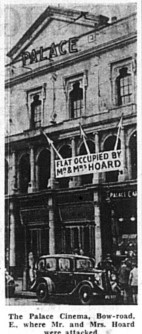
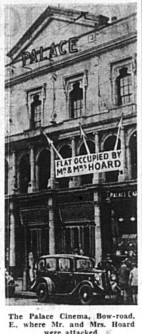
The murder took place on Tuesday morning, 7 August 1934, at the Eastern Palace Cinema in Bromley-by-Bow, in the East End of London. The Eastern Palace cinema was a neighbourhood cinema, co-owned by two local Jewish professionals. It was located on the busy Bow Road, in between a café and a general store. It could seat around 1000 patrons in its auditorium and balcony, where audiences could enjoy the ornate (if somewhat shabby) ‘Oriental’ decorations on the walls.

The facade of the Eastern Palace Cinema. This photo appeared in the Daily Express the day after the murder

The day-to-day management of the cinema fell to 41-year-old Dudley Henry Hoard. As part of his role, Dudley and his wife Maisie were required to live in a flat adjacent to the auditorium – the lease of the building required that it was partially used for domestic occupancy. Dudley got the cinema manager job in March 1934, and he and Maisie moved in a few weeks later. It was the first time since their wedding in spring 1933 that they had their own flat; they had previously been staying with Dudley’s parents in Croydon.

On the morning of 7 August, Dudley and Maisie were sleeping in after a busy Bank Holiday weekend. Ordinarily, one of Dudley’s first tasks every day was to deposit the cinema’s previous day’s takings at the Midland Bank on Mile End Road. Due to the banks having been shut on the Bank holiday Monday, there were now three days’ worth of ticket earnings in the safe in Dudley’s office, one floor below the flat. For the Eastern Palace, the Bank holiday weekend had resulted in total takings of 89 pounds, 5 shillings, and tuppence. By comparison, Dudley earned about £5 a week as cinema manager, and he was the best-paid member of staff in the cinema. Even for him, the nearly £90 in the safe represented around 10 months’ worth of wages.

Around quarter to eight, someone rang the door of the flat – not the doorbell at the cinema’s entrance, but the door of the flat specifically. Dudley quickly put on some trousers over his nightshirt and went to open the door. Maisie had only half woken and was about to doze off, when she heard Dudley shout out. When Maisie walked into the living room, she saw a man standing over her husband, wielding a hatchet. Dudley had a head wound and was trying to fend off the other man. Maisie shouted out to the attacker, a young man. He then turned to her and hit her over the head with the hatchet – she blacked out immediately.

About thirty minutes later, the cinema’s regular team of cleaning women arrived for their morning shift. These three women came in six days a week to clean and tidy the cinema before the first screenings started. Because they arrived hours before any of the other staff, the head cleaner, Mrs Emily Brinklow, had her own set of keys. She let herself and her colleagues in, and they started to get their cleaning materials out. Emily noticed that the post and milk, dropped by the milkman, had not yet been taken upstairs by either Dudley or Maisie. This did not worry her unduly; she would bring them up herself in a minute. Before she could do so, a scream ripped through the building. Nellie Earrey, one of the other cleaners and sister to one of the cinema’s projectionists, had found a heavily injured Dudley Hoard on the staircase leading to the auditorium balcony. He was covered in blood, as were the walls and the staircase he was on. Emily rushed to the flat and banged on the door; after a short while, Maisie opened it. She, too, was covered in blood, and seemed completely dazed.

Nellie ran out onto the street, where a passerby quickly alerted the local Bobby who was patrolling the area. PC Mackay swiftly went over to the cinema and tried to provide emergency aid, as well as alerting his local police station by telephone. The divisional surgeon (the police doctor) is on the scene quickly, as he was still at his home further down Bow Road when the station officer rang him. He too provides emergency aid, and arranges for both Dudley and Maisie to be transported to the nearby St Andrews hospital. They arrive shortly after 10am. Although Dudley is immediately examined and treated by multiple surgeons, the fractures to his skull are too severe. He dies at 3.07pm, without regaining consciousness.

The police know that they now have a murder case on their hands. Maisie is less severely injured, but unable to give more than a brief, confused statement before she needs to rest. Detectives attached to the local police department, known as ‘H’ Division, start questioning all the cinema’s staff as they arrive for their shifts. Most of them live very close to the cinema, and they are aware very quickly that something has happened. The police realise that the cinema’s safe has been opened by the keys which would normally be carried around by Dudley, and that the full weekend’s takings have been stolen. They have a victim and a motive, but not yet a clue as to the killer’s identity.

Featured

Escape (1926 and 1930)

Although British literature of the interwar period is today perhaps popularly associated with the modernism of Virginia Woolf, during the 1920s and 1930s other, less experimental authors were equally, if not more, well-known. John Galsworthy was one of the authors despised by Woolf as an ‘Edwardian’. His best-known work remain the novels that form the Forsythe Saga, but he was also a prolific playwright and a number of his plays were adapted to film during the 1930s. Galsworthy was awarded the Nobel Prize for Literature in 1932, mere months before his death.

One of Galsworthy’s last plays was Escape, which was first performed in the West End in 1926. The play transferred to Broadway the following year, where the lead role was performed by Leslie Howard. In 1930, Galsworthy collaborated with director/producer Basil Dean in adapting the story for film for Associated Radio Pictures. The film version starred screen stalwart Gerald du Maurier in the lead role of Captain Matt Denant. The brief period between the play’s premiere and the film’s release, in addition to the high-profile actors attached to both productions, indicates Galsworthy’s fame and popularity during the interwar period.

The story of Escape is somewhat unusual compared to other mainstream interwar outputs. Whereas most cultural productions of the period seek to reinforce the importance of the state in maintaining an orderly society, Escape opens with a direct challenge to authority. Captain Matt Denant, a celebrated war hero, goes for a walk in Hyde Park in the evening. Hyde Park was known as a favourite spot for prostitutes. During the interwar period, the Home Office worked hard on the management of street prostitution in London.[1] Yet the Metropolitan Police’s hard line on soliciting meant they sometimes overstepped the mark, and police officers arrested women who had not been soliciting at all.[2]

Magistrate courts, frustrated with what they perceived to be an influx of cases with insufficient evidence, insisted that in future, it would be a requirement for the man who was being solicited to provide evidence against the accused woman – women would no longer be convicted on the basis of police evidence alone.[3] This complex legal debate is key to understanding the opening of Escape. Once Captain Denant walks through the park, a prostitute comes up to him and solicits. Denant good-naturedly turns down her offer and is about to continue on his way – however, a plain-clothes police inspector has witnessed the interaction. He approaches Denant and asks him to make a statement that the woman was soliciting. In light of the higher evidence bar set by the magistrate courts, this second statement would be a requirement for any conviction. Denant refuses to co-operate and the interaction with the police officer escalates to the point that Denant hits him. The police officer hits his head and dies; Denant gets arrested and convicted for manslaughter.

After this extraordinary opening, Denant is transferred to Dartmoor, one of the most notorious prisons in the country at this time. Rather than accepting his punishment, Denant manages to escape while on work detail, and the remainder of the play/film tracks him as he encounters various people who help him on his flight. Ultimately, a parson is willing to lie to the police, who are hot on Denant’s trail. This gives Denant a moral dilemma and he decides to give himself up to protect the parson.

Not only does Denant refuse to help the police officer in the opening scene to convict a prostitute, he then rejects the punishment he is given for the manslaughter of the officer. Arguably, the prison sentence meted out to him is fair and appropriate, yet Denant does not initially accept it. This indicates he, to a certain extent, places himself above the law. He only ultimately agrees to undertake his prison sentence because he does not want to morally compromise a previously uninvolved third party – not because he necessarily thinks it is appropriate for him to be imprisoned for his actions.

Although Galsworthy was considered an ‘establishment’ writer, the protagonist in Escape rejects the conventional structures of state authority and is willing to go to considerable lengths to avoid any involvement with them. In the opening scene, Denant does not display any of the moral outrage or shock commonly associated with streetwalking in the popular media of the time. Throughout the action, he retains a keen sense of independence and trust in his own judgement: even when he does ultimately agree to sit out his prison sentence, he does so on his own terms.

This is in stark contrast to the majority of plays and films of the interwar period, in which the police in particular are presented as the unchallenged face of authority, which must be obeyed to avoid a breakdown of social norms. In Escape, Galsworthy ostensibly offers up an alternative point of view in which independent judgement rules supreme, even if that does not align with the rule of law. However, Denant’s ultimate acquiescence to the prison sentence, whether arrived at from a sense of moral obligation or not, ensures that in the end of the story social order is restored.


[1] Stefan Slater, ‘Containment: Managing Street Prostitution in London, 1918-1959’, Journal of British Studies, Vol. 49, no. 2 (2010), 332-357

[2] Julia Laite, ‘The Association for Moral and Social Hygiene: abolitionism and prostitution law in Britain (1915–1959)’, Women’s History Review, Vol. 17 (2008), 207-223

[3] Stefan Slater, ‘Lady Astor and the Ladies of the Night: The Home Office, the Metropolitan Police and the Politics of the Street Offences Committee, 1927-28’, Law and History Review, Vol. 30, no. 2 (2012), 533-573

Featured

J. J. Connington – The Sweepstake Murders (1931)

J. J. Connington was the alias of Albert Walter Stewart, a Scottish-born chemist, crime writer and one of the founding members of the Detection Club. Alongside a successful academic career, Connington published seventeen novels between 1923 and his death in 1947. T.S. Eliot was an admirer of Connington’s detective fiction.[1] Connington’s main ‘sleuth’ was Chief Constable Sir Clinton Driffield, who was accompanied by Wendover, a man of independent means, as a side-kick. These characters reveal Connington’s conservative political views; they have independent wealth and are no political radicals.

The Sweepstake Murders was Connington’s 13th published work, and coincidentally the concept of ‘bad luck’ (accidental or manufactured) is a key motif in the work. The book starts with Wendover, Sir Driffield’s companion, attending a bridge party at a house in the neighbourhood. The nine men in attendance agree to join into a syndicate and buy nine sweepstake tickets for the Epsom Derby. If any of the tickets win, they agree to divide the winnings equally between them.

When one of their number unexpectedly dies before the sweepstake results are announced, it occurs to Wendover that their signed agreement means that the fewer members of the syndicate remain, the more money each individual will receive, as they will have to split the winnings amongst fewer people. When the syndicate wins the second prize, or £241,920, members start getting bumped off with alarming speed. Sir Driffield comes to visit Wendover and helps the local police with their investigation, as he is concerned about his friend’s safety.

The tension in The Sweepstake Murders is two-fold: the reader does not know who the next member of the syndicate will be who will get murdered; but as the murders progress, fewer and fewer suspects remain, as it is assumed that one of the remaining syndicate members is the perpetrator. In this set-up, the murderer can only obtain the highest possible monetary return by revealing themselves as the last person standing. Connington avoids this problem by having some of the syndicate members sell on part of their stake to people not originally involved in the syndicate, thus widening the pool of potential beneficiaries. The set-up also allows Connington to include a range of murder methods and weapons in his story, as the murderer gets creative to make the deaths look like accidents.

The narrative of The Sweepstake Murders is liberally interspersed with letters sent between legal advisers and syndicate members; excerpts of Sir Driffield’s notebook; and various jottings-down of accounts and sums to allow the reader to stay on top of who is entitled to which sum at each stage of proceedings. Towards the end of the story, the behaviour of a roll of film in a photo camera becomes a crucial clue to the plot, and this is duly illustrated with some diagrams. These extra-textual elements add to the puzzle-like feel of the story and engage the reader in its resolution.

The Sweepstake Murders is a high-concept crime story, which incorporates many of the tropes of the genre including meticulous timing of alibis, use of technology to cover and uncover tracks, and a closed circle of potential suspects. Despite Connington’s professional success during the interwar period, he is now a mostly forgotten crime writer and his books are not as readily available as those of other authors of the period. Yet The Sweepstake Murders is a good quality murder mystery and is worth seeking out by readers with an interest in interwar crime literature.


[1] Martin Edwards, The Golden Age of Murder (London: Harper Collins, 2016), p. 186

Featured

From investigation to trial

This is the fourth and final post of this year’s May Murder Month. You can read posts one, two and three elsewhere on the blog.

Most contemporary readers will get their knowledge about interwar murder stories from the realms of fiction – Hercule Poirot gathering together suspects for a drawing room reveal (a device which Agatha Christie actually only used sparingly) or a hard-boiled police officer picking up on a seemingly minute clue that unravels the whole case. Once the murderer is identified, interwar fiction is either silent about what happens next, or the perpetrator is given the opportunity to take the ‘honourable way out’ by committing suicide.[1]

In reality, of course, investigations were conducted by police inspectors. Unlike in modern criminal cases, there was no Crown Prosecution Service in interwar England. Instead, the police both conducted the investigation and prepared the documentation for the criminal trial. The Director of Public Prosecutions was ultimately responsible for bringing the case to trial in the interest of the people. England then, as now, had a two-tier criminal justice system. The magistrate courts were convened locally and dealt with most of the day-to-day criminal offences. Crown courts were reserved for jury trials, which included murder charges.

Before a case could be referred to the crown court, a prima facie case had to be established in the magistrate court that a crime had been committed and it was of a magnitude appropriate to be considered in the crown court. Interwar murder trials were therefore effectively heard twice: once in the magistrate court and then again in the crown court, where the sentencing would take place. It was generally the latter proceedings that drew the attention of the national press. In murder cases, the coroner’s inquest ran in tandem to the magistrate court proceedings. In the interwar period, coroner courts sat with their own juries, who were tasked with determining whether death had occurred naturally, through suicide, accident, or murder. Usually, if foul play was suspected but the police investigation was ongoing, the coroner would suspend the inquest to give the police more time to complete their investigations.

The reading public, then, were experiencing criminal narratives in two different ways. When reading newspapers, the reports mostly focused on the criminal trial, with its rhythm of prosecution, defence, cross-examination, witness statements, a possible statement by the accused, and the judge’s summing up, all cumulating to the jury’s verdict. In crime fiction, the narrative focused on the investigation, with witness statements noted as the investigation developed. Particularly in stories where the protagonist is an amateur sleuth as opposed to a police officer, the formal police and court procedures can be completely outside the scope of the narrative. As crime historian Victoria Stewart has noted: ‘Detective novels tend not to recount the trial of the individual whom the investigator identifies as the guilty party because the watertightness of the investigation itself acts as a substitute for the depiction of the judicial process. An account of the trial would simply reiterate the findings of the investigation that has formed the body of the narrative.’[2]

Other scholars have noted that trial reporting reveals contemporary attitudes to potentially contentious topics such as changing attitudes to gender identity and sexuality.[3] Newspaper historians have also argued that the increased popularity of crime fiction changed crime reporting, with journalists paying more attention to ‘human interest detail’ of the story as opposed to the judicial process. This, in turn, potentially obscured the public’s awareness of legal procedures.[4] Additionally, journalists on occasion played a very active role in gathering evidence that led towards a conviction, for example in the case of Buck Ruxton who murdered his wife and a servant.[5] Conversely, crime fiction novels which had a police inspector as their protagonist, such as the Inspector French novels by Freeman Wills Croft, potentially educated their readership about police procedures in more detail than newspaper reports did.

Whether fictional or factual, murder stories fascinated interwar audiences and allowed them to explore the limits of what was considered acceptable or transgressive behaviour; and how this changed over the course of the two decades. Newspapers and crime novels presented readers with two different lenses through which to consider the criminal justice process, from investigation to trial.


[1] Lord Peter Wimsey’s increasing mental distress at sending murderers to the gallows, which comes to a head at the end of the final Wimsey novel Busman’s Honeymoon, is a notable exception.

[2] Victoria Stewart, Crime Writing in Interwar Britain (Cambridge: University of Cambridge Press, 2017), p. 11

[3] Lucy Bland, Modern Women on Trial: sexual transgressions on the age of the flapper (Manchester: Manchester University Press, 2013), p. 2

[4] Judith Rowbotham; Kim Stevenson; Samantha Pegg, Crime News in Modern Britain (London: Palgrave, 2013), p. 140

[5] Shani D’Cruze, ‘Intimacy, Professionalism and Domestic Homicide in Interwar Britain: the case of Buck Ruxton’, Women’s History Review, vol. 16, no. 5 (2007), 701-722

Featured

Domestic homicides

This is the third post in a themed series for May Murder Month. You can read previous posts here and here.

A significant proportion of murders committed in the interwar period were committed in the domestic sphere, as they are today. Of the 130 women sentenced to death between 1900 and 1950, 102 had killed a child, usually their own and usually when the child was very young.[1] After the adoption of the 1922 Infanticide Act, women who killed their own children were tried for manslaughter rather than murder, which lessened their sentence.

The other significant group of domestic killings were perpetrated by men killing their wives, girlfriends, or ex-partners. Almost all of the famous murders of the interwar period fall into this category. Scholars have argued that the trial reporting on these ‘domestic homicides’ ‘provided significant moments when fractures in the values and aspirations of (often) respectable private lives were held up for exhaustive public scrutiny.’[2] These murder cases have therefore often been used by historians as vehicles for a wider understanding of private lives and the performance of masculinity and femininity.[3]

When considering homicide data, there are two datasets to work from: the people who were convicted of murder and given a death sentence; and those for whom their sentence was not commuted and who were actually executed. Around 60% of men who were sentenced to death were executed. Out of the 223 executions that took place in the interwar period, 118 (53%) were of individuals who had killed a partner or family member, so involved in a so-called ‘domestic homicide’. In the first year after the Great War, 1920, 21 people were executed – a much higher number than in any of the subsequent years of the interwar period. All 21 individuals were men who had killed their wife, girlfriend or ex-girlfriend. This suggests that the end of the war saw a spike in domestic violence as traumatised men returned from the front to partners who had had a completely different war experience, and indeed may have started relationships with others during the conflict.

Later into the interwar period, even less famous murder trials can reveal much about the private lives of marginalised groups of Londoners, such as those who were not British and those who lived in poverty. In 1934, a Cypriot man killed the landlord of his lodging house over a quarrel about a woman. Georgios Kalli Georgiou had lived with his girlfriend ‘as husband and wife’ in a different lodging house, meaning that they shared a bedroom and bed without being formally married. When they moved into the house run by Thomas James in Torrington Square, Georgios and the woman took separate rooms and she started working as a housekeeper for Thomas James. Georgios quickly became suspicious that his partner had moved her affections to Thomas, and the situation came to a head in a three-way quarrel during which Georgios stabbed Thomas to death. Although Georgios was found guilty of murder and sentenced to death, after an appeal the Home Secretary reprieved him and Georgios was held captive in a prison camp on the Isle of Wight for the next nine years, instead.

As this case reveals, interpersonal relationships and living arrangements could be the catalyst for violence. In this instance, however, the foreign identity of the perpetrator, and the relative acceptance of male-on-male violence as a ‘normal’ part of masculine behaviour, likely influenced the Home Office’s decision to grant Georgios a reprieve. In other cases, the perceived social and moral transgressions of perpetrators and/or victims, as revealed during trial hearings, were presented as ‘morality tales’ by the daily press.[4] The famous conviction of Edith Thompson has been covered numerous times in this blog; in 1935 the murder of Francis Rattenbury by his wife’s lover (and the couple’s chauffeur) gave audiences a similar ringside seat to a menage à trois between an older man, a middle-aged wife and a young lover. Although, unlike Edith Thompson, Alma Rattenbury was acquitted of the murder charge brought against her, she committed suicide a few days after her release from prison. The denouement of this case was therefore arguably almost as salacious as that of the Thompson-Bywaters trial some 12 years earlier.

Although domestic homicides constituted a large proportion of the homicides during the interwar period, only cases that were perceived to reveal something that was normally private became established in popular culture. Abusive relationships that escalated to murder rarely became notorious, but cases in which either the woman transgressed her traditional role and enacted violence on a man; or in which relationships were revealed to not be as harmonious as they had appeared, the murders became cemented as morality tales into the popular imagination.


[1] Annette Ballinger, Dead Women Walking: Executed women in England and Wales, 1900-1955 (Aldershot: Ashgate, 2000), p. 1

[2] Shani D’Cruze, ‘Intimacy, Professionalism and Domestic Homicide in Interwar Britain: the case of Buck Ruxton’, Women’s History Review, 2007, vol. 16 no. 5, 701-722 (702)

[3] See D’Cruze, ‘Intimacy, Professionalism and Domestic Homicide’; Julie English Early, ‘A New Man for a New Century: Dr. Crippen and the Principles of Masculinity’ in Disorder in the Court: Trials and Sexual Conflict at the Turn of the Century, ed. by George Robb and Nancy Erber (Basingstoke: Macmillan, 1999), 209-230; Ginger Frost ‘She is but a Woman’: Kitty Byron and the English Edwardian Criminal Justice System’ in Gender & History, 2004, Vol. 16, no. 3, 538-560; Lucy Bland, Modern women on trial: sexual transgression in the age of the flapper (Manchester: Manchester University Press, 2013)

[4] Bland, Modern women on trial, p. 216