Out in the London Casino (1938)

FeaturedOut in the London Casino (1938)

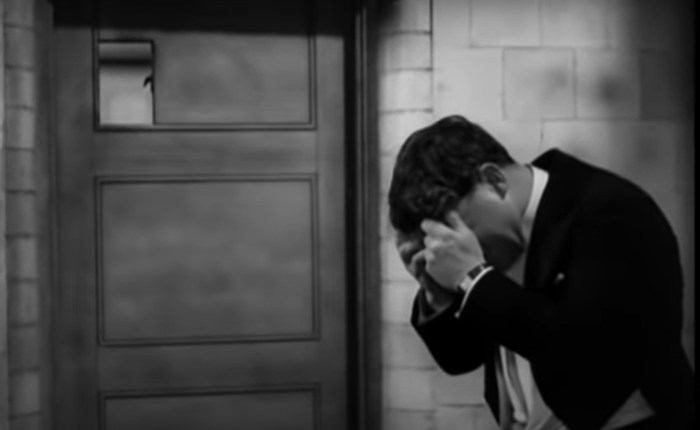
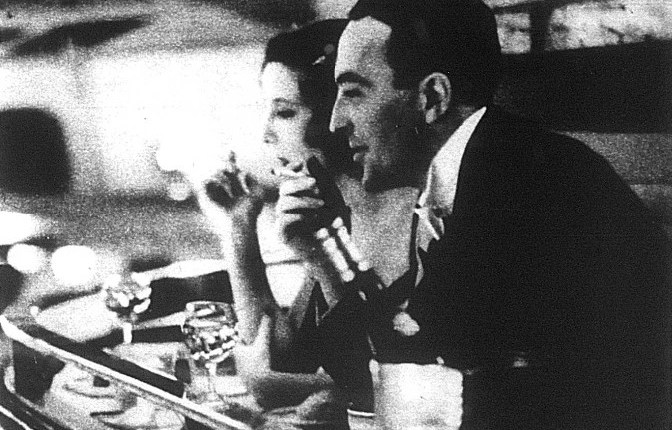
Although films of interwar Britain occasionally had interest in illicit gambling activities (for example, this one), and illegal gambling clubs certainly existed in real life, the London Casino was not, in fact, a casino. Originally it opened as the Prince Edward Theatre on Old Compton Street in 1930, with the intention of putting on Ziegfeld Follies-style revues. This, however, proved commercially unsuccessful. According to a 1938 Picture Post article, the theatre then became the regular host of trade shows for talking films, as it was fully wired for sound films.[1] Trade shows allowed cinema managers and buyers from cinema chains to view films before they hit the market, and decide which films to purchase for exhibition in their own cinemas.

Showing trade films was not necessarily a profitable occupation, however, particularly as the theatre was not being used for anything else. Around 1935, therefore, two investors decided to work together to refurbish the theatre to the tune of (then) £25,000.[2] They renamed the venue the London Casino, and came up with a concept which was entirely new for the British capital at that time. All the theatre seats were stripped out and replaced by rows of dinner tables – in the stalls as well as on the dress circles. The seats nearest to the stage were removed entirely to create a dancefloor. Big staircases led down from the circles to this dancefloor. The space below the stage was converted into kitchens. Going forward, Casino guests would be able to ‘eat and drink inside a London theatre a full-size dinner.’

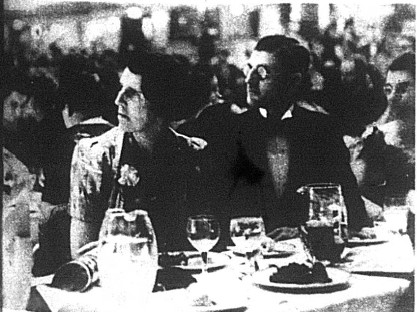
London Casino guests sit in tiered rows of dining tables, as shown in Picture Post

The Casino operated two shifts, one for dinner and one for supper. According to an early advert for the Casino, guests were served a five-course meal during their stay. During the meal, they could watch a show on the stage. After the show and dinner were over, guests could take the dancefloor – as long as they were dressed appropriately. ‘Evening Dress Optional but Essential for Dancing’ states the advert; and the Picture Post article notes that for seats on the balcony you did not have to wear evening dress. The advert suggests that all patrons paid the same price of 15s and 6d during the week and 17s 6d on Saturdays. By the time the Picture Post article was published, however, it was noted that some guests paid only 7s 6d, or less than half price. Presumably these were the balcony seats, right at the top of the theatre, which were ‘viewing only’.

Either way, the London Casino was a high-end night out; guests were only allowed to stay for 3 or 3.5 hours on weekdays, as their ‘slot’ only lasted so long. For comparison, West End cinema seats could only cost 1s 6d during this period, and suburban cinemas would be even cheaper. To spend 15s 6d a head on an evening’s entertainment would have been out of reach for many Londoners. Nonetheless, the Casino boasted of weekly revenues between £6000 and £7000, which would be ‘more money than any other entertainment in London.’[3] Clearly, by the end of the 1930s, there was sufficient disposable income at the top end of British society to sustain an innovative high-end club such as this.

In terms of the shows that patrons were treated to, the ample photography provided with the Picture Post article reveals a heavy reliance on ‘female beauty.’ Indeed, one can presume that the opportunity to publish photographs of scantily clad young women was one of the reasons why the editors of Picture Post decided to publish this article. Through the images in the weekly magazine a whole additional audience, who would not ordinarily be able to visit the Casino in person, were able to enjoy the ‘personal attractions of the dancers and show-girls.’[4]

A dance episode called ‘The Butterfly Hunt’ shows three young, thin, white women; two in bikini tops and gauzy skirts, the third appearing almost nude except for a bra and knickers. Dancer Maurice Brooke performed a stunt which required him to have one woman sitting on his neck and another (again in underwear) being swung round by him. Other scenes included ‘A Slave Market in Algeria’ (female slaves wearing minimal beaded outfits) and ‘The Bird of Night’ (women wearing skin-coloured, skin-tight outfits that make them appear nude). The final page of the article includes a photo of four showgirls backstage playing cards – they wear slinky dressing gowns and show their legs. The caption gives their names, as if to shrink the gap between them and the reader.

Although the Picture Post article exploits the female bodies for the visual pleasure of their readership, the article also cleverly juxtaposes these photos with an equal amount of photographs of audience-members viewing the stage. The article contains six photographs of audience members, most of them medium close-ups showing two or three patrons gazing intently towards what we presume is the stage. There is only one photograph of the guests dancing on the dancefloor after the show. It is implied that passive spectatorship, or ‘ogling’, is the main reason most people visit the Casino. The active participation in the dancing is secondary.

The article’s conclusion confidently states that the Casino ‘appears to have established itself as a permanent feature of London’s night life.’[5] The reality was different. The outbreak of the Second World War put an end to all performances, and by 1942 the theatre was repurposed as an entertainment venue for troops on leave. After the war, the theatre reverted back to being a cinema screening room, this time for ‘Cinerama’ films – films projected across three adjacent screens for a wide-screen effect. In the mid-70s the venue was once again converted back to a theatre, and it has been in business as the Prince Edward Theatre ever since.


[1] ‘A Night Out in London’, Picture Post, 10 December 1938, p. 21

[2] Ibid.

[3] Ibid., p. 24

[4] Ibid., p. 21

[5] Ibid. p. 24
New Year’s Eve 1922

New Year’s Eve 1922

As is tradition on this blog, for the final post of the year we cast our minds back to exactly one hundred years ago and have a look at how New Year’s Eve was celebrated in London that night. After some rain earlier in the day, the evening of Sunday 31 December was cold and a bit windy but dry: no doubt a relief to Londoners keen to let their hair down.[1] According to the Manchester Guardian pre-midnight celebrations were ‘more subdued’ than in previous years owing to 31 December being a Sunday! Due to a special licensing hour dispensation, hotels could stay open till 2am.[2]

Well-heeled Londoners were excited to ring in the new year with elaborate parties in hotels and restaurants. Hotels spared no cost in their interior decoration: the dining room of the Berkeley Hotel ‘was transformed into a lighted vineyard’ and at Claridge’s guests walked through an Italy-inspired landscape.[3] At the Savoy Hotel, a large amount of Christmas crackers were pulled during an ‘elaborate banquet’ – 25,000 crackers according to the Daily Express, but 35,000 according to the Mirror.[4] Some venues put on performances: at the Metropole Hotel midnight was marked by ‘a dainty little girl dressed as Cupid [appearing] from a huge cracker, which was pulled by Father Christmas.’[5] At the Piccadilly Hotel grill room a female singer appeared out of the top of a huge champagne bottle at midnight to sign Auld Lang Syne.[6]

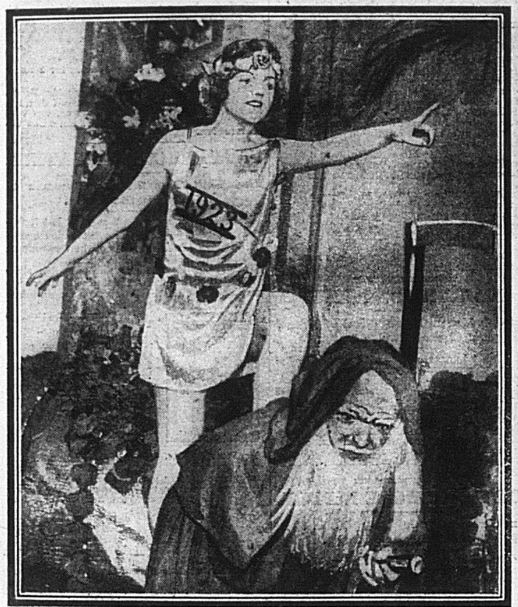
A young woman, representing 1923, banishing old 1922 in an unspecified performance. Image: Daily Mirror, 1 January 1923, front page

For those who could not afford to be in the hotels, the streets of London provided a suitable party venue. The steps of St Paul’s Cathedral were one of the traditional sites of celebration, and crowds started gathering there hours in advance.[7] The Daily Express reporters, always ready with more evocative language then their colleagues at rival papers, described the crowds in the West End as follows:

They were “grown ups” who surged in dense masses through the streets, but the joy of childhood – Christmas party childhood – was rampant. Every one wore a paper hat, and nearly every one was blowing a toy trumpet. Street corners were impromptu ballrooms.[8]

Aside from the evening celebrations, the New Year also meant the publication of the annual honours list, announcing which luminaries had been bestowed honorary titles. In 1923, the prominent and popular Home Office pathologist, Bernard Spilsbury, was knighted and could henceforth call himself Sir Bernard Spilsbury.[9]

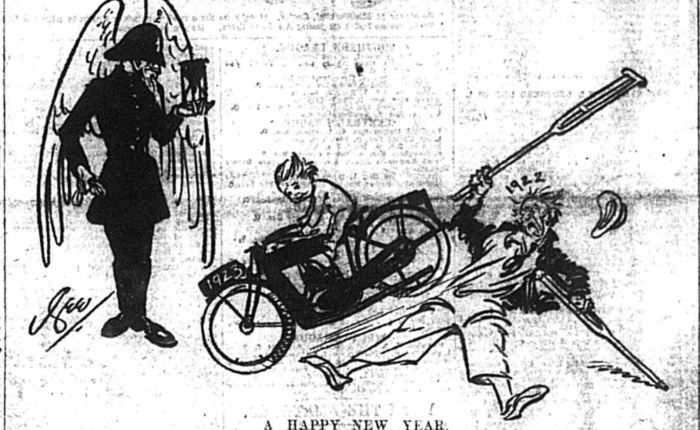
Cartoon in News of the World of 31 December 1922 reflecting the growing concerns on the dangers of motorized traffic, which would come to a head in the early 1930s.

The beginning of the new year also meant the start of winter sales in all the big department stores. The growing importance of consumerism, and the increase in disposable income, are marked by the prominent articles appearing in the popular press about the sales. ‘Thousands of women will to-day celebrate the coming of 1923 by “raiding” the great London stores in the breathless but happy hunt for bargains’ predicted the Daily Mirror.[10] In an article that essentially sums up the offers at each of the great stores, readers are advised that whilst buying ‘indiscriminately’ is never a good idea, one can’t go wrong with staples such as ‘gloves, shoes, underclothes etc’.[11]

The Sunday papers on 31 December had already carried large adverts for each of the store, preparing shoppers to the bargains that could be had. Like the Daily Mirror article, these were almost exclusively aimed at the female readership. It was clearly understood that shopping in a sale was the kind of frivolous activity that only women would engage in. At Dickins & Jones, a clearance of ‘model gowns’ (ie. those used for display purposes) meant that prices started at 7 ½ guineas – a guinea being 1 pound and 1 shilling.[12] On the same page, competitor Marshall & Snelgrove advertised a fur coat for 89 guineas; it had previously been between 125 and 179 guineas so this discount was indeed a ‘wonderful bargain’ although it was clearly out of reach for the vast majority of the population.[13]

By the time the Evening Standard appeared in the afternoon, it was able to report on the ‘bargain day scenes’ in breathless and rather sexist tones. ‘The occasion had much more significance for the ladies than the mere advent of the New Year, and (…) they stormed the whole of the shopping centres in their myriads.’[14] Some of the items on offer according to this article were velour coats with mole collar and cuff trimmings at 4 ½ guineas, and a knitted woollen gown at 27 shillings and sixpence; clearly the readership of the Evening Standard had less to spend than the readers of the Observer.

Elsewhere, the Evening Standard reported on the continued imprisonment of Edith Thompson and Freddie Bywaters, who would be executed on 9 January for the murder of Edith’s husband. Other papers noted the republic of Ireland’s recent independence, which was officially finalised in December 1922.[15] All was not well in the remainder of the Union either, with Scottish hunger marchers protesting in London on the first day of 1923.[16] Although the New Year’s Eve parties and January sales gathered the most prominent coverage, it is clear that below the celebratory surface troubles were brewing as Britain continued to deal with the fall-out of the Great War.


[1] ‘Week-end Weather’, The Observer, 31 December 1922, p. 14

[2] ‘New Year Revels in London’, Manchester Guardian, 1 January 1923, p. 7

[3] ‘At the Hotels’, Daily Express, 1 January 1923, front page

[4] Ibid.; ‘1923 Danced In by Merry Throngs’, Daily Mirror, 1 January 1923, p. 3

[5] ‘1923 Danced In’, Daily Mirror

[6] ‘New Year Revels in London’, Manchester Guardian

[7] Ibid.

[8] ‘Great Crowds in the Streets’, Daily Express, 1 January 1923, front page

[9] ‘New Years Honours’, Daily Express, 1 January 1923, p. 7

[10] ‘Sales Carnival Begins To-Day’, Daily Mirror, 1 January 1923, p. 2

[11] Ibid.

[12] ‘Dickins & Jones’ advert, The Observer, 31 December 1922, p. 9

[13] ‘Marshall & Snelgrove’ advert, The Observer, 31 December 1922, p. 9

[14] ‘Bargain Day Scenes,’ Evening Standard, 1 January 1923, front page

[15] ‘Politics at Home and Abroad’, Daily Telegraph, 1 January 1923, p. 4

[16] ‘Hunger Marchers’ Complaints’, Evening Standard, 1 January 1923, p. 8

Radclyffe Hall

Radclyffe Hall

Radclyffe Hall – which, really, was her given name (in full, Marguerite Antonia Radclyffe Hall) – is probably one of interwar Britain’s most famous LGBTQI+ people. She took the name John later in life, but her novels were published under the name ‘Radclyffe Hall’, which is how she remains best known.

Hall’s most famous work is the 1928 novel The Well of Loneliness, which was subjected to an obscenity trial in the UK after vigorous campaigning by the Sunday Express. As was fairly common at the time, English copies of the Well of Loneliness were subsequently printed in Paris; increased mobility between the two capitals including via airplanes ensured that some copies of the work continued in circulation in Britain.

Hall was also born in a family of means, with both her parents inheriting money from their parents. Hall’s father set her up with an independent income which allowed Hall to shun the conventional route of work and marriage and allowed her to develop her literary ambitions. She initially published poetry – five volumes between 1906 and 1915. From an early age Hall adopted a masculine style of dress, including wearing trousers, tailored jackets, and hats.

During a part of the 1920s, Hall lived in Kensington with her partner, Una, Lady Troubridge. They were together from 1916 until Hall’s death. London’s somewhat unruly nightlife during the interwar period allowed for the existence of LGBT-friendly spaces. From the mid-1920s Hall started to publish works of fiction. Her third book, Adam’s Breed, which was written in the Kensington flat, became a prize-winning bestseller. The commercial success of Adam’s Breed arguably partially caused the vocal backlash to Hall’s next work, The Well of Loneliness. Had she been less famous, there would have perhaps been less concern about the content of the work.

The plot of The Well of Loneliness centres on Stephen Gordon, an upper-class English woman who considers herself a ‘sexual invert’ (ie. she is a lesbian). The book chronicles Stephen’s childhood, an early love affair with an older woman, Stephen’s career as a novelist in both London and Paris, and her experiences as an ambulance driver in World War One. During the war, she meets and falls in love with fellow ambulance driver Mary, and the pair set up a household together after the war.

Although the book is far from sexually explicit, there is one reference to Stephen and Mary going to bed together; and throughout, Stephen insists that ‘sexual inversion’ is not unnatural. Stephen’s (and by extension, Hall’s) views on lesbianism closely echo those of 19th-century lesbian Anne Lister, by some considered to one of Britain’s first ‘modern lesbians.’

Due to the success of Adam’s Breed, The Well of Loneliness was reviewed by journalists upon its publication; early reviews were measured.[1] However, James Douglas, the editor of the Sunday Express who earlier in the decade had found much fault with convicted murderer Edith Thompson, took it upon himself to publish a front-page take-down of the book on 19 August 1928. His editorial included the statement that ‘he would rather give “a healthy boy or a healthy girl” poison than let them read The Well of Loneliness.’[2]

Hall’s publisher protested that the intervention of the Sunday Express gave the book more publicity and sensationalised it, and many other journalists and writers defended the work. Nevertheless, an obscenity trial started on 9 November 1928 and included expert witness testimony to confirm that one could not ‘become gay’ by reading a book about a gay relationship. The magistrate, Sir Chartres Biron, concluded that the novel’s literary merit counted against it: ‘the more palatable the poison the more insidious’.[3] He ordered that all copies of the book were destroyed, and The Well of Loneliness was not published again in Britain until 1959.

Hall attended the trial, although she was not on the stand as the trial was against her publisher rather than herself as a person. Her masculine appearance, widely reported in the press, ‘crystallised a particular vision of the mannish lesbian’ for the remainder of the interwar period.[4] A similar obscenity trial in the US had the opposite outcome to the British one, ‘finding that discussion of homosexuality was not in itself obscene.’ Hall only published one more novel during her lifetime, The Master of the House, which was poorly received. During the 1930s Hall and Troubridge moved out of London to the coastal town of Rye. Hall was diagnosed with cancer during the Second World War and died in 1943. She is buried in Highgate Cemetery in London, alongside other writers and artists such as George Eliot, Elizabeth Siddal and Anna Mahler.


[1] Christopher Hilliard, ‘“Is It a Book That You Would Even Wish Your Wife or Your Servants to Read?” Obscenity Law and the Politics of Reading in Modern England’, American Historical Review, June 2013, p. 666

[2] Ibid.

[3] Merl Storr, ‘Palatable Poison: Critical Perspectives on The Well of Loneliness’, review, Sexualities, Vol 6, no. 2, 2003, p. 264

[4] Emma Liggins, Odd Women? Spinsters, lesbians and widows in British women’s fiction, 1850s–1930s (Manchester: Manchester University Press, 2014), p. 163

Notorious interwar murders (part 2)

Notorious interwar murders (part 2)

This blog post is the second of a three-part series on notorious interwar murders. You can read part 1 here and part 3 here.

Whereas high-profile murders at the start of the interwar period fit the stereotype of apparently unassuming, suburban citizens calculatedly removing tiresome spouses, from the mid-1920s the cases that occupied the front pages were decidedly less cozy. In 1924, a case that became known as the ‘Crumbles Murder’, stretched the skills of celebrity pathologist Sir Bernard Spilsbury as the remains of the victim were so mutilated.

The Crumbles are a stretch of beach east of Eastbourne, where the remains of 38-year-old Emily Kaye were found in a beachside cottage. Kaye had been in an illicit relationship with the charming and handsome, but married, salesman Patrick Mahon. A few months into the affair Kaye became pregnant; Mahon had not told her that he was already married and led her to believe he would marry her. Kaye told her colleagues that she and Mahon would emigrate to South Africa after the wedding; he asked her to take lodgings in a cottage on the Crumbles, in apparent anticipation of their emigration.

It was here that Mahon murdered Kaye, but the exact details of her death were never established. Mahon severed her head and legs and stowed her body in a trunk in a spare room of the cottage. He then went into Eastbourne and picked up another woman, Ethel Duncan, whom he took back to the cottage for the weekend. Duncan was oblivious to the corpse locked away in the spare room. After Duncan left, Mahon destroyed most of Kaye’s body by burning, boiling and pulverising it.

The murder was discovered by a private investigator who had been hired by Mahon’s wife. When Mahon left a bag at the luggage storage in Waterloo station, the private investigator collected this bag and found it contained a bloodied knife. Scotland Yard quickly arrested Mahon and he admitted that Kaye had died, although he framed it as an accident. When Spilsbury and his Home Office colleagues arrived at the cottage, they had great difficulty identifying any of Kaye’s remains. Her skull was never recovered, which led them to assume that the cause of death had been a skull fracture.

After the Crumbles murder Spilsbury developed a ‘murder bag’ for Scotland Yard officers, a standard kit they could use in crime scenes which included ‘rubber gloves, a hand lens, a tape measure, a straightedge ruler, swabs, sample bags, forceps, scissors, a scalpel, and other instruments that may be called for.’[i] Spilsbury had been appalled by the casual conduct of the Scotland Yard detectives at the crime scene.

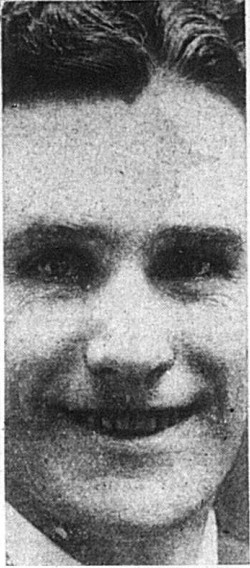
Patrick Mahon, Sunday Express, 12 March 1933, p. 13

Mahon was found guilty of murder and executed in September 1924. Mahon’s good looks, replicated in newspapers across the country during the investigation and trial, seemed to make his acts even more discordant. When the diaries of ‘nightclub queen’ Kate Meyrick were serialised in the Sunday Express in 1933, they were accompanied by a photo of Mahon who Meyrick claimed visited her club quite often. At the time of his arrest, she wrote ‘He is a very nice good-looking man (…) [his eyes] were not like the eyes of ordinary people; there was something behind them.’[ii] As befitted a notorious murderer, his execution became another part of his myth: there were persistent rumours that he had tried to jump off the scaffold when the trapdoor opened.

The high profile of the Crumbles murder, accompanied as it was by voluminous press reporting, led to other young men adopting Mahon as an inspiration. One of these men was Norman Thorne, a 25-year-old chicken farmer and occasional teacher. Mere months after Mahon’s execution, Thorne killed his own fiancée, Elsie Cameron. Like Mahon, he dismembered and hid Cameron’s body after her death. When she was reported missing, Cameron spoke to the press on his farm, every inch the distressed lover but only standing a few feet away from where Cameron’s body was buried.

Once witnesses came forward who had seen Elsie Cameron very near Thorpe’s farm on the day of her disappearance (even though he had denied seeing her), Thorne quickly became the main suspect.[iii] He admitted that Cameron had visited him on the farm but claimed she had committed suicide whilst he was away in the village. When he came back, he allegedly was so distressed that he did not know what to do with the body and decided to hide it. The newspaper clippings about Mahon and the Crumbles murder that were found amongst his belongings cemented the police’s view that Thorne was in fact guilty of murder.

The Thorne case caused controversy at the time, particularly as the forensic experts in the case disagreed about whether the evidence pointed towards death by hanging or death by strangulation. Sir Bernard Spilsbury was convinced that Thorne was guilty; but another pathologist, Robert Brontë, opined that the evidence pointed to hanging. As if the spectacle of two disagreeing forensic specialists in court was not enough, Sir Arthur Conan Doyle happened to live near to Thorne’s farm. He added his voice to Thorne’s defenders. Nevertheless, a jury found Thorne guilty after less than thirty minutes of deliberation.[iv] Whilst awaiting his execution, Thorne wrote a letter to his father which was subsequently published in the national press. In it, Thorne complained that he has become a victim of Bernard Spilsbury’s outsized influence on courts and juries.

Although Thorne was executed, the disagreement on the forensic evidence paired with Thorne’s own insistence of his innocence led to the continued concerns that the conviction was unsafe. This has continued into the 21st century, with the case being re-examined for the BBC series ‘Murder, Mystery and My Family’ (2019 – with a conclusion that the conviction was safe); and in the national press as well as in academic articles.


[i] Colin Evans, The Father of Forensics (Thriplow: Icon, 2007), pp. 148-149

[ii] ‘The Private Diary of Mrs Meyrick’, Sunday Express, 12 March 1933, p. 13

[iii] Ian Burney and Neil Pemberton, ‘Bruised Witness: Bernard Spilsbury and the Performance of Early Twentieth-Century English Forensic Pathology’, Medical History, vol. 55 (2011), p. 46

[iv] Ibid., p. 55

Murder in Soho (1939)

Murder in Soho (1939)

On the eve of the Second World War, Associated British Picture Corporation produced Murder in Soho, a gangster flick starring American actor Jack La Rue (not his real name, obviously). The presence of Italian-American La Rue, with his cleft chin and strong jawline, brings Hollywood glamour to what is otherwise a crime film with an extremely thin plot. Murder in Soho appears to be a solitary British outing for the actor, although he did take the opportunity to get married whilst visiting London for the film’s shooting.

Like the almost contemporaneous They Drive By Night, Murder in Soho works hard to incorporate American slang into its dialogue, presumably to appeal to younger audiences. They Drive By Night, however, was produced by the British arm of American studio Warner Brothers. Murder in Soho comes from a British production company that was Hitchcock’s home for many of his silent films including Blackmail (1929); Murder! (1930)and The Skin Game (1931). Alongside these British thriller/crime films, ABPC (which previously operated as British International Pictures) also produced musical films such as Harmony Heaven (1930) and Over She Goes (1937). They did not have a strong background in producing American-style crime films – and it shows.

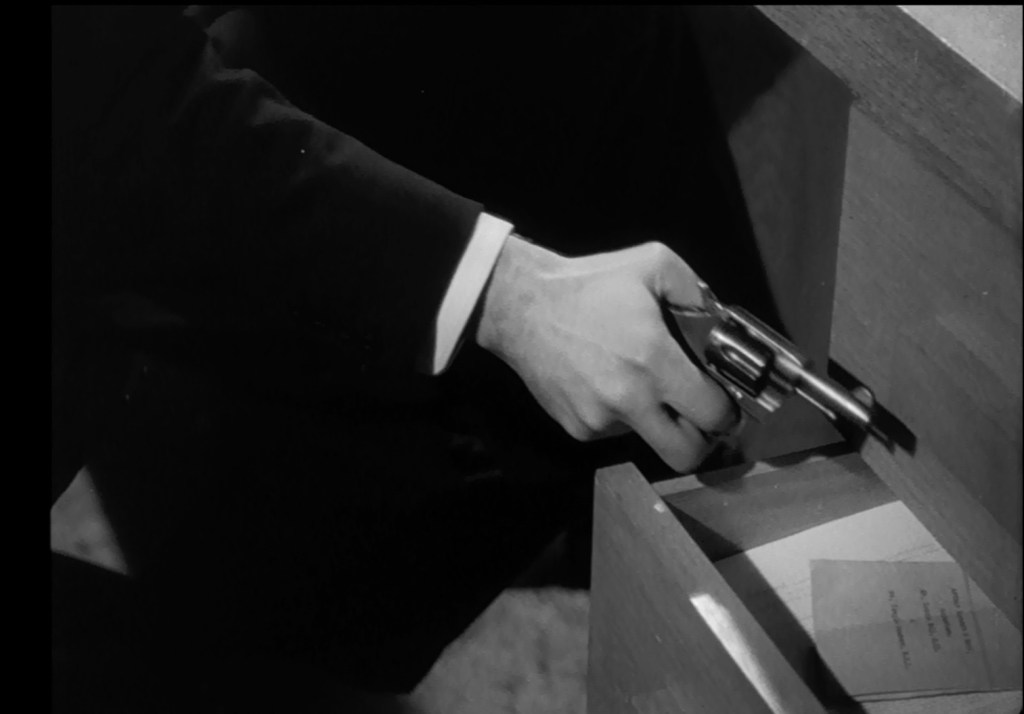
The plot of Murder in Soho is extremely thin. La Rue plays nightclub owner Steve Marco, who runs the ‘Cotton Club’ in Soho. He has just hired a new singer for the club, Ruby Lane. Steve is interested in Ruby as he thinks she has ‘class’. He doesn’t know, however, that Ruby is married (but separated from) Steve’s British associate Joe Lane. When Joe betrays Steve and steals £2000 off him, Steve kills Joe. Soon police inspector Hammond comes asking questions. He recruits Ruby to work with him and reveal Steve’s criminal activities. Also in the mix, although largely superfluous to the plot, are a journalist called Roy Barnes who frequently visits the club and falls in love with Ruby; Steve’s ex Myrtle who he has dumped in favour of Ruby; and performing duo ‘Green and Matthews’ who also work at the club.

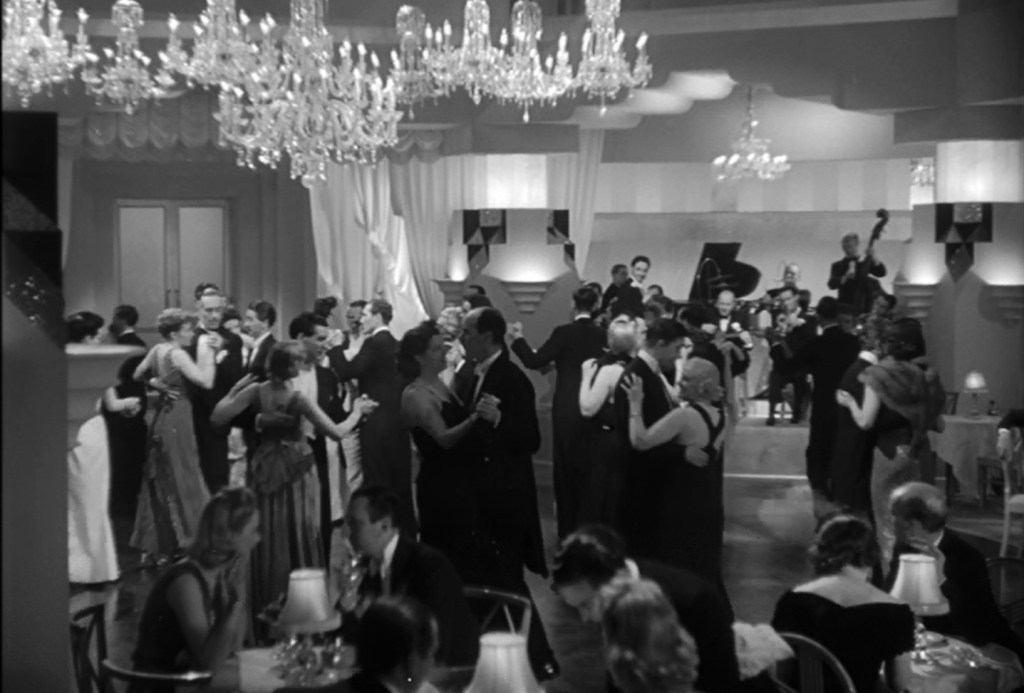
The ‘Cotton Club’ in Murder in Soho

Murder in Soho contains all the popular elements of a 1930s crime film: a nightclub; an international criminal gang; a singer; a police inspector; a journalist. Yet these elements are not fused together with a compelling plot or livened up by any original ingredient. Indeed, the film’s insistence to try and introduce Americanisms into the narrative detracts even more from the action. Steve and his henchmen speak in thick Italian-American accents. The character ‘Lefty’ in particular, who is the young comedy sidekick, litters his dialogue with references to ‘dames’ and ‘cops’. The name of the club obviously refers to the famous Harlem nightclub – but there were no British Cotton Clubs and the name does not have the resonance in Britain as it would do in the United States. Steve employs Black bartenders in his club – again a practice which was much more common in the States than it was in Britain. Compared to depictions of nightclubs in other British films of the 1930s, the Cotton Club in Murder in Soho feels more like a replica of a Hollywood set than of anything resembling British nightlife.

Gun-toting American gangsters in Murder in Soho

The very opening of Murder in Soho also presents a version of Soho that was much more deliberately criminal and seedy than what is usually presented in British films. Familiar shots of the neon lights of Piccadilly Circus are interspersed with a close-up shot of a roulette table; a shot of an underground dive bar; and a shot of two prostitutes propositioning a man in an alleyway. Unlike the majority of British films of the period, which worked to preserve an image of London and Londoners as ultimately adhering to the law and to a high moral code, Murder in Soho explicitly positions Soho as a criminal space. Granted, the main criminal element in the film is foreign, but Joe Lane is British, as is Myrtle, Steve’s scorned ex who ends up killing him. Soho here is a lot seedier than the Soho portrayed in, for example, Piccadilly (1929).

Rather surprisingly, then, Murder in Soho also contains plenty of comic notes, and a few secondary characters who are only included to provide comedy relief. Most notably, the performing duo Green and Matthews, which weave throughout the narrative. Lola Matthews is portrayed by Googie Withers, who this early on in her career already had made a name for herself as an excellent comic actress. As Lola she patters on non-stop, innocently flirting with every man and completely oblivious that her dance partner Nick Green is besotted with her. A frequent club visitor whose role is simply credited as ‘Drunk’ provides diversion in scenes when he tries to eat with chop sticks or enters the dancefloor for a solo performance. These interludes do undercut the drama and suspense that the film attempts to create at other points.

Murder in Soho is a late-interwar curiosity – a film that tries to appeal to British audiences by inserting American glamour; a film that tries to be both serious and funny at the same time; and that ends up feeling like a painting-by-numbers effort that adds up to less than the sum of its parts.

The Divorce of Lady X (1938)

The Divorce of Lady X (1938)

Just as the end of the 1920s saw the introduction of sound film in British cinema, by the time the 1930s drew to a close, a new innovation was introduced: Technicolor – or more correctly, three-strip Technicolor. Earlier versions of ‘two-colour Technicolor’ had been used in Hollywood since the First World War, for example for segments of Carl Laemmle’s 1925 The Phantom of the Opera starring Lon Chaney. Three-strip Technicolor gave more realistic colour images, and is the process which is famously used in The Wizard of Oz (1939).

Technicolor required financial investment, so it took some years to bring it to Britain. The first British Technicolor film was Wings of the Morning, made in 1937. It was followed hot on its heels by a film of Britain’s most lavish film producer, Alexander Korda. A Hungarian by birth, Korda moved in Britain in the early 1930s, when he’d already worked in Hollywood and various European film industries. In 1933, he had a huge success on both sides of the Atlantic with The Private Life of Henry VIII, a lavish period piece that depicted Henry Tudor belching and stuffing his face with food at regular intervals. The role of Anne Boleyn is played by Merle Oberon, in one of her first substantial screen roles.

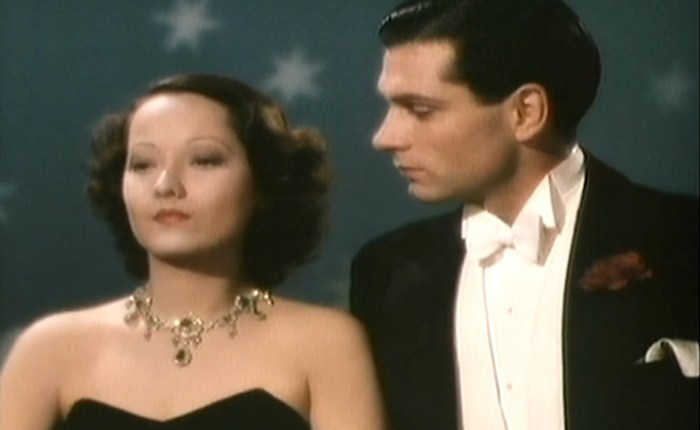
Korda cast her again as the female lead in The Scarlet Pimpernel in 1934, and also in The Private Life of Don Juan in the same year. By 1939, the pair were married, although the marriage only lasted to the end of the Second World War. During their courtship, they made The Divorce of Lady X (1938), in which Oberon stars opposite Laurence Olivier. This comedy, with its frank discussion of divorce and extramarital relations, shows how ‘propriety’ became less important in Britain towards the end of the interwar period.

The Divorce of Lady X is a re-make of a 1933 film, Counsel’s Opinion, which Korda also produced. Both films are based on a play by Gilbert Wakefield. The 1933 film, whilst favourably received upon its release, is no longer extant. The Divorce of Lady X, by contrast, was syndicated for TV release in the US in the 1940s, and is widely available on DVD and online.

The story of The Divorce of Lady X centres on that favourite trope of British interwar cinema: a man and a woman, who are not married, are forced to spend a night together in a (hotel) room. Nothing untoward happens, but everyone assumes the couple must be having an affair. A similar trope is used in Night Alone, as well as numerous Aldwych farces, such as A Cuckoo in the Nest, Rookery Nook, and Lady in Danger. In The Divorce of Lady X, Leslie Steele, a young socialite, and Everard Logan, a divorce lawyer, are thrown together due to an impenetrable fog, which leaves them both stuck in the same central-London hotel. Leslie talks Logan into sharing his suite with her – her sleeping in bed, him on a mattress in the adjacent sitting room.

Laurence Olivier as Everard Logan, getting ready for an
uncomfortable night on the floor in The Divorce of Lady X

During the course of the evening Logan incorrectly assumes Leslie is married. The next day, a member of his club, Lord Meere, comes to Logan’s office and asks him to arrange for a divorce from Lady Meere, as the latter spent the previous night in the same central-London hotel, with a man in her room. Logan assumes that Leslie, who has not given him her last name, is Lady Meere, and that he unwittingly has become both the barrister and the co-respondent in Lord Meere’s divorce suit.[1]

Logan continues to court Leslie, telling her he does not care that his career will be ruined, as long as she will marry him after she’s obtained her divorce from Lord Meere. Leslie continues to play along, although she herself has also fallen in love with Logan. Eventually, Leslie meets the real Lady Meere, and the two women concoct a plan to reveal the truth to Logan. Logan is initially embarrassed by being taken for a ride and he storms off to France, but Leslie follows him onto the boat and manages to change his mind.

Leslie (Merle Oberon) nursing a sick Logan (Laurence Olivier) on the boat to France

Right from the outset of the film, it is made clear that Logan has had multiple affairs – when Leslie comments that his pyjamas are hideous and he should dump the woman who buys them for him, he shoots back ‘we parted six months ago!’. At the same time, he rings up another woman to apologise for not being able to see her that evening, due to the fog. Although Leslie is not explicitly shown to have any lovers of her own, she is very confident and flirts with Logan in a way that makes it unlikely that he is her first love interest. The real Lady Meere, moreover, is repeatedly quoted as having had four husbands and several ‘episodes’ with other men, and at the end of the film it is made clear that she is cheating on Lord Meere. Crucially, none of this is depicted as wrong or objectionable; although all characters admit that four divorces is perhaps a bit much, Lady Meere is also shown to be a sympathetic and attractive woman. When Logan admits to his assistant that he (as he thinks) has fallen in love with a married woman, it is a matter of amusement rather than embarrassment, and divorce is depicted as largely normalised.

Lady Meere (Binnie Barnes) and Leslie (Merle Oberon)
plotting on how to break the truth to Logan (Laurence Olivier)

This representation of marriages as likely not lasting nor monogamous clearly presents a challenge when the central relationship of the film must also fulfil narrative convention. For the audience to be invested in the relationship between Leslie and Logan they must believe that it will end in a happily ever after, not a marriage that will quickly dissolve because one or both parties are conducting affairs.

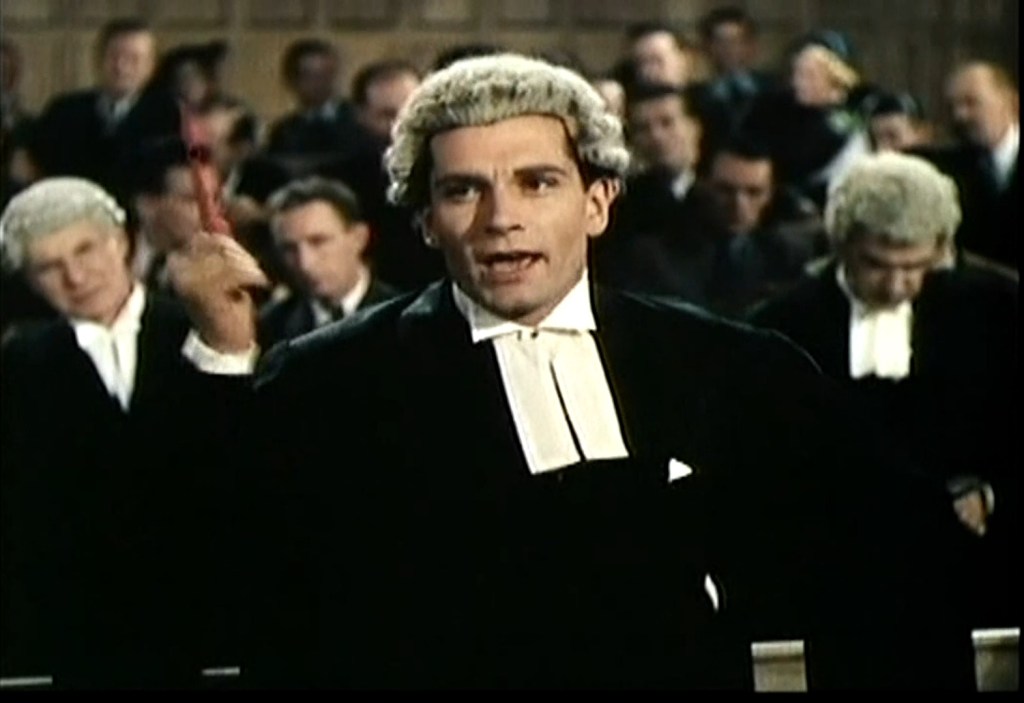
To resolve this, The Divorce of Lady X uses the trope of the woman-as-saviour: Leslie, for all her modern manners, is essentially a respectable girl. When she first meets Logan, he is extremely cynical about women, due to his experience in the divorce court. This cynicism reaches a high point during a withering closing-arguments monologue in one of his divorce cases, which Leslie witnesses from the public gallery. ‘Modern woman has disowned womanhood, and refuses man’s obligation!’ he thunders. ‘She demands freedom, but won’t accept responsibility! She insists upon time to “develop her personality”, and she spends it in cogitating on which part of her body to paint next.’

Laurence Olivier as Everard Logan, spouting against Modern Woman in court

Little wonder that Leslie is not impressed after hearing that speech! But no fear – her steadfast conviction that she is the one to save and reform Logan is rewarded in the end. When she follows him onto the boat to France at the film’s close, the choppy waters give her a chance to mother and nurture Logan. Her triumph is crowned by a final scene in the divorce court, in which Logan’s speech is the opposite of his earlier outburst. Appearing now as the defence of the woman accused of divorce, rather than as counsel for the husband, Logan gushes that his client is ‘a woman – that unique and perfect achievement of the human species (…) especially evolved for the comfort and solace of man.’ The message is clear: Leslie has managed to persuade Logan that married life is, after all, best. The open discussion of, and jokes about, divorce that form the backbone of The Divorce of Lady X point towards the ‘permissive society’ of post-War Britain; but its resolution of the protagonists’ story in a traditional marriage shows that in the 1930s the stability of conservative traditions still held sway.

The Divorce of Lady X can be viewed on the PBS website.


[1] In British divorce law, a co-respondent is a person cited in a divorce case as having committed adultery with the respondent ie. the half of the couple not initiating the divorce.

Kate Meyrick’s Private Diaries

Kate Meyrick’s Private Diaries

Kate Meyrick was known as the ‘Nightclub Queen’ in interwar London. She ran a string of nightclubs, of which the ‘43’ in Gerrard Street was the best-known. Nightclubs operated on the edge of the law – a club in itself was not an illegal space, but if alcohol was sold outside of hours permitted by the club’s license, the club owner could face hefty fines or even prison time. Additionally, clubs were supposed to only be open to members, who paid yearly subscriptions and were known to be of good character. In practice, Meyrick and other club owners generally allowed guests to become ‘members’ upon arrival.

Kate Meyrick made substantial money from her nightclub ventures, although they also cost her a lot to maintain. Her career effectively ended when it was revealed in 1929 that she had been bribing Police Sergeant George Goddard.[1] Goddard would tip Meyrick off if any of her clubs were likely to get raided, so that she could make sure no illegal activity was taking place in them.[2] Both Goddard and Meyrick were convicted – the latter to fifteen months’ hard labour which negatively impacted her health.

Throughout Meyrick’s career as a nightclub owner, she had become a well-known public figure, recognizable from press reports to those who would never get close to setting a foot in her clubs. After her death in 1933, publisher John Long published her memoirs, The Secrets of the 43.[3] Extracts from her ‘private diaries’ were subsequently serialised in the Sunday Express. These posthumous publications show how Meyrick’s family worked to shape her public image from convicted criminal to caring mother.

Meyrick had eight children, and professed that her main goal in entering the nightclub business was to give her family financial support. Many of her children entered her business as managers and staff in her ever-expanding network of clubs. Although Meyrick did not leave her children much capital when she passed, she had been able to secure advantageous marriages for most of them. Mary, one of Meyrick’s eldest daughters, married the Earl of Kinnoull. It was with his introduction that Meyrick’s diaries were published in the Sunday Express, giving them an aura of respectability.

In his introduction, the Earl calls his mother-in-law a ‘remarkable’ and ‘dynamic’ woman who hoped to give her children ‘brilliant chances she had been so determined they should enjoy.’[4] Her decision to start selling alcohol illegally is framed as the only option she had to make money for her children, as well as a result of her ‘impulsive nature’. The subsequent move through periods of financial success followed by raids, fines and prison sentences is related as ‘the slow slipping of the power of wealth from her fingers, her powerlessness to help her children as she longed to do.’

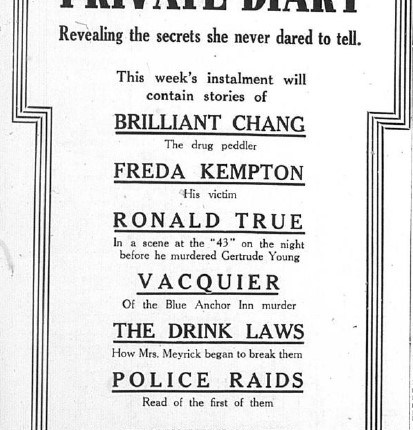
Advert in the Daily Express of 4 March 1933

The diary serialisation was advertised by the Sunday Express with reference to the notorious criminals Meyrick had hosted in her clubs, consciously tightening the public’s association between nightclubs and serious crime. If we accept the printed diaries as accurate copies of what Meyrick recorded, she herself was also eager to align herself and her clubs with notorious criminal cases. She describes that Ronald True, who was convicted of the murder of Gertrude Young, was in the ‘43’ the night before his arrest:

Have just seen the account of the arrest of Ronald True for the murder of Gertrude Young. He was in the 43 last night. Wonder if I am psychic? I went downstairs at 4 a.m. to stop the band, and ask them to come up to the first floor. When I went upstairs I felt I must turn round. When I did turn I found Ronald True gazing at me with murder in his eyes. (…) I suppose I ought to have warned somebody. But who?[5]

True was arrested on 9 March 1922 and was therefore in the club on 8 March – Gertrude Young had been murdered on 6 March, so any warning Meyrick could have given would not have saved her life. The ‘murder’ in True’s eyes was presumably imagined by Meyrick after she heard of his arrest.

This didn’t dissuade Meyrick from believing in her psychic abilities. She raises the topic again when she describes allegedly greeting Patrick Mahon in one of her clubs, shortly before he is arrested for the ‘Crumbles murder’; one of the more graphic murders to take place in England in the 1920s.

He [Mahon] was only in last week. How dreadful to think I shook hands with a murderer. (…) I am sure I am psychic. Just as in the case of Ronald True, Mahon’s eyes impressed me. They were not like the eyes of ordinary people: there was something behind them.[6]

Through the publication of Meyrick’s autobiography and diaries, her family were able to exercise control over her public image, which in turn affected their own reputations. By downplaying the illegal activities in which Meyrick had participated and foregrounding her commitment to her children, the Earl of Kinnoull was presenting his mother-in-law as a courageous and hardworking woman. He also profited from her by selling her diary to a newspaper. The Sunday Express, in the meantime, milked Meyrick’s proximity to notoriety to boost its own circulation. After her death, Meyrick’s own words became a tool for others to use.


[1] Heather Shore, ‘Constable dances with instructress’: the police and the Queen of Nightclubs in inter-war London’, Social History, (2013) Vol. 38, No. 2, 183–202, p. 199

[2] Clive Emsley, ‘Sergeant Goddard: the story of a rotten apple or a diseased orchard?’ In: Srebnik, Amy Gilman and Levy, Rene eds. Crime and culture: an historical perspective. Advances in Criminology (Aldershot, UK: Ashgate, 2005), pp. 85–104

[3] Kate Meyrick, The Secrets of the 43 (London: John Long, 1933)

[4] Earl of Kinnoull, ‘The Things She Could Never Tell’, Sunday Express, 25 February 1933, p. 9

[5] ‘Sergeant Goddard’s First Raid’, Sunday Express, 5 March 1933, p. 13

[6] ‘Valentino – Mahon – Kreuger – and Jimmy White’, Sunday Express, 12 March 1933, p. 13

First a Girl (1935)

First a Girl (1935)

Musical star Jessie Matthews was at the prime of her career in 1935 when she starred as the lead in First a Girl.[1] This musical comedy directed by Victor Saville is one version of a popular film plot; it is a remake of the German comedy Viktor und Viktoria (1933), which was re-made in West Germany in 1957, and most famously adapted by Hollywood in 1982, as Victor/Victoria starring Julie Andrews.

The basic plot of all four films, including First a Girl, is similar. An aspiring stage actress (in the British film she’s called Elizabeth, and naturally is played by Matthews) meets Victor, an actor who aspires to Shakespeare but in reality performs as a female impersonator. When a bad cold prevents Victor from performing one evening, he persuades Elizabeth to take his place, by pretending to be a man who pretends to be a woman. This is a great success, and ‘Victoria’ quickly becomes an international star, forcing Elizabeth to appear as a man when in public. Things get complicated when Elizabeth falls in love with a (straight) man, who believes her to be a man also.

Whilst both the 1933 original and the 1982 American version are regularly interpreted as queer films, First a Girl underplays the homosexual possibilities of Elizabeth’s flirtation with her male love interest. This is partly due to Matthews’ own appearance. As The New York Times noted upon First a Girl’s US release in 1936:

Normally it is with sorrow and self-hatred that this column hints at the inadequacies of a star, but this time it is a distinct pleasure to call Miss Matthews’s acting performance hopelessly bad. In “First a Girl” she is pretending to be a man and making no headway at all, except with the members of her supporting cast, who swoon with astonishment upon discovering her sex. 

Quite beside Matthew’s obviously feminine appearance, First a Girl underplays any potential sexual tension between Elizabeth and her love interest, Robert, until Robert understands that Elizabeth is a woman. Prior to that point, the film focuses on the comedic potential of Elizbeth’s cross-dressing, rather than any transgressive possibilities in her relationship with Robert.

Jessie Matthews as ‘Victoria’, appearing with Sonnie Hale, in First a Girl

All versions of the film appear to include a similar sequence in which ‘Victoria’ is ‘forced’ to perform activities which are coded as specifically masculine, to comic effect. In First a Girl this sequence is set in a Parisian nightclub, where Victor and Elizabeth find themselves during their European tour. Elizabeth has to wear a tuxedo here, and hangs out at the bar with Robert – a part of the club only available to men. She quickly gets drunk when trying to keep up with Robert’s rate of drinking, and struggles when trying to smoke a cigar. Whilst these scenes give Matthews an opportunity to display her comedic talent, they also undermine her sexual capital whilst she is performing as a man. As soon as Elizabeth’s true gender identity is revealed to Robert, she turns from an unsophisticated youth into a charming young woman.

It is significant that these scenes of gender-bending performance are set in Paris – a location that invited connotations of licentiousness and sexual transgression in the British popular imagination of the 1930s. Interestingly, in the 1933 German film, ‘Victoria’ is in London when forced to undertake activities which may ‘out’ her as a woman. ‘Victoria’ finds herself in an environment that is both literally and figuratively foreign to her.

As Jeffrey Richards points out, male and female impersonation had a long tradition on the British theatrical and music hall stage.[2] The character of Victor, then, works well in this British film. He is portrayed as older than Elizabeth (although actor Sonnie Hale was only five years Matthews’ senior) and can easily be read as a music hall performer in the Victorian tradition. His female impersonation act is purely comic, whilst Elizabeth’s is sophisticated. He links the film’s plot to a specifically British performance tradition, whereas the glossy song-and-dance numbers performed by Elizabeth have more in common with Hollywood productions.[3] The film makes no explicit reference to its German origins.

First a Girl, then, significantly dilutes the queer and transgressive possibilities of the original source material, which allowed the film to flourish in interwar Britain. According to the BFI, it was a great commercial success when it was released (something also suggested by its export to the US the following year). It remains a very watchable and enjoyable film for modern audiences; and a good example of how British interwar filmmakers moderated both European and Hollywood influences to arrive at a British compromise between the two.

First a Girl is available for rental on BFI Player (UK only)


[1] Jeffrey Richards, The Age of the Dream Palace: Cinema and Society in 1930s Britain (London: IB Tauris, 2010), pp. 217-218

[2] Ibid., p. 218

[3] This is not unusual for Jessie Matthews films. See Sarah Street, ‘Got to Dance my Way to Heaven’: Jessie Matthews, art deco and the British musical of the 1930s, Studies in European Cinema, 2:1, (2005), 19-30

Night Alone (1938)

Night Alone (1938)

The 69 comedies produced in Britain in 1938 include two George Formby vehicles (I see Ice! and It’s in the Air), Break the News starring Jack Buchanan and Maurice Chevalier, and the marital comedy Night Alone. With a modest run-time of one hour and 16 minutes, the film nevertheless manages to combine a comedy about misunderstandings between husband and wife with a sub-plot involving the international smuggling of fraudulent banknotes.

By the tail end of the 1930s, the British film industry was steadily producing upwards of 150 films a year, and the majority of them were comedies. Comedy is more culturally specific than crime or melodrama, and cheaper to produce. Despite their increased output, British film studios could not usually hope to compete with high-budget Hollywood productions.

Welsh actor Emlyn Williams (who in the same year starred in the hard-boiled They Drive By Night) plays Charles Seaton, a solicitor who for seven years has been happily married to Barbara (Lesley Brook). Whilst on route to visit Barbara’s sister Vi, and see Vi’s daughter in a school play, Charles is unexpectedly detained by urgent business. This means the couple have to spend a night apart for the first time in seven years: Charles in a hotel and Barbara at Vi’s house. Despite Charles’ best intentions to stay in his room for a quiet night in, when he meets his old friend Tommy, he is persuaded to go to a nightclub in Villiers Street. Vi, at the same time, needles Barbara to the point that she starts doubting Charles’ loyalty.

A fair portion of the film is set in the nightclub that Charles, Tommy and two of Tommy’s friends, Gloria and Celia, visit. By 1938, the perceived threat of nightclubs to society had mellowed to the point that the film can joke about the club’s dubious legal status. When Tommy first tries to persuade Charles that he should come out, Charles tries to get out of it by arguing that he is not a member of the nightclub. ‘All you have to do is put a bob in a slot machine and you’re a member for life!’ scoffs Tommy. Towards the end of the film, when Tommy has to give an account of the party’s movements to a police officer, he immediately gives a fake name and address, on the assumption that he is part of a regular nightclub raid and will be let off with a warning.  

Tommy is presented as a bit dim-witted, but ultimately harmless and fun; he certainly knows how to behave in the nightclub. Charles inability to do the same, and his awkwardness in the pub, is played up for its comedic value. After his initial refusal to dance, he sits at the table with Celia, who appears to be in league with the nightclub staff. She first gestures over the cigarette seller. Charles agrees to buy a cigar, but baulks when he’s told it will cost 10 shillings. He then feels obliged to buy a packet of cigarettes instead, even though that is still overpriced at 4 shillings. Celia then waves the girl who sells chocolates, over. Charles again feels that decency compels him to buy some chocolates for Celia, even though they cost 25s and the girl does not give him any change.

Later in the evening, Charles shares a few dances with Gloria, with whom he gets on much better than with Celia. In his nervousness, Charles keeps drinking until he passes out. The other three manage to get him out of the club and into Gloria’s apartment, which is nearby. Celia and Tommy head out again, and Gloria is about to settle in on the couch when her American boyfriend unexpectedly shows up. He has just arrived by plane from Paris with a suitcase of forged banknotes, and the police are hot on his heels. Gloria and he escape the flat, leaving the drunk Charles snoring on the bed. When the police raid the flat shortly afterwards, they arrest Charles as an accomplice to the smuggling and put him in a cell for the rest of the night. The next morning, Charles has to try his hardest to get back to the hotel before Barbara and Vi come back. He manages to do so with seconds to spare and Barbara believes him when he says he’s not left the hotel all night: marital bliss is restored.

Charles has several dances with Gloria and the pair share light-hearted jokes (sample: Charles: ‘I’m not as young as I look’; Gloria: ‘You don’t look young at all’). It is not until Charles thinks he’s about to be arrested for forgery that he is concerned about Barbara finding out what has happened during the night. Night Alone presents Charles initial devotion to his wife and his quiet life as unnatural and comic. In line with other popular comedies of the time, such as the Aldwych farce A Cuckoo in the Nest, the narrative suggests that there is nothing wrong with spending a night in another woman’s flat, as long as your wife doesn’t find out about it.

Barbara, for her part, is admired by one of the other parents at the school play. Vi encourages her to enjoy a little flirtation on the grounds that Charles is bound to be doing the same. The ‘flirtation’ goes no further than an awkward, stilted conversation between Barbara and the man. Her refusal to engage with the man is part of her virtue as a wife, as is her blind belief that Charles would never do anything untoward. Barbara is constantly compared to Vi, whose cynicism and jokes about sex mark her out as coarse, in the same way Tommy is shown to be unreliable compared to Charles. Vi and Tommy are a lot of fun to watch but Night Alone makes it clear that the reward of a stable marriage with trust and companionship is worth more than short-term fun and entertainment.