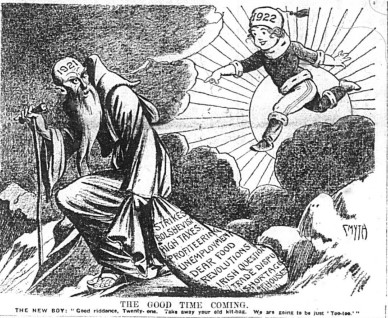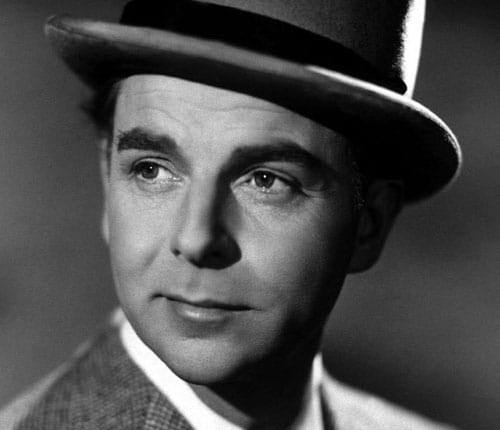
Emlyn Williams

Emlyn Williams

George Emlyn Williams was born in the tiny Welsh village of Pen-y-ffordd in 1905. As a Welshman with dark colouring and an unusual name, Williams appeared very different from popular interwar actors such as Laurence Olivier and Brian Aherne, both of whom performed in West End theatre at the same time. Unlike that other famous Welshman of the period, Ivor Novello, Williams steered clear of musical theatre and nightclubs in favour of writing and performing in plays exploring murder and criminal psychology.

After attending grammar school and undertaking some schooling in France on a scholarship, Williams won a scholarship to Oxford, where he became involved with the Oxford University Dramatic Society (OUDS). Williams was supposed to graduate in 1926, but instead of studying for his exams he wrote a play, Full Moon, which was put on at the Oxford Playhouse under the management of J.B. Fagan. Williams decided to move to London without completing his degree when Fagan offered him a small walk-on part in the production And So To Bed, in which Edmund Gwenn and Yvonne Arnaud appeared as the principal players.[1]

This modest role marked the start of a long West End career, in which Williams combined acting with writing and directing, regularly casting himself as the lead for his own productions. In his autobiography, Williams presents the years from 1926 to 1935 as ones in which he finds his feet both professionally and in his personal life. After numerous failures and some mild successes, the book ends with the first West End performance of his play Night Must Fall, which Williams credits as his ‘first solid success’[2] – it ran for a year and a half before transferring to Broadway for another 64 performances.

Night Must Fall is based on a notorious murder case of the interwar period, the ‘Crumbles Murder’ case of 1924. Patrick Mahon, a charming Richmond-based salesman, struck up an extramarital affair with typist Emily Kaye. Kaye fell pregnant, and Mahon led her to believe that they would travel to South Africa to start a new life together. Instead, he murdered her in a cottage on the Sussex coast and dismembered and destroyed her body so thoroughly that very little of it was found during the police investigation. What particularly spoke to the public’s imagination is that, less than 48 hours after the murder, Mahon picked up another woman and spent a few days at the cottage with her, whilst Kaye’s partly-dismembered body was in the next room.[3]

Williams combined this story with the equally notorious murder perpetrated by Sidney Fox, who in 1929 killed his own mother by strangling her and subsequently set her hotel room on fire to cover his tracks. In Night Must Fall, Dan, a charming man (modelled on Patrick Mahon) strikes up a friendship with a rich but cranky old lady and her niece Olivia. Whilst the niece suspects that Dan is a murderer, she still falls in love with him and helps him stay out of the hands of the police. Eventually, Dan murders the old lady and steals her money – although Olivia wants to help Dan escape, the play ends with him being arrested.

In his autobiography, Williams states that he had initially been interested in adapting the story of Fritz Haarman, a German serial killer who murdered at least 27 boys and young men in Hanover, in 1924. Williams was bisexual and identified with Haarman’s young victims: poor or homeless men, in some instances selling sex for money, lured back to Haarman’s flat with promises of food and shelter. ‘Yes, it could have happened to me’, acknowledges Williams. Although the story is clearly close to his heart, British theatre censorship laws absolutely precluded the depiction of a homosexual, paedophilic murderer.[4]

Alongside this career as theatre author and actor exploring the darker side of life, Williams also appeared in films. One of his first appearances was as the comic best friend to the protagonist in the Oxford comedy Men of Tomorrow (1932). Although the film was a commercial failure, it did bring Williams exposure and he was voted the most popular British actor by the readers of Film Weekly, ahead of Leslie Howard and Jack Hulbert.[5] This in turn landed Williams with a contract at Gaumont-British, where he wrote as well as acted. His first gig with them was writing the dialogue, and starring in, Friday the Thirteenth (1933). He subsequently worked on the Jessie Matthews vehicle Evergreen and supplied dialogue for the 1934 Hitchcock film The Man Who Knew Too Much.

Although his contract with Gaumont was not renewed beyond 1935, Williams stayed active in film for the remainder of the interwar period, and beyond. As well as adapting Night Must Fall for the screen, he also acted in a range of genres such as the comedy Night Alone and the thriller They Drive By Night (both 1938). In 1936, he was cast as Caligula in Joseph von Sternberg’s unfinished I, Claudius, opposite other such greats at Charles Laughton, Flora Robson, and Merle Oberon.

Later in his career, Williams toured with an innovative one-man theatre show called Emlyn Williams as Charles Dickens, in which he delivered parts of Dickens’ novels in a manner similar to how Dickens himself toured in the 19th century. He remained interested in murder, and wrote a book about the Moors murders in 1968. Williams continued to be active as a writer and actor until close to his death in 1987.


[1] Emlyn Williams, Emlyn: A sequel to George (London: Penguin, 1976), p. 13

[2] Ibid., p. 449

[3] Colin Evans, The father of forensics: the groundbreaking cases of Sir Bernard Spilsbury and the beginnings of modern CSI (Thriplow: Icon, 2007), pp. 140-147

[4] Williams, Emlyn, pp. 213-221

[5] Ibid., 319
New Year’s Eve 1921

New Year’s Eve 1921

For this last blog post of the year we’re travelling back in time 100 years, to have a look at how London spent New Year’s Eve in 1921.

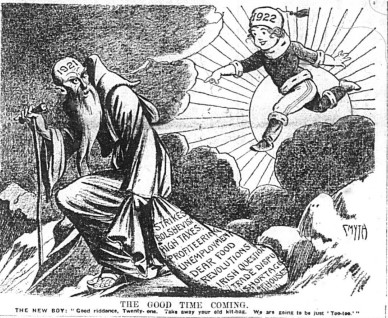
In 1921, 31 December fell on a Saturday, so the Sunday papers had the privilege of welcoming in the new year. The News of the World posted this cartoon on its front page, under the banner ‘A Happy New Year to All of Our Readers’.

Cartoon printed on the front page of News of the World, 1 January 1922

1921 appears to have been considered a year well worth saying goodbye to: the old man representing the past year carries a sack containing, amongst other things, ‘Bolshevism’; ‘Revolutions’ and ‘Shortage of Houses’. These, along with ‘Profiteering’ and ‘Unemployment’, indicate that the impact of the Great War on British society had continued to reverberate. The custom of depicting the previous year as an old person and the new year as a youngster was common, as evidenced by the following report in the Daily Telegraph:

Never has a New Year been welcomed with more public rejoicing and festivity in London than that upon which we have just entered. (…) all the great London hotels and restaurants were crowded with guests, for whom elaborate programmes of feast and entertainment had been arranged, including in most cases some novel and exhilarating means of marking at midnight the death of the Old and the birth of the New Year.[1]

Probably the most extravagant party was held in the Savoy, which catered for either 1600 or 1750 guests (numbers given by the Daily Telegraph and Evening Standard respectively). The distinguished guests, which included Lord Curzon, watched as a recording of Big Ben, projected on a screen, counted down the minutes to midnight.[2] Another notable entertainment was given in the Hotel Victoria, where a miniature airplane carrying a little girl appeared to descend out of the ceiling.[3]

Crowds were not just found inside hotels and restaurants, but also in the churchyard of St Paul’s Cathedral: ‘The crowd which gathered from East and West within the shadow of St Paul’s Cathedral on Saturday night to sing “Auld Lang Syne” was a record one.’[4] This ‘record’ size crowd was unlikely to have only contained ‘London Scots’ as the Daily Telegraph article supposed: the crowd as so great as to make it ‘almost impossible to move.’[5]

Whilst the parties in the hotels and restaurants were only accessible to the wealthy, the poor were not forgotten. The Daily Telegraph reported that some 18,000 deserving children in various East London boroughs had been treated to a special meal earlier in the day.[6]

The Observer looked beyond the London festivities and reminded readers that half the world welcomes the New Year before Britain does, with festivities starting in a ‘small group of islands which belong to New Zealand.’[7] The article also points out that those countries using the ‘inaccurate Julian calendar’ would not be celebrating the New Year until a few weeks later. The article expresses the hope that the newly founded League of Nations may eventually ‘bring about international uniformity in the matter of the calendar and thus ensure a simultaneous celebration of the birth of the New Year among the nations of the Earth.’[8]

In contrast to these reports of parties and celebrations, the Manchester Guardian instead reported on ‘The Old Year’s Violent Passing.’[9] Whilst Londoners were celebrating, other parts of the country experienced forceful gales which particularly affected those living near the sea and rivers and which lead to ‘Wrecks, Heavy Damage, and Loss of Life.’

The other New Year’s tradition was (and is) the publication of the New Year’s honours list, which was reported in full by the Manchester Guardian and The Times but ignored by the more popular papers. Sir J.M. Barrie, who had been made baronet in 1913, was made a member of the Order of Merit in 1922; Gerald du Maurier received his knighthood.[10]

By the time the afternoon of 2 January rolled around, news about the New Year parties already had to make way for developments in what would become one of the most notorious murder cases of the interwar period. The Evening Standard announced a ‘Solicitor’s Sensational Arrest’ on its front page.[11] Over the weekend, whilst everyone had been distracted by the gale force winds and the parties, police in Hay, near the Welsh border, had arrested Herbert Rowse Armstrong, who ran one of the two local law practices.

Armstrong was arrested for the attempted murder of Oswald Norman Martin, a solicitor at the rival firm. By the time the Evening Standard appeared in the stands, the body of Armstrong’s late wife had been exhumed. Upon re-examination it was concluded that she, too, had been poisoned. Armstrong was eventually convicted of her murder and executed – the only solicitor in British history to be hanged for murder. The arrest of the ‘Hay Poisoner’ ensured that 1922 started with the familiar thrill of, as George Orwell would have it, a good old-fashioned English murder.


[1] ‘New Year’s Eve’, The Daily Telegraph, 2 January 1922, p. 6

[2] Ibid., and ‘A Londoner’s Diary’, Evening Standard, 2 January 1922, p. 4

[3] ‘Revels Greet 1922,’ Daily Mail, 2 January 1922, p. 4

[4] ‘Revels Greet 1922’, Daily Mail, 2 January 1922, p. 4

[5] ‘New Year’s Eve’, The Daily Telegraph, 2 January 1922, p. 6

[6] Ibid.

[7] These islands are Tonga, Samoa and Kiribati. ‘The Journey of the New Year’, The Observer, 1 January 1922, p. 9

[8] Ibid.

[9] ‘The Old Year’s Violent Passing’, Manchester Guardian, 2 January 1922, p. 7

[10] ‘New Year Honours,’ Manchester Guardian, 2 January 1922, p. 7

[11] ‘Solicitor’s Sensational Arrest’, Evening Standard, 2 January 1922, p.1

E.M. Delafield – Messalina of the Suburbs (1924)

In 1924, six years before she would become a household name with her Diary of a Provincial Lady, E.M Delafield penned Messalina of the Suburbs, a fictionalised take on one of the most notorious murder trials of interwar Britain. In December 1922, Edith Thompson and her lover Frederick Bywaters were convicted of the murder of Edith’s husband, Percy. They were both hanged, despite the fact that it was Bywaters who stabbed Percy Thompson, and Edith claimed not to have any knowledge that he would do this. At the time, some newspapers launched a campaign to have Bywaters’ sentence commuted or quashed; as historian Lucy Bland notes drily: ‘No public steps were taken at the time on behalf of Edith.’[1] More recently, the case has been re-assessed in favour of Edith’s innocence; there is even a dedicated website that argues her conviction was a miscarriage of justice.

In Messalina of the Suburbs book, Delafield imagines one version of events that could have led to Edith (Elsie in the book) ending up in an unhappy marriage, with a lover who kills her husband. Against the prevailing attitude of the time, Delafield is surprisingly sympathetic to Elsie, without shying away from her more questionable decisions.

The book starts with Elsie as a teenager, living with her sister in the boarding house run by their mother. Elsie is already aware that men find her attractive; in the book’s opening she agrees to go to the cinema with an (older) male lodger, and does not protest when he kisses her. Delafield describes going to the cinema as a sensual experience for Elsie, foregrounding her sexuality:

To-night, as she entered the hot, dark, enervating atmosphere of the cinema theatre, she thrilled in response to the contrast with the street outside. When she heard the loud, emphasised rhythm of a waltz coming from the piano beneath the screen, little shivers of joy ran through her.[2]

After this escapade with the lodger, Elsie ends up working as a live-in help with a doctor and his wife. Before long, the doctor makes advances to her, which culminates in the pair having sex several times. Needless to say, even describing sexual relations between a married man and a younger woman was daring on the part of Delafield. But the scenes also make clear that the doctor is using Elsie for his gratification, with little regard for her well-being. When the doctor’s wife starts to realise what is going on, it’s Elsie who has to pack her bags.

Her next job is as a clerk in the office of Mr Williams, a lawyer. Initially, Elsie thinks the job will be very boring, but she cheers herself up by dressing up for her first day of work:

Elsie spent the week-end in cutting out and making for herself a blue crepe blouse, which she intended to wear on Monday morning. She also made a pair of black alpaca sleeves, with elastic at the wrist and at the elbow, to be drawn on over the blouse while she was working. She put the sleeves, her shorthand pad and pencil, a powder-puff, mirror, pocket-comb, and a paper-covered novel in a small attaché case on Monday morning, pulled on the rakish black velvet tam-o’-shanter, and went off to Mr. Williams’ office.[3]

This quote captures how Delafield consistently presents Elsie as a slightly childish innocent. Although she is aware of her effect on men, and enjoys physical relations with them, she is hardly a calculating vamp.

At the law office, Williams, too, starts flirting with Elsie, and suggests that she go with him on a weekend to the seaside. At this point, Elsie’s friend Irene advises her that she should hold out, as that will persuade Williams to marry her. Marriage represents safety and stability, and both the doctor and Williams indicate to Elsie that her sexual experience lowers her ‘value’. Elsie manages to persuade Williams to marry her by holding off all his sexual advances. Williams tells her that he respects her propriety – but as soon as they get married he makes it clear that she is now his property and he gets to decide what she does, when, and with whom.

Trapped in this stifling marriage with a man she does not find attractive, Elsie eventually meets ‘Morrison’, a friend of her sister’s. From this point, Messalina of the Suburbs largely follows the real-life narrative of Thompson and Bywaters, including the romantic letters they wrote (she destroyed his letters, he didn’t destroy hers – something that weighed heavily against her during the trial) and the fateful events of the final evening. It is here, at the end of the novel, that Delafield makes her sympathies most clear. There is no doubt at all for the reader that Elsie has no idea that Morrison is going to kill Williams. There is no suggestion that she is the mastermind behind the plan, or that she spurred him on to do it, which were suggestions made during the trial. Instead, Elsie’s naiveté and her repeated abuse by men land her in the dock, where the novel ends.

That Messalina of the Suburbs was somewhat controversial is clear from the reviews it received. It was not reviewed very widely, and mostly in the local papers. The most positive review appeared in the Yorkshire Post & Leeds Intelligencer on 16 April 1924:

a powerful psychological reconstruction of the woman in a recent murder case. (…) Miss Delafield does more to make comprehensible the motives of the unhappy and blundering woman than any of the more scientific analyses have succeeded in doing.(…) The story is not pleasant, but it is well told. Miss Delafield knows with incredible intuition the hearts of the lower middle classes’[4] 

The review implies that the writer and readers of the book are of a different species than the ‘lower middle classes’ which populate the novel. Nonetheless, the reviewer appears to grasp and approve of the ultimately sympathetic portrayal at the novel’s core. Other reviewers were not so generous, instead protesting that the novel had no reason to exist. The review in the Westminster Gazette stated

Miss Delafield tells the story very well; but, whether, merely as an exercise in fiction, it was worth telling or not is another matter[5]

and the Birmingham Daily Gazette grumbled that

Whether it was worthwhile thus recalling a sordid tragedy eighteen months afterwards is a little doubtful, but the analysis of indiscipline is very skilful.[6]

Somewhat surprisingly, the most negative review appeared in Common Cause, the newspaper of the National Union of Women’s Suffrage Societies:

the characters in this novel are so unrelievedly sordid that there is little pleasure to be derived from their acquaintance.[7]

Delafield’s psychological analysis did not win her many fans, and her career did not take off until she returned to writing the comic works for which she is now best known. With Messalina of the Suburbs, however, she demonstrated a real sensibility for the complex character of Edith Thompson, and an acute awareness of the structural exploitation young women faced, which could lead to devastating consequences.


[1] Lucy Bland, ‘The Trials and Tribulations of Edith Thompson: The Capital Crime of Sexual Incitement in1920s England’, Journal of British Studies, Vol. 47, No. 3 (Jul., 2008), p. 645

[2] E.M. Delafield, Messalina of the Suburbs (London: Hutchinson, 1924), p. 16

[3] Ibid. p. 64

[4] ‘Messalina of the Suburbs’, Yorkshire Post & Leeds Intelligencer, 16 April 1924, p. 4

[5] ‘A Bold, Bad Girl’, Westminster Gazette, 4 June 1924, p. 5

[6] ‘An Ilford Novel’, Birmingham Daily Gazette, 14 April 1924, p. 4

[7] ‘Messalina of the Suburbs’, Common Cause, 16 May 1924, p. 6

The Lodger (1927 and 1932)

This post is the second of a two-part mini series about Marie Belloc Lowndes’ story The Lodger. The first post considers the short story and novel Lowndes wrote. This post discusses two film adaptations of the book made in interwar Britain.

Marie Belloc Lowndes novel The Lodger, which appeared in 1913, was twice adapted for the screen during the British interwar period. The first, silent, adaptation was directed by Hitchcock in 1927; a sound remake directed by Maurice Elvey appeared five years later. Building on last week’s post which considered the differences between the short story version of The Lodger and the novelisation, this post unpicks the differences between the novel and the films.

The main difference between the novel and the screen adaptations is the identity of the Lodger. In the novel, there is no doubt that the lodger, Mr Sleuth, is responsible for a series of murders of women across London. The book’s tension is generated by the concern of Mr Sleuth’s landlady, Mrs Bunting, that the police are going to find out her lodger is a murderer, and how that will impact her own position. In both film versions of the story, the lodger is ultimately revealed to be a ‘good’ character, who is trailing the murderer in an attempt to stop him. Whilst Mrs Bunting in both films is equally as suspicious of her lodger, because he keeps leaving the house on nights that murders are committed, he is ultimately revealed to have honourable reasons for this.

Hitchcock has publicly claimed that this softer ending was foisted on him, and that he preferred the book’s ending. One presumes that the sound remake followed the same template for the sake of appeasing audiences familiar with the first film. Whilst the change makes the story feel a lot less sinister, it also aligns it more with expected film plots in which the main male character is revealed as a hero and suitable love interest for the female character.

This female character, Daisy (Mr Bunting’s daughter), is much more fleshed out in both films than she is in the book. The role is played by June Tripp in the first film, and by Elizabeth Allan in the second film. In the novel, Daisy is only present in the house every now and then, and she only meets Mr Sleuth face to face right at the book’s end. Generally, Daisy comes across as a bit dim and easily led. In a reflection of women’s increased participation in the workforce during the interwar years, Daisy has a job in both films. In the 1927 version, she is a mannequin for clothes – it is a job, but still one in which she is expected to be passive and decorative. In the 1932 film her job has changed to that of a telephone operator; in that capacity she overhears one of the murders as the victim desperately tries to ring for help.

In the films, Daisy plays a much more material part in the story, and her relationship with the Lodger is more substantial. In both films, she meets him at several points throughout the story and is on friendly terms with him. The fact that the lodger is played by film star and heartthrob Ivor Novello in both productions helps to present him as a viable love interest for Daisy. In the 1932 film, Daisy goes so far as to reject her original boyfriend in favour of the lodger. Again, these changes, which introduce a conventional young romance into the story, make the source material conform more closely to cinematic genre conventions.

Daisy’s original boyfriend, Joe Chandler in the book, also transforms between films. In the Hitchcock version, Joe is a police officer tasked with hunting down the murder, as he is in the novel. Like in the novel, Joe is oblivious to the possibility that the lodger is the murderer he is after – although of course unlike in the book, in the film the lodger is revealed to be innocent. Hitchcock also used the motif of the police officer who is blind to the guilt of those closest to him in his 1929 film Blackmail, so he perhaps appreciated the irony Lowndes built into the novel.

For the later film, Joe Chandler became John Martin, who is not a police officer but rather a tabloid reporter. By 1932 tabloid journalists had become much more socially visible as circulation figures of newspapers rapidly increased. In films, journalists were often presented as pseudo-detectives, collaborating with the police to investigate crimes. Perhaps it was felt that to change the Joe/John character from a police officer to a journalist was not too much of a change. John Martin is a ruthless reporter; at the start of the film, when Daisy witnesses a murder across the telephone line, he passes a picture of her on to his news desk without her consent. To her horror, Daisy finds the portrait printed on the paper’s front page the next day. John excuses this behaviour as he considers it his duty to present his bosses with all the scoops he gets. John’s inconsiderate behaviour paves the way for Daisy to ditch him for the lodger at the end of the film.

A final significant change between the novel and the 1932 film, specifically, is the identity of the lodger. In the book, Mr Sleuth is presented as a British gentleman, albeit one with possibly some foreign blood in him. In the Elvey film, the character is called Angeloff, and Novello plays him with a thick Ruritanian accent. The film’s resolution reveals that Angeloff has been on the trail of the murderer for many years, and that they have both travelled from a foreign country to Britain. Whereas the novel codes the criminal as domestic, the film explicitly presents him as a foreigner, who has wreaked havoc in Britain. The audience can rest assured that such horrific crimes would not be committed by a fellow citizen.

The Lodger enjoyed considerable popularity for decades after its release. However, throughout those years the story, which was originally closely modelled on the Jack the Ripper murders, developed to increasingly deviate from the original to reflect the changing times. The main element of the story, however – a man roaming around the streets at night killing young women – sadly remains relatable to audiences even to this day.

The Lodger (1911 and 1913) – Marie Belloc Lowndes

This post is the first of a two-part mini series about Marie Belloc Lowndes story The Lodger. This first post considers the short story and novel Lowndes wrote. The next post discusses two film adaptations of the book made in interwar Britain.

Today’s post discusses two texts which were written before the Great War, but which had a great cultural impact in interwar Britain due to their popularity. The writer Marie Belloc Lowndes published her short story ‘The Lodger’ in McClure’s Magazine in 1911.[1] She then expanded the story out into a full-length novel which was published by Methuen in 1913.

The Lodger’s main character is Mrs Bunting, a retired domestic servant who lives with her husband just off the Marylebone Road. Mr and Mrs Bunting are very poor at the start of the story, until a mysterious lodger, Mr Sleuth, rents a room with them. Mr Sleuth pays handsomely, but before long Mrs Bunting gets suspicious that he may be responsible for a spate of murders in the capital. Young women are found murdered at night, and these discoveries seem to coincide with Mr Sleuth going for night-time walks.

After a few weeks, Mr Bunting’s daughter Daisy comes to stay with the family, and Mrs Bunting gets increasingly concerned that Mr Sleuth will harm Daisy if he meets her. In the book-length version of the story, there is a fifth character: Joe Chandler, a young and ambitious police officer who is a friend of the family and who is courting Daisy. As the murders start piling up, Joe often pops into the house to give the Buntings updates on the police investigation, but he never once suspects that Mr Sleuth is the killer.

The short story puts the reader in the middle of events, and then relates the arrival of Mr Sleuth into the Bunting’s house through Mrs Bunting’s internal recollections. Daisy visits the house only very briefly in this version of the story. The novelisation presents the action chronologically, and allows much more time for Mrs Bunting’s suspicions and fears to develop. It also expands on Mr Bunting’s thirst for news, which is presented almost as an addiction.

At the start of the book, when the Buntings find themselves in extreme poverty, Mr Bunting is described as buying a paper with one of his last pennies ‘[w]ith an eagerness which was mingled with shame.’[2] Throughout the book he keeps buying papers, rushing out as soon as the newspaper boys come down the street, and sometimes not even waiting to go back inside before reading them. Yet despite Mr Bunting reading every column of newsprint on the case, he does not suspect Mr Sleuth to be the murderer until he physically bumps into him on a late-night stroll and finds his coat covered in blood. In The Lodger, the newspapers sensationalise the case and function as a potentially harmful distraction for the masses, rather than aiding with the resolution of the case.

The police, also, don’t have any grasp on who the murderer may be. This theme is brought out more in the novel rather than the short story. In this expanded version, the character of Joe Chandler frequently provides the Buntings and the readers with updates on the police’s investigation. There are a few moments in the novel where accurate eye-witness accounts of Mr Sleuth are dismissed by the police. When Mrs Bunting attends the inquest of one of the murders, there is one witness who accurately describes Mr Sleuth, but he is ignored. When he tells the coroner that the murderer left the scene carrying a bag such as the one the reader knows Mr Sleuth to possess, ‘not a single reporter at the long, ink-stained table had put down that last remark of Mr. Cannot. In fact, not one of them had heard it.’[3]

When Joe Chandler follows up on a possible sighting of the murderer, ‘on one evening he described at immense length the eccentric-looking gent who had given the barmaid a sovereign, picturing Mr. Sleuth with such awful accuracy that both Bunting and Mrs. Bunting secretly and separately turned sick when they listened to him, he never showed the slightest interest in their lodger.’[4] It is Mrs Bunting, rather than the police or the reporters, who susses out very quickly that it is her lodger who is committing these crimes. Initially, she does not alert the police because her mind refuses to accept her suspicions. Later on, however, her reluctance to alert the police originates from the perceived shame that it will bring on her household. Bunting has the same fears once he gets suspicious about the lodger:

‘But Londoners of Bunting’s class have an uneasy fear of the law. To his mind it would be ruin for him and for his Ellen to be mixed up publicly in such a terrible affair. No one concerned in the business would give them and their future a thought, but it would track them to their dying day, and, above all, it would make it quite impossible for them ever to get again into a good joint situation.’[5]

Instead, Lowndes allows the Buntings to get rid of the lodger without having to report him, in an ending that is near-identical in both the short story and the novel. Daisy ends up staying with the Buntings for her 18th birthday. Mr Sleuth invites her and Mrs Bunting to come to see the waxworks in Madame Tussaud’s. Inside, a private party which includes the Head Commissioner of the Police, is just exiting the building. As they pass the Buntings and Mr Sleuth, the Commissioner is telling his guests that the police know the murderer is someone who previously committed murders elsewhere in Britain, and who had escaped a lunatic asylum just before the London murders started.

The Commissioner makes it clear he would recognise the man if he saw him again; yet when he crosses paths with Mr Sleuth on his way out of Madame Tussaud’s the Commissioner ‘passed by Mr Sleuth unconcernedly, unaware.’[6] The lodger, however, is furious; he believes Mrs Bunting tried to trap him. With an excuse, he hurries out of the Madame Tussaud emergency exit and is never seen by the Buntings again.

The Lodger was clearly inspired by the Jack the Ripper murders which took place in 1888; and whilst its ending echoes the apparent disappearance of Jack the Ripper; and it allows the Buntings to continue their lives in peace, it does leave a murderer out on the streets, ready to strike again. Throughout the story and book, Lowndes spends virtually no time at all discussing the lodger’s victims; her concern is with how the strain of secrets and suspicion affects the Buntings’ marriage. With Mr Sleuth’s exit from the scene (and, in the book, the engagement of Daisy and Joe), their troubles are resolved.

Yet no thought is spared for the women navigating the streets at night. Although the identities of these women are not made explicit, it is suggested by Mrs Bunting that they are not ‘proper’ (in the short story, she refers to one of them as a ‘hussy’, although this reference is removed in the novel[7]). The implication is that respectable people like the Buntings should look out for themselves and do not need to have qualms about protecting those less fortunate. The Lodger provides a female-centred exploration of the strains of retaining respectability at all cost, written at a time when social status was imperative to many people.

The Lodger (novel) can be read for free at Project Gutenberg.


[1] Marie Belloc Lowndes, ‘The Lodger’, reprinted in Into the London Fog: Eerie Tales from the Weird City, ed. Elizabeth Dearnley (London: British Library, 2020), pp. 199-239

[2] Marie Belloc Lowndes, The Lodger, (London: Methuen, 1913), chapter 1, accessed online: https://www.gutenberg.org/files/2014/2014-h/2014-h.htm

[3] Ibid., chapter 19

[4] Ibid., chapter 24

[5] Ibid.

[6] Lowndes, ‘The Lodger’, p. 237

[7] Lowndes, ‘The Lodger’, p. 215

Break the News (1938)

Break the News is a British film of the end of the interwar period that displays some of the ambition of the film industry at that time. The film is a remake of a 1936 French film called Le Mort en Fuite (Death on the Run). Break the News was directed by Frenchman René Clair who cast his compatriot Maurice Chevalier in one of the lead roles. The other male lead was played by Jack Buchanan, a British actor who enjoyed fame both on stage and on film. The main female role was fulfilled by June Knight, a Hollywood starlet who had come over to Europe. Buchanan also produced the film under his short-lived production vehicle Jack Buchanan Productions.

Although Clair is mostly remembered for his post-war films, he started directing in France in the mid-1920s. Break the News was his second picture in the UK, after he directed Robert Donat in the supernatural comedy The Ghost Goes West in 1936. The casting of Break the News demonstrates the high aspirations Buchanan and Clair had for the film. Buchanan had considerable star power in interwar Britain, and Chevalier was a recognised Hollywood star.[1]

The film’s plot is as internationally mobile as its stars. The action starts on the West End, where Teddy and François, played by Buchanan and Chevalier, are in the chorus of a musical comedy show. The show’s lead star is Grace Gatwick, played by Knight. Teddy and François long to have the same level of fame as Grace, so they come up with a cunning plan. After staging a face argument in their lodgings, they make it appear that François has killed Teddy, and make sure that he conspicuously tries to dump the ‘body’ in the Thames. Teddy goes off to the south of France to enjoy a holiday; the plan is that the ‘murder’ will generate a lot of newspaper publicity; François will get arrested and Teddy will dramatically return from France during the trial to ensure François gets acquitted. Both men will get famous and then they will be able to put on their own stage production.

Unfortunately, and obviously, the plan goes awry. Firstly, the anticipated media storm after the ‘murder’ does not materialise, so whilst François eventually gets arrested, the men do not get famous. Secondly, whilst in France Teddy is mistaken for a revolutionary leader of a (fictional) Balkan country, and gets kidnapped and taken back to this Ruritania. He only very narrowly manages to get out and return to Britain just in time before François is executed. This being a musical comedy, of course all is well at the end, and with the help of Grace the men do get their names in lights on the theatre façade.

The plot of Break the News, and indeed the film’s title, place great importance on the operation of the written press. The newspapers are presented as the only vehicle that can give Teddy and François the fame they long for. Fame is not dependent on talent on stage, but rather on who is able to get and keep the attention of the journalists. Grace’s character functions to demonstrate this; early on in the film she manages to create a media storm by reporting that her little dog has gone missing; and then another one when the dog is found. Once the story breaks of a ‘murder’ within her show’s production, she makes sure to put herself in front of journalists and spin the story in a way that puts herself at the centre of it.

Teddy and François also assume that a murder case will most definitely hit the front pages. Much of the comedy in the first part of the film is derived from the way the men stage the ‘murder’, starting with a phoney argument on stage in front of the whole company; moving on to a loud argument in their lodging; and finishing with François taking a black cab to Limehouse to drop a heavy, corpse-shaped parcel in the river. But what the men do not take into account is that the press are not interested in murder per se. Grace is able to generate publicity on anything because the press consider her to be interesting. François and Teddy are never interesting to journalists, no matter what they do. Whereas the men assume that the press can make someone famous, they find that in order for the press to pay attention to you, you must already be interesting or relevant yourself.

The power of the newspaper press is underscored through the implicit assumption that if the press were to write about the murder story, then Teddy and François would become instantly famous. As is often the case in interwar films, ‘the press’ is treated as a homogenous entity, and it is taken for granted that a story is either covered by all papers, or by none. Break the News shows journalists to be operating in a pack, indistinguishable from one another as they all try to get a quote from Grace. Once a story is covered, the next assumption is that the newspapers’ reach is such that the details of the story would become generally known.

The comedy of Break the News relies in a large part on the audience understanding and accepting these beliefs about how the written press operates. It is funny that the murder gets no attention from the papers, because, like Teddy and François, we assume that it would attract column inches. Whilst Break the News pokes fun at these assumptions, the jokes only work because we share the same underlying beliefs that the film’s plot is built on. In that way, Break the News gives insight in the position of the written press in interwar British society.


[1] Andrew Spicer, ‘Jack Buchanan and British Musical Comedy of the 1930s’ in Ian Concrich and Estella Trincknell (eds), Film’s Musical Moments (Edinburgh: Edinburgh University Press, 2006)

Grace Blackaller

Grace Blackaller

Grace Blackaller was born in 1909 and murdered on 9 April 1925. She was a sixteen-year-old amateur dancer who loved going to the cinema. Her murderer was her boyfriend, Ernest Rhodes, aged nineteen. Grace’s murder provided tabloid fodder for about two weeks in April 1925 and has since been completely forgotten.[1] The murder of women by their partners sadly remains so commonplace that it is still treated as ‘normal’. In Grace’s case, newspapers were also quick to suggest her own behaviour was somehow at fault.

The newspaper reports immediately after the murder, which are reasonably sympathetic to Grace, hint at a family set-up that is not straightforward. Grace lived in a lodging in Nevern Square, a few minutes from Earls’ Court tube station; according to her landlady she had lived there for four years so since they age of 12.[2] Her mother, however, lived on Challoner Street, which is on the other side of Warwick Road near West Kensington tube. Both locations are about a 15- minute walk apart.

It was on the corner of Challoner Street that Grace was attacked on that Thursday evening. She managed to get to her mother’s doorstep where ‘Her mother found her on the doorstep of her flat with a wound in her throat. Miss Blackaller could only mumble “a man attacked me” and died in hospital without revealing the secret of her murderer’s identity or any detail of the attack.”[3]

The mystery of the attack was sufficient for a number of tabloids to give the story front-page news, and to include a picture of Grace with the reports as well. Grace’s landlady told the Daily Mirror that Grace was working as a dressmaker and a dance teacher, and although ‘she went out a great deal at night to dances and things’ this was ‘like most girls these days’ and Grace had ‘never seen (…) with a boy.’[4] The Express printed a similar line, that ‘Miss Blackaller was not known to be on friendly terms with any particular man.’[5] In these initial reports, when it is assumed that the attack was conducted by a random stranger, Grace’s behaviour is represented as normal for the period and no moral judgements are made about her.

Grace Blackaller,
Daily Mirror, 11 April 1925, front page

The newspapers only changed their tune about Grace when the story developed further, and a murderer came forward. Press reports no longer presented Grace as a wholesome girl who had fallen victim to a random attack when it became apparent that Grace had been killed by her boyfriend, Ernest. Ernest turned himself in to the police on 11 April, when he read in the newspaper that Grace had died – he claimed that he had thought he only injured her.[6]

According to his account, on the 9th of April the couple went to the Blue Hall Cinema in Ravenscourt Park. They got back to West Kensington at about 11pm, and Ernest walked Grace home. Ernest thought his girlfriend had been stringing him along, and he suspected her of seeing other boys. When she did not take his concerns seriously, he took a razor from his pocket and slashed her throat while they were kissing.

This revelation changed the press’s coverage of the case. Sympathy for the ‘pretty young dancer who was fond of gaiety’ gave way to concerns about young girls’ ‘double lives.’[7]  At the final day of the inquest, the coroner read out a letter he had received from a concerned citizen. According to the coroner, the letter expressed ‘common-sense views,’ including the notion that girl murder victims ‘were forward minxes and made advances to young men, stayed out late at night, frequented cinemas and dance places, and had evidently been allowed to run loose.’[8] Suddenly, the previous reports that Grace’s interests in dancing and cinema were normal for girls her age, were inverted to suggest that the fact that these habits were normal was an indication of a moral and social problem.

The text of the letter was uncritically reprinted in several daily newspapers. The Director of the Liverpool Women’s Patrol stated publicly that she agreed with the letter-writer’s assessment of young girls’ lives.[9] The coroner’s decision to read out this letter during the inquest demonstrates that it was accepted that he would have an opinion on the moral aspects of the case as well as on forensic facts.

The opinion of a single member of the public was presented by the coroner as the belief of the general public, and its subsequent endorsement by the conservative press cemented it as the commonly held view. According to a contemporary journalism trade journal, voicing concerns about the modern girl sold newspapers in the interwar period the way a sensational murder sold them before the First World War. [10] In the reporting on Grace Blakaller, the popular press had managed to combine both ingredients into a successful multi-part story which reaffirmed that it was safer for a woman to stay at home and not have romantic relationships.

To further demonstrate how deeply the narrative that Grace was at fault for her own plight was embedded, these were Ernest Rhodes’ lawyer’s comments when Rhodes was committed for trial: ‘without eliminating the question of provocation, (…) my defence will be – and I shall call on the highest medical evidence to support it – that he [Rhodes] did not know the nature and quality of the act or that, if he did know, he did not know he was doing wrong.’[11]

In other words, the first line of defence was that Grace provoked Ernest, which, it was implied, would diminish his culpability. The second line was that Rhodes did not know that running a razor across someone’s throat could lead to that person dying; and the third line was that Rhodes did not realise that committing an act of violence was wrong. It was this final argument that would be successful; Rhodes was committed to an asylum rather than prison and was released for good behaviour in 1933.

Again, the press reporting partially paved the way for this, as Rhodes was described as ‘a boy with rather a lot of peculiarities’ who was ‘constantly talking about Norman Thorne’ – a young man who had killed his girlfriend in December 1924 and who was awaiting his execution in April 1925.[12] Obsession with a killer was presented as a sign of insanity which, in combination with the narrative that had been constructed around Grace’s ‘provocative’ lifestyle, allowed Rhodes’ legal counsel to mount a successful defence. The daily press was instrumental in influencing the public’s opinion about this case which limited public sympathy for Grace and painted her as culpable for her own murder.

You can read more about Grace Blackaller in my book, Interwar London after Dark in British Popular Culture.


[1] Except by amateur historians and true crime enthusiasts who have pored over the story on internet fora

[2] ‘Murdered Girl: Woman’s Story’, Daily Mirror, 11 April 1925, p. 15

[3] ‘Dance Girl Murdered in London’, Daily Express, 11 April 1925, p. 1

[4] ‘Murdered Girl: Woman’s Story’

[5] ‘Girl Murdered in London’, Daily Express, 11 April 1925, p. 7

[6] ‘Dead Girl Dancer: Story of Youth’s Written Confession’, Daily Mirror, 14 April 1925, p. 2

[7] ‘Murdered Girl: Woman’s Story’; ‘Double-Life Girls’, Daily Express, 23 April 1925, p. 2

[8] ‘Dancing Girl’s Death’, The Times, 23 April 1925, p. 14; ‘Dead Dancer: Boy For Trial’, Daily Mirror, 23 April 1925, p. 21; ‘Double-Life Girls’.

[9] ‘Girls’ Double Lives’, Daily Mirror, 24 April 1925, p. 2

[10] Newspaper World, April 1927, as quoted in Adrian Bingham, Gender, Modernity, and the Popular Press in Inter-War Britain (Oxford: Oxford University Press, 2004), p. 48

[11] ‘Dance Girl Drama’, Daily Mirror, 29 April 1925, p. 2

[12] Ibid.