Featured

The Bow Cinema Murder – Aftermath

This is the eleventh and final part in the investigation into the 1934 ‘Bow Cinema Murder’. You can read all entries in the series here.

After John Stockwell’s execution on 14 November 1934, the Bow Cinema murder case had formally come to a close – but its impact on the people caught up in it lasted beyond the execution. Most significantly, Maisie Hoard continued to recuperate from the substantial injuries that Stockwell had inflicted on her. The psychological damage was naturally also serious. On the day of the execution an interview with Maisie appeared on the front page of the Daily Mirror, under the headline ‘Life Ruined by Murder’. Still in hospital at this stage, Maisie revealed that she would have a scar in her face for the rest of her life. She also pointed out that, as a new cinema manager had been appointed to the Eastern Palace Cinema, she was now effectively homeless:

I have now no home – nothing. I have nowhere to go, for I have no mother, brother or sister. My husband was uninsured – so I have no money. I do not ask for charity. All I want is work. Will someone give me a job as housekeeper?[1]

In the end, Maisie did not have to work as a housekeeper, or at least not for long. By 1939 she had remarried to a Henry White and moved to Ashford in Kent.

The other woman whose life had been most affected by John Stockwell was his girlfriend, Violet Roake. As noted in the previous instalment of this series, she had also gone public and was interviewed in the Daily Herald, reframing her story as a romance novel. Violet was only 18 in 1934 and although she had anticipated marrying John Stockwell before he committed his crime, she clearly had enough opportunity to find another life partner. It is possible that her reputation in the East End was irrevocably tainted though; while her brother and sister stay local, Violet marries a Navy officer and moves to Portsmouth. The couple married in 1939 and had a son in the same year, and a daughter ten years later. Violet lived until 1991. Her husband, Joseph Brimley, survived her and lived until 1995.

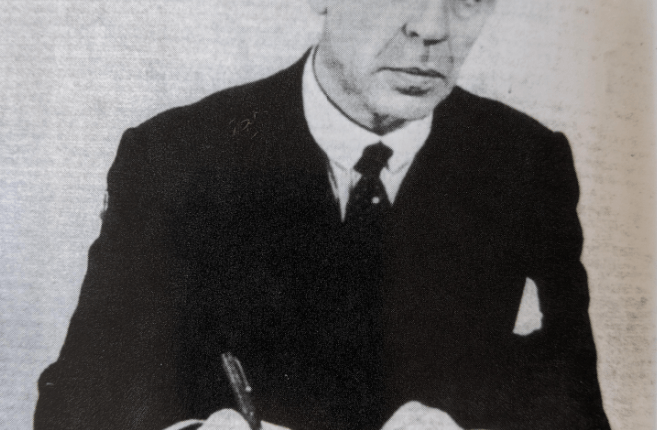
For Fred ‘Nutty’ Sharpe, the Chief Inspector who investigated the case, the Bow Cinema murder investigation was significant enough to warrant a full chapter in the memoirs he published in 1938. Sharpe retired from the CID in 1937. In his book, Sharpe of the Flying Squad, he calls Stockwell ‘the calmest, most coldblooded individual I have ever met and he wasn’t the least bit nervous.’[2] Throughout the chapter Sharpe uses superlatives to stress the violence of the murder: it was ‘one of the most savage [murders] a man has ever committed’ and the attack had been committed with ‘utmost violence.’[3] He juxtaposes this with his descriptions of Stockwell as’ completely unmoved and in entire possession of his nerve.’[4]

Sharpe’s descriptions reinforce the newspaper reporting that had taken place during the case, which also largely described Stockwell as calm and weirdly devoid of emotion. Despite this, though, John Stockwell never entered the popular imagination as a notorious calculating killer. There are plenty of well-known murder cases from the interwar period, but this is not one of them. For a case that was considered at the time to be extremely brutal, and a killer who was unusually young and unemotional, it may seem surprising that this case did not gain the same notoriety as others.

It is not because this case was satisfactorily solved – most of the best-known interwar murders were resolved at the time and their convictions are largely considered sound. Like many of the other famous cases, celebrity pathologist Sir Bernard Spilsbury worked on this case, and it received extensive press reporting. It raised concerns about the callousness of youth, and whether it was appropriate to execute a 19-year old.

I suspect that it is the combination of victim and killer that has made this murder less appealing than others of the same period. Unlike many of the most famous interwar murders, there was no love or domestic angle to this case. There were no betrayed husbands or deserting wives; Stockwell hadn’t murdered a girlfriend like Patrick Mahon or Norman Thorne, or tried to fake his own death due to having too many girlfriends, like Alfred Rouse. He also had not been convicted of killing his own mother, like Sidney Fox. Instead, he was a man killing another, unrelated man, for financial gain. Most years during the interwar period, a handful of men got executed for similar crimes, yet the cases are largely forgotten. Instead, the interwar years are remembered for their colourful domestic dramas, with cases like Edith Thompson’s being so well-known she has a dedicated website.

As this series has demonstrated, the killing of a man by another man can be no less interesting than a murder case involving a jilted lover; and it can reveal much about the attitudes towards masculinity, class, money, and local communities.


[1] ‘Life Ruined by Murderer’, Daily Mirror, 14 November 1934, front page

[2] Frederick Sharpe, Sharpe of the Flying Squad (London: John Long, 1938), p. 126

[3] Ibid., pp. 126-7

[4] Ibid., p. 131
Featured

The Bow Cinema Murder – Crown Court and beyond

This is the ninth in a 11-part investigation into the 1934 ‘Bow Cinema Murder’. You can read all entries in the series here.

After numerous appearances in the Thames Police court, the presiding magistrate ruled that the case for the murder of Dudley Hoard and the theft of the Eastern Palace Cinema earnings, was to be heard at the Old Bailey. Compared to today, court cases in interwar Britain moved through the system very quickly. The murder had taken place on 7 August; the arrest was made on 11 August; the Police court completed its work on 18 September; and the case was set to be heard at the Crown Court on 22 October.

The key feature which distinguished the crown court from the police court was the presence of a jury. In England, the jury consisted of twelve individuals; since 1920, women could be called for jury duty as well as men. By 1934, the presence of women on the jury of a murder case was still considered worthy of comment in the newspapers, as women’s perceived delicate sensibilities were thought to suffer from having to hear violent testimony.

For the trial, John Stockwell was assigned legal counsel through the 1903 Poor Prisoners’ Defense Act: he had no means to pay for his own defense. He was represented by Frederick Levy; a Vincent Evans represented the prosecution. Although the police ostensibly had a written confession from Stockwell, they felt far from secure that he would get convicted. John Stockwell had made his main confession when he was being driven down from Yarmouth to London On the occasion, Detective Inspector Sharpe had decided not to explicitly re-read Stockwell his rights, as he did not want to put Stockwell off. Sharpe had also not taken notes during Stockwell’s confession, instead opting to jot Stockwell’s words down from memory upon arrival in London. A skilled lawyer could argue that the confession was inadmissible.

Additionally, the police were never able to confirm that the hatchet they found at the site of the murder, was the axe used in the household where Stockwell lived. Stockwell had said that he had taken this household axe, used for chopping down coals, and used it to hit Dudley Hoard over the head. Yet when the family Stockwell was lodging with, the Roakes, were shown the hatchet found at the crime scene, all of them separately confirmed that this was not theirs.

Maisie Hoard, who had been in hospital since the attack, was unable to identify Stockwell during an identity parade staged at Brixton Prison on October. There were also persistent rumours that the attack had been carried out by two people, and that John Stockwell was shielding the real attacker. There were enough question marks, in short, to allow a defense team to challenge the police evidence.

In the end, however, none of these issues were unpicked in the courtroom. On the morning of 22 October, after the jury were sworn in and the judge opened the trial, Frederick Levy announced that John Stockwell changed his plea from ‘not guilty’ to ‘guilty’.[1] This was unusual and unexpected, and left the jury no choice but to formally confirm the verdict. This, in turn, lead to an automatic death sentence, although the jury ‘strongly recommended him to mercy, taking in to account the parental guidance which he never received.’[2] The trial was over in a matter of minutes, allowing the court administrators to use the same jury to hear a second case on the same day.

Immediately after the verdict, John Stockwell’s defense team started up a petition. If one was found guilty of a capital offence, such as murder, and there was no question of perpetrator being found insane, there was only one route available to avoid an execution: for the King to offer mercy and commute the sentence to life imprisonment. In practice, the King would offer mercy at the recommendation of the Home Secretary, so applications were made to the Home Office. There was a distinct time pressure, as prisoners were traditionally given only ‘three Sundays’ between sentencing and execution.

One way to persuade the Home Secretary that a sentence should be commuted was to demonstrate widespread popular support for the prisoner. Frederick Levy and his team therefore immediately started a petition in favour of a mercy ruling. The petition primarily argued that Stockwell, at 19 years old, was still very young, and that execution would therefore not be appropriate. The lawyers visited the Home Office on 6 November to argue their case, and on 12 November presented several petitions. On 13 November they even delivered a letter of the foreman of the jury which had convicted Stockwell, pleading for a commuted sentence.

It was to no avail: the Secretary of State concluded that there was no sufficient ground in this case to justify advising the King to “interfere with the due course of law.”[3] The Home Office’s case was primarily one of precedent: the law considered everyone over the age of 18 to be an adult, and there had been cases in 1922, 1925, 1928 and 1932 where men of 18 or 19 years old had been executed.[4] Additionally, the Home Office considered it proven that John Stockwell had set out to kill or grievously harm the Hoards; this despite Stockwell’s insistence that he had no such intention. The Home Office’s thinking here was influenced by that of Inspector Sharpe, who in his final report noted that Dudley Hoard knew John Stockwell, and would have been able to identify him if Stockwell had let Hoard live.

Despite the efforts of John Stockwell’s defence team, then, his execution was scheduled for 14 November at Pentonville Prison. All condemned men who lived in London and north of the river were executed here; and executions always took place at 9am sharp. After the flurry of publicity around the murder, manhunt and police court proceedings, this final chapter of the story received very little public attention. Most papers did not report on the execution at all; it was, after all, the expected outcome which reaffirmed to the public that those who transgressed received due punishment.


[1] ‘Two death sentences in one day,’ Daily Mirror, 23 October 1934, p. 23

[2] Ibid.

[3] PCOM 9/333 ‘STOCKWELL, John Frederick: convicted at Central Criminal Court (CCC) on 22 October 1934’, National Archives

[4] HO 144/19719. ‘CRIMINAL CASES: STOCKWELL, John Frederick Convicted at Central Criminal Court (CCC) on 22 October 1934 for murder and sentenced to death’, National Archives

Featured

The Bow Cinema Murder – the Magistrate’s Court and Newspaper Reporting

This is the eight in a 11-part investigation into the 1934 ‘Bow Cinema Murder’. You can read all entries in the series here. 

As alluded to in previous instalments in this series, the Bow Cinema Murder was heavily reported on in the popular press. The murder itself was brutal enough; but the fact that a nation-wide man-hunt was called for the prime suspect, and that it took several days to locate and arrest John Stockwell, gave the press irresistible material. The press quickly framed the events in a recognisable narrative format, featuring colleagues and acquaintances of John Stockwell as an ensemble cast of characters. Although the initial press interest culminated with Stockwell’s arrest in Yarmouth on 11 August, and return to London the next day, journalists continued to report on the case as it started to progress through the legal system. Stockwell himself changed from a mysterious figure to a named suspect who could be interpreted through his appearances in court.

As I have described previously on this blog, interwar newspapers reported on court cases on a daily basis, and the reporting conventions in this area provided the reading public with a framework through which to understand criminal and deviant behaviour. The reports on the Bow Cinema Murder both worked within these established conventions and further contributed to them.

In 1934, as today, the English justice system had two ‘tiers’ of courts: the police or magistrate courts, which dealt with minor crimes, and the crown court, which considered more serious crimes. Cases at the crown court were decided by a jury; at the lower court a magistrate heard the case and decided the outcome. Unlike today, however, all cases had to first be heard in the police court, where a magistrate would establish the facts of the case. He would then formally decide whether a case should be referred to the crown court to be heard by a jury. Also unlike today, proceedings in the police court started almost immediately upon arrest, and as the name implied, the majority of the evidence heard was provided by the police officers who had investigated the case and made the arrest.

In the case of the Bow Cinema Murder, Inspector Fred Sharpe played a key role in the magistrate court proceedings. Already during the early stages of the investigation, whilst he and his men were tracking down John Stockwell, they were also ensuring that they had sufficient evidence to put the case forward to trial. The police inspectors continued with this after Stockwell’s arrest – (re)interviewing witnesses to ensure that there were no gaps in their narrative that could be exploited by the counsel for the defence.

Stockwell made his first appearance in the Thames Police Court on 13 August, only two days after his dramatic arrest in a Yarmouth hotel. That was a Monday, and from then on the case was heard weekly on Tuesdays until 18 September, when Stockwell was formally committed to trial at the Old Bailey. All of these hearings were reported on in the national press. The reports were standalone articles, outside of the regular ‘today in court’ columns. This underlined the relative importance the press gave to this particular criminal investigation, which was set apart from the daily churn of magistrate court proceedings.

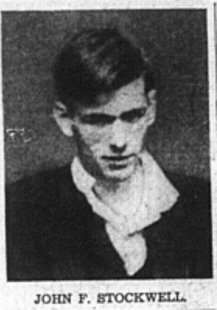
Stockwell’s appearance in court gave reporters the first opportunity to have a good look at him. Although the attack on Dudley Hoard was described as ‘A murder as grim and mysterious as any enacted on [the Eastern Palace Cinema’s] flickering screen’[1], its alleged perpetrator was repeatedly described as quiet, ‘very pale’ and even physically weak.[2] The Daily Mirror went further than most in describing Stockwell as ‘a young man of medium height, with wavy blonde hair, and as he faced the magistrate he stood with his hands clasped behind his back and started straight in front of him.’[3] The reference to ‘wavy blonde hair’ makes Stockwell akin to a romantic hero. He was also noted to be wearing an open-necked shirt and tennis shoes – hardly the outfit of a killer. At the end of the proceedings Stockwell was reported to have asked ‘in a quiet voice’ for leave to see his girlfriend and some other friends.

Even more than John Stockwell’s hair and clothes, newspapers made repeated references to his young age – he was only 19 at the time of the murder and trial. His age usually appeared with the first line of every article about the case. The Daily Mail landed upon the description of him as a ‘lad’.[4] Multiple headlines in the paper referred to the ‘Cinema Lad’ throughout his arrest and trial. ‘Lad’ provides a compromise between ‘man’ and ‘boy’: it refers to Stockwell’s relative youth without suggesting that he should be tried as a juvenile.

The police court proceedings heard evidence of Inspector Sharpe, setting out week by week the case against Stockwell. He first established that Hoard had been murdered; and then that Stockwell had made a full confession to him in the drive back from Yarmouth. The court was also presented with a letter which John Stockwell had sent to Lowestoft police, when he was attempting to fake his own death through suicide. This letter contained another confession of the murder. The people Stockwell interacted with in Lowestoft and Yarmouth were called to give their evidence, as was Sir Bernard Spilsbury, who had been involved in the autopsy of Dudley Hoard.

At the final hearing, Violet Roake, John Stockwell’s one-time girlfriend, was called to testify. Stockwell had written her a letter while he was in Lowestoft, claiming that he was not guilty but also asking her to call him by a different name going forward.[5] Although Stockwell had been granted permission to receive visits from Violet, it appears that she had retained her distance from him; the Evening Standard reported that Violet did not look at Stockwell when she entered court.[6]

Although the police court hearings had given the press and public a first overview of the details of the murder and manhunt, they were considered a preliminary to the inevitable referral of the case to the Crown Court. There, at the Old Bailey in central London, the real drama of the case was expected as a jury of twelve men and women had to decide whether John Stockwell was guilty of murder – and a guilty verdict would automatically lead to a death sentence.


[1] ‘Midnight Murder in a London Cinema’, Daily Mail, 8 August 1934, p. 9

[2] ‘Stockwell Accused of Cinema Murder’, Evening News, 13 August 1934, front page; “I did not mean to kill Mr Hoard”, Daily Mirror, 14 August 1934, p. 8

[3] “I did not mean to kill Mr Hoard”, Daily Mirror, 14 August 1934, p. 8

[4] For example: ‘Cinema Lad Found’, Daily Mail, 11 August 1934, p. 9; ‘Cinema Lad in Court’, Daily Mail, 14 August 1934, p. 10

[5] ‘Cinema Tragedy’, Daily Mail, 19 September 1934, p. 6

[6] ‘Girl’s Talk on Crime with Stockwell’, Evening Standard, 18 September 1934, p. 12

The Bow Cinema Murder – Forensic Evidence

FeaturedThe Bow Cinema Murder – Forensic Evidence

This is the sixth in a 11-part investigation into the 1934 ‘Bow Cinema Murder’. You can read all entries in the series here. 

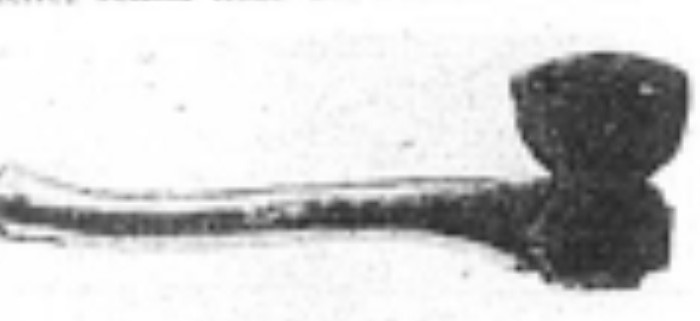
Once the police were on site at the Eastern Palace Cinema, they started gathering forensic evidence. This was partially to aid the investigation, but also to start building an evidence base to use if and when the case would go to court. The items which were recovered from the crime scene included a piece of flooring; human hair and samples of bloodstains. After a thorough search of the cinema, the police also recovered the murder weapon: a small axe, or hatchet. This was also handed over for investigation. Forensic investigations were undertaken by the same specialists who also did the post-mortems of the victims of crime: forensic pathologists.

The pathologist initially appointed to the Bow Cinema Murder case was Dr Francis Temple Grey, a retired Royal Navy surgeon and previously employed as pathologist for the Ministry of Pensions. He was in his late 40s in 1934 and had a deep scientific interest in biochemistry. On 8 August, the day after the murder, he presided over the autopsy of Dudley Hoard at Poplar Mortuary. The post-mortem was also attended by Donald Summers, the police surgeon who had attended Hoard immediately after the attack; Dr Normal Brown, who had treated Dudley in St Andrew’s Hospital; and the most famous pathologist in Britain, Sir Bernard Spilsbury.

Dr Temple Grey (left), pathologist assigned to the Bow Cinema Murder

Bernard Spilsbury was a Home Office pathologist and a celebrity. He had made his name during the notorious murder trial of Dr Crippen, where Spilsbury’s expert evidence nailed Crippen’s conviction. Spilsbury was also responsible for the conviction of a host of other notorious killers, from George Smith, the ‘Brides in the Bath murderer’, in 1915; to Patrick Mahon in 1924. Spilsbury was a workaholic and a brilliant orator, which made him successful both as a pathologist and as an expert witness. His reputation remained untarnished during his lifetime, although in recent years some of his assertions, including those on which basis Crippen was convicted, have been refuted.

In 1934 though, Bernard Spilsbury was considered the best pathologist to have on a case. He was specifically asked to attend the postmortem of Dudley Hoard, and undertake forensic examinations, by Norman Kendall, the Assistant Commissioner for Crime at the Metropolitan Police. As Kendall later wrote to the Director of Public Prosecutions, Tindal Atkinson, he considered Temple Grey a ‘notoriously untrustworthy witness’ when it came to giving evidence in court.[1] Kendall was worried that, if the case were to go to court, Grey would potentially make incorrect or unclear statements that may confuse the jury and jeopardize a conviction. To avoid having to call Grey to the stand, Kendall wanted to make sure that Spilsbury was involved in every step of the forensic investigation, so that he could act as a witness instead. Throughout the investigation, the police continued to worry that they had not built a sufficiently strong case, and be on the look-out for anything that may undermine a ‘guilty’ verdict.

There’s no record of how Temple Grey felt about having Sir Bernard Spilsbury watching over his every move. His report of Dudley’s autopsy noted that Dudley had suffered from nine cuts, six fractures, and three brain injuries. It seemed that Dudley got hit on his head from behind; fell onto the carpet; then got up again; and moved with his assailant out of his flat and up the stairs to the cinema balcony, where he eventually collapsed. There were copious amounts of blood on the floors and walls of the flat and cinema which marked out this trajectory. The pathologist took a photo of Dudley’s skull, and drew a diagram to indicate where the cuts and fractures had been found.

When examining the axe, it was found that it mostly contained blood on the back and left-hand side, implying that Dudley and Maisie had been hit with the blunt back of the axe head. Hairs of both Maisie and Dudley were found on the axe; his below hers, which showed that he had been attacked first. It provided irrefutable proof that the axe had been the weapon used in the attack; that both Dudley and Maisie had been attacked with the same weapon and therefore presumably by the same person; and that Maisie’s initial statement on how the attack had panned out matched the evidence. It did not, however, bring the police any closer to catching their killer.

The murder weapon, a small hatchet

DNA was of course completely unknown during the 1930s, so there was no possibility to match any of the blood found in the cinema to either the victims or the perpetrator. Fingerprints were known, and had first been used to successfully convict two murderers in 1905. That case, the murder of a shopkeeper and his wife in Deptford, bore some striking resemblances to the Bow Cinema Murder.[2] Yet as soon as fingerprinting evidence became commonplace, would-be criminals knew to wear gloves. The Bow Cinema murderer had followed this advice too, and fingerprints played no significant role in the investigation. Instead, the police were to rely on the killer’s behaviour after the murder, which was so erratic that it very quickly made them sure they had found the guilty man.


[1] ‘Defendant: Stockwell, John Frederick. Charge: Murder’, CRIM 1/734, National Archives

[2] Colin Beavan, Fingerprints: Murder and the race to uncover the science of identity (London: Fourth Estate, 2002), pp. 1-19

The Bow Cinema Murder – the Police Investigation

FeaturedThe Bow Cinema Murder – the Police Investigation

This is the fifth in a 11-part investigation into the 1934 ‘Bow Cinema Murder’. You can read all entries in the series here. 

When Dudley and Maisie Hoard were found, critically wounded, around 8.30am on 7 August 1934, the first police officer on the scene was PC Duncan Mackay. He was patrolling the local area at the time, and was therefore able to get to the cinema quickly. PC Mackay was part of the army of patrolling Bobbies who worked all over London, each walking their regular ‘beat’ so that they could be on hand if anyone in the neighbourhood needed police assistance. After arriving at the cinema, PC Mackay quickly rang his local station for back-up. The Metropolitan Police had divided London in a series of divisions; Bow Road was part of ‘H’ Division, which covered the wider Whitechapel area. There were a few police stations near the cinema – Bow Road station was the closest, but there was also a station at Arbour Square, a short distance away.

Each police division had a team of detectives: plain-clothes officers who were tasked with investigating crimes and tracking down criminals. In addition, there was the Criminal Investigation Department (CID), commonly known as Scotland Yard. This team worked across all of London and specialised in the most difficult crimes, as well as criminal activity that was not confined to one area – for example, during the 1920s Scotland Yard spent a fair amount of time investigating crooked racecourse betting gangs.[1] Working for Scotland Yard was prestigious, as the small team often dealt with high-profile cases.

After PC Mackay’s phone call, the first officers to arrive at the cinema were the detectives attached to ‘H’ Division. Most of these men were born locally, and they would spend many hours over the next weeks to not only catch the murderer, but also put together sufficient evidence to ensure a conviction. In the interwar period, the police’s remit was wider than it is today, and the police took on some tasks which would now sit with the Crown Prosecution Service. Detectives were responsible for ensuring that all the evidence fit together and made a convincing court case. This meant that even after a criminal was caught, they would still have significant work in (re)interviewing witnesses, tying up loose ends, and getting additional expert opinions.

The detectives who were the first to arrive at the cinema were Detective Sergeant James Rignell, a 34-year old born in Poplar who had joined the Met shortly after the First World War; Detective Inspector Henry Giddins, who had only been promoted to this rank less than a week before the murder took place; and Detective Sergeant Claud Smith, who was born in Mile End and also joined the police immediately after completing his First World War service. Between them, they started a physical investigation of the murder scene and questioned the cinema staff who had started to arrive for their shifts. James Rignell went to the hospital and took the very first statement from Maisie Hoard.

One of the detectives, possibly James Rignell

Very quickly, a decision was made that Scotland Yard needed to be involved in the investigation. The attack had been brutal, and DI Giddins was very new to his role. Around 3pm on the same day, Detective Inspector Fred ‘Nutty’ Sharpe of Scotland Yard arrived at the cinema. He would be in charge of the investigation from that point onwards, leading the ‘H’ Division team and drawing on staff in other parts of London as needed. As it transpired, the investigation would lead the police out of London to the Norfolk/Suffolk borderlands, and Sharpe’s position in the CID gave him the authority to instruct police forces outside of the capital, too.

Frederick Sharpe, from his memoir Sharpe of the Flying Squad (1938)

Fred Sharpe had joined the Metropolitan Police in 1911, and spent most of the first decades of his police career chasing criminal gangs, pickpockets and car thieves. In his memoirs, which he published in 1938 after his retirement, he advocated that police detectives should cultivate friendly relations with professional criminals. He argued that there was a reciprocal relationship and a level of respect between criminals and the police, in which both groups knew the rules of the game they were involved in. This approach got him in hot waters after his retirement, when Sharpe himself came under police investigation for engaging in bookmaking activities.[2]

Murder, however, appears to have been a separate category for Sharpe. He devoted an entire chapter to the Bow Cinema Murder in his memoirs, in which he referred to the murder as ‘one of the most savage a man has ever committed.’[3] He underscored this supposed savagery by describing his physical reaction to the crime scene: “The flat itself and the hall presented a horrible and ghastly scene, showing that the utmost violence had been used in the attack on this unfortunate couple. (…) the sight of that room and the passageway nearly made me sick.”[4] Sharpe ensured that the details of the crime scene were captured by ordering a police photographer to attend the scene on the day of the murder. These photographs show copious amounts of blood on the staircase where Dudley was found, as well as the blood-soaked bedsheets which Maisie had left behind.

At the close of 7 August, the police did not yet have any clear leads. The staff who had been arriving at the cinema had not been able to share much useful information. Most of the crimes they investigated were committed by criminal gangs, and this guided their initial thinking. Newspaper reports stated that the police were speaking to their contacts in criminal gangs to gather information – using that network which Fred Sharpe often relied on.[5] Police officers remained stationed at the cinema overnight, and some materials had been taken away for forensic examinations. It was not until the next day, however, that a clear suspect would emerge.


[1] Heather Shore, ‘Criminality and Englishness in the Aftermath: The Racecourse Wars of the 1920s’, Twentieth Century British History, vol. 22, no. 4 (2011), 474-497

[2] ‘Ex-Chief Inspector Sharpe of the Flying Squad: bookmaking activities under the name of Williams’, MEPO 3/759, National Archives

[3] Frederick Sharpe, Sharpe of the Flying Squad, (London: John Long, 1938), p. 126

[4] Ibid., p. 127

[5] ‘“Yard” reconstructs the crime,’ Daily Herald, 8 August 1934, p. 2

The Bow Cinema Murder – the Killer 

FeaturedThe Bow Cinema Murder – the Killer 

This is the third in a 11-part investigation into the 1934 ‘Bow Cinema Murder’. You can read all entries in the series here. 

So who was the man who rang the Hoard’s doorbell on the morning of 7 August 1934 and attacked Dudley and Maisie with such deadly consequences? The initial police investigation assumed that the crime was committed by one or perhaps two criminals, who potentially allowed themselves to be locked into the cinema the night before. Investigators were reported to be questioning known criminals in the East End for clues.[1]

The truth was somewhat different, and closer to home. The attack on Dudley and Maisie was committed by a nineteen-year-old employee of the Eastern Palace Cinema: John Frederick Stockwell. John had only worked at the cinema for a few months, after being hired by Dudley. As an attendant, it was his duty to check tickets and show patrons to their seats. Like many neighbourhood cinemas at the time, the Eastern Palace operated on a ‘continuous performance’ basis, meaning that once the first screening of the day started, screenings continued on a loop until the end of the day. Patrons could show up at any time and stay as long as they liked. A crew of male and female attendants were therefore constantly occupied with letting people in and out of the auditorium.

Like many people in the East End, John Stockwell came from an impoverished background – but he was not brought up locally. He was born on 2 March 1915 near King’s Cross. His father had died at the front at Mons before John was even born. His mother re-married, but died in 1926 when John was 11. John had a brother, Horace, who was three years’ his senior – by the time the men had grown up they were no longer close. After his mother’s death, John went to live with an aunt, Elizabeth Brown. Because John’s father had died in the war, Elizabeth received a financial contribution from the state for John’s upkeep. Elizabeth decided around 1930 to move away from central London, and out to Bromley in Kent.

For the teenage John, who was no longer required to attend school, the change from Kings Cross to Bromley was not beneficial. Elizabeth reported that John no longer accepted her as a parental authority; he appears to have been out and about with a group of other young men. Eventually, Elizabeth decided she could no longer support John living with her, and he moved to a Salvation Army Boys Home in Bow Road some time in 1930. These homes were designed exactly for people like John: young men who lacked family or community support. They intended to give these men the skills to get employment and become independent. The SA arranged for John to get a job at a cloth manufacturer at Barbican. During his time there, John stole some cloth; he was caught and appeared before the Magistrate’s court in December 1931. John was sentenced to two year’s probation, meaning he had to meet up with a probation officer regularly.  

The Salvation Army had a zero-tolerance policy when it came to criminal activity, so John lost his lodgings. He had met, through the Army’s church activities, a local widow, Ellen Roake, and had become particularly close to Eliza’s youngest daughter Violet. Ellen agreed to take John on as a lodger, and he moved into the tiny Roake family home in early 1932. John and Violet became an official couple. After a short period working for a pastry chef, John was unemployed until he found the job at the Eastern Palace Cinema, which was only a 15-minute walk from the Roake’s home. One of the cinema’s other attendants, Charles Whitnell, lived practically next door to the Roakes.


As an attendant, John earned 32 shillings and sixpence a week. He paid 15 shillings a week for his board and lodging, leaving him with less than £1 a week for any other expenses. At the time of the murder, he did have a savings account with the Post Office, but it contained only 30 shillings (£1.50). Clearly, John had always lived in poverty. The nearly £90 that he stole from the cinema safe after attacking Dudley and Maisie was probably more money than he had ever seen together in his life; it was certainly more than he could ever imagine to save up himself. By August 1934, John and Violet had been going out for several years, but he could probably not imagine how he would ever make enough money to enable them to get married and start their own family.

He also had virtually no contact with his family at this point, and no social community to fall back on; he’d been removed from the community in King’s Cross in which he had grown up. The East End neighbourhood in which he lived from 1930 was one in which family ties counted for a lot, and he was perceived as an outsider. During the police investigation, his colleagues reported that they had found John odd, and his previous conviction for theft was known and made people suspicious of him.

None of these things justify his attack on the Hoards, but they do illustrate that the lack of structural social care in interwar Britain left individuals vulnerable. If you did not have a strong personal support network, you could very quickly find yourself in a situation that felt interminable. Once John committed the theft of cloth in 1931, what little social support he had been able to count on was also removed. In addition, rigid class boundaries made it even less likely for someone in his position to materially improve his circumstances. It is understandable, then, that someone of his young age, with little adult supervision to guide him, came to the conclusion that the only way to get ahead was to break the rules and commit a theft.

Once John had committed his attack and stolen the money, he managed to leave the Eastern Palace Cinema unseen. Tuesday was his weekly day off work. That evening, when Violet finished her shift at the Kearley & Tonge biscuit factory in Bethnal Green, John treated her to a trip to the Stoll cinema in the West End. Unbeknownst to Violet, he used part of the stolen money to pay for the tickets. On the way to the cinema, they discussed Dudley Hoard’s murder, as it was splashed over the evening papers. It would be the last evening they spent together, as the next day John used his stolen money to escape London, triggering a multi-day manhunt that captured the attention of the nation.


[1] ‘“Yard” reconstructs the crime,’ Daily Herald, 8 August 1934, p. 2

The Bow Cinema Murder – the Victim

FeaturedThe Bow Cinema Murder – the Victim

This is the second in a 11-part investigation into the 1934 ‘Bow Cinema Murder’. You can read all entries in the series here.

One of the effects of a well-publicised murder investigation is that it can put ordinary people into the press spotlight. This was as true in the interwar period as it is today. The Bow Cinema murder was briefly on the front pages of all major newspapers, and the victims, the perpetrator, and the people around them all got dragged onto those front pages too. This can make a murder story a valuable source for the historian: it highlights and preserves the stories of ordinary people as they are put into extraordinary circumstances.

Dudley Henry Hoard, the victim of the Bow Cinema Murder, was one such an ordinary person. If not for the extremely violent end to his life, it’s unlikely his name would ever have entered into the annals of history. He was born in Wandsworth, south-west London, in 1892. His family moved to Croydon when Dudley was a child, and his parents remained in that area. Dudley had an elder sister, Dorothy, and two younger sisters, Avery and Winifred. His father, William, was born in Devon; his mother Mary was from Chelsea in London. Dudley’s father worked as a clerk, indicating the family were in the lower middle class. This is also borne out by the fact that Dudley attended the independent Whitgift School in Croydon.

By the time he was eighteen, Dudley considered himself to be an actor. At 5 ft. 9.5in he was quite tall, and he may have cut a dashing figure on stage. According to his father, Dudley left school to take part in a production at Sadler’s Wells theatre, and toured the country as part of a travelling theatre group. At the same time, he was interested in cinema, which was becoming increasingly popular. Dudley briefly ran his own cinema, the Hippodrome, in Sutton (near Croydon) in the early 1910s.[1]

During the War, Hoard served as a Private in the London Regiment. He did not have a distinguished war record; the most the newspapers can say about it after his death is that he served in France and Greece, and got gassed in an enemy gas attack.[2] After the war he returned to repertoire acting, including a stint working for the Melville Brothers, who were part of a theatre producing dynasty.

At some point, Dudley met Maisie Tait, a native of Newcastle who was close to him in age and also an actor. According to Dudley’s father, the pair met when they were in their late teens; however, they did not get married until 1933, when Dudley was 41 and Maisie was 38. Details of Maisie’s early life are difficult to trace; she was also known as Maisie Robson, and it is not clear whether either Tait or Robson was her birth name, or whether both were assumed names. One thing that is certain is that Maisie had a daughter from a previous marriage; after the attack in 1934, this adult daughter came to visit Maisie in hospital. Her existence may be what stopped Dudley and Maisie getting married any sooner.

Around the time of their wedding, Dudley apparently decided to give up the touring life and to return to the cinema. In 1933, he got his first appointment as cinema manager in London, at the Brittania Picture Theatre in Camden. By the 1930s, cinemas had become enormously popular in Britain, and the industry had professionalised significantly since Hoard’s last foray into cinema management in 1911. The average cinema had upwards of a dozen staff members, and cinema managers were required to ensure that all operations went smoothly; staff were trained appropriately; and the cinema drew as many patrons as possible. Marketing was a significant part of the cinema manager’s role. Trade magazine Kinematograph Weekly highlighted in each issue the innovative and successful marketing stunts that managers up and down the country came up with to draw in audiences.

At the same time, cinemas became increasingly consolidated into chains, such as Odeon and ABC. Within the chains, the patrons’ experiences were increasingly homogenised. Rather than being rewarded for originality and innovation, managers in chains were expected to comply with central directives on how their cinemas should be managed. Dudley never worked for a chain cinema; at the Brittania in Camden he had to make two men redundant to save the cinema money. These men had families to maintain, and they threatened Dudley after he had fired them. This probably was one of the reasons why Dudley swiftly moved on to work at the Cinema House in Oxford Street and then, finally, the Eastern Palace Cinema in Bow.

These three posts in the space of 18 months indicate how fast-moving and insecure the work of cinema management was. For Dudley and Maisie, the job at the Eastern Palace was a step up, as it came with their own private apartment (although they had to pay rent for its use). With it, though, they arrived into a close-knit East End neighbourhood, where many of the staff were neighbours or even family members of one another. The Hoards were outsiders; and as it turned out, so was the man who attacked them.


[1] ‘London Manager Murdered’, Kinematograph Weekly, 9 August 1934

[2] ‘Actor and Producer’, Daily Mirror, 8 August 1934, p. 2; ‘London Cinema Outrage’, Evening Standard, 7 August 1934, p. 2

The Bow Cinema Murder (1934)

FeaturedThe Bow Cinema Murder (1934)

This is the first in a 11-part investigation into the 1934 ‘Bow Cinema Murder’. You can read all entries in the series here.

This blog is no stranger to interwar murder stories. Over the next ten weeks, posts will investigate one 1934 murder case in depth. Unlike some of the other cases covered previously, this murder is no longer well known – it has not been adapted in any novels, plays or films (to the best of my knowledge) and did not become a byword for evil. At the time it was committed, however, it caused a media storm and thrust a group of working-class East Enders into the limelight. It was the Bow Cinema Murder.

The murder took place on Tuesday morning, 7 August 1934, at the Eastern Palace Cinema in Bromley-by-Bow, in the East End of London. The Eastern Palace cinema was a neighbourhood cinema, co-owned by two local Jewish professionals. It was located on the busy Bow Road, in between a café and a general store. It could seat around 1000 patrons in its auditorium and balcony, where audiences could enjoy the ornate (if somewhat shabby) ‘Oriental’ decorations on the walls.

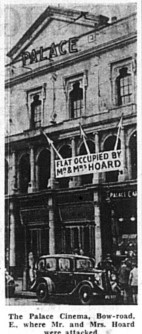
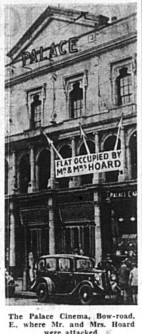
The facade of the Eastern Palace Cinema. This photo appeared in the Daily Express the day after the murder

The day-to-day management of the cinema fell to 41-year-old Dudley Henry Hoard. As part of his role, Dudley and his wife Maisie were required to live in a flat adjacent to the auditorium – the lease of the building required that it was partially used for domestic occupancy. Dudley got the cinema manager job in March 1934, and he and Maisie moved in a few weeks later. It was the first time since their wedding in spring 1933 that they had their own flat; they had previously been staying with Dudley’s parents in Croydon.

On the morning of 7 August, Dudley and Maisie were sleeping in after a busy Bank Holiday weekend. Ordinarily, one of Dudley’s first tasks every day was to deposit the cinema’s previous day’s takings at the Midland Bank on Mile End Road. Due to the banks having been shut on the Bank holiday Monday, there were now three days’ worth of ticket earnings in the safe in Dudley’s office, one floor below the flat. For the Eastern Palace, the Bank holiday weekend had resulted in total takings of 89 pounds, 5 shillings, and tuppence. By comparison, Dudley earned about £5 a week as cinema manager, and he was the best-paid member of staff in the cinema. Even for him, the nearly £90 in the safe represented around 10 months’ worth of wages.

Around quarter to eight, someone rang the door of the flat – not the doorbell at the cinema’s entrance, but the door of the flat specifically. Dudley quickly put on some trousers over his nightshirt and went to open the door. Maisie had only half woken and was about to doze off, when she heard Dudley shout out. When Maisie walked into the living room, she saw a man standing over her husband, wielding a hatchet. Dudley had a head wound and was trying to fend off the other man. Maisie shouted out to the attacker, a young man. He then turned to her and hit her over the head with the hatchet – she blacked out immediately.

About thirty minutes later, the cinema’s regular team of cleaning women arrived for their morning shift. These three women came in six days a week to clean and tidy the cinema before the first screenings started. Because they arrived hours before any of the other staff, the head cleaner, Mrs Emily Brinklow, had her own set of keys. She let herself and her colleagues in, and they started to get their cleaning materials out. Emily noticed that the post and milk, dropped by the milkman, had not yet been taken upstairs by either Dudley or Maisie. This did not worry her unduly; she would bring them up herself in a minute. Before she could do so, a scream ripped through the building. Nellie Earrey, one of the other cleaners and sister to one of the cinema’s projectionists, had found a heavily injured Dudley Hoard on the staircase leading to the auditorium balcony. He was covered in blood, as were the walls and the staircase he was on. Emily rushed to the flat and banged on the door; after a short while, Maisie opened it. She, too, was covered in blood, and seemed completely dazed.

Nellie ran out onto the street, where a passerby quickly alerted the local Bobby who was patrolling the area. PC Mackay swiftly went over to the cinema and tried to provide emergency aid, as well as alerting his local police station by telephone. The divisional surgeon (the police doctor) is on the scene quickly, as he was still at his home further down Bow Road when the station officer rang him. He too provides emergency aid, and arranges for both Dudley and Maisie to be transported to the nearby St Andrews hospital. They arrive shortly after 10am. Although Dudley is immediately examined and treated by multiple surgeons, the fractures to his skull are too severe. He dies at 3.07pm, without regaining consciousness.

The police know that they now have a murder case on their hands. Maisie is less severely injured, but unable to give more than a brief, confused statement before she needs to rest. Detectives attached to the local police department, known as ‘H’ Division, start questioning all the cinema’s staff as they arrive for their shifts. Most of them live very close to the cinema, and they are aware very quickly that something has happened. The police realise that the cinema’s safe has been opened by the keys which would normally be carried around by Dudley, and that the full weekend’s takings have been stolen. They have a victim and a motive, but not yet a clue as to the killer’s identity.

Featured

J. J. Connington – The Sweepstake Murders (1931)

J. J. Connington was the alias of Albert Walter Stewart, a Scottish-born chemist, crime writer and one of the founding members of the Detection Club. Alongside a successful academic career, Connington published seventeen novels between 1923 and his death in 1947. T.S. Eliot was an admirer of Connington’s detective fiction.[1] Connington’s main ‘sleuth’ was Chief Constable Sir Clinton Driffield, who was accompanied by Wendover, a man of independent means, as a side-kick. These characters reveal Connington’s conservative political views; they have independent wealth and are no political radicals.

The Sweepstake Murders was Connington’s 13th published work, and coincidentally the concept of ‘bad luck’ (accidental or manufactured) is a key motif in the work. The book starts with Wendover, Sir Driffield’s companion, attending a bridge party at a house in the neighbourhood. The nine men in attendance agree to join into a syndicate and buy nine sweepstake tickets for the Epsom Derby. If any of the tickets win, they agree to divide the winnings equally between them.

When one of their number unexpectedly dies before the sweepstake results are announced, it occurs to Wendover that their signed agreement means that the fewer members of the syndicate remain, the more money each individual will receive, as they will have to split the winnings amongst fewer people. When the syndicate wins the second prize, or £241,920, members start getting bumped off with alarming speed. Sir Driffield comes to visit Wendover and helps the local police with their investigation, as he is concerned about his friend’s safety.

The tension in The Sweepstake Murders is two-fold: the reader does not know who the next member of the syndicate will be who will get murdered; but as the murders progress, fewer and fewer suspects remain, as it is assumed that one of the remaining syndicate members is the perpetrator. In this set-up, the murderer can only obtain the highest possible monetary return by revealing themselves as the last person standing. Connington avoids this problem by having some of the syndicate members sell on part of their stake to people not originally involved in the syndicate, thus widening the pool of potential beneficiaries. The set-up also allows Connington to include a range of murder methods and weapons in his story, as the murderer gets creative to make the deaths look like accidents.

The narrative of The Sweepstake Murders is liberally interspersed with letters sent between legal advisers and syndicate members; excerpts of Sir Driffield’s notebook; and various jottings-down of accounts and sums to allow the reader to stay on top of who is entitled to which sum at each stage of proceedings. Towards the end of the story, the behaviour of a roll of film in a photo camera becomes a crucial clue to the plot, and this is duly illustrated with some diagrams. These extra-textual elements add to the puzzle-like feel of the story and engage the reader in its resolution.

The Sweepstake Murders is a high-concept crime story, which incorporates many of the tropes of the genre including meticulous timing of alibis, use of technology to cover and uncover tracks, and a closed circle of potential suspects. Despite Connington’s professional success during the interwar period, he is now a mostly forgotten crime writer and his books are not as readily available as those of other authors of the period. Yet The Sweepstake Murders is a good quality murder mystery and is worth seeking out by readers with an interest in interwar crime literature.


[1] Martin Edwards, The Golden Age of Murder (London: Harper Collins, 2016), p. 186