Autobiography of an interwar journalist

JC (John Clucas) Cannell was a man of two, seemingly completely separate, careers. He was a Fleet Street journalist, but also a magician. In that latter capacity he became vice-president of The Magician’s Club. After his fellow (and more illustrious) Club member Harry Houdini died in 1926, Cannell wrote the book-length The Secrets of Houdini (1931)[1] which painstakingly explains exactly how each of Houdini’s famous tricks worked. In 1935 Cannell collaborated with Quaker Oats to distribute to Quaker customers copies of The Master Book of Magic[2]; again a book which explained how magic tricks worked.

Sources that relate to Cannell’s work as a magician are silent about his other career as a Fleet Street journalist. Yet the books Cannell wrote about magic show his reporting appetite. He was driven to lift the curtain on how magic worked; a stance that his fellow magicians did not necessarily appreciate. Cannell’s instinct to reveal the ‘truth’ to his readers would have served him well as a tabloid journalist in interwar London.

Aside from his books on magic, JC Cannell also wrote an autobiographical account of his work as a reporter: When Fleet Street Calls.[3] This book, which unfortunately has not been reprinted since its first issue, not only gives insight to journalism practices of the period but also to how journalists wanted to present themselves. In the 1930s British tabloid newspapers were in stiff competition with one another, and all tried to increase their circulation.

This decade also saw the launch of the first university-level course on journalism, at the University of London.[4] There was ongoing public debate about the training and education of journalists. Traditionally most journalists had no formal qualifications but learnt on the job, usually starting out as teenagers on local and provincial papers before making the move to Fleet Street in their 20s. This group of journalists commonly stated that university graduates did not have enough ‘real-life experience’ to be good journalists. The counterargument was that journalists had a duty to explain increasingly complex political, technological and scientific news to their readers; and that without a formal education journalists would not be able to understand the topics they were reporting on.

Cannell’s autobiography is published in the midst of these discussions. In it, he builds a very specific picture of the job and the type of person suited to it. It is an early example of the mythologising of the journalist, that has been expanded on by many subsequent books and films.

For example, Cannell states authoritatively:

“In no profession are contrasts so swift and strange, or is life more full of the unexpected than in that of Fleet Street journalism.”[5]

And

“Because Fleet Street journalism is so unlike every other profession or occupation, the people who follow it are totally different from, may I say, the normal folk.”[6]

His argument is clear: journalism is a very varied job, and not everyone is cut out for it. The role’s fast pace requires stamina and wits. Cannell also implies that whether someone is ‘cut out’ to be a journalist is innate; you either are the right type of person or you are not. A university degree in the subject would not make any difference if you are part of the ‘normal folk’ who are not able to grapple with the challenges of the job.

A bit later on, Cannell addresses the arguments about journalists’ supposed lack of formal education, more head-on:

“There is at least as much culture and accomplishment per head in journalism as in any other of the professions, and the journalist has an additional advantage of more worldly knowledge and shrewdness than the others, apart from, I think I may say, the law.”[7]

The foregrounding here of ‘worldly knowledge and shrewdness’ again plays against the popular stereotype of the educated man as ‘bookish’; it evokes notions of journalists being scrappy and surviving on their wits.

The final part of the above quote concedes some respect only to those enforcing law and order, the most visible exponents of which were police. Cannell considers journalists and police officers as partners, with both groups contributing complimentary skills that allow criminals to be arrested. He describes reporting on a murder story, and going to visit the suspect’s family. Whilst Cannell is in their neighbourhood, he actually spots the main suspect:

“I was bound to inform the police that I had seen the wanted man. (…) The police are well aware that they cannot ignore the Press in their fight against crime, and I know of many cases in which detectives of national repute have asked the opinion of journalists covering a big murder story.”[8]

It is clear that in Cannell’s view journalists, like everyone else, had a duty to respect the rule of law. However, he also makes it clear that in his opinion, the police would not get very far without assistance from journalists. Although it is no doubt true that journalists occasionally provided the police with tips and information, the same happened in the other direction. The police were able to use the press to their advantage when they needed information, such as the description of a suspect, to be distributed quickly. The relationship between police and journalists was more symbiotic than Cannell wants to make it appear. He prefers a more macho representation in which even the police are dependent on the tough journalist to give them clues.

It unfortunately goes almost without saying that Cannell’s ideal, imagined journalist is indisputably male. Although women had worked in British journalism since the Victorian times, and their numbers increased steadily in the run-up to the Second World War, Cannell does not acknowledge their existence at all. Cannell’s description of his job implies that it is unsuitable for women; for example, he boasts that when King George V was seriously ill in 1928, Cannell spent eight nights outside Buckingham Palace, waiting for news.[9] He also describes that journalists can receive a call from their editor any time of the day or night that requires them to stop what they are doing and pursue a story.[10] These working conditions were simply not safe or feasible for women, particularly if they had caring responsibilities.

JC Cannell’s autobiography not only gives insight to the working conditions of tabloid journalists in the interwar period; it also shows how journalists of that period wanted to present the profession. He describes journalism as a challenging job, one that only those with natural aptitude are able to succeed at. Cannell also presents journalism as an essential part of the law enforcement apparatus, to give the profession more legitimacy. When Fleet Street Calls purports to reveal to the reader the inner workings of tabloid journalism, in the same way that Cannell’s magic books revealed the workings of magic tricks. However, in reality the journalism book rather reveals to the reader contemporary attempts to shape the image of journalism in the public imagination.


[1] JC Cannell, The Secrets of Houdini (London: Hutchinson & Son, 1931). The book was re-issued in 1973 by Dover Publications in New York – that version is still readily available for purchase.

[2] JC Cannell, The Master Book of Magic (London: Quaker Oats Ltd, 1935). Second-hand copies of this book are also available online.

[3] JC Cannell, When Fleet Street Calls: being the experiences of a London journalist (London: Jarrolds ltd, 1932)

[4] Political and Economic Planning. Report on the British Press: a survey of its current operations and problems with special reference to national newspapers and their part in public affairs (London: PEP, 1938), p. 14

[5] Cannell, When Fleet Street Calls, p. 92

[6] Ibid., p. 200

[7] Ibid., p. 201

[8] Ibid., p. 177

[9] Ibid., p. 140

[10] Ibid., p. 100

Grace Blackaller

Grace Blackaller

Grace Blackaller was born in 1909 and murdered on 9 April 1925. She was a sixteen-year-old amateur dancer who loved going to the cinema. Her murderer was her boyfriend, Ernest Rhodes, aged nineteen. Grace’s murder provided tabloid fodder for about two weeks in April 1925 and has since been completely forgotten.[1] The murder of women by their partners sadly remains so commonplace that it is still treated as ‘normal’. In Grace’s case, newspapers were also quick to suggest her own behaviour was somehow at fault.

The newspaper reports immediately after the murder, which are reasonably sympathetic to Grace, hint at a family set-up that is not straightforward. Grace lived in a lodging in Nevern Square, a few minutes from Earls’ Court tube station; according to her landlady she had lived there for four years so since they age of 12.[2] Her mother, however, lived on Challoner Street, which is on the other side of Warwick Road near West Kensington tube. Both locations are about a 15- minute walk apart.

It was on the corner of Challoner Street that Grace was attacked on that Thursday evening. She managed to get to her mother’s doorstep where ‘Her mother found her on the doorstep of her flat with a wound in her throat. Miss Blackaller could only mumble “a man attacked me” and died in hospital without revealing the secret of her murderer’s identity or any detail of the attack.”[3]

The mystery of the attack was sufficient for a number of tabloids to give the story front-page news, and to include a picture of Grace with the reports as well. Grace’s landlady told the Daily Mirror that Grace was working as a dressmaker and a dance teacher, and although ‘she went out a great deal at night to dances and things’ this was ‘like most girls these days’ and Grace had ‘never seen (…) with a boy.’[4] The Express printed a similar line, that ‘Miss Blackaller was not known to be on friendly terms with any particular man.’[5] In these initial reports, when it is assumed that the attack was conducted by a random stranger, Grace’s behaviour is represented as normal for the period and no moral judgements are made about her.

Grace Blackaller,
Daily Mirror, 11 April 1925, front page

The newspapers only changed their tune about Grace when the story developed further, and a murderer came forward. Press reports no longer presented Grace as a wholesome girl who had fallen victim to a random attack when it became apparent that Grace had been killed by her boyfriend, Ernest. Ernest turned himself in to the police on 11 April, when he read in the newspaper that Grace had died – he claimed that he had thought he only injured her.[6]

According to his account, on the 9th of April the couple went to the Blue Hall Cinema in Ravenscourt Park. They got back to West Kensington at about 11pm, and Ernest walked Grace home. Ernest thought his girlfriend had been stringing him along, and he suspected her of seeing other boys. When she did not take his concerns seriously, he took a razor from his pocket and slashed her throat while they were kissing.

This revelation changed the press’s coverage of the case. Sympathy for the ‘pretty young dancer who was fond of gaiety’ gave way to concerns about young girls’ ‘double lives.’[7]  At the final day of the inquest, the coroner read out a letter he had received from a concerned citizen. According to the coroner, the letter expressed ‘common-sense views,’ including the notion that girl murder victims ‘were forward minxes and made advances to young men, stayed out late at night, frequented cinemas and dance places, and had evidently been allowed to run loose.’[8] Suddenly, the previous reports that Grace’s interests in dancing and cinema were normal for girls her age, were inverted to suggest that the fact that these habits were normal was an indication of a moral and social problem.

The text of the letter was uncritically reprinted in several daily newspapers. The Director of the Liverpool Women’s Patrol stated publicly that she agreed with the letter-writer’s assessment of young girls’ lives.[9] The coroner’s decision to read out this letter during the inquest demonstrates that it was accepted that he would have an opinion on the moral aspects of the case as well as on forensic facts.

The opinion of a single member of the public was presented by the coroner as the belief of the general public, and its subsequent endorsement by the conservative press cemented it as the commonly held view. According to a contemporary journalism trade journal, voicing concerns about the modern girl sold newspapers in the interwar period the way a sensational murder sold them before the First World War. [10] In the reporting on Grace Blakaller, the popular press had managed to combine both ingredients into a successful multi-part story which reaffirmed that it was safer for a woman to stay at home and not have romantic relationships.

To further demonstrate how deeply the narrative that Grace was at fault for her own plight was embedded, these were Ernest Rhodes’ lawyer’s comments when Rhodes was committed for trial: ‘without eliminating the question of provocation, (…) my defence will be – and I shall call on the highest medical evidence to support it – that he [Rhodes] did not know the nature and quality of the act or that, if he did know, he did not know he was doing wrong.’[11]

In other words, the first line of defence was that Grace provoked Ernest, which, it was implied, would diminish his culpability. The second line was that Rhodes did not know that running a razor across someone’s throat could lead to that person dying; and the third line was that Rhodes did not realise that committing an act of violence was wrong. It was this final argument that would be successful; Rhodes was committed to an asylum rather than prison and was released for good behaviour in 1933.

Again, the press reporting partially paved the way for this, as Rhodes was described as ‘a boy with rather a lot of peculiarities’ who was ‘constantly talking about Norman Thorne’ – a young man who had killed his girlfriend in December 1924 and who was awaiting his execution in April 1925.[12] Obsession with a killer was presented as a sign of insanity which, in combination with the narrative that had been constructed around Grace’s ‘provocative’ lifestyle, allowed Rhodes’ legal counsel to mount a successful defence. The daily press was instrumental in influencing the public’s opinion about this case which limited public sympathy for Grace and painted her as culpable for her own murder.

You can read more about Grace Blackaller in my book, Interwar London after Dark in British Popular Culture.


[1] Except by amateur historians and true crime enthusiasts who have pored over the story on internet fora

[2] ‘Murdered Girl: Woman’s Story’, Daily Mirror, 11 April 1925, p. 15

[3] ‘Dance Girl Murdered in London’, Daily Express, 11 April 1925, p. 1

[4] ‘Murdered Girl: Woman’s Story’

[5] ‘Girl Murdered in London’, Daily Express, 11 April 1925, p. 7

[6] ‘Dead Girl Dancer: Story of Youth’s Written Confession’, Daily Mirror, 14 April 1925, p. 2

[7] ‘Murdered Girl: Woman’s Story’; ‘Double-Life Girls’, Daily Express, 23 April 1925, p. 2

[8] ‘Dancing Girl’s Death’, The Times, 23 April 1925, p. 14; ‘Dead Dancer: Boy For Trial’, Daily Mirror, 23 April 1925, p. 21; ‘Double-Life Girls’.

[9] ‘Girls’ Double Lives’, Daily Mirror, 24 April 1925, p. 2

[10] Newspaper World, April 1927, as quoted in Adrian Bingham, Gender, Modernity, and the Popular Press in Inter-War Britain (Oxford: Oxford University Press, 2004), p. 48

[11] ‘Dance Girl Drama’, Daily Mirror, 29 April 1925, p. 2

[12] Ibid.

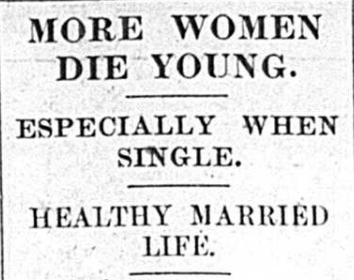
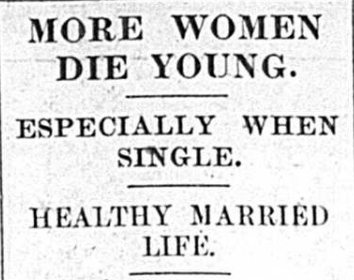
1927: More Women Die Young

1927: More Women Die Young

On 22 September 1927 the Daily Mail printed the following article on page 9 of the London edition:

More Women Die Young

Especially When Single

Healthy Married Life

A remarkable fact revealed in a report by the
Government actuary, Sir Alfred W. Watson, on the
expectation of life as shown by statistics, is that the
death rate is increasing for single women between 18 and 27.[i]

The article goes on to note that life expectancy for both men and women has gone up; that both sexes between the ages of 30 and 60 are showing considerably increased levels of ‘vitality’; and that married women between the ages of 18 and 27 are ‘healthier than ever’.

Despite this apparent abundance of good news, the article’s main concern is that for the subset of single women between 18 and 27, a ‘deterioration’ in life expectancy is observed. The article does not only note this trend, but also presents an expert opinion as to what may be the cause of this.

The article’s final paragraph quotes Dr Ethel Browning, an accomplished scientist who was in the process of writing a book on common illnesses and how to prevent them.[ii] Browning is quoted in the Daily Mail as follows:

Probably the increased rates of mortality among
young unmarried women are due to the fact that
so many more of them are now doing really hard work
and closely confined in offices. At night, instead of getting
fresh air, they go to dances or spend their time in cinemas,
with a continuation of the same evil tendencies.[iii]

On the face of it, this article is unremarkable. The article was a one-off, not part of a special series or campaign. It was wedged in on the page between an article about a man who was wrongfully convicted of being drunk and disorderly; and a report on a deadly fire in a school in Winnipeg, Canada. Page 9 of the Daily Mail was reserved for general news items which were not the lead stories of the day. Yet the article is based on a number of tacit underlying assumptions which are highly political. A close reading of a seemingly throwaway article such as this, can demonstrate the agenda of national popular newspapers in the interwar period.

The article makes it clear that the part of the survey that readers should be most interested in is that young, unmarried women appear statistically more likely to die at a younger age, than in previous decades. This implies that the death of a young, unmarried woman deserves more attention and concern than the death of other members of society. The article’s headline explicitly ties marriage to health, underscoring the desirability for women to follow this conventional route.

The report does not actually specify by how much the life expectancy of young single women has declined; it merely states that this is the only group for which a decline has been identified. At the end of the article, Dr Browning is addressed by her title, but no additional information is given about her credentials or area of expertise.[iv] Her title provides her with sufficient authority that her subsequent argument about the detrimental effects of office work, dancing and cinema-going to women’s health are presented as fact. The choice to quote a female scientist sets up a dynamic between a (presumed) older, learned woman criticising the behaviour of younger, more frivolous women.

The Daily Mail editorial team could have chosen to highlight any of the positive aspects of the statistical survey, such as the increased life expectancy for boys and girls. Instead, the article taps into concerns about young women’s behaviour which were amplified regularly through the pages of the Mail and other newspapers in this period. During 1927 and 1928 concerns about ‘flappers’ were particularly fraught as the Representation of the People Act 1928 extended voting rights to women from the age of 21.[v] Articles such as the one under consideration here, helped to subtly reinforce the narrative that young women were irresponsible in their lifestyle choices.

Dr Browning’s comments about office work potentially contributing to earlier deaths for women can be interpreted as a rejection of women’s entrance into the workplace. One could reason that if women were not working in ‘closely confined’ offices but instead spent their time home-making (as they would do when they were married) then women would be healthier. The second part of the quote focuses on leisure activities which, it is implied, women participate in through choice – as they could instead choose to ‘get fresh air’. The supposed ill health of the women therefore becomes their own responsibility; if they chose to have healthier leisure pursuits when single, and endeavoured to get married as soon as possible, they would be healthier and live longer.

This short analysis demonstrates how, through day-to-day reporting, popular newspapers such as the Daily Mail promoted conservative values and stoked concerns that social change was having detrimental effects, in this case implying that fertile young women were dying. Although an article such as this may not seem political, its structure, its language and its cavalier approach providing evidence for statements all work together to reinforce ‘common-sense’ assumptions to its readers. When replicated across hundreds of articles in the daily popular press, these tacit assumptions went a long way to influence how newspaper readers thought about the world around them.


[i] ‘More Women Die Young’, Daily Mail, 22 September 1927, p. 9

[ii] Bartrip, P. W. J. “Browning [née Chadwick], Ethel (1891–1969), toxicologist and factory inspector.” Oxford Dictionary of National Biography. 23 Sep. 2004; Accessed 19 Dec. 2020. https://www.oxforddnb.com/view/10.1093/ref:odnb/9780198614128.001.0001/odnb-9780198614128-e-57854

[iii] ‘More Women Die Young’, Daily Mail, 22 September 1927, p. 9

[iv] Ether Browning is primarily remembered as an industrial toxicologist.

[v] Adrian Bingham, Gender, Modernity, and the Popular Press in Inter-War Britain (Oxford: Oxford University Press, 2004), p. 16