Should journalists go to university?

The interwar period saw the continued rapid expansion of print media, which started in the Victorian and Edwardian period. A host of tabloid newspapers launched between 1896 and 1910, including the Daily Mail, Daily Mirror and Daily Express. During the 1920s and 1930s national newspapers aggressively sought to expand their readership. In addition to the national morning papers, British readers could also enjoy Sunday and evening papers, as well as local newspaper titles. The magazine and periodical market also continued to expand, providing content catered to specialist interests.

This ever-growing market required a constant and increased supply of journalists to provide content to all these publications. Journalism was an occupation without formal entry requirements, and traditionally journalists were trained on the job. The sheer size of the print media sector meant that most British people learnt about current affairs, and the world around them, through journalists’ reports. As the interwar period progressed, there were increased concerns about the influence that this group of writers, who often lacked formal qualifications, yielded over the British public. These concerns crystallised in a debate which has continued for the remainder of the twentieth century: should journalists receive a formal university qualification, or is it better to receive on the job training?

As a government-issued report in 1938 noted,

Most London journalists are still recruited from the ranks of the provincial Press. In the past this has meant that reporters and sub-editors on Fleet Street were men whose formal education ceased when they left school at the age of 14 or 15, and this has been a considerable obstacle to the raising of the cultural standards of the Press.[1]

The raising of the ‘cultural standards’ of the press is closely linked to the level of formal education received by journalists, and there was a real concern that journalists ended up having to report on items that they would not understand, which could lead to incorrect reporting. Formal education for journalists, then, seemed to be the answer, but the sector continued to be sceptical about the value of this.

Recent studies suggest that journalism was not established as a university subject in Britain until the 1970s, and that compared to other English-speaking countries, journalism has not been considered a subject worthy of study in Britain.[2] It is true that journalism enjoys a much longer history as a university subject in the USA, and that Australian universities and journalism professional bodies collaborated in the interwar period to build a recognised and respected curriculum.[3] Although developments in Britain were less structured or widespread, here too, the first university course in journalism was established in 1919.

This Diploma for Journalism was established at the University of London, initially as a training course for ex-servicemen who were entitled to government funding for their education.[4] The diploma course existed up until 1939 and throughout the interwar period was the only university course in journalism.[5] Its creation suggests that there was an appetite for university-educated journalists. However, from the start, the diploma was ambivalent about its purpose, and had detractors as well as supporters in the journalism sector.

Initially, students on the diploma took only academic subjects which were part of degree courses delivered by the University of London, such as general history, languages and composition.[6] Unlike students on degree courses, however, the diploma was open to students who had not passed the matriculation exam, the general entry exam for entry onto University degrees.[7] From the start, the academic nature of the course drew criticism from, amongst others, the National Union of Journalists. Throughout the interwar period the syllabus was revised, including a significant update in 1933 after which students spent at least a third of their time on ‘practical journalism.’[8]

According to surveys undertaken by the diploma’s own lecturers, a significant number of graduates landed jobs in the regional or national press, and graduates were generally positive about their experiences on the course.[9] It should also be noted that the diploma welcomed a significant number of female students, who may have experienced barriers entering other types of university education. However, the course delivery team did not unpick whether the diploma was the deciding factor in graduates obtaining employment.

Teaching on the diploma was delivered by journalists, and guest lectures were delivered by high-profile industry names. Needless to say, none of them had themselves undertaken any formal journalism training, and even those involved with the diploma hesitated to state categorically that it was a necessary pre-requisite to employment in the newsroom. When Frederick Peaker, president of the Institute of Journalists, delivered an address on ‘The Training of the Journalist’ to the International Association of Journalists in 1927, he talked at length about the diploma course, but still concluded that ‘the real training of the journalist must be inside a newspaper office.’[10] According to Peaker, the diploma gave the complete novice a general sense of what is required of the role, but the real training began once they are in the newsroom.

Interestingly, graduates of the diploma mostly praised the solid grounding in general knowledge that they received, which expanded their analytical skills.[11] This implies a tacit acknowledgement that practical skills were better learnt in the work environment, a sentiment echoed by Scottish journalism graduates nearly 100 years later.[12] Despite the diploma course, which saw healthy enrolments throughout its twenty years of existence, the 1938 government report still raised concerns about the general lack of education of journalists. As a profession without entry requirements, journalism was difficult to regulate, despite the government’s efforts in stimulating the diploma course. The persistent ethos that the best route into journalism was that of starting at the bottom and working your way up, further hindered acceptance of formal qualifications for journalists. Although those taking the diploma clearly benefited from it, the general view remained that journalists should not go to university.


[1] Political and Economic Planning, Report on the British Press: a survey of its current operations and problems with special reference to national newspapers and their part in public affairs (London: PEP, 1938), p. 14

[2] Mark Hanna and Karen Sanders, ‘Journalism Education in Britain: Who are the students and what do they want?’, Journalism Practice, vol. 1, no 3 (2007), 404-420 (p. 405); Simon Frith and Peter Meech, ‘Becoming a Journalist: Journalism education and journalism culture’, Journalism, vol. 8, no 2 (2007), 137-164 (p. 138)

[3] Kate Darian-Smith and Jackie Dickenson, ‘University Education and the Quest for the Professionalisation of Journalism in Australia between the World Wars’, Media History, vol. 27, no. 4 (2021), 491-509

[4] Frederic Newlands Hunter, ‘Grub Street and Academia: The relationship between journalism and education,1880-1940, with special reference to the London University Diploma for Journalism, 1919-1939’, unpublished PhD thesis (City University, 1982), pp. 160-161; PEP, Report on the British Press, p. 14

[5] Ibid., p. 205

[6] Ibid., p. 164

[7] Ibid., p. 167

[8] Ibid., p. 188

[9] Ibid., p. 184

[10] Frederick Peaker, The Training of the Journalist. An Address (London: International Association of Journalists, 1927), p. 14

[11] Newlands Hunter, ‘Grub Street and Academia’, pp. 183-184

[12] Frith and Meech, ‘Becoming a Journalist’, p. 152

Careers for Girls (1927)

The interwar decades were a fertile period for non-fiction books that provided advice and guidance on how to self-improve your life. As well as health and fitness books and books on how to take up new hobbies or learn DIY skills, publishers also put out a steady stream of books that purported to help readers establish a new career. In 1927, George Allen & Unwin publishers produced Careers for Girls, a practical guide written by one Eleanor Page.

Careers for Girls was part of a series of self-help books. The book’s opening sentence immediately set out its purpose:

This work has been compiled to assist girls who have to earn a livelihood to choose a sphere of work suited to their individual gifts and temperaments, and by which they may earn a happy and comfortable living; and for the more favoured girls anxious to develop any talent they may be endowed with, so that they may take their rightful place in the scheme of things.

Immediately the book distinguishes between two types of ‘girls’ (really, young women): those who have to earn a living, and those who have some private income to rely on but have a drive to make a contribution to society, based on their skills and talents. Almost all the career paths covered in Careers for Girls are registered professions, which require formal schooling and certification, which in turn require financial investment to pay for classes and examination fees.

Although most of the roles described in Careers for Girls don’t appear to be particularly exclusive to a modern reader, in the interwar period compulsory schooling stopped at 14. Secondary schools charged tuition fees; the only way for a child of a working-class family to attend was through obtaining a scholarship. Only 14% of all teenagers went on to a secondary school; and only a fraction of those went on to University.[1]

Whilst women were allowed to attend university and could now even obtain a degree, the overall proportion of female students remained very low.[2] So when Careers for Girls advised that to become a librarian, you could complete on-the-job training as long as you had a secondary school diploma, this career would not be accessible to 86% of the population.[3] To become a musician was even more difficult: a qualification at either a University or the Royal College of Music/Royal College of Art would be expected.[4] When the book’s opening therefore distinguishes two types of ‘girls’, it wholly ignores the vast majority of young women for which the pursuit of a skilled profession was completely out of reach.

The rest of Careers for Girls is divided up in chapters, each of which covers a different area of work. Teaching and nursing – two roles traditionally associated with women – make an appearance, as do accounting, civil service, journalism, social service and many others. By 1927, Britain suffered from a surplus of women, as the impact of the Great War, and the thousands of young men who had died on the front, continued to be felt.

Guides like Careers for Girls gave young women ideas to an alternative to domestic married life. The pursuit of a career rather than marriage would have been a necessity to many. Tellingly, a number of the advertised professions, such as nursing and teaching, generally came with room and board. These roles provided a solution to the single woman who had no family members with whom she could, or wanted to, live.

Careers for Girls also gives estimated salary expectations for all posts. One of the more lucrative careers included is the top rung of the Civil Service, the “Administrative Class”. In order to obtain a position here, a woman had to meet the standard criteria for all Civil Service positions, namely be a British subject with a British father, unmarried, at least 5 feet tall and of certified good health.[5] “In the highest branch of the Service – the Administrative Class – candidates must be twenty-two to twenty-four years of age. The standard of education for examination is equal to that for a University Degree.” After meeting all these criteria (and remaining single, as the Civil Service operated a Marriage Bar), Careers for Girls stated that a woman could enjoy an annual salary of up to £550. However, in reality, Administrative Class posts in the Civil Service were only theoretically open to women – no women actually penetrated to this level of work.[6]

The jobs that appeared to give the young woman the chance of the highest salary, without requiring extensive or expensive training, were those in the distinctly modern fields of media and advertising. Eleanor Page claims that ‘Good positions, with salaries from £500 to £2,000 a year, are open to the woman advertising expert. (…) a university degree or large amount of capital are not required.’[7] Both marketing and press firms ‘prefer to take girls from school and train them to their own methods’, making formal qualifications a hindrance rather than a help.[8]

Similarly, it is telling which careers appear to be not for ‘girls’: glaringly absent are, for example, doctor or surgeon – although Elizabeth Garrett Anderson qualified as both in 1865. Women can train to become secretaries, but not board members; chief assistant librarian but not head librarian; a staff manager, but not the head of the business. Ultimately, Careers for Girls provided a small sub-section of British women with suggestions for professions that were acceptable for them to pursue within the prevailing social norms of the period. The book likely allowed some women to plan out a career trajectory, but for many more its advice would have been so far removed from their day-to-day experience that it was no help whatsoever.


[1] Deirdre Beddoe, Back to Home and Duty: Women Between the Wars 1918-1939 (London: Pandora, 1989), p. 34

[2] Francesca Wade, Square Haunting: Five women, freedom and London between the wars (London: Faber & Faber, 2020), pp. 93-94

[3] Eleanor Page, Careers for Girls (London: George Allen & Unwin Ltd, 1927), p. 85

[4] Ibid., p. 81

[5] Ibid., p. 38

[6] Beddoe, Back to Home and Duty, p. 83

[7] Page, Careers for Girls, p. 14

[8] Ibid., p. 73 and p. 14

Alastair Sim

Alastair Sim

Alastair Sim was born in 1900 in Edinburgh. After an aborted university education and active duty during the Great War, he trained as an elocution teacher and took up a lectureship in that subject at the University of Edinburgh in 1925. Elocution and drama teaching was his route into an acting career, of which his parents were not supportive. In 1930 Sim moved down to London, where his acting career took off.

After several years of stage roles, Sim made his film debut in 1935, with no fewer than five film credits to his name in that year alone. All were mostly low-budget comedies or crime films, in which Sim played smaller parts. Throughout his career he mostly played supporting roles, with the notable exception of Scrooge (1951) in which he played the titular character. It’s still considered one of the best portrayals of Scrooge on film.

As the 1930s continued, Sim got more substantial film roles in higher-profile films. His lanky frame (he was just over 6 feet tall) and distinctive voice made him instantly recognisable to audiences. In 1936 Sim starred opposite George Formby in the Monty Banks-directed Keep Your Seats, Please!. In the same year he was also directed by Monty Banks in the comedy The Man in the Mirror, although his name was misspelt as Alistair in the film’s credits.

In 1937-38, Sim starred opposite Jessie Matthews three times, in Gangway (1937); Sailing Along (1938) and Climbing High (1938). In Gangway, Matthews plays a journalist who gets caught up in a trans-Atlantic criminal plot. Sim is Detective Taggett, who is attempting to arrest the criminals. In Sailing Along, Matthews plays a precocious young woman and aspiring dancer who is brought up on a tug-boat. Sim here is the supporting character Sylvester, a confused and slightly simple-minded man who helps Matthews in her career aspirations. By the time of Climbing High, Sim was sufficiently famous that his name was included on the film’s poster. He again plays a supporting comedy relief character in this film.

Sim was only seven years older than Matthews, but in none of the three films is there the slightest inkling that he may be a suitable romantic partner for her characters. In fact, throughout the films Sim made in the interwar period, he plays characters who don’t have any romantic entanglements with co-stars. This was no doubt partly to do with his appearance, which did not meet conventional beauty standards of the period. Even in his thirties, he looked older than his years, and appeared somewhat ageless. His persistent casting in comedy roles further diminished his romantic appeal.

It is surprising, then, that in the 1937 crime film The Squeaker, Alistair Sim plays a character who has a settled domestic life, just when you least expect it. In The Squeaker Sim is Joshua Collie, a crime reporter for a popular newspaper. Journalists featured regularly in British interwar films, and were usually portrayed on the move, gathering news on the street; or pushing against deadlines in the newspaper offices.

Collie, on the other hand, is shown inside his comfortable living room, where he smokes a pipe after dinner like a suburban family man. He is not particularly interested in chasing down news, even though his friend, Scotland Yard inspector Barrabal, is feeding him plenty of information about the big criminal case he is working on. Collie reluctantly follows Barrabal’s leads only when his editor threatens to sack him for neglecting his duties. Alastair Sim played against the expected stereotype of the crime reporter, by making Collie a bit lazy and committed to his creature comforts. This enabled him to position himself again as a comedy character, even in a serious crime film which was based on a hard-boiled Edgar Wallace novel.

At the tail end of the interwar period Sim starred opposite Gordon Harker, another prolific interwar actor of comedy roles, in Inspector Hornleigh (1939). Sim played Sergeant Bingham, assistant to Harker in the titular role of Hornleigh. The pair are asked to investigate a murder in this comedy. The film was successful enough to spawn two sequels: Inspector Hornleigh on Holiday (also 1939) and Inspector Hornleigh Goes to It (1941).

Sim’s acting career lasted until his death in 1976. In the 1950s, as well as his interpretation of Scrooge, Sim also starred as the headmistress in the original St Trinian’s films, The Belles of St. Trinian’s (1954); and Blue Murder at St. Trinian’s (1957). Although his most commercially successful roles date from the second half of his career, he built up his screen persona and fame throughout the interwar period.

New Year’s Eve 1921

New Year’s Eve 1921

For this last blog post of the year we’re travelling back in time 100 years, to have a look at how London spent New Year’s Eve in 1921.

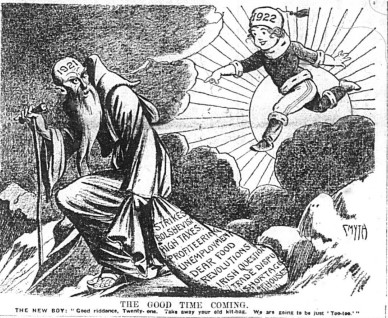
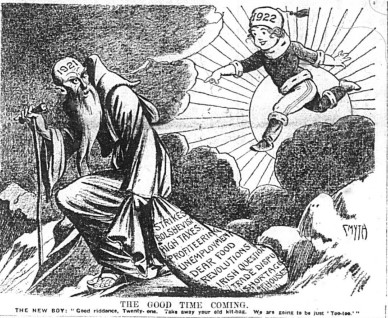
In 1921, 31 December fell on a Saturday, so the Sunday papers had the privilege of welcoming in the new year. The News of the World posted this cartoon on its front page, under the banner ‘A Happy New Year to All of Our Readers’.

Cartoon printed on the front page of News of the World, 1 January 1922

1921 appears to have been considered a year well worth saying goodbye to: the old man representing the past year carries a sack containing, amongst other things, ‘Bolshevism’; ‘Revolutions’ and ‘Shortage of Houses’. These, along with ‘Profiteering’ and ‘Unemployment’, indicate that the impact of the Great War on British society had continued to reverberate. The custom of depicting the previous year as an old person and the new year as a youngster was common, as evidenced by the following report in the Daily Telegraph:

Never has a New Year been welcomed with more public rejoicing and festivity in London than that upon which we have just entered. (…) all the great London hotels and restaurants were crowded with guests, for whom elaborate programmes of feast and entertainment had been arranged, including in most cases some novel and exhilarating means of marking at midnight the death of the Old and the birth of the New Year.[1]

Probably the most extravagant party was held in the Savoy, which catered for either 1600 or 1750 guests (numbers given by the Daily Telegraph and Evening Standard respectively). The distinguished guests, which included Lord Curzon, watched as a recording of Big Ben, projected on a screen, counted down the minutes to midnight.[2] Another notable entertainment was given in the Hotel Victoria, where a miniature airplane carrying a little girl appeared to descend out of the ceiling.[3]

Crowds were not just found inside hotels and restaurants, but also in the churchyard of St Paul’s Cathedral: ‘The crowd which gathered from East and West within the shadow of St Paul’s Cathedral on Saturday night to sing “Auld Lang Syne” was a record one.’[4] This ‘record’ size crowd was unlikely to have only contained ‘London Scots’ as the Daily Telegraph article supposed: the crowd as so great as to make it ‘almost impossible to move.’[5]

Whilst the parties in the hotels and restaurants were only accessible to the wealthy, the poor were not forgotten. The Daily Telegraph reported that some 18,000 deserving children in various East London boroughs had been treated to a special meal earlier in the day.[6]

The Observer looked beyond the London festivities and reminded readers that half the world welcomes the New Year before Britain does, with festivities starting in a ‘small group of islands which belong to New Zealand.’[7] The article also points out that those countries using the ‘inaccurate Julian calendar’ would not be celebrating the New Year until a few weeks later. The article expresses the hope that the newly founded League of Nations may eventually ‘bring about international uniformity in the matter of the calendar and thus ensure a simultaneous celebration of the birth of the New Year among the nations of the Earth.’[8]

In contrast to these reports of parties and celebrations, the Manchester Guardian instead reported on ‘The Old Year’s Violent Passing.’[9] Whilst Londoners were celebrating, other parts of the country experienced forceful gales which particularly affected those living near the sea and rivers and which lead to ‘Wrecks, Heavy Damage, and Loss of Life.’

The other New Year’s tradition was (and is) the publication of the New Year’s honours list, which was reported in full by the Manchester Guardian and The Times but ignored by the more popular papers. Sir J.M. Barrie, who had been made baronet in 1913, was made a member of the Order of Merit in 1922; Gerald du Maurier received his knighthood.[10]

By the time the afternoon of 2 January rolled around, news about the New Year parties already had to make way for developments in what would become one of the most notorious murder cases of the interwar period. The Evening Standard announced a ‘Solicitor’s Sensational Arrest’ on its front page.[11] Over the weekend, whilst everyone had been distracted by the gale force winds and the parties, police in Hay, near the Welsh border, had arrested Herbert Rowse Armstrong, who ran one of the two local law practices.

Armstrong was arrested for the attempted murder of Oswald Norman Martin, a solicitor at the rival firm. By the time the Evening Standard appeared in the stands, the body of Armstrong’s late wife had been exhumed. Upon re-examination it was concluded that she, too, had been poisoned. Armstrong was eventually convicted of her murder and executed – the only solicitor in British history to be hanged for murder. The arrest of the ‘Hay Poisoner’ ensured that 1922 started with the familiar thrill of, as George Orwell would have it, a good old-fashioned English murder.


[1] ‘New Year’s Eve’, The Daily Telegraph, 2 January 1922, p. 6

[2] Ibid., and ‘A Londoner’s Diary’, Evening Standard, 2 January 1922, p. 4

[3] ‘Revels Greet 1922,’ Daily Mail, 2 January 1922, p. 4

[4] ‘Revels Greet 1922’, Daily Mail, 2 January 1922, p. 4

[5] ‘New Year’s Eve’, The Daily Telegraph, 2 January 1922, p. 6

[6] Ibid.

[7] These islands are Tonga, Samoa and Kiribati. ‘The Journey of the New Year’, The Observer, 1 January 1922, p. 9

[8] Ibid.

[9] ‘The Old Year’s Violent Passing’, Manchester Guardian, 2 January 1922, p. 7

[10] ‘New Year Honours,’ Manchester Guardian, 2 January 1922, p. 7

[11] ‘Solicitor’s Sensational Arrest’, Evening Standard, 2 January 1922, p.1

Kate Meyrick’s Private Diaries

Kate Meyrick’s Private Diaries

Kate Meyrick was known as the ‘Nightclub Queen’ in interwar London. She ran a string of nightclubs, of which the ‘43’ in Gerrard Street was the best-known. Nightclubs operated on the edge of the law – a club in itself was not an illegal space, but if alcohol was sold outside of hours permitted by the club’s license, the club owner could face hefty fines or even prison time. Additionally, clubs were supposed to only be open to members, who paid yearly subscriptions and were known to be of good character. In practice, Meyrick and other club owners generally allowed guests to become ‘members’ upon arrival.

Kate Meyrick made substantial money from her nightclub ventures, although they also cost her a lot to maintain. Her career effectively ended when it was revealed in 1929 that she had been bribing Police Sergeant George Goddard.[1] Goddard would tip Meyrick off if any of her clubs were likely to get raided, so that she could make sure no illegal activity was taking place in them.[2] Both Goddard and Meyrick were convicted – the latter to fifteen months’ hard labour which negatively impacted her health.

Throughout Meyrick’s career as a nightclub owner, she had become a well-known public figure, recognizable from press reports to those who would never get close to setting a foot in her clubs. After her death in 1933, publisher John Long published her memoirs, The Secrets of the 43.[3] Extracts from her ‘private diaries’ were subsequently serialised in the Sunday Express. These posthumous publications show how Meyrick’s family worked to shape her public image from convicted criminal to caring mother.

Meyrick had eight children, and professed that her main goal in entering the nightclub business was to give her family financial support. Many of her children entered her business as managers and staff in her ever-expanding network of clubs. Although Meyrick did not leave her children much capital when she passed, she had been able to secure advantageous marriages for most of them. Mary, one of Meyrick’s eldest daughters, married the Earl of Kinnoull. It was with his introduction that Meyrick’s diaries were published in the Sunday Express, giving them an aura of respectability.

In his introduction, the Earl calls his mother-in-law a ‘remarkable’ and ‘dynamic’ woman who hoped to give her children ‘brilliant chances she had been so determined they should enjoy.’[4] Her decision to start selling alcohol illegally is framed as the only option she had to make money for her children, as well as a result of her ‘impulsive nature’. The subsequent move through periods of financial success followed by raids, fines and prison sentences is related as ‘the slow slipping of the power of wealth from her fingers, her powerlessness to help her children as she longed to do.’

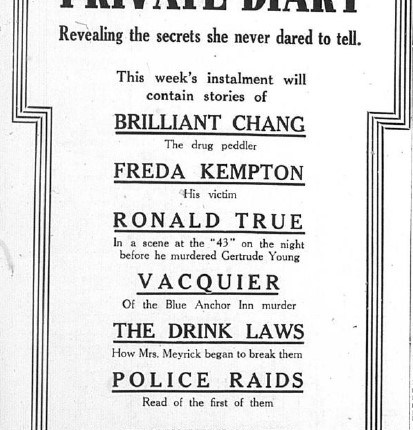
Advert in the Daily Express of 4 March 1933

The diary serialisation was advertised by the Sunday Express with reference to the notorious criminals Meyrick had hosted in her clubs, consciously tightening the public’s association between nightclubs and serious crime. If we accept the printed diaries as accurate copies of what Meyrick recorded, she herself was also eager to align herself and her clubs with notorious criminal cases. She describes that Ronald True, who was convicted of the murder of Gertrude Young, was in the ‘43’ the night before his arrest:

Have just seen the account of the arrest of Ronald True for the murder of Gertrude Young. He was in the 43 last night. Wonder if I am psychic? I went downstairs at 4 a.m. to stop the band, and ask them to come up to the first floor. When I went upstairs I felt I must turn round. When I did turn I found Ronald True gazing at me with murder in his eyes. (…) I suppose I ought to have warned somebody. But who?[5]

True was arrested on 9 March 1922 and was therefore in the club on 8 March – Gertrude Young had been murdered on 6 March, so any warning Meyrick could have given would not have saved her life. The ‘murder’ in True’s eyes was presumably imagined by Meyrick after she heard of his arrest.

This didn’t dissuade Meyrick from believing in her psychic abilities. She raises the topic again when she describes allegedly greeting Patrick Mahon in one of her clubs, shortly before he is arrested for the ‘Crumbles murder’; one of the more graphic murders to take place in England in the 1920s.

He [Mahon] was only in last week. How dreadful to think I shook hands with a murderer. (…) I am sure I am psychic. Just as in the case of Ronald True, Mahon’s eyes impressed me. They were not like the eyes of ordinary people: there was something behind them.[6]

Through the publication of Meyrick’s autobiography and diaries, her family were able to exercise control over her public image, which in turn affected their own reputations. By downplaying the illegal activities in which Meyrick had participated and foregrounding her commitment to her children, the Earl of Kinnoull was presenting his mother-in-law as a courageous and hardworking woman. He also profited from her by selling her diary to a newspaper. The Sunday Express, in the meantime, milked Meyrick’s proximity to notoriety to boost its own circulation. After her death, Meyrick’s own words became a tool for others to use.


[1] Heather Shore, ‘Constable dances with instructress’: the police and the Queen of Nightclubs in inter-war London’, Social History, (2013) Vol. 38, No. 2, 183–202, p. 199

[2] Clive Emsley, ‘Sergeant Goddard: the story of a rotten apple or a diseased orchard?’ In: Srebnik, Amy Gilman and Levy, Rene eds. Crime and culture: an historical perspective. Advances in Criminology (Aldershot, UK: Ashgate, 2005), pp. 85–104

[3] Kate Meyrick, The Secrets of the 43 (London: John Long, 1933)

[4] Earl of Kinnoull, ‘The Things She Could Never Tell’, Sunday Express, 25 February 1933, p. 9

[5] ‘Sergeant Goddard’s First Raid’, Sunday Express, 5 March 1933, p. 13

[6] ‘Valentino – Mahon – Kreuger – and Jimmy White’, Sunday Express, 12 March 1933, p. 13

Gracie Fields in Picture Post (1938)

Gracie Fields in Picture Post (1938)

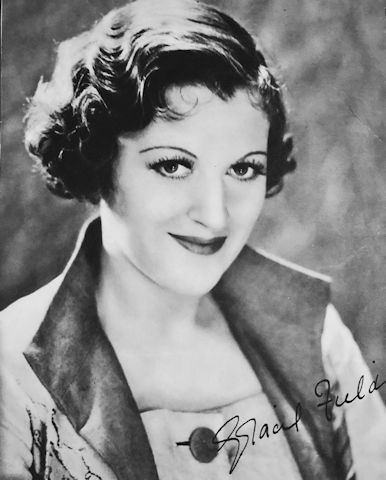
Gracie Fields was one of Britain’s biggest stars during the interwar period, and she is certainly one of the stars that is best remembered today. With her signature Lancashire accent; dry, witty comedy; and hearty songs, she came to represent a version of Britishness grounded in no-nonsense hard work and companionship. Whilst the music hall stage was her natural home, in the 1930s Fields expanded her reach through appearing in a string of musical comedy films. In these, she generally played a working-class woman with aspirations to perform as a singer. Her characters, often called Grace/Gracie or Sally, met any obstacles with good cheer and eventually achieved their ambitions.

In 1938, Fields was invited to perform for Queen Mary (the late King’s wife and grandmother of Queen Elizabeth II) in the Royal Albert Hall. To mark the occasion, Picture Post featured an extensive spread titled ‘A Day With Gracie’.[1] The text and pictures of this article give an insight in how Fields’ celebrity persona was constructed at this stage of her career, when she had become an established star.

Rochdale News | News Headlines | Appeal for Gracie Fields memories for new  biography - Rochdale Online

The article starts with an imaginative recounting of how a six-year old Gracie used to sing on the streets of Rochdale, whilst dreaming of future riches: ‘She thought of the day when she would be a famous actress, with enough money to buy clothes, mansions, motor-cars, and holidays abroad.’[2] The article positions Fields’ working-class and Northern background as a pivotal part of her development as a singer. However, it also states that a desire for material wealth underpinned her ambition.

The article goes on to describe Fields’ first attempts as a singer: supporting an existing music hall act; singing at local competitions and charity events; joining a troupe of ‘Juveniles’ on tour. Throughout these descriptions, the article constantly refers back to Fields’ father’s scepticism of her ambitions, and the need for Fields to bring income into the family. After the failed Juveniles tour, Fields’ mother ‘got Gracie a job as an errand girl to a confectioner.’[3] The article goes into the formative part of Fields’ career in such detail, because it allows the journalist to present Fields as completely determined in her ambition to succeed. Like Fields’ personas in her various films, she was not deterred by setbacks, but instead kept trying to find a way to realise her ambitions.

Initially, this path to success took the form of incredibly hard work: Fields was working shifts in a local mill, going to school, and also attending dance classes in Manchester several times a week.[4] She studied music hall acts and eventually was given another opportunity to perform at a local music hall. Rather ironically, it was not until Archie Pitt, a performer sixteen years her senior, ‘spotted’ her and decided to build his next show around her, that Fields’ career really took off. She married Pitt in 1923, when she was 25 and he 41; the couple divorced in 1939 and the marriage was already very rocky by the time the Picture Post article was published – Pitt does not appear in any of the images accompanying the piece.

Although the article refers to Fields as ‘probably the highest-paid woman in the world’[5] and the ‘Most-interviewed woman in the world’[6] (both unsubstantiated claims), the article is at great pains to stress that Fields is no diva. She finds buying clothes ‘a bore’, likes walking around in old clothes, and is ‘vague’ – a characteristic apparently demonstrated by her tendency to leave half-written letters lying about the house. Although the article originally set up the premise that the young Gracie dreamt of riches, it then takes pains to underline how little the adult Grace is interested in a wealthy lifestyle.

Even more strikingly, the article refers very minimally to Fields’ actual work, despite her enormous success in that area. Instead it focuses a great deal on her work with children. No fewer than 8 out of the 17 photographs that accompany the piece, feature her nephew Michael, who looks about three years old. The captions state that ‘There are almost always children in the house’[7] and ‘Hundreds of children have spent happy afternoons’[8] in Grace’s garden. She also set up a charitable children’s home near Brighton.

What is glaringly absent through the many references to her apparent fondness of children, is any acknowledgement that Fields herself was childless. At the time the article was written she was 40, which is explicitly referred to in the text; the conclusion is quickly drawn that Fields’ childlessness at that age was not wanted. The reality is that Fields’ battled cervical cancer which greatly diminished her ability to get pregnant. Whilst it is understandable that Fields was not keen that her medical history would be known to the public, one wonders how she felt about being presented as such an explicitly maternal figure in this article.

Overall, the Picture Post article is ambiguous in the way it presents Fields. She is both British through and through and someone with international allure and star power. The article devotes considerable attention to her ‘talent, hard work, and personality’[9] and ability to overcome setbacks. At the same time, it frames Archie Pitt as the catalyst of her success. It presents Fields as a rich woman who loves re-modelling her vast house, but also someone who ‘is not interested in money’.[10] It provides an interesting study of how the interwar press attempted to present a successful female star as she moved into middle age.

See Gracie Fields in action in this clip recorded in 1938

[1] ‘A Day With Gracie’, Picture Post, 29 October 1938, pp. 10-16 and 70

[2] Ibid., p. 12

[3] Ibid., p. 14

[4] Ibid., pp. 15-16

[5] Ibid., p. 12

[6] Ibid., p. 15

[7] Ibid., p. 12

[8] Ibid., p. 14

[9] Ibid., p. 70

[10] Ibid.

Dorothy L. Sayers – Murder Must Advertise (1933)

Dorothy L. Sayers – Murder Must Advertise (1933)

Dorothy L. Sayers is readily regarded as one of the most prominent contributors to the ‘Golden Age of Crime Fiction’: a period that spans nearly all of the interwar period. It marked not only a huge increase in the popularity of crime stories in Britain, but also saw innovations in the genre, for example the unreliable narrator in Agatha Christie’s The Murder of Roger Ackroyd (1926) and a crime with half a dozen possible solutions in Anthony Berkeley’s The Poisoned Chocolates Case (1929).

Sayers’ main contribution to the genre were the eleven novels she wrote around amateur sleuth Lord Peter Wimsey; the debonair younger brother of the Duke of Denver who combines a passion for antiquarian book-collecting with his hobby of crime detection. The first Wimsey novel, Whose Body? appeared in 1922 in the US and in Britain a year later. Sayers’ continued writing Wimsey novels until Busman’s Honeymoon in 1937, after which she turned her attention to writing scholarly works on theology.[1]

The eight Wimsey novel out of a total of eleven, Murder Must Advertise, appeared in 1933. In this book, Wimsey goes undercover to work as a copywriter at a fictional advertising firm, Pym’s Publicity. He is invited to do this by the manager, Mr Pym himself, after a suspicious death on the firm’s premises: one of the staffers has fallen to his death from a spiral staircase. Sayers drew on inspiration from her own time working as a copywriter in the early 1920s for S.H. Benson; the Benson office even had a steep spiral staircase like the one that appears in Murder Must Advertise.[2]

Sayers’ real-life work experience lend the novel’s descriptions of the office life in an advertising firm an authentic air. The novel’s opening sees all the firm’s office staff gathered in the typists’ room, to surreptitiously organise a sweep on the horse races. There are pages of rapid, overlapping dialogue of staff discussing the sweep and the arrival of the new colleague. When they hear one of the managers approach,

‘the scene dislimned as by magic. (…) Mr Willis (…) picked a paper out at random and frowned furiously at it (…) Mr Garrett, unable to get rid of his coffee-cup, smiled vaguely and tried to look as though he had picked it up by accident and didn’t know it was there (…) Miss Rossiter, clutching Mr Armstrong’s carbons in her hand, was able to look businesslike, and did so.’[3]

It is a scene still familiar from modern office-based comedies and dramas such as Mad Men (2007-2015) and The Devil Wears Prada (2006). Throughout the book, the copywriting staff spend most of their time chatting and trying to come up with new slogans, interspersed with bursts of extreme stress when an advert needs to be reworked close to the printing deadline. A key scene in the novel sees the Morning Star newspaper ring the office at 6.15pm because they have noticed an unintentionally rude image in one of the adverts due to be printed that evening.[4] The resolution to the murder investigation ultimately also lies in the adverts: Wimsey finds out that a drug racket uses advertisements to communicate with one another.

Because of Wimsey’s aristocratic background, he does not normally engage in paid work in any of the books. Alongside the murder mystery, Murder Must Advertise gives the reader the opportunity to glimpse the world of advertising in 1930s Britain. The subject matter gives Sayers’ ample opportunity to poke fun at the public. During his time at Pym’s, Wimsey accidentally comes up with a wildly successful campaign for (fictional) Whifflet cigarettes:

‘It was in that moment, (…) that [Wimsey] conceived that magnificent idea that everybody remembers and talks about today – the scheme that achieved renown as ‘Whiffling Round Britain’ (…) It is not necessary to go into details. You have probably Whiffled yourself.’[5]

Essentially, the campaign is a coupon scheme; coupons collected on cigarette packets could be traded for hotel stays, train tickets, holiday outings et cetera. Sayers’ describes the scheme as growing beyond the initial campaign to

‘Whifflet wedding[s] with Whifflet cake[s] (…) a Whifflet house, whose Wihfflet furniture included a handsome presentation smoking cabinet, free from advertising matter and crammed with unnecessary gadgets. After this, it was only a step to a Whifflet Baby.’[6]

At the time the novel was published, this type of all-encompassing branding had also been embraced by the British Union of Fascists, as discussed in a previous post. Advertising and marketing in general had taken an enormous flight during these decades, in no small part due to the increased circulation of daily newspapers.

Sayers herself is sceptical of the industry – the novel ends with a paragraph of fictional advertising slogans and the closing line ‘Advertise, or go under.’[7] Although Sayers apparently enjoyed her time working at S. H. Benson in 1923,[8] when Murder Must Advertise was published ten years later she appears to have been more critical of the industry. Nonetheless, Murder Must Advertise provides a comic look into what was a growing industry in interwar Britain, written by someone with first-hand knowledge of its operations.

A 1973 TV adaptation of Murder Must Advertise can be found on YouTube.


[1] Francesca Wade, Square Haunting: Five Women, Freedom and London Between the Wars (London: Faber & Faber, 2020), pp. 329-331

[2] Martin Edwards, The Golden Age of Murder (London: Collins Crime Club, 2016), p. 13

[3] Dorothy L. Sayers, Murder Must Advertise (London: New English Library, 2003 [1933]), p. 6

[4] Ibid., pp. 135-145

[5] Ibid., p. 288

[6] Ibid., p. 289

[7] Ibid., p. 388

[8] Wade, Square Haunting, p. 125

Night Work for ‘Phone Girls (1929)

An ubiquitous feature of books and films in the interwar period is the use of telephones, and therefore the presence of phone exchange operators. Throughout the 1920s and 1930s, most phone calls in England were put through manual switchboards, which were owned by the Post Office and were mostly operated by young women. These operators would ask the caller which number they wanted to connect to, and then connect the wires on the switchboard to place the call. Switchboard operating became a ‘female’ job, because, in the words of the Science Museum: ‘The job of a switchboard operator took concentration, good interpersonal skills and quick hands. The Post Office, which ran the telephone service in the UK, soon realised that women and girls were much more skilled and reliable than the messenger boys who had first taken on the job.’

Switchboard operating fell into the same category as other jobs which were presumed to require nimble hands, such as hand-colouring films and working in confectionary and biscuit factories.[1] The operators were usually young because it was still the convention that women gave up paid work upon their marriage. There are plenty of anecdotes about regular callers getting to know ‘their’ switchboard operator. The romantic and dramatic potential of the job was effectively used by Maurice Elvey in his 1932 film The Lodger (The Phantom Fiend) in which a young female operator overhears a murder down the line.

In 1929, switchboard operators found themselves at the heart of a debate in which modernity and progress clashed with perceived notions of the suitability of female labour. The Daily Telegraph ran an article on 6 July of that year headlined ‘Night Work for ‘Phone Girls’ – note both the novelty of shortening the word ‘telephone’ and the referral to working women as ‘girls’, as was common practice. The article reports that the Postmaster General proposed to extend the shifts of female operators from 8pm to 10.30pm or 11pm. This would necessitate the hiring of more operators as an individual’s working hours would not increase, but rather a shift pattern would be introduced.

According to the article, the current convention to end women operator’s days at 8pm was maintained at the recommendation of ‘Parliamentary committees’ which were opposed to the employment of girls late at night. The Postmaster General however was of the opinion ‘that social conditions as they affect the employment of women have so changed in recent years’ that this rule could now be abandoned. The increased mobility of women in the immediate post-War period, as well as better access to public transport, had made women much more mobile after dark, and it was becoming commonplace for women to travel around at night.

Curiously, there is also reference to a ‘medical argument’ against women working at night. Although this argument is not spelled out, on suspects there would be concerns that night-work negatively impacts women’s health and may in turn affect their ability to have children. This argument is countered by the Postmaster General through reference to the extensive work women undertook during the Great War, which did not compromise their health.

So far for the social arguments against women working late at night – but the proposal to extend their shifts in the telephone exchange also touched on a recurring debate about jobs for men versus jobs for women. While the women’s roles were ending at 8pm, the evening shift in the exchanges was undertaken by part-time male operators, whose work was apparently ‘subject to a disproportionate number of complaints’. This appears to be the key reason the Post Office was proposing a change; they wanted to improve the service to their customers.

The part-time nature of these men’s contracts is pivotal: the Post Office stresses that for these men, the ‘post office pay is not intended to form their principal means of livelihood.’ [emphasis mine] If the proposal was for women to replace full-time male breadwinners, there would have been considerable opposition to it, even if it would improve the evening telephone service. During the interwar period, the narrative of the male head of household working to provide for his family was much supported.[2] It was regularly argued that women should not be ‘taking’ any roles that should go to male workers. The careful phrasing of the Postmaster General implies that the loss of labour would not be a hardship to any of these men; but it seems likely that for some of them, at least, the Post Office role was their primary income, and a redundancy would be keenly felt.

As this article demonstrates, an apparently simple desire to improve the telephone service for customers was enmeshed in wider debates and concerns that echoed throughout the interwar period. The attentive and powerful press industry could help or hinder an organisation’s ambitions by being either supportive or obstructive. During this period, heads of organisations such as the Post Office had to be acutely sensitive to the political environment even for innovations which may have appeared as strictly internal affairs.

You can see switchboard operators at work here at the International switchboard in London


[1] Miriam Glucksmann, Women Assemble: Women Workers and the New Industries in Inter-War Britain (London: Routledge, 1990)

[2] Christine Grandy, Heroes and Happy Endings: Class, Gender, and Nation in Popular Film and Fiction in Interwar Britain (Manchester: Manchester University Press, 2014)

Glamour Girls

We’re going to have a closer look today at two articles that appeared in early issues of Picture Post. Picture Post was a weekly photojournalism magazine that was launched in Britain in 1938. Its pages contained a huge breath of articles and reportage, which covered topics from word politics to science and nature to fashion and entertainment. Due to the timing of its launch, and the fact that its founder and editor was the Jewish journalist Stefan Lorant, the first issues contain frequent criticism and condemnation of Nazi Germany. This political content was balanced with pieces on ‘lighter’ topics.

In November 1938 and May 1939, Picture Post ran two pieces on ‘Glamour Girls’. Together, these pieces give an insight into the position of young female stage performers in London at the end of the interwar period. By the end of the 1930s, ‘glamour girl’ was the name for the young women who danced on the stage as part of troupes – they were more commonly referred to as ‘chorus girls’ in the earlier part of the interwar period. The adoption of the term ‘glamour girl’ is symptomatic of the continued Americanization of British popular culture throughout the 1920s and 1930s – indeed, one of the Picture Post articles follows an American dance troupe in London.

The row of young, thin, white chorus girls who are all dressed alike and dance in perfect unison was a very recognizable feature of modern urban entertainment during the interwar period. The phenomenon has most famously been critiqued by Siegfried Kracauer in his essay ‘The Mass Ornament’ which originally appeared as a series of articles in the Frankfurter Zeitung in 1927. Kracauer, too, centres his analysis around an American troupe, the Tiller Girls – but British chorus girl troupes quickly sprang up to emulate the American original. Chorus girls appear in myriad British films of this period, from Friday the Thirteenth (1933) to The Show Goes On (1937).

But what of the glamour girl in news reportage? The first Picture Post article under consideration was published in the issue of 22 October 1938 and is entitled ‘A Glamour Girl’s Day’. This piece purports to give insight into the day-to-day life of a group of American dancers who were performing at the Dorchester hotel at that time. Why the show’s impresario, Mr Chester Hale, did not recruit British girls when he had to put on ‘the snappiest cabaret show’ possible, is not made clear. Chester Hale himself appears to have been an American; and it’s implied that American girls are better qualified for ‘snappy’ shows.

The piece both observes the dancers as a foreign species and reassures the readers that they are completely harmless; and it also does not neglect to draw attention to the girls’ physical features. The captions to some of the photos give a good indication of the article’s overall tone:

Hard-working, ambitious, well-educated, carefully chaperoned is the first-class glamour girl of to-day. Wanda Cochran has studied philosophy and public-speaking. Is studying now at the R.A.D.A. (…) Doris Call, a blue-eyed blonde from Virginia, is also studying at the R.A.D.A. She has six sisters, two brothers.

The piece makes much of the fact that the girls are very young – some of them are reported to be only 16. A few have brought their mothers and siblings with them for company; according to one of the mothers, she thinks dancing in a cabaret is much safer for a girl than going to high school (in America). The article runs the reader through a typical day for the troupe during their run at the Dorchester, and repeatedly stresses that the girls engage in wholesome activities such as learning about London and British history; educating their siblings; and improving their dancing and singing skills. It is also emphasised that they usually go home after they finish their shows at 1am – they very much do not go to nightclubs with young men.

Slipped in between the descriptions of the girls’ physiques (average weight 8 st 8 lbs; average height 5 ft 6 in) is the following:

Mr Hale gets a lump sum per week from the Dorchester. Out of that he pays the girls and their fares, and provides the dresses (…) the dresses have run him into a good many hundred pounds. The girls pay their own living expenses. Most of them stay in flats with various accompanying members of their family.

As the dancers have to pay for their own accommodation in central London, as well as their food and regular clothes and expenses, one suspects that they did not actually have any money left over to save. It is also not specified whether the fares for the ‘various accompanying members of their family’ were covered by the Dorchester. What the young women get out of the experience is the ‘glamour’ of their costumes, and the opportunity to learn more about British history and British culture; which covers up a precarious employment position that required them to temporarily relocate; work late hours; and forego traditional schooling.

The conditions of employment also receive attention in the second Picture Post article, printed on 6 May 1939 under the title ‘The Making of a Glamour Girl.’ Although this piece appeared only 6 months after the previous article, the tone differs markedly. The status of the glamour girl appears to have rapidly deteriorated; no longer does the article attempt to stress the career aspirations of glamour girls. Instead, the piece confidently states that ‘Few of them [glamour girls] have any stage ambitions, the majority realise their limitations and are content to be just glamorous.’

Indeed, the low requirements for the role are presented as a selling point:

To be a good Glamour Girl, a girl must possess four qualities. She must have good looks and a figure to match, she must be able to walk gracefully in time to music, she must know how to wear clothes, and she must be tall. No girl who has these attributes need starve or spend her days tapping on a typewriter, stage managers will only be too eager for her services.

The role of the glamour girl (now capitalized) is no longer presented as one that requires hard physical work or any skill, but instead is reduced purely to physical requirements. It is presented as an ideal job for a ‘fun’ girl who wants to make easy money; the jobs are alleged to pay at least £5 a week. The implication that this is a good wage is belied by the statement also included in the article, that many glamour girls work as fashion models and mannequins during the day. The apparent need to work two jobs, alongside the short ‘shelf life’ of the glamour girl (the article estimates the average girl’s stage career to last 3 or 4 years) do not signal this as a financially sound or stable career path. Through these articles, girls and young women were not encouraged to consider long-term benefits of education or jobs that could be done at any age, but instead were directed to consider a job in which one had to work relatively few hours and wear nice clothes, as desirable.

Of course, it would be amiss to imply that these articles were primarily aimed at aspiring glamour girls; both articles were clearly (also) an excuse to print photographs of slender young women in revealing outfits. The 1939 article is accompanied by a dozen photographs, nine of which show the performers in bathing suits or other similarly revealing performance outfits. The 1938 article mostly shows the girls dressed in everyday clothes, but allows the reader a glimpse ‘backstage’ with photos of the girls putting on make-up and putting on their shoes. Both articles present the reader with a fantasy of young, happy, untroubled dancers and only hint at the financial precarity these roles perpetuated.