Short story writing in interwar Britain

Short stories are a relatively niche genre of fiction writing these days. The fiction short story appears to have originated in the 1820s. It is primarily the short stories of famous novelists that have stood the test of time: Sir Walter Scott, Charles Dickens, and, on the other side of the pond, Edgar Allan Poe, F. Scott Fitzgerald and Ernest Hemingway.[i] For the interwar period, literary authors such as James Joyce and Katherine Mansfield may come to mind. Yet the works of Joyce and Mansfield were only read by a limited audience at the time of their publication. They are decidedly ‘highbrow’ authors with no mass-market appeal.

Alongside these literary outputs, thousands of other, now forgotten, short stories were published in interwar Britain. They were found in newspapers, weekly magazines and dedicated publications such as the Strand Magazine. Due to their placement, short story writing was often considered aligned with journalism. Dozens of guide books appeared in the 1920s and 1930s instructing young hopefuls in how to ‘live off the pen’, whether that was through writing news articles; human interest stories; short stories; or novels (or even screenplays for films).

Literary critic Q.D. Leavis let rip against this commercial market of fiction writing in her 1932 polemic Fiction and the Reading Public. She is highly critical of the marketisation of fiction, which in her view sees editors prioritise high circulation figures above all else. ‘The kind of fiction published in this way – the briefest inspection will show that it is all of a kind – is carefully chosen by the editors in accordance with the policy of wat is called ‘Giving the Public what it wants.’’[ii] The result, Leavis argues, is that the public is inundated with ‘fiction that requires the least effort to read and will set the reader up with a comfortable state of mind.’[iii]

Although the tone of Leavis’ book is snobbish in her assumption that the increased commercialisation of literature signals a cultural decline, an inspection of 1920s and 1930s guide books on ‘how to become a writer’ demonstrates that these books did consistently advise to keep the readership in mind when writing short stories. Often, these books break the short story down into constituent elements and tell the aspirant writer how to put together a successful story. They actively warn against individualism or stylistic flourishes in writing. For example, the author of the 1934 book Short Stories and How to Write Them declares: ‘My earnest advice to all at this stage is to study the markets. The stories you find should be your models. Every story should be written with a definite market in view.’[iv] Similarly, The Craft of the Short Story, published two years later, argues that ‘Always remember that your purpose in writing a short story is, or should be, to amuse and entertain.’[v] It is the reader, not the writer, who is the most important part of the equation.

The explosion of print media had made commercial writing an attractive career option for many people. Unlike professions such as medicine or law, you did not need an expensive university education to become a journalist or writer. Indeed, many of the books on the subject argued that all that was needed was a sound grasp of the English language, some stationary supplies and probably a cheap typewriter, and resilience, as the aspiring writer could expect many of their first attempts to be rejected by editors.

One author who made a good living out of the writing of guide books was Michael Joseph, who was also a literary agent and from 1935 a publisher (Michael Joseph continues to exist as an imprint of Penguin). Joseph wrote eight books on the topic of writing and making money, between 1924 and 1931. His prominence in the field is acknowledged by Leavis, who repeatedly uses his books as examples of how writing has become a business. In How to Write a Short Story, Joseph argues that ‘Many writers actually cannot visualise their market when they set to work on a story. Artistically, there is a good deal of justification for this; commercially, it is liable to result in failure to place the MS [manuscript].’[vi] Some of his other books tackle the business side of writing even more explicitly, by listing publications which accept submissions and explaining in detail how one goes about submitting a manuscript.

If the self-study of guidebooks was not enough, the aspiring writer could also enrol into one of dozens of writing schools and correspondence courses that were available in the interwar period. Often these were advertised in short story publications. Professional writers were generally highly sceptical of these ‘schools’ which tended to promise unrealistic returns on investment. Yet some writers set up schools themselves. One of the earliest and most commercially successful was the London School of Journalism, founded by novelist Max Pemberton and still in business today. ‘The Short Story Course’ offered by the School in the 1920s consisted of 12 lessons, each ending with a few exercises which the student could complete and send back to the School to be marked. Lessons include ‘About Plot’ (lesson 2); ‘Heroes and Heroines’ (lesson 4); and ‘Atmosphere’ (lesson 5). Exercises often included copying out examples of existing short stories to study them. The main advice at the end of the course is to ‘work with diligence every day’ and apply oneself, and then success is sure to follow.

All of these courses and books demonstrate that the writing of short stories was big business in interwar Britain, at least for the happy few who were able to claim authority in the field and make a living out of encouraging others to follow the same career path. All of the books highlight resilience and consistency as key to success, but do not mention elements more traditionally linked to artistic endeavours such as inspiration or reflection. Like journalism, which had become increasingly commercialised, short story writing became ‘hack work’ in the interwar period.


[i] All male, of course – not because men are better short story writers but because they have traditionally been more readily classed as ‘great authors’ and have had their oeuvres canonized accordingly.

[ii] Q.D. Leavis, Fiction and the Reading Public (London: Chatto & Windus, 1968 [1932]), p. 27

[iii] Ibid.

[iv] Cecil Hunt, Short Stories and How to Write Them (London: George Harrap & Co, 1934), p. 187

[v] Donald McConochie, The Craft of the Short Story (London: Sir Isaac Pitman & Sons, 1936), p. 27

[vi] Michael Joseph, How to Write a Short Story (London: Hutchinson & Co, 1925), p. 91

Female aviators in interwar Britain

Female aviators in interwar Britain

With the rise in popularity of civil and commercial aviation in the 1920s and 1930s, which has been covered elsewhere in this blog, there was naturally also an increase in the number of people who got a pilot’s license. What is perhaps more surprising to the casual observer is the number of women who became (amateur) pilots. During a time when women were increasingly able to participate in public life, changing social norms made it more acceptable for women to engage with new modes of mobility.

As with the introduction of cars, learning how to fly was mostly open to women from wealthy and privileged backgrounds. Nonetheless, some women from working- and lower-middle class backgrounds were also able to gain a pilot’s license. Unlike today, the training requirements for new pilots were minimal, with some clocking fewer than 10 hours in the cockpit before deciding to set off on long solo adventures. This, too, lowered the threshold to becoming a pilot, although the other big expense required was of course the purchase of a plane.

The most famous female pilot in interwar Britain was Amy Johnson. ‘Amy, Wonderful Amy’ as the song written in her honour called her, became hugely famous when she flew on her own to Australia in May 1930. The journey took her 19.5 days – it was not an outright record but she was the first female pilot to undertake the route as a solo pilot. Johnson had grown up in a middle-class family, attending university and working as a legal secretary before re-training as an engineer and realising her aviation dreams.[1]

‘Amy Johnson, Queen of the Skies’ newsreel

Also in 1930, Mildred Mary Petre (usually known as Mrs Victor Bruce) completed a solo flight to Tokyo in 25 days. Unlike Johnson, Petre’s passion was not solely for flight – she had previously been a record-breaking motor racer. When she undertook her long-distance flight in 1930 she’d only had 40 hours of flight experience.[2] The feats of female pilots caught the popular imagination in 1930, leading the Daily Mirror to enthuse in a bold headline that 1930 was ‘The most wonderful year in the history for women’ and that the year had seen ‘months of triumph over male rivals in almost every sphere.’[3]

Most female pilots either flew as amateurs for private enjoyment, or sought to gain publicity and income by completing record-breaking flights. The commercial airlines were extremely resistant to hiring female pilots. In 1928, amateur pilot Lady Heath was briefly employed by KLM as a pilot on their Amsterdam to London route, but this did not result in a permanent appointment. Lady Heath had grown up in Ireland where she had obtained a degree in science. During the First World War she served as a despatch rider, and in the 1920s she was a champion javelin thrower and one of the founders of England’s Women’s Amateur Athletics Association. Rather than trying to break distance records, Lady Heath focused on height records in her plane, becoming the first pilot to fly a light plane to an altitude of 16,000ft in 1927, and to 23,000ft the following year.

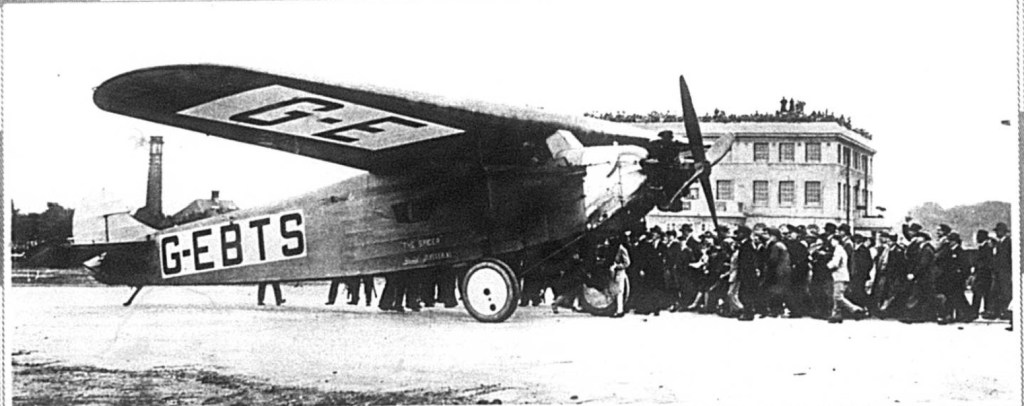
Mary Russell, the Duchess of Bedford, came to flying later in life. As a young woman in the Victorian era she spent a significant part of her life setting up and managing hospitals. She also trained in jiu-jitsu. The Duchess’s interest in flight came late in her life; she took her first flight from Croydon Airport to Woburn in 1926, when she was 60 years old. In 1929, she conducted a record-breaking flight from Lympne Airport to Karachi (India) and back to Croydon. She completed this round-trip in eight days, in her single-engine Fokker plane which she nicknamed ‘The Spider’. Her trip and return in Croydon were widely reported in the press. The following year, she flew The Spider from Lympne to Cape Town in a record breaking 91 hours and 20 minutes of flight time over 10 days. 

Mary Russell arriving back at Croydon Airport after a record-breaking flight,
The Illustrated London News, 17 August 1929

An example of a female pilot from a less moneyed background is Winifred Spooner, who was born in Woolwich. Spooner was the 16th woman in Britain to gain her pilot’s license when she obtained it in 1927. The following year, she was the first female pilot to participate in the prestigious King’s Cup, a long-distance race over the British Isles that was first established in 1922. At this first attempt at the race, Spooner came third. In 1931, she became the first woman in Britain to make a living as a private pilot, working for Sir William Everard MP. This highlights how for someone with more limited financial means such as Spooner, flying could never just be a hobby but had to constitute a source of income if she was to continue with it.

Winifred Spooner (By The Flight magazine archive from Flightglobal, CC BY-SA 4.0, Link)

Unfortunately, many of these illustrious women had their lives cut tragically short. Amy Johnson disappeared over the North Sea in 1941, age 38. Winifred Spooner caught pneumonia whilst flying and died in 1933, when she was just 32. Mary Russell, although living to the ripe old age of 70, disappeared during a solo flight around her family’s private estate in 1937. Lady Heath developed an alcohol dependency and in 1939 fell from the stairs in a double-decker tram; she later died of her injuries. Notwithstanding the glamourous treatment female pilots received in popular culture, in reality their flying exposed them to significant dangers which were generally not foregrounded in press narratives.


[1] Allain Pelletier, High-Flying Women: A world history of female pilots (Yeovil: Haynes Publishing, 2012), p. 101

[2] Ibid. p. 92

[3] ‘1930 the most wonderful year in history for women’, Daily Mirror, 29 December 1930, p. 3

Out in the London Casino (1938)

Out in the London Casino (1938)

Although films of interwar Britain occasionally had interest in illicit gambling activities (for example, this one), and illegal gambling clubs certainly existed in real life, the London Casino was not, in fact, a casino. Originally it opened as the Prince Edward Theatre on Old Compton Street in 1930, with the intention of putting on Ziegfeld Follies-style revues. This, however, proved commercially unsuccessful. According to a 1938 Picture Post article, the theatre then became the regular host of trade shows for talking films, as it was fully wired for sound films.[1] Trade shows allowed cinema managers and buyers from cinema chains to view films before they hit the market, and decide which films to purchase for exhibition in their own cinemas.

Showing trade films was not necessarily a profitable occupation, however, particularly as the theatre was not being used for anything else. Around 1935, therefore, two investors decided to work together to refurbish the theatre to the tune of (then) £25,000.[2] They renamed the venue the London Casino, and came up with a concept which was entirely new for the British capital at that time. All the theatre seats were stripped out and replaced by rows of dinner tables – in the stalls as well as on the dress circles. The seats nearest to the stage were removed entirely to create a dancefloor. Big staircases led down from the circles to this dancefloor. The space below the stage was converted into kitchens. Going forward, Casino guests would be able to ‘eat and drink inside a London theatre a full-size dinner.’

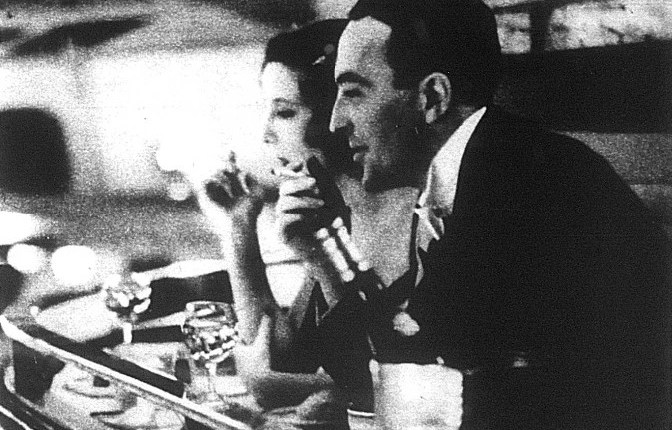
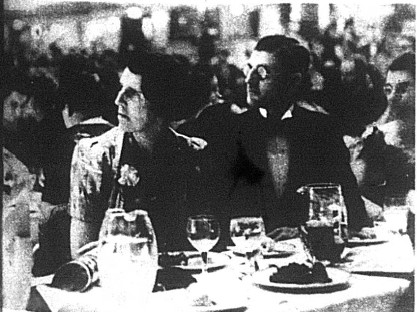
London Casino guests sit in tiered rows of dining tables, as shown in Picture Post

The Casino operated two shifts, one for dinner and one for supper. According to an early advert for the Casino, guests were served a five-course meal during their stay. During the meal, they could watch a show on the stage. After the show and dinner were over, guests could take the dancefloor – as long as they were dressed appropriately. ‘Evening Dress Optional but Essential for Dancing’ states the advert; and the Picture Post article notes that for seats on the balcony you did not have to wear evening dress. The advert suggests that all patrons paid the same price of 15s and 6d during the week and 17s 6d on Saturdays. By the time the Picture Post article was published, however, it was noted that some guests paid only 7s 6d, or less than half price. Presumably these were the balcony seats, right at the top of the theatre, which were ‘viewing only’.

Either way, the London Casino was a high-end night out; guests were only allowed to stay for 3 or 3.5 hours on weekdays, as their ‘slot’ only lasted so long. For comparison, West End cinema seats could only cost 1s 6d during this period, and suburban cinemas would be even cheaper. To spend 15s 6d a head on an evening’s entertainment would have been out of reach for many Londoners. Nonetheless, the Casino boasted of weekly revenues between £6000 and £7000, which would be ‘more money than any other entertainment in London.’[3] Clearly, by the end of the 1930s, there was sufficient disposable income at the top end of British society to sustain an innovative high-end club such as this.

In terms of the shows that patrons were treated to, the ample photography provided with the Picture Post article reveals a heavy reliance on ‘female beauty.’ Indeed, one can presume that the opportunity to publish photographs of scantily clad young women was one of the reasons why the editors of Picture Post decided to publish this article. Through the images in the weekly magazine a whole additional audience, who would not ordinarily be able to visit the Casino in person, were able to enjoy the ‘personal attractions of the dancers and show-girls.’[4]

A dance episode called ‘The Butterfly Hunt’ shows three young, thin, white women; two in bikini tops and gauzy skirts, the third appearing almost nude except for a bra and knickers. Dancer Maurice Brooke performed a stunt which required him to have one woman sitting on his neck and another (again in underwear) being swung round by him. Other scenes included ‘A Slave Market in Algeria’ (female slaves wearing minimal beaded outfits) and ‘The Bird of Night’ (women wearing skin-coloured, skin-tight outfits that make them appear nude). The final page of the article includes a photo of four showgirls backstage playing cards – they wear slinky dressing gowns and show their legs. The caption gives their names, as if to shrink the gap between them and the reader.

Although the Picture Post article exploits the female bodies for the visual pleasure of their readership, the article also cleverly juxtaposes these photos with an equal amount of photographs of audience-members viewing the stage. The article contains six photographs of audience members, most of them medium close-ups showing two or three patrons gazing intently towards what we presume is the stage. There is only one photograph of the guests dancing on the dancefloor after the show. It is implied that passive spectatorship, or ‘ogling’, is the main reason most people visit the Casino. The active participation in the dancing is secondary.

The article’s conclusion confidently states that the Casino ‘appears to have established itself as a permanent feature of London’s night life.’[5] The reality was different. The outbreak of the Second World War put an end to all performances, and by 1942 the theatre was repurposed as an entertainment venue for troops on leave. After the war, the theatre reverted back to being a cinema screening room, this time for ‘Cinerama’ films – films projected across three adjacent screens for a wide-screen effect. In the mid-70s the venue was once again converted back to a theatre, and it has been in business as the Prince Edward Theatre ever since.


[1] ‘A Night Out in London’, Picture Post, 10 December 1938, p. 21

[2] Ibid.

[3] Ibid., p. 24

[4] Ibid., p. 21

[5] Ibid. p. 24

Rose Macaulay – Keeping Up Appearances (1928)

Author and journalist Rose Macaulay has largely receded from the collective memory. Nevertheless, she published 24 novels, three volumes of poetry and 18 works of non-fiction during her lifetime. Born in 1881, her literary career started during the Edwardian period. The interwar decades were prolific for her though: she published 12 novels in the 1920s and 1930s. The 1920s were also the decade in which Macaulay found widespread commercial success for the first time.[1] Some of these interwar works have been republished since their first appearance, including her 1928 work Keeping Up Appearances which was re-issued by the British Library in 2022 as part of their Women Writers series.[2]

Not to be confused with the popular 1990s BBC sitcom, Keeping Up Appearances is about two half-sisters, Daisy and Daphne. Daisy is 30, Daphne is 25. Daisy is awkward in social situations and considers herself a coward; Daphne is cool, confident and ‘good fun’. The girls’ father was an upper-middle class intellectual; Daisy’s mother is a lower-middle class woman from East Sheen who had Daisy as a result of a youthful fling. She has since married a labourer and had three more children, who are now adults. Daisy is embarrassed about her mother, whom she considers uncultured. For reasons that will become clear in a moment, we do not find out anything about Daphne’s mother.

At the opening of the novel both women are on holiday with a middle-class family, the Folyots, to act as au-pairs to the family’s younger children, Cary and Charles. The Folyots also have an adult son, Raymond, who is a biologist. Daisy is hopelessly in love with Raymond, who in turn seems only charmed by the cooler Daphne. Mrs Folyot is involved in myriad political causes, including the sheltering of ‘White’ Russians who fled the country after the bolshevist revolution; and the support of independence and self-governance of such varied groups as Basque Spaniards, Estonians and Indians. Although Mrs Folyot’s activities mostly serve as a (comical) backdrop to the novel’s main activities, they remind the modern reader of the huge political turmoil underway across Europe in the interwar period. They also highlight the longstanding nature of some debates that remain unresolved today: both Catalan and Scottish independence get a name-check.

About one hundred pages into the novel, Macaulay reveals the central deceit which sets Keeping Up Appearances apart from many other novels concerned with the emotional life of 20-something women: Daphne and Daisy are one and the same person. Daphne Daisy Simpson, as is the woman’s full name, considers ‘Daisy’ to be the self she is when she is alone, or with her birth family. Daisy is lower-middle class and has to work hard as a journalist and novelist to make some independent income. Daphne is the funnier, cleverer, and younger persona she has adopted when she is around more sophisticated friends, such as the Folyots.

When Raymond proposes to ‘Daphne’, it sets the two personas on a collision course. Daisy’s family understandably are confused why Daisy does not want to introduce her fiancé to them; Daisy has to work extremely hard to prevent Raymond from seeing her ‘real’ self, which she is sure he will not like. The lies pile up and become impossible to all keep hidden. First Raymond finds out that Daphne works as a journalist and writer, under the pen name Marjorie Wynne. He is puzzled why Daphne has not been open about it, but lets it slide. Then Daisy struggles to continue the pretence that she is interested in Raymond’s work: Daphne has always happily escorted Raymond on endless jaunts around the cold and muddy countryside, but Daisy increasingly snaps at Raymond when she is freezing on a heath. Finally, inevitably, Daisy’s mother and aunt visit the Folyot’s unannounced, and all of Daisy’s lies come out.

The book’s preoccupation with ‘real’ selves versus ‘presented’ selves is cleverly mirrored in its discussion of the popular press. Both Daisy and her half-brother Edward work for the Daily Wire, a fictional popular daily along the lines of the Daily Express. But whilst Edward is a reporter, constantly churning out peppy headlines like ‘West End Flat Mystery Surprise – Dead Girl Sensation – Amazing Revelations’; Daisy as Marjorie Wynne is condemned to the women’s pages.[3] Throughout the book, she is asked to write articles on topics such as ‘can a woman run a baby and a business at the same time’[4], ‘modern married life’[5] and ‘should flappers vote?’[6] When Daisy tries to return a sarcastic article under the latter headline, she is promptly told to rectify it to fit with the newspaper’s expected tone. ‘The remuneration was good, so Daisy (…) wrote the article on these lines.’[7]

It is understood by Daisy throughout, as it would have been by Macaulay herself, that women journalists are almost always pigeonholed into providing content relating to ‘the women question’ only. Whereas Edward is mobile during his working day, dashing to and fro to get interviews and eye-witness accounts, Daisy types all her work in her flat. It is, however, the only way she sees that allows her to make an independent income.

By the end of Keeping Up Appearances, Daisy’s second novel (written under the pseudonym Marjorie Wynne) becomes a modest commercial success. Daisy’s regard for her own writing is extremely low; she considers her novels to be middle-brow at best. However, their commercial success gives her financial independence at the novel’s close.[8] They also give her the tantalising opportunity to shed both Daisy and Daphne and adopt Marjorie Wynne as yet another persona in which to navigate the world.

Although Keeping Up Appearances ends on a happy note of sorts for Daphne Daisy, it makes clear that all people, including men, continue to be trapped between behavioural expectations and their true desires. Throughout the novel Macaulay gives the reader glimpses of the ‘secret life’ of the other characters, including Raymond. Everyone behaves differently when unobserved, and despite the loosening of rigid social conventions after the First World War, there remained plenty of conventions to follow in order to ensure financial and romantic success.


[1] Sarah Lonsdale, Rebel Women Between the Wars (Manchester: Manchester University Press, 2020), p. 45

[2] Rose Macaulay, Keeping Up Appearances (London: British Library, 2022)

[3] Ibid., p. 49

[4] Ibid., p. 64

[5] Ibid., p. 157

[6] Ibid., p. 137

[7] Ibid., p. 138

[8] Ibid., p. 247

The Monkey Club

The Monkey Club

Picture Post, the left-wing photojournalism magazine launched in October 1938, has a proud track record of political journalism, including comprehensive reporting on the plight of Jewish people under Nazi rule. In amongst this serious political reportage, however, the weekly magazine also provided plenty of lighter content, such as an article in an early issue about the so-called ‘Monkey Club’, a club where ‘debutantes learn to be housewives.’

The five-page spread appeared in the issue of 10 December 1938, early on in the Post’s existence. The Monkey Club was a slightly odd hybrid between a member’s club and an educational establishment. One would become a member either by being put forward by two existing members, or by serving probation – by 1938 there were apparently eighty members in total. The club had been founded in 1923 and lasted at least until the early 1950s. According to the Club’s founder, Marion Ellison, she wanted to ‘supply a social and educational club for society girls, who at eighteen may not wish to enter a University, but who do not want to idle away their days.’[1]

Debutantes were daughters of prominent families who were presented at Court during their first ‘season’ and subsequently attended the annual round of balls and parties. The ‘season’ was a long-established London tradition and once upon a time the primary way for young wealthy people to meet their marriage partners. By the late 1930s, however, social change had been such that debutantes could not necessarily expect the same lives as their mothers and grandmothers, and some of them undoubtedly also wished to have a profession.

The Monkey Club’s varied offering demonstrates the transitional space in which it operated. It offered residential lodgings for about 30 of its members, providing young women who wanted to live independently a more socially elevated alternative to lodging in a Bloomsbury boarding house.[2] The club also provided five main strands of educational activity: ‘General Education, Music, Secretarial Training, Domestic Science, and Dressmaking.’[3] The five categories had different purposes, depending on what the debutante needed.

Should she need to learn a job to earn her own living, clearly the secretarial training would be very useful. It is a sign of significant social change that a sizeable sub-section of the Club membership was ‘training for careers’ – even a generation earlier the notion of a debutante taking a secretarial course would have raised eyebrows.[4] But by the late 1930s, ‘debs’ could not necessarily expect to marry into wealth and live out the rest of their days as matriarchs. Secretarial work, on the other hand, was in constant and increasing demand and provided a respectable route into paid employment for young women, at least until such a moment that they got married.

The ‘Domestic Science’ training, which Picture Post called ‘probably the highlight of the club’, also demonstrates how society had changed.[5] Although the debutantes come from wealthy families, they can clearly no longer expect to run households with a lot of staff. The Monkeys are not taught how to manage servants, but rather how to undertake household tasks themselves. From ironing shirts to cleaning windows, the Monkeys are given instructions on how to undertake each part of household management. ‘Every debutante wants to be a good housewife’ enthuses the Post.[6]

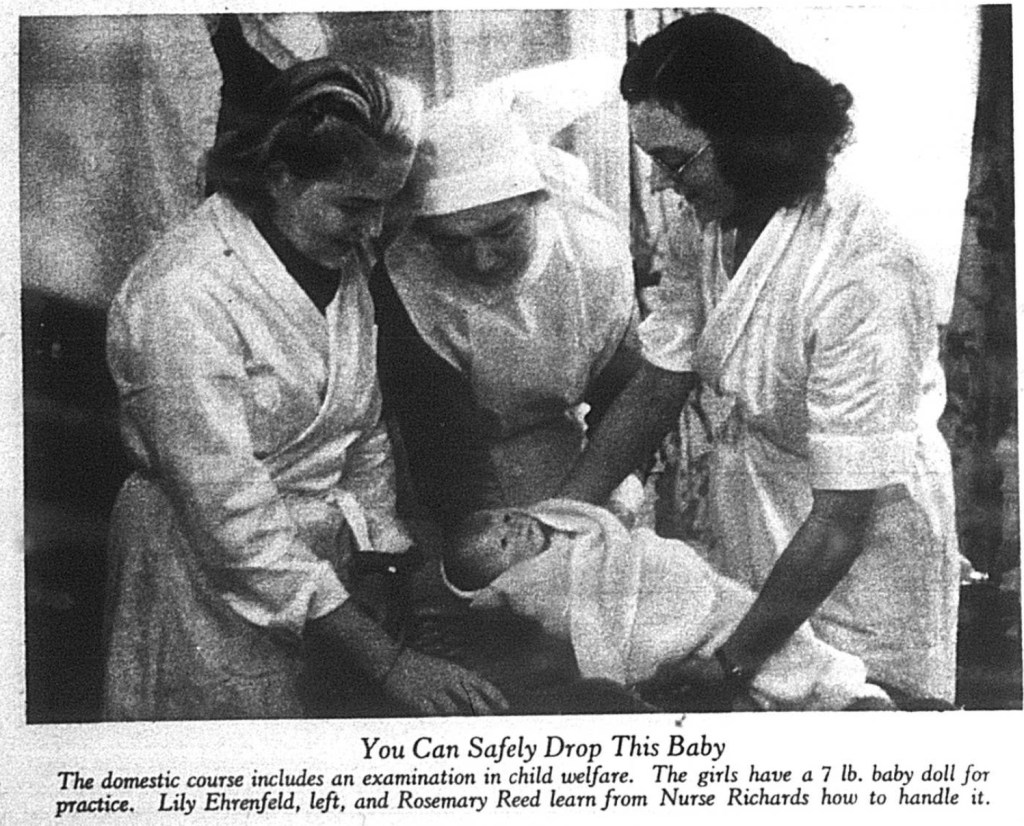
The club building even contains a complete flat, where members who are about to get married take ‘Bride’s Course’. The flat gives them a trial at running a complete household, including planning and executing dinner parties. Says the Post: ‘The “Bride’s Course” is no romantic interlude. The brides are thoroughly prepared to cope with all emergencies, even to leaky pipes and broken armchairs.’[7] Clearly, most of the debutantes were expecting to be quite hands-on in their household management after marriage, reflecting the replacement of servants with labour-saving devices as the job market changed. Another area for change was that of childrearing. Like with the household, debutantes would be expected to be hands-on in the raising of their children. To that end, the Monkey Club had a ‘perfect 7lbs “baby” with moveable head and limbs’ – a realistic model which the club members were taught to bathe and dress in the ‘correct’ way.[8]

Other parts of the ‘educational’ curriculum serve to a more traditional conception of a debutante’s life. The music and art education mostly built on what club members had learnt at the inevitable ‘finishing school abroad’: in-depth teaching on music history and theory to allow members to ‘know how to listen and enjoy good music.’[9] Also popular are classes on ‘dancing, stage technique and elocution’ – skills that have less practical use and are more designed to enhance the pupil’s appearance and effectiveness at social engagements.

The Monkey Club clearly fulfilled a function during a time of significant social change. As class barriers were broken down, the old system of sending debutantes to finishing schools and expect almost everyone else to either be a housewife or learn a trade no longer worked. In this ambiguous space, the Monkey Club bridged the old and the new, providing debutantes with a familiar space from which they could navigate their own way through a changing society.


[1] ‘This is the Monkey Club’, Picture Post, 10 December 1938, p. 33

[2] Chiara Briganti and Kathy Mezei (eds), Living with Strangers: Bedsits and Boarding Houses in Modern British Life, Literature and Film (London: Bloomsbury Academic, 2018)

[3] ‘This is the Monkey Club’, Picture Post, 10 December 1938, p. 33

[4] Ibid., p. 34

[5] Ibid, pp. 35-6

[6] Ibid., p. 36

[7] Ibid.

[8] Ibid.

[9] Ibid., p. 35

New Year’s Eve 1922

New Year’s Eve 1922

As is tradition on this blog, for the final post of the year we cast our minds back to exactly one hundred years ago and have a look at how New Year’s Eve was celebrated in London that night. After some rain earlier in the day, the evening of Sunday 31 December was cold and a bit windy but dry: no doubt a relief to Londoners keen to let their hair down.[1] According to the Manchester Guardian pre-midnight celebrations were ‘more subdued’ than in previous years owing to 31 December being a Sunday! Due to a special licensing hour dispensation, hotels could stay open till 2am.[2]

Well-heeled Londoners were excited to ring in the new year with elaborate parties in hotels and restaurants. Hotels spared no cost in their interior decoration: the dining room of the Berkeley Hotel ‘was transformed into a lighted vineyard’ and at Claridge’s guests walked through an Italy-inspired landscape.[3] At the Savoy Hotel, a large amount of Christmas crackers were pulled during an ‘elaborate banquet’ – 25,000 crackers according to the Daily Express, but 35,000 according to the Mirror.[4] Some venues put on performances: at the Metropole Hotel midnight was marked by ‘a dainty little girl dressed as Cupid [appearing] from a huge cracker, which was pulled by Father Christmas.’[5] At the Piccadilly Hotel grill room a female singer appeared out of the top of a huge champagne bottle at midnight to sign Auld Lang Syne.[6]

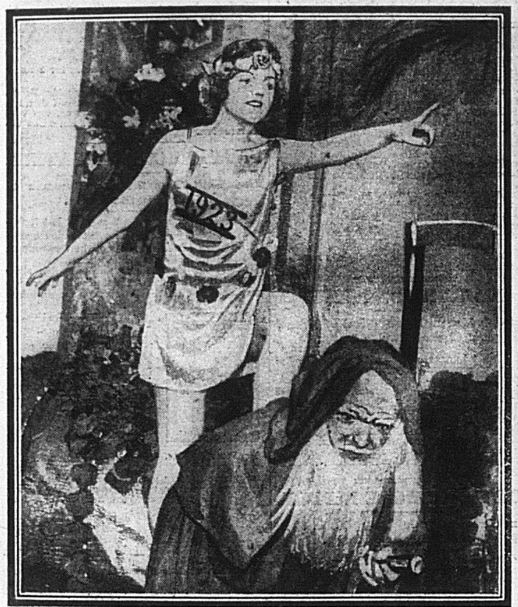
A young woman, representing 1923, banishing old 1922 in an unspecified performance. Image: Daily Mirror, 1 January 1923, front page

For those who could not afford to be in the hotels, the streets of London provided a suitable party venue. The steps of St Paul’s Cathedral were one of the traditional sites of celebration, and crowds started gathering there hours in advance.[7] The Daily Express reporters, always ready with more evocative language then their colleagues at rival papers, described the crowds in the West End as follows:

They were “grown ups” who surged in dense masses through the streets, but the joy of childhood – Christmas party childhood – was rampant. Every one wore a paper hat, and nearly every one was blowing a toy trumpet. Street corners were impromptu ballrooms.[8]

Aside from the evening celebrations, the New Year also meant the publication of the annual honours list, announcing which luminaries had been bestowed honorary titles. In 1923, the prominent and popular Home Office pathologist, Bernard Spilsbury, was knighted and could henceforth call himself Sir Bernard Spilsbury.[9]

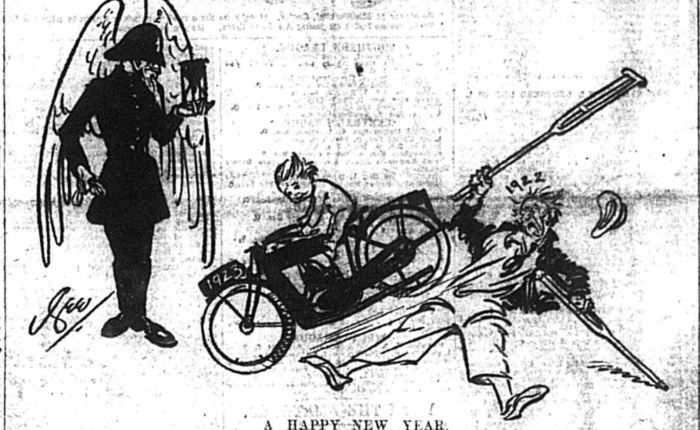
Cartoon in News of the World of 31 December 1922 reflecting the growing concerns on the dangers of motorized traffic, which would come to a head in the early 1930s.

The beginning of the new year also meant the start of winter sales in all the big department stores. The growing importance of consumerism, and the increase in disposable income, are marked by the prominent articles appearing in the popular press about the sales. ‘Thousands of women will to-day celebrate the coming of 1923 by “raiding” the great London stores in the breathless but happy hunt for bargains’ predicted the Daily Mirror.[10] In an article that essentially sums up the offers at each of the great stores, readers are advised that whilst buying ‘indiscriminately’ is never a good idea, one can’t go wrong with staples such as ‘gloves, shoes, underclothes etc’.[11]

The Sunday papers on 31 December had already carried large adverts for each of the store, preparing shoppers to the bargains that could be had. Like the Daily Mirror article, these were almost exclusively aimed at the female readership. It was clearly understood that shopping in a sale was the kind of frivolous activity that only women would engage in. At Dickins & Jones, a clearance of ‘model gowns’ (ie. those used for display purposes) meant that prices started at 7 ½ guineas – a guinea being 1 pound and 1 shilling.[12] On the same page, competitor Marshall & Snelgrove advertised a fur coat for 89 guineas; it had previously been between 125 and 179 guineas so this discount was indeed a ‘wonderful bargain’ although it was clearly out of reach for the vast majority of the population.[13]

By the time the Evening Standard appeared in the afternoon, it was able to report on the ‘bargain day scenes’ in breathless and rather sexist tones. ‘The occasion had much more significance for the ladies than the mere advent of the New Year, and (…) they stormed the whole of the shopping centres in their myriads.’[14] Some of the items on offer according to this article were velour coats with mole collar and cuff trimmings at 4 ½ guineas, and a knitted woollen gown at 27 shillings and sixpence; clearly the readership of the Evening Standard had less to spend than the readers of the Observer.

Elsewhere, the Evening Standard reported on the continued imprisonment of Edith Thompson and Freddie Bywaters, who would be executed on 9 January for the murder of Edith’s husband. Other papers noted the republic of Ireland’s recent independence, which was officially finalised in December 1922.[15] All was not well in the remainder of the Union either, with Scottish hunger marchers protesting in London on the first day of 1923.[16] Although the New Year’s Eve parties and January sales gathered the most prominent coverage, it is clear that below the celebratory surface troubles were brewing as Britain continued to deal with the fall-out of the Great War.


[1] ‘Week-end Weather’, The Observer, 31 December 1922, p. 14

[2] ‘New Year Revels in London’, Manchester Guardian, 1 January 1923, p. 7

[3] ‘At the Hotels’, Daily Express, 1 January 1923, front page

[4] Ibid.; ‘1923 Danced In by Merry Throngs’, Daily Mirror, 1 January 1923, p. 3

[5] ‘1923 Danced In’, Daily Mirror

[6] ‘New Year Revels in London’, Manchester Guardian

[7] Ibid.

[8] ‘Great Crowds in the Streets’, Daily Express, 1 January 1923, front page

[9] ‘New Years Honours’, Daily Express, 1 January 1923, p. 7

[10] ‘Sales Carnival Begins To-Day’, Daily Mirror, 1 January 1923, p. 2

[11] Ibid.

[12] ‘Dickins & Jones’ advert, The Observer, 31 December 1922, p. 9

[13] ‘Marshall & Snelgrove’ advert, The Observer, 31 December 1922, p. 9

[14] ‘Bargain Day Scenes,’ Evening Standard, 1 January 1923, front page

[15] ‘Politics at Home and Abroad’, Daily Telegraph, 1 January 1923, p. 4

[16] ‘Hunger Marchers’ Complaints’, Evening Standard, 1 January 1923, p. 8

Father Christmases of London

Father Christmases of London

After last week’s slightly political piece, this week we’re launching into proper festive content. Again we’re turning our attention to Picture Post, the weekly photojournalism magazine launched in October 1938. In it’s first December, Picture Post ran an article on the ‘Father Christmases of London.’ The reportage gives an insight in this enduring seasonal job and the backgrounds of the men who took it on.

The piece appeared in the Picture Post of 17 December 1938 and ran across four pages. It is an article of two parts; the bottom third of the pages is taken up by an article setting out the cultural and historical background of Santa Claus in detail. It recalls the original Catholic Saint Nicholas, and how the worship of this saint diverged across different countries over time. It notes that ‘Protestantism has rooted out St. Nicholas Day from the English ecclesiastical calendar’[1] but that Santa Claus got imported back from the US after the tradition was started there by Dutch settlers. The article even covers localised European customs such as the Krampus, the origin of Christmas trees and of Santa Claus’s traditional dress.

Alongside this thorough exploration of the origins of Santa Claus, Picture Post presents portraits of ten men who are playing Santa across various department stores in London in the winter of 1938. Each man is shown both in their Santa outfit, and as their ‘normal selves’. The article shows how important and well-known the tradition of live Santa’s was to London’s luxury shopping market.

The background of these men puts them in one of two camps: half of them work or have worked in the department stores in which they act as Santa; the other half are actors, models or other types of entertainers. In the case of the first group, playing Santa appears to be a nice break from their day job for the month of December, after which they move back to their regular duties in January. George Dixon, for example, ordinarily worked in the wallpaper department at Barker’s, a large department store in Kensington. He had acted as the store’s Santa every year since his appointment as salesperson. It is likely Dixon was chosen for the role because he had a background as an actor in travelling troops.

George Dixon as Father Christmas for Barker’s in Kensington

Henry Tapsell, who acted as Santa in the Thomas Wallis department store in Holborn, did not have an acting background. He was a porter in the furniture department of the shop, a job which appears to have been one in a line of various manual labour roles. He started playing Father Christmas at the tender age of 26, finding it ‘a pleasant relaxation after shifting furniture for eleven months.’ At the other end of the age range, Alfred Hibbard, who played Santa in the Clapham store of Arding & Hobbs, was already retired. Prior to his retirement he worked in the shop as a porter. He took up the Father Christmas role after his retirement, probably to supplement his pension payments. Harrods’ Santa was also a member of staff: Herbert Heslam, who had worked in the calico, cotton and rayon department for twelve years.

It obviously made financial sense for some department stores to use existing staff for this December engagement. These men were often long-term employees so proven to be reliable, and apparently they could be spared on the shop floor despite a likely Christmas rush. Their regular roles demonstrate that department stores regularly employed male staff, but that they were often placed in furniture and home furnishing departments which required more heavy lifting and manual handling.

Other shops went down a different route, hiring freelance actors and models for this seasonal employment. Selfridge’s, for example, opted in 1938 to hire actor and model Charles Mackenzie. Mackenzie, an Australian who had made it over to Britain after fighting as an Anzac in the First World War, estimated he had appeared in up to 200 feature films. Sydney Kempster, who played Santa at Gamage’s department store in Holborn, was also a film extra. Although he was less prolific, he had some high-profile credits to his name such as a small role in Victor Saville’s Sailing Along and the ensemble film O-Kay for Sound. According to the article, ‘in the old days of silent films’, Kempster also ran a cinema.

Charles Mackenzie as Santa for Selfridge’s

A similarly enterprising attitude was taken by Stanley Ross, who played Father Christmas at Whiteley’s in Bayswater. Prior to the First World War Ross was a producer of silent films, producing two films with the famous actor Lupino Lane. Ross also acted in films. The most varied showman playing Santa in 1938 was Hamilton Harvey, who took up the red mantle for Derry & Tom’s in Kensington. Harvey was a conjuror, ventriloquist, musician and composer with his own music hall act. According to the Picture Post article he played eight different instruments – it is not recorded whether he incorporated any of them in his Santa Claus act.

This Father Christmas article is typical of the things Picture Post printed in its early years. It combines fairly in-depth historical detail with contemporary reportage on a human interest topic. One can imagine the editorial pitch meeting in which a reporter suggests finding out who is behind the fake moustaches and beards of London’s Santa’s. The 1930s still saw a high number of large department stores in the capital, each willing to invest in a real, permanent Father Christmas for December to draw in the crowds.

At the same time the men taking up the elaborate robes in these opulent surroundings were largely of working-class backgrounds. For some, playing the role was a welcome break from a physically demanding job on the shop floor. For others, it represented a quasi-steady gig in an uncertain free-lance career in the developing entertainment industry. The Picture Post article not only gives an insight into Christmas traditions of the late 1930s, but also into consumer culture and working conditions of the time.


[1] ‘These are the Father Christmases of London’, Picture Post, 17 December 1938, pp. 34-37

Christmas in hard times

I was looking over copies of Picture Post magazine in the hope of finding some nice Christmas-related content to write about. I did find something fun, which I’ll expand on in next week’s blog post, but during my search I also came across an opinion piece which seemed to speak in some way to the climate in which we are celebrating Christmas in 2022.

Picture Post was founded in October 1938 as a weekly news photography magazine. Each issue contained mostly short articles accompanied by extensive photo reportages. The types of items covered ranged from science and biology (the development of a kangaroo embryo) to international politics and society and celebrity news (like the article on Gracie Fields I’ve written about before). Each week there was also an opinion piece by Edward Hulton, the publisher of Picture Post.

Within a year of it’s launch, Britain was at war. During December 1939, the editors of Picture Post attempted to strike a balance between delivering war news – such as a weekly recap of developments – with the kind of feel-good content the magazine was also associated with. On 9 December 1939 Hulton used his regular page to encourage readers to ‘Spend at Christmas!’.[1] Readers would be helping the war effort, he argues, not by saving their money but rather by spending it freely to boost the economy. Additionally, going all-out at Christmas would ‘not only [be] an escape from the horrors of war, but [also] a remembrance of nobler ideals.’[2]

The main area in which money should be spent, according to Hulton, was women’s fashion. In this ‘silk stockings economics’ model, people spend on consumer goods that require rapid replacement (although under our current fast fashion model, the rapidity with which silk stockings wore out in the 1930s is probably relative). This, in turn, generates economic activity which is good for the country as a whole. Additionally, retaining a focus on the production of fashion at a national level would, Hulton argued, allow Britain to collaborate at an economic level with France. Paris was still the undisputed fashion capital of the western world, and ‘[t]here is no reason why London and Paris should not go hand in hand as arbiters of style.’[3]

Conscious that his male readership may find all this concern about women’s fashion to be a tad frivolous, Hulton hastens to add, almost as an afterthought, that the British motoring industry should continue to export to raise funds for the production and purchase of armaments. But for Hulton, celebrating Christmas and buying luxury goods is a matter of principle, too. He ends his article with the following bold statement:

And if we are merry at Christmas, we shall be showing the Nazis that we are winning the war of nerves, and maintaining the gallant spirit which has overcome adversities which are no novelty to this very windswept isle.[4]

The idea of British pluck is here repurposed to make it a moral obligation for people to celebrate Christmas as normally as possible, despite the country being in a state of war. Granted, December 1939 was in the middle of the ‘Phoney War’ during which there was limited fighting and the anticipated air raids on British cities had not yet materialised.

Hulton turns national pride into a capitalist function, arguing that to spend money on perishable and luxury goods demonstrates a commitment to British values in the face of Nazism. It should be noted that Hulton, and the editorial staff of Picture Post, were politically left-wing and continually highlighted the plight of Jewish people and refugees throughout the Second World War. His reference to the ‘gallant spirit’ of the British was not one that was specifically linked to one political party over the other.

In 2022, millions of people in Britain are facing economic hardship in the run-up to Christmas, often unable to afford basic necessities such as food and fuel. Average spend on Christmas gifts is expected to drop across almost all categories, particularly more expensive goods such as electronics and clothing. Although there is a foreign ruler whose criminal actions have impacted on the economy, much of the current situation is created by successive British governments.

The argument that people should carry on as normal in the face of adversity as an act of national defiance certainly does not hold any weight in the current context. Equally, encouragement to spend on consumer goods to boost the economy, which may have had more resonance during more recent economic crises, become irrelevant when people have no additional money to spend. Consumers no longer have the ability to boost the domestic economy, leaving us to face a Christmas worse than one that took place during the Second World War.


[1] Edward Hulton, ‘Spend at Christmas!’, Picture Post, 9 December 1939, p. 45

[2] Ibid.

[3] Ibid.

[4] Ibid.

Radclyffe Hall

Radclyffe Hall

Radclyffe Hall – which, really, was her given name (in full, Marguerite Antonia Radclyffe Hall) – is probably one of interwar Britain’s most famous LGBTQI+ people. She took the name John later in life, but her novels were published under the name ‘Radclyffe Hall’, which is how she remains best known.

Hall’s most famous work is the 1928 novel The Well of Loneliness, which was subjected to an obscenity trial in the UK after vigorous campaigning by the Sunday Express. As was fairly common at the time, English copies of the Well of Loneliness were subsequently printed in Paris; increased mobility between the two capitals including via airplanes ensured that some copies of the work continued in circulation in Britain.

Hall was also born in a family of means, with both her parents inheriting money from their parents. Hall’s father set her up with an independent income which allowed Hall to shun the conventional route of work and marriage and allowed her to develop her literary ambitions. She initially published poetry – five volumes between 1906 and 1915. From an early age Hall adopted a masculine style of dress, including wearing trousers, tailored jackets, and hats.

During a part of the 1920s, Hall lived in Kensington with her partner, Una, Lady Troubridge. They were together from 1916 until Hall’s death. London’s somewhat unruly nightlife during the interwar period allowed for the existence of LGBT-friendly spaces. From the mid-1920s Hall started to publish works of fiction. Her third book, Adam’s Breed, which was written in the Kensington flat, became a prize-winning bestseller. The commercial success of Adam’s Breed arguably partially caused the vocal backlash to Hall’s next work, The Well of Loneliness. Had she been less famous, there would have perhaps been less concern about the content of the work.

The plot of The Well of Loneliness centres on Stephen Gordon, an upper-class English woman who considers herself a ‘sexual invert’ (ie. she is a lesbian). The book chronicles Stephen’s childhood, an early love affair with an older woman, Stephen’s career as a novelist in both London and Paris, and her experiences as an ambulance driver in World War One. During the war, she meets and falls in love with fellow ambulance driver Mary, and the pair set up a household together after the war.

Although the book is far from sexually explicit, there is one reference to Stephen and Mary going to bed together; and throughout, Stephen insists that ‘sexual inversion’ is not unnatural. Stephen’s (and by extension, Hall’s) views on lesbianism closely echo those of 19th-century lesbian Anne Lister, by some considered to one of Britain’s first ‘modern lesbians.’

Due to the success of Adam’s Breed, The Well of Loneliness was reviewed by journalists upon its publication; early reviews were measured.[1] However, James Douglas, the editor of the Sunday Express who earlier in the decade had found much fault with convicted murderer Edith Thompson, took it upon himself to publish a front-page take-down of the book on 19 August 1928. His editorial included the statement that ‘he would rather give “a healthy boy or a healthy girl” poison than let them read The Well of Loneliness.’[2]

Hall’s publisher protested that the intervention of the Sunday Express gave the book more publicity and sensationalised it, and many other journalists and writers defended the work. Nevertheless, an obscenity trial started on 9 November 1928 and included expert witness testimony to confirm that one could not ‘become gay’ by reading a book about a gay relationship. The magistrate, Sir Chartres Biron, concluded that the novel’s literary merit counted against it: ‘the more palatable the poison the more insidious’.[3] He ordered that all copies of the book were destroyed, and The Well of Loneliness was not published again in Britain until 1959.

Hall attended the trial, although she was not on the stand as the trial was against her publisher rather than herself as a person. Her masculine appearance, widely reported in the press, ‘crystallised a particular vision of the mannish lesbian’ for the remainder of the interwar period.[4] A similar obscenity trial in the US had the opposite outcome to the British one, ‘finding that discussion of homosexuality was not in itself obscene.’ Hall only published one more novel during her lifetime, The Master of the House, which was poorly received. During the 1930s Hall and Troubridge moved out of London to the coastal town of Rye. Hall was diagnosed with cancer during the Second World War and died in 1943. She is buried in Highgate Cemetery in London, alongside other writers and artists such as George Eliot, Elizabeth Siddal and Anna Mahler.


[1] Christopher Hilliard, ‘“Is It a Book That You Would Even Wish Your Wife or Your Servants to Read?” Obscenity Law and the Politics of Reading in Modern England’, American Historical Review, June 2013, p. 666

[2] Ibid.

[3] Merl Storr, ‘Palatable Poison: Critical Perspectives on The Well of Loneliness’, review, Sexualities, Vol 6, no. 2, 2003, p. 264

[4] Emma Liggins, Odd Women? Spinsters, lesbians and widows in British women’s fiction, 1850s–1930s (Manchester: Manchester University Press, 2014), p. 163