New Year’s Eve 1923

As is tradition, the final blog post of the year looks back at New Year’s Eve one hundred years ago. You can read the 1921 edition here and the 1922 edition here.

In 1923, New Year’s Eve fell on a Monday. Unlike today, when British workers generally get given the 1 January off as a Bank Holiday, in the 1920s staff in London had to work as normal on the first day of the new year. ‘Northerners’ apparently did get the day off. The Evening Standard, as London’s evening paper, reported on 1 January:

London to-day is largely populated by tired but happy people who but a few hours ago in a thousand various ways were deliberately making a night of it. And none of them seem ashamed of it. Their eyelids may sag as they bend over their work, but they are full of conscious virtue. They have begun the New year well.[1]

As was common every year, the New Year’s Eve celebrations in the capital were reported to have been the most successful yet, although it appears to have been raining heavily on 31 December 1923. The people of London celebrated in the usual way: the rich went to hotels and restaurants, and everyone else partied on the streets, with St Paul’s cathedral a particular focal point for those who were perhaps religiously-minded. The Daily Telegraph noted that well-heeled Londoners increasingly stayed in a hotel for the whole Christmas period: ‘It is not at all unusual for groups of friends to move into an hotel for Christmas and the New Year, thus, while enjoying the nightly round of festivities, avoiding the trouble of getting home to the suburbs in the early hours of the morning.’[2] The ‘shortage of servants’ which was starting to bite in the post-War years, was quoted as one reason to outsource all Christmas festivities to professional caterers.

Although celebrations in London were largely business as usual, two things happened on New Year’s Eve 1923 that radically altered the nation’s experience of the festive period. The BBC had been founded in October 1922, and by the end of 1923 it had sufficiently established itself, and enough people in the country now owned wireless (radio) sets, to allow two things to happen. First, at 6.35pm, the Archbishop of Canterbury addressed the nation with a New Year’s message. As the Manchester Guardian reported: ‘every word came through quite clearly. The Archbishop spoke from the British Broadcasting Company’s premises in London.’ His speech related the ‘glamour’ of the War years to the ‘common-place’ lives most people now found themselves in:

We must translate the poetry and glamour of the exciting war years into the prose of common days. The Ypres salient, or the North Sea minesweeper on a stormy night, or the Anzac beach and cliff, or the midnight vigil of the hospital, with the ghastly stretchers coming in: these things, with all their dreadness, had an uplift of their own. There is no such uplift in your rather commonplace sitting-room, or at the clerk’s dull office desks, or behind the shop counter. But such are the “settings” in 1924 of many of the self-same men and women who six years ago had the other, the “romantic” setting.[3]

Although we may today primarily think of the 1920s as a decade of glitz and glamour, the Archbishop clearly picked up on a mood of discontent in the nation. Presenting the war as glamorous and exciting is a shift away from how newspapers had generally discussed the war until that point, as a period of hardship and sacrifice. The increased distance from the horrors of war allowed space for alternative viewpoints to be aired.

The other momentous thing that happened was that for the first time ever, the whole country could hear Big Ben chime at midnight over the radio:

Cover it up as we may, it is a solemn moment as the New Year is ushered in. And these sonorous notes of Big Ben, carried so magically through space, struck the right note at the right moment. (…) The broadcasting of Big Ben is a big idea which will remain with us. It has something of the power of the Two Minutes Silence in it.[4]

The Evening Standard reporter had the right instinct, as the chiming of Big Ben is still broadcast by the BBC and still the definitive start of the new year across the British isles. In 1924, it demonstrated the unifying power of the new mass media, binding together people from all across the country to the same moment and sound; and irrevocably placing a historical London landmark at the centre of that unification. How different would it be if instead, the BBC had chosen to broadcast church bells from Middlesborough, Swansea or Perth?

The New Year’s Honours list, normally good for extensive coverage in newspapers, got very short shrift in 1924. It was shorter than usual, there was no-one on the list who may be known by the wider public, and there were no women on it at all – the latter was, even in 1924, unusual.[5] There were also no interesting new laws that were coming into effect on 1 January 1924. Where’s 1923 had seen a change to the divorce and unemployment laws which potentially affected millions, in 1924 the most significant new law was the ‘Salmon and Freshwater Fisheries Act (…) designed to prevent the destruction of salmon and trout by such methods as the use of the spear and explosives.’[6]

Finally, the London Underground shared its annual statistics with the readers of The Times. In 1923, it transported 1.7 billion passengers: ‘so that every Londoner travelled, on average, 219 times in the year in either its railway cars, tramcars or motor omnibuses.’[7] It was the busiest year yet for the transport body. The advert links this increase in travel to an increase in general employment figures: ‘The number of passengers is growing steadily. This means that trade is improving and unemployment lessening.’ For the new year, the board predicted continued expansion of both passenger numbers and rolling stock.

A general note of optimism pervaded the newspapers at the start of 1924, although the memories of the First World War were fading away. There were no references to relief that the war was over, or remembrance of those who had fallen. Instead, the Archbishop’s speech indicates that relief was being replaced with frustration and boredom. The country had to figure out how to settle back into normality after years of disruption that, with hindsight, could have taken on a sheen of glamour.


[1] ‘London goes to work on the “morning after”’, Evening Standard, 1 January 1924, front page

[2] ‘Greeting the New Year – Music, Mirth and Dancing’, Daily Telegraph, 1 January 1924, p. 7

[3] ‘Primate Broadcasts his New Year Message’, Daily Telegraph, 1 January 1924, p. 13

[4] ‘London goes to work on the “morning after”’, Evening Standard, 1 January 1924, front page

[5] ‘A Londoner’s Diary’, Evening Standard, 1 January 1924, p. 4

[6] ‘New Legislation’, The Times, 1 January 1924, p. 9

[7] ‘A New Year’s Message from the Underground’, The Times, 1 January 1924, p. 10

Featured

The Bow Cinema Murder – Crown Court and beyond

This is the ninth in a 11-part investigation into the 1934 ‘Bow Cinema Murder’. You can read all entries in the series here.

After numerous appearances in the Thames Police court, the presiding magistrate ruled that the case for the murder of Dudley Hoard and the theft of the Eastern Palace Cinema earnings, was to be heard at the Old Bailey. Compared to today, court cases in interwar Britain moved through the system very quickly. The murder had taken place on 7 August; the arrest was made on 11 August; the Police court completed its work on 18 September; and the case was set to be heard at the Crown Court on 22 October.

The key feature which distinguished the crown court from the police court was the presence of a jury. In England, the jury consisted of twelve individuals; since 1920, women could be called for jury duty as well as men. By 1934, the presence of women on the jury of a murder case was still considered worthy of comment in the newspapers, as women’s perceived delicate sensibilities were thought to suffer from having to hear violent testimony.

For the trial, John Stockwell was assigned legal counsel through the 1903 Poor Prisoners’ Defense Act: he had no means to pay for his own defense. He was represented by Frederick Levy; a Vincent Evans represented the prosecution. Although the police ostensibly had a written confession from Stockwell, they felt far from secure that he would get convicted. John Stockwell had made his main confession when he was being driven down from Yarmouth to London On the occasion, Detective Inspector Sharpe had decided not to explicitly re-read Stockwell his rights, as he did not want to put Stockwell off. Sharpe had also not taken notes during Stockwell’s confession, instead opting to jot Stockwell’s words down from memory upon arrival in London. A skilled lawyer could argue that the confession was inadmissible.

Additionally, the police were never able to confirm that the hatchet they found at the site of the murder, was the axe used in the household where Stockwell lived. Stockwell had said that he had taken this household axe, used for chopping down coals, and used it to hit Dudley Hoard over the head. Yet when the family Stockwell was lodging with, the Roakes, were shown the hatchet found at the crime scene, all of them separately confirmed that this was not theirs.

Maisie Hoard, who had been in hospital since the attack, was unable to identify Stockwell during an identity parade staged at Brixton Prison on October. There were also persistent rumours that the attack had been carried out by two people, and that John Stockwell was shielding the real attacker. There were enough question marks, in short, to allow a defense team to challenge the police evidence.

In the end, however, none of these issues were unpicked in the courtroom. On the morning of 22 October, after the jury were sworn in and the judge opened the trial, Frederick Levy announced that John Stockwell changed his plea from ‘not guilty’ to ‘guilty’.[1] This was unusual and unexpected, and left the jury no choice but to formally confirm the verdict. This, in turn, lead to an automatic death sentence, although the jury ‘strongly recommended him to mercy, taking in to account the parental guidance which he never received.’[2] The trial was over in a matter of minutes, allowing the court administrators to use the same jury to hear a second case on the same day.

Immediately after the verdict, John Stockwell’s defense team started up a petition. If one was found guilty of a capital offence, such as murder, and there was no question of perpetrator being found insane, there was only one route available to avoid an execution: for the King to offer mercy and commute the sentence to life imprisonment. In practice, the King would offer mercy at the recommendation of the Home Secretary, so applications were made to the Home Office. There was a distinct time pressure, as prisoners were traditionally given only ‘three Sundays’ between sentencing and execution.

One way to persuade the Home Secretary that a sentence should be commuted was to demonstrate widespread popular support for the prisoner. Frederick Levy and his team therefore immediately started a petition in favour of a mercy ruling. The petition primarily argued that Stockwell, at 19 years old, was still very young, and that execution would therefore not be appropriate. The lawyers visited the Home Office on 6 November to argue their case, and on 12 November presented several petitions. On 13 November they even delivered a letter of the foreman of the jury which had convicted Stockwell, pleading for a commuted sentence.

It was to no avail: the Secretary of State concluded that there was no sufficient ground in this case to justify advising the King to “interfere with the due course of law.”[3] The Home Office’s case was primarily one of precedent: the law considered everyone over the age of 18 to be an adult, and there had been cases in 1922, 1925, 1928 and 1932 where men of 18 or 19 years old had been executed.[4] Additionally, the Home Office considered it proven that John Stockwell had set out to kill or grievously harm the Hoards; this despite Stockwell’s insistence that he had no such intention. The Home Office’s thinking here was influenced by that of Inspector Sharpe, who in his final report noted that Dudley Hoard knew John Stockwell, and would have been able to identify him if Stockwell had let Hoard live.

Despite the efforts of John Stockwell’s defence team, then, his execution was scheduled for 14 November at Pentonville Prison. All condemned men who lived in London and north of the river were executed here; and executions always took place at 9am sharp. After the flurry of publicity around the murder, manhunt and police court proceedings, this final chapter of the story received very little public attention. Most papers did not report on the execution at all; it was, after all, the expected outcome which reaffirmed to the public that those who transgressed received due punishment.


[1] ‘Two death sentences in one day,’ Daily Mirror, 23 October 1934, p. 23

[2] Ibid.

[3] PCOM 9/333 ‘STOCKWELL, John Frederick: convicted at Central Criminal Court (CCC) on 22 October 1934’, National Archives

[4] HO 144/19719. ‘CRIMINAL CASES: STOCKWELL, John Frederick Convicted at Central Criminal Court (CCC) on 22 October 1934 for murder and sentenced to death’, National Archives

Featured

The Bow Cinema Murder – the Magistrate’s Court and Newspaper Reporting

This is the eight in a 11-part investigation into the 1934 ‘Bow Cinema Murder’. You can read all entries in the series here. 

As alluded to in previous instalments in this series, the Bow Cinema Murder was heavily reported on in the popular press. The murder itself was brutal enough; but the fact that a nation-wide man-hunt was called for the prime suspect, and that it took several days to locate and arrest John Stockwell, gave the press irresistible material. The press quickly framed the events in a recognisable narrative format, featuring colleagues and acquaintances of John Stockwell as an ensemble cast of characters. Although the initial press interest culminated with Stockwell’s arrest in Yarmouth on 11 August, and return to London the next day, journalists continued to report on the case as it started to progress through the legal system. Stockwell himself changed from a mysterious figure to a named suspect who could be interpreted through his appearances in court.

As I have described previously on this blog, interwar newspapers reported on court cases on a daily basis, and the reporting conventions in this area provided the reading public with a framework through which to understand criminal and deviant behaviour. The reports on the Bow Cinema Murder both worked within these established conventions and further contributed to them.

In 1934, as today, the English justice system had two ‘tiers’ of courts: the police or magistrate courts, which dealt with minor crimes, and the crown court, which considered more serious crimes. Cases at the crown court were decided by a jury; at the lower court a magistrate heard the case and decided the outcome. Unlike today, however, all cases had to first be heard in the police court, where a magistrate would establish the facts of the case. He would then formally decide whether a case should be referred to the crown court to be heard by a jury. Also unlike today, proceedings in the police court started almost immediately upon arrest, and as the name implied, the majority of the evidence heard was provided by the police officers who had investigated the case and made the arrest.

In the case of the Bow Cinema Murder, Inspector Fred Sharpe played a key role in the magistrate court proceedings. Already during the early stages of the investigation, whilst he and his men were tracking down John Stockwell, they were also ensuring that they had sufficient evidence to put the case forward to trial. The police inspectors continued with this after Stockwell’s arrest – (re)interviewing witnesses to ensure that there were no gaps in their narrative that could be exploited by the counsel for the defence.

Stockwell made his first appearance in the Thames Police Court on 13 August, only two days after his dramatic arrest in a Yarmouth hotel. That was a Monday, and from then on the case was heard weekly on Tuesdays until 18 September, when Stockwell was formally committed to trial at the Old Bailey. All of these hearings were reported on in the national press. The reports were standalone articles, outside of the regular ‘today in court’ columns. This underlined the relative importance the press gave to this particular criminal investigation, which was set apart from the daily churn of magistrate court proceedings.

Stockwell’s appearance in court gave reporters the first opportunity to have a good look at him. Although the attack on Dudley Hoard was described as ‘A murder as grim and mysterious as any enacted on [the Eastern Palace Cinema’s] flickering screen’[1], its alleged perpetrator was repeatedly described as quiet, ‘very pale’ and even physically weak.[2] The Daily Mirror went further than most in describing Stockwell as ‘a young man of medium height, with wavy blonde hair, and as he faced the magistrate he stood with his hands clasped behind his back and started straight in front of him.’[3] The reference to ‘wavy blonde hair’ makes Stockwell akin to a romantic hero. He was also noted to be wearing an open-necked shirt and tennis shoes – hardly the outfit of a killer. At the end of the proceedings Stockwell was reported to have asked ‘in a quiet voice’ for leave to see his girlfriend and some other friends.

Even more than John Stockwell’s hair and clothes, newspapers made repeated references to his young age – he was only 19 at the time of the murder and trial. His age usually appeared with the first line of every article about the case. The Daily Mail landed upon the description of him as a ‘lad’.[4] Multiple headlines in the paper referred to the ‘Cinema Lad’ throughout his arrest and trial. ‘Lad’ provides a compromise between ‘man’ and ‘boy’: it refers to Stockwell’s relative youth without suggesting that he should be tried as a juvenile.

The police court proceedings heard evidence of Inspector Sharpe, setting out week by week the case against Stockwell. He first established that Hoard had been murdered; and then that Stockwell had made a full confession to him in the drive back from Yarmouth. The court was also presented with a letter which John Stockwell had sent to Lowestoft police, when he was attempting to fake his own death through suicide. This letter contained another confession of the murder. The people Stockwell interacted with in Lowestoft and Yarmouth were called to give their evidence, as was Sir Bernard Spilsbury, who had been involved in the autopsy of Dudley Hoard.

At the final hearing, Violet Roake, John Stockwell’s one-time girlfriend, was called to testify. Stockwell had written her a letter while he was in Lowestoft, claiming that he was not guilty but also asking her to call him by a different name going forward.[5] Although Stockwell had been granted permission to receive visits from Violet, it appears that she had retained her distance from him; the Evening Standard reported that Violet did not look at Stockwell when she entered court.[6]

Although the police court hearings had given the press and public a first overview of the details of the murder and manhunt, they were considered a preliminary to the inevitable referral of the case to the Crown Court. There, at the Old Bailey in central London, the real drama of the case was expected as a jury of twelve men and women had to decide whether John Stockwell was guilty of murder – and a guilty verdict would automatically lead to a death sentence.


[1] ‘Midnight Murder in a London Cinema’, Daily Mail, 8 August 1934, p. 9

[2] ‘Stockwell Accused of Cinema Murder’, Evening News, 13 August 1934, front page; “I did not mean to kill Mr Hoard”, Daily Mirror, 14 August 1934, p. 8

[3] “I did not mean to kill Mr Hoard”, Daily Mirror, 14 August 1934, p. 8

[4] For example: ‘Cinema Lad Found’, Daily Mail, 11 August 1934, p. 9; ‘Cinema Lad in Court’, Daily Mail, 14 August 1934, p. 10

[5] ‘Cinema Tragedy’, Daily Mail, 19 September 1934, p. 6

[6] ‘Girl’s Talk on Crime with Stockwell’, Evening Standard, 18 September 1934, p. 12

A Week in Whitechapel (1933)

FeaturedA Week in Whitechapel (1933)

In early 1933, international politics was increasingly tense, with Mussolini having overseen a Fascist regime in Italy for over 10 years, and the inexorable rise of Hitler and the National Socialist Party in Germany. It had become increasingly clear to Britons that anti-Semitism was a key tenet of Nazism.

In the run-up to the March 1933 German federal election, which Hitler hoped to use to reach a majority in parliament, the Daily Express printed a 6-part series of articles headlined ‘A Week in Whitechapel.’ Although the Express was in no way a left-wing paper, it used this series of articles to shine a positive light on Whitechapel’s Jewish community. Although the articles are not labelled as explicitly political, and present as ‘human interest’, they were printed for six consecutive days on page 3 of the paper, a prominent position otherwise reserved for national and international news reports.

The headline of the first article, which appeared on Monday 27 February 1933, states ‘Jewish Youth Looks Westward’. Although the body of the article makes it clear that this is meant to be London’s West End, the headline holds the double connotation of Jewish people looking to Western Europe as the basis for its future. According to the article, Jewish people have ‘found sanctuary’ in Whitechapel after persecutions in ‘Europe’.[1] A young Jewish woman is described as ‘lusciously pretty’ and dressed ‘magnificently.’ Although the young Jews are presented as dressing slightly more loudly than British (white) people, the overall tone of the article is not derogatory and the Jewish woman is presented as desirable.

The second article, printed the next day, champions a Jewish business owner who, according to the article headline, had a ‘£5,000 business built up in four years – Photographic studio opened with a capital of 6s 6d.’[2] In contradiction to the anti-Semitic stereotype of money-obsessed Jews, this anonymous photographer is held up as a savvy businessman. The man argues that ‘The Gentile [a non-Jewish person] works for an old-age pension: the Jew to be his own master.’ The reporter has to conclude that the Jewish photographer has made the better deal – he has £5,000 in capital, whereas ‘the old-age pension is only 10s a week.’[3]

On the same day, the front page of the Express was given over to a large report on the Reichstag fire, which had occurred the previous night. Historians agree that this fire, for which Hitler blamed Communists, was a key event in the establishment of Nazi power. It allowed Hitler to argue for emergency powers, which allowed him to order the arrest of thousands of Communists, only days before the federal election. The Daily Express’s juxtaposition of this story with the positive depiction of Jewish Londoners in the ‘A Week in Whitechapel’ series highlights how much attitudes towards Jewish people were contested in this period.

The series of reports continues on 1 March with a description of a Jewish wedding, which was again positive although it followed a tried-and-tested tabloid reporting method by highlighting the custom of shattering glass: this would have appeared unusual to any readers not familiar with Jewish traditions. Nevertheless, the article is not exploitative in its tone. For the fourth instalment, the reporter visited a Jewish pub. Again, a potential stereotype – Jewish people eat a lot of food – is touched on but turned into a positive: ‘Everywhere was food, for the Jew eats as he drinks, and so surpasses a Gentile in sobriety.’[4]

For the penultimate article, the reporter attended a Christian mission attempting (and failing) to convert Jews, and a synagogue. The rabbi is described as ‘a marvel of learning’ and the Jewish school as a place where ‘the seed is lovingly sown. The shoot is exquisitely nurtured.’[5] The Christian mission, by contrast, is described as providing free healthcare to the poor only as long as they attend a Christian gospel service.

Only for the final article, printed on Saturday 4 March, the day before the German elections, does the series touch on the other thing that made Whitechapel famous: the Jack the Ripper murders.[6] This is the only of the articles which does not focus on the Jewish community, instead quoting an East End housewife whom the author encountered. Several pages further in the same paper, a Sidney Strube cartoon was very clear about what he thought about the German elections – a shaking old man is intimidated and led up to a ballot box placed under a guillotine.[7]

A Sidney Strube cartoon, printed in the Daily Express, 4 March 1933, p. 8

Although the Daily Express was not as politically explicit as some of its competitor papers like the Daily Mail or the Daily Herald (on the right and left of the political spectrum, respectively), it commissioned and printed a series of articles which spoke positively about the Jews. At a politically fraught period for Jews in Europe, this indicates that the paper’s editors were willing to quietly counteract the anti-Semitic sentiments that were also becoming more prominent in Britain, following the founding of the British Union of Fascists the year before.


[1] ‘Jewish Youth Looks Westward’, Daily Express, 27 February 1933, p. 3

[2] ‘£5,000 Business Built Up in Four Years’, Daily Express, 28 February 1933, p. 3

[3] Ibid.

[4] ‘The Landlord of the Aspidistra has a Plan to Settle the Irish Problem’, Daily Express, 2 Mach 1933, p. 3

[5] ‘The Definition of Hope – A Mission to the Jews’, Daily Express, 3 March 1933, p. 3

[6] ‘Along the “Ripper’s” Route’, Daily Express, 4 March 1933, p. 3

[7] ‘Vox Populi’, Daily Express, 4 March 1933, p. 8

So-called Schools of Journalism

FeaturedSo-called Schools of Journalism

Journalism boomed during the interwar period – the British were avid newspaper readers: its post-war newspaper consumption per capita was the highest in the world.[1] The increased popularity of newsprint fuelled the demand for more journalists – by 1938 there were an estimated 9000 people working as journalists in Britain.[2] The often glamorous depiction of journalists in novels, autobiographies and (Hollywood) films, plus the fact that there were no formal entry requirements to the profession, made journalism an appealing potential career path.

As has been covered elsewhere in the blog, a formal University Diploma for Journalism launched at the University of London after the First World War. Additionally, there was a flourishing market of self-help books aimed at teaching novices how to become professional writers. The University qualification, however, was not accessible to many people as it was only taught in-person in London and required entrants to have matriculated (i.e. passed a University entry exam). Self-help books required substantial self-discipline on the part of the aspiring journalist. It is no wonder, then, that a third potential route into journalism gained popularity: attendance at a non-accredited ‘School of Journalism.’

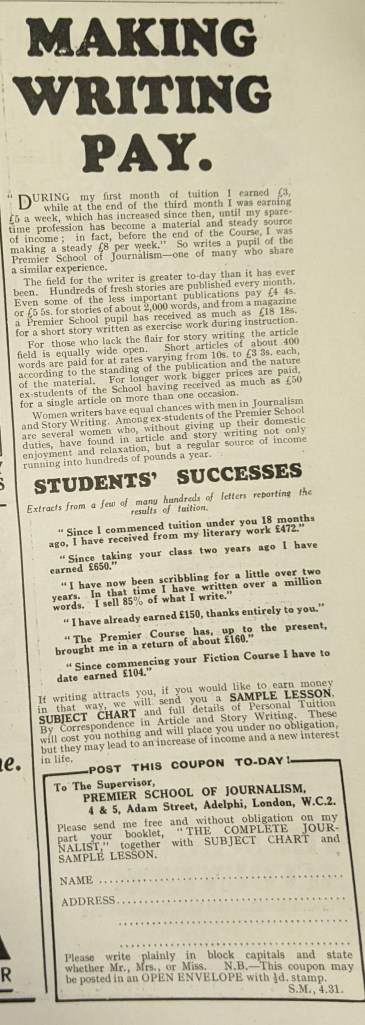
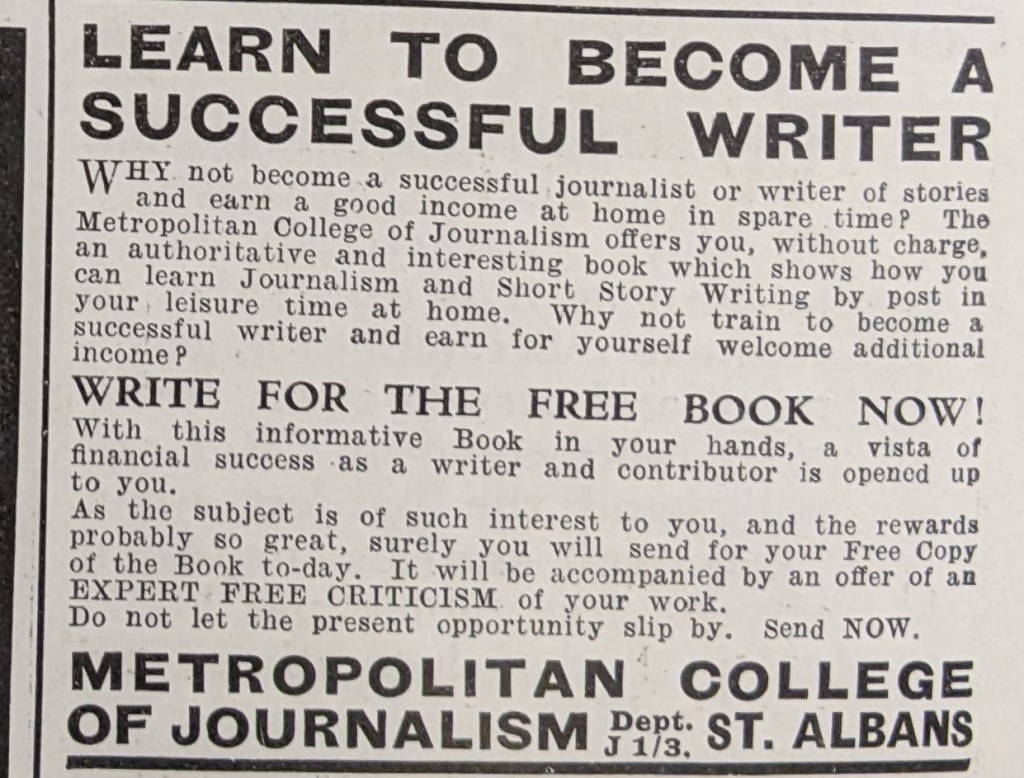
There has not been any historical research published on the phenomenon of ‘schools of journalism’, but my own research indicates that they started up immediately after the First World War, and that in a short space of time many different establishments were formed. A single issue of The Strand Magazine, a monthly publication of fiction short stories and non-fiction pieces, contained adverts for the Premier School of Journalism (‘Making Writing Pay.’), the Metropolitan College of Journalism (‘Learn to become a successful writer’) and The Regent Institute (‘Free Lessons for New Writers’). These schools all offered potential clients an easy route into a remunerative writing career. As the advert for the Metropolitan College posed: ‘Why not become a successful journalist or writer of stories and earn a good income at home in spare time?’

Most Schools of Journalism offered a variation of the same: a correspondence course in which students could submit their trial articles, which would then be corrected by tutors and sent back to students with constructive feedback. After a set period of study, students were promised that their writing would be good enough to sell. The advert for the Premier School of Journalism includes (alleged) testimonials of former students quoting significant financial gains from their work: ‘Since taking your class two years ago I have earned £650’ and ‘Since I commenced tuition under you 18 months ago, I have received from my literary work £472.’ For comparison, the minimum weekly pay for a staff journalist in the early 1930s was just shy of £5 – and that was a considerably better wage than journalists had been paid before the National Union of Journalists pushed for national pay agreements.[3]

The aggressive advertising of these journalism schools caused considerable anxiety and disgruntlement for members of the NUJ, who were either worried that these schools would lead to a surplus of journalists and therefore a competitive job market; or felt that these schools were scams designed to make money off unsuspecting people. One of the first schools to launch after the First World War was The London School of Journalism (which still operates today). It was founded by novelist Max Pemberton and it ran a prominent advertising campaign in the national press. In August 1920, NUJ member and journalist John Ramage Jarvie argued that this advertising campaign must have cost the School a significant amount; and that as the fees they charged students were modest, the School’s operating model must rely on recruiting a high volume of students in order to make a profit. Jarvie therefore considered it inevitable that businesses like the LSJ would increase unemployment amongst journalists by flooding the market.[4]

The NUJ initially did not pick up on its members’ concerns about the LSJ and similar ventures, and gave Max Pemberton a platform to advertise his school to NUJ members. Pemberton stated in an article for the Union monthly newsletter that his school actually told many potential students that journalism was not the right career for them. He presented his initiative as a sort of gatekeeper for the profession, and argued (rather disingenuously) that the School’s adverts did not explicitly promise to turn students into journalists.[5]

Pemberton’s arguments failed to convince the NUJ membership, and the Union’s executive swiftly decided that they would only provide advertising space to training initiatives aimed at current, working journalists. Nevertheless, the schools continued to do business throughout the interwar period. Journalist Harold Herd described how he set up his own school in the late 1910s, which was still trading by the time he wrote his memoir in 1936. Like Pemberton, he argued that he only took on students who had a chance of making it as a professional journalist: ‘Every year we reject hundreds of people on the ground that they do not reveal sufficient promise to justify a recommendation to enrol.’[6]

Despite the protestations of school founders, the sheer volume of such organisations; their modest tuition fees; and the simplicity of their teaching materials (one correspondence course mainly encouraged students to learn from, and copy, existing writers’ work) suggest that it is unlikely that many of their students found professional success. Despite there being no formal entry requirements to becoming a journalist, these unregulated schools sold a dream of easy earnings which could not become a reality for most of their pupils.


[1] Adrian Bingham, ‘‘It Would be Better for the Newspapers to Call a Spade a Spade’: the British Press and Child Sexual Abuse, c. 1918–90’, History Workshop Journal, vol. 88 (2019), 91

[2] Political and Economic Planning, Report on the British Press (London: PEP, 1938), p. 13

[3] A.M. Carr-Saunders and P.A. Wilson, The Professions (Oxford: Clarendon Press, 1933), p. 268

[4] J.R. Jarvie, ‘The London School of Journalism LTD’, The Journalist, August 1920, p. 68

[5] Max Pemberton, ‘The London School of Journalism LTD’, The Journalist, October 1920, p. 90

[6] Harold Herd, Press Days and Other Days (London: Fleet Publications, 1936), p. 124

Holidays in interwar London

FeaturedHolidays in interwar London

With the summer season upon us, many may be planning to head off for a few weeks to relax on holiday. The right to paid holiday these days is enshrined in UK law. The first legal intervention in this area came in 1938 with the Holidays With Pay Act. Rather than setting out an inalienable right to holiday, however, the purpose of the act was to ‘enable wage regulating authorities to make provision for holidays and holiday remuneration for workers whose wages they regulate, and to enable the Minister of Labour to assist voluntary schemes for securing holidays with pay for workers in any industry.’ It was facilitative rather than prescriptive, giving employers a framework for offering paid holiday if they wanted to do so. Even for those covered by the Act, they would only receive one week of paid holiday a year.

Prior to 1938, there was no legal concept of a holiday in Britain. What’s more, the ‘weekend’ for most of the interwar period comprised only Saturday afternoon and Sunday; this 5.5 day work-week had developed in the 19th century. Bank Holiday weekends (where the Monday was a national holiday) could be the only extended break a working person had. The notion that workers should be entitled to extended time off work whilst still receiving pay was not commonly held. At the other end of the social spectrum, the upper classes were generally not in wage-earning roles and therefore had much more freedom over how they used their time.

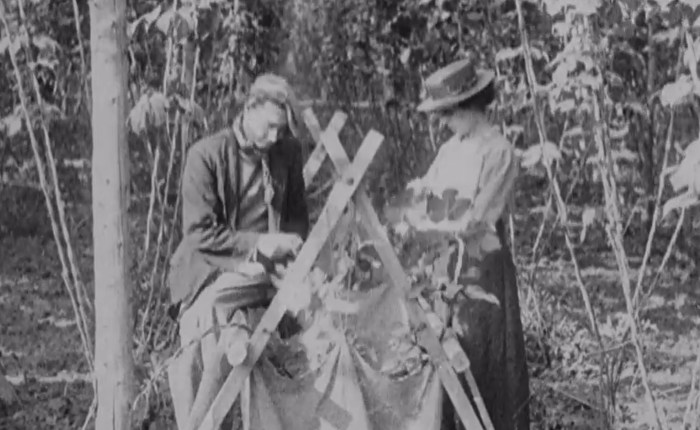
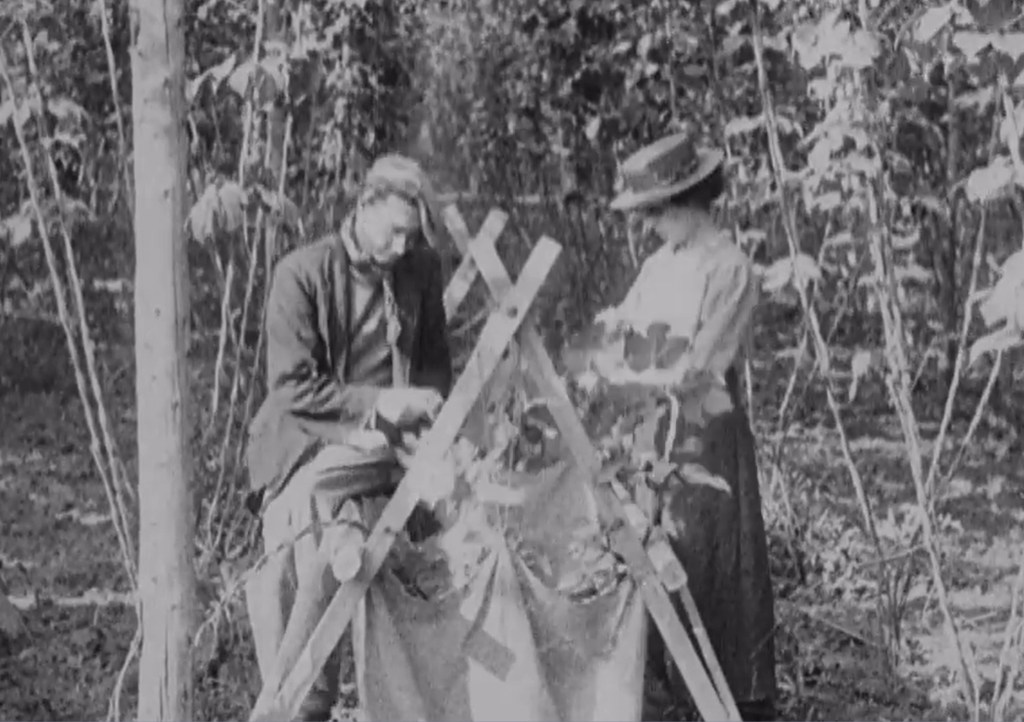
What were the options for breaks, then, for different social groups during the interwar period? At the lower end of the social scale, East End workers could go to Kent in the summer months to go hop-picking. This was not a holiday as such as they would still be required to undertake long hours of manual labour, but it gave an opportunity to leave the city and enjoy the countryside. They would also get paid for their efforts and be given lodgings by the farmers. George Orwell went hop-picking in 1931 during one of his expeditions moonlighting as an iterant worker. He describes the communal aspects of the picking, with whole families coming down and picking together. The 1917 film East is East includes extensive scenes on Kent hop-picking fields as the main character makes her way there for a summer job.

Hop-picking scene from East is East (dir. Henry Edwards, 1917)

Hop-picking was not a holiday, but rather an opportunity to undertake seasonal work and escape the squalor of London during the hottest months. If you had slightly more disposable income, a day-trip could be a welcome activity. The cheapest and most comfortable way to travel would be by charabanc (an early type of motor bus); either by buying a ticket on a scheduled service or by pooling together as a community group and hiring a private coach.[1] The proximity of a range of seaside towns to London made them a popular choice of destination for these trips; then, as now, many seaside towns offered entertainment on the pier and quayside.

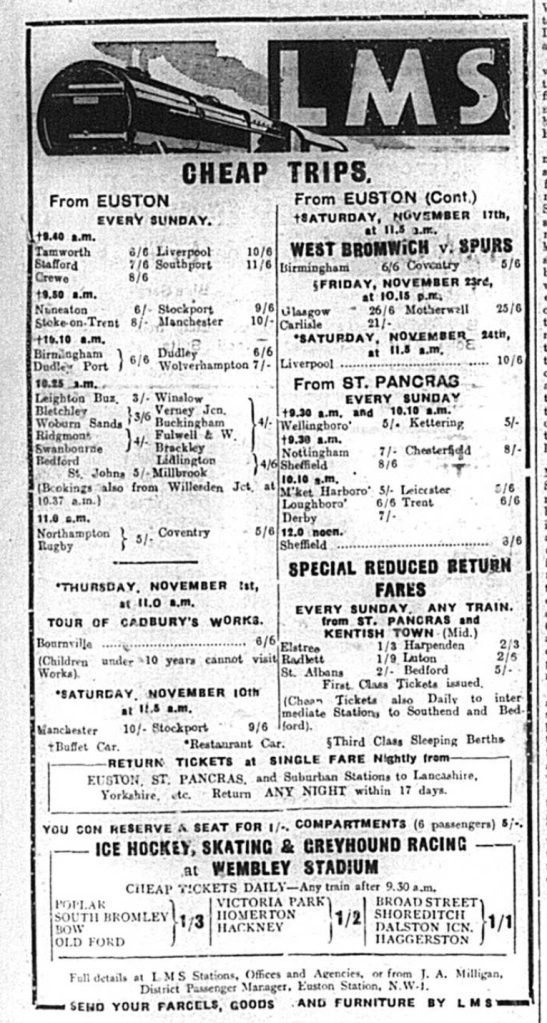
For those able to spend a bit more, travelling by train allowed access to a much larger part of Britain. By the interwar period, Britain’s rail network was mature and there were numerous London terminals from which to board trains. Train operators advertised ‘cheap trips’ in London newspapers. For example, this 1934 advert from the London, Midland and Scottish Railways advertises a range of services for holidaymakers. There are trains leaving to the Midlands and the North every Saturday and Sunday. These are offered with a flexible return ticket, that can be used for 17 days after the initial trip. This implies that travellers are expected to be using the train for a holiday of a week or two. Those travelling to Birmingham and environs can benefit from a tour of the Cadbury chocolate factory at Bournville – an attractive holiday outing which shows the railway collaborating with a large company to offer a package deal. Those who cannot afford to travel far of be away from home long are invited to consider a day-trip to Wembley Stadium for ‘Ice Hockey, Skating & Greyhound Racing’.

LMS advert, The City & East London Observer, 27 October 1934, p. 7

At the top end of the social scale, foreign travel was a possibility. Tourist guides and travel agencies had been available since the 19th century, taking much of the organisation and guesswork out of foreign travel. Commercial flight routes greatly developed during the interwar period, providing a faster way to travel in addition to overland routes and travel by ship. For those who opted for comfort and style over speed, luxury ocean liners and overnight rail journeys through Europe with the Compagnie des Wagon-Lits were good options.

Whether it was to have fish and chips at the seaside or a five-course meal in a dining carriage, throughout the interwar period there was an increased agreement that Londoners should be able to leave the city every now and then and enjoy relaxation and a change of scenery. For many, however, these trips remained limited to single-day outings, as there was little provision for paid holidays and most people could ill afford to take unpaid leave and were at risk of losing their jobs if they did so.


[1] Michael John Law, ‘Charabancs and social class in 1930s Britain’, The  Journal  of  Transport  History, Volume 36, No. 1 (June 2015), 45

Featured

From investigation to trial

This is the fourth and final post of this year’s May Murder Month. You can read posts one, two and three elsewhere on the blog.

Most contemporary readers will get their knowledge about interwar murder stories from the realms of fiction – Hercule Poirot gathering together suspects for a drawing room reveal (a device which Agatha Christie actually only used sparingly) or a hard-boiled police officer picking up on a seemingly minute clue that unravels the whole case. Once the murderer is identified, interwar fiction is either silent about what happens next, or the perpetrator is given the opportunity to take the ‘honourable way out’ by committing suicide.[1]

In reality, of course, investigations were conducted by police inspectors. Unlike in modern criminal cases, there was no Crown Prosecution Service in interwar England. Instead, the police both conducted the investigation and prepared the documentation for the criminal trial. The Director of Public Prosecutions was ultimately responsible for bringing the case to trial in the interest of the people. England then, as now, had a two-tier criminal justice system. The magistrate courts were convened locally and dealt with most of the day-to-day criminal offences. Crown courts were reserved for jury trials, which included murder charges.

Before a case could be referred to the crown court, a prima facie case had to be established in the magistrate court that a crime had been committed and it was of a magnitude appropriate to be considered in the crown court. Interwar murder trials were therefore effectively heard twice: once in the magistrate court and then again in the crown court, where the sentencing would take place. It was generally the latter proceedings that drew the attention of the national press. In murder cases, the coroner’s inquest ran in tandem to the magistrate court proceedings. In the interwar period, coroner courts sat with their own juries, who were tasked with determining whether death had occurred naturally, through suicide, accident, or murder. Usually, if foul play was suspected but the police investigation was ongoing, the coroner would suspend the inquest to give the police more time to complete their investigations.

The reading public, then, were experiencing criminal narratives in two different ways. When reading newspapers, the reports mostly focused on the criminal trial, with its rhythm of prosecution, defence, cross-examination, witness statements, a possible statement by the accused, and the judge’s summing up, all cumulating to the jury’s verdict. In crime fiction, the narrative focused on the investigation, with witness statements noted as the investigation developed. Particularly in stories where the protagonist is an amateur sleuth as opposed to a police officer, the formal police and court procedures can be completely outside the scope of the narrative. As crime historian Victoria Stewart has noted: ‘Detective novels tend not to recount the trial of the individual whom the investigator identifies as the guilty party because the watertightness of the investigation itself acts as a substitute for the depiction of the judicial process. An account of the trial would simply reiterate the findings of the investigation that has formed the body of the narrative.’[2]

Other scholars have noted that trial reporting reveals contemporary attitudes to potentially contentious topics such as changing attitudes to gender identity and sexuality.[3] Newspaper historians have also argued that the increased popularity of crime fiction changed crime reporting, with journalists paying more attention to ‘human interest detail’ of the story as opposed to the judicial process. This, in turn, potentially obscured the public’s awareness of legal procedures.[4] Additionally, journalists on occasion played a very active role in gathering evidence that led towards a conviction, for example in the case of Buck Ruxton who murdered his wife and a servant.[5] Conversely, crime fiction novels which had a police inspector as their protagonist, such as the Inspector French novels by Freeman Wills Croft, potentially educated their readership about police procedures in more detail than newspaper reports did.

Whether fictional or factual, murder stories fascinated interwar audiences and allowed them to explore the limits of what was considered acceptable or transgressive behaviour; and how this changed over the course of the two decades. Newspapers and crime novels presented readers with two different lenses through which to consider the criminal justice process, from investigation to trial.


[1] Lord Peter Wimsey’s increasing mental distress at sending murderers to the gallows, which comes to a head at the end of the final Wimsey novel Busman’s Honeymoon, is a notable exception.

[2] Victoria Stewart, Crime Writing in Interwar Britain (Cambridge: University of Cambridge Press, 2017), p. 11

[3] Lucy Bland, Modern Women on Trial: sexual transgressions on the age of the flapper (Manchester: Manchester University Press, 2013), p. 2

[4] Judith Rowbotham; Kim Stevenson; Samantha Pegg, Crime News in Modern Britain (London: Palgrave, 2013), p. 140

[5] Shani D’Cruze, ‘Intimacy, Professionalism and Domestic Homicide in Interwar Britain: the case of Buck Ruxton’, Women’s History Review, vol. 16, no. 5 (2007), 701-722

Featured

Executions in interwar London

Continuing May Murder Month, this week we take a look at the ultimate outcome of a murder case – the execution. Last week’s May Murder Month entry on police memoirs can be found here.

If you were found guilty of murder in interwar Britain, you would automatically be sentenced to death, unless your legal team had managed to convince the jury that you were insane at the time you committed the murder. After the adoption of the Infanticide Act in 1922, women who killed their new-born babies were tried as for manslaughter rather than for murder, meaning they no longer received death sentences. Yet even those found guilty of murder could appeal to the King (via the Home Secretary) for a reprieve. Reprieves were fairly common: in the first half of the 20th century around 40% of convicted male murderers, and an astonishing 90% of convicted women murderers, were granted a reprieve of execution.[1] This usually meant their sentence was commuted to ‘penal servitude for life’.

The period of appeal following a death sentence was usually ‘three Sundays’, meaning that if an appeal or reprieve was not granted, execution usually followed within a month of the trial. Murder trials were much shorter than we are used to today and prisoners were committed to trial much more quickly. This meant that convicted murderers were usually executed within a year of the crime having taken place. In interwar London, condemned prisoners were held in a special ‘condemned cell’ adjacent to the prison gallows. During the 1920s and 1930s, there were never more than 21 executions in a single year across the whole of Britain; and in many years there were fewer than 10.[2] This meant it was extremely unlikely for two convicted murderers to be held at the same prison at the same time, unless they were both convicted for the same murder committed jointly. There was no concept like ‘death row’ as it currently exists in the US, where prisoners can spend years awaiting execution.

Since 1868, executions were no longer held in public but were conducted inside prison walls. In London, there were three prisons in which executions took place until capital punishment was formally abolished in 1969: Pentonville Prison for male prisoners who lived north of the Thames; Wandsworth Prison for male prisoners who lived south of the Thames; and Holloway Prison for female convicts. Gradually, over the course of the first few decades of the 20th century, capital punishment became less ritualistic and more bureaucratic. Until 1902, a black flag was raised over the prison after an execution had taken place. The tolling of a bell during an execution was abolished around the same time.[3] After the end of public executions, journalists were still regularly invited to attend, so that their newspaper reports could serve as a proxy for public scrutiny. The last time a journalist attended an execution was 1934.[4]

The only ritual elements of execution which remained in place is that they usually took place at 9am; and that an execution notice was posted on the prison door immediately after the event. This is depicted, for example, in the 1938 thriller They Drive By Night, where a small crowd of people is shown gathered around the prison entrance. Papers of record, such as The Times, usually posted brief notices of executions as they had taken place. How an actual execution unfolded was usually ‘shrouded in secrecy’, with official statements invariably confirming that nothing unusual had occurred.[5] This vacuum of official information allowed rumours to swirl. After the controversial execution of Edith Thompson it was suggested that ‘her insides had fallen out’ as she dropped through the trap door, suggesting she may have been pregnant at the time of her death. Thompson’s executioner, John Ellis, committed suicide nine years after Thompson’s death, and it was suggested that he had never been able to get over the horror of that particular hanging.

Hanging had been the principal form of execution in Britain for centuries. By the interwar period, the government prided itself on having perfected a highly efficient method, which was considered ‘humane’ because it aimed to be swift and accurate. The objective was to ensure the prisoner’s neck broke immediately, so that he or she did not have to suffer through asphyxiation. Around a decade after the last execution took place in Britain, one of the country’s most famous hangmen, Albert Pierrepoint, published his memoirs. This book finally revealed in detail how executions were conducted, although interwar fiction novels such as Trial and Error had given descriptions of the process decades earlier.

Pierrepoint described in detail how he would arrive at a prison the day before the execution to make his preparations, which included the crucial calculation of ‘the drop’: the length of rope required which depended on the prisoner’s weight and size. For the neck to break at the 4th or 5th vertebrae was considered ideal as it would cause instant death. If the drop was too short, the prisoner could end up suffocating rather than breaking their neck; if it was too long, the worst-case scenario would be that the prisoner was decapitated as they dropped.

Executions were conducted extremely quickly: the execution of Norman Thorne was reported to last no more than ten seconds ‘[f]rom the time that [he] emerged from his cell door until the moment he passed into eternity.’[6] After the execution, the prisoner was left hanging for an hour before being cut down and submitted to a post-mortem, during which a note was made of the exact cause of death and where the neck had broken. An official statement on a pre-prepared template, signed and sealed by a coroner and jury, would confirm the death of the prisoner under the 1868 Capital Punishment Amendment Act. The body would then be buried in a dedicated cemetery inside the prison walls the same day.[7]

Despite the relative rarity of executions in interwar Britain, the state had developed a highly polished routine to ensure that these executions were conducted as efficiently as possible. This efficiency was considered humane, as it would limit the prisoner’s suffering as much as possible. At the same time, however, it also incorporated capital punishment into the bureaucratic machinery of government. Treating capital punishment as a largely administrative process also minimised the scope for challenging its principles, as it was incorporated into the judicial system as ‘business as usual.’ The abolition movement consequently only gained momentum in Britain after the Second World War.


[1] Shani D’Cruze, ‘Intimacy, Professionalism and Domestic Homicide in Interwar Britain: the case of Buck Ruxton’, Women’s History Review, 2007, vol. 16, no. 5, 701-722 (706)

[2] Source: http://www.capitalpunishmentuk.org/

[3] Lizzie Seal, Capital Punishment in Twentieth-Century Britain: Audience, justice, memory (London: Routledge, 2014), p. 17

[4] Ibid., p. 36

[5] Lizzie Seal, ‘Albert Pierrepoint and the cultural persona of the twentieth-century hangman’, Crime, Media, Culture, 2016, vol. 12, no. 1, 83-100 (86)

[6] Seal, Capital Punishment, p. 41

[7] Albert Pierrepoint, Executioner: Pierrepoint (London: Coronet, 1998 [1974]), p. 175

Featured

Coronation of George VI

As the UK prepares for the first coronation since 1953, it is a good opportunity to look back on the only coronation which took place during the interwar period. On 12 May 1937, King George VI was crowned in Westminster Abbey. Initially, it had been planned that the coronation that day would have been of Edward VIII, but after the Abdication Crisis of late 1936, it was decided to use the same date for a different coronation ceremony.

Although the coronation of Queen Elizabeth II was famously the first national ‘TV event’ in Britain (there’s even a Dr Who episode about it), new media were also used for the coronation in 1937. The last coronation before this year had been in 1911, when moving image mediums were still in the early stages of development. In that year, silent film footage of the procession was recorded from static cameras, mostly at a remove from the action. By 1937, sound cinema was omnipresent, and making a filmed record of the coronation was an integral part of the day. A film of nearly an hour was recorded, which included many shots taken inside Westminster Abbey during the service. The whole was overlaid with an informative voice-over explaining the action.

Although a large number of people, possibly up to a million, travelled to London to witness the procession, there were many more subjects who would not have been able to see this royal ceremony in person. These were not just in Britain, but across the world. As one local newspaper put it, ‘figuratively waiting upon the Throne and its new King to-day were the 500,000,000 people of the Empire.’[1]

The distribution of the coronation film was one of the key strategies to ensure that these half a billion people could feel a connection with the new monarch. The film was edited and distributed quickly – only two days after the coronation, on Friday 14 May, people in provincial towns such as Gloucester were able to see ‘The Great Coronation Film: The House of Windsor.’ It was advertised as including ‘THE ACTUAL CROWNING CEREMONY IN THE ABBEY’. In the case of Gloucester, it was showing in three different cinemas with each screening it four times a day.[2]

A shortened newsreel version of the footage taken at the coronation

Other mass media were also used to create a sense of a community of subjects. Arguably, the fact that until six months before the coronation no-one had expected this second son to become king, made it likely that most people in the country had only a very limited understanding of who their new King was. Local newspapers printed articles setting out details about the new King and Queen, to inform their readership. The Lancashire-based Nelson Leader told its readers that for the new King, ‘Duty is a quiet passion with him, as it was with his father.’[3] Multiple newspapers assert that the King’s main interests are the nation’s industry and support for young people – both uncontroversial topics. The other key feature that papers highlighted was the domestic bliss of the new royal couple: ‘Ideally happy has been the married life of King George and Queen Elizabeth’; and most articles also describe the couple’s daughters in flattering terms.[4]

The spectre of King Edward VIII is mostly in the background of these reports; but in the Derbyshire Times he is evoked explicitly: ‘King George lacks some of the qualities that inspired high hopes of King Edward VIII – he is more reserved, more conventional, and makes friends less easily – but he has certain qualities that his more brilliant brother lacks: he is steadier, less impulsive, more persevering, and more dutiful.’[5]  And, of course, the new King’s steady family life is infinitely preferable to a King married to an American divorcee, although none of the newspapers make that explicit.

A final strategy employed to create an ‘imagined community’ of subjects around the new King is the issue of special coronation stamps. These went on sale on the day after the coronation, and multiple papers reported that there was a record interest in them. ‘Queues formed at many post offices and for the first time special stamp counters dealt with the rush. Arrangements had been made for the sale of 38 millions.’[6] Stamps, bearing the image of the new monarch and uniquely linked to national identity, are another tactic to reinforce to the audience that they are part of a defined group of royal subjects.

So, beyond the actual coronation ceremony itself in London, which saw ‘[m]ore than 5,669,000 passengers (…) carried by the London Underground Railways during the forty-six hours of continuous service’; ‘200 tons of litter (…) removed from the three miles of the Coronation route and side streets’; and a 6.5 mile procession through Westminster, modern mass media methods were used to ensure that the coronation’s impact reached to all corners of Britain, and beyond that through the Empire.[7] After the unprecedented events of the Abdication, which had the potential to damage the crown, the coronation was used to reinforce the monarchy as a stable and positive influence.


[1] ‘Happy and Glorious’, Lincolnshire Echo, 12 May 1937, p.6

[2] Cinema adverts, Gloucester Citizen, 14 May 1937, p. 11

[3] ‘Long May They Reign!’, Nelson Leader, 14 May 1937, p. 6

[4] Ibid.

[5] ‘King George VI and his coronation’, Derbyshire Times, 14 May 1937, p. 30

[6] ‘Rush to buy new stamps’, Daily News, 14 May 1937, p. 8

[7] ‘King and Queen thank the nation,’ Liverpool Echo, 14 May 1937, p. 11; ‘Long May They Reign!’, Nelson Leader, 14 May 1937, p. 6