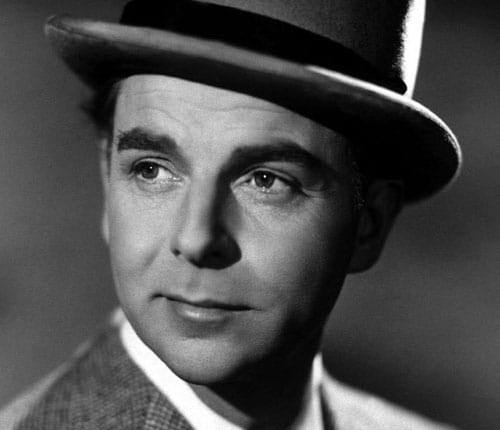
Sonnie Hale

Sonnie Hale

Sonnie Hale was born John Robert Hale-Munro in London in 1902. His father, Robert, was also an actor. After an education at the Roman Catholic Beaumont College, Hale turned to a career in show business. During the interwar years, he was one of the most recognisable comedy stars in British film, often co-starring with Jessie Matthews, who would become his wife in 1931.

Like other interwar comedy stars, such as Gracie Fields, Hale’s career in the 1920s was based on the stage. His brand of comedy was mainly verbal – Hale was great at the quick repartee. The silent films made during this decade demanded a different, more physical type of comedy. During the 1920s, therefore, Hale appeared in revues which allowed him to perfect his singing and dancing skills. Once sound film became an established medium in Britain in the early 1930s, Hale combined his theatre work with film appearances.

Musical comedy was a popular film genre in 1930s Britain, and Hale packed his schedule with film roles in the first half of the decade. He starred in two films each in 1932 and 1933, a whopping four films in 1934, and three in 1935. He then appeared in one film each in 1936, 1938 and 1939. His acting output slowed down in the second half of the decade because he had at that point also turned his hand to writing and directing, directing three films across 1937 and 1938.

Hale’s first feature film role was a leading part opposite star Jack Hulbert. In the musical comedy Happy Ever After, Hulbert and Hale star as two window cleaners, both named Willie, who try and help a young starlet who is hoping to break into Hollywood. Hale’s time on the stage had evidently given him good connections with stars such as Hulbert and Hulbert’s wife Cicely Courtneidge, who also starred in the film.

From 1933, Hale started appearing in films with Jessie Matthews, by that point his real-life wife. From 1926 to 1930 Hale had been married to actress Evelyn Lay. Matthews had been married to her first husband for the same period. The relationship between Matthews and Hale started when he was still married to Lay, and caused much publicity and controversy at the time. Matthews was cited as co-respondent in Hale’s divorce case against Lay and Matthews’ letters to him were read out in court. The press, naturally, lapped it up, and the judge saw it fit to make comments about Matthews’ conduct.

Public sympathy was with Lay, but Hale and Matthews proved to be a successful professional as well as personal couple, and the public did not reject their collaborations. They appeared together in the ensemble piece Friday the Thirteenth (Hale as a comic bus conductor, Matthews as a chorus girl) and Hale played a supporting role in the Matthews’ star vehicles Evergreen, First a Girl and It’s Love Again, all directed by Victor Saville.

In none of these films, however, does Hale play the love interest to Matthews; he lacked the traditional good looks that 1930s British cinema demanded for the part of the romantic lead. Instead, Hale is the funny, supportive sidekick to either Matthews herself, or to the male lead. In It’s Love Again, for example, he plays Freddie Rathbone, who helps his friend and gossip journalist Peter Carlton come up with his gossip column every day. When Peter’s job is on the line, the pair come up with a fictional society figure, Mrs Smythe-Smythe, about whom Peter can make up the most outrageous stories and thus scoop his rivals at other papers. Hale plays Rathbone as a bit of a waster, who mainly enjoys going to society parties for the free food and wine. He is also, however, loyal to Peter and supportive of Peter’s attempt to impress the aspiring actress Elaine Bradford, played by Matthews.

After It’s Love Again, Hale took over from Saville as director. He directed Matthews in three films: Head over Heels, Gangway and Sailing Along. All three are less accomplished than Saville’s turns directing Matthews, and Hale gave up directing after 1938.

He did not, however, give up acting. His next role after It’s Love Again was a move away from musical comedy. Hale starred as petty criminal Sam Hackett in the Edgar Wallace crime thriller The Gaunt Stranger. Although Hale’s performance still has comic touches to it, the film’s overall tone is much darker than his previous work. It was only a brief foray into a different genre – by 1939 Hale was back to comedy, in the Walter Forde-directed Let’s Be Famous.

The Second World War caused a hiatus in Hale’s film career, although he was able to pick up his stage career which had languished for most of the 1930s. He briefly returned to film and TV films in the second half of the 1940s – by now divorced from Matthews and married to his third wife, Mary Kelsey. Towards the end of his life, he wrote the comedy play The French Mistress which was a success in the West End and made into a film in 1960. Hale died in London in 1959.
Emlyn Williams

Emlyn Williams

George Emlyn Williams was born in the tiny Welsh village of Pen-y-ffordd in 1905. As a Welshman with dark colouring and an unusual name, Williams appeared very different from popular interwar actors such as Laurence Olivier and Brian Aherne, both of whom performed in West End theatre at the same time. Unlike that other famous Welshman of the period, Ivor Novello, Williams steered clear of musical theatre and nightclubs in favour of writing and performing in plays exploring murder and criminal psychology.

After attending grammar school and undertaking some schooling in France on a scholarship, Williams won a scholarship to Oxford, where he became involved with the Oxford University Dramatic Society (OUDS). Williams was supposed to graduate in 1926, but instead of studying for his exams he wrote a play, Full Moon, which was put on at the Oxford Playhouse under the management of J.B. Fagan. Williams decided to move to London without completing his degree when Fagan offered him a small walk-on part in the production And So To Bed, in which Edmund Gwenn and Yvonne Arnaud appeared as the principal players.[1]

This modest role marked the start of a long West End career, in which Williams combined acting with writing and directing, regularly casting himself as the lead for his own productions. In his autobiography, Williams presents the years from 1926 to 1935 as ones in which he finds his feet both professionally and in his personal life. After numerous failures and some mild successes, the book ends with the first West End performance of his play Night Must Fall, which Williams credits as his ‘first solid success’[2] – it ran for a year and a half before transferring to Broadway for another 64 performances.

Night Must Fall is based on a notorious murder case of the interwar period, the ‘Crumbles Murder’ case of 1924. Patrick Mahon, a charming Richmond-based salesman, struck up an extramarital affair with typist Emily Kaye. Kaye fell pregnant, and Mahon led her to believe that they would travel to South Africa to start a new life together. Instead, he murdered her in a cottage on the Sussex coast and dismembered and destroyed her body so thoroughly that very little of it was found during the police investigation. What particularly spoke to the public’s imagination is that, less than 48 hours after the murder, Mahon picked up another woman and spent a few days at the cottage with her, whilst Kaye’s partly-dismembered body was in the next room.[3]

Williams combined this story with the equally notorious murder perpetrated by Sidney Fox, who in 1929 killed his own mother by strangling her and subsequently set her hotel room on fire to cover his tracks. In Night Must Fall, Dan, a charming man (modelled on Patrick Mahon) strikes up a friendship with a rich but cranky old lady and her niece Olivia. Whilst the niece suspects that Dan is a murderer, she still falls in love with him and helps him stay out of the hands of the police. Eventually, Dan murders the old lady and steals her money – although Olivia wants to help Dan escape, the play ends with him being arrested.

In his autobiography, Williams states that he had initially been interested in adapting the story of Fritz Haarman, a German serial killer who murdered at least 27 boys and young men in Hanover, in 1924. Williams was bisexual and identified with Haarman’s young victims: poor or homeless men, in some instances selling sex for money, lured back to Haarman’s flat with promises of food and shelter. ‘Yes, it could have happened to me’, acknowledges Williams. Although the story is clearly close to his heart, British theatre censorship laws absolutely precluded the depiction of a homosexual, paedophilic murderer.[4]

Alongside this career as theatre author and actor exploring the darker side of life, Williams also appeared in films. One of his first appearances was as the comic best friend to the protagonist in the Oxford comedy Men of Tomorrow (1932). Although the film was a commercial failure, it did bring Williams exposure and he was voted the most popular British actor by the readers of Film Weekly, ahead of Leslie Howard and Jack Hulbert.[5] This in turn landed Williams with a contract at Gaumont-British, where he wrote as well as acted. His first gig with them was writing the dialogue, and starring in, Friday the Thirteenth (1933). He subsequently worked on the Jessie Matthews vehicle Evergreen and supplied dialogue for the 1934 Hitchcock film The Man Who Knew Too Much.

Although his contract with Gaumont was not renewed beyond 1935, Williams stayed active in film for the remainder of the interwar period, and beyond. As well as adapting Night Must Fall for the screen, he also acted in a range of genres such as the comedy Night Alone and the thriller They Drive By Night (both 1938). In 1936, he was cast as Caligula in Joseph von Sternberg’s unfinished I, Claudius, opposite other such greats at Charles Laughton, Flora Robson, and Merle Oberon.

Later in his career, Williams toured with an innovative one-man theatre show called Emlyn Williams as Charles Dickens, in which he delivered parts of Dickens’ novels in a manner similar to how Dickens himself toured in the 19th century. He remained interested in murder, and wrote a book about the Moors murders in 1968. Williams continued to be active as a writer and actor until close to his death in 1987.


[1] Emlyn Williams, Emlyn: A sequel to George (London: Penguin, 1976), p. 13

[2] Ibid., p. 449

[3] Colin Evans, The father of forensics: the groundbreaking cases of Sir Bernard Spilsbury and the beginnings of modern CSI (Thriplow: Icon, 2007), pp. 140-147

[4] Williams, Emlyn, pp. 213-221

[5] Ibid., 319

Alastair Sim

Alastair Sim

Alastair Sim was born in 1900 in Edinburgh. After an aborted university education and active duty during the Great War, he trained as an elocution teacher and took up a lectureship in that subject at the University of Edinburgh in 1925. Elocution and drama teaching was his route into an acting career, of which his parents were not supportive. In 1930 Sim moved down to London, where his acting career took off.

After several years of stage roles, Sim made his film debut in 1935, with no fewer than five film credits to his name in that year alone. All were mostly low-budget comedies or crime films, in which Sim played smaller parts. Throughout his career he mostly played supporting roles, with the notable exception of Scrooge (1951) in which he played the titular character. It’s still considered one of the best portrayals of Scrooge on film.

As the 1930s continued, Sim got more substantial film roles in higher-profile films. His lanky frame (he was just over 6 feet tall) and distinctive voice made him instantly recognisable to audiences. In 1936 Sim starred opposite George Formby in the Monty Banks-directed Keep Your Seats, Please!. In the same year he was also directed by Monty Banks in the comedy The Man in the Mirror, although his name was misspelt as Alistair in the film’s credits.

In 1937-38, Sim starred opposite Jessie Matthews three times, in Gangway (1937); Sailing Along (1938) and Climbing High (1938). In Gangway, Matthews plays a journalist who gets caught up in a trans-Atlantic criminal plot. Sim is Detective Taggett, who is attempting to arrest the criminals. In Sailing Along, Matthews plays a precocious young woman and aspiring dancer who is brought up on a tug-boat. Sim here is the supporting character Sylvester, a confused and slightly simple-minded man who helps Matthews in her career aspirations. By the time of Climbing High, Sim was sufficiently famous that his name was included on the film’s poster. He again plays a supporting comedy relief character in this film.

Sim was only seven years older than Matthews, but in none of the three films is there the slightest inkling that he may be a suitable romantic partner for her characters. In fact, throughout the films Sim made in the interwar period, he plays characters who don’t have any romantic entanglements with co-stars. This was no doubt partly to do with his appearance, which did not meet conventional beauty standards of the period. Even in his thirties, he looked older than his years, and appeared somewhat ageless. His persistent casting in comedy roles further diminished his romantic appeal.

It is surprising, then, that in the 1937 crime film The Squeaker, Alistair Sim plays a character who has a settled domestic life, just when you least expect it. In The Squeaker Sim is Joshua Collie, a crime reporter for a popular newspaper. Journalists featured regularly in British interwar films, and were usually portrayed on the move, gathering news on the street; or pushing against deadlines in the newspaper offices.

Collie, on the other hand, is shown inside his comfortable living room, where he smokes a pipe after dinner like a suburban family man. He is not particularly interested in chasing down news, even though his friend, Scotland Yard inspector Barrabal, is feeding him plenty of information about the big criminal case he is working on. Collie reluctantly follows Barrabal’s leads only when his editor threatens to sack him for neglecting his duties. Alastair Sim played against the expected stereotype of the crime reporter, by making Collie a bit lazy and committed to his creature comforts. This enabled him to position himself again as a comedy character, even in a serious crime film which was based on a hard-boiled Edgar Wallace novel.

At the tail end of the interwar period Sim starred opposite Gordon Harker, another prolific interwar actor of comedy roles, in Inspector Hornleigh (1939). Sim played Sergeant Bingham, assistant to Harker in the titular role of Hornleigh. The pair are asked to investigate a murder in this comedy. The film was successful enough to spawn two sequels: Inspector Hornleigh on Holiday (also 1939) and Inspector Hornleigh Goes to It (1941).

Sim’s acting career lasted until his death in 1976. In the 1950s, as well as his interpretation of Scrooge, Sim also starred as the headmistress in the original St Trinian’s films, The Belles of St. Trinian’s (1954); and Blue Murder at St. Trinian’s (1957). Although his most commercially successful roles date from the second half of his career, he built up his screen persona and fame throughout the interwar period.

Edmund Gwenn

Edmund Gwenn

British actor Edmund Gwenn is internationally best-known for his role as Kris Kringle (‘Santa’) in the 1947 Christmas classic Miracle on 34th Street. This role earned Gwenn his only Oscar win (although he was nominated once more in 1950). Prior to his move to Hollywood at the start of World War II, Gwenn was a prolific stage and screen actor in interwar London. His instantly recognisable demeanour and voice made him a reliable choice for both leading and supporting roles.

Gwenn was born in 1877 and started his acting career on the late-Victorian and Edwardian stage, specialising in supporting roles of plays written by contemporary playwrights such as J.M. Barrie and John Galsworthy. He was a successful stage actor and did not make the transition to film acting until the start of the interwar period, when films were settling into the length and narrative types that we still recognise today.

Gwenn starred in only two feature-length silent films (Unmarried, opposite Gerald du Maurier, in 1920; and The Skin Game in 1921) before giving films a rest again until talkies became the norm in the early 1930s. Gwenn likely recognised that his power as an actor required him to be able to use dialogue as a means of expression. Once sound film work was available, he took to it with a vengeance, making no fewer than 36 films in the 1930s. No mean feat for an actor who was already 53 when the decade started.

In this film work, as in his stage roles, Gwenn continued to be associated with contemporary English writers. His first foray into sound film was a remake of The Skin Game, released ten years after the silent version in 1931. Both films were based on a Galsworthy play; the 1931 version was directed by Alfred Hitchcock.[1] Gwenn stars as Hornblower, a nouveau-riche industrialist who is looking to buy a piece of land from genteel landowner Hillcrist, to build industrial works. The conflict between ‘old England’ which values rural landscape, tranquillity and honour; and the new, industrial outlook which favours trade, progress and money, is at the heart of the film. The emotions between the two men and their families run so high that Hillcrist’s wife decides to reveal a damning secret about Hornblower’s daughter-in-law, as a result of which the young woman commits suicide. Hornblower, crushed with grief, decides to leave the area. Hillcrist’s victory is hollow, however, as he contemplates the moral depths to which his family has stooped to defend their way of life.

Gwenn played a man from a different social background a couple of years later in The Good Companions, a 1933 adaptation of a popular J.B. Priestley novel.[2] This Victor Saville-directed film remains a popular example of a British interwar comedy, and also stars Jessie Matthews and John Gielgud. In The Good Companions, Gwenn plays Jess Oakroyd, a Northern labourer who gets fired for speaking up against a malicious manager. Oakroyd decides to travel ‘south’ in search of work. In the Midlands, he stumbles across a faltering theatre troupe called the Dinky Doos. Simultaneously with Oakroyd’s arrival in the midlands, the film also follows teacher Inigo Jollifant and Miss Elizabeth Trant, who reach the Midlands from the East and West of England respectively. The three travellers join the Dinky Doos and help to make the troupe a success. The Good Companions was well-received by critics, who praised it as a ‘British’ picture at a time when the British film industry had been under considerable domestic pressure to prove it could stand up to the influence of Hollywood.[3]

Gwenn used his non-threatening appearance to great effect in 1936’s Laburnum Grove (directed by Carol Reed), which has been discussed in detail elsewhere in this blog. In this film, Gwenn plays Radfern, a seemingly innocent and typical suburban husband who is secretly involved in an international crime network. The film is, again, based on J.B. Priestley source material. Reed directed Gwenn again in 1938, as the working-class lead of Penny Paradise. This comedy-drama is set in Liverpool, and Gwenn plays Joe Higgins, a tug-boat captain who religiously enters the ‘penny pools’ – a postage betting system in which players try to guess the correct football scores for the entire league. Miraculously, Higgins guesses all the scores correctly, and he believes himself a rich man. However, his friend Pat, who was supposed to have posted in Higgins’ winning score, forgot to post it on time. Higgins gives up his job and throws a large party for the entire community before Pat has the courage to tell him what has happened.

Penny Paradise is a fairly typical 1930s British comedy, with the expected happy ending and moral lessons for the main characters. Gwenn rounded out the decade with a very different part, in what has commonly been called the ‘first Ealing Comedy’. Cheer Boys Cheer, produced by Michael Balcon and directed by Walter Forde, was released in 1939. It follows the plight of a small beer brewery which is up against a big, capitalist brewing corporation. The conviviality of the workers at the small brewery models how Balcon planned to run his new studio. Gwenn plays Edward Ironside, the head of the industrial brewer. The film’s most striking scene (to a modern audience) is a brief shot of Ironside reading Hitler’s Mein Kampf. In this last role of the decade, just before his move across the Atlantic, Gwenn came full circle with his performance as Hornblower in The Skin Game: that of an industrialist intent on undermining traditional British values. The changes which Britain underwent in the 1930s, however, meant that whilst at the beginning of the 1930s it was the life of the landed gentry that was worth protecting, by the end of the decade it was the working-class community spirit that was held up as the British ideal.

Gwenn continued to act almost up to his death at the age of 81, in 1959. His later roles increasingly included incidental parts in TV series. Whilst his later, American career may have brought him international and lasting fame and recognition, his frequent appearances in British films of the 1930s made him a key contributor to the interwar cultural landscape.


[1] Jeffrey Richards, The Age of the Dream Palace (London: IB Tauris, 2010) p. 316

[2] Laurence Napper, British Cinema and Middlebrow Culture in the Interwar Years (Exeter: University of Exeter Press, 2009), p. 81

[3] Ibid., p. 123

First a Girl (1935)

First a Girl (1935)

Musical star Jessie Matthews was at the prime of her career in 1935 when she starred as the lead in First a Girl.[1] This musical comedy directed by Victor Saville is one version of a popular film plot; it is a remake of the German comedy Viktor und Viktoria (1933), which was re-made in West Germany in 1957, and most famously adapted by Hollywood in 1982, as Victor/Victoria starring Julie Andrews.

The basic plot of all four films, including First a Girl, is similar. An aspiring stage actress (in the British film she’s called Elizabeth, and naturally is played by Matthews) meets Victor, an actor who aspires to Shakespeare but in reality performs as a female impersonator. When a bad cold prevents Victor from performing one evening, he persuades Elizabeth to take his place, by pretending to be a man who pretends to be a woman. This is a great success, and ‘Victoria’ quickly becomes an international star, forcing Elizabeth to appear as a man when in public. Things get complicated when Elizabeth falls in love with a (straight) man, who believes her to be a man also.

Whilst both the 1933 original and the 1982 American version are regularly interpreted as queer films, First a Girl underplays the homosexual possibilities of Elizabeth’s flirtation with her male love interest. This is partly due to Matthews’ own appearance. As The New York Times noted upon First a Girl’s US release in 1936:

Normally it is with sorrow and self-hatred that this column hints at the inadequacies of a star, but this time it is a distinct pleasure to call Miss Matthews’s acting performance hopelessly bad. In “First a Girl” she is pretending to be a man and making no headway at all, except with the members of her supporting cast, who swoon with astonishment upon discovering her sex. 

Quite beside Matthew’s obviously feminine appearance, First a Girl underplays any potential sexual tension between Elizabeth and her love interest, Robert, until Robert understands that Elizabeth is a woman. Prior to that point, the film focuses on the comedic potential of Elizbeth’s cross-dressing, rather than any transgressive possibilities in her relationship with Robert.

Jessie Matthews as ‘Victoria’, appearing with Sonnie Hale, in First a Girl

All versions of the film appear to include a similar sequence in which ‘Victoria’ is ‘forced’ to perform activities which are coded as specifically masculine, to comic effect. In First a Girl this sequence is set in a Parisian nightclub, where Victor and Elizabeth find themselves during their European tour. Elizabeth has to wear a tuxedo here, and hangs out at the bar with Robert – a part of the club only available to men. She quickly gets drunk when trying to keep up with Robert’s rate of drinking, and struggles when trying to smoke a cigar. Whilst these scenes give Matthews an opportunity to display her comedic talent, they also undermine her sexual capital whilst she is performing as a man. As soon as Elizabeth’s true gender identity is revealed to Robert, she turns from an unsophisticated youth into a charming young woman.

It is significant that these scenes of gender-bending performance are set in Paris – a location that invited connotations of licentiousness and sexual transgression in the British popular imagination of the 1930s. Interestingly, in the 1933 German film, ‘Victoria’ is in London when forced to undertake activities which may ‘out’ her as a woman. ‘Victoria’ finds herself in an environment that is both literally and figuratively foreign to her.

As Jeffrey Richards points out, male and female impersonation had a long tradition on the British theatrical and music hall stage.[2] The character of Victor, then, works well in this British film. He is portrayed as older than Elizabeth (although actor Sonnie Hale was only five years Matthews’ senior) and can easily be read as a music hall performer in the Victorian tradition. His female impersonation act is purely comic, whilst Elizabeth’s is sophisticated. He links the film’s plot to a specifically British performance tradition, whereas the glossy song-and-dance numbers performed by Elizabeth have more in common with Hollywood productions.[3] The film makes no explicit reference to its German origins.

First a Girl, then, significantly dilutes the queer and transgressive possibilities of the original source material, which allowed the film to flourish in interwar Britain. According to the BFI, it was a great commercial success when it was released (something also suggested by its export to the US the following year). It remains a very watchable and enjoyable film for modern audiences; and a good example of how British interwar filmmakers moderated both European and Hollywood influences to arrive at a British compromise between the two.

First a Girl is available for rental on BFI Player (UK only)


[1] Jeffrey Richards, The Age of the Dream Palace: Cinema and Society in 1930s Britain (London: IB Tauris, 2010), pp. 217-218

[2] Ibid., p. 218

[3] This is not unusual for Jessie Matthews films. See Sarah Street, ‘Got to Dance my Way to Heaven’: Jessie Matthews, art deco and the British musical of the 1930s, Studies in European Cinema, 2:1, (2005), 19-30

Jessie Matthews

Jessie Matthews

Jessie Matthews was one of the biggest British screen stars of the 1930s. She achieved success not only in Britain, but also in the US, even though she never made a Hollywood film.[1] Matthews starred in a whopping fourteen films between 1931 and 1938; yet most contemporary articles foreground her private life over her film career. The BFI article linked to above references her ‘generally loveless marriages’; many sources refer to the details surrounding her second marriage to co-star and director Sonnie Hale.

Such interest in Matthew’s romantic life, with its undertones of tragedy and disapproval, undermine her considerable professional success. Matthews was not only an actress, but also a singer and dancer; her films showcase her considerable talent and the hard work she put in to master her craft.

Matthews was a commercial success almost from the start of her film career, but her establishment as a real star originated from the beginning of her collaboration with director Victor Saville. Saville and Matthews first worked together on The Good Companions; followed by Friday the Thirteenth (both 1933); Evergreen (1934); First a Girl (1935); and It’s Love Again (1936).

The Good Companions was based on a J. B. Priestley novel[2]; the text, as Lawrence Napper has argued, seeks to “express ‘modernity’ (…) without a retreat either away from the popular audience or into cultural pessimism.”[3] In other words, it seeks to create a balance between literary intellectualism and popular entertainment. By casting Matthews in a prominent role in the film, Saville picked an actor who herself embodied this duality. Matthews was born in a large, working-class family in Soho but much-commented-on elocution lessons allowed her to shape an upper-middle-class star persona.[4]

After The Good Companions, in which Matthews plays an ambitious actress from a humble background, Saville continued to cast Matthews in similar roles. The seemingly upper-class actress repeatedly played aspiring stage stars from common backgrounds:

  • In Friday the Thirteenth, as related in the post about that film, she’s an aspiring stage star caught in a bus crash.
  • In Evergreen Matthews is the daughter of a famous turn-of-the-century music hall star, who decides to impersonate her mother to achieve fame and success.
  • In First a Girl – an adaptation of the German film Viktor und Viktoria (1933) – she is an aspiring stage star who pretends to be a female impersonator to achieve fame and success.
  • In It’s Love Again she’s an aspiring stage star who pretends to be a socialite to achieve fame and success.

It was not unusual for 1930s actors on either side of the Atlantic to have such a defined star persona and to appear in a number of films along the same formula. In fact, in this respect Matthews had much in common with the other big British female star of the time, Gracie Fields. Although one of Fields’ key characteristics was her strong Northern accent, which was diametrically opposed to Matthew’s ‘plummy’ pronunciation, Fields also starred in a number of films in which she is a performer from a humble background who ends up achieving great success. As a female film viewer the message you received remained the same, regardless of whether you identified more with Matthews or Fields: being a stage performer was a desirable and exciting career through which you could find romantic love.

However, whereas Fields’ films were grounded in a very British, very working-class environment, with a strong emphasis on community, collaboration and staying positive in the face of adversity; Matthews’ films on the other hand presented the viewer with a glamourous and consumerist fantasy.[5] The sets are bright and light, with smooth floors that are perfect for impromptu dance performances. In Evergreen, Matthews’ character and her would-be love interest stay in a modern mansion in which she can showcase the latest luxury homeware whilst waltzing across the rooms.

To the modern viewer, the Matthews/Saville musicals feel akin to Hollywood films of the same period. Although the films are (mostly) set in Britain, they express a cosmopolitan outlook. They contain handsome, worldly men; art deco architecture; cocktails; and trips to the French Riviera. Contemporary audiences were already familiar with this fantasy world through the American films also available at the British box office. Matthews’ films brought that glamour to a British setting, suggesting that the same level of sophistication and modernity was also within reach on this side of the Atlantic. Although intellectual circles in interwar Britain retained a stubborn anti-Americanism, the popular success of Matthews as a film star indicates that the mass audience had no such qualms.

Today, however, Gracie Fields has remained relatively prominent in the public imagination, whereas Matthews is largely forgotten. Fields body of work evokes supposedly fundamental British qualities which appear to reflect the ‘good old days’ of community, common sense and national pride. Matthew’s oeuvre, on the other hand, shows only how much 1930s British culture was also about international cultural exchange and a dissolution of national identity. In the current times, which seem to be a near-constant quest of what it means to be ‘British’, it is Field who provides the more appealing answer to most; but the films of Jessie Matthews show that even a hundred years ago, being British was as much about having an international outlook as it was about celebrating local culture.

Jessie Matthew’s films are available on DVD from Network On Air.


[1] Jeffrey Richards, The Age of the Dream Palace: Cinema and Society in 1930s Britain (London: IB Tauris, 2010), p. 207

[2] For more on J.B. Priestley see the post on Laburnum Grove (1933)

[3] Lawrence Napper, British Cinema and Middlebrow Culture in the Interwar Years (Exeter: University of Exeter Press, 2009), p. 83

[4] Richards, The Age of the Dream Palace, pp. 208-209

[5] Sarah Street, ‘‘Got to Dance my Way to Heaven’: Jessie Matthews, art deco and the British musical of the 1930s’, in Studies in European Cinema vol 2. no. 1 (2005), 19-30

Friday the Thirteenth (1933)

Long before the seemingly endless horror franchise of the same name, Gainsborough Pictures made Friday the Thirteenth (1933). This comedy/drama directed by Victor Saville centres on the passengers of a London bus on the eponymous unlucky day. Due to a freakish bad weather event, the bus crashes. We find out that two of the passengers are killed in the crash; which ones pass away is not revealed until the end of the film. First, the film goes back in time and shows the activities of each of the passengers in the day leading up to the crash.

Friday the Thirteenth was one of Saville’s many films for Gainsborough, and one of six in which he directed Jessie Matthews. She appears in this film alongside her then-husband Sonnie Hale; the cast also includes Ralph Richardson, Robertson Hare, Emlyn Williams, Edmund Gwenn and Mary Jerrold.

The film is one of several produced in interwar Britain that foregrounds modern culture’s ability to bring people of all walks of life together. Public transport in London, particularly Underground trains and buses, fostered social mixing. Long-distance railway trains at the time operated three different ticket prices, which in turn ensured that people of different social strata sat in separate carriages. Tubes and buses, on the other hand, operated a flat fare and there were no separate seating arrangements.

According to transport historian Christian Wolmar, during the 1930s London’s public transport network “was probably most crucial as a means of transport to the widest range of social classes”.[1] This was the brief period in which the public transport network had expanded to cover the city and its suburbs; and private car ownership was not yet commonplace, particularly not for travel in the city centre.[2] For almost everyone in London, using public transport was one of the easiest, quickest and cheapest ways to get around.

The characters on the bus in Friday the Thirteenth are a careful mix of familiar stereotypes. There is the aspiring showgirl; the put-upon husband; the East-End crook; the well-to-do City trader; the clerk struggling to make ends meet; the devious blackmailer; and of course the street-wise bus driver and conductor. As we are introduced to these characters throughout the film, we see that each one of them has their problems. Despite their differences, they all end up travelling alongside one another, and get caught up in the same accident. No matter how wealthy or poor, or successful or not, these characters are, the film highlights how the city brings them all together.

A similar trope appears in the 1928 film Underground, directed by Anthony Asquith. That film’s opening title states about the London Tube:

The “Underground” of the Great Metropolis of the British
Empire, with its teeming multitudes of ‘all sorts and
conditions of men’, contributes its share of light and shade,
romance and tragedy and all those things that go to make
up what we call ‘life’.

Both films purport to show a ‘slice of life’; normal people going about their business. For most Londoners in the interwar period, using public transport would have been a very common experience. The city’s suburban expansion (in the 1930s in particular) meant that many people lived so far away from the city’s centre that public transport was imperative to get to their place of work as well as to central places of entertainment such as West End theatres and cinemas. Audiences could recognise the characters and situations the films presented.

It was an appealing message that public transport was a great leveller, and that the modern urban experience eroded class differences and strengthened commonality of experience. Cinema itself, alongside other emergent forms of mass-communication, provided a common cultural ‘language’ for all Britons during the interwar period.[3] For the working- and middle-class members of the audience it was no doubt reassuring to be reminded that wealth and success do not make one immune from being potentially caught up in a deadly bus crash.

However, Friday the Thirteenth deviates from its central tenet that all men (and women) are fundamentally equal, in its resolution. At the end of the film it is revealed which two passengers did not survive the crash. One is the struggling clerk, who was just about to go home and surprise his unhappy wife with tickets to a dream holiday. The other is the blackmailer who was carrying a cheque written by his latest victim; his death releases his target from a lifetime of extortion. All the other characters are shown to have learnt their lesson from the crash; they make amends with their partners or revisit the bad decisions they were about to make.

The two victims of the crash clearly represent the two ends of the scale. The death of the blackmailer not only helps his victim, but also society as a whole: a police officer informs the erstwhile victim that the police had been trying to pin down the blackmailer for a while. The message is clearly that many future crimes are now prevented. The death of the clerk, on the other hand, appears designed to elicit nothing but sympathy from the audience. Whereas most of the other characters were making morally questionable choices (selling stolen goods, cheating on their spouses) the clerk is presented as faithful to his wife and hardworking.

It is in this resolution, then, that Friday the Thirteenth moves away from its apparent principle of demonstrating equality between people, and instead reminds the viewer that death and fate are not always ‘fair’. The viewer is asked to reflect on whether the surviving characters deserve to live. It is precisely the assumption that some people are more deserving than others that drives the narrative tension in Friday the Thirteenth; and it is an assumption that the film ultimately encourages rather than dispels.

Friday the Thirteenth is available on the Internet Archive. Please note the film contains the mention of a racial slur by one of the characters.


[1] Christian Wolmar, The Subterranean Railway: How the London Underground was built and how it changed the city forever (London: Atlantic, 2005), p. 276

[2] Michael John Law, “‘The car indispensable’: the hidden influence of the car in inter-war suburban London”, in Journal of Historical Geography, 38 (2012), 424-433 (p. 424-425)

[3] D. L. LeMahieu, A Culture for Democracy: Mass Communication and the Cultivated Mind in Britain Between the Wars (Oxford: Clarendon Press, 1998), pp. 59-66