Trouble Brewing (1939)

<strong><em>Trouble Brewing</em> (1939)</strong>

Lancashire singer and comedian George Formby was an extremely popular entertainer during the interwar period. He had an instantly recognisable brand: catch-phrases such as ‘Turned out nice again!’; songs full of gentle innuendo and always accompanying himself with his banjolele (a cross between a ukulele and a banjo).

Supported by his wife Beryl as his manager, Formby made a series of comedy films in the second half of the 1930s, at the rate of two a year. These were often directed by Anthony Kimmins, a writer and director who also worked with that other Lancashire star, Gracie Fields. Kimmins and Formby’s sixth collaboration was Trouble Brewing, which was released in July 1939 and could serve as an antidote to the ever-increasing concerns about impending war in Europe.

In Trouble Brewing, Formby plays George Gullip, a newspaper printer at a fictional daily tabloid. George wants to be a detective, and has developed a type of ink which is impossible to rub off, to help him take fingerprints. The police are on the track of a gang which is distributing counterfeit money. When George and his friend Bill are duped by the gang, they team up with secretary Mary to unmask the gang once and for all.

George (George Formby), left, and Bill (Gus McNaughton), right, at work in the print room in Trouble Brewing

The film takes its title from the beer brewery which the counterfeiting gang uses as a front for their operations. As is common for these 1930s comedies that are primarily showcases for individual stars, Trouble Brewing consists of a series of set pieces which are only loosely strung together by a plot. George and Bill get duped on the racetrack; their subsequent investigations have them dress up as waiters at a private party; join a wrestling match; break into the police inspector’s home (and accidentally kidnap him); and confront the criminal gang in their brewery. At each stage, the script allows Formby plenty of physical comedy. His scenes with Mary and other female characters are opportunities for George to serenade them with his songs, even if they are more cheeky than romantic.
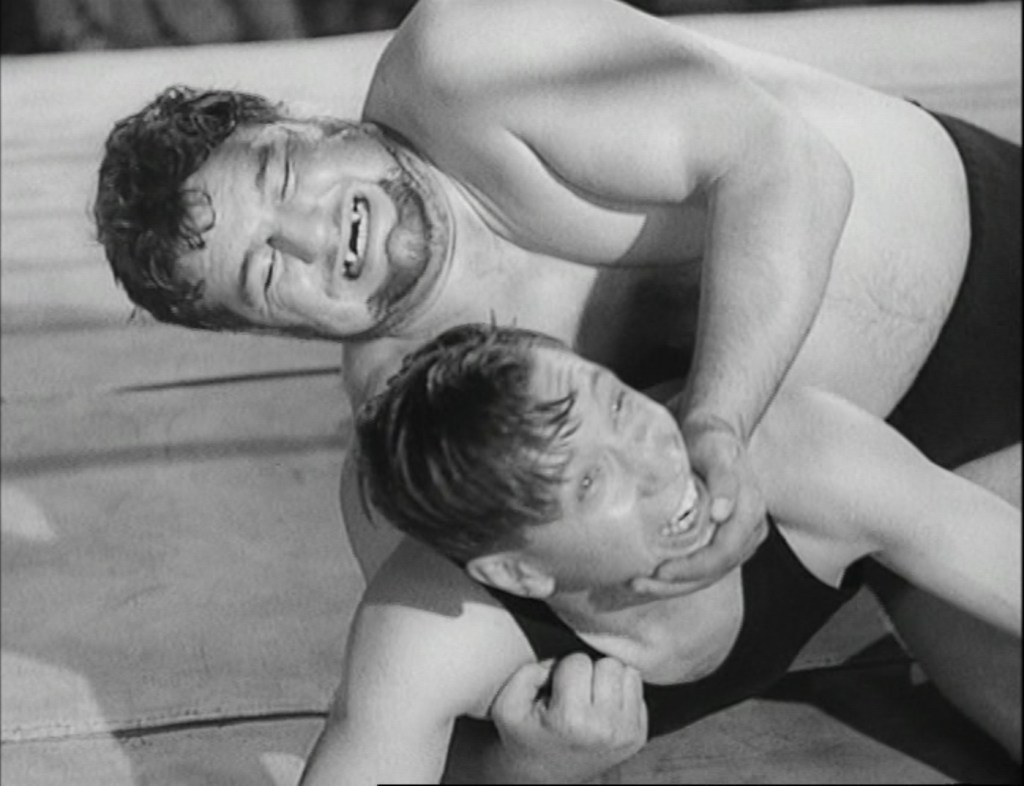
George subjected to a wrestling match in Trouble Brewing

In Trouble Brewing, the line between journalism and policing is blurred to the point that it almost disappears. When George says to his superiors as the paper that he wants to become a detective, the newspaper proprietor harrumphs that being a journalist is pretty much the same thing. Although in reality, printers and journalists had very distinct professional identities, George moves between the basement print room and the editorial offices with relative ease. Mary, who works as the secretary to the newspaper’s editor, appears to know George and Bill and treats them as her direct colleagues.

The police in Trouble Brewing have been ineffective in rounding up the counterfeiting gang, which has been at work for at least six months at the beginning of the film. Yet the two printers and the secretary manage to close the gang down in a matter of days. There are plenty of other British interwar films in which journalists collaborate closely with the police, but Trouble Brewing takes this a step further by focusing on main characters who are not even actual journalists. At the same time it is tacitly assumed that George wants to get promoted and work as a journalist, which he achieves at the end of the film when both the newspaper proprietor and the police inspector are duly impressed with his work in rounding up the criminal gang.

Trouble Brewing gives Formby plenty of opportunity to exploit the sexual innuendo he was known for, not only in his songs but also in the scene when he and Bill serve as waiters at a private house party. The party is thrown by an opera singer, whom George and Bill suspect may be part of the criminal gang. George has gotten the singer to put her fingerprint on a piece of paper, but she put that piece of paper in the top of her stocking. When the woman sits down to speak to a male guest at her party, George creeps under the table in an attempt to get the paper. The woman naturally assumes that her conversation partner is touching her leg under the table. This joke is repeated three separate times, causing the singer to shout at and slap at the various men she sits down with. For modern spectators, it is perhaps clearer that such a joke primarily works for male viewers; female audience members may find little to laugh at here. This indicates that Formby’s primary appeal was to men, whereas Gracie Fields aimed her jokes and songs at a broader audience.
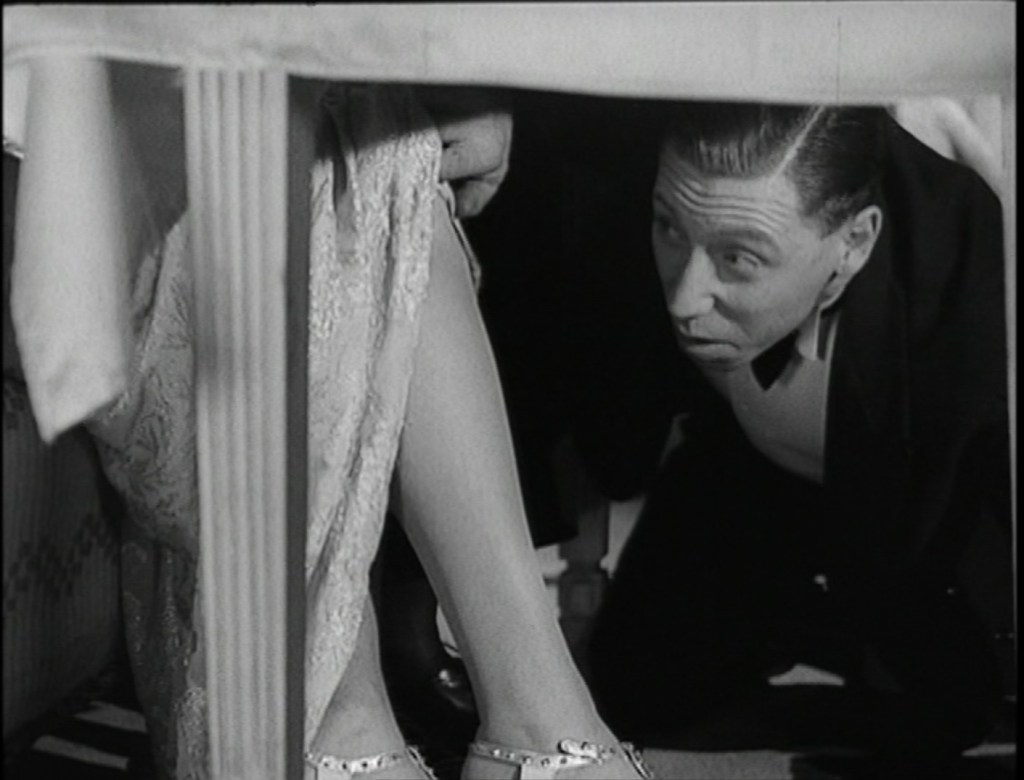
George under the table in Trouble Brewing

Trouble Brewing ends in the beer brewery where the gang is hiding. Here physical comedy takes over, with actors running up and down stairs, hiding in barrels, and hanging on ropes. The brewery contains several vast vats of beer, which are left uncovered. Bill lands in one and becomes inebriated almost immediately; the same eventually happens with the counterfeiting gang members. The apparently instantaneous effects of alcohol on the men underlines how far the events on screen are removed from reality at this stage of the film. It has developed into slapstick, harking back to earlier cinematic traditions.

Unlike another 1939 film set in a brewery, Cheer Boys Cheer, which makes direct reference to Nazi Germany, Trouble Brewing offered audiences complete escapism. Money laundering and the circulation of counterfeit money were popular tropes in interwar crime fiction, but they were far removed from the real-life horrors of war and fascism. The film expanded on the already-established cinematic narrative that journalists could effectively solve crimes, by presenting three workers as skilled detectives. The film’s happy ending no doubt provided audiences with welcome escapism as the international political situation deteriorated.  
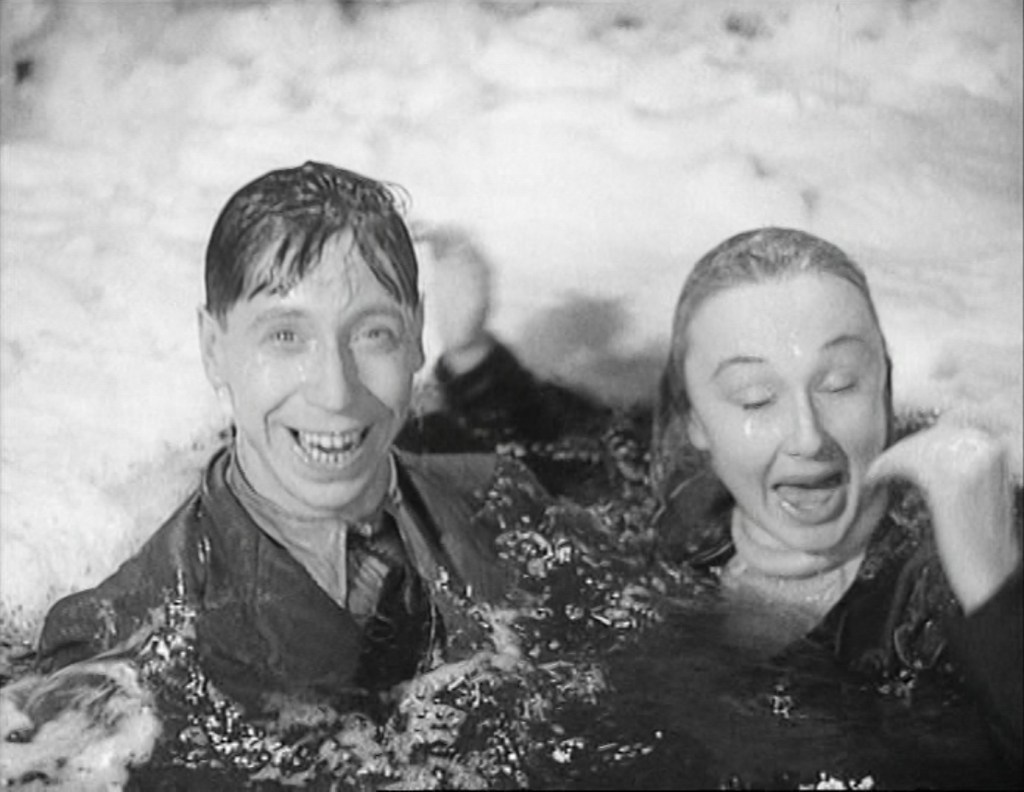
George (George Formby) and Mary (Googie Withers) end up in a beer barrel at the close of Trouble Brewing

Sonnie Hale

Sonnie Hale

Sonnie Hale was born John Robert Hale-Munro in London in 1902. His father, Robert, was also an actor. After an education at the Roman Catholic Beaumont College, Hale turned to a career in show business. During the interwar years, he was one of the most recognisable comedy stars in British film, often co-starring with Jessie Matthews, who would become his wife in 1931.

Like other interwar comedy stars, such as Gracie Fields, Hale’s career in the 1920s was based on the stage. His brand of comedy was mainly verbal – Hale was great at the quick repartee. The silent films made during this decade demanded a different, more physical type of comedy. During the 1920s, therefore, Hale appeared in revues which allowed him to perfect his singing and dancing skills. Once sound film became an established medium in Britain in the early 1930s, Hale combined his theatre work with film appearances.

Musical comedy was a popular film genre in 1930s Britain, and Hale packed his schedule with film roles in the first half of the decade. He starred in two films each in 1932 and 1933, a whopping four films in 1934, and three in 1935. He then appeared in one film each in 1936, 1938 and 1939. His acting output slowed down in the second half of the decade because he had at that point also turned his hand to writing and directing, directing three films across 1937 and 1938.

Hale’s first feature film role was a leading part opposite star Jack Hulbert. In the musical comedy Happy Ever After, Hulbert and Hale star as two window cleaners, both named Willie, who try and help a young starlet who is hoping to break into Hollywood. Hale’s time on the stage had evidently given him good connections with stars such as Hulbert and Hulbert’s wife Cicely Courtneidge, who also starred in the film.

From 1933, Hale started appearing in films with Jessie Matthews, by that point his real-life wife. From 1926 to 1930 Hale had been married to actress Evelyn Lay. Matthews had been married to her first husband for the same period. The relationship between Matthews and Hale started when he was still married to Lay, and caused much publicity and controversy at the time. Matthews was cited as co-respondent in Hale’s divorce case against Lay and Matthews’ letters to him were read out in court. The press, naturally, lapped it up, and the judge saw it fit to make comments about Matthews’ conduct.

Public sympathy was with Lay, but Hale and Matthews proved to be a successful professional as well as personal couple, and the public did not reject their collaborations. They appeared together in the ensemble piece Friday the Thirteenth (Hale as a comic bus conductor, Matthews as a chorus girl) and Hale played a supporting role in the Matthews’ star vehicles Evergreen, First a Girl and It’s Love Again, all directed by Victor Saville.

In none of these films, however, does Hale play the love interest to Matthews; he lacked the traditional good looks that 1930s British cinema demanded for the part of the romantic lead. Instead, Hale is the funny, supportive sidekick to either Matthews herself, or to the male lead. In It’s Love Again, for example, he plays Freddie Rathbone, who helps his friend and gossip journalist Peter Carlton come up with his gossip column every day. When Peter’s job is on the line, the pair come up with a fictional society figure, Mrs Smythe-Smythe, about whom Peter can make up the most outrageous stories and thus scoop his rivals at other papers. Hale plays Rathbone as a bit of a waster, who mainly enjoys going to society parties for the free food and wine. He is also, however, loyal to Peter and supportive of Peter’s attempt to impress the aspiring actress Elaine Bradford, played by Matthews.

After It’s Love Again, Hale took over from Saville as director. He directed Matthews in three films: Head over Heels, Gangway and Sailing Along. All three are less accomplished than Saville’s turns directing Matthews, and Hale gave up directing after 1938.

He did not, however, give up acting. His next role after It’s Love Again was a move away from musical comedy. Hale starred as petty criminal Sam Hackett in the Edgar Wallace crime thriller The Gaunt Stranger. Although Hale’s performance still has comic touches to it, the film’s overall tone is much darker than his previous work. It was only a brief foray into a different genre – by 1939 Hale was back to comedy, in the Walter Forde-directed Let’s Be Famous.

The Second World War caused a hiatus in Hale’s film career, although he was able to pick up his stage career which had languished for most of the 1930s. He briefly returned to film and TV films in the second half of the 1940s – by now divorced from Matthews and married to his third wife, Mary Kelsey. Towards the end of his life, he wrote the comedy play The French Mistress which was a success in the West End and made into a film in 1960. Hale died in London in 1959.

Looking on the Bright Side (1932)

Looking on the Bright Side (1932)

By 1932, Gracie Fields was already a huge star. Although she’d only appeared in one film, 1931’s Sally in Our Alley, she had been a major stage star and popular singer since the mid-1920s. After the big success of her first film, it was quickly followed up with a second one which showcases both Field’s singing talent and her comic wit.

In Looking on the Bright Side Fields plays Gracie, first in a series of film roles in which her character have her name, to provide the illusion that she is essentially playing herself. Gracie is a manicurist who lives in a flat in a modern housing estate in London. Her boyfriend, Laurie, is a hairdresser in the same beauty parlour, and lives in a flat opposite Gracie. He is also a budding songwriter who is looking for his big break.

Directors Basil Dean and Graham Cutts make the most of the stage set with its symmetrical staircases running up the front of the building. During the film’s opening, all inhabitants of the estate sing along to Laurie’s newest song in a scene reminiscent of stage musicals. Laurie’s song is the titular ‘Looking on the Bright Side’ which reflects the particular brand of working-class optimism on which much of Fields’ stage persona traded.

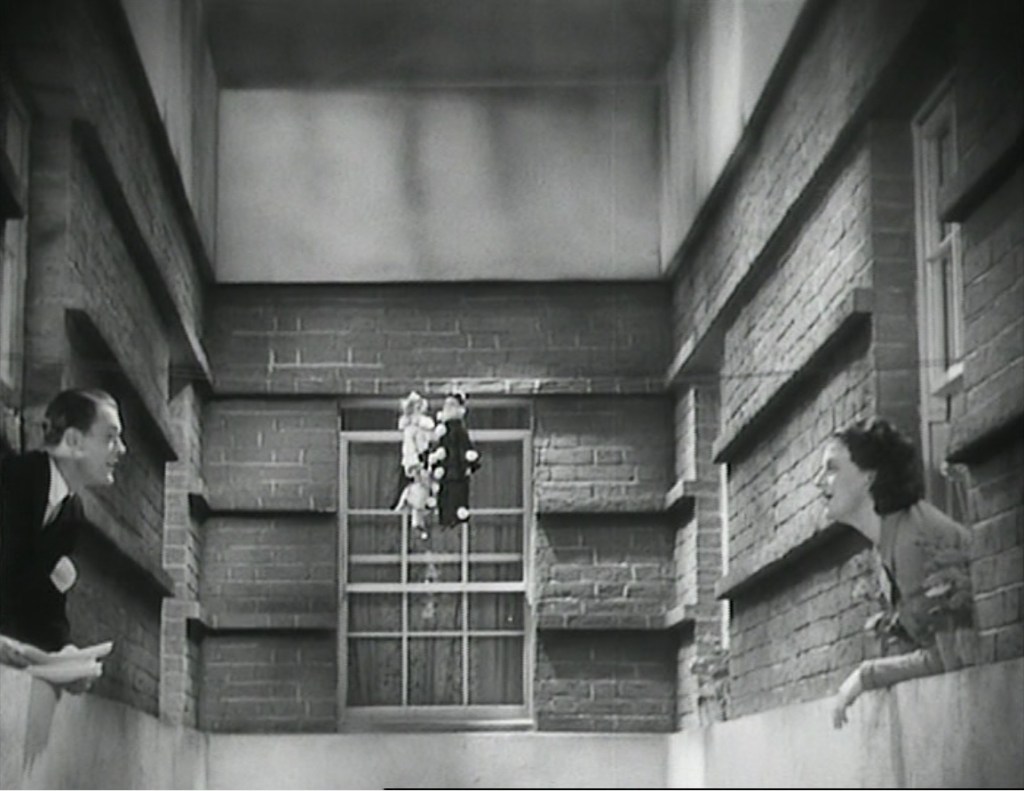
Gracie and Laurie in their adjacent flats in Looking on the Bright Side

In the beauty parlour, where Laurie and Gracie work as a team on actress Josie Joy. When the couple tell Josie about Laurie’s new song, she offers to introduce them to her manager, Oscar Schultz. Gracie is sceptical but Laurie enthusiastically jumps at the chance to further his career. When Laurie’s song is a success with Schultz, Laurie gives up his hairdressing job and is swept off his feet by the attentions of Josie Joy.

Laurie doing Miss Josie Joy’s hair in Looking on the Bright Side

Gracie is left behind on the estate. She loses her job when the arrogant Josie Joy comes in for a manicure and Gracie is unable to treat her civilly. After briefly taking a job as a female police officer – a section of the film mostly used to showcase Fields’ comic talent – Laurie sees the error of his ways and he and Gracie reunite for a big singalong at the estate.

Fields’ celebrity persona was inextricably linked with her own, working-class Lancashire roots. She retained her strong northern accent throughout her career, and her films celebrate working-class community over individual fame and riches. The class conflict in Looking on the Bright Side is introduced when Laurie is first invited to play his songs for Oscar Schultz. When Laurie and Gracie arrive at Schultz’ suite at the Dorchester Hotel, a busy cocktail party is in full swing. The women present call each other ‘darling’ and use expressions like ‘it’s a scream!’ – expressions which the down-to-earth Gracie would never use.

After Laurie and Gracie perform their song, Schultz singles out Gracie and tries to persuade her to agree to a role in his next musical production. Although Schultz’ intentions appear to be honourable, his way of cornering Gracie and persuading her to drink another cocktail put her off, and she declines his offer. Laurie, in the meantime, is sitting at the piano surrounded by women and does not want to leave the party with Gracie. Instead he stays out till 3.30am, much to Gracie’s dismay.

Laurie’s dreams to make it big in showbusiness are portrayed as naïve and, to a certain extent, wrong. This is partly because his talent as a songwriter is limited; without Gracie, he struggles to write good songs and eventually Schultz sacks him. Gracie, on the other hand, is genuinely talented but is not interested in pursuing fame. Instead, she prioritises the community of the estate over individual ambition.

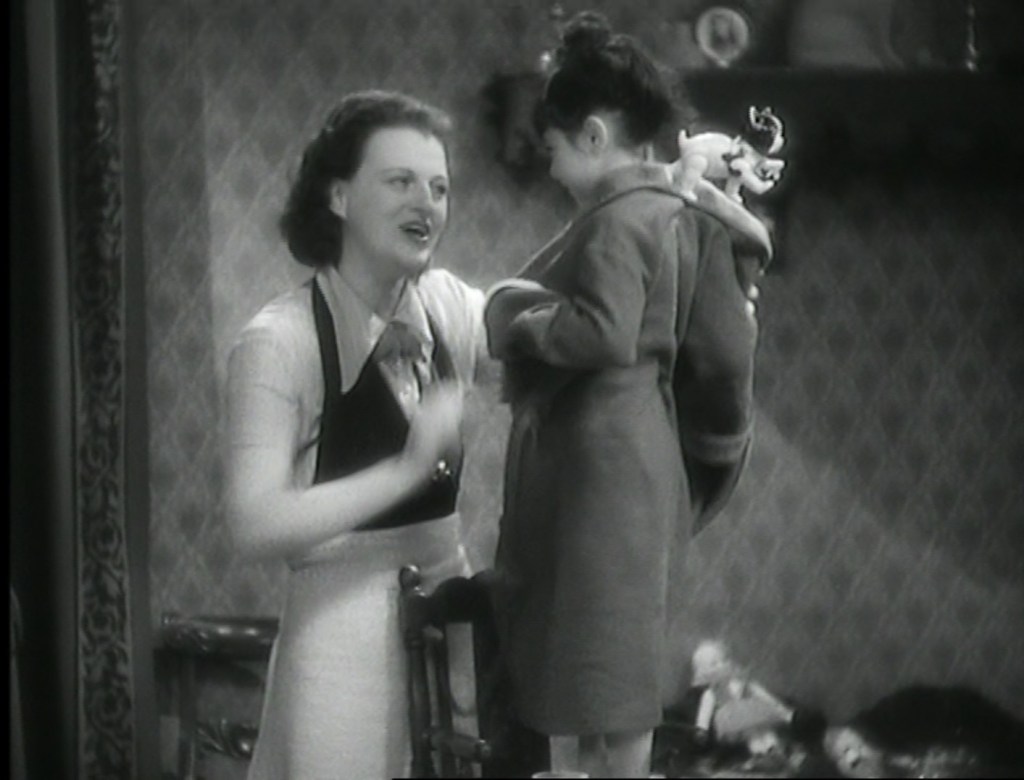
The sense of community is not only shown in the estate-wide singalongs that bookend the film, but also in Gracie’s relationship with her neighbour Hetty and Hetty’s young daughter Bettina. No explanation is given for Bettina’s absent father. Hetty works as a police officer and Gracie frequently looks after Bettina when Hetty is on duty. The very warm and natural relationship between Fields and the child actor provides a strong counterpoint to the vacuous lovemaking between Laurie and Miss Joy.

Fields acting with Bettina Montahners in Looking on the Bright Side

The section in which Gracie signs up with the Metropolitan Police has little relevance to the plot. Female police officers were still relatively rare in 1932, and they were certainly not regularly portrayed on screen. Predicably, the rigid enforcement of rules within the corps is used to set up some physical slapstick comedy situations for Fields. Although Fields quickly decides to leave the Police force, it is not the notion of female police officers which is rejected, but rather the idea that Fields herself would be suitable in such a controlled environment.

Looking on the Bright Side takes a reasonably meta approach to the business of song writing and song-selling, as the film itself was clearly a vehicle for selling records and sheet music of the songs it includes. At the same time, it obfuscates its own part in commercial song writing by presenting other careers and industries as more valuable and viable.

Gracie Fields in Picture Post (1938)

Gracie Fields in Picture Post (1938)

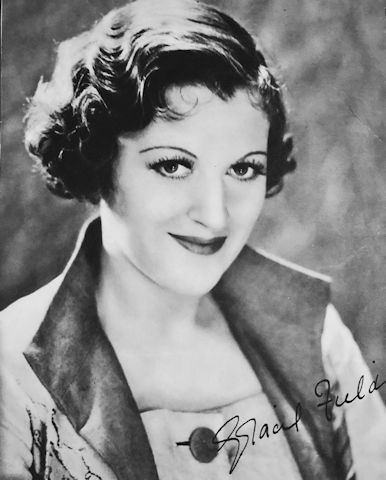
Gracie Fields was one of Britain’s biggest stars during the interwar period, and she is certainly one of the stars that is best remembered today. With her signature Lancashire accent; dry, witty comedy; and hearty songs, she came to represent a version of Britishness grounded in no-nonsense hard work and companionship. Whilst the music hall stage was her natural home, in the 1930s Fields expanded her reach through appearing in a string of musical comedy films. In these, she generally played a working-class woman with aspirations to perform as a singer. Her characters, often called Grace/Gracie or Sally, met any obstacles with good cheer and eventually achieved their ambitions.

In 1938, Fields was invited to perform for Queen Mary (the late King’s wife and grandmother of Queen Elizabeth II) in the Royal Albert Hall. To mark the occasion, Picture Post featured an extensive spread titled ‘A Day With Gracie’.[1] The text and pictures of this article give an insight in how Fields’ celebrity persona was constructed at this stage of her career, when she had become an established star.

Rochdale News | News Headlines | Appeal for Gracie Fields memories for new  biography - Rochdale Online

The article starts with an imaginative recounting of how a six-year old Gracie used to sing on the streets of Rochdale, whilst dreaming of future riches: ‘She thought of the day when she would be a famous actress, with enough money to buy clothes, mansions, motor-cars, and holidays abroad.’[2] The article positions Fields’ working-class and Northern background as a pivotal part of her development as a singer. However, it also states that a desire for material wealth underpinned her ambition.

The article goes on to describe Fields’ first attempts as a singer: supporting an existing music hall act; singing at local competitions and charity events; joining a troupe of ‘Juveniles’ on tour. Throughout these descriptions, the article constantly refers back to Fields’ father’s scepticism of her ambitions, and the need for Fields to bring income into the family. After the failed Juveniles tour, Fields’ mother ‘got Gracie a job as an errand girl to a confectioner.’[3] The article goes into the formative part of Fields’ career in such detail, because it allows the journalist to present Fields as completely determined in her ambition to succeed. Like Fields’ personas in her various films, she was not deterred by setbacks, but instead kept trying to find a way to realise her ambitions.

Initially, this path to success took the form of incredibly hard work: Fields was working shifts in a local mill, going to school, and also attending dance classes in Manchester several times a week.[4] She studied music hall acts and eventually was given another opportunity to perform at a local music hall. Rather ironically, it was not until Archie Pitt, a performer sixteen years her senior, ‘spotted’ her and decided to build his next show around her, that Fields’ career really took off. She married Pitt in 1923, when she was 25 and he 41; the couple divorced in 1939 and the marriage was already very rocky by the time the Picture Post article was published – Pitt does not appear in any of the images accompanying the piece.

Although the article refers to Fields as ‘probably the highest-paid woman in the world’[5] and the ‘Most-interviewed woman in the world’[6] (both unsubstantiated claims), the article is at great pains to stress that Fields is no diva. She finds buying clothes ‘a bore’, likes walking around in old clothes, and is ‘vague’ – a characteristic apparently demonstrated by her tendency to leave half-written letters lying about the house. Although the article originally set up the premise that the young Gracie dreamt of riches, it then takes pains to underline how little the adult Grace is interested in a wealthy lifestyle.

Even more strikingly, the article refers very minimally to Fields’ actual work, despite her enormous success in that area. Instead it focuses a great deal on her work with children. No fewer than 8 out of the 17 photographs that accompany the piece, feature her nephew Michael, who looks about three years old. The captions state that ‘There are almost always children in the house’[7] and ‘Hundreds of children have spent happy afternoons’[8] in Grace’s garden. She also set up a charitable children’s home near Brighton.

What is glaringly absent through the many references to her apparent fondness of children, is any acknowledgement that Fields herself was childless. At the time the article was written she was 40, which is explicitly referred to in the text; the conclusion is quickly drawn that Fields’ childlessness at that age was not wanted. The reality is that Fields’ battled cervical cancer which greatly diminished her ability to get pregnant. Whilst it is understandable that Fields was not keen that her medical history would be known to the public, one wonders how she felt about being presented as such an explicitly maternal figure in this article.

Overall, the Picture Post article is ambiguous in the way it presents Fields. She is both British through and through and someone with international allure and star power. The article devotes considerable attention to her ‘talent, hard work, and personality’[9] and ability to overcome setbacks. At the same time, it frames Archie Pitt as the catalyst of her success. It presents Fields as a rich woman who loves re-modelling her vast house, but also someone who ‘is not interested in money’.[10] It provides an interesting study of how the interwar press attempted to present a successful female star as she moved into middle age.

See Gracie Fields in action in this clip recorded in 1938

[1] ‘A Day With Gracie’, Picture Post, 29 October 1938, pp. 10-16 and 70

[2] Ibid., p. 12

[3] Ibid., p. 14

[4] Ibid., pp. 15-16

[5] Ibid., p. 12

[6] Ibid., p. 15

[7] Ibid., p. 12

[8] Ibid., p. 14

[9] Ibid., p. 70

[10] Ibid.

Jack Hulbert

Jack Hulbert

A wildly popular musical comedy star of stage and screen in the 1930s, Jack Hulbert has since been dismissed by some critics as a ‘light entertainer’[1] who ‘can seem tirelessly jaunty company.’[2] During the peak of his film career, Hulbert ranked high in popularity charts. In 1933 he was voted the top British male star in audience questionnaires and 1936 he was the third most popular British star based on domestic box office returns.[3] He starred in fourteen films across the decade.

Jack Hulbert was born in Cambridgeshire in 1892 to a doctor. He studied at Cambridge where he joined the Cambridge Footlights. His brother Claude Hulbert, who was eight years his junior, followed the same trajectory. Both brothers became two of the first Footlights alumni to reach acting success and fame. After Cambridge, Jack Hulbert got a role in a theatre production, playing opposite Cicely Courtneidge. The couple married in 1916 and stayed together for the rest of their lives, often working together on stage and screen.

After completing his war service, Hulbert returned to his career in variety theatre and produced and acted in numerous stage productions across the West End. During the 1920s, British films were still silent and therefore did not provide a suitable medium for comedy stage stars like Hulbert and Courtneidge, who depended on witty dialogue and song-and-dance numbers to win over their audiences. Further, until the adoption of the 1927 Cinematograph Films Act, very limited numbers of British films were being produced at all.

By the start of the 1930s the couple found themselves in debt due to financial mismanagement. As the British film industry was at the same time transitioning to sound, the time had come for Hulbert and Courtneidge to make the leap to the silver screen. Their first appearance was as themselves in Elstree Calling! (1930). As implied by the title, this film was a series of separate sketches performed by popular entertainers supposedly broadcasting from Elstree studios north of London.

After Elstree Calling! Hulbert moved into narrative fiction films, and increasingly worked separately from Courtneidge. In common with other popular comedy stars of the period, such as George Formby and Gracie Fields, Hulbert usually played characters called Jack. The titles of some of his films, such as Jack’s the Boy (1932), Jack Ahoy (1934), Bulldog Jack (1935) and Jack of All Trades (1936) worked to eliminate the difference between the actor and his characters even further.

Hulbert’s persona was a confident and likeable middle-class charmer who was able to be both comic and romantic.[4] . His films ‘appear to exist primarily for the display of [his] talents as singer, dancer and comedian.’[5] In Jack of All Trades, he plays a likeable chancer who is looking for a job. After striking up an acquaintance with Lionel, a bank clerk (played by Robertson Hare) Jack starts showing up at Lionel’s office and pretend that he works there. His pretence is so successful that he ends up convincing the bank bosses to build an entire new shoe factory. The scenes where Jack and Lionel present their proposal to the Board, all of whom approve the plans because they are too embarrassed to admit that they have no idea what they are being shown, still have the power to resonate with modern audiences. The final third of Jack of All Trades, however, descends into fast-paced slapstick action typical of Hulbert films with a lot of physical comedy.

Hulbert singing ‘Where There’s You, There’s Me’ in Jack of All Trades

A similar tension between narrative and apparently stand-alone action can be found in Bulldog Jack, a film satirising the extremely popular Bulldog Drummond book and film series. Bulldog Drummond was a fictional, highly successful police inspector. At the start of Bulldog Jack, Jack Hulbert’s character accidentally crashes his car into Bulldog Drummond’s, injuring the latter and making him bed-bound. When the young daughter of a jeweller asks for help because her father has fallen victim to a gang of thieves and blackmailers, Drummond asks Jack to pretend to be the famous ‘Bulldog’ and take on the case.

Again, the first section of the film gives plenty of space for comedy and romance, before the action-packed climax set in the London Underground. The criminal gang have set up their headquarters in a disused Underground station, and the gang leader hijacks an Underground train in an attempt to get away. Jack ends up crawling over the top of the train carriages, like a true action hero, to stop the train. Prior to this final chase, Bulldog Jack uses sped-up shots of Jack and his friends chasing the criminals up and down the spiral staircases of the Underground station.

By the mid-1930s the use of sped-up film was quite unusual; it was a device much more often used in the ‘cinema of attractions’ that pre-dated World War One. Jack Hulbert’s films did not fully conform to the conventions of narrative filmmaking. Instead, they applied techniques from earlier film genres and from the variety stage onto the long-form fiction film medium. Although this allowed Hulbert to perform in a similar mode across his stage and film productions, as a result his 1930s film work can jar to modern audiences and make it more challenging to understand Hulbert’s enormous popularity at the time.

Elstree Calling! can be viewed on YouTube.


[1] James Chapman, ‘Celluloid Shockers’, in The Unknown 1930s: An alternative history of the British cinema, 1929-1939, ed. Jeffrey Richards (London: IB Tauris, 1998), p. 91

[2] Brian McFarlane, ‘Jack of All Trades: Robert Stevenson’, in The Unknown 1930s, p. 164

[3] Jeffrey Richards, The Age of the Dream Palace: Cinema and Society in 1930s Britain (London: IB Tauris, 2010) pp. 160-161

[4] McFarlane, ‘Jack of All Trades’, p. 163

[5] Ibid.

Jessie Matthews

Jessie Matthews

Jessie Matthews was one of the biggest British screen stars of the 1930s. She achieved success not only in Britain, but also in the US, even though she never made a Hollywood film.[1] Matthews starred in a whopping fourteen films between 1931 and 1938; yet most contemporary articles foreground her private life over her film career. The BFI article linked to above references her ‘generally loveless marriages’; many sources refer to the details surrounding her second marriage to co-star and director Sonnie Hale.

Such interest in Matthew’s romantic life, with its undertones of tragedy and disapproval, undermine her considerable professional success. Matthews was not only an actress, but also a singer and dancer; her films showcase her considerable talent and the hard work she put in to master her craft.

Matthews was a commercial success almost from the start of her film career, but her establishment as a real star originated from the beginning of her collaboration with director Victor Saville. Saville and Matthews first worked together on The Good Companions; followed by Friday the Thirteenth (both 1933); Evergreen (1934); First a Girl (1935); and It’s Love Again (1936).

The Good Companions was based on a J. B. Priestley novel[2]; the text, as Lawrence Napper has argued, seeks to “express ‘modernity’ (…) without a retreat either away from the popular audience or into cultural pessimism.”[3] In other words, it seeks to create a balance between literary intellectualism and popular entertainment. By casting Matthews in a prominent role in the film, Saville picked an actor who herself embodied this duality. Matthews was born in a large, working-class family in Soho but much-commented-on elocution lessons allowed her to shape an upper-middle-class star persona.[4]

After The Good Companions, in which Matthews plays an ambitious actress from a humble background, Saville continued to cast Matthews in similar roles. The seemingly upper-class actress repeatedly played aspiring stage stars from common backgrounds:

  • In Friday the Thirteenth, as related in the post about that film, she’s an aspiring stage star caught in a bus crash.
  • In Evergreen Matthews is the daughter of a famous turn-of-the-century music hall star, who decides to impersonate her mother to achieve fame and success.
  • In First a Girl – an adaptation of the German film Viktor und Viktoria (1933) – she is an aspiring stage star who pretends to be a female impersonator to achieve fame and success.
  • In It’s Love Again she’s an aspiring stage star who pretends to be a socialite to achieve fame and success.

It was not unusual for 1930s actors on either side of the Atlantic to have such a defined star persona and to appear in a number of films along the same formula. In fact, in this respect Matthews had much in common with the other big British female star of the time, Gracie Fields. Although one of Fields’ key characteristics was her strong Northern accent, which was diametrically opposed to Matthew’s ‘plummy’ pronunciation, Fields also starred in a number of films in which she is a performer from a humble background who ends up achieving great success. As a female film viewer the message you received remained the same, regardless of whether you identified more with Matthews or Fields: being a stage performer was a desirable and exciting career through which you could find romantic love.

However, whereas Fields’ films were grounded in a very British, very working-class environment, with a strong emphasis on community, collaboration and staying positive in the face of adversity; Matthews’ films on the other hand presented the viewer with a glamourous and consumerist fantasy.[5] The sets are bright and light, with smooth floors that are perfect for impromptu dance performances. In Evergreen, Matthews’ character and her would-be love interest stay in a modern mansion in which she can showcase the latest luxury homeware whilst waltzing across the rooms.

To the modern viewer, the Matthews/Saville musicals feel akin to Hollywood films of the same period. Although the films are (mostly) set in Britain, they express a cosmopolitan outlook. They contain handsome, worldly men; art deco architecture; cocktails; and trips to the French Riviera. Contemporary audiences were already familiar with this fantasy world through the American films also available at the British box office. Matthews’ films brought that glamour to a British setting, suggesting that the same level of sophistication and modernity was also within reach on this side of the Atlantic. Although intellectual circles in interwar Britain retained a stubborn anti-Americanism, the popular success of Matthews as a film star indicates that the mass audience had no such qualms.

Today, however, Gracie Fields has remained relatively prominent in the public imagination, whereas Matthews is largely forgotten. Fields body of work evokes supposedly fundamental British qualities which appear to reflect the ‘good old days’ of community, common sense and national pride. Matthew’s oeuvre, on the other hand, shows only how much 1930s British culture was also about international cultural exchange and a dissolution of national identity. In the current times, which seem to be a near-constant quest of what it means to be ‘British’, it is Field who provides the more appealing answer to most; but the films of Jessie Matthews show that even a hundred years ago, being British was as much about having an international outlook as it was about celebrating local culture.

Jessie Matthew’s films are available on DVD from Network On Air.


[1] Jeffrey Richards, The Age of the Dream Palace: Cinema and Society in 1930s Britain (London: IB Tauris, 2010), p. 207

[2] For more on J.B. Priestley see the post on Laburnum Grove (1933)

[3] Lawrence Napper, British Cinema and Middlebrow Culture in the Interwar Years (Exeter: University of Exeter Press, 2009), p. 83

[4] Richards, The Age of the Dream Palace, pp. 208-209

[5] Sarah Street, ‘‘Got to Dance my Way to Heaven’: Jessie Matthews, art deco and the British musical of the 1930s’, in Studies in European Cinema vol 2. no. 1 (2005), 19-30