Dorothy L. Sayers

Dorothy L. Sayers

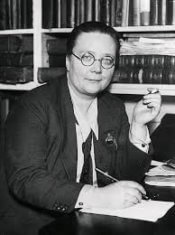
Agatha Christie is undoubtedly the most famous author of the ‘Golden Age of Crime Fiction’ (or indeed the most famous crime author of all time). She did not stand alone, however, but rather was part of a closely connected network of crime writers who worked in Britain and the rest of the Empire between the two wars. Some of the more illustrious authors organised themselves in the Detection Club, a group which was founded in the 1930s and still exists today. One of the founding members of the Detection Club was Dorothy L. Sayers, another female crime fiction writer who obtained widespread recognition during the 1920s and 1930s.

Sayers was born in 1893 in Oxford to a well-to-do couple; her father was a reverend and chaplain to Christ Church Cathedral in the city. Sayers herself studied at Somerville, the all-female College of the University of Oxford. She was there from 1912 to 1915, leaving before the arrival of Vera Brittain and, later, Winifred Holtby.[1] At Sommerville Sayers would also meet Muriel Jaeger, who eventually established her own literary career. Sayers would later draw heavily on her experiences at Somerville for the crime novel Gaudy Night, which appeared in 1935.[2]

After completing her degree, Sayers moved to London and briefly took up a teaching post: teaching was one of the career paths young women were strongly encouraged to enter into, with its associations of helping, caring and other supposedly typical feminine traits.[3] After the teaching stint, she briefly returned to Oxford and then travelled to France, only to eventually return again to London and take up a job as a copywriter.[4] She never lost sight of her literary ambitions and some time in 1920 she started to come up with the amateur detective who would become her most famous character: Lord Peter Wimsey.

Eventually, Sayers published eleven Wimsey novels as well as a series of short stories in which he featured. It can be argued that in Wimsey, Sayers created an ideal man, and part of the fun of the Wimsey stories lies in the interplay between their plots and Sayers’ private life. Wimsey is an aristocrat, the second son of the Dowager Duchess of Denver. He has a private income, a very steady butler named Bunter, an MA from Oxford and an interest in collecting rare books. He also appears to work for the British government on occasion, as he is sent across Europe to undertake diplomatic missions to try and avoid war. He is close friends with detective Charles Parker of the Metropolitan Police, who later in the series marries Wimsey’s sister. Wimsey’s intellect, financial independence, links with the police and elevated status in society make him the ideal amateur sleuth, as he has the means and ability to enter almost any situation.

In Strong Poison, the fifth Wimsey novel, Sayers started to really draw on her own life for the book’s plot. Although all the Wimsey novels contain intricately plotted crime puzzles which adhere to the rules of ‘fair play’, its in the interpersonal relationships of the characters where the clues are to Sayers’ private life. In the early 1920s, Sayers had a relationship with fellow writer John Cournos, which came to an end when Cournos wanted to sleep together outside of the marriage, which Sayers did not want.[5] In Strong Poison, Sayers introduces Harriet Vane, a clear alter-ego for herself. Vane is a crime fiction author who is on trial for the murder of her partner; in this fictional relationship the question of sex outside of marriage was also paramount. The victim in Strong Poison is clearly meant to be a stand-in for Cournos, and Sayers no doubt got great satisfaction from giving the character an extremely painful death from arsenic poisoning.

Wimsey falls in love with Harriet Vane in Strong Poison, and throughout the remainder of the Wimsey series their relationship takes on increased importance until, in the aforementioned Gaudy Night, Harriet feels that Peter is ready to enter into marriage on equal terms. In Sayers’ real life, no such happy ending was forthcoming. Shortly after the end of her relationship with Cournos, she met Bill White, a man who later turned out to be already married. By the time Sayers found that out, however, she had already agreed to a sexual relationship with him and she found herself pregnant in 1923. Sayers never even told her parents about her pregnancy, so convinced was she that they would not be able to accept it. Amazingly, though, Bill White’s wife came to her aid. Sayers gave birth to her son, John Anthony, in complete secret during a brief leave of absence from her copywriting job. Bill White’s wife, Beatrice, made arrangements for the birth. John Anthony grew up in a foster home run by Sayers’ cousin; during her lifetime Sayers only revealed his existence to five people and never told her parents they had a grandchild.[6]  

Aside from the Wimsey novels and stories, Sayers was a prolific reviewer of crime fiction and also contributed to several volumes written by a group of Detection Club members. The last full Wimsey novel, Busman’s Honeymoon, appeared in 1937. After this, Sayers mostly turned her attention to religious work, such as a translation of Dante’s Divine Comedy. [7] She remained a key member of the Detection Club until her death in 1957.[8] Her books remain in print and have been adapted for the screen several times.


[1] Francesca Wade, Square Haunting (London: Faber & Faber, 2020), pp. 96-101

[2] Mo Moulton, The Mutual Admiration Society: ow Dorothy L. Sayers and Her Oxford Circle Remade the World for Women (New York: Basic Books, 2019)

[3] Wade, Square Haunting, p. 107

[4] Martin Edwards, The Golden Age of Murder, (London: Collins Crime Club, 2016), p. 18

[5] Ibid., pp. 19-20

[6] Wade, Square Haunting, pp. 128-132

[7] Edwards, The Golden Age of Murder, p. 404

[8] Ibid., p. 410

Leonard Gribble – The Arsenal Stadium Mystery (1939)

Ahead of the 2022 World Cup starting in Qatar, there will be a couple of weeks of football-related content on the blog. Football was a popular sport for working-class spectators in interwar Britain, alongside (greyhound) racing and motor sports. Some historians even credit the popularity of football with bringing diverse social and ethnic groups togethers as neighbours went to support their local teams.[1] By the end of the interwar period, football clubs at the top end of the league were almost completely populated by professional footballers; but there were also still plenty of amateur clubs which delivered players of a high calibre. League matches were usually played on a Saturday afternoon, as most workers finished their weekly shifts at lunchtime on Saturday.

At the close of the 1930s, the Daily Express decided to capitalise on the increased popularity of professional football by commissioning author Leonard Gribble to write a serialised murder mystery which featured the real-life players and staff of Arsenal Football Club.[2] After serialisation, The Arsenal Stadium Mystery was published as a book and a film version was made almost immediately; both appearing shortly before the outbreak of the Second World War.

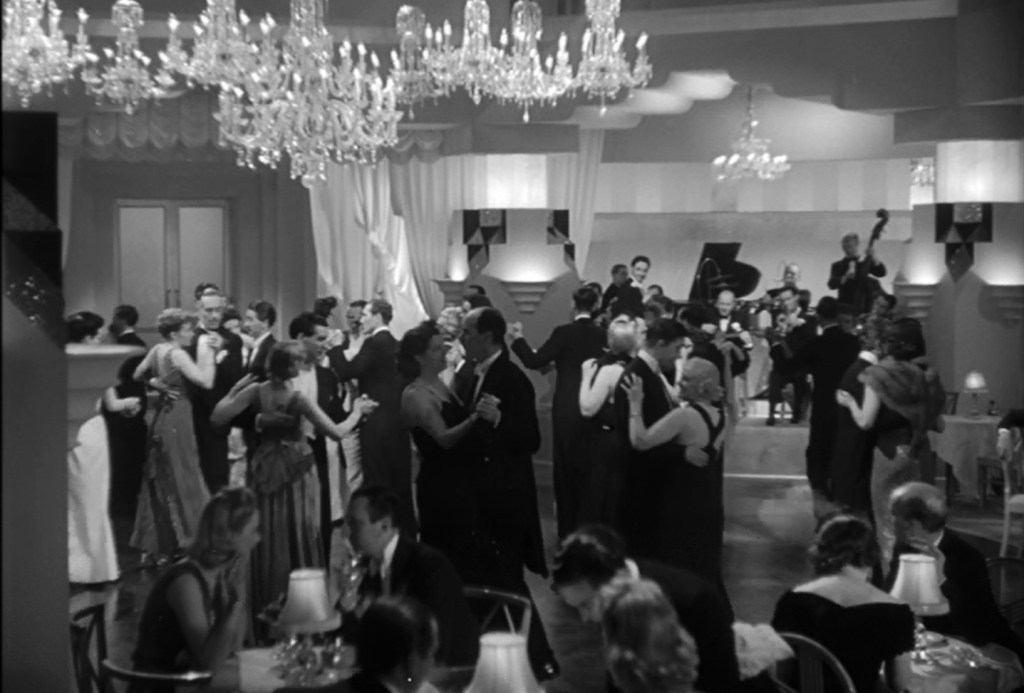
The plot of The Arsenal Stadium Mystery is fairly straightforward: Arsenal play an amateur team, the Trojans. During the match, one of the Trojan players, Doyce, collapses on the field and dies shortly afterwards. Scotland Yard are called in and conclude Doyce was poisoned; Inspector Slade methodically works through the possible suspects until the case is resolved. Although a number of Arsenal players appear as characters in the book (and the Arsenal manager, George Allinson, even got a speaking part in the film adaptation) they are naturally not implicated in the murder or its resolution.

The police investigation concentrates solely on the Trojan players and staff. The conceit of the football game provides the type of ‘closed circle’ which interwar detective fictions liked to use: a very limited number of suspects, a tightly controlled window in which the murder must have taken place; and limited ways in which the weapon could be disposed of.

Aside from the murder story, The Arsenal Stadium Mystery provides the modern reader with plenty of insight into 1930s professional football practices. Gribble was clearly given access to the Arsenal club players and grounds in the writing of the book – the parts of the stadium to which the public do not usually have access are described in detail. The rapid professionalisation of football is reflected in the vigorous training practices of the players: ‘The game to-day is faster than it has ever been (…) Only the fit can survive.’[3] Arsenal also apparently already had a youth academy set up, dubbed a ‘nursery’, to train up promising young players.[4]

When it comes to the game itself, Gribble provides a diagram reflecting the starting positions of both teams. Both Arsenal and Trojans are shown to play with five forwards, three midfielders and two defenders[5]; a formation that was much more common in the early days of professional football than it is today. The author also provides an almost play-by-play account of the match, in sections of the story clearly written with football-mad Daily Express readers in mind.

As well as details about the actual gameplay, Gribble pays substantial attention to convey the culture of football fandom. For example, he spends several pages describing the convivial atmosphere in the streets and train stations around the stadium after the match is over:

‘In the trains the corridors and entrance platforms are choked (…) The air is full of expunged breath, smoke, human smells, and heat. But there is plenty of laughter, plenty of Cockney chaff. Whatever happens, however great the discomfort, the crowd keeps its good-temper. This herded homegoing is just part of the afternoon’s entertainment.’[6]

Needless to say, this ‘entertainment’ is described as an innately masculine past-time. It would not be possible for women to enter this crush of human bodies. When Inspector Slade of Scotland Yard enters the story, he too enters in a social pact with the football players which excludes women. During his investigation, he questions one of the Trojan players, Morring, in front of a woman friend, Jill. Morring implies in guarded language that his fiancée, Pat Laruce, had had an affair with the victim, Doyce. Slade:

‘‘I take it you told him to be careful or next time he’d have more painful reason to regret his – um – interference?’ The two men grinned, while the girl looked from one to the other, wide-eyed, unable to appreciate a humour that was essentially masculine.’[7]

Phrases like this make it clear enough that Gribble was writing for a male audience; he also made the main female character, Pat Laruce, extremely unlikeable. Not only is Pat revealed as having cheated on her fiancé Morring, Gribble also portrays her as an extremely calculating woman who uses fake emotional outbursts to control men’s behaviour. He describes her as follows: ‘The daughter of a chorus girl who had married a publican after burning her fingers with a scion of the aristocracy, she [Pat] had imbibed her mother’s outlook on life.’[8]

Pat works as a model for advertisements; a job that entails her offering up her physical appearance for (male) consumption. Pat’s independence and modernity are unequivocally rejected by Gribble, and presented as intergenerational faults that are passed on from mother to daughter. There are several points in the book at which Pat is described as confused that her emotional manipulations are not working on men as she expects them to. Her friend Jill, by contrast, is presented as pure and innocent (as in the quote above which implies her complete ignorance about sex), and therefore a much more suitable life partner.

The Arsenal Stadium Mystery reveals much about the practicalities of professional football in 1930s Britain, as well as delivering a reasonably competent murder mystery story. It also carries its sexist gender views on its sleeve, by using the medium of football to promote a misogynist worldview in which professional sport is equated with male sociability.

The film version of The Arsenal Stadium Mystery (starring the real 1939 Arsenal squad) can be viewed for free on YouTube.


[1] Benjamin Lammers, ‘The Birth of the East Ender: Neighborhood and Local Identity in Interwar East London’, Journal of Social History, Vol. 39, No. 2, (2005), pp. 331-344 (pp. 338-9)

[2] Martin Edwards, ‘Introduction’, in Leonard Gribble, The Arsenal Stadium Mystery, (London: British Library, 2018), p. 7

[3] Gribble, The Arsenal Stadium Mystery, p. 123

[4] Ibid., p. 119

[5] Ibid., p. 19

[6] Ibid., p. 38

[7] Ibid., p. 171

[8] Ibid., p. 106

Trouble Brewing (1939)

<strong><em>Trouble Brewing</em> (1939)</strong>

Lancashire singer and comedian George Formby was an extremely popular entertainer during the interwar period. He had an instantly recognisable brand: catch-phrases such as ‘Turned out nice again!’; songs full of gentle innuendo and always accompanying himself with his banjolele (a cross between a ukulele and a banjo).

Supported by his wife Beryl as his manager, Formby made a series of comedy films in the second half of the 1930s, at the rate of two a year. These were often directed by Anthony Kimmins, a writer and director who also worked with that other Lancashire star, Gracie Fields. Kimmins and Formby’s sixth collaboration was Trouble Brewing, which was released in July 1939 and could serve as an antidote to the ever-increasing concerns about impending war in Europe.

In Trouble Brewing, Formby plays George Gullip, a newspaper printer at a fictional daily tabloid. George wants to be a detective, and has developed a type of ink which is impossible to rub off, to help him take fingerprints. The police are on the track of a gang which is distributing counterfeit money. When George and his friend Bill are duped by the gang, they team up with secretary Mary to unmask the gang once and for all.

George (George Formby), left, and Bill (Gus McNaughton), right, at work in the print room in Trouble Brewing

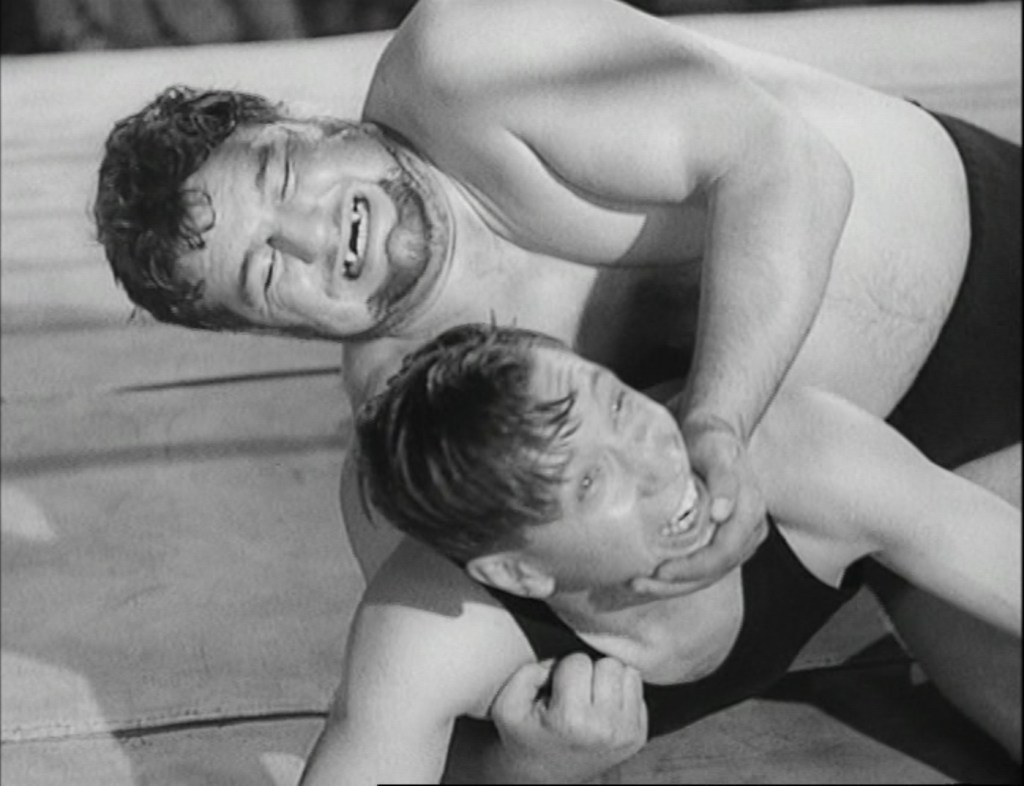
The film takes its title from the beer brewery which the counterfeiting gang uses as a front for their operations. As is common for these 1930s comedies that are primarily showcases for individual stars, Trouble Brewing consists of a series of set pieces which are only loosely strung together by a plot. George and Bill get duped on the racetrack; their subsequent investigations have them dress up as waiters at a private party; join a wrestling match; break into the police inspector’s home (and accidentally kidnap him); and confront the criminal gang in their brewery. At each stage, the script allows Formby plenty of physical comedy. His scenes with Mary and other female characters are opportunities for George to serenade them with his songs, even if they are more cheeky than romantic.

George subjected to a wrestling match in Trouble Brewing

In Trouble Brewing, the line between journalism and policing is blurred to the point that it almost disappears. When George says to his superiors as the paper that he wants to become a detective, the newspaper proprietor harrumphs that being a journalist is pretty much the same thing. Although in reality, printers and journalists had very distinct professional identities, George moves between the basement print room and the editorial offices with relative ease. Mary, who works as the secretary to the newspaper’s editor, appears to know George and Bill and treats them as her direct colleagues.

The police in Trouble Brewing have been ineffective in rounding up the counterfeiting gang, which has been at work for at least six months at the beginning of the film. Yet the two printers and the secretary manage to close the gang down in a matter of days. There are plenty of other British interwar films in which journalists collaborate closely with the police, but Trouble Brewing takes this a step further by focusing on main characters who are not even actual journalists. At the same time it is tacitly assumed that George wants to get promoted and work as a journalist, which he achieves at the end of the film when both the newspaper proprietor and the police inspector are duly impressed with his work in rounding up the criminal gang.

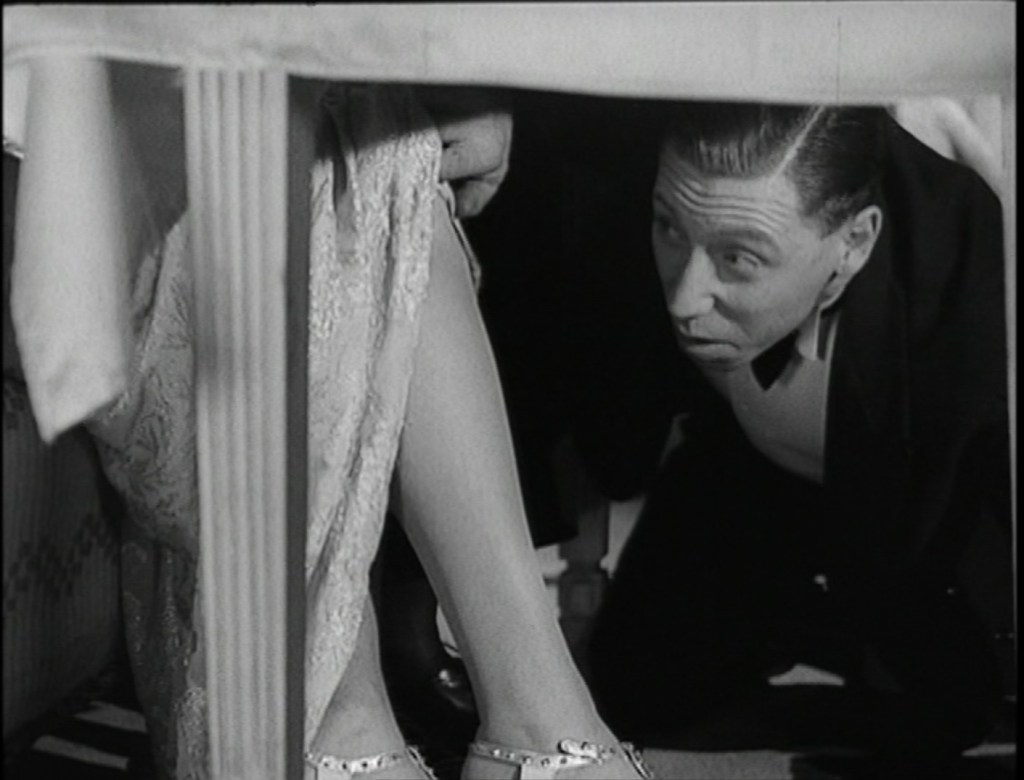
Trouble Brewing gives Formby plenty of opportunity to exploit the sexual innuendo he was known for, not only in his songs but also in the scene when he and Bill serve as waiters at a private house party. The party is thrown by an opera singer, whom George and Bill suspect may be part of the criminal gang. George has gotten the singer to put her fingerprint on a piece of paper, but she put that piece of paper in the top of her stocking. When the woman sits down to speak to a male guest at her party, George creeps under the table in an attempt to get the paper. The woman naturally assumes that her conversation partner is touching her leg under the table. This joke is repeated three separate times, causing the singer to shout at and slap at the various men she sits down with. For modern spectators, it is perhaps clearer that such a joke primarily works for male viewers; female audience members may find little to laugh at here. This indicates that Formby’s primary appeal was to men, whereas Gracie Fields aimed her jokes and songs at a broader audience.

George under the table in Trouble Brewing

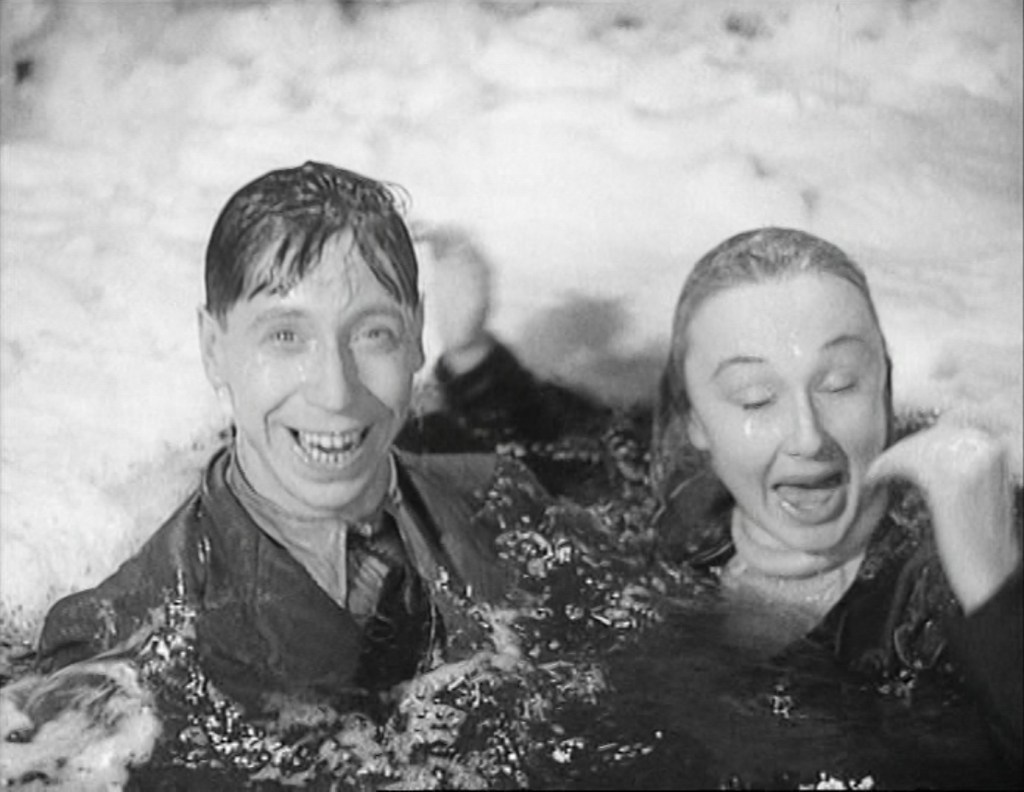
Trouble Brewing ends in the beer brewery where the gang is hiding. Here physical comedy takes over, with actors running up and down stairs, hiding in barrels, and hanging on ropes. The brewery contains several vast vats of beer, which are left uncovered. Bill lands in one and becomes inebriated almost immediately; the same eventually happens with the counterfeiting gang members. The apparently instantaneous effects of alcohol on the men underlines how far the events on screen are removed from reality at this stage of the film. It has developed into slapstick, harking back to earlier cinematic traditions.

Unlike another 1939 film set in a brewery, Cheer Boys Cheer, which makes direct reference to Nazi Germany, Trouble Brewing offered audiences complete escapism. Money laundering and the circulation of counterfeit money were popular tropes in interwar crime fiction, but they were far removed from the real-life horrors of war and fascism. The film expanded on the already-established cinematic narrative that journalists could effectively solve crimes, by presenting three workers as skilled detectives. The film’s happy ending no doubt provided audiences with welcome escapism as the international political situation deteriorated.  

George (George Formby) and Mary (Googie Withers) end up in a beer barrel at the close of Trouble Brewing

The Gaunt Stranger (1938)

<strong>The Gaunt Stranger (1938)</strong>

As has been noted previously on this blog, the work of detective fiction writer Edgard Wallace was often used as source material for British interwar films. Wallace was a prolific writer, so despite his early death in 1932, there were plenty of opportunities to translate his work to the screen for years afterwards. One such crime thriller is 1938’s The Gaunt Stranger. What sets this story apart from most British interwar crime fodder is that, very unusually, the criminal escapes the police at the end of the story.

Like so many interwar texts, The Gaunt Stranger existed in multiple formats and under different titles. Wallace originally published the story as a novel in 1925 under the title The Gaunt Stranger. Shortly after its publication, Wallace adapted it for the stage in collaboration with celebrated acter Gerald Du Maurier under the same name. In 1926 Wallace re-published the novel, now titled The Ringer, with some modifications to the text based on the stage production. The Ringer appears to have been put on stage again in 1929, and was also adapted as a film in Britain in 1928, 1931 and 1952. The second of these films was directed by Walter Forde, who in 1938 directed the story again under the auspices of Michael Balcon at Ealing Studios, but this time under the book’s original title.

The story of The Gaunt Stranger is almost as intricate as its production history. Set over a period of only 48 hours, it centres on lawyer-cum-criminal Maurice Meister, who receives warning that he is to be killed on 17 November, in two days’ time, by the notorious criminal ‘The Ringer’. Everyone in England, including Scotland Yard, believed the Ringer to have been killed two years’ previously in Australia. After the Ringer’s apparent death, Meister took in the Ringer’s sister as his secretary. It is insinuated that his relationship with the woman was more than just professional, and she committed suicide on 17 November the previous year. The Ringer appears to have come back from the dead to avenge his sister.

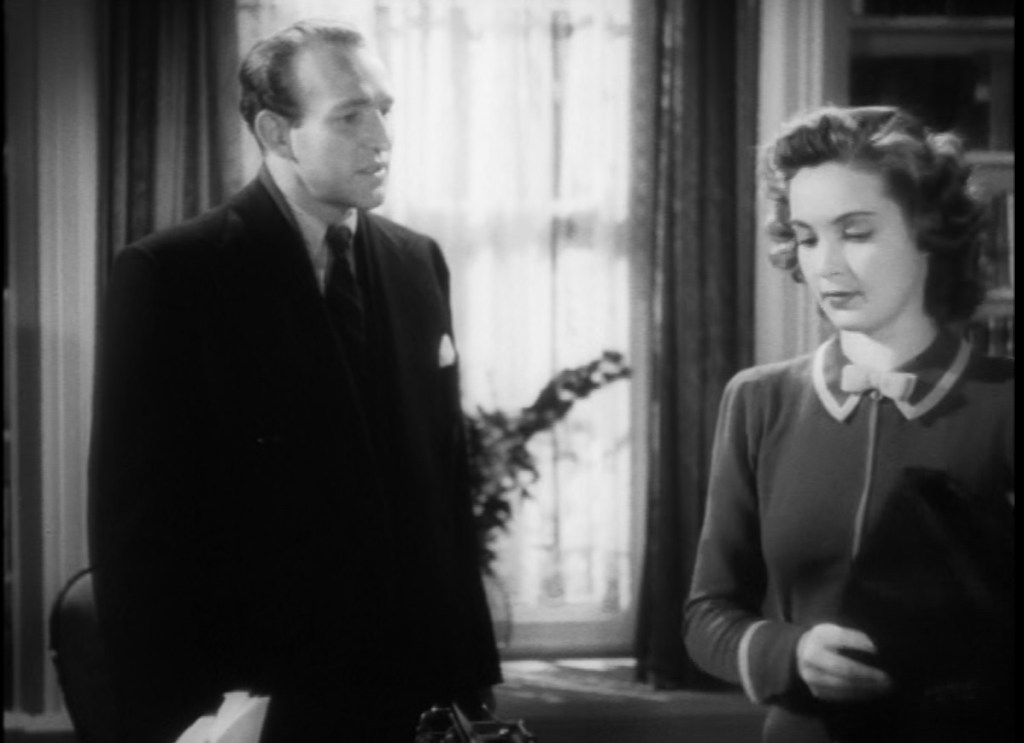
The Scotland Yard team is made up of DI Alan Wembury, Scottish police surgeon Dr Lomond, and Inspector Bliss, who has recently returned from Australia and who was the man who ostensibly killed the Ringer two years previously. Wembury calls in the help of small-time criminal Sam Hackett, who is one of the few men in England who would be able to recognise the Ringer. Wembury also has an admiration for Meister’s current secretary, Mary Lenley, whose brother Johnnie is also a criminal recently released from Dartmoor. Finally, in the course of the investigation the police identify and question Cora Ann, the Ringer’s American wife.

DI Alan Wembury and Mary Lenley in The Gaunt Stranger

With a runtime of only 71 minutes and a comprehensive cast of characters with complicated interrelations, The Gaunt Stranger moves at a rapid pace. Nonetheless, Forde makes effective use of repeated panning shots of empty rooms inside Meister’s house. The film opens with several shots of these empty rooms, ending with a shot of Meister playing his piano. Similar shots are repeated several times during the film, to stress Meister’s solitary living arrangements and highlight his vulnerability. As the 17 November dawns, Scotland Yard effectively imprison Meister in his own house to ensure he stays safe. Little do they know that the danger will not be coming from outside the house.

The closed circle of characters and the physical closure of Meister’s house set The Gaunt Stranger up as a classic murder mystery. What remains unclear until the end, however, is the identity of the Ringer himself. Johnnie, the criminal brother of secretary Mary, is a possible contender. More suspicious is inspector Bliss, who so recently returned from Australia. He acts oddly throughout the film, and seems reluctant to trust Wembury or collaborate fully with the investigation. Wembury does not know Bliss personally, opening up the possibility of him being someone other than who he pretends to be. Cora Ann also behaves oddly, first insisting that her husband is dead, before changing her story and admitting that he is still alive.

Johnnie Lenley and Sam Hackett in The Gaunt Stranger

Meister himself is also anything but a sympathetic character. Like other books of the period, Wallace opted to make his victim an unpleasant character, so that the audience is not too concerned whether the murder is prevented or not. More unusually, however, Wallace also arranged for the Ringer, when his identity is eventually revealed, to make a spectacular escape from the police and the country. Once the Ringer’s identity is confirmed, it is clear to the audience in retrospect that Cora Ann has been playing along with her husband throughout the film. Their escape, which involves piloting a plane from a nearby airfield, was clearly planned in advance.

The Ringer and Cora Ann escape in The Gaunt Stranger

The police in The Gaunt Stranger are depicted as organised and capable. They effectively arrest multiple people throughout the film and are not fooled by Meister’s attempts to come across as a respectable lawyer – they are fully aware of his criminal activities. When Sam Hackett, the criminal informer, attempts to steal some of Meister’s silverware, he is apprehended by a Bobby almost immediately. Johnnie, too, is arrested as soon as he tries to break into a house. The film puts some of the police’s technological infrastructure on display, such as telegrams and cars wired with radios. Nevertheless the Ringer’s unscrupulous nature allows him to escape despite the police’s efforts. The Gaunt Stranger is one of the few British interwar films which entertains the possibility of a fallible police force that can be outwitted by master criminals.

F. Tennyson Jesse – A Pin To See The Peepshow (1934)

The trial and execution of Edith Thompson have been discussed several times on this blog. The 1922 trial was extensively covered in the press of the period. In short, Edith Thompson was tried and executed alongside her lover Frederick Bywaters, for the murder of Edith’s husband Percy. At the time, newspapers judged Edith harshly for her affair with a younger man (she was nine years older than Frederick). Current scholarship is generally of the opinion that Edith probably knew nothing about the planned murder and should not have been found guilty. You can read a fuller account of the case here.

Due to the high profile nature of the case, it is no wonder that contemporary authors drew on the case for inspiration. I’ve previously discussed E.M. Delafield’s 1924 novel Messalina of the Suburbs which was based on the Thompson-Bywaters case. Where Delafield’s interpretation of the case was fairly loose, a novel published a decade later took a more forensic approach to recreate the story.

The extra years which had passed since the case no doubt help F. Tennyson Jesse to gain more perspective when she wrote A Pin To See The Peepshow, a novel frequently referenced as the definitive fictionalisation of the case. Tennyson Jesse was a prolific writer across several genres including novels, plays, poetry and non-fiction.[1] Some of her work is available to read for free online. She had a definite interest in true crime: in 1924 she wrote a non-fiction work Murder and its Motives and throughout her career she contributed to the long-running book series Notable British Trials. One of the volumes she was responsible for was the trial of Sidney Fox, who was found guilty of killing his own mother.

In A Pin To See The Peepshow Edith Thompson is transformed into Julia Almond, a young, somewhat pretty woman who, like Edith Thompson, works in a women’s fashion boutique and ends up marrying to a man she finds dreadfully dull. The strength of the book is that Julia is not necessarily a sympathetic character, the reader does sympathise with her. Like E.M. Delafield before her, Tennyson Jesse leaves no doubt that her fictional heroine had no involvement in the plot to murder her husband.

The novel starts when Julia is a school girl, living in West London with her parents and counting down the days to her adulthood. When she is ordered to mind a class of younger children one day, one of the younger boys, Leonard Carr, has a ‘peepshow’: a cardboard box with a decorative interior that can be seen through a small hole. Julia is enchanted by this portal into another world: a first indication of her romantic nature which is reiterated throughout the book. Leonard Carr, when he grows up, becomes the fictional version of Frederick Bywaters. In Tennyson Jesse’s narrative, Julia and Leonard’s relationship is marked by make-believe from its inception.

During the real Thompson-Bywaters trial, much was made of Edith’s letters to Frederick. He had kept these letters despite the couple’s agreement that they would destroy each other’s epistles – Edith did destroy Frederick’s letters to her. The letters alluded to supposed plots to kill Percy. The prosecution at the time used them as evidence that Edith wanted her husband to die, and that she was manipulating Frederick to commit the act for her. From the novel, it appears that F Tennyson Jesse agreed with scholars such as Lucy Bland that the letters were works of fiction, written by a woman with a vivid imagination.[2] Another feature that Tennyson Jesse awards her heroine, which may not be entirely historically accurate, is that Julia is terribly short-sighted. This gives her a plausible defense when she claims she did not recognise her husband’s killer, as the real Edith Thompson also initially said.

The heart of the case is, of course, extramarital relationship which Edith Thompson deigned to embark on. In Delafield’s novel, the heroine is sexually active at a young age, but also gets sexually abused by a series of men who are in positions of power over her. Tennyson Jesse’s Julia is less obviously interested in men, but the brief affair she has with a young man at the start of the First World War is described as completely natural and nothing to be ashamed about.

Julia’s eventual marriage to family friend Herbert Startling is primarily motivated by her desire to leave her parents’ home, and her inability to afford her own living space. When Leonard Carr re-appears on the scene as a young adult, Tennyson Jesse makes it clear that sexual relations with Leonard are extremely satisfying to Julia, again without judging or moralising about it.

Julia is less obviously a victim than Delafield’s heroine. Throughout A Pin To See A Peepshow, Julia is often in command. She earns more money than Herbert and is largely able to dictate when she allows him to sleep in her bed. Nonetheless, Tennyson Jesse makes clear that ultimately, Julia is too naïve to understand the passions she’s unleashed in Leonard which drive him to his ultimate act. Her subsequent foolish attempt to cover up Leonard’s involvement to make the murder seem like an accident, seals her fate in a patriarchal justice system. Tennyson Jesse’s Julia probably comes close to the real Edith Thompson: a woman not without faults, whose options in life were narrowly determined by her sex and who paid the price for transgressing accepted norms.

A Pin To See The Peepshow was recently re-issued as part of the British Library Women’s Writers series. Copies can be bought here.


[1] Lucy Evans, ‘Preface’, in F. Tennyson Jesse, A Pin To See The Peepshow (London: British Library, 2021), p. viii

[2] Lucy Bland, ‘The Trials and Tribulations of Edith Thompson: The Capital Crime of Sexual Incitement in 1920s England’, Journal of British Studies, Vol. 47, no. 3 (2008), 624-648

Limehouse

Limehouse is a neighbourhood in London, situated east of the Tower of London at the North bank of the Thames. It is right next to Canary Wharf, which is these days one of London’s financial districts. Limehouse has accordingly gentrified – Google’s description of the area states ‘Limehouse is a regenerated former dockland area where housing in converted warehouses and modern towers lines the Thames and Limehouse Basin, which is also home to a yacht-filled marina. (…) Upscale restaurants and hip cafes sit alongside laid-back global eateries.’

Back in the interwar period, however, Limehouse had very different connotations. As the area housed docks, it had from the mid-19th century been mainly populated by seamen. More specifically, from 1860 onwards Chinese sailors had settled in lodging houses in the area.[1] A similar development occurred in Liverpool, which also had a big and busy port. Unlike the Liverpool ‘Chinatown’, however, Limehouse obtained a cultural significance that far outstripped the mere 5000 Chinese who lived in the area.[2]

The stereotypes and fears around the Chinese inhabitants of Limehouse centred around drugs, gambling, and interracial relationships. Being sailors, most of the Chinese living in Limehouse were single men, who often lived in lodging houses. Those who did decide to settle down often married white women, as there were few Chinese women living in London and they had little means of paying passage for women living in China. At a time when racism was rife and eugenics was still acceptable, the spectre of mixed-race children being raised in Britain was used to cause moral alarm.

Limehouse and the Chinese were also consistently linked to opium and other drugs. In the 19th century, Britain had introduced opium from India into China for financial gain. After millions of Chinese became addicted to the drug, the so-called Opium War took place between Britain and China from 1839 to 1842. So whilst opium came to be seen as a Chinese drug, it had in fact originated from the British empire and planted in China by British officials.

Until the First World War, opium could be fairly easily obtained over the pharmacy counter and it was used as a recreational drug.[3] During the war, the Defence of the Realm Act (DORA) introduced widespread government powers to clamp down on anything from pub opening hours to press freedom. In the same way that DORA led to the rise of illegal nightclubs in the 1920s, it also facilitated the boom of ‘opium dens’ in Limehouse. Pushing opium use into illegality caused it to be more profitable for traders, and more tempting for users. Alongside opium, the possession and selling of cocaine was also banned in 1921.

The third aspect commonly linked to Chinatown in interwar fictions and reports is gambling. Betting on horse races, greyhound races and football pools was a popular pastime for the British working classes, and card parties often played for substantial amounts of money. The Chinese, however, introduced the casino-style games of Fan Tan and ‘Puck-apu’, a ‘lottery-like gambling game.’ A visit to Limehouse became a great opportunity for West End socialites to go ‘slumming’, partake in recreational drugs, gamble money, and flirt with the possibility of interracial relations.[4]

But beyond the actual activities of Limehouse, which ultimately consisted of a small Chinese community which mostly lived quietly and ‘respectably’, the idea of Limehouse was what really took flight in the interwar period. This started with fictional portrayals of shady Chinese master criminals, most notably Sax Rohmer’s ‘Fu Manchu’. The concept was then borrowed by crime fiction powerhouses Edgar Wallace and Agatha Christie.[5]

In Christie’s The Big Four (1927) Hercule Poirot hunts four criminal masterminds who are in league to take over the world order. ‘Number 1’, the ringleader and most dangerous criminal, is the Chinese Li Chang Yen. The Big Four is one of the weaker Poirot novels, pieced together from short stories to fulfil contractual obligations whilst Christie’s first marriage was ending. It is telling that during this time, when Christie did not have the capacity to write a brilliant novel, she fell back on the ‘Chinese mastermind’ stereotype – it had already become an easy shorthand for readers.

Cinema, too, used and abused Limehouse as an atmospheric setting. Possibly the most famous interwar film set in Limehouse is actually an American production, D.W. Griffith’s Broken Blossoms starring Lilian Gish (1919). In Britain, E.A. Dupont’s 1929 film Piccadilly features the Chinese scullery maid Shosho, who works in an expensive nightclub in the West End, but lives in Limehouse with a Chinese companion. As noted above, in reality there were few Chinese women in Limehouse. Shosho (played by Asian American actor Anna Mae Wong) serves to fulfil white male fantasies about ‘Oriental’ women.

Piccadilly’s white male hero, Valentine Wilmott, falls for Shosho, or is seduced by her, depending on your interpretation. The film features extensive scenes of Shosho dancing in revealing outfits with unusual headdresses. She takes Valentine with her to a Limehouse bar, where other patrons use cocaine. Afterwards, Shosho invites Valentine to her house and bed – an invitation which he accepts. Although it was considered deeply inappropriate for a white woman to have a relationship with a Chinese man, Valentine is able to pursue Shosho without consequences. In fact, it is Shosho who ends up dead: she is shot by her Chinese friend Jim, who was secretly in love with her and kills her in a jealous rage. Piccadilly thus ultimately reaffirms stereotypes of Limehouse as a space of criminality and transgression.

During the Second World War the Limehouse docks were subjected to heavy bombing. After the war, London’s Chinese community mostly migrated to the town centre in Soho, which currently remains the city’s ‘Chinatown’. Soho has an enduring mythology of its own, of which Chinatown is a part, but in which it is not prominent. It is in Limehouse and during the interwar period where the stories of London’s Chinese community consolidated into something much bigger than its parts.   


[1] Yat Ming Loo, ‘“Mixed race,” Chinese identity, and intercultural place: Decolonizing urban memories of Limehouse Chinatown in London,’ Journal of Race, Ethnicity and the City, 2022,  3:1, 23-41 (p. 23)

[2] Annie Lai, Bob Little, Pippa Little, ‘Chinatown Annie: The East End Opium Trade, 1920-1935: The Story of a Woman Opium Dealer’, Oral History Journal, 1986, vol. 14, no. 1, 18-30 (p. 18)

[3] Ibid., p. 21

[4] For more on slumming in London see Seth Koven, Slumming: Sexual and Social Politics in Victorian London (Princeton: Princeton University Press, 2004)

[5] John Seed, ‘Limehouse Blues: Looking for Chinatown in the London Docks, 1900-40,’ History Workshop Journal, 2006, 62, p. 58

Anthony Berkeley – Trial and Error (1937)

Crime novelist Anthony Berkeley (born Anthony Berkeley Cox in 1893) was one of the key crime writers of the interwar period, producing books both as Anthony Berkeley and as Francis Iles. Many of his books innovated the crime genre, such as The Poisoned Chocolates Case (1929) in which the members of an amateur crime detective club each put forward unique and plausible solutions to the same crime.[1] In Before the Fact (1932, written as Francis Iles) the female protagonist becomes gradually convinced that her husband is planning to murder her.

Berkeley’s main sleuth was Roger Sheringham, an amateur detective and author. It was common, indeed expected, for interwar crime writers to have a regular detective character, and Berkeley wrote ten novels starring Sheringham. His crime novels that do not include Sheringham, however, allowed him more flexibility in terms of plot development. This is also true of Trial and Error, which Berkeley wrote in the mid-1930s. Trial and Error does feature other characters from the Berkeley crime universe, such as the bumbling Ambrose Chitterwick who also stars in The Poisoned Chocolates Case and The Piccadilly Murder (1929).

The plot of Trial and Error is as typically convoluted and rewarding as can be expected from Berkeley, including a twist in the very final sentence of the book. Like other crime novels by Berkeley and his fellow writers, the plot is based on a historical crime, in this instance a case from 1864.[2] In Trial and Error, Lawrence Todhunter is told he is going to die of an aortic aneurysm at some point soon – as long as he does not exert himself, he may live another year, but anything that increases his heartrate may kill him.

Todhunter asks his friends a seemingly hypothetical question – what would they advise a man who has only a few months left to live, to do? The unanimous response is that such a man should kill someone – after all, the death penalty would form no deterrent. Although Todhunter at first entertains thoughts of killing Hitler or Mussolini (the latter of which was seen as a bigger threat in 1937)[3]; he eventually decides to kill an ‘ordinary’ person who makes the lives of those around them miserable. He finds his victim in Miss Jean Norwood, a stage actress who seduces married men and then financially drains them.

The selection of Miss Norwood as the victim and her eventual successful murder takes up less than the first half of Trial and Error. The second half of the book is concerned with the aftermath – and this is where it copies the historical case. After the murder Todhunter decides to go on a world tour, expecting to peacefully die somewhere en route. Several weeks into his trip, however, he is horrified to find out that another man has been arrested for the murder of Jean Norwood. Todhunter speeds back to England to prove his guilt – but he has been so thorough in hiding his tracks that there is no material evidence to convict him, and the police do not believe his confession.

With the other man tried and found guilty, Todhunter has very little time to prevent the execution of an innocent man (the time between conviction and execution was traditionally only three weeks). Together with his friends, he comes up with a plan. One of his friends, a civil servant, sues Todhunter for the murder under civil law. Whilst the police controlled who would be prosecuted in a criminal court, anyone could bring a case to anyone else a civil court. Todhunter actively works with the prosecution’s legal team to make the case against him as strong as possible. They also ensure that the case gets plenty of press attention, which in turn leads to political debate. The execution of the previously convicted man is paused until Todhunter’s case is completed. At the end of the book, Todhunter is victorious – he gets found guilty of the murder and sentences to death, whilst the other man walks free.  

In Trial and Error, Todhunter’s impending aneurism not only provides the catalyst for the plot, but it is also an effective tool to ratchet up the tension throughout the narrative. During the trial, Todhunter is increasingly worried he may die before he is convicted, and his friends shelter him away from the media circus to keep him alive. The tight timelines of the criminal court case and execution also put the pressure on Todhunter, which of course in turn makes him more likely to suffer his aneurism.

But beyond the race to save a condemned man, Trial and Error raises some questions about the British justice system. The man who is originally convicted is innocent – the police have been able to provide motive and circumstantial evidence and the jury has made its decision based on that. When Todhunter returns to Britain and makes a full confession, the police are unwilling to believe him.[4] A miscarriage of justice is a very real possibility in this scenario. Because Todhunter is initially unable to provide any material evidence to back up his confession, he is disbelieved. Technical advances in policing have made physical evidence so important that even a genuine confession holds no weight.

Like other Berkeley books, such as The Poisoned Chocolates Case and Before the Fact, there is no direct connection between those who commit murder and those who get punished for it. Whereas other crime novelists such as Dorothy L. Sayers and Agatha Christie often ensured that their criminals were either killed or arrested at the end of the novel, Berkeley’s books are much more ambiguous. This critical stance at the British justice system is perhaps one of the reasons why Trial and Error has only been transferred to the screen once, in a 1958 BBC miniseries. Berkeley’s satire still raises uncomfortable questions about the robustness of Western justice systems.


[1] Martin Edwards, The Golden Age of Murder (London: HarperCollins, 2015), pp. 85-86

[2] Ibid., p. 360

[3] Anthony Berkeley, Trial and Error (London: Acturus, 2012), pp. 12-13

[4] Ibid., pp. 125-129

Murder in Soho (1939)

Murder in Soho (1939)

On the eve of the Second World War, Associated British Picture Corporation produced Murder in Soho, a gangster flick starring American actor Jack La Rue (not his real name, obviously). The presence of Italian-American La Rue, with his cleft chin and strong jawline, brings Hollywood glamour to what is otherwise a crime film with an extremely thin plot. Murder in Soho appears to be a solitary British outing for the actor, although he did take the opportunity to get married whilst visiting London for the film’s shooting.

Like the almost contemporaneous They Drive By Night, Murder in Soho works hard to incorporate American slang into its dialogue, presumably to appeal to younger audiences. They Drive By Night, however, was produced by the British arm of American studio Warner Brothers. Murder in Soho comes from a British production company that was Hitchcock’s home for many of his silent films including Blackmail (1929); Murder! (1930)and The Skin Game (1931). Alongside these British thriller/crime films, ABPC (which previously operated as British International Pictures) also produced musical films such as Harmony Heaven (1930) and Over She Goes (1937). They did not have a strong background in producing American-style crime films – and it shows.

The plot of Murder in Soho is extremely thin. La Rue plays nightclub owner Steve Marco, who runs the ‘Cotton Club’ in Soho. He has just hired a new singer for the club, Ruby Lane. Steve is interested in Ruby as he thinks she has ‘class’. He doesn’t know, however, that Ruby is married (but separated from) Steve’s British associate Joe Lane. When Joe betrays Steve and steals £2000 off him, Steve kills Joe. Soon police inspector Hammond comes asking questions. He recruits Ruby to work with him and reveal Steve’s criminal activities. Also in the mix, although largely superfluous to the plot, are a journalist called Roy Barnes who frequently visits the club and falls in love with Ruby; Steve’s ex Myrtle who he has dumped in favour of Ruby; and performing duo ‘Green and Matthews’ who also work at the club.

The ‘Cotton Club’ in Murder in Soho

Murder in Soho contains all the popular elements of a 1930s crime film: a nightclub; an international criminal gang; a singer; a police inspector; a journalist. Yet these elements are not fused together with a compelling plot or livened up by any original ingredient. Indeed, the film’s insistence to try and introduce Americanisms into the narrative detracts even more from the action. Steve and his henchmen speak in thick Italian-American accents. The character ‘Lefty’ in particular, who is the young comedy sidekick, litters his dialogue with references to ‘dames’ and ‘cops’. The name of the club obviously refers to the famous Harlem nightclub – but there were no British Cotton Clubs and the name does not have the resonance in Britain as it would do in the United States. Steve employs Black bartenders in his club – again a practice which was much more common in the States than it was in Britain. Compared to depictions of nightclubs in other British films of the 1930s, the Cotton Club in Murder in Soho feels more like a replica of a Hollywood set than of anything resembling British nightlife.

Gun-toting American gangsters in Murder in Soho

The very opening of Murder in Soho also presents a version of Soho that was much more deliberately criminal and seedy than what is usually presented in British films. Familiar shots of the neon lights of Piccadilly Circus are interspersed with a close-up shot of a roulette table; a shot of an underground dive bar; and a shot of two prostitutes propositioning a man in an alleyway. Unlike the majority of British films of the period, which worked to preserve an image of London and Londoners as ultimately adhering to the law and to a high moral code, Murder in Soho explicitly positions Soho as a criminal space. Granted, the main criminal element in the film is foreign, but Joe Lane is British, as is Myrtle, Steve’s scorned ex who ends up killing him. Soho here is a lot seedier than the Soho portrayed in, for example, Piccadilly (1929).

Rather surprisingly, then, Murder in Soho also contains plenty of comic notes, and a few secondary characters who are only included to provide comedy relief. Most notably, the performing duo Green and Matthews, which weave throughout the narrative. Lola Matthews is portrayed by Googie Withers, who this early on in her career already had made a name for herself as an excellent comic actress. As Lola she patters on non-stop, innocently flirting with every man and completely oblivious that her dance partner Nick Green is besotted with her. A frequent club visitor whose role is simply credited as ‘Drunk’ provides diversion in scenes when he tries to eat with chop sticks or enters the dancefloor for a solo performance. These interludes do undercut the drama and suspense that the film attempts to create at other points.

Murder in Soho is a late-interwar curiosity – a film that tries to appeal to British audiences by inserting American glamour; a film that tries to be both serious and funny at the same time; and that ends up feeling like a painting-by-numbers effort that adds up to less than the sum of its parts.

Henry Wade – Heir Presumptive (1935)

In the Golden Age of crime fiction, many authors were tempted by the ‘perfect murder’. In Dorothy L. Sayers’ Unnatural Death, Lord Peter Wimsey ruefully states that the perfect murder would never be considered a murder, and would therefore necessarily go undetected. In 1936, six writers of the Detection Club each wrote a short story containing the ‘perfect crime’. Each story was then followed by an analysis of a retired CID inspector, who unpicked whether the crime would be detected in real life, or not.[1] The inspector concludes that in each case, the police would eventually identify the killer – not surprisingly, he probably felt that to admit otherwise was to invite readers to have a go at replicating the ‘perfect murder’!

This is how it ends up in most interwar crime stories – no matter how ingenious the plot, usually the killer gets caught and either brought to justice, or given the option to take the ‘honourable way out’ and commit suicide. Not so, however, in Henry Wade’s Heir Presumptive. In this inverted murder story, the murder central to the book is judged to be an accident.

Henry Wade was one of the original members of the Detection Club. An ex-soldier, he turned to crime fiction writing after the Great War. Unlike most other crime writers of the period, he was genuinely part of the landed gentry – his real name was Henry Lancelot Aubrey-Fletcher.[2] Wade used his insider knowledge of entailed estates to concoct the plot of Heir Presumptive, which features a family tree so intricate that a diagram is provided on the first page of the book (and to which this reader, for one, grateful referred back to multiple times).

The main character of the book is Eustace Hendel, a 35-year-old member of the secondary branch of descendants of the 1st Baron Barradys. The Baron’s title and estate are being passed down the male line and Eustace is far removed from them. He trained as a doctor, but after meeting ‘a rich widow’ who then ‘conveniently died’ (through natural means) Hendel came into an inheritance that allowed him to live as a man of independent means.[3] At the opening of the book, these means have nearly run out, debts are racking up, and Hendel is on the look-out for a way to continue his lifestyle without having to work. He also has a relationship with Jill, an actress who makes it clear that she will not stick around if Eustace can’t afford her.

When Hendel reads in the paper that the son and grandson of the current Baron Barradys have both died in a mysterious swimming accident, he makes sure to attend the funeral, in the hope of mending relationships with his wealthy family. Hendel re-acquaints himself with his cousin David, who is now unexpectedly the next heir to the family name and estate. David’s only son is a 20-year-old invalid who is expected to die soon. However, David is young enough to remarry, and there is a general expectation that he will do so now that he is next in line for the inheritance.

It is at this point that Eustace formulates his plan. After David and his invalid son, he believes he himself is the next male heir. If he kills David and the son dies as expected, then he would become the next Baron, and inherit the sizable estate attached to that title. And even until the current Baron dies, being next in line to inherit would be sufficient to secure loans and favours.

It is clear at this point in the book, about six chapters in, that Eustace Hendel is not a sympathetic character. He is greedy, lazy, and openly contemplating murdering his next of kin for his own benefit. Wade surprises, then, by allowing Hendel to execute the perfect murder. David invites him up to his lodge in Scotland, to go deerstalking. On the final day of the trip, David and Eustace go off without assistance to a remote part of the estate. After Eustace shoots a stag, he asks if he can also be the one to cut its throat to allow it to bleed out quickly. Feigning a slip, Eustace instead plunges the knife into David’s femoral artery.[4] After that, the remote spot and lack of onlookers make it easy for Eustace to ensure David bleeds to death before help can be found.

Although there is of course an investigation by the Scottish authorities, who are presented as more thorough and less obliging than their English counterparts, in the end, they decide not to pursue a criminal investigation. Although Wade allows Eustace to get away with the perfect murder from the perspective of a prosecution, he does not get the enjoy the expected benefits of his deed. The current Baron starts exploring options to cut Eustace out of the line of succession altogether, based on the general unfavourable impression he has of him.

In order to change the line of succession, the Baron needs the agreement of the current heir, David’s sick son Desmond. Eustace starts visiting Desmond and, under increasing pressure of Jill and various moneylenders, starts planning a second murder. Before he has time to execute it, however, Desmond dies. It is here that the reader starts to realise that Wade has been stringing them on all along. Although the focus has been almost exclusively on Eustace Hendel, it turns out he has been nothing but a pawn in someone else’s plan.

All along, the real mastermind has been David’s brother-in-law, lawyer Henry Carr. Henry orchestrated the swimming accident of the original heirs; Henry killed Desmond; and, after offering legal advice to Eustace, Henry frames Eustace for Desmond’s murder and then kills Eustace himself, making it look like a suicide. As if this isn’t enough, Eustace finds out just before he dies that whilst he is due to inherit the title of Baron, the estate and money are not passing through the male line and will instead be inherited by Henry’s wife (who is completely oblivious as to her husband’s murdering schemes).

For the final few pages of the book, after Eustace has died, the perspective switches to that of Henry Carr. We move from a world of country houses and independent incomes to suburbia – Carr travels by Underground to Waterloo as a seasoned commuter. ‘It was past the hour of the daily rush return from work, though the third-class carriages were fairly full; he himself never travelled first-class on ordinary occasions, but this was one on which he thought the luxury was justified.’[5] The motive for his murdering was to allow his wife to move out of the ‘semi-detached villa’ and to be able to afford the school fees for the children – middle-class aspirations if ever there were some.[6]

In the end, then, it is not the lazy, good-for-nothing playboy who is the threat to the upper classes, but rather the ambitious professional man who stops at nothing to give his wife and children a better future. Heir Presumptive is a cynical book, perhaps reflecting Wade’s ‘pessimism about the state of Britain’.[7] Eustace, Henry, even Jill – all are grasping for more than they have, without wanting to work for it. But whilst Eustace manages to orchestrate the perfect murder, he is too naïve to see the trap he walks into himself. Henry Carr, for all his cleverness, also has to reckon with justice – the final line of the book announces that ‘In the hall stood Chief-Inspector Darnell, accompanied by a uniformed police officer.’[8] Ultimately, Wade reassures the reader that no matter how clever the crime, justice will eventually be served.


[1] Published as Six Against the Yard (London: Selwyn & Blount, 1936). See Martin Edwards, The Golden Age of Murder (London: Collins Crime Club, 2016), pp. 285-6

[2] Edwards, The Golden Age of Murder, p. 194

[3] Henry Wade, Heir Presumptive (London: Remploy, 1980), p. 3

[4] Ibid., p. 77

[5] Ibid., p. 203

[6] Ibid. pp. 203-7

[7] Edwards, The Golden Age of Murder, p. 197

[8] Wade, Heir Presumptive, p. 209