The Woman from China (1931)

FeaturedThe Woman from China (1931)

As has been covered on this blog before, in 1927 the British Government adopted the Cinematograph Films Act, a legal measure which prescribed a minimum volume of British-made films which each exhibitor had to show. It was no longer possible for a cinema to solely show Hollywood films. The intention of the Act was to boost the British film industry; its unintended consequence was that American studios set up cheap studio contracts in Britain and started churning out low-quality films which became known as ‘quota quickies’.[1]

Shortly after the Act was passed, Britain started transitioning to sound film, with the earliest ‘talkies’ with continuous sound appearing in 1929/1930. The transition was rapid, with sound film becoming the norm within just a few years. Yet for the ‘quota quickie’ industry, sound film could be an expensive business. It was generally the aim of American studios to shoot their British films as cheaply as possible, often for as little as £1 per foot of film.[2] Shooting sound film required additional technology such as microphones, and also forced on-set shooting in the early years, as location shooting was too noisy and complicated. It is not surprising, then, that quota quickie producers continued to make silent films into the early 1930s.

One of these is The Woman from China, which was made in 1930. According to Steve Chibnall, the film was produced in a rush. Under the 1927 Act, the ‘quota year’ ran from 1 April to 31 March, meaning that by 31 March each year exhibitors had to be able to evidence that they had shown the appropriate proportion of British films in the preceding twelve months. In January 1930, the major American studio MGM commissioned two British producers to create a film by the end of March that year. The result was The Woman from China, for which shooting and editing was completed within four weeks, with a half-finished script.

The final scenes were shot five days before the scheduled trade show, and director Dryhurst was obliged to double as editor with the help of one young assistant. The two worked ninety hours without sleep to meet the deadline, although the first of the two shows as lacking the final reel.[3]  

Considering those circumstances, The Woman from China can be considered a fairly accomplished film from a technical perspective, although it perpetuates many obvious and damaging stereotypes in its narrative, staging and costuming. The plot is one familiar from films of this period: a young secretary and a naval officer are engaged, but their relationship is thwarted by a mysterious British woman who has recently arrived from China, and who is in love with the naval officer. The ‘woman from China’ is being blackmailed by a Chinese Svengali, Chung-Li, who in turn wants to marry the secretary. The Chinese man directs his henchmen to kidnap both the officer and the secretary, and proceeds to emotionally torture them until they can break free. The ‘woman from China’ has a change of heart and sacrifices herself to save the naval officer; the Chinese man and his henchmen are killed; and the original couple are able to get away unscathed.

Frances Cuyler and Tony Wylde as the protagonists in The Woman from China

There was already an established history of racist depictions of Chinese characters in popular culture in Britain. The most successful proponent of this was pulp writer Sax Rohmer, who started his ‘Fu Manchu’ series of books just before the First World War. In these books, a Chinese evil mastermind is working to reinstate China as a superior power. Fu Manchu is associated with Limehouse, which at that time was London’s Chinatown. The Woman from China acknowledges its debt to these earlier pulp novels by a character noting that Laloe Berchmans, the woman who has made a deal with Chung-Li, is ‘like a character from an Edgar Wallace novel.’

Julie Suedo as ‘the Woman from China’ and Tony Wylde in The Woman from China

Chung-Li is played by white British actor Gibb McLaughlin in yellowface. The second most prominent Chinese character, an anonymous ‘Chinaman’, is played by Japanese actor Kiyoshi Takase. The Woman from China incorporates such racist tropes as Chung-Li having pointedly filed fingernails; leering after the secretary; and working to increase China’s power in the world. (I’ve deliberately not included any stills from the film featuring McLaughlin in this post as his costume and appearance throughout is offensive).
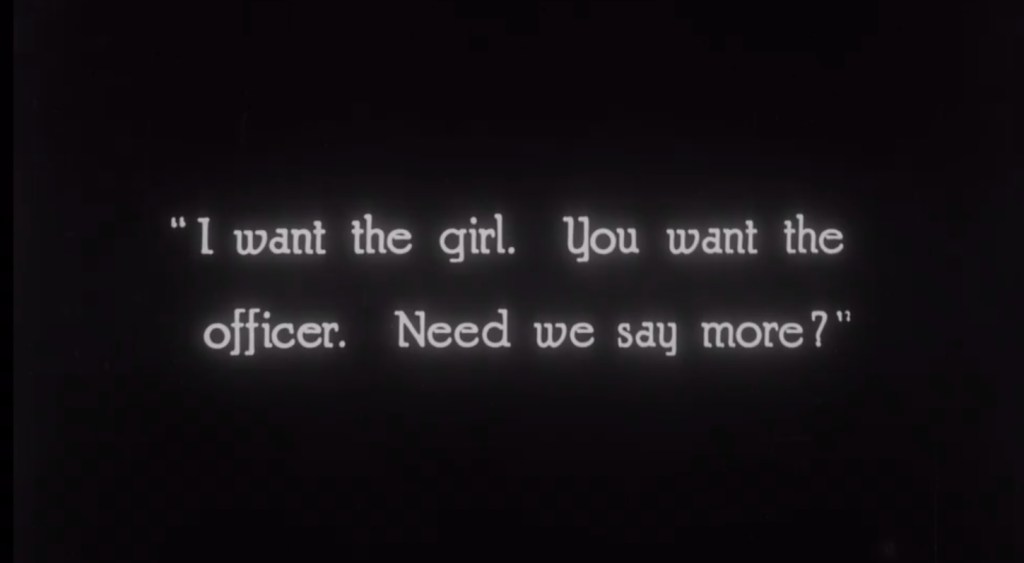
Chung-Li proposes his deal to the woman under his control

Although The Woman from China may appear to be a good example of a 1930s British film that is best forgotten about, it also allows us to explore the conditions of film production during this volatile period of the British film industry; contemporary portrayals of race; and a late example of a British silent film which includes on-location shooting. Its preservation allows us to appreciate the full range of British film output of this period, and to engage with the challenging legacy of racial discrimination which was pervasive in Britain during the interwar years.

Readers based in the UK can watch The Woman from China for free on the BFI Player.


[1] Steve Chibnall, Quota Quickies: The Birth of the British ‘B’ Film (London: BFI, 2007), p. 4

[2] Ibid., p. xii

[3] Ibid., p. 19
Featured

Ethel Lina White – The Wheel Spins (1936)

This is the first of a two-part blog looking at the novel The Wheel Spins, and its film adaptation The Lady Vanishes.

Ethel Lina White is one of a mass of interwar authors who were quite prolific, had some commercial success during their lifetime, and whose names have been mostly forgotten by the general public. In the case of White, if it were not for the successful adaptation of two of her novels into films, she may have dropped into obscurity altogether. However, her 1933 novel Someone Must Watch was adapted for the screen in 1946 as the American horror film The Spiral Staircase, and her 1936 novel The Wheel Spins was filmed by Alfred Hitchcock in 1938 under the title The Lady Vanishes.

The plot of the book is relatively straightforward: Iris Carr is a young, wealthy, but bored woman who is travelling back to London by train after a holiday in Eastern Europe. On the first stage of the journey there is another British woman in her carriage, a Miss Froy. Iris has suffered sunstroke just before boarding the train and falls asleep. When she wakes up, Miss Froy has disappeared, and everyone else in the train appears to deny she has ever existed at all. Iris gets increasingly frantic trying to prove that Miss Froy exists, and attempts to enlist the help of the various British passengers on the train.

The Wheel Spins is an unusual entry to the suspense and mystery genre, in that the solution to the problem of what happened to Miss Froy is probably quite clear to the reader at an early stage. Instead, the tension of the novel is much more psychological, centring on whether the protagonist, Iris Carr, will be believed or will be dismissed as mentally unstable. That the fear of women being dismissed as crazy, and potentially locked up, has enduring cultural resonance is in evidence in texts such as the 1963 American novel The Group, where a (sane) character is checked into a mental institution by her husband against her will; or the 2018 Stevan Soderbergh film Unsane, in which the female protagonist also appears to be institutionalised against her will. Throughout The Wheel Spins, the other characters, particularly the men, repeatedly tell Iris that she is making things up. The sunstroke she has suffered has given her ‘delirium’ (p. 107); she is ‘loopy’ (p. 207), in a ‘dangerous mental state’ (p. 227) or ‘deranged’ (p. 230). At various points, the conspiracy against her makes Iris believe that perhaps they are right, and Miss Froy never existed; but then she finds a clue left by the other woman which reinforces her resolve.

The bond between these two women, who have never previously met and have very little in common, stands in contrast to the efforts of the passengers on the train to get Iris to give up her search. At the beginning of the book, Iris is part of a ‘crowd’ of ‘vain, selfish and useless’ people (p. 16). She has no interest in others and actively alienates the other British tourists in the hotel; something that comes back to her later when those same tourists are on the train and she appeals for their help. When Iris meets Miss Froy, she quickly finds her company grating: ‘She’s decent, although she is a crashing bore’ is Iris’ verdict on the other woman (p. 77). Yet when Miss Froy disappears, Iris is relentless in her attempts to find her, despite the obstacles in her way. This suggests a connection between women, helping one another out even if their personalities have little in common.

The other theme running throughout the book is that of British people sticking together against foreigners. Time and again, Iris expects other passengers on the train to help her because they are British, even if she has treated them poorly. When Iris first notices Miss Froy is gone, she goes into the dining carriage of the train to ask for help. It is when she explains to two British men that ‘an English lady’ has gone missing, that they feel compelled to help her (p. 100). Two sisters, the Misses Flood-Porters, can be depended on because they are of aristocratic British stock and will therefore always feel obliged to come through in a crisis. A British vicar, despite being sick, also feels it his duty to come to Iris’ aid. The foreigners on the train are variously described as ‘pallid’, ‘callous’ (p. 70), with ‘grinning faces’ (p. 206) that sneer (p. 211). The kidnapping of Miss Froy is part of a political plot in an unspecified Eastern European country, which is described as ‘feudal, and centuries behind us’ (p. 75). The agents of the ruling party do not blanch at the idea of killing someone like Miss Froy, who has accidentally inserted herself into their affairs. The British characters, in contrast, uphold decency and the rule of law.

Throughout The Wheel Spins, the reader is treated to interludes describing Miss Froy’s parents, an elderly couple who live in the British countryside and are eager for their daughter to come home. These scenes have multiple functions: they reassure the reader that Iris is right and Miss Froy is a real person; they raise the emotional stakes of the story as they highlight how devastated the parents would be if Miss Froy were to come to harm; and they reinforce the notion that the orderly, somewhat boring lifestyle of the Froys is aspirational. Iris has no family and no fixed abode; this is presented as giving her a lack of purpose, rather than freedom. The novel ends with Miss Froy safely arriving at her parents’ house at last; ensuring a restoration of the traditional British family.

The Wheel Spins is not a traditional whodunnit, in that the puzzle of what happened to Miss Froy is resolved halfway through the novel, and the details of who was behind her disappearance are left underdeveloped. Instead, it explores themes of alienation and belonging across a range of different registers.

The Wheel Spins has recently been reissued by British Library Publishing. All page numbers given refer to this 2023 paperback edition.

Featured

J. J. Connington – The Sweepstake Murders (1931)

J. J. Connington was the alias of Albert Walter Stewart, a Scottish-born chemist, crime writer and one of the founding members of the Detection Club. Alongside a successful academic career, Connington published seventeen novels between 1923 and his death in 1947. T.S. Eliot was an admirer of Connington’s detective fiction.[1] Connington’s main ‘sleuth’ was Chief Constable Sir Clinton Driffield, who was accompanied by Wendover, a man of independent means, as a side-kick. These characters reveal Connington’s conservative political views; they have independent wealth and are no political radicals.

The Sweepstake Murders was Connington’s 13th published work, and coincidentally the concept of ‘bad luck’ (accidental or manufactured) is a key motif in the work. The book starts with Wendover, Sir Driffield’s companion, attending a bridge party at a house in the neighbourhood. The nine men in attendance agree to join into a syndicate and buy nine sweepstake tickets for the Epsom Derby. If any of the tickets win, they agree to divide the winnings equally between them.

When one of their number unexpectedly dies before the sweepstake results are announced, it occurs to Wendover that their signed agreement means that the fewer members of the syndicate remain, the more money each individual will receive, as they will have to split the winnings amongst fewer people. When the syndicate wins the second prize, or £241,920, members start getting bumped off with alarming speed. Sir Driffield comes to visit Wendover and helps the local police with their investigation, as he is concerned about his friend’s safety.

The tension in The Sweepstake Murders is two-fold: the reader does not know who the next member of the syndicate will be who will get murdered; but as the murders progress, fewer and fewer suspects remain, as it is assumed that one of the remaining syndicate members is the perpetrator. In this set-up, the murderer can only obtain the highest possible monetary return by revealing themselves as the last person standing. Connington avoids this problem by having some of the syndicate members sell on part of their stake to people not originally involved in the syndicate, thus widening the pool of potential beneficiaries. The set-up also allows Connington to include a range of murder methods and weapons in his story, as the murderer gets creative to make the deaths look like accidents.

The narrative of The Sweepstake Murders is liberally interspersed with letters sent between legal advisers and syndicate members; excerpts of Sir Driffield’s notebook; and various jottings-down of accounts and sums to allow the reader to stay on top of who is entitled to which sum at each stage of proceedings. Towards the end of the story, the behaviour of a roll of film in a photo camera becomes a crucial clue to the plot, and this is duly illustrated with some diagrams. These extra-textual elements add to the puzzle-like feel of the story and engage the reader in its resolution.

The Sweepstake Murders is a high-concept crime story, which incorporates many of the tropes of the genre including meticulous timing of alibis, use of technology to cover and uncover tracks, and a closed circle of potential suspects. Despite Connington’s professional success during the interwar period, he is now a mostly forgotten crime writer and his books are not as readily available as those of other authors of the period. Yet The Sweepstake Murders is a good quality murder mystery and is worth seeking out by readers with an interest in interwar crime literature.


[1] Martin Edwards, The Golden Age of Murder (London: Harper Collins, 2016), p. 186

Featured

From investigation to trial

This is the fourth and final post of this year’s May Murder Month. You can read posts one, two and three elsewhere on the blog.

Most contemporary readers will get their knowledge about interwar murder stories from the realms of fiction – Hercule Poirot gathering together suspects for a drawing room reveal (a device which Agatha Christie actually only used sparingly) or a hard-boiled police officer picking up on a seemingly minute clue that unravels the whole case. Once the murderer is identified, interwar fiction is either silent about what happens next, or the perpetrator is given the opportunity to take the ‘honourable way out’ by committing suicide.[1]

In reality, of course, investigations were conducted by police inspectors. Unlike in modern criminal cases, there was no Crown Prosecution Service in interwar England. Instead, the police both conducted the investigation and prepared the documentation for the criminal trial. The Director of Public Prosecutions was ultimately responsible for bringing the case to trial in the interest of the people. England then, as now, had a two-tier criminal justice system. The magistrate courts were convened locally and dealt with most of the day-to-day criminal offences. Crown courts were reserved for jury trials, which included murder charges.

Before a case could be referred to the crown court, a prima facie case had to be established in the magistrate court that a crime had been committed and it was of a magnitude appropriate to be considered in the crown court. Interwar murder trials were therefore effectively heard twice: once in the magistrate court and then again in the crown court, where the sentencing would take place. It was generally the latter proceedings that drew the attention of the national press. In murder cases, the coroner’s inquest ran in tandem to the magistrate court proceedings. In the interwar period, coroner courts sat with their own juries, who were tasked with determining whether death had occurred naturally, through suicide, accident, or murder. Usually, if foul play was suspected but the police investigation was ongoing, the coroner would suspend the inquest to give the police more time to complete their investigations.

The reading public, then, were experiencing criminal narratives in two different ways. When reading newspapers, the reports mostly focused on the criminal trial, with its rhythm of prosecution, defence, cross-examination, witness statements, a possible statement by the accused, and the judge’s summing up, all cumulating to the jury’s verdict. In crime fiction, the narrative focused on the investigation, with witness statements noted as the investigation developed. Particularly in stories where the protagonist is an amateur sleuth as opposed to a police officer, the formal police and court procedures can be completely outside the scope of the narrative. As crime historian Victoria Stewart has noted: ‘Detective novels tend not to recount the trial of the individual whom the investigator identifies as the guilty party because the watertightness of the investigation itself acts as a substitute for the depiction of the judicial process. An account of the trial would simply reiterate the findings of the investigation that has formed the body of the narrative.’[2]

Other scholars have noted that trial reporting reveals contemporary attitudes to potentially contentious topics such as changing attitudes to gender identity and sexuality.[3] Newspaper historians have also argued that the increased popularity of crime fiction changed crime reporting, with journalists paying more attention to ‘human interest detail’ of the story as opposed to the judicial process. This, in turn, potentially obscured the public’s awareness of legal procedures.[4] Additionally, journalists on occasion played a very active role in gathering evidence that led towards a conviction, for example in the case of Buck Ruxton who murdered his wife and a servant.[5] Conversely, crime fiction novels which had a police inspector as their protagonist, such as the Inspector French novels by Freeman Wills Croft, potentially educated their readership about police procedures in more detail than newspaper reports did.

Whether fictional or factual, murder stories fascinated interwar audiences and allowed them to explore the limits of what was considered acceptable or transgressive behaviour; and how this changed over the course of the two decades. Newspapers and crime novels presented readers with two different lenses through which to consider the criminal justice process, from investigation to trial.


[1] Lord Peter Wimsey’s increasing mental distress at sending murderers to the gallows, which comes to a head at the end of the final Wimsey novel Busman’s Honeymoon, is a notable exception.

[2] Victoria Stewart, Crime Writing in Interwar Britain (Cambridge: University of Cambridge Press, 2017), p. 11

[3] Lucy Bland, Modern Women on Trial: sexual transgressions on the age of the flapper (Manchester: Manchester University Press, 2013), p. 2

[4] Judith Rowbotham; Kim Stevenson; Samantha Pegg, Crime News in Modern Britain (London: Palgrave, 2013), p. 140

[5] Shani D’Cruze, ‘Intimacy, Professionalism and Domestic Homicide in Interwar Britain: the case of Buck Ruxton’, Women’s History Review, vol. 16, no. 5 (2007), 701-722

Featured

Executions in interwar London

Continuing May Murder Month, this week we take a look at the ultimate outcome of a murder case – the execution. Last week’s May Murder Month entry on police memoirs can be found here.

If you were found guilty of murder in interwar Britain, you would automatically be sentenced to death, unless your legal team had managed to convince the jury that you were insane at the time you committed the murder. After the adoption of the Infanticide Act in 1922, women who killed their new-born babies were tried as for manslaughter rather than for murder, meaning they no longer received death sentences. Yet even those found guilty of murder could appeal to the King (via the Home Secretary) for a reprieve. Reprieves were fairly common: in the first half of the 20th century around 40% of convicted male murderers, and an astonishing 90% of convicted women murderers, were granted a reprieve of execution.[1] This usually meant their sentence was commuted to ‘penal servitude for life’.

The period of appeal following a death sentence was usually ‘three Sundays’, meaning that if an appeal or reprieve was not granted, execution usually followed within a month of the trial. Murder trials were much shorter than we are used to today and prisoners were committed to trial much more quickly. This meant that convicted murderers were usually executed within a year of the crime having taken place. In interwar London, condemned prisoners were held in a special ‘condemned cell’ adjacent to the prison gallows. During the 1920s and 1930s, there were never more than 21 executions in a single year across the whole of Britain; and in many years there were fewer than 10.[2] This meant it was extremely unlikely for two convicted murderers to be held at the same prison at the same time, unless they were both convicted for the same murder committed jointly. There was no concept like ‘death row’ as it currently exists in the US, where prisoners can spend years awaiting execution.

Since 1868, executions were no longer held in public but were conducted inside prison walls. In London, there were three prisons in which executions took place until capital punishment was formally abolished in 1969: Pentonville Prison for male prisoners who lived north of the Thames; Wandsworth Prison for male prisoners who lived south of the Thames; and Holloway Prison for female convicts. Gradually, over the course of the first few decades of the 20th century, capital punishment became less ritualistic and more bureaucratic. Until 1902, a black flag was raised over the prison after an execution had taken place. The tolling of a bell during an execution was abolished around the same time.[3] After the end of public executions, journalists were still regularly invited to attend, so that their newspaper reports could serve as a proxy for public scrutiny. The last time a journalist attended an execution was 1934.[4]

The only ritual elements of execution which remained in place is that they usually took place at 9am; and that an execution notice was posted on the prison door immediately after the event. This is depicted, for example, in the 1938 thriller They Drive By Night, where a small crowd of people is shown gathered around the prison entrance. Papers of record, such as The Times, usually posted brief notices of executions as they had taken place. How an actual execution unfolded was usually ‘shrouded in secrecy’, with official statements invariably confirming that nothing unusual had occurred.[5] This vacuum of official information allowed rumours to swirl. After the controversial execution of Edith Thompson it was suggested that ‘her insides had fallen out’ as she dropped through the trap door, suggesting she may have been pregnant at the time of her death. Thompson’s executioner, John Ellis, committed suicide nine years after Thompson’s death, and it was suggested that he had never been able to get over the horror of that particular hanging.

Hanging had been the principal form of execution in Britain for centuries. By the interwar period, the government prided itself on having perfected a highly efficient method, which was considered ‘humane’ because it aimed to be swift and accurate. The objective was to ensure the prisoner’s neck broke immediately, so that he or she did not have to suffer through asphyxiation. Around a decade after the last execution took place in Britain, one of the country’s most famous hangmen, Albert Pierrepoint, published his memoirs. This book finally revealed in detail how executions were conducted, although interwar fiction novels such as Trial and Error had given descriptions of the process decades earlier.

Pierrepoint described in detail how he would arrive at a prison the day before the execution to make his preparations, which included the crucial calculation of ‘the drop’: the length of rope required which depended on the prisoner’s weight and size. For the neck to break at the 4th or 5th vertebrae was considered ideal as it would cause instant death. If the drop was too short, the prisoner could end up suffocating rather than breaking their neck; if it was too long, the worst-case scenario would be that the prisoner was decapitated as they dropped.

Executions were conducted extremely quickly: the execution of Norman Thorne was reported to last no more than ten seconds ‘[f]rom the time that [he] emerged from his cell door until the moment he passed into eternity.’[6] After the execution, the prisoner was left hanging for an hour before being cut down and submitted to a post-mortem, during which a note was made of the exact cause of death and where the neck had broken. An official statement on a pre-prepared template, signed and sealed by a coroner and jury, would confirm the death of the prisoner under the 1868 Capital Punishment Amendment Act. The body would then be buried in a dedicated cemetery inside the prison walls the same day.[7]

Despite the relative rarity of executions in interwar Britain, the state had developed a highly polished routine to ensure that these executions were conducted as efficiently as possible. This efficiency was considered humane, as it would limit the prisoner’s suffering as much as possible. At the same time, however, it also incorporated capital punishment into the bureaucratic machinery of government. Treating capital punishment as a largely administrative process also minimised the scope for challenging its principles, as it was incorporated into the judicial system as ‘business as usual.’ The abolition movement consequently only gained momentum in Britain after the Second World War.


[1] Shani D’Cruze, ‘Intimacy, Professionalism and Domestic Homicide in Interwar Britain: the case of Buck Ruxton’, Women’s History Review, 2007, vol. 16, no. 5, 701-722 (706)

[2] Source: http://www.capitalpunishmentuk.org/

[3] Lizzie Seal, Capital Punishment in Twentieth-Century Britain: Audience, justice, memory (London: Routledge, 2014), p. 17

[4] Ibid., p. 36

[5] Lizzie Seal, ‘Albert Pierrepoint and the cultural persona of the twentieth-century hangman’, Crime, Media, Culture, 2016, vol. 12, no. 1, 83-100 (86)

[6] Seal, Capital Punishment, p. 41

[7] Albert Pierrepoint, Executioner: Pierrepoint (London: Coronet, 1998 [1974]), p. 175

Featured

Police memoirs

It’s May Murder Month again! Last year I covered a host of infamous interwar murder cases in three posts which you can find here, here and here. This year we’ll take a step back and review some of the institutions and trends connected to interwar homicides.

The Metropolitan Police was founded in 1829 to provide a cohesive policing structure for the entirety of London.[1] Initially the focus of the force was on uniformed bobbies patrolling their respective beats. As Kate Summerscale has demonstrated, in mid-Victorian English society, plain-clothes investigators were treated with suspicion.[2] A permanent Criminal Investigation Department staffed by plain-clothes detectives was not formed until 1878.[3] By the interwar period, the notion of an established ‘Scotland Yard’ detective branch of the Metropolitan Police was still relatively novel, and there had only been a few generations of high-ranking police investigators.

It is perhaps not surprising, then, that the 1920s and 1930s saw the publication of a host of police memoirs. The establishment of crime detection as an accepted part of police activity coincided with the increased popularity of crime fiction; and a rise in literacy levels across the population. Police historian Paul Lawrence has noted that ‘There was a marked bias towards memoirs written by officers from large urban forces, particularly detectives, although as a rule books written by most types of officer can be found.’[4]

These police memoirs indicate that there was a popular appetite for ‘true crime’ histories as well as crime fiction. They also reveal to us how police officers wanted to position themselves and their work in the public consciousness. Some of the memoirs were written by senior officers who had become personally famous, such as Frederick Porter Wensley who was Chief Constable of the Metropolitan Police from 1924 till his retirement in 1929.[5] Others were penned by detectives who reached mid-tier positions and whose names would not be familiar to the wider public.[6] Almost invariably, however, the memoirs primarily deal with murder cases, as these were clearly thought to hold the widest appeal for the readership.

Despite advances in forensic science, such as the use of fingerprinting to identify criminals, several officers insist throughout the interwar period that personal knowledge of habitual criminals is the most effective way of detecting and preventing crime. This is despite there having been some high-profile cases of mistaken identity in the Yard’s recent history.[7] Chief Constable Wensley confidently states early on in his book: ‘The only real method [to detect crime] is to employ detectives who know rogues by direct contact, know their habits, their ways of thought, their motives, and above all, know their friends and associates.’[8] CID Chief Inspector Frederick Sharpe similarly insists that a good detective has to know the local gangs and crooks in order to be able to solve crime.[9] This suggests that senior investigators were reluctant to let go of outdated methods; or that they sought to present a romanticised view of inner-city policing to their readership, favouring personal connections over anonymous forensic methods.

Another feature common across several memoirs is the author relating their start in the field in a particularly rough district of London. Tom Divall, another former head of the CID, started off in Southwark, which he claimed was the part of London that was most infected with vice.[10] Ex-superintendent G.W. Cornish had his start in Whitechapel, which he described as a ‘human rabbit warren’ housing ‘[e]very type of criminal, both men and women, from the meanest sneak thieves and pickpockets to the smart crooks who worked further “up West”.’[11] In all cases, poorer districts of London are described in emotive language, evoking images of dirt, squalor, and neglect. However, areas which were ‘rough’ at the turn of the century are described as much ‘cleaned up’ by the 1920s and 1930s, thanks to the unfailing efforts of the Metropolitan Police.

Unsurprisingly, these memoirs unfailingly present the Metropolitan Police and Scotland Yard as forces for good, keeping the public safe and apprehending criminals quickly and efficiently. Policing is described as a career which ‘will supply excitement, a good salary, sound companions, a healthy life and plenty of chances to make a mark’, although at this time generally open to men only.[12] Detection had come a long way since the days of Mr Whicher, who was derided in 1860 for his handling of the Road Hill House case but later proven correct in his deductions. By the interwar period, plain-clothes detectives were well-respected and could even be quite glamorous. The stream of police memoirs published in this period both attest to the popularity of real-life detectives and further strengthened their positive position in the public’s imagination.


[1] Except the City of London, which retained (and still retains) its own police force as part of its special administrative duties

[2] Kate Summerscale, The Suspicions of Mr Whicher (London: Bloomsbury, 2008)

[3] Robert Reiner, The Politics of the Police, 3rd edition (Oxford: Oxford University Press, 2000), pp. 56-57

[4] Paul Lawrence, ‘‘Scoundrels and Scallywags, and some honest men….’ Memoirs and the self-image of French and English policemen, c. 1870-1939’ In Comparative Histories of Crime, eds. Barry Godfrey, Clive Emsley, Graeme Dunstall (Uffculme: Willan Publishing, 2003) 125-144 (p. 127)

[5] Frederick Porter Wensley, Forty Years of Scotland Yard (New York: Greenwood Press, 1968 [1931]), p. xvi

[6] Herbert T. Fitch, Traitors Within: The Adventures of Detective Inspector Herbert T Fitch (London: Hurst & Blackett, 1933)

[7] Colin Beavan, Fingerprints: Murder and the race to uncover the science of identity (London: Fourth Estate, 2003), pp. 147-166

[8] Wensley, Forty Years of Scotland Yard, p. 12

[9] Frederick Sharpe, Sharpe of the Flying Squad (London: John Long, 1938), p. 11

[10] Tom Divall, Scoundrels and Scallywags (And Some Honest Men), (London: Ernest Benn, 1929), pp. 31-32

[11] G.W. Cornish, Cornish of the ‘Yard’: His reminiscences and cases (London: John Lane, 1935), pp. 2-3

[12] Fitch, Traitors Within, p. 249. The first female police inspector in the UK was Florence Mildred White, who rose to this rank in 1930 at Birmingham City Police.

Featured

Victor Gollancz

Practically all of the notable interwar people covered by this blog to date have been artists, performers and people whose professions otherwise put them firmly in the limelight. This post covers someone whose job was by definition more ‘back office’, although he was quite adept at publicity: publisher and activist Victor Gollancz.

Anyone with only a passing interest in British interwar literature is sure to come across Gollancz name sooner rather than later. Born in London to Jewish parents in 1893, Oxford-educated Gollancz initially worked as a schoolteacher. After the First World War he worked for a publishing house before setting up his own company, which carried his name, in 1927.

Gollancz connections in the publishing world and his explicit left-wing political stance quickly ensured that he signed a number of high-profile authors, including George Orwell (until around 1937); Daphne du Maurier, Vera Brittain, and Ford Madox Ford. He was also very active in the publishing of crime fiction. Dorothy L. Sayers had initially been signed by the publishing house for which Gollancz worked until 1927. From Strong Poison (1930) onwards, she published all her Wimsey novels with Gollancz.

Anthony Berkeley, who generally published his works with Collins, went to Gollancz for the first two books he wrote under the pseudonym Francis Iles, Malice Aforethought (1931) and Before the Fact (1932). It made sense for Berkeley to pick a different publisher for his Francis Iles venture, as he intended to keep his real identity firmly hidden. Under his real name, Berkeley was not associated with Gollancz. According to crime fiction historian Martin Edwards the venture was also beneficial for Gollancz, who was able to use his marketing nous to increase sales when Before the Fact was published: ‘Gollancz seized his chance with gusto. ‘Who is Iles?’ demanded the dust jacket, which listed twenty candidates put forward in ‘the public prints.’’[1]

Victor Gollancz did not just publish crime fiction: he also drew inspiration from the Collins Crime Club, a book club set up in 1930, to co-found the Left Book Club in 1936.[2] Subscribers to the club were sent one book a month, mostly on political topics. At this point, and until 1939, Gollancz was closely aligned with the Communist Party, which influenced the monthly book choices: many were written by members of the Communist Party and the Party vetted the book choices in the early days of the club.

The Club was successful and influential, gaining 40,000 members within its first year. There was also overlap between the club and Gollancz activities in crime fiction publishing: in 1937 the club picked two books written by G.D.H. Cole (one of which co-authored by his wife M.I. Cole). The Coles had been members of the Detection Club of crime fiction writers since its foundation in 1930 and co-wrote detective fiction as well as works of political non-fiction.

Victor Gollancz was also politically active outside of the Left Book Club. In 1934, after the controversial British Union of Fascists rally at Kensington Olympia, during which many members of the public were attacked and beaten up by BUF members, Gollancz published the pamphlet Fascists at Olympia: A record of eye-witnesses and victims. As the title implies, this was a collection of statements of people who had been present in the Hall, which explicitly accused the BUF of unfounded and severe violence. This pamphlet, which was distributed free of charge to raise awareness of the BUFs tactics, was sufficiently influential to spur the BUF to publish their own pamphlet in return, contracting the claims of violence.

During the Second World War, Gollancz was a prominent voice drawing attention to the plight of Jews in Nazi-occupied territories. After the war, he campaigned for humanitarian treatment for German citizens, insisting that they were not responsible for Nazi atrocities. In the 1950s, Gollancz became a prominent campaigner for the abolition of capital punishment in Britain after the controversial execution of Ruth Ellis, a woman who had killed her abusive partner and the last woman to be hanged in Britain. [3] Gollancz lived to see the death penalty suspended in 1965, a legal move which effectively ended capital punishment in Britain although it was not officially abolished until 1969, two years after Gollancz’ death.

Victor Gollancz was an influential figure in interwar Britain, both through his political activities and as a publisher of some of the most successful and popular crime fiction authors of the period. The publishing house bearing his name lives on as an imprint of Orion Publishing Group.


[1] Martin Edwards, The Golden Age of Murder (London: Collins Crime Club, 2015), p. 136

[2] Ibid., p. 310

[3] Lizzie Seal, Capital Punishment in Twentieth-Century Britain: Audience, Justice, Memory (London: Routledge, 2014), p. 24

Featured

Agatha Christie and drug dispensing

Agatha Christie is one of the best-selling authors of all time. During the interwar period, she was already an incredibly prolific and popular author and one of the key proponents of the Golden Age of Detective Fiction. Over the years, Christie became well-known for often using poison as the murder weapon in her stories. Almost always, the poisons she had her murders used were real, and the effects she described were scientifically accurate.[1]

The reason Christie was able to use poison to such effect in her writing was because during the First World War, she had worked as a medical dispenser in a hospital in Devon, mixing drugs as prescribed by the hospital’s doctors. Her training for this role required her to learn all about medicine and poisons, and it was during this same period that she worked on her first novel, The Mysterious Affair at Styles (featuring Hercule Poirot and strychnine as the murder weapon). During the Second World War, Christie would once again take up a role as dispenser in a hospital.[2]

Thus, Agatha Christie is probably the best-known dispenser of the First World War, but that it was a growing profession which women were encouraged to join is evidenced by the 1917 book How to become a dispenser: The new profession for women.[3] This slender volume was written by academic and author Emily L.B. Forster, who also penned How to become a woman doctor (1918); Analytical chemistry as a profession for women (1920); and, later, Everybody’s Vegetarian Cookbook (1930). As these titles demonstrate, Forster was clearly passionate about encouraging female participation in the sciences.

How to become a dispenser was written during the First World War, when professional opportunities opened up for women due to the large number of men being called up to the front. This is acknowledged in the book’s opening line: ‘There are few professions in the present day whose doors are not open to women.’[4] Yet for Forster, dispensing has the potential to be a fulfilling lifelong career for women, not just a stop-gap during the war. To that end, she encourages readers to undertake the training and qualifications required to become a dispenser.

As outlined in the book, there were two different possible qualifications an aspiring dispenser could attempt: assistant dispenser, which required six months of training; or pharmacist, which took three years to complete. Agatha Christie completed the shorter qualification to become an assistant dispenser. In a time when ‘patent’ (pre-made and mass produced) medicines were rare and treated with some suspicion, dispensers and pharmacists were a key part of the medical infrastructure and required to mix medications precisely to doctor’s orders. The role required a thorough understanding of botany, chemistry and physiology and a great deal of accuracy, as the difference between a medicine and a poison could be minimal.

Forster encourages student-dispensers to enrol in a pharmaceutical college for six months to learn for the assistant-dispenser qualification. Those wanting to aim for the more comprehensive pharmacist diploma are advised to apprentice themselves to either a chemist or a hospital dispensing department. Assistant dispensers had to be at least 19 to take the exam; pharmacists had to be 21 to qualify. In either case a ‘girl’ had to have completed secondary school at least; that, in addition to the further study required, marked dispensing out as a career for better-off women. (Indeed, Christie came from a fairly upper-class family).

The benefits of the role were clear to Forster, who herself was a career scientist. There was plenty of work in the field, and the role was active: ‘although it is an indoor occupation, it means constantly moving about in the dispensary, and is not so sedentary as most indoor work.’[5] Depending on the position, hours could be fairly regular and when working in a chemist or pharmacist, there would be no need to wear a uniform.[6] Within the dispensary, there was freedom to organise the work to one’s own taste. For the most ambitious women, there was scope to set up their own business, perhaps in partnership with another woman – although readers were warned that in existing chemist shops they would be unlikely to tolerate a woman to be the boss of male dispensers: ‘a woman at the head might not be a recommendation to the aspiring [male] chemist.’[7]

In terms of pay, an assistant dispenser working at a hospital, like Agatha Christie, could expect anything between 30s and £3 a week ‘according to the size of the hospital and the position held by the dispenser.’[8] The downside of working in a hospital was that it would be necessary to cover Sunday and evening shifts in rotation.

The back of the book included adverts for no less than twelve different pharmaceutical colleges, confirming Forster’s opinion that there was plenty of opportunity in this field of work during the First World War. Although Agatha Christie used her experience as a dispenser as fuel for her creative career, for other women becoming a dispenser could be a route into satisfying scientific work which was intellectually challenging, responsible and independent. Scientists like Emily Forster told their readers that it was completely within their abilities to succeed in a career path of their choice. Even after the First World War, books such as these continued to encourage women to participate in the world of work on their own terms.


[1] Carla Valentine, Murder isn’t easy: The forensics of Agatha Christie (London: Sphere, 2021), p. 309

[2] Lucy Worsley, Agatha Christie: A very elusive woman (London: Hodder & Stoughton, 2022)

[3] Emily L.B. Forster, How to become a dispenser: The new profession for women (London: T. Fisher Unwin, 1917)

[4] Ibid., p. 1

[5] Ibid., p. 9

[6] Ibid., p. 42

[7] Ibid., pp. 39-40

[8] Ibid., p. 41

Freeman Wills Crofts – The 12.30 from Croydon (1934)

Freeman Wills Crofts – The 12.30 from Croydon (1934)

Freeman Wills Crofts today is not one of the more famous writers of the Golden Age of Detective Fiction. During the 1920s and 1930s, however, he was a prominent and early member of the Detection Club, a select circle of crime authors that included Agatha Christie, Anthony Berkeley, Dorothy L. Sayers and others. T.S Eliot rated Crofts as ‘the finest detective story writer to have emerged during the Twenties.’[1] An engineer by training, Crofts’ detective stories often include modes of transport which he describes in exact detail. In Mystery in the Channel, published in 1931, two dead bodies are found on a yacht in the English Channel. The eventual unravelling of the case by Crofts’ regular police protagonist, Inspector French, hinges on the exact timings several vessels embarked on their journey, their relative speeds, and the weather conditions.

The title of Inspector French’s 1934 outing, The 12.30 from Croydon, would have immediately communicated to a contemporary audience that airplanes, not boats, were the mode of transport under scrutiny this time. Like Christie’s more famous Death in the Clouds, published the following year, Crofts’ murder victim dies whilst up in the air.

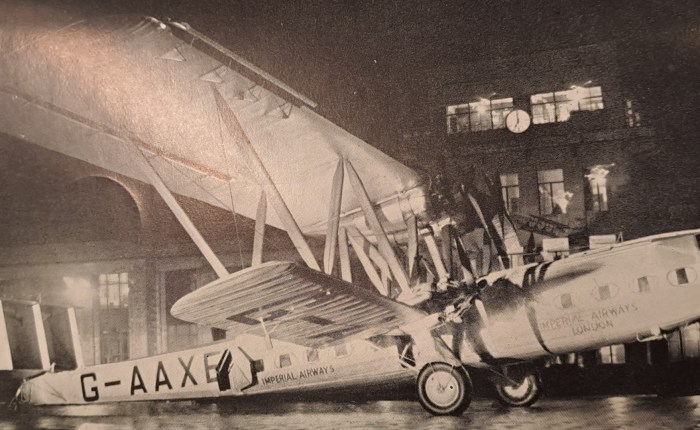
The 12.30 from Croydon opens with a delightful chapter told from the perspective of the murder victim’s ten-year-old granddaughter Ruby, who is terribly excited that she will be flying for the first time. Ruby, her father Peter, her grandfather Andrew, and Andrew’s butler Weatherup are all due to fly to Paris because Ruby’s mother Elsie has been in a traffic accident in the French capital. Crofts’ engineer’s eye for detail is evident in this opening chapter, which describes the Imperial Airways plane the family board:

It was just a huge dragonfly with a specially long head, which projected far forward before the wings like an enormous snout. And those four lumps were its motors, two on each wing, set into the front edge of the wing and each with its great propeller twirling in front of it. And there was its name, painted on its head: H, E, N, G, I, S, T; HENGIST.’[2]

‘Hengist’ was the colloquial name for a real Imperial Airways plane which until 1934 (the year of the book’s publication) flew on the European routes. It was subsequently converted to fly long-distance and as far as Australia, until the plane was destroyed in an accident in 1937. Once up in the air, Ruby and her family are served a ‘four-course lunch followed by coffee, all very nice and comfortably served’.[3] When they land, disaster strikes: Andrew Crowther, Ruby’s grandfather, is found unresponsive and declared dead.

A contemporary photo of the real Hengist plane standing outside Croydon Aerodrome, taken from A Million Miles in the Air,
the memoirs of pilot Gordon P. Olley, published in 1934

After the murder in the opening chapter, Wills Crofts shifts perspective and takes the reader back in time. The 12.30 from Croydon is a ‘psychological crime novel’ – rather than the reader trying to work out who has committed the murder and how, the author takes the reader into the mind of the murderer as he plots out his murder and attempts to escape justice. Andrew Crowther’s murderer, as it turns out, is his nephew Charles Swinburn. Charles is the managing director of the Crowther Electromotor Works, a firm originally set up by Andrew and his business partner Henry Swinburn. Although modest in size, the firm had been flourishing under Andrew’s leadership.

By the early 1930s, however, Charles is finding it impossible to stay afloat in the challenging economic environment following the 1929 Wall Street crash. Having already sunk his personal capital and a bank loan into the business, Charles approaches his uncle for financial help. Andrew, however, is not willing to give more than £1000, when Charles needs at least £6000. Knowing that he is one of the two heirs to Andrew’s estate (alongside Andrew’s daughter Elsie), Charles devises his plan to kill Andrew.

Charles method for murdering Andrew is one also used on occasion in other crime novels of the period. Andrew takes a ‘patent medicine’ against indigestion after lunch each day. Patent medicine were mass-produced pills designed to remedy common ills. Unlike more traditional medicine which was prescribed by a doctor and then mixed up to order by a pharmacist, patent medicines were available in standardized bottles and could be purchased without a doctor’s prescription.

In novels of the 1920s and 1930s they are often treated with disdain and considered to be inferior to the personalised prescriptions that a doctor would give out. However, their wide availability and uniform appearance also made them an ingenious murder weapon. Charles buys a bottle of pills identical to the one Andrew uses, but replaces one of the pills with a pill filled with potassium cyanide, an extremely lethal poison. Like in the Poirot short story ‘Wasps’ Nest’, Charles manages to obtain the poison with the excuse that he needs to eradicate a wasps nest from his garden. When at dinner with Andrew, Charles distracts him and swaps the pill bottles, pocketing Andrew’s bottle and replacing it with the one that contains the one deadly pill. He then books himself onto a Mediterranean cruise to be out of the way when Andrew eventually takes the poisoned pill.

Although the murder plan works and Charles duly inherits half of Andrew’s estate, Charles swiftly finds out that murderers rarely rest easily. First Weatherup reveals that he has seen Charles swap the pill bottles, and starts blackmailing him. Charles swiftly decides to kill Weatherup, too. Then Inspector French arrives and starts asking some awkward questions. The arrest, when it inevitably comes, takes Charles by surprise. It is not until the final chapter of the book that the reader is shown how Inspector French conducted his investigation, and how his powers of deduction led him to correctly identify Charles as the murder. The perfect murder plan conceived by Charles is revealed to have had some rather large holes in it.

Charles is duly condemned to death and executed. There is less moral ambiguity in The 12.30 from Croydon than, for example, Anthony Berkeley’s Malice Aforethought, or even than in Henry Wade’s Heir Presumptive. Although Andrew Crowther is not a hugely sympathetic character, there is no doubt to the reader that Charles’ actions are wrong, and that the policing and justice systems will catch up with him and serve him the expected sentence. The book’s reversed structure allows Wills Crofts to reveal Inspector French’s intellect in the final chapter, transmitting the reassuring fiction to the reader that no matter how well one may think they have planned a crime, the men from Scotland Yard will always ensure that justice is dispensed.


[1] Martin Edwards, The Golden Age of Murder (London: Collins Crime Club, 2016), p. 75

[2] Freeman Wills Crofts, The 12.30 from Croydon (London: British Library, 2016), p. 16

[3] Ibid., p. 19