Hints and Hobbies (1926)

By 1926, cinemagoing was firmly established in Britain, and it was transforming from a working-class hobby to something rather more respectable. Super cinemas, which offered lounges and tearooms as well as screenings, were designed to attract middle-class women. Film historian Ina Rae Hark has argued that cinemas tried to draw in female customers by “attempting to create a dream home in which the woman could (…) enjoy complete freedom from responsibility for its maintenance.”[1] Like the department stores that appeared in Britain at the end of the nineteenth century, super cinemas gave women a respectable place to go when they were out in town: a female equivalent for male clubland.

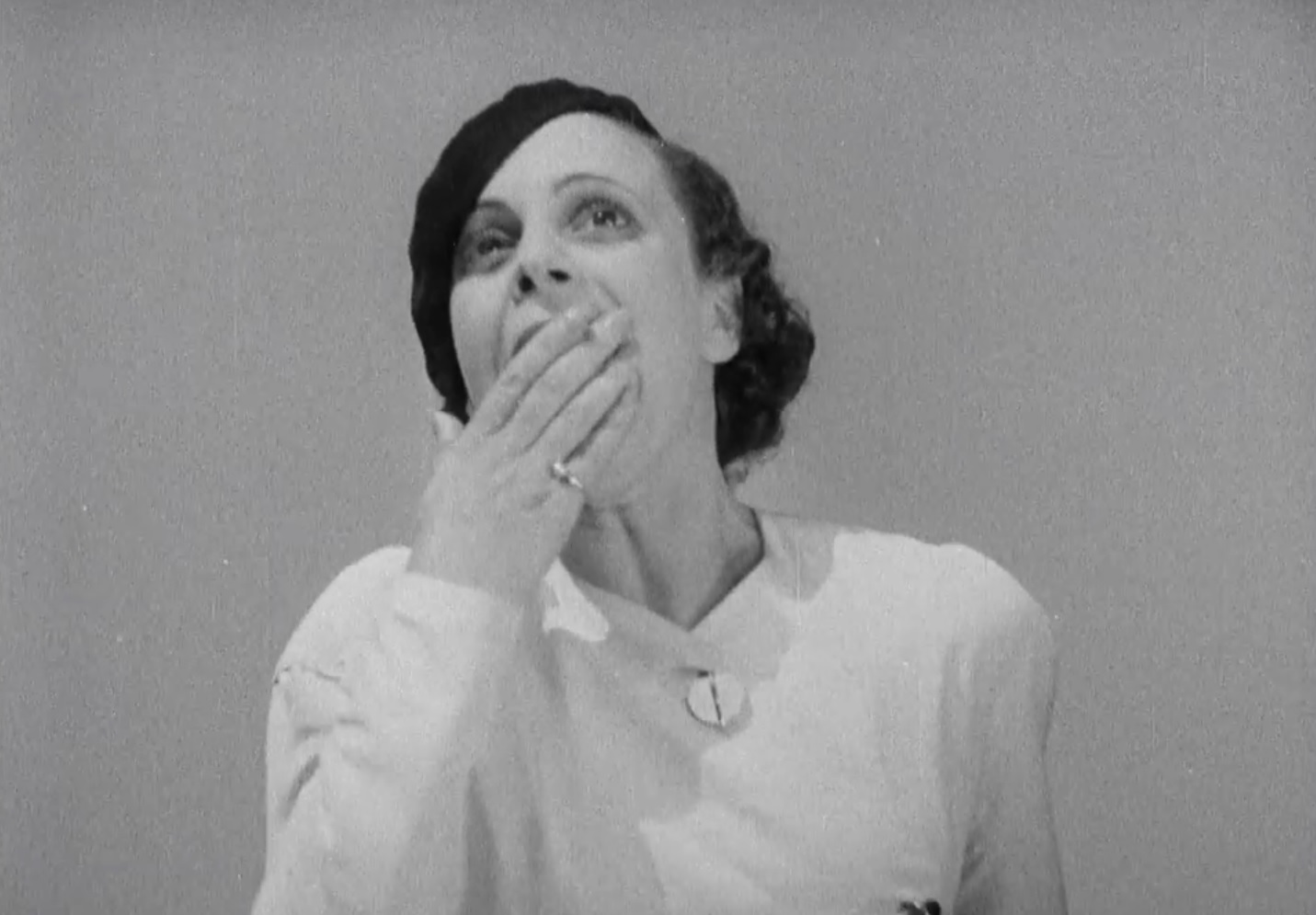
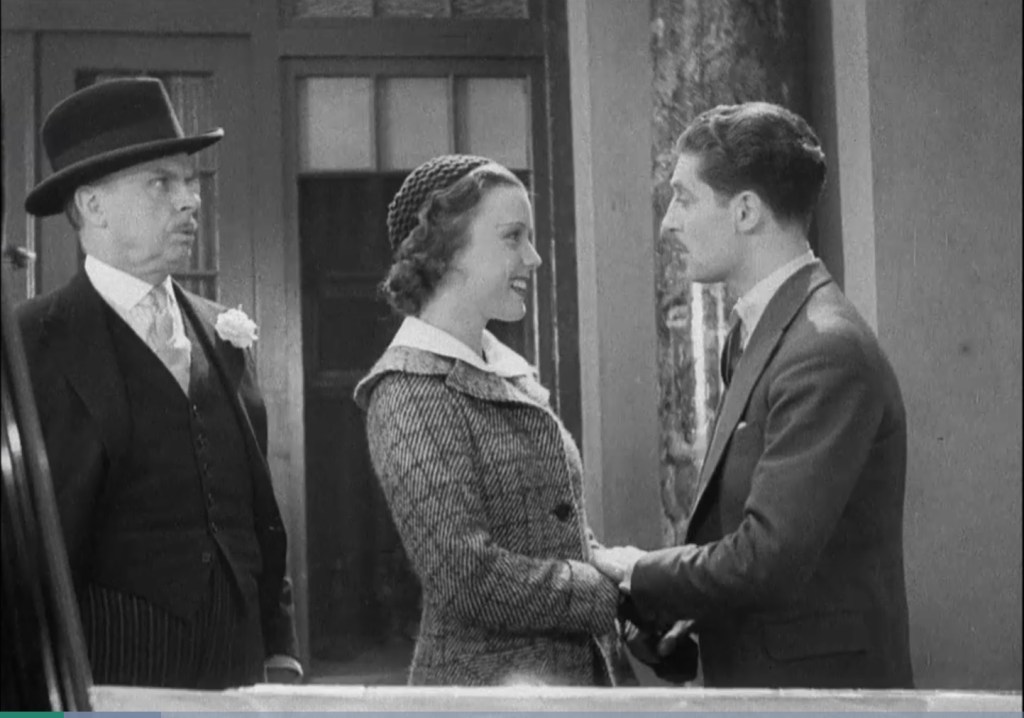
Inside the screening room, audiences did not just see a single film, but rather a varied programme of features, cartoons, informational films and advertisements. In 1926, silent film director A.E. Coleby, who had previously directed morality tales such as The Lure of Drink (1915) produced a series called Hints and Hobbies. Twelve episodes of this weekly bulletin survive in the BFI National Archives and are available to view online for UK-based audiences. These amusing films provide insight to the range of topics which were deemed relevant and suitable to a largely female audience.

Each episode of the series is about fifteen minutes long and covers a series of topics for a few minutes each. The very first Hints and Hobbies starts with a ‘Pets Column’ featuring kittens and puppies, showing that a version of the cat video has been a crowd pleaser for over a century. It then moves to a woman demonstrating how you can make a large decorative vase out of cardboard – for the use of dried flowers only one presumes! It is introduced with the title: ‘An Interesting Hobby which can be made to help pay the rent (?)’ It is evidently not going to be the most effective way to earn extra cash, but this does show that the target audience for this segment are women who are not poor but still could do with some more disposable income.

The penultimate sketch included in episode one is clearly aimed at the same audience. Titled ‘If only husbands were like this!’, it shows a married couple at the breakfast table. The woman receives a number of bills for recent clothes purchases: £8 8s for two hats, £10 10s for a ‘costume’, and £21 for an evening dress. This was serious money in 1926, but the fictional husband is unperturbed. ‘Quite alright, darling’, he says, and even says his wife should have treated herself to a second gown. E.M. Delafield’s Provincial Lady, no stranger to the lure of the boutique and the subsequent bank overdraft, would no doubt have appreciated this scene.

Hints and Hobbies also reflected modern concerns of the time, such as road safety. As this blog has noted previously, the interwar period saw a huge increase in car ownership but little in the way of safety regulations. In lieu of driving licenses or instructors, poor driving was rife. The first episode of the series exhorts drivers to be mindful of others when overtaking one another; the second episode asks female drivers specifically to not be ‘Miss Kareless Kornerer’ when taking a left-hand turn.

Along with the household and cooking tips included in each episode, Hints and Hobbies also took the traditionally feminised profession of nursing and used it to teach first aid to a wide audience. Lady Superintendent Mrs Webb from the St John’s Ambulance Brigade was on hand to demonstrate how to dress a wound in the palm of one’s hand, or how to make a splint for a fractured leg. Seven years after many women had trained as nurses during the First World War, these segments taught a new, younger generation of women the principles of emergency care. Mrs Webb appears in her uniform, capably handling the tools of her trade to fix up male patients.

The penultimate surviving episode of Hints and Hobbies veered away from accepted femininity and treated its audiences to something rather more transgressive: jiu-jitsu for women. The alarmist intertitle ‘You never know when the following may happen to you’ is followed by a sequence showing a young woman being attacked by a male loafer, who tries to steal her handbag. Luckily for the victim, a capable female motorist steps out of her car, grabs the man, retrieves the handbag, and ends with throwing the attacker to the ground. When returning the bag to the first woman, she tells her ‘My dear, it behoves every girl to-day to be able to protect herself…If you will come to the address I will give you at 7 o’clock to-night I will give you a few hints.’

It’s no surprise that this particular episode of Hints and Hobbies has been embraced by some LGBTQ viewers as representing an example of ‘lesbian erotica.’ Dressed in short tunics and standing on mattresses, the two women demonstrate several self-defence moves on one another. This no doubt also gave straight male viewers plenty of ‘visual pleasure’ but the casting of the man as the villain rather than hero in this segment, and a final shot of the two women embracing and leaving the room with their arms around one another, give plenty of space for a queer reading.

Little else appears to be known about Hints and Hobbies – who decided which topics to include, which cinemas they were shown at, or why the series did not last. However, even without any additional information the series provides plenty of insight into what the producers thought would entertain and inform their mostly female audiences. The changing gender norms of the period are reflected in the content that veers from tips on how to remove ink stains from aprons to improvising fancy dress for your next flapper party.  

The full Hints and Hobbies series can be viewed for free by UK-based viewers on the BFI Player.


[1] Ina Rae Hark, ed, Exhibition: The Film Reader (London: Routledge, 2001), chapter 12, Ina Rae Hark, ‘The “Theatre Man” and the “Girl in the Box Office”, pp. 143-154 (p. 145)

Notorious interwar murders (part 3)

This blog post is the final of a three-part series on notorious interwar murders. You can read part 1 here and part 2 here.

After the Thorne case, the 1930s started with two murder cases which were even more sensational. On 8 April 1930 Sidney Fox was executed for a crime which was considered even more heinous than murdering a pregnant woman and destroying her body: he was convicted for murdering his own mother Rosaline.

Matricide is rare in the United Kingdom, and Fox became notorious.[1] Fox was also the first person condemned to death since 1907 who did not appeal his conviction, which seemed to further prove his guilt.[2] However, like the Thorne case, the Fox conviction has continued to spark debate and recent re-examinations conclude that it is possible Rosaline died of an accident.

Fox and Rosaline lived a nomadic existence, travelling from seaside hotel to seaside hotel, and committing thefts and frauds to obtain money. In spring of 1929, under the instructions of Fox, Rosaline took out a life insurance policy that guarded against accidental death. The policy expired at midnight on 23 October. And on 23 October, in a hotel in Margate, Rosaline’s bedroom apparently caught fire at 11.40pm. Rosaline’s body was discovered inside, making Fox eligible for a life insurance pay-out.

The doctor attending the scene considered that Rosaline had died in the fire, and she was buried without further examination. However, Fox’s behaviour on the night, the fact of the life insurance, as well as the forensic evidence in the room led Scotland Yard to conduct further investigations. After Rosaline’s body was exhumed, Sir Bernard Spilsbury (yes, him again) concluded that she had been strangled before the fire had started.

The oratory power of Spilsbury, combined with the emotional horror of alleged matricide, Fox’s criminal past, and his homosexual inclinations, were enough to convince the jury to convict him. Not surprisingly, the Home Secretary did not use his executive powers to commute the sentence.[3] The Home Secretary usually only reprieved condemned prisoners if ‘popular feeling’ was in favour of the prisoner, which in this case it was decidedly not.[4]

The British public had barely recovered from the excitement of the Fox case when yet another murder case grabbed the headlines. Whereas the 1920s had seen husbands poisoning their wives and later, men killing their girlfriends, Alfred Rouse tried to fake his own death by killing another (still unidentified) man and setting his corpse on fire to make it unrecognisable. Contemporary commentators may have argued that the nefarious influence of Hollywood cinema had led to this spectacular crime!

Like Patrick Mahon, Alfred Rouse was a salesman; and like Mahon, Rouse also had many affairs with women and teenage girls which his wife was unaware of. These affairs often led to the women having Rouse’s children. Rouse always pretended he was single, and even went as far as to illegally marry several of his mistresses, to keep up the pretence that he was fully committed to them. Although he made a good salary with his job, it was not sufficient to secretly support these many women and children. Things came to a head in the summer of 1930, when two of Rouse’s longstanding girlfriends were both expecting marriage, and several of his past partners were demanding child support money from him.

Rouse planned his scheme carefully; he took out a life insurance policy in case of death in a car accident. He then found a man in a pub who claimed to be out of work and with no family or other support network, who also was of roughly the same height and build as Rouse. This was the perfect victim for his purposes. Rouse offered the man a lift to the Midlands on the evening of 5 November – Guy Fawkes night in England during which a lot of bonfires are traditionally lighted. Rouse hoped that the bonfires would provide cover for his plan.

It has never been fully clarified what exactly happened in the car, but Rouse got his companion drunk enough that he fell asleep. According to Rouse, he never found out the man’s name or any personal details about him. Rouse parked his car in a ditch off a country lane, doused it in petrol and set it on fire.

It is possible his plan would have worked, had he not been spotted emerging from the lane by two teenage boys who were walking home from the bonfires. Seeing a man in a suit (but without a hat!) clambering out of a ditch in the middle of the night was unusual enough, but when they found a car ablaze a few meters further they naturally warned the local constable.

By the time the fire was put out, the body was horrifically charred and unrecognisable. The car, however, was identified as belonging to Rouse. This was passed on to the newspapers, as well as an urgent call for the man without a hat to report as a witness to the police. Rouse in the meantime met up with one of his mistresses, who showed him the newspaper articles about his car. Although Rouse claimed the car was not his, the woman was sufficiently suspicious to alert the police. Rouse was arrested as he got off a coach at Hammersmith bus station.

At the trial, the jury once again took less than half an hour to find Rouse guilty. During the trial Rouse claimed that the unknown man’s death was accidental, but shortly before his execution he wrote a full confession to the Daily Sketch. The newspapers, which had played a material part in Rouse’s arrest, were also able to benefit from his execution. For a man like Rouse, the newspaper coverage of the case was not just a threat, but also one final opportunity to bolster his ego.

There are (many) more murder cases that could have been included in this series, from those which got ample newspaper coverage to those which were considered not newsworthy. Those which were sensationally described in the press, however, subsequently filtered into contemporary crime fiction and non-fiction books, and from there into that nebulous concept, the ‘public imagination.’ Newspapers were instrumental not only in helping solve the crimes, but also in building up a shared body of knowledge on what it means to commit a British murder.


[1] Playwright and actor Emlyn Williams refers in his autobiography to an acquaintance, whose own claim to fame was that he had known Sidney Fox. Emlyn Williams, Emlyn: A sequel to George (London: Penguin, 1976)

[2] Colin Evans, The Father of Forensics (Thriplow: Icon, 2007), p. 221

[3] ‘Margate Matricide: Death Sentence to Stand’. Evening Post, 7 April 1930. p. 9

[4] Douglas G Browne and E.V. Tullett, Bernard Spilsbury: His Life and His Cases (London: Harrap, 1951), p. 264

Brooklands

Brooklands

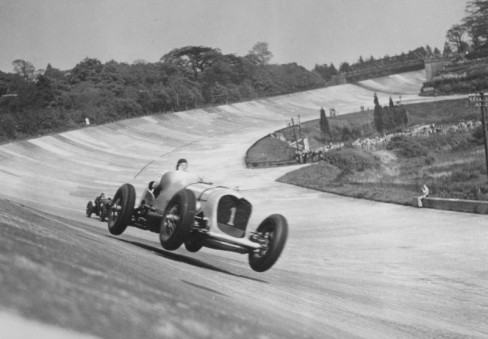
Brooklands race course was an institution in interwar England. Opened in 1907 in Weybridge, just south of London, it was the world’s first purpose-built, permanent racing circuit. Coinciding with the rise of car manufacturing in England, Brooklands was used to test out and perfect new car models. Like greyhound racing and horse racing, Brooklands races became a popular entertainment. Each race held the potential for injury and death, which piqued the audiences’ interest.

Still from Death Drives Through (1935) which was shot at Brooklands

The Brooklands track could be shaped into different configurations, but was mostly used as a long oval lap, made of concrete, and concave, so that the outer edges of the track were higher than the middle (like a modern indoor speed cycling circuit). Footage shot in 1928 shows how cars started on a flat section, and how drivers were positioned outside their vehicle at the start of a race. Pit stop booths were available for technical check-ups during the race. Although the cars in this particular footage look fairly similar to normal road cars, there were plenty of racing cars being developed also.[1]

Examples of these racing cars are on display in the 1935 film Death Drives Through, directed by Edward L. Cahn. Most of the action of this film is set in and around Brooklands, as the main characters of the film are two rival race car drivers. Kit Woods (Robert Douglas) is an up-and-coming driver who built his own race car and used to drive on local tracks before being talent-spotted and contracted to appear at Brooklands. Once he arrives there, established racer Garry Ames (Miles Mander) does everything within his power to destroy Kit’s reputation, including causing accidents on the race track. Death Drives Through features a staged crash at Brooklands which ends in the death of a driver, highlighting the potential for danger which was contained in each race.

A 1938 Gaumont newsreel features footage of a real Brooklands crash. Because the driver in that instance survived the accident, the newsreel commentator can play the incident up as thrilling entertainment, which was ‘filmed exclusively by Gaumont British News’.

‘Mr Clayton was flung out into the trees….miraculously he escaped death although he was seriously injured…his car was reduced to wreckage…below the banking outside the track it was a crumpled mess…hardly to be recognised as a car.’

The newsreel as a whole is titled ‘120 M.P.H CRASH AT BROOKLANDS’, making no bones about the fact that the crash, rather than the overall race, was what was expected to be of interest to audiences.

Racing drivers became celebrities, to the point that by the mid-1930s, their endorsements were featured in Castrol car oil adverts. Drivers not only competed in England, but also participated in European competitions which potentially increased their profile even more.[2] The British Government gratefully used the fame and prestige of some drivers in its own ‘Safety First’ campaign, launched in 1934. The purpose of this campaign was to increase road safety. In the absence of any formal driving test, racing driver the 5th Earl of Howe patiently explains to viewers how to indicate and overtake, and advises against canoodling with a lover whilst driving a car. Although none of the regular traffic rules would apply on a race track, the audience is still asked to presume the Earl to be an expert adviser, both due to his title and his status as a racing driver.

Racedriver John Cobb endorsing Castrol XXL – Front page of the Daily Express, 11 August 1934

There were plenty of women racing at Brooklands too – like aviation, car racing was a sport in which technical skill, rather than physical strength, were paramount. Despite initial opposition, from 1932 onwards women were allowed to compete in the same races as men. One of the most famous female drivers, Kay Petre, appears in the 1938 video showing a crash, referred to above. There are plenty of stories about other female drivers available on the Brooklands Museum website.

A final note on the audiences to these races. The 1928 footage referred to at the top of this blog shows an audience apparently exclusively made up of middle-aged men in three-piece suits and top hats. By 1938, the audience is much more mixed both in terms of gender and (judging by the clothes) social status. There are plenty of men visible in flat caps, or even, no hats at all. There also appears to be a much larger crowd than ten years’ prior.

This change reflects the overall change to car ownership which happened in parallel, away from the race track. Whereas car ownership had started off as something exclusive and only available to the very wealthy, by the end of the 1930s cars were affordable to most middle-class families. This greater exposure to car driving likely also increased interest in car racing. Although most racing drivers came from privileged backgrounds (if not from the actual aristocracy, then at least from wealthy families), there was always the possibility for a ‘regular’ person with technical knowledge and talent to establish him- or herself. Death Drives Through pandered to this fantasy, as Kit is exactly the kind of enterprising and plucky hero whom audience members could relate to. The tracks of Brooklands become not just a space for thrills and entertainment, but also a site of dreams of social mobility.


[1] Bart H. Vanderveen (ed), British Cars of the Late Thirties, 1935-1939, (London: Frederick Warne & Co, 1973)

[2] Bernhard Rieger, ‘Fast  couples’:  technology,  gender  and  modernity  in  Britain  and  Germany  during  the  nineteen-thirties”, Historical Research, vol. 76, no. 193 (August 2003), 370

Pa Puts His Foot Down (1934)

Pa Puts His Foot Down (1934)

With the rapid increase of car ownership in interwar Britain, it is no wonder that car production companies started to produce high-end advertisements to persuade the public that their cars were superior to all others. In 1934, Zoltan Korda, brother of Alexander Korda, produced a 15-minute advert for Daimler subsidiary company BSA cars. As with other adverts produced in this period, this film would have been shown in cinemas as part of a mixed programme.

Pa Puts His Foot Down starts with several high-angle establishing shots of Piccadilly Circus. There are few road markers and vehicles are seemingly randomly moving around the roundabout. By 1934, the majority of vehicles on the road are motorised: double-decker buses, private cars, taxis, and trucks. Closer shots of traffic, however, also reveal cyclists, bike couriers and the occasional horse-drawn cart. Pedestrians do their best to avoid traffic as they cross the road. These shots are clearly taken on location in Central London.

We are then introduced to Pa and his daughter Betty, who are standing on a pavement trying to cross. For the shots in which the characters are talking, they are clearly on a sound stage mocked up to look like a pavement with a series of shop-fronts. Betty tries to persuade her father several times to cross the road. Each time the shot of her stepping off the pavement in the studio is followed by a shot of a vehicle rushing close by, clearly shot on location. This gives the illusion that the actors really are in Piccadilly Circus.

Betty tells her dad he should ‘just cross over’, after which he starts grumbling about the dangers of modern traffic. It transpires that Pa used to drive a car in the past but now is too nervous to drive. Rather than owning up to his fear, he pretends that modern cars are too expensive, which of course gives his daughter the opportunity to tell him (and the audience) that ‘good cars are quite cheap nowadays’ and ‘the best people drive themselves nowadays’.

After this exposition dialogue which has placed the notion of cheap, reliable cars in the audience’s mind, Pa tries to cross the road himself. In quick succession we see Pa stepping off the pavement; a police officer directing traffic; a close-up of a car; the daughter shouting at Pa; the police officer looking alarmed; Pa’s hat on the asphalt; a female passer-by screaming; and Pa gathering his hat off the road. The final shots are overlaid with the sound of a car horn honking. Korda effectively conveys the illusion of a near-miss without having to stage a stunt or even have any of the actors get close to a moving vehicle. Although Pa Puts His Foot Down is a sound production, this sequence is heavily indebted to silent cinema conventions.

Once Pa is safely back on the pavement, a car pulls up and a young man jumps out, who immediately greets Betty in a very familiar way. She explains to Pa that they met ‘at a dance somewhere’ and that the man has a ‘good job in the motoring business’. The young man promptly offers to drive the pair to their destination – home in the country, 30 miles outside of London. Pa gets bundled in the back seat whilst Betty sits next to the driver.

Immediately after they set off, the young man starts explaining to the daughter that his Daimler BSA has gears but no clutch, because of the Daimler Fluid Flywheel. With a rather dreamy voice, the man starts talking about this innovation, at which point the image cuts away to a diagram demonstrating to the audience the inner workings of this novel gearbox. The Daimler BSA essentially was halfway between a car with a manual clutch and an automatic car. It still had gears, but rather than having to manipulate the clutch pedal and gear change at the same time, the driver could ‘pre-select’ the next gear and then press the clutch pedal at their leisure.

After a minute and a half of diagrammatic explanation, we cut back to the trio in the car where the daughter asks some more detailed questions about how the gearbox works in practice. After several more minutes of explanation, the man invites Betty to try it for herself. Although she previously stated quite confidently to her father that she drove cars, she now minimises her abilities by hastening to add she drives ‘very little’. Naturally, this is no impediment to her being able to drive the Daimler BSA with ease. When Pa wakes up and is alarmed to see that his daughter is driving, the man says it’s quite alright, as ‘this car would be safe in the hands of a child’. The fluid flywheel is so successful that even Pa is starting to get interested in its operation.

After a few more demonstrations of gear changes and brakes, the trio arrive at their destination. While the daughter invites the man in for a drink, Pa subjects the car to a closer inspection. Over a drink, Betty states she is determined to raise the money to get herself a Daimler BSA car. The man immediately ups the ante by suggesting they get engaged. Although Betty quite reasonably counters that they hardly know one another, she falls in with the plan quite readily. Clearly half an hour’s conversation about fluid flywheels has convinced her of the match.

When the couple try to find Pa to get his consent, they realise that he’s driven off with the car and is driving it round the common. When Pa returns he tells the man ‘I thought, if you go off with my daughter, I’ll go off with your car.’ He follows it with saying that he’d always heard the pre-selector gearbox described as an ‘effeminate thing’ but that this was ‘utter rubbish’. When Betty asks him if she may get engaged to the man, Pa jokes that he won’t ‘find her as easy to control as the car’ and then suggests a ‘bargain’: ‘You take the girl, I take the car’.

At this, the end of the advert, both car and woman are commodified and put on equal footing with one another. At the same time, the advert has taken great pains to portray the BSA car as both easy to handle for inexperienced / female drivers, and robust and ‘masculine’ enough for male or experienced drivers who wanted to show off their driving skill. The diagrammatic explanation of the flywheel may appeal to technically-minded viewers, whilst the subsequent practical demonstration demonstrates its benefits to a less specialised audience. Rather implausibly, extensive talk about car technology is also presented as the way to a woman’s heart.

Pa Puts His Foot Down can be viewed on the BFI Player (UK only)

They Drive By Night (1938)

Towards the end of the interwar period, Warner Brothers’ British arm produced the thriller They Drive by Night, directed by Arthur Woods. This should not be confused with the 1940 American film of the same title, starring George Raft and Ida Lupino; although both films make reference to the long-distance lorry driving community, which is what their titles also refer to. Woods was still only in his early thirties when he directed They Drive By Night, but he’d already had a long career in the industry as a director (Radio Parade of 1935; Music Hath Charms) and screenwriter (Red Wagon; I Spy). They Drive By Night is a thriller, different from the majority of Woods’ work which was in musical comedy. Woods died in 1944 in active combat after joining the RAF at the outbreak of the Second World War.

The hero of They Drive By Night is ‘Shorty’ Matthews, played by Emlyn Williams. A the start of the film Shorty has just been released from prison, and he goes to look up Alice, an old flame who works as a dance hostess. When he arrives at her lodgings, Alice is dead in her room. Shorty panics and goes on the run, by posing as a long-distance lorry driver. With the help of Molly, one of Alice’s friends and colleagues, he keeps out of the hands of the police and is eventually able to track down Alice’s real killer. The killer is an older man with an obsession for the ‘criminal mind’, who used to often dance with Alice at the dance hall.

Although They Drive By Night is based on a British novel and set in England, the influence of the American producers on the film is marked. It is a prime example of the kind of film that met the criteria of a ‘British’ film under the 1927 Cinematograph Films Act, without actually conveying the British cultural values the Act also aimed to promote. For example, the characters use Americanisms and slang throughout the film. When Shorty first gets out of prison, he meets a woman in a bar: she is ostentatiously chewing gum, and her hair is dyed platinum blonde. This was hardly the type of womanhood thought to reflect British values, but Shorty and the barman look after the woman appreciatively.

They Drive By Night’s overall narrative also espoused values that are not typical of British films of the period. The main characters are a convicted criminal and a dance hostess turned lorry girl. As Julia Laite has explored, the lorry driving community caused concern in 1930s Britain as some young women hitched rides from drivers. It was suggested that this type of hitchhiking sometimes involved an exchange of sexual favours, which in turn led to the spread of venereal diseases amongst the lorry driving community.[1] This in turn could lead, it was feared, to unsafe road situations when lorry drivers were ill, thus neatly linking the whole matter to ongoing road safety debates.

In They Drive By Night, however, there is no suggestion that Molly sleeps with the lorry drivers that help her, and the general practice of girls hitching rides is not condemned. When one of them tries to take advantage of her, she fights him off. This driver is presented as a ‘bad sort’ and not representative of the whole lorry driving community – a second driver whom Shorty spends some time with is shown to be faithful to his wife at home. Overall, the lorry driver scene is presented as a more positive male environment than Shorty’s criminal network back in London; but ultimately the film presents a heterosexual coupling as the only truly appropriate outcome for Shorty.

The police play only a minor part in They Drive By Night, and they are not instrumental to the capture of Alice’s killer. Unlike other thrillers of the late 1930s such as The Squeaker or The Dark Eyes of London, the police inspector in They Drive By Night is not one of the protagonists who leads on the resolution of the case. Indeed, they do not feature in the film’s climax, in which Shorty and Molly are at home with the killer and he nearly succeeds in murdering Molly, at all. They Drive By Night skips over the killer’s arrest and trial – the parts of the process in which the police would be involved – straight to the day of his execution.

The police primarily feature as a plot device that gives urgency to Shorty’s actions as the police chase him. Shorty’s criminal record is no impediment to his status as the film’s hero, but throughout the film characters encourage him to ‘go straight’. First the owner of his regular bar tells Shorty not to go back to his old criminal habits. Then Molly’s steadfast support of Shorty whilst he is on the run for the police persuades him to say goodbye to his criminal life for good and turn himself in voluntarily. Only then is he able to outwit the killer and save Molly’s life as a traditional hero would. The eighteen months Shorty has done in prison for his earlier crimes are sufficient to wipe these off his slate and allow him a fresh start; arguably a philosophy more reflective of American culture than British values. Molly, too, is presented as a suitable romantic partner despite her past as a lorry girl and her work as a dance hostess; two roles which were regularly connected with loose morals.

They Drive By Night seems to represent a transitional point in British interwar cinema, where American values had influenced British culture so much that they started to permeate British films. Despite the best efforts of the legislators, they were not able to stem the tide of American cultural influence on the domestic film industry. This influence went beyond hairstyles and mannerisms to a fundamental re-appraisal of morality and social values.

They Drive By Night is available to view on Youtube.


[1] Julia Laite, ‘Immoral Traffic: Mobility, Health, Labor, and the “Lorry Girl” in Mid-Twentieth-Century Britain’, Journal of British Studies (2013) 52:3, pp. 693-721 (693-4)

Death in a Taxi

The hansom cab has been a mainstay of the London streets since the 17th century.[1] The black horse-drawn carriages were largely replaced by motorised vehicles by the end of the First World War. The designs of the motorcar taxis were based on the hansom cab that preceded it, which meant that the driver was seated in the open air, or under a canvas roof, and was physically separated from the passengers. This design ensured that the passenger(s) continued to enjoy privacy during their trip and did not have to share it in close proximity to a stranger. It also assuaged any class anxieties about wealthier passengers having to share a space with a driver from a lower socio-economic background.

Taxis occupy a unique position in the transport landscape: they are open to all users who can afford them but provide a private transport experience; they are also essentially urban and predominantly found in big cities. Both these features as well as the separation of passenger and driver all stress the anonymity of the taxi experience. There were no records of who used taxis beyond what a driver could remember of his customers.

It was presumably for these reasons that for some people, the London taxi was the chosen site for murder or suicide. Tabloids reported on a number of such cases in the first half of the 1920s. In November 1923 the Daily Mirror printed the headline ‘Dead Woman in Cab’.[2] The article described that at the end of the afternoon the previous day, a young man had come into a police station in Knightsbridge and said to the officer on duty ‘the woman is in the cab outside’. In the taxi the police found the body of Ethel Howard, with a wound to the throat and a razor lying next to the body.

Daily Mirror, 16 November 1923, p. 2

At first glance this could be a case of either suicide or murder. The man who reported the death remained unnamed in the article but was described as a ‘portrait painter’. This immediately sought to evoke images of bohemia in the newspaper reader’s mind. The romance and mystery of the case was brought crashing down to earth in the follow up article printed the next day, which reported on the magistrate’s inquest on the case.[3]

The ‘portrait painter’ was in fact the 24-year-old butcher’s assistant George William Iggulden. Iggulden and Ethel Howard had been engaged to be married on 16 November. Instead, Iggulden murdered his fiancée the night before the wedding. The Mirror called this ‘the irony of fate’, although the reader may conclude that this was not so much fate as George Iggulden using desperate measures to get out of his commitment. In the taxi, he found a confined space where Ethel would not be able to escape from, and where he was sure not to be interrupted. In this second newspaper article, Iggulden is reported not just to have said ‘the woman is in the cab outside’ but also ‘I did it with a razor’. He was duly remanded to stand trial for murder.

The party who is curiously absent in all this is the taxi driver. The only oblique reference to their presence is in the second article, which described that Iggulden ‘asked to be driven to the nearest police station’ rather than to Chelsea, halfway through the drive. The police are not reported to have spoken to the driver or gotten their statement, and there is no consideration as to what the impact of a murder being committed several feet away from them may have had.

A taxi driver did have a more active role in proceedings in a case in 1925. On 23 April of that year, the Daily Express reported on a ‘Mystery of A Taxicab’.[4] On 21 April, a Sunday, Major Frank Montague Noel Newton had engaged a cab to take him from his club to his hotel. Immediately it is clear to the reader that this passenger is a man of substance, who comfortably moves around the West End. Upon passing the Hotel Metropole (now known as the Corinthia Hotel) just off Trafalgar Square, the driver heard a noise ‘as though someone was knocking on the window with a stick’. The driver was evidentially located outside the cab, with a window separating him and his passenger.

Daily Express, 23 April 1925, p. 9

The driver didn’t notice anything out of the ordinary when he turned to look through the window, so he drove on to Major Newton’s hotel. Once he arrived there, he engaged the help of the hotel porter to try and rouse Major Newton, who appeared to be asleep. Then the men realised that there was a revolver on the floor of the cab, and that the noise the driver had heard was Major Newton shooting himself.

One must make allowances for the noise cars in the 1920s generated, but it still seems extraordinary that a driver would not identify a shot fired within such close proximity. However, the story repeated itself a year later:

On arriving at Charing Cross Station about midnight on Monday the driver of a taxicab found his fare shot dead. The man hailed the driver on Cromwell Road and nothing occurred during the journey to attract attention. When he did not alight at Charing Cross, the driver got down from his seat and found the man lying dead. A revolver was on the floor.[5]

Evidently, for these men, the mobile and anonymous nature of the taxi provided a suitable space for them to commit suicide. They knew they would not be disturbed for the duration of the trip, and that they would be found by a stranger. The man who was driving to Charing Cross was reported to be a Swede visiting London. Like Major Newton, he did not have a fixed address in the city; the locations of their deaths underscore this sense of fluidity and lack of permanency.

For the drivers, finding a dead body in their vehicle appears to have been something they were expected to handle in the course of their employment. They remain anonymous in the reports, their taxis indistinguishable from the rest of the fleet that swarmed London’s streets. It is this anonymity which made their taxis such appealing sites for illicit and illegal behaviour in interwar London.


[1] George N Georgano, A History of the London Taxicab (Newton Abbot: David and Charles, 1972), p. 110

[2] ‘Dead Woman in Cab’, Daily Mirror, 16 November 1923, p. 2

[3] ‘Dead Girl in Taxi’, Daily Mirror, 17 November 1923, p. 2

[4] ‘Mystery of a Taxicab’, Daily Express, 23 April 1925, p. 9

[5] ‘Shot Dead in Taxi’, Daily Mirror, 3 November 1926, p. 2

Car ownership and regulation in interwar London

One of the features of the British interwar period is the absolute explosion of car ownership that took place, and the development of ‘car culture’. The number of private (non-commercial) vehicles on the road increased in particular; from 187,000 private cars in 1920 to 1,523,000 by the outbreak of the Second World War, of which around 350,000 drove around London.[1] Not only were there more and more cars on the road; they also were able to reach increasingly high speeds. These two developments led inevitably to one of the greatest traffic concerns of the interwar period: an increase in road traffic accidents leading to casualty or even death.

The rapid increase in the number of privately-owned cars was facilitated by both a reduction the price of cars (and a burgeoning second-hand market), and a general rise in living and income standards for lower-middle-class workers, particularly those in London and the South East.[2] More people were able to put money aside to buy consumer goods, and many more families were able to buy a low-power, low-cost car, or buy a care through a hire-purchase scheme in which one pays in instalments. For those who had moved into one of London’s newly developed suburbs, the car represented the possibility to go on weekend day-trips outside of the city and visit roadhouses. Yet suburban development also increased the chances of accidents, “because of the high number of fast arterial roads built there and the predilection for building housing estates near to these new roads.”[3]

As the number of vehicles on the road increased, so did the number of fatal accidents: from 2386 fatal accidents in England and Wales in 1920, to 5690 fatal accidents in 1935.[4] To put these figures in context: “there were more road fatalities in the three years 1929 to 1931 than there were British soldiers killed in the wars with France between 1793 and 1815.”[5] Naturally, these figures sharpened minds and political will to make roads safer. It seems counter-intuitive, then, that the Government actually decided to abolish maximum speed limits in 1930.[6] As the average car could reach speeds of 70 miles per hour, abandoning speed limits had consequences.[7] The decision was hastily reversed in 1934 in light of the fast-increasing numbers of accidents and casualties.[8]

The reason for the original abolishment of speed limits came down to social class, as so many things in interwar Britain do. Before the First World War, cars were luxury items that were only accessible to a select few. In the Victorian tradition of law making, the upper classes were used to their leisure pursuits to be unregulated.[9] When traffic regulations were adopted, many drivers suddenly found themselves confronted with the law for the first time.[10] To make matters worse, those enforcing the regulations were police officers who were generally working class.[11] Those with political clout and influence found themselves suddenly treated as criminals when they breached traffic regulations, and they were able to build a coalition that successfully lobbied for the removal of the speed limit in 1930.

The 1930 Road Traffic Act did, conversely, introduce additional offences in ‘careless driving’ and driving under the influence of alcohol or drugs.[12] This subtle shift in legislation meant that rather than allowing blanket prosecution for anyone breaking an (arbitrary) speed limit, only individuals in specific circumstances could be prosecuted. It assumed that most drivers would be responsible enough to stick to a sensible speed limit. The rise in road traffic incidents and casualties following the passing of the Act, however, indicated otherwise. Before long, those lobbying on behalf of pedestrians and other vulnerable road users were able to argue in parliament for the (re)introduction of tighter traffic safety laws.[13]

The big flaw in depending on drivers to be responsible, was that there was no formal system for training or testing drivers. People taught each other how to drive, and there was no agreed quality test that determined what constituted ‘good’ or ‘safe’ driving. The 1934 Road Traffic Act tackled both issues together by not only re-introducing a speed limit (although it was raised from 20 mph to 30 mph[14]) but also introducing a compulsory driving test for everyone who started driving after 1 April 1934. The road infrastructure was also amended with the introduction of pedestrian and pelican crossings.[15] Ford made this reassuring instruction video for budding drivers in 1935, explaining how the driving test worked:

By the end of the interwar period the debates around traffic regulations and car safety had settled down as car ownership had become normalised. Cars were no longer a dangerous and transgressive novelty but rather had been incorporated into the standard and expected middle-class experience. After a period in which various futures for car ownership and regulation appeared possible, the matter solidified into a regulatory framework that is still in use today.


[1] Clive Emsley, ‘’Mother, What Did Policemen Do When There Weren’t Any Motors?’ The Law, the Police and the Regulation of Motor Traffic in England, 1900-1939’, The Historical Journal, Vol. 36, No. 2 (Jun., 1993), 357-381 (p. 358); Michael John Law, 1930s London: The Modern City (Canterbury: Yellowback Press, 2015), p. 62

[2] Michael John Law, ‘‘The car indispensable: the hidden influence of the car in inter-war suburban London’, Journal of Historical Geography, no. 38 (2012), 424-433 (p. 427)

[3] Law, 1930s London, p. 70

[4] Emsley, ‘Mother’, p. 359

[5] P.W.J.Bartrip, ‘Pedestrians, Motorists, and No-Fault Compensation for Road Accidents in 1930s Britain’, The Journal of Legal History, 31:1 (2010), 45-60, p. 47

[6] Ibid.

[7] Law, 1930s London, p. 70

[8] Claire Corbett, Car Crime (Uffculme : Willan 2003), p. 107

[9] Emsley gives the examples of racecourse betting and foxhunting, which were permitted when equivalent pursuits of the working-classes were regulated. The regulation of foxhunting of course remains a live political issue in the 21st century. Emsley, ‘Mother’, pp. 358-360

[10] Corbett, Car Crime, p. 18

[11] Emsley, ‘Mother’, p. 358

[12] Corbett, Car Crime, p. 19

[13] Bartip, ‘Pedestrians’, p. 50

[14] Corbett, Car Crime, p. 19

[15] Bartip, ‘Pedestrians’, p. 48

Roadhouses

One of the lesser-known aspects of interwar Britain was the existence and popularity of roadhouses. A roadhouse was a large-ish venue, often located in the countryside a short driving distance from London. Their primary function was as a bar/pub, but many contained other entertainment spaces such as a dancefloor, a garden, or even a swimming pool.[1]

Cultural historian Michael John Law has done substantial work on roadhouses. He has demonstrated links between the emergence of roadhouses, the expansion of London’s suburbs, and the increase of private car ownership. Roadhouses were usually located alongside new bypasses, making it nigh impossible to access them in any way other than by car. Their location just outside the city allowed for the roadhouses to be bigger than a regular pub. The drive required to reach the roadhouse transformed the visit into an excursion. (It’s probably worth mentioning at this point that driving after drinking alcohol was perfectly legal in Britain until the mid-1960s.)

The interest of the popular media in the roadhouse appears to have peaked in 1932-1933. British Pathé visited a few roadhouses for their newsreels; those showing the ‘Ace of Spades’ near Kingston and the ‘Showboat’ in Maidenhead remain readily available. Both newsreels gratefully and extensively use the visual spectacle of roadhouse guests in swimwear, using the pool facilities. Beyond this focus on the swimming pool, however, both roadhouses are portrayed markedly differently.

The newsreel on the Ace of Spades consciously contrasts the roadhouse with more historical leisure pursuits and implies that the activities in the roadhouse are more energetic and transgressive. It exclusively shows activities taking place at night, including late-night swimming and a trio of singers performing a Duke Ellington song. The newsreel situates the Ace of Spades in the wider narrative of the aftermath of the roaring twenties and the London of the Bright Young Things. It shows the roadhouse as a space where adults can access ever-more exuberant entertainment and enjoy American cultural products.

The film taken at the Showboat, on the other hand, starts off during the day, and shows families with children enjoying the swimming pool. Here the roadhouse appears more like a country club where the community can enjoy its facilities. The evening’s cabaret is fairly staid, including dance performances and a comedian to whom no-one appears to be paying much attention. The Showboat is portrayed as less cosmopolitan and transgressive as the Ace of Spades, and as a less problematic space for Londoners to enjoy.

The links with American culture hinted at in the Ace of Spades newsreel were made much more explicitly in a 1932 Daily Express article entitled ‘Roadhouse Joys of Merrie England.’[2] In a stream of flowery language, the Express reporter describes his experiences in the ‘circle of gaiety that has been built around London.’ Yet the pleasure of the roadhouse cannot be enjoyed without complication for this reporter.

In 1932, some elements of the Defence of the Realm Act (DORA), originally implemented during World War One, still remained in place. Amongst these were the restrictions on when alcohol could be purchased and consumed; any venue with a license to serve alcohol could only do so until 10pm, or 11pm in London. The roadhouse the journalist visited, however, did not have a license to serve alcohol. Rather, guests were asked to bring their own – and consequently there was no government-imposed closing time.

The reporter writes: ‘So here was the English “speakie”, flavoured with a touch of American slang.’ Really, the link with the speakeasy and the Prohibition is tenuous: there was no outright ban on alcohol in England and, as the roadhouse waiter who is quoted in the article explains, it is perfectly legal for anyone to bring in their own alcohol and consume it. But throughout the article the journalist appears determined to link the roadhouse to Americanisation: he implies that the phenomenon was imported from America and that the ‘spirit of Jazz’ pervaded the place. The overall impression is that the young people frequenting the roadhouses are turning their back on traditional English culture and values; but also that they are having tremendous fun whilst doing so. The article encapsulates a recurrent tension in British interwar reporting where new developments are welcomed and distrusted at the same time.

Roughly a year later, the debate about whether the roadhouses were fun or to be feared, continued. The proprietors of an island in the Thames near Hampton Court, known as the ‘Thames Riviera’, sued the owners of the Reynolds Illustrated News for libel.[3] The paper had printed a series of critical articles about ‘up-river’ nightlife, which the owners of the island argued were without foundation. The contested reports included ‘Scandalous Bathing and Dancing Scenes’; ‘Plea that Mobile Police Should Combat Growing Menace’; and claims that ‘a large number of young ladies [were] running about naked.’ Although the claims were vehemently disputed by the venue proprietors, there was clearly an assumption both in the papers and in court that the reports could be true.

Roadhouses were a brief and now largely forgotten phenomenon in interwar London. They originated at the intersection between urban expansion, a boost in car ownership, an increase in leisure time and disposable income, and a rise of interest in American culture. As with many other interwar developments that were primarily focused on entertainment, roadhouses caused considerable anxiety about the ‘Americanisation’ of Britain and a potential loosening of morals. These anxieties appear to have been articulated more explicitly in the written press, whereas the newsreels leveraged the visual pleasures roadhouses provided to present them primarily as places of innocent, wholesome and British fun.


[1] Michael John Law, ‘Turning night into day: transgression and Americanization at the English inter-war roadhouse’, Journal of Historical Geography, 35 (2009), 473-494

[2] ‘Roadhouse Joys of Merrie England,’ Daily Express, 18 April 1932, p. 11

[3] ‘Night Life up the River’, Daily Express, 3 March 1933, p. 7