The Bow Cinema Murder – the Victim

The Bow Cinema Murder – the Victim

This is the second in a 11-part investigation into the 1934 ‘Bow Cinema Murder’. You can read all entries in the series here.

One of the effects of a well-publicised murder investigation is that it can put ordinary people into the press spotlight. This was as true in the interwar period as it is today. The Bow Cinema murder was briefly on the front pages of all major newspapers, and the victims, the perpetrator, and the people around them all got dragged onto those front pages too. This can make a murder story a valuable source for the historian: it highlights and preserves the stories of ordinary people as they are put into extraordinary circumstances.

Dudley Henry Hoard, the victim of the Bow Cinema Murder, was one such an ordinary person. If not for the extremely violent end to his life, it’s unlikely his name would ever have entered into the annals of history. He was born in Wandsworth, south-west London, in 1892. His family moved to Croydon when Dudley was a child, and his parents remained in that area. Dudley had an elder sister, Dorothy, and two younger sisters, Avery and Winifred. His father, William, was born in Devon; his mother Mary was from Chelsea in London. Dudley’s father worked as a clerk, indicating the family were in the lower middle class. This is also borne out by the fact that Dudley attended the independent Whitgift School in Croydon.

By the time he was eighteen, Dudley considered himself to be an actor. At 5 ft. 9.5in he was quite tall, and he may have cut a dashing figure on stage. According to his father, Dudley left school to take part in a production at Sadler’s Wells theatre, and toured the country as part of a travelling theatre group. At the same time, he was interested in cinema, which was becoming increasingly popular. Dudley briefly ran his own cinema, the Hippodrome, in Sutton (near Croydon) in the early 1910s.[1]

During the War, Hoard served as a Private in the London Regiment. He did not have a distinguished war record; the most the newspapers can say about it after his death is that he served in France and Greece, and got gassed in an enemy gas attack.[2] After the war he returned to repertoire acting, including a stint working for the Melville Brothers, who were part of a theatre producing dynasty.

At some point, Dudley met Maisie Tait, a native of Newcastle who was close to him in age and also an actor. According to Dudley’s father, the pair met when they were in their late teens; however, they did not get married until 1933, when Dudley was 41 and Maisie was 38. Details of Maisie’s early life are difficult to trace; she was also known as Maisie Robson, and it is not clear whether either Tait or Robson was her birth name, or whether both were assumed names. One thing that is certain is that Maisie had a daughter from a previous marriage; after the attack in 1934, this adult daughter came to visit Maisie in hospital. Her existence may be what stopped Dudley and Maisie getting married any sooner.

Around the time of their wedding, Dudley apparently decided to give up the touring life and to return to the cinema. In 1933, he got his first appointment as cinema manager in London, at the Brittania Picture Theatre in Camden. By the 1930s, cinemas had become enormously popular in Britain, and the industry had professionalised significantly since Hoard’s last foray into cinema management in 1911. The average cinema had upwards of a dozen staff members, and cinema managers were required to ensure that all operations went smoothly; staff were trained appropriately; and the cinema drew as many patrons as possible. Marketing was a significant part of the cinema manager’s role. Trade magazine Kinematograph Weekly highlighted in each issue the innovative and successful marketing stunts that managers up and down the country came up with to draw in audiences.

At the same time, cinemas became increasingly consolidated into chains, such as Odeon and ABC. Within the chains, the patrons’ experiences were increasingly homogenised. Rather than being rewarded for originality and innovation, managers in chains were expected to comply with central directives on how their cinemas should be managed. Dudley never worked for a chain cinema; at the Brittania in Camden he had to make two men redundant to save the cinema money. These men had families to maintain, and they threatened Dudley after he had fired them. This probably was one of the reasons why Dudley swiftly moved on to work at the Cinema House in Oxford Street and then, finally, the Eastern Palace Cinema in Bow.

These three posts in the space of 18 months indicate how fast-moving and insecure the work of cinema management was. For Dudley and Maisie, the job at the Eastern Palace was a step up, as it came with their own private apartment (although they had to pay rent for its use). With it, though, they arrived into a close-knit East End neighbourhood, where many of the staff were neighbours or even family members of one another. The Hoards were outsiders; and as it turned out, so was the man who attacked them.


[1] ‘London Manager Murdered’, Kinematograph Weekly, 9 August 1934

[2] ‘Actor and Producer’, Daily Mirror, 8 August 1934, p. 2; ‘London Cinema Outrage’, Evening Standard, 7 August 1934, p. 2
The Bow Cinema Murder (1934)

The Bow Cinema Murder (1934)

This is the first in a 11-part investigation into the 1934 ‘Bow Cinema Murder’. You can read all entries in the series here.

This blog is no stranger to interwar murder stories. Over the next ten weeks, posts will investigate one 1934 murder case in depth. Unlike some of the other cases covered previously, this murder is no longer well known – it has not been adapted in any novels, plays or films (to the best of my knowledge) and did not become a byword for evil. At the time it was committed, however, it caused a media storm and thrust a group of working-class East Enders into the limelight. It was the Bow Cinema Murder.

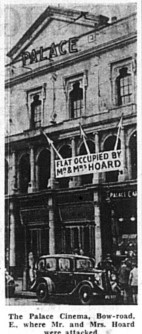
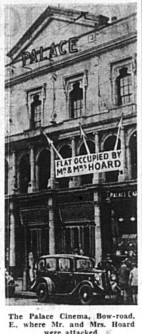
The murder took place on Tuesday morning, 7 August 1934, at the Eastern Palace Cinema in Bromley-by-Bow, in the East End of London. The Eastern Palace cinema was a neighbourhood cinema, co-owned by two local Jewish professionals. It was located on the busy Bow Road, in between a café and a general store. It could seat around 1000 patrons in its auditorium and balcony, where audiences could enjoy the ornate (if somewhat shabby) ‘Oriental’ decorations on the walls.

The facade of the Eastern Palace Cinema. This photo appeared in the Daily Express the day after the murder

The day-to-day management of the cinema fell to 41-year-old Dudley Henry Hoard. As part of his role, Dudley and his wife Maisie were required to live in a flat adjacent to the auditorium – the lease of the building required that it was partially used for domestic occupancy. Dudley got the cinema manager job in March 1934, and he and Maisie moved in a few weeks later. It was the first time since their wedding in spring 1933 that they had their own flat; they had previously been staying with Dudley’s parents in Croydon.

On the morning of 7 August, Dudley and Maisie were sleeping in after a busy Bank Holiday weekend. Ordinarily, one of Dudley’s first tasks every day was to deposit the cinema’s previous day’s takings at the Midland Bank on Mile End Road. Due to the banks having been shut on the Bank holiday Monday, there were now three days’ worth of ticket earnings in the safe in Dudley’s office, one floor below the flat. For the Eastern Palace, the Bank holiday weekend had resulted in total takings of 89 pounds, 5 shillings, and tuppence. By comparison, Dudley earned about £5 a week as cinema manager, and he was the best-paid member of staff in the cinema. Even for him, the nearly £90 in the safe represented around 10 months’ worth of wages.

Around quarter to eight, someone rang the door of the flat – not the doorbell at the cinema’s entrance, but the door of the flat specifically. Dudley quickly put on some trousers over his nightshirt and went to open the door. Maisie had only half woken and was about to doze off, when she heard Dudley shout out. When Maisie walked into the living room, she saw a man standing over her husband, wielding a hatchet. Dudley had a head wound and was trying to fend off the other man. Maisie shouted out to the attacker, a young man. He then turned to her and hit her over the head with the hatchet – she blacked out immediately.

About thirty minutes later, the cinema’s regular team of cleaning women arrived for their morning shift. These three women came in six days a week to clean and tidy the cinema before the first screenings started. Because they arrived hours before any of the other staff, the head cleaner, Mrs Emily Brinklow, had her own set of keys. She let herself and her colleagues in, and they started to get their cleaning materials out. Emily noticed that the post and milk, dropped by the milkman, had not yet been taken upstairs by either Dudley or Maisie. This did not worry her unduly; she would bring them up herself in a minute. Before she could do so, a scream ripped through the building. Nellie Earrey, one of the other cleaners and sister to one of the cinema’s projectionists, had found a heavily injured Dudley Hoard on the staircase leading to the auditorium balcony. He was covered in blood, as were the walls and the staircase he was on. Emily rushed to the flat and banged on the door; after a short while, Maisie opened it. She, too, was covered in blood, and seemed completely dazed.

Nellie ran out onto the street, where a passerby quickly alerted the local Bobby who was patrolling the area. PC Mackay swiftly went over to the cinema and tried to provide emergency aid, as well as alerting his local police station by telephone. The divisional surgeon (the police doctor) is on the scene quickly, as he was still at his home further down Bow Road when the station officer rang him. He too provides emergency aid, and arranges for both Dudley and Maisie to be transported to the nearby St Andrews hospital. They arrive shortly after 10am. Although Dudley is immediately examined and treated by multiple surgeons, the fractures to his skull are too severe. He dies at 3.07pm, without regaining consciousness.

The police know that they now have a murder case on their hands. Maisie is less severely injured, but unable to give more than a brief, confused statement before she needs to rest. Detectives attached to the local police department, known as ‘H’ Division, start questioning all the cinema’s staff as they arrive for their shifts. Most of them live very close to the cinema, and they are aware very quickly that something has happened. The police realise that the cinema’s safe has been opened by the keys which would normally be carried around by Dudley, and that the full weekend’s takings have been stolen. They have a victim and a motive, but not yet a clue as to the killer’s identity.