Film Star Cigarette Cards (1934)

FeaturedFilm Star Cigarette Cards (1934)

A recent trip to an antique shop delivered a great find: a complete album of film star cigarette cards, collected and collated some time in early 1934. Cigarette brands regularly put out series of cigarette cards, which young people could collect and paste into dedicated albums. In 1934, John Player & Sons, a branch of the Imperial Tobacco Company, published a 50-card series of portrait drawings of film stars. The reverse of each card had some information about the actor. All cards could be pasted into an album; the information that appeared on the reverse of each card was reprinted on the album pages.

My copy was put together by John MacLaren, who lived in Addison Gardens (between Shepherd’s Bush and Kensington Olympia) in West London. We can assume that John was a big film fan as the album is complete, all the cards are inserted into the album neatly, and he handled the album carefully. Nearly 90 years after its composition, it is still in excellent shape with very little wear and tear. The album reveals aspects of 1930s British film fan culture to us: which stars were included, what biographical information was included on them, and which stars were left out?

The first thing to note is that this album is all about the ‘film stars’: there is virtually no mention of directors or producers anywhere in the album. An exception is the entry given for Greta Garbo, which notes that producer Joseph Stiller, upon being given a Hollywood contract, took Garbo ‘along with him’ to the US. The entry for Jessie Matthews, however, makes no mention of Victor Saville, even though she had regularly worked with him by 1934. Similarly, under Marlene Dietrich’s picture there is no mention of Joseph von Sternberg, even though the pair had successfully collaborated several times at this point. Film fan culture in the interwar period was all about the ‘stars’ which appeared on the screen: although retrospectively directors like Hitchcock, Korda and Asquith are recognised as masters of the form, in the interwar period audiences would have been unlikely to seek out a film on the strength of its director alone.

The focus on ‘stars’ rather than ‘actors’ also means that the album mostly contains young, good-looking actors, although a few British ‘character actors’ are included. There are 30 female actors and 20 male actors included; although images of female stars were generally considered more commercially attractive, the album shows that male actors were by no means unimportant and could have considerable ‘sex-appeal’.

Some of the text descriptions, particularly those of male actors, include their height. This was clearly deemed to be important information for the film fan. The description of Johnny Weissmuller thus reads ‘The Olympic Swimming Champion, who stands 6 feet 3 inches in height, made his screen début in short sports films, and because of his magnificent physique was given the title role in Tarzan the Ape Man.’ Even if one had never seen a Johnny Weissmuller film, this description is graphic enough to let the imagination run wild. The drawing of actor Ramon Novarro (5 feet 10 inches) shows him in a vest top which he is tugging slightly to reveal his chest. His Mexican heritage no doubt played a part in this exoticized depiction: virtually all other male stars are shown wearing a suit.
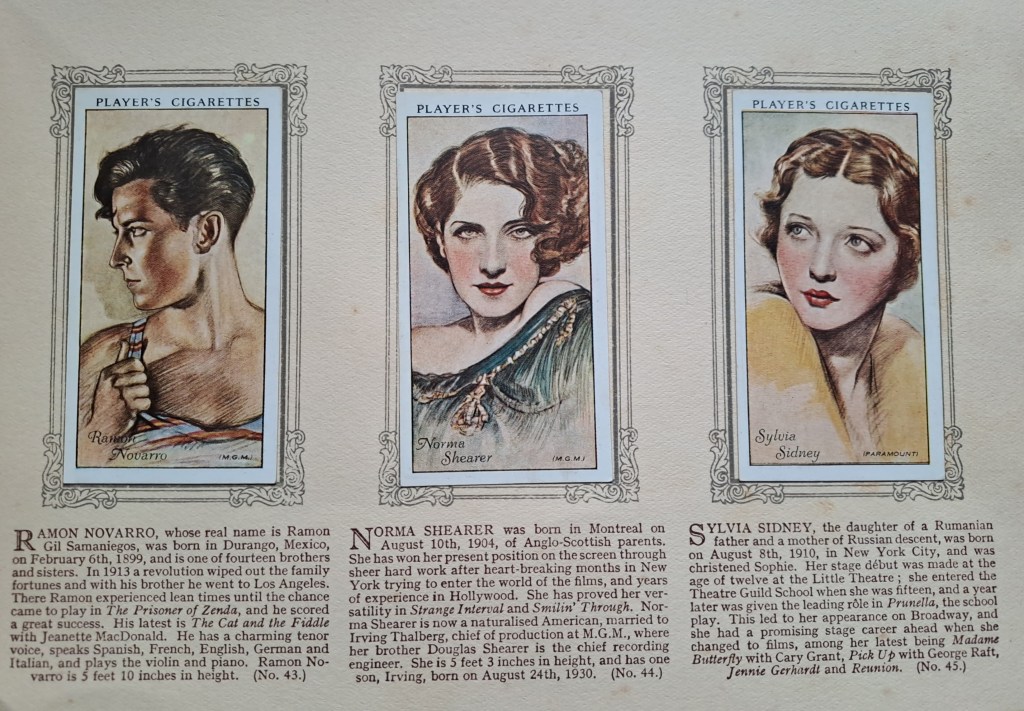
Ramon Novarro in the cigarette card album

Out of the 50 actors included in the album, 29 are American, 11 are British, and the remaining 10 are from other countries – mainly European, but it also includes two Mexicans, a Canadian, and one star born in China to white expat parents (Sari Maritza ‘Her father was English, her mother Viennese’). ‘Talkie’ films were well-established by 1934, and the album shows that although the transition from silent to sound film had limited the international opportunities for non-native English speakers, it had not completely removed them. The aforementioned Garbo and Dietrich were celebrated for their European appearance and demeanour – and both had a powerful male industry figure supporting them. The range of actors included in the album also shows the popularity of Hollywood films in Britain, despite the British government’s attempts to boost the domestic film industry. American stars continued to exert their influence over British fans.

Johnny Weissmuller appearing alongside Mexican actor Raquel Torres and
British actor, producer and race-horse owner Tom Walls

Another reason for the popularity of film stars can be found in many of the narratives that accompany the pictures. Although they are only a short paragraph each, a significant number of them present the careers of film stars as being reached almost by accident. American star Jack Holt, for example, is described as having been ‘in turn a civil engineer, a prospector, a mail carrier in Alaska, a cow-puncher [a cowboy], and finally an actor.’ Madeleine Carroll first worked as a school teacher before taking to the stage; Frederic March was a bank clerk; and Robert Montgomery worked ‘in a mill, then on an oil tanker, and finally became prop man in a touring company.’ The implication is that it is possible to move from a blue-collar or white-collar job into film stardom, and that such a move may be open to the film fan collecting the cigarette cards. This reiteration of the humble origins of many stars, and the supposed open entry to film acting, was an important part of the film industry’s myth-making that constantly held out the possibility to fans that they too could join their favourite stars on the silver screen.

We have no way of knowing whether John Maclaren, the owner of this particular album, had any aspirations to become an actor. Nonetheless, the survival of this album and the care John took in pasting in the cards demonstrates how important film fandom was for him, as it was for thousands of other (young) people in Britain at the time. The cigarette cards gave film fans another accessible way to connect with their favourite actors, in addition to going to the cinema and reading fan magazines. It stands as a testament to (commercial) fan culture in interwar Britain.
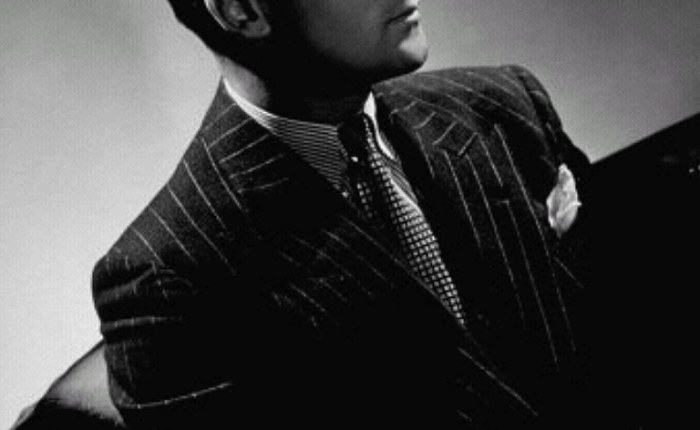
Brian Aherne

Brian Aherne

Like other actors featured on this blog, Brian Aherne started his career in English film in the 1920s, before moving to Hollywood in the 1930s. Unlike some of his contemporaries, however, he was able to establish a long and successful career in the US, which lasted until the 1960s. He was nominated for an Academy Award for Best Actor in a Supporting Role for his portrayal of Emperor Maximilian I of Mexico in the 1939 US production Juarez. The seeds of this career were sown in interwar London.

Aherne’s full name was William Brian de Lacy Aherne, which hints at his upper middle-class background. His father was an architect, his mother an actress; Aherne trained in his father’s profession before deciding to follow into his mother’s footsteps instead and pursue acting. He started out on the stage and landed his first film role in 1924, in a supporting role in the no longer extant film The Eleventh Commandments (dir. George A Cooper).

Aherne quickly moved into leading man parts and working with established directors; he was directed by Sinclair Hill in The Squire of Long Hadley and by veteran director Henry Edwards in King of the Castle, both released in 1925. He returned to work with Hill two years later in A Woman Redeemed. However, modern audiences are most likely to have seen Aherne in one of the two silent films he made with Anthony Asquith: Shooting Stars (1928) and Underground (1928). Both have been restored and re-released by the BFI in the last ten years so are readily available to us.

Brian Aherne in 1938

In both films, Aherne plays a good, kind and dependable man who has to endure adversity in his romantic relationships. His even features and a slightly dreamy look in his eyes made him a suitable romantic hero. In Shooting Stars, he plays Julian Gordon, an actor married to actress Mae Feather. Julian and Mae often act together in genre flicks in which he is the hero to her damsel in distress. Off set, however, their relationship is far from happy, and Mae enters into an affair with another actor, the comedian Andy Wilkes.

Mae worries that she will suffer professionally if she were to divorce Julian, so instead she hatches a plan. The couple are recording a western film, and are due to record a scene in which a stooge has to shoot at Julian with a shotgun. Mae secretly puts a live bullet in the gun, hoping that Julian will die and she can pass it off as a freak accident. Of course, the plan goes wrong; the bullet instead hits Andy, who is filming on an adjacent sound stage. Julian realises what Mae was planning and leaves her; her career is destroyed as a result, whilst Julian becomes a successful director.

Much of the joy from viewing Shooting Stars is derived from its tongue-in-cheek knowingness about the film industry, which is perfectly encapsulated by its double-entendre title. Julian’s graduation from actor to director reflects (not very subtly) his journey from a naïve young man to someone who literally calls the shots. Shooting Stars includes a telling scene in which Julian, as yet unaware of Mae’s infidelity, goes to the cinema to watch one of their own films, a typical action flick. He sits among the young boys in the audience and becomes completely engrossed in the fantasy-world in which he is Mae’s hero, saving her from danger. Although Mae is certainly positioned as a cold-hearted, manipulating woman, Aherne’s performance also initially shows Julian as gullible and a bit foolish. By the end of the film, director Julian is hardened and unmoved by Mae’s distress.

Aherne followed Shooting Stars immediately with a lead role in Underground, in which he played London Underground employee Bill. Underground portrays the romantic entanglements between four individuals, and uses the space of a London Underground station to link them together. Bill works as an attendant in the station, helping travellers to find the right trains, making sure they do not fall of the escalator, and answering any queries they may have. He meets Nell when she drops her glove whilst travelling up the escalator. It is love at first sight, but Nell is already being pursued by Bert, a worker at Lott’s power station. Bert in turn has an admirer in the seamstress Kate, who lives in the same boarding house as him.

As soon as Bert realises that Bill is his rival for Nell’s interests, he sends Kate to the underground station; she does as Bert says in the vain hope she will win his affection. Kate manages to lure Bill to an emergency staircase off the main Tube platform, under false pretences. She then waits for the platform to fill up before running out of the staircase and accusing Bill of assaulting her. As planned by Bert, Nell witnesses the incident and she (temporarily) withdraws from Bill as a result. To resolve the misunderstanding and win back Nell, Bill must fight Bert, in this case physically. He succeeds, and the film ends with Nell and Bill united in matrimonial bliss. Like Julian in Shooting Stars, Brian Aherne’s character in Underground starts out as an innocent, but matures through adversity and by tapping in to more traditionally ‘masculine’ behaviours.

After the transition to sound film, Aherne’s last notable British film appearance was his role as Lewis Dodd in the 1933 version of The Constant Nymph (directed by Basil Dean). The 1928 silent film based on the same source material, in which Ivor Novello played Dodd, is the one that is best remembered today. By the time the version with Aherne was released in cinemas, he was already across the Atlantic and appeared opposite Marlene Dietrich in Song of Songs (Rouben Mamoulian, 1933). By the time of his death, Aherne was generally remembered as a Hollywood actor first; but as his appearance in two of the best-known British films of the late silent period testifies, he was also a part of the cultural scene in interwar London.

Pygmalion

George Bernard Shaw’s play Pygmalion technically originated prior to the Great War, but it continued to appear on the West End throughout the interwar period. Indeed, its impact has lasted throughout the twentieth century and into the twenty-first. Shaw’s play continues to be regularly performed in London. The various film adaptations have made the story familiar to generations: the 1964 version My Fair Lady with Audrey Hepburn is probably the best-known, but more recent films such as She’s All That (1999) and The Duff (2015) have used the same source material to transplant the story into a modern setting.

The story of Pygmalion, in turn, is based on the Greek myth about a sculptor of the same name, who makes a sculpture of a woman so beautiful that he falls in love with it. Aphrodite, goddess of love, is moved by Pygmalion’s devotion and decides to turn the statue into a real woman, so they can live happily ever after.

Shaw’s play dispenses with the mythical elements. In his story, Professor Higgins who has an interest in phonetics, meets the cockney flower girl Eliza. Higgins places a bet with his friend Colonel Pickering, that he (Higgins) can change Eliza’s speech so thoroughly that he will be able to introduce her into high society as a duchess. Higgins and Eliza embark on a rigorous training regime, during the course of which affection develops between them. The original play does not end with Higgins and Eliza in a romantic relationship – however, subsequent productions and film adaptations have made changes to increase the story’s appeal.

Pygmalion shows the international nature of British cultural life in this period. Shaw himself was Irish; although Ireland was still part of Britain when the play debuted, he was removed from the core of the Empire. Pygmalion’s first production was in Vienna in 1912; it was also performed in the US before it reached the West End. Consequently, there was a lot of ‘buzz’ around the play when it arrived in His Majesty’s Theatre in 1914. Newspapers covered the first performance extensively with text and pictures, as the play had already built up a reputation. Of particular interest to the tabloids was the line ‘Not bloody likely’ which is uttered by Eliza during the play. That a female actor would say the word ‘bloody’ on stage was considered extremely transgressive; the papers were not even willing to print the word but rather referred to it as ‘b—-‘.

Despite the ostensibly extremely British setting of the story, which for a substantial part hinges on Eliza’s Cockney slang and the peculiarities of class identities in British society, the production continued to have international appeal. This is also evident from the film adaptions. As the story is so dependent on pronunciation, it would have made little sense to attempt to adapt it as a silent film. However, once sound films became the norm in the 1930s, the first country to adapt Pygmalion for the screen was Germany.

Rather incredibly, the second feature length film version was made in the Netherlands in 1937; it moves the plot to Amsterdam and introduces a romantic ending for Higgins and Eliza. The first Dutch sound film was only made in 1934, years after the first sound films were made in Britain, Germany and the US. That Dutch filmmakers were willing to invest into a production of Pygmalion, which included paying a substantial sum for the rights to the story, indicates that the producers were confident the film would be a hit with the domestic audience.

In 1938 the first British film version of Pygmalion appears; co-directed by Anthony Asquith and actor Leslie Howard, the latter also fulfilling the role of Professor Higgins. Wendy Hiller stars as Eliza. This version introduces some of the elements modern audiences are most likely to be familiar with from subsequent adaptations, for example Eliza’s speech exercises ‘the rain in Spain stays mainly in the plain’ and ‘In Hertford, Hereford, and Hampshire, hurricanes hardly ever happen.’ The ‘not bloody likely’ line was also retained, but by 1938 it caused notably less controversy than it had done two decades prior.

The casting of Howard, who was mid-forties at the time, as Professor Higgins, changed the dynamic of the story’s central relationship considerably. In the original productions, Higgins was an older man who was primarily interested in Eliza as a research object. When she emancipates herself throughout the story and asserts her rights as an individual, it takes Higgins by surprise as he has not previously considered her as an equal. Howard, who was a successful film star on both sides of the Atlantic, plays Higgins as an absent-minded but romantic hero, who comes to realise he loves Eliza. Although the ending of the film is somewhat open, it can be interpreted that Eliza ends up choosing Higgins over her (other) love interest, Freddie. Shaw hated Howard’s interpretation of the role; he was insistent that Eliza should not end up marrying Higgins.[1]

However, audiences favoured the ending and it was retained for the musical adaptation of the play, My Fair Lady, which was first produced on Broadway in 1956 and then, as noted above, turned into a successful film in 1964. The original story which promoted female emancipation and independence was turned into a more conventional romantic tale, in which the woman stays with the man who has provided for her rather than making her own way. Pygmalion shows both the changing social norms of interwar Britain which allowed the production to thrive despite (or because of) the female lead uttering a swear word; and the enduring attachment to patriarchal values which over time reduced and removed the story’s more radical ideas.

The 1938 film version of Pygmalion is in the public domain and available to view for free via the Internet Archive.


[1] Jeffrey Richards, The Age of the Dream Palace: Cinema and Society in 1930s Britain (London: IB Tauris, 2010), p. 237