Coronation of George VI

As the UK prepares for the first coronation since 1953, it is a good opportunity to look back on the only coronation which took place during the interwar period. On 12 May 1937, King George VI was crowned in Westminster Abbey. Initially, it had been planned that the coronation that day would have been of Edward VIII, but after the Abdication Crisis of late 1936, it was decided to use the same date for a different coronation ceremony.

Although the coronation of Queen Elizabeth II was famously the first national ‘TV event’ in Britain (there’s even a Dr Who episode about it), new media were also used for the coronation in 1937. The last coronation before this year had been in 1911, when moving image mediums were still in the early stages of development. In that year, silent film footage of the procession was recorded from static cameras, mostly at a remove from the action. By 1937, sound cinema was omnipresent, and making a filmed record of the coronation was an integral part of the day. A film of nearly an hour was recorded, which included many shots taken inside Westminster Abbey during the service. The whole was overlaid with an informative voice-over explaining the action.

Although a large number of people, possibly up to a million, travelled to London to witness the procession, there were many more subjects who would not have been able to see this royal ceremony in person. These were not just in Britain, but across the world. As one local newspaper put it, ‘figuratively waiting upon the Throne and its new King to-day were the 500,000,000 people of the Empire.’[1]

The distribution of the coronation film was one of the key strategies to ensure that these half a billion people could feel a connection with the new monarch. The film was edited and distributed quickly – only two days after the coronation, on Friday 14 May, people in provincial towns such as Gloucester were able to see ‘The Great Coronation Film: The House of Windsor.’ It was advertised as including ‘THE ACTUAL CROWNING CEREMONY IN THE ABBEY’. In the case of Gloucester, it was showing in three different cinemas with each screening it four times a day.[2]

A shortened newsreel version of the footage taken at the coronation

Other mass media were also used to create a sense of a community of subjects. Arguably, the fact that until six months before the coronation no-one had expected this second son to become king, made it likely that most people in the country had only a very limited understanding of who their new King was. Local newspapers printed articles setting out details about the new King and Queen, to inform their readership. The Lancashire-based Nelson Leader told its readers that for the new King, ‘Duty is a quiet passion with him, as it was with his father.’[3] Multiple newspapers assert that the King’s main interests are the nation’s industry and support for young people – both uncontroversial topics. The other key feature that papers highlighted was the domestic bliss of the new royal couple: ‘Ideally happy has been the married life of King George and Queen Elizabeth’; and most articles also describe the couple’s daughters in flattering terms.[4]

The spectre of King Edward VIII is mostly in the background of these reports; but in the Derbyshire Times he is evoked explicitly: ‘King George lacks some of the qualities that inspired high hopes of King Edward VIII – he is more reserved, more conventional, and makes friends less easily – but he has certain qualities that his more brilliant brother lacks: he is steadier, less impulsive, more persevering, and more dutiful.’[5]  And, of course, the new King’s steady family life is infinitely preferable to a King married to an American divorcee, although none of the newspapers make that explicit.

A final strategy employed to create an ‘imagined community’ of subjects around the new King is the issue of special coronation stamps. These went on sale on the day after the coronation, and multiple papers reported that there was a record interest in them. ‘Queues formed at many post offices and for the first time special stamp counters dealt with the rush. Arrangements had been made for the sale of 38 millions.’[6] Stamps, bearing the image of the new monarch and uniquely linked to national identity, are another tactic to reinforce to the audience that they are part of a defined group of royal subjects.

So, beyond the actual coronation ceremony itself in London, which saw ‘[m]ore than 5,669,000 passengers (…) carried by the London Underground Railways during the forty-six hours of continuous service’; ‘200 tons of litter (…) removed from the three miles of the Coronation route and side streets’; and a 6.5 mile procession through Westminster, modern mass media methods were used to ensure that the coronation’s impact reached to all corners of Britain, and beyond that through the Empire.[7] After the unprecedented events of the Abdication, which had the potential to damage the crown, the coronation was used to reinforce the monarchy as a stable and positive influence.


[1] ‘Happy and Glorious’, Lincolnshire Echo, 12 May 1937, p.6

[2] Cinema adverts, Gloucester Citizen, 14 May 1937, p. 11

[3] ‘Long May They Reign!’, Nelson Leader, 14 May 1937, p. 6

[4] Ibid.

[5] ‘King George VI and his coronation’, Derbyshire Times, 14 May 1937, p. 30

[6] ‘Rush to buy new stamps’, Daily News, 14 May 1937, p. 8

[7] ‘King and Queen thank the nation,’ Liverpool Echo, 14 May 1937, p. 11; ‘Long May They Reign!’, Nelson Leader, 14 May 1937, p. 6

Victor Gollancz

Practically all of the notable interwar people covered by this blog to date have been artists, performers and people whose professions otherwise put them firmly in the limelight. This post covers someone whose job was by definition more ‘back office’, although he was quite adept at publicity: publisher and activist Victor Gollancz.

Anyone with only a passing interest in British interwar literature is sure to come across Gollancz name sooner rather than later. Born in London to Jewish parents in 1893, Oxford-educated Gollancz initially worked as a schoolteacher. After the First World War he worked for a publishing house before setting up his own company, which carried his name, in 1927.

Gollancz connections in the publishing world and his explicit left-wing political stance quickly ensured that he signed a number of high-profile authors, including George Orwell (until around 1937); Daphne du Maurier, Vera Brittain, and Ford Madox Ford. He was also very active in the publishing of crime fiction. Dorothy L. Sayers had initially been signed by the publishing house for which Gollancz worked until 1927. From Strong Poison (1930) onwards, she published all her Wimsey novels with Gollancz.

Anthony Berkeley, who generally published his works with Collins, went to Gollancz for the first two books he wrote under the pseudonym Francis Iles, Malice Aforethought (1931) and Before the Fact (1932). It made sense for Berkeley to pick a different publisher for his Francis Iles venture, as he intended to keep his real identity firmly hidden. Under his real name, Berkeley was not associated with Gollancz. According to crime fiction historian Martin Edwards the venture was also beneficial for Gollancz, who was able to use his marketing nous to increase sales when Before the Fact was published: ‘Gollancz seized his chance with gusto. ‘Who is Iles?’ demanded the dust jacket, which listed twenty candidates put forward in ‘the public prints.’’[1]

Victor Gollancz did not just publish crime fiction: he also drew inspiration from the Collins Crime Club, a book club set up in 1930, to co-found the Left Book Club in 1936.[2] Subscribers to the club were sent one book a month, mostly on political topics. At this point, and until 1939, Gollancz was closely aligned with the Communist Party, which influenced the monthly book choices: many were written by members of the Communist Party and the Party vetted the book choices in the early days of the club.

The Club was successful and influential, gaining 40,000 members within its first year. There was also overlap between the club and Gollancz activities in crime fiction publishing: in 1937 the club picked two books written by G.D.H. Cole (one of which co-authored by his wife M.I. Cole). The Coles had been members of the Detection Club of crime fiction writers since its foundation in 1930 and co-wrote detective fiction as well as works of political non-fiction.

Victor Gollancz was also politically active outside of the Left Book Club. In 1934, after the controversial British Union of Fascists rally at Kensington Olympia, during which many members of the public were attacked and beaten up by BUF members, Gollancz published the pamphlet Fascists at Olympia: A record of eye-witnesses and victims. As the title implies, this was a collection of statements of people who had been present in the Hall, which explicitly accused the BUF of unfounded and severe violence. This pamphlet, which was distributed free of charge to raise awareness of the BUFs tactics, was sufficiently influential to spur the BUF to publish their own pamphlet in return, contracting the claims of violence.

During the Second World War, Gollancz was a prominent voice drawing attention to the plight of Jews in Nazi-occupied territories. After the war, he campaigned for humanitarian treatment for German citizens, insisting that they were not responsible for Nazi atrocities. In the 1950s, Gollancz became a prominent campaigner for the abolition of capital punishment in Britain after the controversial execution of Ruth Ellis, a woman who had killed her abusive partner and the last woman to be hanged in Britain. [3] Gollancz lived to see the death penalty suspended in 1965, a legal move which effectively ended capital punishment in Britain although it was not officially abolished until 1969, two years after Gollancz’ death.

Victor Gollancz was an influential figure in interwar Britain, both through his political activities and as a publisher of some of the most successful and popular crime fiction authors of the period. The publishing house bearing his name lives on as an imprint of Orion Publishing Group.


[1] Martin Edwards, The Golden Age of Murder (London: Collins Crime Club, 2015), p. 136

[2] Ibid., p. 310

[3] Lizzie Seal, Capital Punishment in Twentieth-Century Britain: Audience, Justice, Memory (London: Routledge, 2014), p. 24

Short story writing in interwar Britain

Short stories are a relatively niche genre of fiction writing these days. The fiction short story appears to have originated in the 1820s. It is primarily the short stories of famous novelists that have stood the test of time: Sir Walter Scott, Charles Dickens, and, on the other side of the pond, Edgar Allan Poe, F. Scott Fitzgerald and Ernest Hemingway.[i] For the interwar period, literary authors such as James Joyce and Katherine Mansfield may come to mind. Yet the works of Joyce and Mansfield were only read by a limited audience at the time of their publication. They are decidedly ‘highbrow’ authors with no mass-market appeal.

Alongside these literary outputs, thousands of other, now forgotten, short stories were published in interwar Britain. They were found in newspapers, weekly magazines and dedicated publications such as the Strand Magazine. Due to their placement, short story writing was often considered aligned with journalism. Dozens of guide books appeared in the 1920s and 1930s instructing young hopefuls in how to ‘live off the pen’, whether that was through writing news articles; human interest stories; short stories; or novels (or even screenplays for films).

Literary critic Q.D. Leavis let rip against this commercial market of fiction writing in her 1932 polemic Fiction and the Reading Public. She is highly critical of the marketisation of fiction, which in her view sees editors prioritise high circulation figures above all else. ‘The kind of fiction published in this way – the briefest inspection will show that it is all of a kind – is carefully chosen by the editors in accordance with the policy of wat is called ‘Giving the Public what it wants.’’[ii] The result, Leavis argues, is that the public is inundated with ‘fiction that requires the least effort to read and will set the reader up with a comfortable state of mind.’[iii]

Although the tone of Leavis’ book is snobbish in her assumption that the increased commercialisation of literature signals a cultural decline, an inspection of 1920s and 1930s guide books on ‘how to become a writer’ demonstrates that these books did consistently advise to keep the readership in mind when writing short stories. Often, these books break the short story down into constituent elements and tell the aspirant writer how to put together a successful story. They actively warn against individualism or stylistic flourishes in writing. For example, the author of the 1934 book Short Stories and How to Write Them declares: ‘My earnest advice to all at this stage is to study the markets. The stories you find should be your models. Every story should be written with a definite market in view.’[iv] Similarly, The Craft of the Short Story, published two years later, argues that ‘Always remember that your purpose in writing a short story is, or should be, to amuse and entertain.’[v] It is the reader, not the writer, who is the most important part of the equation.

The explosion of print media had made commercial writing an attractive career option for many people. Unlike professions such as medicine or law, you did not need an expensive university education to become a journalist or writer. Indeed, many of the books on the subject argued that all that was needed was a sound grasp of the English language, some stationary supplies and probably a cheap typewriter, and resilience, as the aspiring writer could expect many of their first attempts to be rejected by editors.

One author who made a good living out of the writing of guide books was Michael Joseph, who was also a literary agent and from 1935 a publisher (Michael Joseph continues to exist as an imprint of Penguin). Joseph wrote eight books on the topic of writing and making money, between 1924 and 1931. His prominence in the field is acknowledged by Leavis, who repeatedly uses his books as examples of how writing has become a business. In How to Write a Short Story, Joseph argues that ‘Many writers actually cannot visualise their market when they set to work on a story. Artistically, there is a good deal of justification for this; commercially, it is liable to result in failure to place the MS [manuscript].’[vi] Some of his other books tackle the business side of writing even more explicitly, by listing publications which accept submissions and explaining in detail how one goes about submitting a manuscript.

If the self-study of guidebooks was not enough, the aspiring writer could also enrol into one of dozens of writing schools and correspondence courses that were available in the interwar period. Often these were advertised in short story publications. Professional writers were generally highly sceptical of these ‘schools’ which tended to promise unrealistic returns on investment. Yet some writers set up schools themselves. One of the earliest and most commercially successful was the London School of Journalism, founded by novelist Max Pemberton and still in business today. ‘The Short Story Course’ offered by the School in the 1920s consisted of 12 lessons, each ending with a few exercises which the student could complete and send back to the School to be marked. Lessons include ‘About Plot’ (lesson 2); ‘Heroes and Heroines’ (lesson 4); and ‘Atmosphere’ (lesson 5). Exercises often included copying out examples of existing short stories to study them. The main advice at the end of the course is to ‘work with diligence every day’ and apply oneself, and then success is sure to follow.

All of these courses and books demonstrate that the writing of short stories was big business in interwar Britain, at least for the happy few who were able to claim authority in the field and make a living out of encouraging others to follow the same career path. All of the books highlight resilience and consistency as key to success, but do not mention elements more traditionally linked to artistic endeavours such as inspiration or reflection. Like journalism, which had become increasingly commercialised, short story writing became ‘hack work’ in the interwar period.


[i] All male, of course – not because men are better short story writers but because they have traditionally been more readily classed as ‘great authors’ and have had their oeuvres canonized accordingly.

[ii] Q.D. Leavis, Fiction and the Reading Public (London: Chatto & Windus, 1968 [1932]), p. 27

[iii] Ibid.

[iv] Cecil Hunt, Short Stories and How to Write Them (London: George Harrap & Co, 1934), p. 187

[v] Donald McConochie, The Craft of the Short Story (London: Sir Isaac Pitman & Sons, 1936), p. 27

[vi] Michael Joseph, How to Write a Short Story (London: Hutchinson & Co, 1925), p. 91

Britannia of Billingsgate (1933)

Britannia of Billingsgate (1933)

Britannia of Billingsgate is a reasonably early sound film which provides a critical commentary on the film industry’s shallowness, whilst simultaneously wanting to present a career on screen as aspirational. The film strikes an awkward balance between promoting traditional British values of community and common sense; and foregrounding the glamour of cinema.

At the opening of the film we are introduced to the Bolton family: Bert Bolton is a porter at Billingsgate fish market, whilst his wife Bessie runs a chip shop adjacent to the market. The couple’s young adult children, Pearl and Fred, are obsessed with movies and motorcycles respectively. The Billingsgate community is shown as a warm, Cockney environment where everyone knows and supports everyone else.

Bessie (Violet Lorraine) singing among her regular customers in Britannia of Billingsgate

An Italian director has picked the market as a location for his latest film. Due to a technical mix-up, the film set’s sound recorders accidentally record Bessie singing in her café. The film’s producers are so impressed with the quality of Bessie’s singing that they track her down and offer her a big contract to star in a musical film. Bessie has no interest in an acting career, but her husband and children all want the money that is attached to the offer. Bessie relents and agrees to star in the new film, which will be called Piccadilly Playground.

Whilst Bessie is working on the film, the family move into a luxurious apartment. Bert, Pearl and Fred all start moving in wealthier circles. Bert drinks heavily and starts gambling; Pearl also gambles and tries to ingratiate herself with her favourite film star. Fred secretly pursues his dreams of becoming a motorbike racer – something Bessie is against as she perceives it to be very dangerous.

Bert (Gordon Harker) enjoying the high life in Britannia of Billingsgate

Bessie is the only one not corrupted by the sudden wealth that has befallen the family. She rejects fancy dinners in favour of fish and chips and visits her old café where she engages in a community sing-a-long with the regulars. In this middle section of the film, Britannia of Billingsgate is clear to show that money is leading Bert, Pearl and Fred astray, most notably in a scene where Bert engages in a game of strip poker with a number of younger women. Bessie’s commitment to her roots and her rejection of luxury are clearly presented as commendable.

On the night of Bessie’s film premiere, both Pearl and Fred pretend to be ill. Pearl wants to secretly sneak into the flat of the film star she so admires, in the hopes that her sudden presence in his bedroom will seduce him. Fred plans to take part in a motorcycle race. Bessie and Bert duly head to the film screening alone. Bessie is convinced Piccadilly Plaground will be a terrible flop. In the meantime, Pearl and Fred conduct their own plans, but they are spotted by one of Bessie’s friends and by her butler.

The premiere of Piccadilly Playground in Britannia of Billingsgate

Bessie’s friend comes into the cinema and alerts Bessie that Pearl has gone to the actor’s apartment. Bessie leaves the film screening halfway to confront Pearl, who by that point has been discovered by the actor (who is disgruntled to find this vapid young woman in his bedroom). After Bessie has given Pearl a literal spanking, the party go to the racetrack to find Fred. Seeing Fred win his race makes Bessie change her mind about racing and she becomes supportive. Meanwhile, Piccadilly Playground has proven to be a huge success and the film producers offer Bessie an even bigger contract. Despite her misgivings about wealth and acting, which she has voiced consistently throughout the story so far, Bessie agrees to make another film. At the end of Britannia of Billingsgate we see that the film producers have replicated Bessie’s old fish and chip shop on set, and she records a scene in which she sings with the guests, just like she was doing in ‘real life.’

Like other films of the period, such as Sally in Our Alley (1932) and Say it with Flowers (1934), Britannia of Billingsgate romanticises working class communities and shows the working-class woman as sensible, down-to-earth, and representing British values. Indeed, the film’s title compares Bessie to Britannia herself. Bessie’s rejection of wealth and the make-believe world of film fits entirely within that worldview. Pearl’s obsession with film, expressed through the avid reading of film magazines, cutting out photos of her favourite film star, and her eventual decision to make herself sexually available to this actor, are presented as both silly and morally wrong.

Yet at the film’s end, Bessie agrees to continue as a film actor, even though she appears to have had very little enjoyment out of the role so far. And while Pearl gets punished for her transgression, Fred’s ambitions as a motorcycle racer are ultimately shown to be commendable, inadvertently demonstrating Bessie’s double standard in her attitude to her daughter and son. Like many other films of the period, Britannia of Billingsgate presents a rags-to-riches story, where an ordinary person is catapulted to national fame and wealth. Although this narrative was very popular with audiences, it stood at odds with a traditional class-based society in which everyone supposedly knew their place and the working-classes were expected to work hard and be satisfied with very little. Ultimately, Britannia of Billingsgate tries to have its cake and eat it too: it allowed viewers to dream of being suddenly discovered and made famous; whilst also reaffirming that ultimately, audiences would be best off in the environments in which they were raised.

Britannia of Billingsgate is available to watch for free on BFI Player (for those based in the UK).

Rose Macaulay – Dangerous Ages (1921)

Prolific interwar author Rose Macaulay won the 1922 Femina-Vie Heureuse Prize for her novel Dangerous Ages. The prize was founded in 1919 as a British counterpart to the French Prix Femina: an annual novel prize awarded by an all-female committee. The winning author was often, but not always, female too. Other illustrious winners include E.M. Forster who was awarded the prize in 1925 for A Passage To India; Radclyffe Hall who won for Adam’s Breed in 1927, and Virginia Woolf who was given the prize in 1928 for To The Lighthouse. The British prize was awarded until 1939; the original French prize is still running today.

Dangerous Ages was Macaulay’s eleventh novel, published when she was forty. Her age when writing the novel is significant, as the work chronicles six female members of the same family, each at a different, but equally ‘dangerous’ age. Grandmamma is eighty-four; her daughter Mrs Hilary is sixty-three; Mrs Hilary’s daughters Neville, Pam and Nan are forty-three; thirty-nine and thirty-three respectively. Finally, Neville’s daughter Gerda is twenty. The novel spends little to no time describing the men of the family; brothers and husbands exist, but are only given cursory mention and their inner lives are not explored in depth. Instead, the work is deeply concerned with the emotional experience of womanhood in early 1920s Britain, and Macaulay appears to take a fairly dim view on this. Almost all the female characters experience a deep emotional lack, brought about by the expectation that their primary role in life is to be a wife and a mother.

Mrs Hilary’s first name is Emily, but she is only called that in the novel by her own mother. At all other points she is ‘Mrs Hilary’, foregrounding the perceived importance of her marital status to herself and her children and grandchildren. Her husband has passed away ten years previously and Mrs Hilary lives with her mother in a seaside town. She is described as being not intelligent and having no hobbies. Grandmamma has settled into a life of little eventfulness, knowing that she is near the end of her time on earth. Nonetheless, she makes a point of always visiting any new babies born in the family. Mrs Hilary, on the other hand, knows she may have several decades more to live, and has no meaningful work to fill it with.

Similarly, Neville at forty-three is casting around for a purpose now that her two children are grown up. We are told that when she was in her early twenties, Neville started medical school, but left the course without qualifying at twenty-two when she met her husband and got married. Now that she is done raising her children, the role of MP’s wife does not seem sufficiently fulfilling for Neville. She determines to return to medical school to finish her studies and qualify. However, Macaulay does not grant Neville a simple triumph. Instead, she finds her studies ‘difficult beyond her imaginings.’[1]

After weeks of studying her brother Jim, who did qualify as a surgeon, quizzes Neville and she realises that she’s not going to be able to reach the required level of academic knowledge after twenty years of not applying her brain with any discipline. When she asks her brother what else she can do to give meaning to her life, he can only suggest that she continues her ‘political work – public speaking, meetings, and so on. Isn’t that enough?’[2] It is clear to the reader that it will not be enough for Neville, who is repeatedly described as having a keen mind.

For Mrs Hilary, temporary salvation of a sort comes from taking a course of psycho-analysis. In this new type of talking therapy, which had recently arrived on British shores, she finds a man who, for two hours every week, has to listen to all of her memories, thoughts and dreams and has to show an interest in them. For a woman like Mrs Hilary, who is endured and indulged by her children but not taken seriously, this therapeutic relationship gives her a sense of importance and purpose, even if she quickly becomes dependent on her therapist.

Nan, Mrs Hilary’s youngest daughter and an author, has spent her thirty-three years to date dating around without making a serious emotional commitment to anyone. One of her admirers is thirty-five year old Barry Briscoe. After years of keeping Barry at arms’ length, Nan realises that she is ready to settle down. She resolves to spend a few weeks in Cornwall finishing her latest book, and then to invite Barry over and let him know that she is ready to commit to him. Unfortunately for Nan, during the weeks she is in Cornwall writing, Barry decides that she is probably never going to agree to marry him and he falls in love with her niece Gerda instead.

Nan has missed her opportunity for conventional happiness and is left travelling abroad and pursuing a very public but rather unhappy affair with a married painter. Gerda, initially absolutely committed to not subjecting to the institution of marriage, is eventually persuaded by Barry to drop her ideals and agree to matrimony. His assurance that ‘Next time we differ I’ll try to be the one to do it [change his mind], I honestly will….’ rings hollow to the reader, who can foresee Gerda walking into a life of compromise and self-neglect like her mother and grandmother before her.

Despite the book’s publication shortly after the Great War, the conflict plays no role in the novel’s plot, beyond a few references to the notion of ‘surplus women.’ There is no sense that these post-war women have greater freedom or opportunities than previous generations: instead, almost all the women in the novel see their lives dictated by the expectations of marriage and motherhood. The exception is thirty-nine year old Pam, who lives with a female friend in a Hoxton flat and does social work. Macaulay allows Pam the final word: ‘Pamela, who seemed lightly, and, as it were, casually, to swing a key to the door against which Neville, among many others, beat’.[3] Pam’s secret is a supreme detachment from the details and emotions of life: ‘I certainly don’t see quite what all the fuss is about…’[4] The choice these 1920s women have, according to Macaulay, is to either remove themselves from life’s passions and emotions; or to live a life of constant frustration.


[1] Rose Macaulay, Dangerous Ages (London: British Library, 2020), p. 39

[2] Ibid., p. 90

[3] Ibid., p. 206

[4] Ibid.

Agatha Christie and drug dispensing

Agatha Christie is one of the best-selling authors of all time. During the interwar period, she was already an incredibly prolific and popular author and one of the key proponents of the Golden Age of Detective Fiction. Over the years, Christie became well-known for often using poison as the murder weapon in her stories. Almost always, the poisons she had her murders used were real, and the effects she described were scientifically accurate.[1]

The reason Christie was able to use poison to such effect in her writing was because during the First World War, she had worked as a medical dispenser in a hospital in Devon, mixing drugs as prescribed by the hospital’s doctors. Her training for this role required her to learn all about medicine and poisons, and it was during this same period that she worked on her first novel, The Mysterious Affair at Styles (featuring Hercule Poirot and strychnine as the murder weapon). During the Second World War, Christie would once again take up a role as dispenser in a hospital.[2]

Thus, Agatha Christie is probably the best-known dispenser of the First World War, but that it was a growing profession which women were encouraged to join is evidenced by the 1917 book How to become a dispenser: The new profession for women.[3] This slender volume was written by academic and author Emily L.B. Forster, who also penned How to become a woman doctor (1918); Analytical chemistry as a profession for women (1920); and, later, Everybody’s Vegetarian Cookbook (1930). As these titles demonstrate, Forster was clearly passionate about encouraging female participation in the sciences.

How to become a dispenser was written during the First World War, when professional opportunities opened up for women due to the large number of men being called up to the front. This is acknowledged in the book’s opening line: ‘There are few professions in the present day whose doors are not open to women.’[4] Yet for Forster, dispensing has the potential to be a fulfilling lifelong career for women, not just a stop-gap during the war. To that end, she encourages readers to undertake the training and qualifications required to become a dispenser.

As outlined in the book, there were two different possible qualifications an aspiring dispenser could attempt: assistant dispenser, which required six months of training; or pharmacist, which took three years to complete. Agatha Christie completed the shorter qualification to become an assistant dispenser. In a time when ‘patent’ (pre-made and mass produced) medicines were rare and treated with some suspicion, dispensers and pharmacists were a key part of the medical infrastructure and required to mix medications precisely to doctor’s orders. The role required a thorough understanding of botany, chemistry and physiology and a great deal of accuracy, as the difference between a medicine and a poison could be minimal.

Forster encourages student-dispensers to enrol in a pharmaceutical college for six months to learn for the assistant-dispenser qualification. Those wanting to aim for the more comprehensive pharmacist diploma are advised to apprentice themselves to either a chemist or a hospital dispensing department. Assistant dispensers had to be at least 19 to take the exam; pharmacists had to be 21 to qualify. In either case a ‘girl’ had to have completed secondary school at least; that, in addition to the further study required, marked dispensing out as a career for better-off women. (Indeed, Christie came from a fairly upper-class family).

The benefits of the role were clear to Forster, who herself was a career scientist. There was plenty of work in the field, and the role was active: ‘although it is an indoor occupation, it means constantly moving about in the dispensary, and is not so sedentary as most indoor work.’[5] Depending on the position, hours could be fairly regular and when working in a chemist or pharmacist, there would be no need to wear a uniform.[6] Within the dispensary, there was freedom to organise the work to one’s own taste. For the most ambitious women, there was scope to set up their own business, perhaps in partnership with another woman – although readers were warned that in existing chemist shops they would be unlikely to tolerate a woman to be the boss of male dispensers: ‘a woman at the head might not be a recommendation to the aspiring [male] chemist.’[7]

In terms of pay, an assistant dispenser working at a hospital, like Agatha Christie, could expect anything between 30s and £3 a week ‘according to the size of the hospital and the position held by the dispenser.’[8] The downside of working in a hospital was that it would be necessary to cover Sunday and evening shifts in rotation.

The back of the book included adverts for no less than twelve different pharmaceutical colleges, confirming Forster’s opinion that there was plenty of opportunity in this field of work during the First World War. Although Agatha Christie used her experience as a dispenser as fuel for her creative career, for other women becoming a dispenser could be a route into satisfying scientific work which was intellectually challenging, responsible and independent. Scientists like Emily Forster told their readers that it was completely within their abilities to succeed in a career path of their choice. Even after the First World War, books such as these continued to encourage women to participate in the world of work on their own terms.


[1] Carla Valentine, Murder isn’t easy: The forensics of Agatha Christie (London: Sphere, 2021), p. 309

[2] Lucy Worsley, Agatha Christie: A very elusive woman (London: Hodder & Stoughton, 2022)

[3] Emily L.B. Forster, How to become a dispenser: The new profession for women (London: T. Fisher Unwin, 1917)

[4] Ibid., p. 1

[5] Ibid., p. 9

[6] Ibid., p. 42

[7] Ibid., pp. 39-40

[8] Ibid., p. 41

Female aviators in interwar Britain

Female aviators in interwar Britain

With the rise in popularity of civil and commercial aviation in the 1920s and 1930s, which has been covered elsewhere in this blog, there was naturally also an increase in the number of people who got a pilot’s license. What is perhaps more surprising to the casual observer is the number of women who became (amateur) pilots. During a time when women were increasingly able to participate in public life, changing social norms made it more acceptable for women to engage with new modes of mobility.

As with the introduction of cars, learning how to fly was mostly open to women from wealthy and privileged backgrounds. Nonetheless, some women from working- and lower-middle class backgrounds were also able to gain a pilot’s license. Unlike today, the training requirements for new pilots were minimal, with some clocking fewer than 10 hours in the cockpit before deciding to set off on long solo adventures. This, too, lowered the threshold to becoming a pilot, although the other big expense required was of course the purchase of a plane.

The most famous female pilot in interwar Britain was Amy Johnson. ‘Amy, Wonderful Amy’ as the song written in her honour called her, became hugely famous when she flew on her own to Australia in May 1930. The journey took her 19.5 days – it was not an outright record but she was the first female pilot to undertake the route as a solo pilot. Johnson had grown up in a middle-class family, attending university and working as a legal secretary before re-training as an engineer and realising her aviation dreams.[1]

‘Amy Johnson, Queen of the Skies’ newsreel

Also in 1930, Mildred Mary Petre (usually known as Mrs Victor Bruce) completed a solo flight to Tokyo in 25 days. Unlike Johnson, Petre’s passion was not solely for flight – she had previously been a record-breaking motor racer. When she undertook her long-distance flight in 1930 she’d only had 40 hours of flight experience.[2] The feats of female pilots caught the popular imagination in 1930, leading the Daily Mirror to enthuse in a bold headline that 1930 was ‘The most wonderful year in the history for women’ and that the year had seen ‘months of triumph over male rivals in almost every sphere.’[3]

Most female pilots either flew as amateurs for private enjoyment, or sought to gain publicity and income by completing record-breaking flights. The commercial airlines were extremely resistant to hiring female pilots. In 1928, amateur pilot Lady Heath was briefly employed by KLM as a pilot on their Amsterdam to London route, but this did not result in a permanent appointment. Lady Heath had grown up in Ireland where she had obtained a degree in science. During the First World War she served as a despatch rider, and in the 1920s she was a champion javelin thrower and one of the founders of England’s Women’s Amateur Athletics Association. Rather than trying to break distance records, Lady Heath focused on height records in her plane, becoming the first pilot to fly a light plane to an altitude of 16,000ft in 1927, and to 23,000ft the following year.

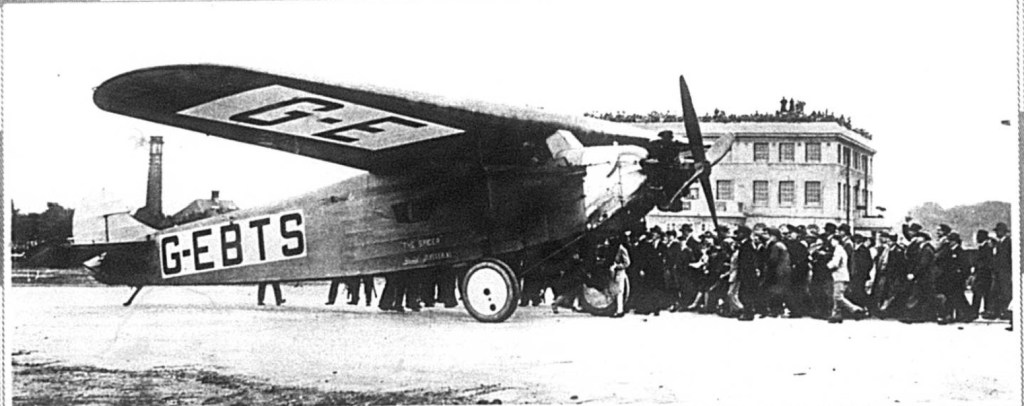
Mary Russell, the Duchess of Bedford, came to flying later in life. As a young woman in the Victorian era she spent a significant part of her life setting up and managing hospitals. She also trained in jiu-jitsu. The Duchess’s interest in flight came late in her life; she took her first flight from Croydon Airport to Woburn in 1926, when she was 60 years old. In 1929, she conducted a record-breaking flight from Lympne Airport to Karachi (India) and back to Croydon. She completed this round-trip in eight days, in her single-engine Fokker plane which she nicknamed ‘The Spider’. Her trip and return in Croydon were widely reported in the press. The following year, she flew The Spider from Lympne to Cape Town in a record breaking 91 hours and 20 minutes of flight time over 10 days. 

Mary Russell arriving back at Croydon Airport after a record-breaking flight,
The Illustrated London News, 17 August 1929

An example of a female pilot from a less moneyed background is Winifred Spooner, who was born in Woolwich. Spooner was the 16th woman in Britain to gain her pilot’s license when she obtained it in 1927. The following year, she was the first female pilot to participate in the prestigious King’s Cup, a long-distance race over the British Isles that was first established in 1922. At this first attempt at the race, Spooner came third. In 1931, she became the first woman in Britain to make a living as a private pilot, working for Sir William Everard MP. This highlights how for someone with more limited financial means such as Spooner, flying could never just be a hobby but had to constitute a source of income if she was to continue with it.

Winifred Spooner (By The Flight magazine archive from Flightglobal, CC BY-SA 4.0, Link)

Unfortunately, many of these illustrious women had their lives cut tragically short. Amy Johnson disappeared over the North Sea in 1941, age 38. Winifred Spooner caught pneumonia whilst flying and died in 1933, when she was just 32. Mary Russell, although living to the ripe old age of 70, disappeared during a solo flight around her family’s private estate in 1937. Lady Heath developed an alcohol dependency and in 1939 fell from the stairs in a double-decker tram; she later died of her injuries. Notwithstanding the glamourous treatment female pilots received in popular culture, in reality their flying exposed them to significant dangers which were generally not foregrounded in press narratives.


[1] Allain Pelletier, High-Flying Women: A world history of female pilots (Yeovil: Haynes Publishing, 2012), p. 101

[2] Ibid. p. 92

[3] ‘1930 the most wonderful year in history for women’, Daily Mirror, 29 December 1930, p. 3

Bobbed, shingled or waved: women’s hair in interwar London

Bobbed, shingled or waved: women’s hair in interwar London

Well-off women in interwar Britain were told that the state of their hair was an important consideration. Throughout the interwar period, different hairstyle trends followed one another and for the fashion-conscious woman, it was easy to be considered completely démodé if sporting the wrong style. Short hairstyles were favoured, which required less daily maintenance and upkeep than the traditional Edwardian long hairstyles. Film stars showed off these new trends to the wider public, enhancing their aspirational qualities.

The bobbed haircut made a big impact in the early 1920s, aided by American film stars such as Clara Bow (the original ‘It girl’) and Louise Brooks.[1] Brooks in particular cut her bob very short. In British film, the bob perhaps most famously appears in 1929s Piccadilly, where Anna Mae Wong’s character Shosho wears her hair in the style. Wong was an American actress, and her character Shosho was Chinese and is constantly ‘othered’ in the film, aligning the bobbed hairstyle with a dangerous exoticism.

Anna Mae Wong as Shosho in Piccadilly

By the mid-1920s, however, the bob had generally been replaced by the ‘shingled’ hairstyle, an even shorter cut that exposed the wearer’s neck. In the 1928 novel Keeping Up Appearances there are frequent reminders that the novel’s heroine, Daisy/Daphne, wears her hair shingled. It would appear to be the perfect hairstyle for a character who is a journalist and a single woman living independently in London, mixing with a ‘fast set’ of drinking friends and trying to find her own way in life. Daisy is frequently asked to write for her newspaper on the ‘Post-War Girl’, a stereotype which she herself embodies and which would commonly be assumed to wear her hair short.[2]

Shingled hair was much more complicated to achieve than a regular bob, and would require the wearer to undergo frequent and extensive treatment in a beauty salon. In interwar London, hairdresser for women often operated as part of a beaty parlour, where customers could also get manicures and other treatments. Whereas the bob had been very achievable for working-class women, shingled hair denoted someone who could spend time and money on its maintenance.

In the 1930s, hairstyles got longer again, and the most important thing to achieve was a ‘wave’. The ‘Marcel wave’, although patented in the 1870s, remained fashionable. It required the application of heated tongs onto a woman’s hair, to set it in long-lasting waves. This operation, which needed to be undertaken in a professional parlour, could be hazardous for the customer. E.M. Delafield’s Provincial Lady visits a hairdresser for a ‘permanent wave’ in The Provincial Lady Goes Further, which originally appeared in 1932:

Undergo permanent wave, with customary interludes of feeling that nothing on earth can be worth it, and eventual conviction that it was. The hairdresser (…) assures me that I shall not be left alone whilst the heating is on, and adds gravely that no client ever is left alone at that stage – which has a sinister sound, and terrifies me. However, I emerge safely, and my head is also declared to have come up beautifully – which it has.[3]

The Provincial Lady, by the way, always gets her hair done in London, and indeed often resolves to visit the hairdresser immediately upon her arrival in the capital, when she sees that fashions have changed since her last visit.[4] In rural Devon, where she normally resides, hairstyles are evidentially not subject to the whims of fashion, but in the big cities women are expected to keep up with changing expectations.

The beauty parlour appears in some interwar films, most notably Anthony Asquith’s thriller A Cottage on Dartmoor. In this film, the protagonists are Joe, a barber’s assistant, and Sally, a manicurist, who both work in the same salon. Joe is in love with Sally and pursues her doggedly, but Sally does not reciprocate his feelings and is disturbed by Joe’s persistence. When a male customer from the countryside enters the salon, he and Sally fall in love at first sight. Joe’s jealousy leads him to murderous intent. The forced proximity of the trio in the salon, where Joe has to work on his rival’s hair and observe Sally touching the man’s hands as she delivers his manicure, ratchets up the tension.

On a lighter note, the male love interest in the Gracie Fields film Looking on the Bright Side also works as a hairdresser in a beauty parlour. In this film, Fields maximises the comic opportunities of the environment, with water, soap and complicated hairdressing machines all playing a part in a key slapstick scene.

Laurie helps a customer in Looking on the Bright Side (1932)

For women who could not afford to go to the beauty parlour, home treatments such as the heavily-marketed ‘Amami’ shampoo offered a solution. Under the slogan ‘Friday Night is Amami Night’ customers were encouraged to use the brand’s ‘shampoo and set’ products every week, to achieve that elusive ‘wave.’ No matter if you visited a high-end beauty salon, or used at-home products, if you wanted to be a fashion-conscious woman in interwar London you had to spend time, money and effort to ensure that your hair passed muster.


[1] Anna Cottrell, ‘Deathless Blondes and Permanent Waves: Women’s Hairstyles in Interwar Britain’, Literature and History, vol. 25, no. 1 (2016), 22-40, p. 28

[2] Rose Macaulay, Keeping Up Appearances (London: British Library, 2022 [1928]), p. 25

[3] E. M. Delafield, The Provincial Lady Goes Further, (London: Penguin, 2013 [1932]), p. 140

[4] Ibid., p. 228

Naturism

The interwar period was a time when new and radical beliefs were developed and distributed between like-minded people. Physical health and exercise became increasingly popular for both men and women, as evidenced by the exercise manuals published in the aftermath of the First World War. This was partially a response against the perceived physical deterioration of the nation; during the Second Boer War (1899-1902) ‘between forty and sixty percent of recruits for the British Army were turned down as physically unfit for service.’[1] Prime Minister David Lloyd George famously declared in a speech in 1918 ‘that you cannot maintain an A-1 Empire with a C-3 population.’[2] A-1 and C-3 refer to the British Army’s then classification system for physical fitness, with A-1 being the highest category and C-3 being the lowest.

Yet the interest in physical wellbeing was not only generated from an imperial perspective. Cycling and rambling became popular as accessible ways to explore the countryside. Alongside these mainstream forms of enjoying nature, more niche interests developed. From the mid-1920s, naturism increasingly gained a foothold in Britain. This movement, which promoted nude exercise and movement in nature, drew on ideas originally articulated in Germany’s Freikörperkultur. Naturists promoted the health benefits of open air, sunlight and exercise, often in direct response to the perceived negative health effects of inner-city living. Influential German naturist Hans Surén ‘promoted a moral geography of landscape in which the contemporary city was considered to be an unsuitable environment for humans.’[3]

It is not surprising, then, that one of the first naturist resorts opened just north of London, in Hertfordshire. There, a few miles outside St Albans, the couple Charles and Dorothy Macaski settled at ‘Spielplatz’ in 1927.[4] Spielplatz is German for ‘playground’, the name a reference back to the German origins of the naturism movement. For the first few years the Macaskis used the grounds as a private haven. Then, in 1930, a group of naturists who swam and sunbathed naked in private grounds in Hendon, north-west London, were attacked by outraged locals. The proximity of the ‘Welsh Harp’ reservoir to the rest of the community caused tensions to rise, which spilled out in the populist press. After the ‘Welsh Harp’ incident, the Macaskis received inquiries from individuals who wanted to use their, more secluded and remote, grounds to practice their naturism. For the Macaskis, this meant extra income, and before long Spielplatz developed into a naturist community.[5]

Amateur film footage shot in 1938 shows Spielplatz in full swing. Because it is shot with a personal camera, there is no sound; but the community members attempted to reconstruct a fictional narrative in which an unsuspecting tramp stumbles upon the land and is persuaded to join in the free-flowing fun. Additionally, there are plenty of shots of Spielplatz members pulling silly faces to the camera, demonstrating acrobatic skills, and enjoying various types of exercise. They appear to range between their early 20s and mid-50s, with some couples having their young children with them (rather unexpectedly, some of the toddlers are fully clothed, perhaps against the cold).

The overall impression is of a true playground: the community members are permanently outdoors, enjoying physical activity, picnics, and camaraderie. Exposure to fresh air and sunlight continued to be important tenets of the naturist movement, which is also reflected in the name of its official membership organisation, the National Sun & Air Association. By 1937 it boasts over 2000 members.

Although in Germany, some naturist attach themselves to Nazi ideology which promoted Aryan fitness ideals, in Britain the movement continued to thrive as a progressive, left-of-centre fringe movement.[6] In the Spielplatz footage, although the community members evidently enjoy physical movement and they all appear fit and healthy (albeit some are habitual smokers), there is no sense that exercise is undertaken for the purpose of corporeal enhancement. There are no ‘drills’ or rigid exercises; instead, members appear to favour organic movement and expression such as dance and tumbling.

Spielplatz thrived in the run-up to the Second World War and even benefited from the war, as members increasingly took up permanent residence. During the Blitz, it was safer to be in the Hertfordshire countryside then in London.[7] Once again, there was a health benefit to being out of the city centre, albeit for very different reasons than had been cited in the 1920s. Today, the park continues to operate as a family-friendly naturism club.

Although never more than a fringe movement in interwar Britain, naturism is an example of new social experiments which were launched after the First World War. Like some of the political movements which gained traction in the 1920s, naturism had international roots, and it offered people a way to challenge the status quo and imagine a new way of being in the world.  


[1] J.M. Winter, ‘Military Fitness and Civilian Health in Britain during the First World War’, Journal of Contemporary History, vol. 15, no 2 (1980), 211-244 (p. 211)

[2] Ibid., p. 212

[3] Nina J. Morris, ‘Naked in nature: naturism, nature and the senses in early 20th century Britain’, Cultural Geographies, vol. 16, no. 3 (2009), 283-308 (p. 286)

[4] Jacob David Santos, ‘To the Frustration of Many a Birdwatcher: The Rise and Development of Naturism in Great Britain’, Unpublished PhD thesis, Providence College (2018), p. 49

[5] Ibid., pp. 50-51

[6] Morris, ‘Naked in nature’, p. 297

[7] Santos, ‘Rise and Development’, p. 64