J. J. Connington – The Sweepstake Murders (1931)

J. J. Connington was the alias of Albert Walter Stewart, a Scottish-born chemist, crime writer and one of the founding members of the Detection Club. Alongside a successful academic career, Connington published seventeen novels between 1923 and his death in 1947. T.S. Eliot was an admirer of Connington’s detective fiction.[1] Connington’s main ‘sleuth’ was Chief Constable Sir Clinton Driffield, who was accompanied by Wendover, a man of independent means, as a side-kick. These characters reveal Connington’s conservative political views; they have independent wealth and are no political radicals.

The Sweepstake Murders was Connington’s 13th published work, and coincidentally the concept of ‘bad luck’ (accidental or manufactured) is a key motif in the work. The book starts with Wendover, Sir Driffield’s companion, attending a bridge party at a house in the neighbourhood. The nine men in attendance agree to join into a syndicate and buy nine sweepstake tickets for the Epsom Derby. If any of the tickets win, they agree to divide the winnings equally between them.

When one of their number unexpectedly dies before the sweepstake results are announced, it occurs to Wendover that their signed agreement means that the fewer members of the syndicate remain, the more money each individual will receive, as they will have to split the winnings amongst fewer people. When the syndicate wins the second prize, or £241,920, members start getting bumped off with alarming speed. Sir Driffield comes to visit Wendover and helps the local police with their investigation, as he is concerned about his friend’s safety.

The tension in The Sweepstake Murders is two-fold: the reader does not know who the next member of the syndicate will be who will get murdered; but as the murders progress, fewer and fewer suspects remain, as it is assumed that one of the remaining syndicate members is the perpetrator. In this set-up, the murderer can only obtain the highest possible monetary return by revealing themselves as the last person standing. Connington avoids this problem by having some of the syndicate members sell on part of their stake to people not originally involved in the syndicate, thus widening the pool of potential beneficiaries. The set-up also allows Connington to include a range of murder methods and weapons in his story, as the murderer gets creative to make the deaths look like accidents.

The narrative of The Sweepstake Murders is liberally interspersed with letters sent between legal advisers and syndicate members; excerpts of Sir Driffield’s notebook; and various jottings-down of accounts and sums to allow the reader to stay on top of who is entitled to which sum at each stage of proceedings. Towards the end of the story, the behaviour of a roll of film in a photo camera becomes a crucial clue to the plot, and this is duly illustrated with some diagrams. These extra-textual elements add to the puzzle-like feel of the story and engage the reader in its resolution.

The Sweepstake Murders is a high-concept crime story, which incorporates many of the tropes of the genre including meticulous timing of alibis, use of technology to cover and uncover tracks, and a closed circle of potential suspects. Despite Connington’s professional success during the interwar period, he is now a mostly forgotten crime writer and his books are not as readily available as those of other authors of the period. Yet The Sweepstake Murders is a good quality murder mystery and is worth seeking out by readers with an interest in interwar crime literature.


[1] Martin Edwards, The Golden Age of Murder (London: Harper Collins, 2016), p. 186

Prelude (1927)

Prelude (1927)

Alongside the interwar feature films and newsreels that have been preserved in film archives, on occasion there are other, more unusual artefacts. One such text is the short film Prelude, made in 1927. This six-minute piece is dense with intertextual references. This blog has discussed before how interwar films often represent one expression of a story that is told in multiple formats. In the case of Prelude, the film references music, written text and other films which places the text in a wider cultural context.

Prelude is ‘conceived, produced, [and] acted by’ Castleton Knight. It is Knight’s first credited film output; in the 1930s he would become a feature film director working on, amongst others, the action film The Flying Scotsman (1930). Later in his career he specialised in more nationalist fare, including the World War Two documentary The Second Battle of London (1944) and, in 1953, a documentary of the coronation of Queen Elizabeth II. Prelude, by contrast, is an experimental horror film. Given Knight’s multiple credits on that first project, it seems safe to assume that it was a self-funded first foray into the world of film production.

Prelude (1927) by Castleton Knight

Prelude explicitly draws together two other cultural sources: Rachmaninoff’s ‘Prelude in C Sharp Minor (Op. 3, No. 2)’ and Edgar Allan Poe’s short story ‘The Premature Burial’. The Poe story first appeared in 1844; Rachmaninoff debuted his Prelude in 1892. The musical piece was popularly imagined to represent someone being buried alive and struggling to get out of the coffin – although the composer himself never made this connection. Poe’s story, as can be imagined from the title, deals with the same topic. The film’s opening intertitle explains to the viewer that ‘the producer’ of the film wants to imagine what inspired Rachmaninoff to his composition, and that therefore the ‘accepted theory of premature burial’ is expanded on here.

Being made in 1927, Prelude is a silent production. By taking a classical piece as the foundation of the narrative, Knight is assuming that audiences are familiar with Rachmaninoff’s work. His ‘Prelude’ was one of his best-known pieces, but it still seems likely that only educated audiences would be able to understand the connection between the music and the film. Edgar Allan Poe’s reputation had grown on both sides of the Atlantic since his premature death in 1849, although arguably viewers of Prelude do not need to be overly familiar with his work as excerpts from his story are displayed as intertitles and no further contextual knowledge is required.[1]

Prelude makes the most of a very minimal set and props; Knight, starring as the film’s character, poses as a Victorian man sitting in a chair reading Poe’s story. The story’s themes, along with a rather creepy statuette on the fireplace, and a memento mori cigarette lighter, work on the man’s imagination. As he dozes off, he imagines being buried alive. The funeral procession is conveyed solely through shots of feet and carriage wheels, and silhouettes of a coffin being loaded out of the carriage. The impression of being buried alive is achieved by superimposing an image of the man on the image of the coffin, making the man appear trapped.

Then, Prelude cuts to a close-up of the man’s eyes, and the final intertextual references take place. In the iris of the right eye, images of ‘hell’ are shown – this is actually footage from the immensely popular Swedish ‘horror documentary’ Häxen (‘The Witch’) which was released in 1922. A close-up of the other eye reveals a still image of a soul being borne aloft to Heaven. Unlike the work of Rachmaninoff and Poe, the footage from Häxen is not explicitly named, implying that the viewers are not expected to recognise its source. Instead, Knight appears to have used the footage to save having to stage and shoot a complex hellscape himself.

Footage of Haxan (1922) in Prelude (1927)

The man wakes up and realises that it was simply a nightmare – but the film’s enigmatic return in its final shots to the creepy statuette, representing Death, leaves the audience with a lingering sense of unease. Prelude references Victorian source materials and uses a Victorian setting to create a semi-experimental film. It can be considered as an attempt to translate Victorian (Gothic) horror to the modern medium of cinema. By making its explicit references to other cultural texts, Knight places Prelude in a longer horror tradition. Yet his use of editing, superimposition and unusual lenses means that Prelude incorporates techniques that are unique to the film medium, thus updating the Victorian horror genre and adapting it to a new means of expression.

Prelude remains an oddity – part low-budget horror short, part sophisticated reinterpretation of existing genre conventions. Its intertextual references demand that its audience have a understanding of Victorian cultural texts. It is unclear in which context Knight expected Prelude to be shown; it seems unlikely that it was meant for commercial exhibition and perhaps it primarily served as an artistic expression and his ‘calling card’ to gain a foothold in the industry. Its survival in the archives gives us an additional dimension to our understanding of the interwar British film landscape.


[1] Dudley R. Hutcherson, ‘Poe’s Reputation in England and America, 1850-1909’, American Literature, Vol. 14, no. 3 (1942), 211-233

Merle Oberon

Merle Oberon

When Michelle Yeoh was nominated in the ‘Best Actress in a Leading Role’ category at the 95th Academy Awards, some news outlets reported that she was the first actress from Asian descent to be nominated in this category. In the way of internet culture, this was followed by a slew of articles pointing out that Yeoh was, in fact, the second actress with Asian roots to be nominated. In 1936, actress Merle Oberon had been nominated in the same category for her performance in The Dark Angel. Coining Yeoh ‘the first’ was not necessarily simply an oversight, however, as Oberon hid her Asian heritage and passed as white throughout her decade-long film career.

Yeoh’s Oscar nomination thus brought brief pop-culture attention to an actress who had otherwise largely sunk out of the public consciousness. Merle Oberon was born Estelle Merle O’Brien Thompson in 1911. Her later stage name took the Irish ‘O’Brien’ and turned it into something more glamorous. When Oberon moved to Britain as a teenager with a view to start a film career, she told everyone that she had been born in Tasmania and lived in India as a child. This was to be the story of her family background and upbringing, which she maintained for her entire life.

Only after her death in 1979 did a biography reveal the real story: Oberon was born to an Irish father and a Sri-Lankan mother in India and had no connection to Australia at all. It is not hard to understand why Oberon sought to obscure her racial background: mixed-race families were treated with disdain and suspicion in interwar Britain, and in Hollywood the Production Code (which was in place from 1934) explicitly banned depiction of inter-racial relationships.[1] Although Oberon’s looks were frequently called ‘exotic’ in the press, she was able to pass as white throughout her career.

One assumes that Oberon picked Tasmania as her purported birth location due to its remoteness; it was about as far away as one could go from Britain whilst still remaining in the British Empire. Curiously, as late as at least the 2000s stories circulated in Tasmania and the rest of Australia that claimed that Oberon had in fact been born there and was the daughter of a local Australian-Chinese woman named Lottie Chintock.[2] There is no historical archival material to support this claim, whereas Oberon’s biographers were able to trace her birth certificate in India.

Oberon’s upbringing in India was impoverished, although she would later claim that she had lived with aristocratic relatives.[3] As a teenager, she started using creams to lighten her skin. After being bullied out of a prestigious all-girls school in Calcutta due to her mixed-race background, Oberon moved to Europe in the late 1920s. Between 1928 and 1933 she had bit-parts in about a dozen British films, mostly uncredited. She did, however, catch the eye of director/producer Alexander Korda, who cast her in Service for Ladies (1932), Men of Tomorrow (1932) and Strange Evidence (1933) before offering her break-through role as Anne Boleyn in his wildly successful The Private Life of Henry VIII. Oberon and Korda were married from 1939 to 1945.

Oberon as Anne Boleyn in The Private Life of Henry VIII (1933)

The Private Life of Henry VIII was a huge success on both sides of the Atlantic and allowed Oberon to transition into a Hollywood career. For the remainder of the 1930s, she made films in both Britain and the US. Korda cast her again in his 1934 epic The Private Life of Don Juan, and a year later Oberon landed the lead role in the US production The Dark Angel, for which she would receive her Oscar nomination. In 1937 she was cast as the female lead in I, Claudius, opposite British acting legend Charles Laughton (who had also played Henry VIII) and Emlyn Williams. This film was directed by Josef von Sternberg, who had launched Marlene Dietrich’s career; and produced by Korda. Unfortunately, Oberon suffered injuries in a car crash during production and Korda halted the project; it remained unfinished.

From the end of the 1930s, Oberon transitioned more fully to Hollywood, with The Divorce of Lady X one of her last significant British productions. Throughout her career, press reports labelled her ‘exotic’, and ‘un-British’, and from time to time she played Asian characters on screen, but always under the pretence that she was a white woman playing an Asian character. There were very few successful non-white actors during the 1920s and 1930s, and those that did manage to build a career, such as Anna May Wong and Paul Robeson, continuously contended with racism. People with mixed-race heritage, who could be referred to as ‘half-caste’, were often treated even worse than those of full Asian or African backgrounds.

Oberon kept her racial identity hidden her entire life, including towards her children and four husbands. In 1978, a year before she died, she even went as far as attending a ‘welcome home’ event in Tasmania, a country with which she had no familial connection and which she had probably never visited.[4] The persistent labelling of her looks as ‘exotic’ and the reasonably swift reveal of her true background, four years after her death, suggests that during her lifetime audiences and journalists may have suspected that she had a mixed-race background. The conventions and prejudices of the period prevented them from raising these openly, preferring to sustain the myth Oberon had created around herself.


[1] Babli Sinha, ‘“A Strangely Un-English Actress”: Race, legibility and the films of Merle Oberon’, in Journal of Popular Film and Television, vol. 44, no. 4, 2016, 220-226 (223)

[2] Maree Delofski, ‘Place, race and stardom: Becoming Merle Oberon’ in Continuum, vol. 26, no. 6, 2012, 803-814 (805)

[3] Ibid., p. 804

[4] Ibid.

Holidays in interwar London

Holidays in interwar London

With the summer season upon us, many may be planning to head off for a few weeks to relax on holiday. The right to paid holiday these days is enshrined in UK law. The first legal intervention in this area came in 1938 with the Holidays With Pay Act. Rather than setting out an inalienable right to holiday, however, the purpose of the act was to ‘enable wage regulating authorities to make provision for holidays and holiday remuneration for workers whose wages they regulate, and to enable the Minister of Labour to assist voluntary schemes for securing holidays with pay for workers in any industry.’ It was facilitative rather than prescriptive, giving employers a framework for offering paid holiday if they wanted to do so. Even for those covered by the Act, they would only receive one week of paid holiday a year.

Prior to 1938, there was no legal concept of a holiday in Britain. What’s more, the ‘weekend’ for most of the interwar period comprised only Saturday afternoon and Sunday; this 5.5 day work-week had developed in the 19th century. Bank Holiday weekends (where the Monday was a national holiday) could be the only extended break a working person had. The notion that workers should be entitled to extended time off work whilst still receiving pay was not commonly held. At the other end of the social spectrum, the upper classes were generally not in wage-earning roles and therefore had much more freedom over how they used their time.

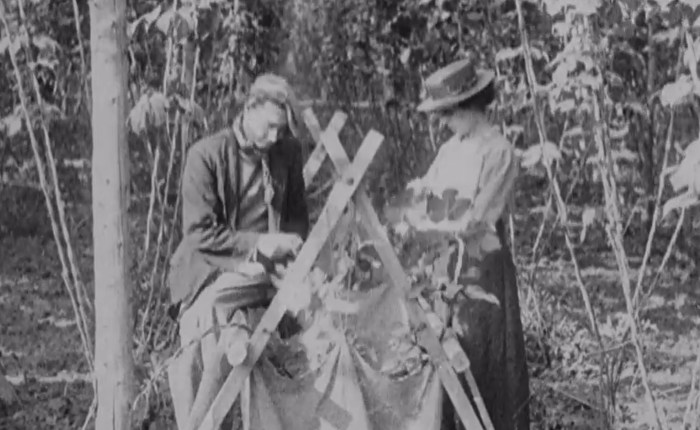
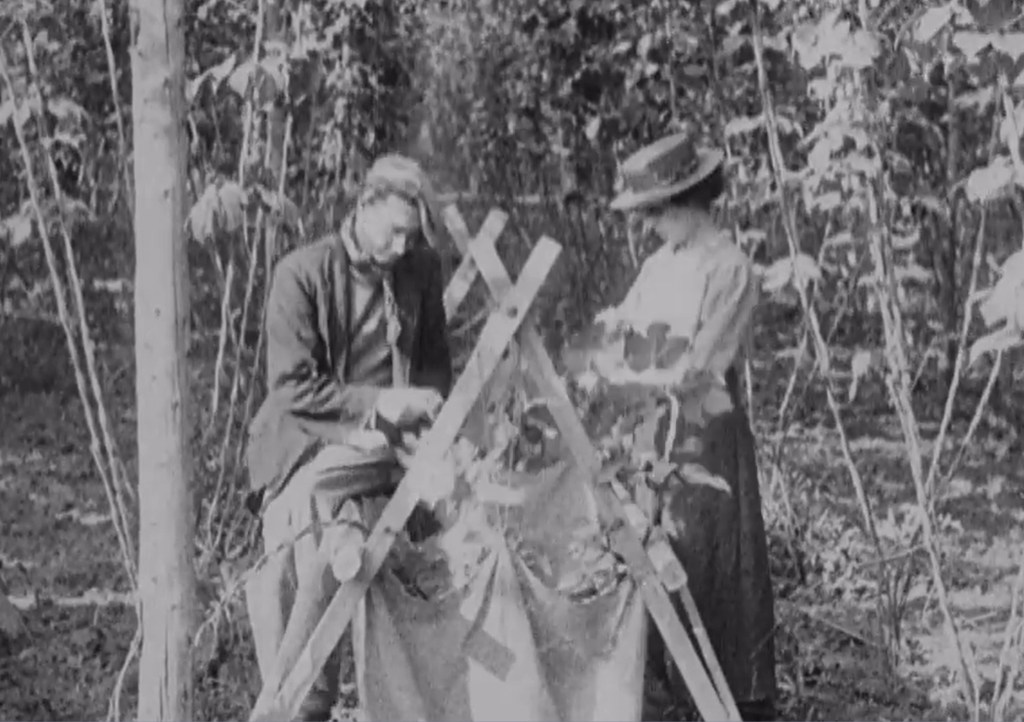
What were the options for breaks, then, for different social groups during the interwar period? At the lower end of the social scale, East End workers could go to Kent in the summer months to go hop-picking. This was not a holiday as such as they would still be required to undertake long hours of manual labour, but it gave an opportunity to leave the city and enjoy the countryside. They would also get paid for their efforts and be given lodgings by the farmers. George Orwell went hop-picking in 1931 during one of his expeditions moonlighting as an iterant worker. He describes the communal aspects of the picking, with whole families coming down and picking together. The 1917 film East is East includes extensive scenes on Kent hop-picking fields as the main character makes her way there for a summer job.

Hop-picking scene from East is East (dir. Henry Edwards, 1917)

Hop-picking was not a holiday, but rather an opportunity to undertake seasonal work and escape the squalor of London during the hottest months. If you had slightly more disposable income, a day-trip could be a welcome activity. The cheapest and most comfortable way to travel would be by charabanc (an early type of motor bus); either by buying a ticket on a scheduled service or by pooling together as a community group and hiring a private coach.[1] The proximity of a range of seaside towns to London made them a popular choice of destination for these trips; then, as now, many seaside towns offered entertainment on the pier and quayside.

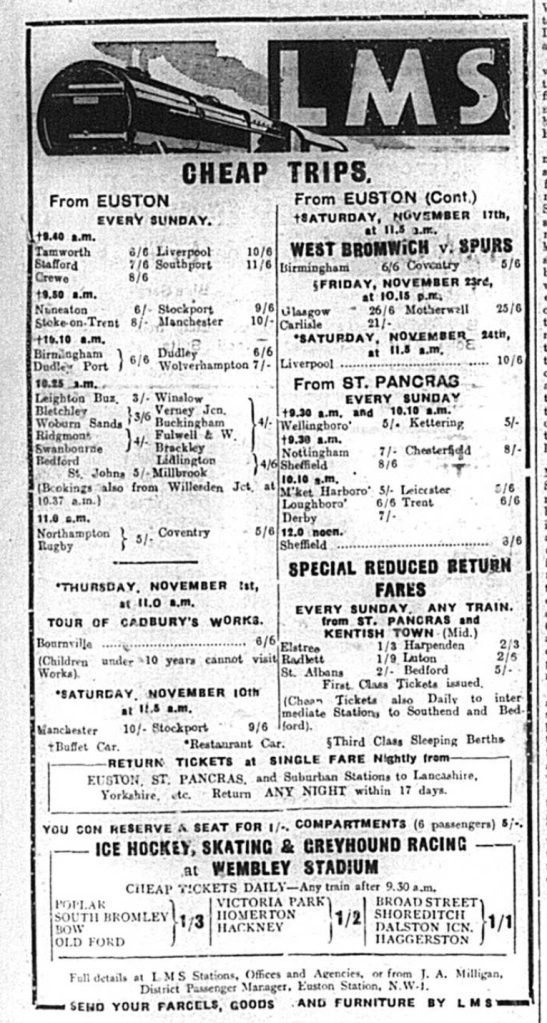
For those able to spend a bit more, travelling by train allowed access to a much larger part of Britain. By the interwar period, Britain’s rail network was mature and there were numerous London terminals from which to board trains. Train operators advertised ‘cheap trips’ in London newspapers. For example, this 1934 advert from the London, Midland and Scottish Railways advertises a range of services for holidaymakers. There are trains leaving to the Midlands and the North every Saturday and Sunday. These are offered with a flexible return ticket, that can be used for 17 days after the initial trip. This implies that travellers are expected to be using the train for a holiday of a week or two. Those travelling to Birmingham and environs can benefit from a tour of the Cadbury chocolate factory at Bournville – an attractive holiday outing which shows the railway collaborating with a large company to offer a package deal. Those who cannot afford to travel far of be away from home long are invited to consider a day-trip to Wembley Stadium for ‘Ice Hockey, Skating & Greyhound Racing’.

LMS advert, The City & East London Observer, 27 October 1934, p. 7

At the top end of the social scale, foreign travel was a possibility. Tourist guides and travel agencies had been available since the 19th century, taking much of the organisation and guesswork out of foreign travel. Commercial flight routes greatly developed during the interwar period, providing a faster way to travel in addition to overland routes and travel by ship. For those who opted for comfort and style over speed, luxury ocean liners and overnight rail journeys through Europe with the Compagnie des Wagon-Lits were good options.

Whether it was to have fish and chips at the seaside or a five-course meal in a dining carriage, throughout the interwar period there was an increased agreement that Londoners should be able to leave the city every now and then and enjoy relaxation and a change of scenery. For many, however, these trips remained limited to single-day outings, as there was little provision for paid holidays and most people could ill afford to take unpaid leave and were at risk of losing their jobs if they did so.


[1] Michael John Law, ‘Charabancs and social class in 1930s Britain’, The  Journal  of  Transport  History, Volume 36, No. 1 (June 2015), 45

The Faithful Heart (1932)

This blog has previously discussed some of the films of Victor Saville, who is mainly remembered for his collaborations with musical comedy star Jessie Matthews. Yet before that collaboration started, Saville had directed over a dozen other films, some of them silent films in the1920s.

In 1932 he directed The Faithful Heart, a melodrama based on a stage play, like so many of the films of the period were. The male lead was played by Herbert Marshall, a famous stage and film star who later in the same year would play husband to Marlene Dietrich in Blonde Venus. The female lead in The Faithful Heart is played by Marshall’s real-life spouse at the time (he ended up marrying five times) Edna Best. Best also had a significant stage career and in this film plays a dual role as both mother and daughter.

The plot of The Faithful Heart is reasonably simple. In 1899, young sailor Waverley Ango lands in Southampton port and takes a liking to a local barmaid, Grace, who he calls ‘Blackie’. After some persuasion Grace falls in love with Waverley and the pair spend about a week together before Waverley is called up to go to Africa. Despite his promises that he will return to Southampton as soon as possible, Grace knows that his heart is in Africa and she will not see him again.

Then, about a third of the way into the film, the action moves to 1919, with Waverley established in an army career and returning from the front with decorations. He is engaged to Diana, a wealthy and sophisticated woman. Then a young woman called Blackie shows up, who tells him she is Grace’s daughter and that Grace died in childbirth. Waverley understands that he is Blackie’s father, and he feels responsible for helping her. Diana, however, persuades Blackie to emigrate to Canada to join her aunt. When Waverley finds out Blackie is about to travel to Canada, Diana tells him he must choose between them. The film ends with Waverley and Blackie boarding the ship to Canada together.

Under the terms of the BBFC censorship code at the time, films were not allowed to show sexual liaisons. As a result, many films use proxies to insinuated sexual interaction has taken place. In 1929’s Piccadilly, for example, we see a woman giving a man her house key, the two of them entering the house together, and then a close-up shot of the woman reclining on a bed with her hair loose. In Blackmail (also 1929), Hitchcock has two people enter a four-poster bed with the curtains drawn, with the implication that a sexual assault takes place in the bed, unseen by the viewer.

The Faithful Heart is a lot less explicit, to the point that one is left wondering when this baby was conceived. On their first date together, Grace tells Waverley that she has no expectations of him, and she kisses him first. However, we also see that on subsequent nights they go to the theatre every night, and they lodge in a house shared by Blackie’s aunt, cousin and an older male member of the family – hardly an environment that provides a lot of privacy. Yet the audience is asked to accept that the relationship was consummated. This then leads to an insinuated portrayal of extramarital sex, which is not roundly condemned by the film. It partially justifies this by making it clear that Grace and Waverley love each other, and possibly would have married if circumstances had allowed them. Crucially, the film’s ending, with Waverley choosing to ditch Diana in favour of looking after Blackie, re-confirms his commitment to the memory of Grace who is presented as his ‘true’ life partner.

The film’s message of staying true and committed to your first love is particularly ironic in light of the private lives of both Marshall and Best. Marshall, as mentioned above, married five times during his life; Best had a total of three marriages. They had both already been divorced once by the time The Faithful Heart was made. Best’s divorce came through 2 weeks before she married Marshall; Marshall’s own divorce was finalised only 3 days before his marriage to Best. This implies that they both left their first marriages legally intact long after they had decided to live separately from their first spouses. The same pattern repeats for their next marriages, with Best actually marrying her third husband on the day the divorce with Marshall came through.

Clearly, the reality was that it was not that uncommon, particularly in showbiz circles, to have multiple significant relationships in life, and there was no moral imperative to stay with one’s first partner. In The Faithful Heart, Diana, Waverley’s fiancée, also largely acts reasonably. She is not shocked or upset that he has a child from a previous relationship. However, quite understandably, she does want to be sure that he is no longer emotionally committed to Grace. The film gets away with positioning Diana as the ‘bad’ character because throughout the film, she uses her family to try and manipulate Waverley to do things he does not want to do, like live in a luxurious flat or accept an allowance from her father. This builds the pair up as fundamentally incompatible, which is reaffirmed when Diana asks Waverley to give up Blackie – something that goes against his core values.

A final note on the soundtrack, which is unusual in the first part of the film, set in 1899. This section includes many shots of boats and ships in Southampton dock, and much of the soundtrack consists of a male choir singing sea shanties. One particular sequence, when Waverley is waking up with a hangover, is scored by a very whisper-y and somewhat unnerving rendition of ‘Drunken Sailor’. Unlike during the silent film era, when each cinema had its own musicians and the scoring of a film would differ from venue to venue and even from screening to screening, with sound films directors could make creative decisions about the soundtrack as well. Victor Saville had a somewhat unusual approach to the music for this first section of the film, which makes it memorable and showcases Saville’s talent for musical direction which would become much more prominent in his later work.

The Faithful Heart ultimately purports to be a morality tale, but the incident that gets the plot underway has to be fudged because it does not align with what was considered morally acceptable to show on film at the time. It does not necessarily walk this tightrope successfully, leaving audiences to significantly suspend their disbelief while watching this film.

The Faithful Heart is available to watch for free on BFI Player, for viewers based in the UK.

From investigation to trial

This is the fourth and final post of this year’s May Murder Month. You can read posts one, two and three elsewhere on the blog.

Most contemporary readers will get their knowledge about interwar murder stories from the realms of fiction – Hercule Poirot gathering together suspects for a drawing room reveal (a device which Agatha Christie actually only used sparingly) or a hard-boiled police officer picking up on a seemingly minute clue that unravels the whole case. Once the murderer is identified, interwar fiction is either silent about what happens next, or the perpetrator is given the opportunity to take the ‘honourable way out’ by committing suicide.[1]

In reality, of course, investigations were conducted by police inspectors. Unlike in modern criminal cases, there was no Crown Prosecution Service in interwar England. Instead, the police both conducted the investigation and prepared the documentation for the criminal trial. The Director of Public Prosecutions was ultimately responsible for bringing the case to trial in the interest of the people. England then, as now, had a two-tier criminal justice system. The magistrate courts were convened locally and dealt with most of the day-to-day criminal offences. Crown courts were reserved for jury trials, which included murder charges.

Before a case could be referred to the crown court, a prima facie case had to be established in the magistrate court that a crime had been committed and it was of a magnitude appropriate to be considered in the crown court. Interwar murder trials were therefore effectively heard twice: once in the magistrate court and then again in the crown court, where the sentencing would take place. It was generally the latter proceedings that drew the attention of the national press. In murder cases, the coroner’s inquest ran in tandem to the magistrate court proceedings. In the interwar period, coroner courts sat with their own juries, who were tasked with determining whether death had occurred naturally, through suicide, accident, or murder. Usually, if foul play was suspected but the police investigation was ongoing, the coroner would suspend the inquest to give the police more time to complete their investigations.

The reading public, then, were experiencing criminal narratives in two different ways. When reading newspapers, the reports mostly focused on the criminal trial, with its rhythm of prosecution, defence, cross-examination, witness statements, a possible statement by the accused, and the judge’s summing up, all cumulating to the jury’s verdict. In crime fiction, the narrative focused on the investigation, with witness statements noted as the investigation developed. Particularly in stories where the protagonist is an amateur sleuth as opposed to a police officer, the formal police and court procedures can be completely outside the scope of the narrative. As crime historian Victoria Stewart has noted: ‘Detective novels tend not to recount the trial of the individual whom the investigator identifies as the guilty party because the watertightness of the investigation itself acts as a substitute for the depiction of the judicial process. An account of the trial would simply reiterate the findings of the investigation that has formed the body of the narrative.’[2]

Other scholars have noted that trial reporting reveals contemporary attitudes to potentially contentious topics such as changing attitudes to gender identity and sexuality.[3] Newspaper historians have also argued that the increased popularity of crime fiction changed crime reporting, with journalists paying more attention to ‘human interest detail’ of the story as opposed to the judicial process. This, in turn, potentially obscured the public’s awareness of legal procedures.[4] Additionally, journalists on occasion played a very active role in gathering evidence that led towards a conviction, for example in the case of Buck Ruxton who murdered his wife and a servant.[5] Conversely, crime fiction novels which had a police inspector as their protagonist, such as the Inspector French novels by Freeman Wills Croft, potentially educated their readership about police procedures in more detail than newspaper reports did.

Whether fictional or factual, murder stories fascinated interwar audiences and allowed them to explore the limits of what was considered acceptable or transgressive behaviour; and how this changed over the course of the two decades. Newspapers and crime novels presented readers with two different lenses through which to consider the criminal justice process, from investigation to trial.


[1] Lord Peter Wimsey’s increasing mental distress at sending murderers to the gallows, which comes to a head at the end of the final Wimsey novel Busman’s Honeymoon, is a notable exception.

[2] Victoria Stewart, Crime Writing in Interwar Britain (Cambridge: University of Cambridge Press, 2017), p. 11

[3] Lucy Bland, Modern Women on Trial: sexual transgressions on the age of the flapper (Manchester: Manchester University Press, 2013), p. 2

[4] Judith Rowbotham; Kim Stevenson; Samantha Pegg, Crime News in Modern Britain (London: Palgrave, 2013), p. 140

[5] Shani D’Cruze, ‘Intimacy, Professionalism and Domestic Homicide in Interwar Britain: the case of Buck Ruxton’, Women’s History Review, vol. 16, no. 5 (2007), 701-722

Domestic homicides

This is the third post in a themed series for May Murder Month. You can read previous posts here and here.

A significant proportion of murders committed in the interwar period were committed in the domestic sphere, as they are today. Of the 130 women sentenced to death between 1900 and 1950, 102 had killed a child, usually their own and usually when the child was very young.[1] After the adoption of the 1922 Infanticide Act, women who killed their own children were tried for manslaughter rather than murder, which lessened their sentence.

The other significant group of domestic killings were perpetrated by men killing their wives, girlfriends, or ex-partners. Almost all of the famous murders of the interwar period fall into this category. Scholars have argued that the trial reporting on these ‘domestic homicides’ ‘provided significant moments when fractures in the values and aspirations of (often) respectable private lives were held up for exhaustive public scrutiny.’[2] These murder cases have therefore often been used by historians as vehicles for a wider understanding of private lives and the performance of masculinity and femininity.[3]

When considering homicide data, there are two datasets to work from: the people who were convicted of murder and given a death sentence; and those for whom their sentence was not commuted and who were actually executed. Around 60% of men who were sentenced to death were executed. Out of the 223 executions that took place in the interwar period, 118 (53%) were of individuals who had killed a partner or family member, so involved in a so-called ‘domestic homicide’. In the first year after the Great War, 1920, 21 people were executed – a much higher number than in any of the subsequent years of the interwar period. All 21 individuals were men who had killed their wife, girlfriend or ex-girlfriend. This suggests that the end of the war saw a spike in domestic violence as traumatised men returned from the front to partners who had had a completely different war experience, and indeed may have started relationships with others during the conflict.

Later into the interwar period, even less famous murder trials can reveal much about the private lives of marginalised groups of Londoners, such as those who were not British and those who lived in poverty. In 1934, a Cypriot man killed the landlord of his lodging house over a quarrel about a woman. Georgios Kalli Georgiou had lived with his girlfriend ‘as husband and wife’ in a different lodging house, meaning that they shared a bedroom and bed without being formally married. When they moved into the house run by Thomas James in Torrington Square, Georgios and the woman took separate rooms and she started working as a housekeeper for Thomas James. Georgios quickly became suspicious that his partner had moved her affections to Thomas, and the situation came to a head in a three-way quarrel during which Georgios stabbed Thomas to death. Although Georgios was found guilty of murder and sentenced to death, after an appeal the Home Secretary reprieved him and Georgios was held captive in a prison camp on the Isle of Wight for the next nine years, instead.

As this case reveals, interpersonal relationships and living arrangements could be the catalyst for violence. In this instance, however, the foreign identity of the perpetrator, and the relative acceptance of male-on-male violence as a ‘normal’ part of masculine behaviour, likely influenced the Home Office’s decision to grant Georgios a reprieve. In other cases, the perceived social and moral transgressions of perpetrators and/or victims, as revealed during trial hearings, were presented as ‘morality tales’ by the daily press.[4] The famous conviction of Edith Thompson has been covered numerous times in this blog; in 1935 the murder of Francis Rattenbury by his wife’s lover (and the couple’s chauffeur) gave audiences a similar ringside seat to a menage à trois between an older man, a middle-aged wife and a young lover. Although, unlike Edith Thompson, Alma Rattenbury was acquitted of the murder charge brought against her, she committed suicide a few days after her release from prison. The denouement of this case was therefore arguably almost as salacious as that of the Thompson-Bywaters trial some 12 years earlier.

Although domestic homicides constituted a large proportion of the homicides during the interwar period, only cases that were perceived to reveal something that was normally private became established in popular culture. Abusive relationships that escalated to murder rarely became notorious, but cases in which either the woman transgressed her traditional role and enacted violence on a man; or in which relationships were revealed to not be as harmonious as they had appeared, the murders became cemented as morality tales into the popular imagination.


[1] Annette Ballinger, Dead Women Walking: Executed women in England and Wales, 1900-1955 (Aldershot: Ashgate, 2000), p. 1

[2] Shani D’Cruze, ‘Intimacy, Professionalism and Domestic Homicide in Interwar Britain: the case of Buck Ruxton’, Women’s History Review, 2007, vol. 16 no. 5, 701-722 (702)

[3] See D’Cruze, ‘Intimacy, Professionalism and Domestic Homicide’; Julie English Early, ‘A New Man for a New Century: Dr. Crippen and the Principles of Masculinity’ in Disorder in the Court: Trials and Sexual Conflict at the Turn of the Century, ed. by George Robb and Nancy Erber (Basingstoke: Macmillan, 1999), 209-230; Ginger Frost ‘She is but a Woman’: Kitty Byron and the English Edwardian Criminal Justice System’ in Gender & History, 2004, Vol. 16, no. 3, 538-560; Lucy Bland, Modern women on trial: sexual transgression in the age of the flapper (Manchester: Manchester University Press, 2013)

[4] Bland, Modern women on trial, p. 216

Executions in interwar London

Continuing May Murder Month, this week we take a look at the ultimate outcome of a murder case – the execution. Last week’s May Murder Month entry on police memoirs can be found here.

If you were found guilty of murder in interwar Britain, you would automatically be sentenced to death, unless your legal team had managed to convince the jury that you were insane at the time you committed the murder. After the adoption of the Infanticide Act in 1922, women who killed their new-born babies were tried as for manslaughter rather than for murder, meaning they no longer received death sentences. Yet even those found guilty of murder could appeal to the King (via the Home Secretary) for a reprieve. Reprieves were fairly common: in the first half of the 20th century around 40% of convicted male murderers, and an astonishing 90% of convicted women murderers, were granted a reprieve of execution.[1] This usually meant their sentence was commuted to ‘penal servitude for life’.

The period of appeal following a death sentence was usually ‘three Sundays’, meaning that if an appeal or reprieve was not granted, execution usually followed within a month of the trial. Murder trials were much shorter than we are used to today and prisoners were committed to trial much more quickly. This meant that convicted murderers were usually executed within a year of the crime having taken place. In interwar London, condemned prisoners were held in a special ‘condemned cell’ adjacent to the prison gallows. During the 1920s and 1930s, there were never more than 21 executions in a single year across the whole of Britain; and in many years there were fewer than 10.[2] This meant it was extremely unlikely for two convicted murderers to be held at the same prison at the same time, unless they were both convicted for the same murder committed jointly. There was no concept like ‘death row’ as it currently exists in the US, where prisoners can spend years awaiting execution.

Since 1868, executions were no longer held in public but were conducted inside prison walls. In London, there were three prisons in which executions took place until capital punishment was formally abolished in 1969: Pentonville Prison for male prisoners who lived north of the Thames; Wandsworth Prison for male prisoners who lived south of the Thames; and Holloway Prison for female convicts. Gradually, over the course of the first few decades of the 20th century, capital punishment became less ritualistic and more bureaucratic. Until 1902, a black flag was raised over the prison after an execution had taken place. The tolling of a bell during an execution was abolished around the same time.[3] After the end of public executions, journalists were still regularly invited to attend, so that their newspaper reports could serve as a proxy for public scrutiny. The last time a journalist attended an execution was 1934.[4]

The only ritual elements of execution which remained in place is that they usually took place at 9am; and that an execution notice was posted on the prison door immediately after the event. This is depicted, for example, in the 1938 thriller They Drive By Night, where a small crowd of people is shown gathered around the prison entrance. Papers of record, such as The Times, usually posted brief notices of executions as they had taken place. How an actual execution unfolded was usually ‘shrouded in secrecy’, with official statements invariably confirming that nothing unusual had occurred.[5] This vacuum of official information allowed rumours to swirl. After the controversial execution of Edith Thompson it was suggested that ‘her insides had fallen out’ as she dropped through the trap door, suggesting she may have been pregnant at the time of her death. Thompson’s executioner, John Ellis, committed suicide nine years after Thompson’s death, and it was suggested that he had never been able to get over the horror of that particular hanging.

Hanging had been the principal form of execution in Britain for centuries. By the interwar period, the government prided itself on having perfected a highly efficient method, which was considered ‘humane’ because it aimed to be swift and accurate. The objective was to ensure the prisoner’s neck broke immediately, so that he or she did not have to suffer through asphyxiation. Around a decade after the last execution took place in Britain, one of the country’s most famous hangmen, Albert Pierrepoint, published his memoirs. This book finally revealed in detail how executions were conducted, although interwar fiction novels such as Trial and Error had given descriptions of the process decades earlier.

Pierrepoint described in detail how he would arrive at a prison the day before the execution to make his preparations, which included the crucial calculation of ‘the drop’: the length of rope required which depended on the prisoner’s weight and size. For the neck to break at the 4th or 5th vertebrae was considered ideal as it would cause instant death. If the drop was too short, the prisoner could end up suffocating rather than breaking their neck; if it was too long, the worst-case scenario would be that the prisoner was decapitated as they dropped.

Executions were conducted extremely quickly: the execution of Norman Thorne was reported to last no more than ten seconds ‘[f]rom the time that [he] emerged from his cell door until the moment he passed into eternity.’[6] After the execution, the prisoner was left hanging for an hour before being cut down and submitted to a post-mortem, during which a note was made of the exact cause of death and where the neck had broken. An official statement on a pre-prepared template, signed and sealed by a coroner and jury, would confirm the death of the prisoner under the 1868 Capital Punishment Amendment Act. The body would then be buried in a dedicated cemetery inside the prison walls the same day.[7]

Despite the relative rarity of executions in interwar Britain, the state had developed a highly polished routine to ensure that these executions were conducted as efficiently as possible. This efficiency was considered humane, as it would limit the prisoner’s suffering as much as possible. At the same time, however, it also incorporated capital punishment into the bureaucratic machinery of government. Treating capital punishment as a largely administrative process also minimised the scope for challenging its principles, as it was incorporated into the judicial system as ‘business as usual.’ The abolition movement consequently only gained momentum in Britain after the Second World War.


[1] Shani D’Cruze, ‘Intimacy, Professionalism and Domestic Homicide in Interwar Britain: the case of Buck Ruxton’, Women’s History Review, 2007, vol. 16, no. 5, 701-722 (706)

[2] Source: http://www.capitalpunishmentuk.org/

[3] Lizzie Seal, Capital Punishment in Twentieth-Century Britain: Audience, justice, memory (London: Routledge, 2014), p. 17

[4] Ibid., p. 36

[5] Lizzie Seal, ‘Albert Pierrepoint and the cultural persona of the twentieth-century hangman’, Crime, Media, Culture, 2016, vol. 12, no. 1, 83-100 (86)

[6] Seal, Capital Punishment, p. 41

[7] Albert Pierrepoint, Executioner: Pierrepoint (London: Coronet, 1998 [1974]), p. 175

Police memoirs

It’s May Murder Month again! Last year I covered a host of infamous interwar murder cases in three posts which you can find here, here and here. This year we’ll take a step back and review some of the institutions and trends connected to interwar homicides.

The Metropolitan Police was founded in 1829 to provide a cohesive policing structure for the entirety of London.[1] Initially the focus of the force was on uniformed bobbies patrolling their respective beats. As Kate Summerscale has demonstrated, in mid-Victorian English society, plain-clothes investigators were treated with suspicion.[2] A permanent Criminal Investigation Department staffed by plain-clothes detectives was not formed until 1878.[3] By the interwar period, the notion of an established ‘Scotland Yard’ detective branch of the Metropolitan Police was still relatively novel, and there had only been a few generations of high-ranking police investigators.

It is perhaps not surprising, then, that the 1920s and 1930s saw the publication of a host of police memoirs. The establishment of crime detection as an accepted part of police activity coincided with the increased popularity of crime fiction; and a rise in literacy levels across the population. Police historian Paul Lawrence has noted that ‘There was a marked bias towards memoirs written by officers from large urban forces, particularly detectives, although as a rule books written by most types of officer can be found.’[4]

These police memoirs indicate that there was a popular appetite for ‘true crime’ histories as well as crime fiction. They also reveal to us how police officers wanted to position themselves and their work in the public consciousness. Some of the memoirs were written by senior officers who had become personally famous, such as Frederick Porter Wensley who was Chief Constable of the Metropolitan Police from 1924 till his retirement in 1929.[5] Others were penned by detectives who reached mid-tier positions and whose names would not be familiar to the wider public.[6] Almost invariably, however, the memoirs primarily deal with murder cases, as these were clearly thought to hold the widest appeal for the readership.

Despite advances in forensic science, such as the use of fingerprinting to identify criminals, several officers insist throughout the interwar period that personal knowledge of habitual criminals is the most effective way of detecting and preventing crime. This is despite there having been some high-profile cases of mistaken identity in the Yard’s recent history.[7] Chief Constable Wensley confidently states early on in his book: ‘The only real method [to detect crime] is to employ detectives who know rogues by direct contact, know their habits, their ways of thought, their motives, and above all, know their friends and associates.’[8] CID Chief Inspector Frederick Sharpe similarly insists that a good detective has to know the local gangs and crooks in order to be able to solve crime.[9] This suggests that senior investigators were reluctant to let go of outdated methods; or that they sought to present a romanticised view of inner-city policing to their readership, favouring personal connections over anonymous forensic methods.

Another feature common across several memoirs is the author relating their start in the field in a particularly rough district of London. Tom Divall, another former head of the CID, started off in Southwark, which he claimed was the part of London that was most infected with vice.[10] Ex-superintendent G.W. Cornish had his start in Whitechapel, which he described as a ‘human rabbit warren’ housing ‘[e]very type of criminal, both men and women, from the meanest sneak thieves and pickpockets to the smart crooks who worked further “up West”.’[11] In all cases, poorer districts of London are described in emotive language, evoking images of dirt, squalor, and neglect. However, areas which were ‘rough’ at the turn of the century are described as much ‘cleaned up’ by the 1920s and 1930s, thanks to the unfailing efforts of the Metropolitan Police.

Unsurprisingly, these memoirs unfailingly present the Metropolitan Police and Scotland Yard as forces for good, keeping the public safe and apprehending criminals quickly and efficiently. Policing is described as a career which ‘will supply excitement, a good salary, sound companions, a healthy life and plenty of chances to make a mark’, although at this time generally open to men only.[12] Detection had come a long way since the days of Mr Whicher, who was derided in 1860 for his handling of the Road Hill House case but later proven correct in his deductions. By the interwar period, plain-clothes detectives were well-respected and could even be quite glamorous. The stream of police memoirs published in this period both attest to the popularity of real-life detectives and further strengthened their positive position in the public’s imagination.


[1] Except the City of London, which retained (and still retains) its own police force as part of its special administrative duties

[2] Kate Summerscale, The Suspicions of Mr Whicher (London: Bloomsbury, 2008)

[3] Robert Reiner, The Politics of the Police, 3rd edition (Oxford: Oxford University Press, 2000), pp. 56-57

[4] Paul Lawrence, ‘‘Scoundrels and Scallywags, and some honest men….’ Memoirs and the self-image of French and English policemen, c. 1870-1939’ In Comparative Histories of Crime, eds. Barry Godfrey, Clive Emsley, Graeme Dunstall (Uffculme: Willan Publishing, 2003) 125-144 (p. 127)

[5] Frederick Porter Wensley, Forty Years of Scotland Yard (New York: Greenwood Press, 1968 [1931]), p. xvi

[6] Herbert T. Fitch, Traitors Within: The Adventures of Detective Inspector Herbert T Fitch (London: Hurst & Blackett, 1933)

[7] Colin Beavan, Fingerprints: Murder and the race to uncover the science of identity (London: Fourth Estate, 2003), pp. 147-166

[8] Wensley, Forty Years of Scotland Yard, p. 12

[9] Frederick Sharpe, Sharpe of the Flying Squad (London: John Long, 1938), p. 11

[10] Tom Divall, Scoundrels and Scallywags (And Some Honest Men), (London: Ernest Benn, 1929), pp. 31-32

[11] G.W. Cornish, Cornish of the ‘Yard’: His reminiscences and cases (London: John Lane, 1935), pp. 2-3

[12] Fitch, Traitors Within, p. 249. The first female police inspector in the UK was Florence Mildred White, who rose to this rank in 1930 at Birmingham City Police.