The Bow Cinema Murder – the Police Investigation

The Bow Cinema Murder – the Police Investigation

This is the fifth in a 11-part investigation into the 1934 ‘Bow Cinema Murder’. You can read all entries in the series here. 

When Dudley and Maisie Hoard were found, critically wounded, around 8.30am on 7 August 1934, the first police officer on the scene was PC Duncan Mackay. He was patrolling the local area at the time, and was therefore able to get to the cinema quickly. PC Mackay was part of the army of patrolling Bobbies who worked all over London, each walking their regular ‘beat’ so that they could be on hand if anyone in the neighbourhood needed police assistance. After arriving at the cinema, PC Mackay quickly rang his local station for back-up. The Metropolitan Police had divided London in a series of divisions; Bow Road was part of ‘H’ Division, which covered the wider Whitechapel area. There were a few police stations near the cinema – Bow Road station was the closest, but there was also a station at Arbour Square, a short distance away.

Each police division had a team of detectives: plain-clothes officers who were tasked with investigating crimes and tracking down criminals. In addition, there was the Criminal Investigation Department (CID), commonly known as Scotland Yard. This team worked across all of London and specialised in the most difficult crimes, as well as criminal activity that was not confined to one area – for example, during the 1920s Scotland Yard spent a fair amount of time investigating crooked racecourse betting gangs.[1] Working for Scotland Yard was prestigious, as the small team often dealt with high-profile cases.

After PC Mackay’s phone call, the first officers to arrive at the cinema were the detectives attached to ‘H’ Division. Most of these men were born locally, and they would spend many hours over the next weeks to not only catch the murderer, but also put together sufficient evidence to ensure a conviction. In the interwar period, the police’s remit was wider than it is today, and the police took on some tasks which would now sit with the Crown Prosecution Service. Detectives were responsible for ensuring that all the evidence fit together and made a convincing court case. This meant that even after a criminal was caught, they would still have significant work in (re)interviewing witnesses, tying up loose ends, and getting additional expert opinions.

The detectives who were the first to arrive at the cinema were Detective Sergeant James Rignell, a 34-year old born in Poplar who had joined the Met shortly after the First World War; Detective Inspector Henry Giddins, who had only been promoted to this rank less than a week before the murder took place; and Detective Sergeant Claud Smith, who was born in Mile End and also joined the police immediately after completing his First World War service. Between them, they started a physical investigation of the murder scene and questioned the cinema staff who had started to arrive for their shifts. James Rignell went to the hospital and took the very first statement from Maisie Hoard.

One of the detectives, possibly James Rignell

Very quickly, a decision was made that Scotland Yard needed to be involved in the investigation. The attack had been brutal, and DI Giddins was very new to his role. Around 3pm on the same day, Detective Inspector Fred ‘Nutty’ Sharpe of Scotland Yard arrived at the cinema. He would be in charge of the investigation from that point onwards, leading the ‘H’ Division team and drawing on staff in other parts of London as needed. As it transpired, the investigation would lead the police out of London to the Norfolk/Suffolk borderlands, and Sharpe’s position in the CID gave him the authority to instruct police forces outside of the capital, too.

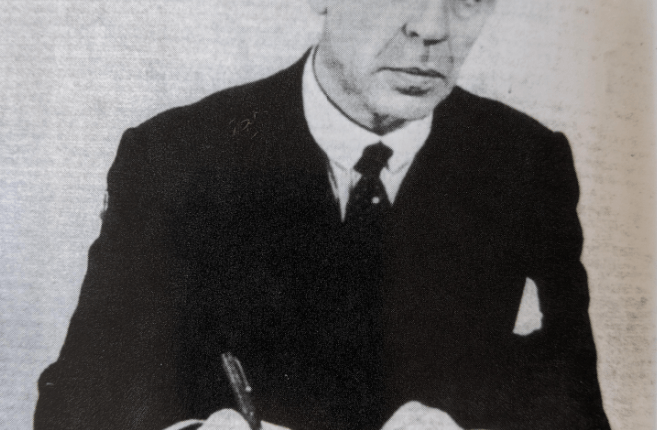
Frederick Sharpe, from his memoir Sharpe of the Flying Squad (1938)

Fred Sharpe had joined the Metropolitan Police in 1911, and spent most of the first decades of his police career chasing criminal gangs, pickpockets and car thieves. In his memoirs, which he published in 1938 after his retirement, he advocated that police detectives should cultivate friendly relations with professional criminals. He argued that there was a reciprocal relationship and a level of respect between criminals and the police, in which both groups knew the rules of the game they were involved in. This approach got him in hot waters after his retirement, when Sharpe himself came under police investigation for engaging in bookmaking activities.[2]

Murder, however, appears to have been a separate category for Sharpe. He devoted an entire chapter to the Bow Cinema Murder in his memoirs, in which he referred to the murder as ‘one of the most savage a man has ever committed.’[3] He underscored this supposed savagery by describing his physical reaction to the crime scene: “The flat itself and the hall presented a horrible and ghastly scene, showing that the utmost violence had been used in the attack on this unfortunate couple. (…) the sight of that room and the passageway nearly made me sick.”[4] Sharpe ensured that the details of the crime scene were captured by ordering a police photographer to attend the scene on the day of the murder. These photographs show copious amounts of blood on the staircase where Dudley was found, as well as the blood-soaked bedsheets which Maisie had left behind.

At the close of 7 August, the police did not yet have any clear leads. The staff who had been arriving at the cinema had not been able to share much useful information. Most of the crimes they investigated were committed by criminal gangs, and this guided their initial thinking. Newspaper reports stated that the police were speaking to their contacts in criminal gangs to gather information – using that network which Fred Sharpe often relied on.[5] Police officers remained stationed at the cinema overnight, and some materials had been taken away for forensic examinations. It was not until the next day, however, that a clear suspect would emerge.


[1] Heather Shore, ‘Criminality and Englishness in the Aftermath: The Racecourse Wars of the 1920s’, Twentieth Century British History, vol. 22, no. 4 (2011), 474-497

[2] ‘Ex-Chief Inspector Sharpe of the Flying Squad: bookmaking activities under the name of Williams’, MEPO 3/759, National Archives

[3] Frederick Sharpe, Sharpe of the Flying Squad, (London: John Long, 1938), p. 126

[4] Ibid., p. 127

[5] ‘“Yard” reconstructs the crime,’ Daily Herald, 8 August 1934, p. 2
The Bow Cinema Murder – the East End family

The Bow Cinema Murder – the East End family

This is the fourth in a 11-part investigation into the 1934 ‘Bow Cinema Murder’. You can read all entries in the series here. 

When John Stockwell decided to attack and rob his employer, he was living as a lodger with a local East End family. He had met Eliza Roake, the head of the family, through the charitable activities she undertook for her Church. After John lost his place in the Salvation Army Boys Home after being convicted of theft, Ellen took him in. After the events of 7 August 1934, their association with John drew this poor but respectable family into a police investigation and a tabloid press sensation.

Ellen Eliza Roake was born Ellen Hoare in 1876; when she was 26, she married Henry George Roake who was five years her junior. The couple had five surviving children: Nellie, born in 1903; William, born in 1906; Eva, born in 1909; Frederick, born in 1913; and Violet, born in 1915. In addition, there were at least two other sons who did not survive past early childhood. All the children were born in Bromley-by-Bow, where Ellen and Henry settled after their marriage. Henry worked as a railway porter in nearby Liverpool Street Station.

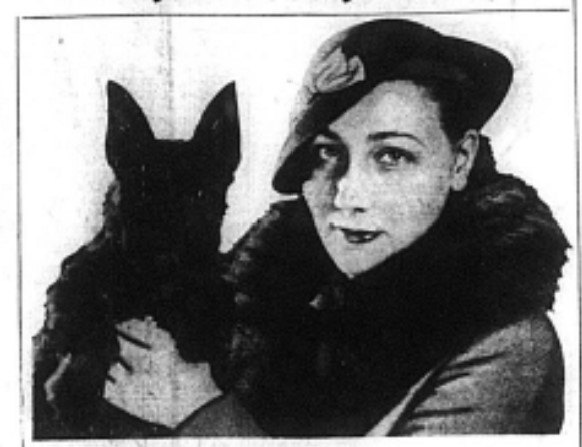
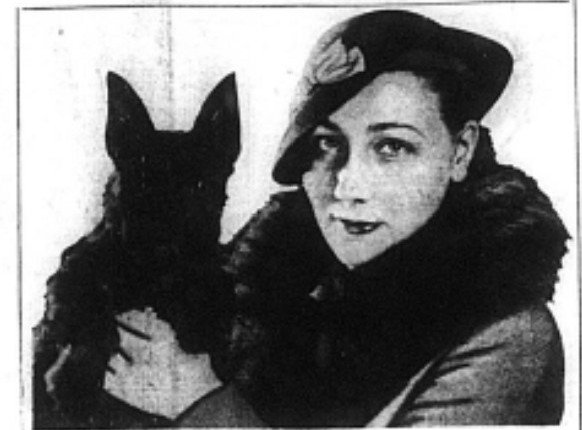
Ellen Roake. This photo appeared in the Daily Herald on 12 Sept 1934

In 1926, Henry passed away; five years later, William and Eva both married and moved out of the family home on Empson Street in Bromley. The space that was freed up by their departure is perhaps one of the reasons why Ellen felt able to invite John Stockwell to move into the family home in early 1932.

The Empson Street house was considered small even at that time; the police inspector investigating the murder of Dudley Hoard commented on the house’s small size in one of his reports. There was only one bedroom, which Ellen shared with Nellie and Violet. Beyond the bedroom, there were no other rooms on the house’s first floor. The ground floor consisted of a sitting room, kitchen and scullery. John and Frederick had to make up their beds in the sitting room floor every night. The toilet was attached to the back of the house and needed to be accessed through the garden.

Nellie Roake, who was around 30 at the time of the murder, worked as a ‘chocolate finisher’ in Millwall, an adjacent neighbourhood. The manufacture of chocolates and sweets was an industry that typically employed women, who were believed to be better suited to the detailed work. In addition to her job, Nellie also took care of part of the household chores including cooking meals. She was engaged to William Hilsdon, a labourer who lived around the corner from the Roakes with his parents. William was also born in Bromley; also had a number of siblings; and his parents were also working-class. Although he and Nellie moved in together (with William’s mother) some time in the late 1930s, they did not get married until 1953, after Ellen Roake passed away. There does not appear to have been any bad blood between Ellen and William, however; on the night before the murder on Dudley Hoard in 1934, William spent the evening at the Roake’s house playing cards with the family until nearly midnight.

Unlike his elder sister, Frederick Roake appears to have provided less support to the family. At the time of the murder, he was unemployed due to a knee injury for which he was receiving outpatient treatment at St Andrew’s hospital, where Maisie and Dudley were also taken after the attack. Beyond that, Frederick seems to have spent considerable time loafing around the neighbourhood; he was able to immediately go over to the cinema once news of the attack broke. Frederick and John were not friendly; after John’s arrest, Frederick reported that he usually did not have ‘a lot to say’ to the other man. Despite sharing a bed together every night, the pair appear to have tried to avoid one another as much as possible. Frederick had a girlfriend, Henrietta, who was also born locally. They married in 1938 and stayed in the East End, where Frederick ended up working as a transporter of goods on horse cart.

Violet Roake was the youngest of the family, and the one most closely involved with John Stockwell. They were of the same age, and had been going out from around 1931, when they were both 16. Violet worked as a biscuit packer in a Bethnal Green factory; for many young working class women, light factory work had replaced domestic service as the career of choice. Every morning, John walked Violet to the bus stop around 7.30am. Her shifts started at 8am and finished at 6pm. Because John’s hours at the cinema did not finish until 11pm, most days the only time they had together was that half hour in the morning. The exception was Tuesday, when John was off work and they could do something in the evening. If they were at home, it was likely that there were other people around, and the small size of the house would have afforded them no privacy.

Violet Roake. This photo appeared in the Daily Herald on 14 November 1934

Until the murder, Violet had assumed that she and John would be getting married some day. She eventually married a naval officer in 1939 and moved down to Portsmouth with him. They had a son in 1939 and a daughter in 1949. Unlike most other participants in this story, Violet left the East End definitively when she was in her early twenties. It is possible that her association with a murderer, however unwitting, left a lasting mark on her reputation in the local area.

The Roakes were a typical East End family, with blue collar jobs, little money, a small living space, and a lot of family and friendship ties to the local area. Despite their small house, Ellen invited John to live with them when he became homeless, which speaks to her civic-mindedness. If it had not been for their involuntary involvement in the story of the Bow Cinema murder, they would have been absorbed in history without a trace. The case no doubt had a lasting impact on Violet in particular, whose expectations for her life were radically changed as a result of the case. As part of the fall-out, the family were exposed to police investigators, which came onto the scene within minutes of the crime being discovered. The next blog post will unpick who got involved in the police investigation, and how they approached the East End community in which the crime had taken place.

The Bow Cinema Murder – the Killer 

The Bow Cinema Murder – the Killer 

This is the third in a 11-part investigation into the 1934 ‘Bow Cinema Murder’. You can read all entries in the series here. 

So who was the man who rang the Hoard’s doorbell on the morning of 7 August 1934 and attacked Dudley and Maisie with such deadly consequences? The initial police investigation assumed that the crime was committed by one or perhaps two criminals, who potentially allowed themselves to be locked into the cinema the night before. Investigators were reported to be questioning known criminals in the East End for clues.[1]

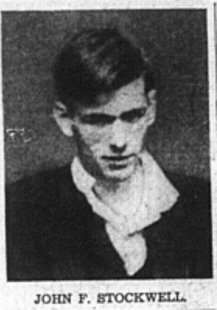
The truth was somewhat different, and closer to home. The attack on Dudley and Maisie was committed by a nineteen-year-old employee of the Eastern Palace Cinema: John Frederick Stockwell. John had only worked at the cinema for a few months, after being hired by Dudley. As an attendant, it was his duty to check tickets and show patrons to their seats. Like many neighbourhood cinemas at the time, the Eastern Palace operated on a ‘continuous performance’ basis, meaning that once the first screening of the day started, screenings continued on a loop until the end of the day. Patrons could show up at any time and stay as long as they liked. A crew of male and female attendants were therefore constantly occupied with letting people in and out of the auditorium.

Like many people in the East End, John Stockwell came from an impoverished background – but he was not brought up locally. He was born on 2 March 1915 near King’s Cross. His father had died at the front at Mons before John was even born. His mother re-married, but died in 1926 when John was 11. John had a brother, Horace, who was three years’ his senior – by the time the men had grown up they were no longer close. After his mother’s death, John went to live with an aunt, Elizabeth Brown. Because John’s father had died in the war, Elizabeth received a financial contribution from the state for John’s upkeep. Elizabeth decided around 1930 to move away from central London, and out to Bromley in Kent.

For the teenage John, who was no longer required to attend school, the change from Kings Cross to Bromley was not beneficial. Elizabeth reported that John no longer accepted her as a parental authority; he appears to have been out and about with a group of other young men. Eventually, Elizabeth decided she could no longer support John living with her, and he moved to a Salvation Army Boys Home in Bow Road some time in 1930. These homes were designed exactly for people like John: young men who lacked family or community support. They intended to give these men the skills to get employment and become independent. The SA arranged for John to get a job at a cloth manufacturer at Barbican. During his time there, John stole some cloth; he was caught and appeared before the Magistrate’s court in December 1931. John was sentenced to two year’s probation, meaning he had to meet up with a probation officer regularly.  

The Salvation Army had a zero-tolerance policy when it came to criminal activity, so John lost his lodgings. He had met, through the Army’s church activities, a local widow, Ellen Roake, and had become particularly close to Eliza’s youngest daughter Violet. Ellen agreed to take John on as a lodger, and he moved into the tiny Roake family home in early 1932. John and Violet became an official couple. After a short period working for a pastry chef, John was unemployed until he found the job at the Eastern Palace Cinema, which was only a 15-minute walk from the Roake’s home. One of the cinema’s other attendants, Charles Whitnell, lived practically next door to the Roakes.


As an attendant, John earned 32 shillings and sixpence a week. He paid 15 shillings a week for his board and lodging, leaving him with less than £1 a week for any other expenses. At the time of the murder, he did have a savings account with the Post Office, but it contained only 30 shillings (£1.50). Clearly, John had always lived in poverty. The nearly £90 that he stole from the cinema safe after attacking Dudley and Maisie was probably more money than he had ever seen together in his life; it was certainly more than he could ever imagine to save up himself. By August 1934, John and Violet had been going out for several years, but he could probably not imagine how he would ever make enough money to enable them to get married and start their own family.

He also had virtually no contact with his family at this point, and no social community to fall back on; he’d been removed from the community in King’s Cross in which he had grown up. The East End neighbourhood in which he lived from 1930 was one in which family ties counted for a lot, and he was perceived as an outsider. During the police investigation, his colleagues reported that they had found John odd, and his previous conviction for theft was known and made people suspicious of him.

None of these things justify his attack on the Hoards, but they do illustrate that the lack of structural social care in interwar Britain left individuals vulnerable. If you did not have a strong personal support network, you could very quickly find yourself in a situation that felt interminable. Once John committed the theft of cloth in 1931, what little social support he had been able to count on was also removed. In addition, rigid class boundaries made it even less likely for someone in his position to materially improve his circumstances. It is understandable, then, that someone of his young age, with little adult supervision to guide him, came to the conclusion that the only way to get ahead was to break the rules and commit a theft.

Once John had committed his attack and stolen the money, he managed to leave the Eastern Palace Cinema unseen. Tuesday was his weekly day off work. That evening, when Violet finished her shift at the Kearley & Tonge biscuit factory in Bethnal Green, John treated her to a trip to the Stoll cinema in the West End. Unbeknownst to Violet, he used part of the stolen money to pay for the tickets. On the way to the cinema, they discussed Dudley Hoard’s murder, as it was splashed over the evening papers. It would be the last evening they spent together, as the next day John used his stolen money to escape London, triggering a multi-day manhunt that captured the attention of the nation.


[1] ‘“Yard” reconstructs the crime,’ Daily Herald, 8 August 1934, p. 2
The Bow Cinema Murder – the Victim

The Bow Cinema Murder – the Victim

This is the second in a 11-part investigation into the 1934 ‘Bow Cinema Murder’. You can read all entries in the series here.

One of the effects of a well-publicised murder investigation is that it can put ordinary people into the press spotlight. This was as true in the interwar period as it is today. The Bow Cinema murder was briefly on the front pages of all major newspapers, and the victims, the perpetrator, and the people around them all got dragged onto those front pages too. This can make a murder story a valuable source for the historian: it highlights and preserves the stories of ordinary people as they are put into extraordinary circumstances.

Dudley Henry Hoard, the victim of the Bow Cinema Murder, was one such an ordinary person. If not for the extremely violent end to his life, it’s unlikely his name would ever have entered into the annals of history. He was born in Wandsworth, south-west London, in 1892. His family moved to Croydon when Dudley was a child, and his parents remained in that area. Dudley had an elder sister, Dorothy, and two younger sisters, Avery and Winifred. His father, William, was born in Devon; his mother Mary was from Chelsea in London. Dudley’s father worked as a clerk, indicating the family were in the lower middle class. This is also borne out by the fact that Dudley attended the independent Whitgift School in Croydon.

By the time he was eighteen, Dudley considered himself to be an actor. At 5 ft. 9.5in he was quite tall, and he may have cut a dashing figure on stage. According to his father, Dudley left school to take part in a production at Sadler’s Wells theatre, and toured the country as part of a travelling theatre group. At the same time, he was interested in cinema, which was becoming increasingly popular. Dudley briefly ran his own cinema, the Hippodrome, in Sutton (near Croydon) in the early 1910s.[1]

During the War, Hoard served as a Private in the London Regiment. He did not have a distinguished war record; the most the newspapers can say about it after his death is that he served in France and Greece, and got gassed in an enemy gas attack.[2] After the war he returned to repertoire acting, including a stint working for the Melville Brothers, who were part of a theatre producing dynasty.

At some point, Dudley met Maisie Tait, a native of Newcastle who was close to him in age and also an actor. According to Dudley’s father, the pair met when they were in their late teens; however, they did not get married until 1933, when Dudley was 41 and Maisie was 38. Details of Maisie’s early life are difficult to trace; she was also known as Maisie Robson, and it is not clear whether either Tait or Robson was her birth name, or whether both were assumed names. One thing that is certain is that Maisie had a daughter from a previous marriage; after the attack in 1934, this adult daughter came to visit Maisie in hospital. Her existence may be what stopped Dudley and Maisie getting married any sooner.

Around the time of their wedding, Dudley apparently decided to give up the touring life and to return to the cinema. In 1933, he got his first appointment as cinema manager in London, at the Brittania Picture Theatre in Camden. By the 1930s, cinemas had become enormously popular in Britain, and the industry had professionalised significantly since Hoard’s last foray into cinema management in 1911. The average cinema had upwards of a dozen staff members, and cinema managers were required to ensure that all operations went smoothly; staff were trained appropriately; and the cinema drew as many patrons as possible. Marketing was a significant part of the cinema manager’s role. Trade magazine Kinematograph Weekly highlighted in each issue the innovative and successful marketing stunts that managers up and down the country came up with to draw in audiences.

At the same time, cinemas became increasingly consolidated into chains, such as Odeon and ABC. Within the chains, the patrons’ experiences were increasingly homogenised. Rather than being rewarded for originality and innovation, managers in chains were expected to comply with central directives on how their cinemas should be managed. Dudley never worked for a chain cinema; at the Brittania in Camden he had to make two men redundant to save the cinema money. These men had families to maintain, and they threatened Dudley after he had fired them. This probably was one of the reasons why Dudley swiftly moved on to work at the Cinema House in Oxford Street and then, finally, the Eastern Palace Cinema in Bow.

These three posts in the space of 18 months indicate how fast-moving and insecure the work of cinema management was. For Dudley and Maisie, the job at the Eastern Palace was a step up, as it came with their own private apartment (although they had to pay rent for its use). With it, though, they arrived into a close-knit East End neighbourhood, where many of the staff were neighbours or even family members of one another. The Hoards were outsiders; and as it turned out, so was the man who attacked them.


[1] ‘London Manager Murdered’, Kinematograph Weekly, 9 August 1934

[2] ‘Actor and Producer’, Daily Mirror, 8 August 1934, p. 2; ‘London Cinema Outrage’, Evening Standard, 7 August 1934, p. 2

The Bow Cinema Murder (1934)

The Bow Cinema Murder (1934)

This is the first in a 11-part investigation into the 1934 ‘Bow Cinema Murder’. You can read all entries in the series here.

This blog is no stranger to interwar murder stories. Over the next ten weeks, posts will investigate one 1934 murder case in depth. Unlike some of the other cases covered previously, this murder is no longer well known – it has not been adapted in any novels, plays or films (to the best of my knowledge) and did not become a byword for evil. At the time it was committed, however, it caused a media storm and thrust a group of working-class East Enders into the limelight. It was the Bow Cinema Murder.

The murder took place on Tuesday morning, 7 August 1934, at the Eastern Palace Cinema in Bromley-by-Bow, in the East End of London. The Eastern Palace cinema was a neighbourhood cinema, co-owned by two local Jewish professionals. It was located on the busy Bow Road, in between a café and a general store. It could seat around 1000 patrons in its auditorium and balcony, where audiences could enjoy the ornate (if somewhat shabby) ‘Oriental’ decorations on the walls.

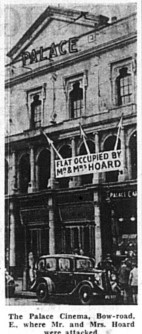
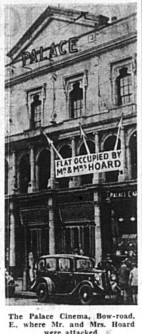
The facade of the Eastern Palace Cinema. This photo appeared in the Daily Express the day after the murder

The day-to-day management of the cinema fell to 41-year-old Dudley Henry Hoard. As part of his role, Dudley and his wife Maisie were required to live in a flat adjacent to the auditorium – the lease of the building required that it was partially used for domestic occupancy. Dudley got the cinema manager job in March 1934, and he and Maisie moved in a few weeks later. It was the first time since their wedding in spring 1933 that they had their own flat; they had previously been staying with Dudley’s parents in Croydon.

On the morning of 7 August, Dudley and Maisie were sleeping in after a busy Bank Holiday weekend. Ordinarily, one of Dudley’s first tasks every day was to deposit the cinema’s previous day’s takings at the Midland Bank on Mile End Road. Due to the banks having been shut on the Bank holiday Monday, there were now three days’ worth of ticket earnings in the safe in Dudley’s office, one floor below the flat. For the Eastern Palace, the Bank holiday weekend had resulted in total takings of 89 pounds, 5 shillings, and tuppence. By comparison, Dudley earned about £5 a week as cinema manager, and he was the best-paid member of staff in the cinema. Even for him, the nearly £90 in the safe represented around 10 months’ worth of wages.

Around quarter to eight, someone rang the door of the flat – not the doorbell at the cinema’s entrance, but the door of the flat specifically. Dudley quickly put on some trousers over his nightshirt and went to open the door. Maisie had only half woken and was about to doze off, when she heard Dudley shout out. When Maisie walked into the living room, she saw a man standing over her husband, wielding a hatchet. Dudley had a head wound and was trying to fend off the other man. Maisie shouted out to the attacker, a young man. He then turned to her and hit her over the head with the hatchet – she blacked out immediately.

About thirty minutes later, the cinema’s regular team of cleaning women arrived for their morning shift. These three women came in six days a week to clean and tidy the cinema before the first screenings started. Because they arrived hours before any of the other staff, the head cleaner, Mrs Emily Brinklow, had her own set of keys. She let herself and her colleagues in, and they started to get their cleaning materials out. Emily noticed that the post and milk, dropped by the milkman, had not yet been taken upstairs by either Dudley or Maisie. This did not worry her unduly; she would bring them up herself in a minute. Before she could do so, a scream ripped through the building. Nellie Earrey, one of the other cleaners and sister to one of the cinema’s projectionists, had found a heavily injured Dudley Hoard on the staircase leading to the auditorium balcony. He was covered in blood, as were the walls and the staircase he was on. Emily rushed to the flat and banged on the door; after a short while, Maisie opened it. She, too, was covered in blood, and seemed completely dazed.

Nellie ran out onto the street, where a passerby quickly alerted the local Bobby who was patrolling the area. PC Mackay swiftly went over to the cinema and tried to provide emergency aid, as well as alerting his local police station by telephone. The divisional surgeon (the police doctor) is on the scene quickly, as he was still at his home further down Bow Road when the station officer rang him. He too provides emergency aid, and arranges for both Dudley and Maisie to be transported to the nearby St Andrews hospital. They arrive shortly after 10am. Although Dudley is immediately examined and treated by multiple surgeons, the fractures to his skull are too severe. He dies at 3.07pm, without regaining consciousness.

The police know that they now have a murder case on their hands. Maisie is less severely injured, but unable to give more than a brief, confused statement before she needs to rest. Detectives attached to the local police department, known as ‘H’ Division, start questioning all the cinema’s staff as they arrive for their shifts. Most of them live very close to the cinema, and they are aware very quickly that something has happened. The police realise that the cinema’s safe has been opened by the keys which would normally be carried around by Dudley, and that the full weekend’s takings have been stolen. They have a victim and a motive, but not yet a clue as to the killer’s identity.

The Poplar Rates Rebellion (1921)

In 1921, a group of thirty Labour councillors of the London Borough of Poplar were imprisoned as a result of their approach to poor relief in the borough. This almost forgotten episode, known as the Poplar Rates Rebellion or Poplar Rates Revolt, highlights the fraught relationships between national and local politicians in interwar Britain, as well as the diverging approaches to how poverty should be treated.

The Labour Party was founded in 1900 and it grew steadily in popularity in the first decades of its existence. The Party primarily targeted working-class voters. Two extensions to the franchise helped Labour gain more votes and seats in parliament: the 1918 Representation of the People Act gave the vote to all men over 21, regardless of their income or background. It also gave the vote to women over 30 who met a property qualification. In 1924, Labour delivered its first Prime Minister, Ramsey McDonald. In 1928 the vote was given to all men and women over 21, leading to the 1929 general election being dubbed the ‘flapper election.’  

For some in the Conservative Party, the extension of the franchise to include ‘the poor’ risked corrupting democracy. If those from poor backgrounds were allowed to vote, they argued, politicians could in effect ‘bribe’ voters by promising high rates of poor relief.[1] As historian Liam Ryan has pointed out, this argument echoes Victorian values which equate poverty with ‘a lack of the moral qualities needed to sustain independence in society.’[2] The actions of the Poplar Labour Party in 1921 would serve to evidence this argument.

In addition to the national party, Labour was active at a local level. The party controlled 34 out of 85 local authorities in London for at least part of the interwar period.[3] Poplar was one of London’s poorest boroughs at this time: in 1932, nearly a quarter of residents lived below the poverty line.[4] By focusing on providing generous poor relief, the Poplar Labour Party was able to build up a sold voter base even before the First World War.[5] The local councillors were themselves from the East End and from working-class backgrounds, which further embedded them in the community.[6]

Immediately following the First World War, the Poplar Labour Party decided to implement an extensive, and expensive, poor relief programme including a minimum wage of £4 a week for municipal workers. Such a local initiative had to be funded from ‘rates’, taxes on property levied on local inhabitants and businesses. A proportion of the rate income was for the local council, but some of it was supposed to be passed on to fund the London County Council, the police, and the Water Board.

Due to the high levels of poverty in the area, rate income was low, and rates could not be raised without harming the local community. When an application for financial support from the national government was denied, the local party refused to collect the proportion of the rates that was supposed to fund London-wide initiatives.[7] When the council ignored a court order to levy the rates, almost all the councillors were arrested and sent to prison for contempt of court – the men to Brixton and the women to Holloway. They remained imprisoned for six weeks, during which they received much popular support.

The Poplar Rates Protest gave rise to what became known as ‘Poplarism’ – ‘a polemical epithet used by Conservatives to refer to high-spending, left-wing poor law guardians in the 1920s.’[8] The leader of the revolt, George Lansbury, who had been a Labour MP between 1910 and 1912, returned to Parliament in 1922 and became leader of the Labour Party from 1932 to 1935. He remained on the left of the party for the rest of his career. The Conservative governments of the interwar period eventually abolished local poor law boards, which prevented a repeat of the Rates Rebellion.[9] Ultimately, though, it became accepted at both sides of the political aisle that offering poor relief did not equate to political corruption.


[1] Liam Ryan, ‘Socialism and corruption: Conservative responses to nationalisation and Poplarism, 1900–40’, in The many lives of corruption: The reform of public life in modern Britain, 1750-1950, eds. Ian Cawood and Tom Crook (Manchester: Manchester University Press, 2022), 239-258, (248)

[2] Ibid.

[3] Dan Weinbren, ‘Building Communities, Constructing Identities: The Rise of the Labour Party in London’, The London Journal, vol. 23, no. 1 (1998), 41-60 (41)

[4] Gillian Rose, ‘Imagining Poplar in the 1920s: contested concepts of community’, Journal of Historical Geography, vol. 16, no. 4 (1990), 425-437 (427)

[5] Weinbren, 45

[6] Rose, 432

[7] Ryan, 248

[8] Ibid., 240

[9] Ibid., 254

The Woman from China (1931)

The Woman from China (1931)

As has been covered on this blog before, in 1927 the British Government adopted the Cinematograph Films Act, a legal measure which prescribed a minimum volume of British-made films which each exhibitor had to show. It was no longer possible for a cinema to solely show Hollywood films. The intention of the Act was to boost the British film industry; its unintended consequence was that American studios set up cheap studio contracts in Britain and started churning out low-quality films which became known as ‘quota quickies’.[1]

Shortly after the Act was passed, Britain started transitioning to sound film, with the earliest ‘talkies’ with continuous sound appearing in 1929/1930. The transition was rapid, with sound film becoming the norm within just a few years. Yet for the ‘quota quickie’ industry, sound film could be an expensive business. It was generally the aim of American studios to shoot their British films as cheaply as possible, often for as little as £1 per foot of film.[2] Shooting sound film required additional technology such as microphones, and also forced on-set shooting in the early years, as location shooting was too noisy and complicated. It is not surprising, then, that quota quickie producers continued to make silent films into the early 1930s.

One of these is The Woman from China, which was made in 1930. According to Steve Chibnall, the film was produced in a rush. Under the 1927 Act, the ‘quota year’ ran from 1 April to 31 March, meaning that by 31 March each year exhibitors had to be able to evidence that they had shown the appropriate proportion of British films in the preceding twelve months. In January 1930, the major American studio MGM commissioned two British producers to create a film by the end of March that year. The result was The Woman from China, for which shooting and editing was completed within four weeks, with a half-finished script.

The final scenes were shot five days before the scheduled trade show, and director Dryhurst was obliged to double as editor with the help of one young assistant. The two worked ninety hours without sleep to meet the deadline, although the first of the two shows as lacking the final reel.[3]  

Considering those circumstances, The Woman from China can be considered a fairly accomplished film from a technical perspective, although it perpetuates many obvious and damaging stereotypes in its narrative, staging and costuming. The plot is one familiar from films of this period: a young secretary and a naval officer are engaged, but their relationship is thwarted by a mysterious British woman who has recently arrived from China, and who is in love with the naval officer. The ‘woman from China’ is being blackmailed by a Chinese Svengali, Chung-Li, who in turn wants to marry the secretary. The Chinese man directs his henchmen to kidnap both the officer and the secretary, and proceeds to emotionally torture them until they can break free. The ‘woman from China’ has a change of heart and sacrifices herself to save the naval officer; the Chinese man and his henchmen are killed; and the original couple are able to get away unscathed.

Frances Cuyler and Tony Wylde as the protagonists in The Woman from China

There was already an established history of racist depictions of Chinese characters in popular culture in Britain. The most successful proponent of this was pulp writer Sax Rohmer, who started his ‘Fu Manchu’ series of books just before the First World War. In these books, a Chinese evil mastermind is working to reinstate China as a superior power. Fu Manchu is associated with Limehouse, which at that time was London’s Chinatown. The Woman from China acknowledges its debt to these earlier pulp novels by a character noting that Laloe Berchmans, the woman who has made a deal with Chung-Li, is ‘like a character from an Edgar Wallace novel.’

Julie Suedo as ‘the Woman from China’ and Tony Wylde in The Woman from China

Chung-Li is played by white British actor Gibb McLaughlin in yellowface. The second most prominent Chinese character, an anonymous ‘Chinaman’, is played by Japanese actor Kiyoshi Takase. The Woman from China incorporates such racist tropes as Chung-Li having pointedly filed fingernails; leering after the secretary; and working to increase China’s power in the world. (I’ve deliberately not included any stills from the film featuring McLaughlin in this post as his costume and appearance throughout is offensive).

Chung-Li proposes his deal to the woman under his control

Although The Woman from China may appear to be a good example of a 1930s British film that is best forgotten about, it also allows us to explore the conditions of film production during this volatile period of the British film industry; contemporary portrayals of race; and a late example of a British silent film which includes on-location shooting. Its preservation allows us to appreciate the full range of British film output of this period, and to engage with the challenging legacy of racial discrimination which was pervasive in Britain during the interwar years.

Readers based in the UK can watch The Woman from China for free on the BFI Player.


[1] Steve Chibnall, Quota Quickies: The Birth of the British ‘B’ Film (London: BFI, 2007), p. 4

[2] Ibid., p. xii

[3] Ibid., p. 19

A Week in Whitechapel (1933)

A Week in Whitechapel (1933)

In early 1933, international politics was increasingly tense, with Mussolini having overseen a Fascist regime in Italy for over 10 years, and the inexorable rise of Hitler and the National Socialist Party in Germany. It had become increasingly clear to Britons that anti-Semitism was a key tenet of Nazism.

In the run-up to the March 1933 German federal election, which Hitler hoped to use to reach a majority in parliament, the Daily Express printed a 6-part series of articles headlined ‘A Week in Whitechapel.’ Although the Express was in no way a left-wing paper, it used this series of articles to shine a positive light on Whitechapel’s Jewish community. Although the articles are not labelled as explicitly political, and present as ‘human interest’, they were printed for six consecutive days on page 3 of the paper, a prominent position otherwise reserved for national and international news reports.

The headline of the first article, which appeared on Monday 27 February 1933, states ‘Jewish Youth Looks Westward’. Although the body of the article makes it clear that this is meant to be London’s West End, the headline holds the double connotation of Jewish people looking to Western Europe as the basis for its future. According to the article, Jewish people have ‘found sanctuary’ in Whitechapel after persecutions in ‘Europe’.[1] A young Jewish woman is described as ‘lusciously pretty’ and dressed ‘magnificently.’ Although the young Jews are presented as dressing slightly more loudly than British (white) people, the overall tone of the article is not derogatory and the Jewish woman is presented as desirable.

The second article, printed the next day, champions a Jewish business owner who, according to the article headline, had a ‘£5,000 business built up in four years – Photographic studio opened with a capital of 6s 6d.’[2] In contradiction to the anti-Semitic stereotype of money-obsessed Jews, this anonymous photographer is held up as a savvy businessman. The man argues that ‘The Gentile [a non-Jewish person] works for an old-age pension: the Jew to be his own master.’ The reporter has to conclude that the Jewish photographer has made the better deal – he has £5,000 in capital, whereas ‘the old-age pension is only 10s a week.’[3]

On the same day, the front page of the Express was given over to a large report on the Reichstag fire, which had occurred the previous night. Historians agree that this fire, for which Hitler blamed Communists, was a key event in the establishment of Nazi power. It allowed Hitler to argue for emergency powers, which allowed him to order the arrest of thousands of Communists, only days before the federal election. The Daily Express’s juxtaposition of this story with the positive depiction of Jewish Londoners in the ‘A Week in Whitechapel’ series highlights how much attitudes towards Jewish people were contested in this period.

The series of reports continues on 1 March with a description of a Jewish wedding, which was again positive although it followed a tried-and-tested tabloid reporting method by highlighting the custom of shattering glass: this would have appeared unusual to any readers not familiar with Jewish traditions. Nevertheless, the article is not exploitative in its tone. For the fourth instalment, the reporter visited a Jewish pub. Again, a potential stereotype – Jewish people eat a lot of food – is touched on but turned into a positive: ‘Everywhere was food, for the Jew eats as he drinks, and so surpasses a Gentile in sobriety.’[4]

For the penultimate article, the reporter attended a Christian mission attempting (and failing) to convert Jews, and a synagogue. The rabbi is described as ‘a marvel of learning’ and the Jewish school as a place where ‘the seed is lovingly sown. The shoot is exquisitely nurtured.’[5] The Christian mission, by contrast, is described as providing free healthcare to the poor only as long as they attend a Christian gospel service.

Only for the final article, printed on Saturday 4 March, the day before the German elections, does the series touch on the other thing that made Whitechapel famous: the Jack the Ripper murders.[6] This is the only of the articles which does not focus on the Jewish community, instead quoting an East End housewife whom the author encountered. Several pages further in the same paper, a Sidney Strube cartoon was very clear about what he thought about the German elections – a shaking old man is intimidated and led up to a ballot box placed under a guillotine.[7]

A Sidney Strube cartoon, printed in the Daily Express, 4 March 1933, p. 8

Although the Daily Express was not as politically explicit as some of its competitor papers like the Daily Mail or the Daily Herald (on the right and left of the political spectrum, respectively), it commissioned and printed a series of articles which spoke positively about the Jews. At a politically fraught period for Jews in Europe, this indicates that the paper’s editors were willing to quietly counteract the anti-Semitic sentiments that were also becoming more prominent in Britain, following the founding of the British Union of Fascists the year before.


[1] ‘Jewish Youth Looks Westward’, Daily Express, 27 February 1933, p. 3

[2] ‘£5,000 Business Built Up in Four Years’, Daily Express, 28 February 1933, p. 3

[3] Ibid.

[4] ‘The Landlord of the Aspidistra has a Plan to Settle the Irish Problem’, Daily Express, 2 Mach 1933, p. 3

[5] ‘The Definition of Hope – A Mission to the Jews’, Daily Express, 3 March 1933, p. 3

[6] ‘Along the “Ripper’s” Route’, Daily Express, 4 March 1933, p. 3

[7] ‘Vox Populi’, Daily Express, 4 March 1933, p. 8

Suburban dreams

London underwent massive suburban expansion in the interwar period. The interwar period saw a combination of an increase of Londoners who were looking for suitable living space; an increase in disposable income and a reduction of housing costs; and a greater availability of accessible building plots around the outskirts of the city. These factors led to a veritable suburban ‘boom’ during the 1920s and 1930s, at the end of which London’s size had increased threefold and the population of its suburbs had grown by 2.5 million compared to the start of the century.[1]

The first London suburbs were built by private investors during the nineteenth century, when the introduction of tramcars and other modes of public transport opened up areas further away from the city centre, for residential development. By the end of the nineteenth century the London County Council also ordered the development of suburban estates, to provide healthier living quarters to poorer Londoners.[2] These two types of suburbs – private developments and council estates – continued to co-exist in the Edwardian and interwar periods. Private developments were mostly aimed at the aspirational middle-classes, who would look to mortgage a semi-detached or detached house.

Elsewhere in this blog I have considered how the suburbs were represented on film; how tennis was a key social activity for suburbanites; how an expansion of car ownership changed the entertainment opportunities open to suburban Londoners and how the experience of suburban women was captured in interwar novels. The suburbs, in short, were on the forefront of social changes and the experiences of their inhabitants provided inspiration for artists.

Yet suburbs were also synonymous with boredom and small-mindedness, particularly to the urban intelligentsia.[3] Privately developed suburbs were built by builders and speculators, who bought up cheap land, built houses on them, and then sought to sell these brand new dwellings as quickly as possible. One of the key ways they used to entice Londoners to buy a suburban house was to present suburbia as a rural environment.

‘Most advertisements and brochures were accordingly illustrated with idealised sketches or heavily retouched photographs which skilfully suggested that the house stood quite along in matured surroundings of judiciously placed trees and shrubs, against a background of windblown clouds and gently rolling hills.’[4]    

In London’s north-western corner, new estates serviced by the Metropolitan Railway were quickly badged up as part or ‘Metro-land’. Transport posters presented this new land as a rural idyll with ‘Gorgeous Autumnal Scenery’ and ‘Charming Country Walks’; as well as an excellent place to go fishing. At Radlett, near Watford, a developer promised such aristocratic pursuits as ‘Hunting, Shooting, Beagling and the like….every phase of rural life at Radlett provides the perfect antidote to business worries.’[5] At the same time, it was crucial that suburban estates had quick and easy transport lines into the centre of London. Here, misleading advertisements could be the developer’s friend: brochures and advertisements frequently cited the fastest possible travel time as standard, even if most of the daily trains would take much longer to get to the city.[6]

Because suburbs kept expanding incessantly, any estate that started out as a semi-rural enclave would quickly find itself engulfed by other estates, the ‘rolling hills’ and ‘mature trees’ covered by more semi-detached housing. Most suburban dwellers were exposed to nature primarily through their garden. Because suburban houses were often built in styles to remind people of cottages and other old-fashioned houses, historian Matthew Hollow has argued that ‘the move out to the cottage estate was accompanied by a desire to indulge in new, more family-centred, pastimes. Gardening became a popular family pastime for many.’[7] Gardening also allowed suburban houseowners to express their creativity and compete with their neighbours in popular and wide-spread estate garden shows.[8] Perhaps surprisingly, in the popular imagination the garden became the domain of the male head of the household, retreating to the garden after dinner to tend to his plants. As ever, London Underground’s poster designers had their finger on the pulse with this 1933 poster, showing a city man seamlessly transforming into a suburban gardener mowing his lawn.

One final way in which suburban inhabitants themselves sought to underline the rural character of their neighbourhoods was through their house names. As completely new developments, many privately-built suburban estates did not yet have properly assigned addresses when their first inhabitants moved in – another sign of the speed of suburban development, which outpaced the local authority administration. To ensure their homes could be identified, many suburbanites named their own houses, and names such as ‘Meadowside’, ‘Woodsview’ and ‘Fieldsend’ both highlight the semi-rural nature of the suburban environment, and indicate that for the people living in these houses, the natural surroundings were significant.

Despite its sometimes negative reputation, suburban living was a dream for many working- and middle-class Londoners during the interwar period; a dream encouraged by the sometimes fanciful advertising techniques used by speculative developers. For many, suburban living offered a first chance of home ownership, and access to private green space. The vast suburban developments of the 1920s and 1930s continue to shape London to this day.


[1] Mark Clapson, Suburban Century: Social change and urban growth in England and the United States (Oxford: Berg, 2003), p. 2; Stephen Halliday, Underground to Everywhere (Sutton: Stroud, 2001), p. 113

[2] Peter Hall, Cities of Tomorrow (Oxford: Blackwell, 2002) pp. 21 and 50-52

[3] Alan A. Jackson, Semi-Detached London (London: George Allen & Unwin, 1973), p. 162

[4] Ibid., p. 204

[5] Ibid., p. 205

[6] Ibid., p. 206

[7] Matthew Hollow, ‘Suburban ideals on England’s interwar council estates’, Garden History, vol. 39, no. 2 (2011), 203-217 (213)

[8] Ibid., p. 209