Comparing two nightclub raids

In the interwar period, London’s nightlife developed rapidly, in a grateful response to the lifting of blackouts and other restrictions imposed during the Great War by the Defence of the Realm Act (DORA). Nightclubs in particular, over restaurants, dance halls or cinemas, have captured the imagination and become emblematic of interwar London’s night-time culture. Nightclubs as such were not illegal, but many of them operated on the border of illegality by serving alcohol past permitted hours; not operating a sufficiently strict membership system; or allowing ‘indecent’ behaviour. As Judith Walkowitz has demonstrated, the appeal of the nightclub was largely that they were spaces that allowed people who would not normally come across one another, to mix freely.[1]  

The policing and controlling of nightclubs was a topic of public interest from the mid-1920s onwards. Due to the clubs’ restricted access, surveillance could only be done by undercover police officers. In order not to draw attention to themselves, these constables had to partake in the club’s activities during their observations. The image of the police officer spending his shift dancing and drinking champagne caused public discomfort, particularly as repeated observations were often deemed necessary before a club could be raided.[2] As nightclub owners got more suspect of single men entering clubs, the Metropolitan police started using undercover female officers as well. Female police officers were still a relative novelty; a male and female officer posing as a couple and entering a club together were less likely to raise suspicions.[3]

Nightclub raids were gratefully covered by newspapers; the reports reveal that the social background of the people attending a club to a large extent shaped how cases were dealt with. In March 1932 for example, the Daily Express covered a hearing at Marlborough Street Police Court relating to the Burlington Club, which had been observed and then raided in January.[4] The charge against the club’s owner and secretary was that of selling alcohol outside of licensing hours; this was the most common charge used against nightclub owners. Despite this illegal activity, the newspaper article takes every opportunity to stress the respectability of the club.

It starts with the description of the police constable who had conducted observations in the club: he is described as ‘debonair’ and having ‘beautifully curly hair and a public school voice.’ The inference is that in the only police officers who were able to successfully blend in with the clientele of the club were those who appeared to be of a high social class. The club itself is described as ‘extensive and well-furnished’ and the police inspector leading the investigation admitted that those present in the club during the raid were ‘reputable people of position’: “You could not put the place down as one of the usual dens”.

In deference to these visitors’ reputations, none of them were charged or even named in the newspaper reports; not even the club visitor who was found by the police to be ‘very drunk’ and emptying half a bottle of champagne over the head and neck of his female companion. The police had also found clear evidence that alcohol had been served at the club beyond permitted hours and not in accompaniment of the substantial meal that was required by law.

Very different was the newspaper reporting on the raid of the Caravan Club in 1934. The Caravan was a gay club in Endell Street, Soho, which was raided within months of its opening. The opening of the Bow Street police court hearing warranted reports across two pages in the Evening Standard of 28 August, against the one column given to the raid on the Burlington Club in the Express two years’ prior.[5]

Unlike the common charge of selling alcohol after hours, which was only laid against the proprietors of a club, in the case of the Caravan Club the charges were those of keeping a place for the purpose of exhibiting ‘lewd’ and ‘obscene’ behaviour; and aiding and abetting such premises. The aiding and abetting aspect applied to all the visitors of the Club – a total of 103 individuals were put in front of the magistrate.

The first part of the Evening Standard report deals almost exclusively with the huge crowd that gathered around Bow Street to see all those charged as they entered the court. The reporter specifically states that ‘Most of the onlookers were market porters’.[6] This evokes an image of a crowd of men who look and behave within the bounds of masculinity as it was accepted at the time. As becomes clear of the remainder of the report, the ‘indecent behaviour’ witnessed at the Caravan Club mostly centred around men behaving in ways that were considered improper and not masculine. The reporter also notes that the crowd of market porters cheered and jeered at each of the defendants as they entered the court, further underscoring that those present at the club had behaved in ways that elicited public ridicule.

Although the language of the report is circumspect when it comes to describing the activities within the club, they are still reported in much greater detail than those that took place inside the Burlington Club. Men were seen dancing with men; men were dressed up as women; a male performer was half-naked; and the ‘conversation in the club was a lot on sex matters’.[7] Interestingly there were no allegations made of alcohol being served without a license; it appears that the club’s proprietors had been observing that particular rule. After the evidence was given, one of the counsels for the defence described the club as a ‘horrible place’.

As is evident from the comparison of these two newspaper reports, the moral judgement of what went on inside a nightclub weighed heavier than the legal argument. The language of the newspaper reports underscores the tacit assumption that wealthy, educated people should be allowed privacy even if they break the law, whereas men engaging in transgressive behaviour can be jeered and shouted at.

Serving alcohol outside of permitted hours was a clear offense, but if the club served ‘reputable’ people then the proprietors were simply fined. However, if the club allowed the display of ‘indecent’ behaviour, particularly behaviour that challenged what was considered appropriate for men, the punishments were much more severe. In the case of the Caravan Club, custodial sentences rather than fines were meted out, with the longest sentence given to the club’s proprietor who had to undertake 20 months of hard labour. Interwar nightclubs may have allowed their visitors to engage in transgressive behaviours but if they threatened to challenge accepted norms too much, institutions of authority were swift to move against them.


[1] Judith Walkowitz, Nights Out: Life in Cosmopolitan London (New Haven: Yale University Press, 2012), pp. 209-252

[2] Heather Shore, ‘Constable dances with instructress’: the police and the Queen of Nightclubs in inter-war London’, Social History, 2013 Vol. 38, No. 2, 183–202, p. 200

[3] Louise A. Jackson, ‘Lady Cops’ and ‘Decoy Doras’: Gender, Surveillance

and the Construction of Urban Knowledge 1919–59, The London Journal, 2002, 27:1, 63-83, p. 77

[4] ’72 People in Raided Club’, Daily Express, 11 March 1932, p. 7

[5] ‘Crowd of 500 in Club Case Scenes at Bow-street’, Evening Standard, 28 August 1934, p. 1; ‘Constable Tells of Scenes in Raided Club’, Evening Standard, 28 August 1934, p. 2

[6] ‘Crowd of 500 in Club Case Scenes at Bow-street’, Evening Standard, 28 August 1934, p. 1

[7] ‘Constable Tells of Scenes in Raided Club’, Evening Standard, 28 August 1934, p. 2

Break the News (1938)

Break the News is a British film of the end of the interwar period that displays some of the ambition of the film industry at that time. The film is a remake of a 1936 French film called Le Mort en Fuite (Death on the Run). Break the News was directed by Frenchman René Clair who cast his compatriot Maurice Chevalier in one of the lead roles. The other male lead was played by Jack Buchanan, a British actor who enjoyed fame both on stage and on film. The main female role was fulfilled by June Knight, a Hollywood starlet who had come over to Europe. Buchanan also produced the film under his short-lived production vehicle Jack Buchanan Productions.

Although Clair is mostly remembered for his post-war films, he started directing in France in the mid-1920s. Break the News was his second picture in the UK, after he directed Robert Donat in the supernatural comedy The Ghost Goes West in 1936. The casting of Break the News demonstrates the high aspirations Buchanan and Clair had for the film. Buchanan had considerable star power in interwar Britain, and Chevalier was a recognised Hollywood star.[1]

The film’s plot is as internationally mobile as its stars. The action starts on the West End, where Teddy and François, played by Buchanan and Chevalier, are in the chorus of a musical comedy show. The show’s lead star is Grace Gatwick, played by Knight. Teddy and François long to have the same level of fame as Grace, so they come up with a cunning plan. After staging a face argument in their lodgings, they make it appear that François has killed Teddy, and make sure that he conspicuously tries to dump the ‘body’ in the Thames. Teddy goes off to the south of France to enjoy a holiday; the plan is that the ‘murder’ will generate a lot of newspaper publicity; François will get arrested and Teddy will dramatically return from France during the trial to ensure François gets acquitted. Both men will get famous and then they will be able to put on their own stage production.

Unfortunately, and obviously, the plan goes awry. Firstly, the anticipated media storm after the ‘murder’ does not materialise, so whilst François eventually gets arrested, the men do not get famous. Secondly, whilst in France Teddy is mistaken for a revolutionary leader of a (fictional) Balkan country, and gets kidnapped and taken back to this Ruritania. He only very narrowly manages to get out and return to Britain just in time before François is executed. This being a musical comedy, of course all is well at the end, and with the help of Grace the men do get their names in lights on the theatre façade.

The plot of Break the News, and indeed the film’s title, place great importance on the operation of the written press. The newspapers are presented as the only vehicle that can give Teddy and François the fame they long for. Fame is not dependent on talent on stage, but rather on who is able to get and keep the attention of the journalists. Grace’s character functions to demonstrate this; early on in the film she manages to create a media storm by reporting that her little dog has gone missing; and then another one when the dog is found. Once the story breaks of a ‘murder’ within her show’s production, she makes sure to put herself in front of journalists and spin the story in a way that puts herself at the centre of it.

Teddy and François also assume that a murder case will most definitely hit the front pages. Much of the comedy in the first part of the film is derived from the way the men stage the ‘murder’, starting with a phoney argument on stage in front of the whole company; moving on to a loud argument in their lodging; and finishing with François taking a black cab to Limehouse to drop a heavy, corpse-shaped parcel in the river. But what the men do not take into account is that the press are not interested in murder per se. Grace is able to generate publicity on anything because the press consider her to be interesting. François and Teddy are never interesting to journalists, no matter what they do. Whereas the men assume that the press can make someone famous, they find that in order for the press to pay attention to you, you must already be interesting or relevant yourself.

The power of the newspaper press is underscored through the implicit assumption that if the press were to write about the murder story, then Teddy and François would become instantly famous. As is often the case in interwar films, ‘the press’ is treated as a homogenous entity, and it is taken for granted that a story is either covered by all papers, or by none. Break the News shows journalists to be operating in a pack, indistinguishable from one another as they all try to get a quote from Grace. Once a story is covered, the next assumption is that the newspapers’ reach is such that the details of the story would become generally known.

The comedy of Break the News relies in a large part on the audience understanding and accepting these beliefs about how the written press operates. It is funny that the murder gets no attention from the papers, because, like Teddy and François, we assume that it would attract column inches. Whilst Break the News pokes fun at these assumptions, the jokes only work because we share the same underlying beliefs that the film’s plot is built on. In that way, Break the News gives insight in the position of the written press in interwar British society.


[1] Andrew Spicer, ‘Jack Buchanan and British Musical Comedy of the 1930s’ in Ian Concrich and Estella Trincknell (eds), Film’s Musical Moments (Edinburgh: Edinburgh University Press, 2006)

Freeman Wills Crofts – Inspector French and the Box Office Murders (1929)

The British interwar period is often referred to as the ‘Golden Age’ of British crime fiction. Some of the authors of this period, most notably Agatha Christie, remain popular. Many others have sunk to relative obscurity, although in recent years publishers are re-issuing works that have previously fallen out of print. Irish author Freeman Wills Crofts is one of the crime writers who had a successful career during the interwar period, but who is less of a household name today.

Crofts was a prolific writer, producing 34 novels, 3 short story collections and a handful of plays and works of non-fiction. Like many other writers of his generation, he created a crime-solving protagonist whom he could use for multiple books: Inspector French of Scotland Yard CID. French first appeared in the 1924 novel Inspector French’s Greatest Case. Five years later, Crofts wrote Inspector French and the Box Office Murders, which we’ll explore here.

In this book, Inspector French is called upon for help by a cinema box office attendant, Thurza Darke, who believes one of her colleagues at another cinema was murdered. The book’s opening chapter, in which French interviews Darke, immediately gives insight in what was considered a typical set of circumstances for cinema box office staff. It is certainly true that the box office was usually staffed exclusively by women, in contrast to other parts of the cinema. Film historian Ina Rae Hark has persuasively argued that this is due to the cashier’s role to draw in patrons – in many cinemas, particularly in the US, the ticket seller would be enclosed in the glass box of the ticket office, which was often out on the pavement or immediately adjacent to it.[1]

In The Box Office Murders, Thurza is described as:

a pretty blonde of about five-and-twenty, with a good manner and something of a presence. Well but plainly dressed in some light summery material, she looked what she evidently was, an ordinary, pleasant, healthy young woman of the lower middle classes.[2]

We then find out Thurza is an orphan from Birkenhead; lives in a boarding house in Clapham; is good friends with a fellow boarder who works as a typist for a lawyer; travels to work by Tube; and attends evening arithmetic classes, where she met the box office girl who since got murdered. In a few short pages Crofts presents the reader with the outline of the typical life of a young woman working in the city and looking to better herself – although Thurza’s lack of family is undoubtedly added to avoid French having to deal with noisy family members when Thurza later gets murdered.

As French finds out, a criminal gang is operating in London who first get cinema box office girls in debt, and then get them to use the cinema box office takings to launder stolen money. Cinema box offices were considered vulnerable to theft. Contemporary cinema manager’s guide and industry publications often stressed that staff could be tempted to steal from the till, and suggested tactics to minimise this risk. For example, box office staff should not be encouraged to mix too much with other staff in the cinema, lest the (male) attendants could convince the female box office attendant to dip her hand in the till.[3]

After Thurza is killed by the gang, French recruits yet another box office attendant, Molly Moran, to help him entrap the gang members. French has identified that Molly has already fallen into the gang’s clutches. Before he approaches her directly, he first speaks to her manager as well as the managers of some other potential victims:

But as he had foreseen, the managers were not helpful. None of them had noticed anything abnormal or suspicious in the conduct of the girl in his company’s employment nor had there been any irregularity about her cash.[4]

Each of the girls lives in a boarding house, like Thurza Darke. When French goes to speak to the landladies, they have noticed that the girls were in ‘evident trouble’, but they did not know what it was: they ‘did not think it was financial (…) none of the girls had shown a difficulty in meeting her bill’.[5] The picture Crofts paints is one of a mass of young women who live in the city on their own; have no-one to look out for their best interests; and are vulnerable to exploitation and attack. Their relationships at work are surface-level and transactional: as long as the tills check out, their managers are not concerned. At home, they live with strangers, and the relationship is again primarily based on a financial transaction: if they can meet their rent, the landladies aren’t concerned either.

What underpins Inspector French and the Box Office Murders, then, is a discomfort with the independent lives young women were living in interwar London. Crofts, through French, primarily frames this independence as a vulnerability. The implication is that girls who lived at home with their parents, and who had people (men) to look out for their safety, would be better off.

This theme comes across particularly strongly at the end of the novel, when Molly Moran ends up kidnapped by the gang and French has to save her. Molly, who was introduced as having ‘a stubborn little chin [which] showed she had no lack of character’[6], by the end of the book is longingly waiting for French to save her.[7] When he does, and kisses her on the mouth in relief of finding her alive, she ‘instead of indignantly protesting against his conduct and demanding a commission of inquiry into the whole circumstances, smiled up into his face’.[8] It is all well and good for girls to be stubborn as long as they do not use their character to interfere with maverick police inspectors.

Inspector French and the Box Office Murders gives an insight into the anxieties that were provoked by one of the country’s most popular leisure activities depending on young women living and working independently. The book reveals the assumptions made about the type of woman who worked at the cinema box office. Whilst the criminal plot is fantastical, the concerns about young women challenging social norms were all too real.

Inspector French and the Box Office Murders and other Freeman Wills Crofts novels can be purchased in a variety of formats.


[1] Ina Rae Hark, ‘The “Theatre Man” and “The Girl in the Box Office”, in Film Exhibition Reader, ed. by Ina Rae Hark (2002), pp. 143-159 (p. 148)

[2] Freeman Wills Crofts, Inspector French and the Box Office Murders, (London: HarperCollins, 2017), p. 2

[3] JH Hutchison, The Complete Kinemanager, (London: Kinematograph Publications, 1937), pp.86-87

[4] Crofts, Box Office Murders, p. 99

[5] Ibid.

[6] Ibid., p. 100

[7] Ibid., p. 208

[8] Ibid., p. 228

Jameson Thomas

Jameson Thomas

Jameson Thomas was born in London in 1888 as Thomas Jameson – he swapped his name around for his professional career, presumably to either give him more recognisability or to hold his career at one remove from his family. As the BFI Screenonline entry on Thomas has noted, he is a ‘curiously overlooked star of 1920s British cinema.’ His film career started in 1923 in the Hebert Wilcox vehicle Chu Chin Chow.

At the turn of the next decade Thomas moved to Hollywood, where he appeared in approximately 50 films during the 1930s. The high-watermark of his Hollywood career was in 1934, when he played Claudette Colbert’s playboy lover King Westley in It Happened One Night. Thomas’ career came to an early end with his death of tuberculosis in 1939 – as a final testament to his ability to mould his public persona, his New York Times obituary shaves a whole five years of his age.[1]

Thomas was a prolific actor on both stage and screen, and his singular appearance makes him an instantly recognisable actor of the interwar period.

By Source (WP:NFCC#4), Fair use, https://en.wikipedia.org/w/index.php?curid=55030210

His best-known appearance in British film is as the male lead in E.A. Dupot’s Piccadilly (1929), in which he plays nightclub owner Valentine Wilmot. Thomas worked across genres and also appeared in Adrian Brunel’s historical drama Blighty (1927), the 1929 sci-fi High Treason (directed by Maurice Elvey), the crime thriller Night Birds (directed by Richard Eichberg, 1930). He even appeared as himself in the variety sketch compendium Elstree Calling (1930).

Piccadilly remains popular with modern audiences for its beautiful cinematography and the star turn of Anna May Wong as Shosho, the Chinese scullery-maid turned nightclub dancer.[2] Thomas plays Wilmot as debonair and detached, coolly surveying the activity inside his Piccadilly club. Yet beneath the surface smoulders an intensity which comes to the fore once he sets eyes on Shosho, dancing on the table in the club’s kitchens. Wilmot’s point of view serves as the literal male gaze that allows the camera its slow pan down Shosho’s body, lingering on her hips and legs. The construction is repeated in a later scene when Shosho, now opulently dressed in furs, descends from a spiral staircase at which Wilmot stands at the bottom.

Throughout Piccadilly, Thomas continues to restrain Wilmot’s passion for Shosho behind the trappings of an English gentleman’s conduct. One of the film’s more passionate moments occurs when he dares to grab and hold her hand in the middle of a rowdy Limehouse pub. Yet through his intense gazes at Shosho, which he does not bestow on the (white) dancer Mabel, Thomas makes clear where Wilmot’s passions lie.

Thomas used a similar restraint in his role in Brunel’s Blighty. This 1927 films follows the experiences of one upper-class family during the Great War. Thomas plays David Marshall, the family’s driver who secretly loves the family’s daughter. Marshall is quiet, steady and responsible, and is presented in juxtaposition to the family’s young and idealistic son Robin. Whereas Robin dies at the front, Marshall survives the war and ends up supporting the mother and daughter of the family. Blighty presents Marshall’s maturity as more desirable and useful to the family than Robin’s naivety, even though he is a servant. In line with the prevailing notion that the common experience of war allowed class boundaries to be broken down, Marshall is ultimately able to marry Ann, the family’s daughter.

Thomas put yet another spin on the type of the responsible and restrained man in Maurice Elvey’s 1929 science-fiction film High Treason, of which both a silent and a sound version exist. The events of this film take place in 1940, when a war threatens to break out between the ‘United States of Europe’ and the ‘Empire of the Atlantic States’. Benita Hume plays the lead as Evelyn, the daughter of the leader of the Peace League who is trying to prevent war. Thomas takes the role of Michael Deane, Evelyn’s boyfriend and the commander of the European Air Force. Evelyn tries to persuade Deane that he should not instruct his troops to take off towards America, as that would surely start hostilities. Deane, however, is adamant he must do his duty to protect Europe.

In the film’s visually striking climax, Evelyn leads hundreds of female Peace League members, all dressed in white, into confrontation with Deane’s air force troops, all dressed in black. Evelyn instructs the women to go onto the airfield to stop the planes from being able to take off; Deane instructs his men in turn to ready their firearms. Evelyn calls his bluff (‘They’ll never fire on women!’) before they are interrupted by a national broadcast which asks all activities to cease pending a government announcement. High Treason reflects the real-world anti-war sentiment which was promoted by the League of Nations. Whereas in Blighty Thomas’ character is praised for his sense of duty and responsibility, in High Treason he showcases what happens if that sense of duty becomes blind to reason.

In his British productions, Thomas proved himself a versatile actor who was not afraid to work across genres. He avoided getting typecast and tended to inject a sense of gravitas and responsibility in his roles. Along the way, he worked with some of the most famous directors and actors. However, he also had time to advertise the benefits of growing cacti, in this surviving clip which shows him from a different side:

You can watch High Treason for free on the BFI Player in both sound and silent versions (within UK only)


[1] ‘JAMESON THOMAS, HOLLYWOOD ACTOR; Londoner, Who Entered Films After Career on Stage, Is Dead at 45’, New York Times, 11 January 1939, p. 25

[2] Indeed, a new Blu-Ray edition is due to be released in June 2021.

The King and Queen go to the Movies

The King and Queen go to the Movies

The 1920s were a turbulent time for Britain, both at home and abroad. The decade saw the beginning of the end of the British Empire, as Ireland and Egypt gained a level of independence in 1922. Throughout the 1920s popular support for independence grew in India, with Ghandi’s Non-Cooperation Movement founded in 1920. At home, as in the rest of Europe, ideological and extremist political factions gained support. The British imperial identity was clearly under threat during this period.

The Royal Family, as the figureheads of this imperial identity, worked hard to reaffirm conservative values and traditions and bolster a sense of national cohesion. They used cinema as one of the ways in which to promote the Empire and their own role in maintaining it. In the 1920s the King, Queen and Prince of Wales interacted with cinema both as consumers and as subjects of films. By engaging with cinema, the Royal Family both shared in a common activity which appeared to bind them together with the general public; and set themselves apart as extraordinary figures whose importance enabled them to appear on the silver screen.

The Prince of Wales was a subject of films that were made of his various Tours of the Empire which he undertook in the 1920s. He visited New Zealand in 1921, India in 1921-22, South America in 1924 and South Africa in 1925. These tours were routinely filmed, and the films were screened in British cinemas. At their initial release the films usually premiered at the Marble Arch Pavilion and the Stoll Picture Theatre on the Kingsway, before being distributed more widely. On 12 May 1925 more than half of The Times’ regular ‘The Film World’ column is taken up by a detailed description of Part 1 of the Prince’s Tour of Africa film, which gives an indication of the importance these films held at least for the Empire-minded Times.[1]

These Tour films placed the Prince of Wales as inextricably connected with the Empire, in the popular imagination. For the general public, the Prince was frequently visible as visiting all the corners of the Empire, reasserting his Royal authority over citizens across the globe. The images and intertitles of the films show how the texts consciously stress the coherence and common experience of Empire. In the newsreel summary of the Prince’s Tour of South America, when he visits a group of war veterans, the intertitle confidently states that ‘There are few cities under the sun that cannot raise a muster of British ex-servicemen.’ Empire here is emblematised in the image of the war veteran, who risked his life and health in order to maintain the integrity of said Empire.

Apart from the Prince of Wales’ tours, the Royal Family was also subject of a number of feature length films. In 1922 Cecil Hepworth produced Through Three Reigns, a compilation film which consists of footage of the Royal Family between 1897 and 1911, as well as extracts from actualities and other early cinema footage. Hepworth updated his efforts in 1929 with Royal Remembrances, which was also a compilation of footage of the Royal Family but this time the most recent footage was of 1929.

On 25 September 1922 the King and Queen asked for a special ‘command’ performance of Through Three Reigns at Balmoral Castle. This event was widely reported in the press.[2] The Royal couple invited 200 guests, including their tenants and servants, to attend the screening where they effectively watched their own family history. Shown in conjunction with Through Three Reigns – and different newspapers give different weight to this – was Nanook of the North, the ground-breaking Inuit documentary made by Brit Robert Flaherty. In one evening, the King and Queen watched a film that reasserts the significance of the Royal Family, and a film which demonstrates the technological and geographical advancements of the British Empire. This was the third of such ‘command’ performances that year – at an earlier screening at Windsor Castle the King and Queen had asked for the Prince of Wales Tour of India film.

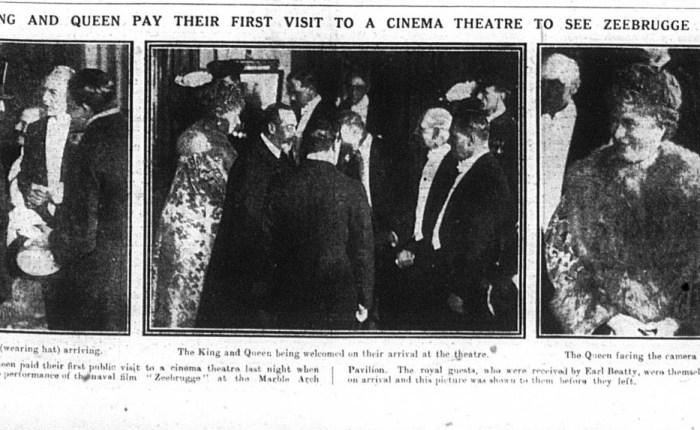
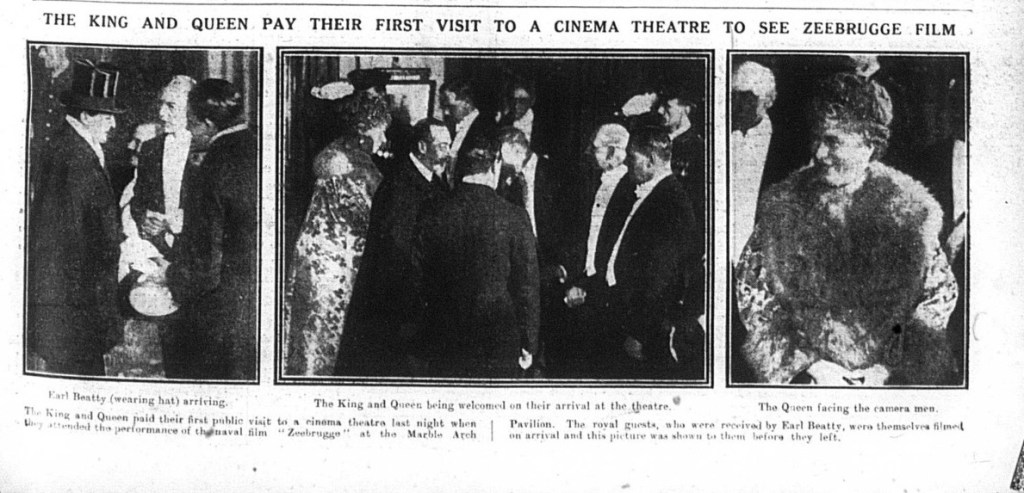
The King and Queen’s first public visit to a cinema came two years later, in November 1924 on the eve of Armistice Day. The occasion was a charity screening to raise money for the newly formed British Legion. The royal couple saw the non-fiction film Zeebrugge, which told the story of the British army’s attempt to close off the Belgian port of Zeebrugge during World War One. Again the event was covered extensively in the press.[3] Crowds cheered the Royal Couple as they arrived at the Marble Arch Pavilion and were shown to the Royal Box which was constructed for the occasion. Three commanders who had received Victoria Crosses for their bravery during the Zeebrugge Raid were also in the audience.

Photos in the Daily Mirror of the Royal visit to the cinema. Daily Mirror, 11 November 1924, front page

The Daily Telegraph gave a detailed report of all the aristocrats who attended the screening. The cinema space, normally open to audiences of all backgrounds, on this occasion became a much more exclusive space. It seems that the King and Queen could endorse cinema, as long as cinema related to serious and inoffensive topics –and the films they viewed were British productions, of course. The Royal’s support of cinema underscored the Royal Family’s values: of course the King and Queen saw films like everyone else, but only those that promoted the national identity of their country, and those that would not cause offence to any of their subjects.

During the visit to the Marble Arch the Royal Family also became the subject of a novel technological experiment: their arrival at the cinema was filmed, and while they were watching Zeebrugge the film was developed, and played back to the audience at the end of the evening. The Royals became subject of a film which they later consumed as an audience. This circularity was also demonstrated in the private Royal screenings in 1922: one of the topics that the Royal family could watch without risk of controversy was – the Royal family.

By the end of the 20s, film had become a recognised medium to promote empire, either directly through ‘educational films’ or indirectly by using cinema screenings to raise money for charities with Royal patronage. In this decade, the Royal family had gotten involved in the cinema business, and started using it as a means of increasing their popularity and profile, and of reaffirming discourse on empire and nationalism. Although the cinema could be a democratic space, the Royal Family’s interactions with it were carefully constructed. This way, they cleared the way for later generations of Royals to use popular entertainment to maintain the ‘common-sense’ status quo of monarchy.

Through Three Reigns is available to watch for free on the BFI Player (UK only)


[1] ‘The Film World’, The Times, 12 May 1925, p. 14

[2] ‘The King Sees Himself’, Daily Express, 26 September 1922, p. 7; ‘Royal Family Film’, Daily Mail, 26 September 1922, p.6; ‘Films at Balmoral Castle’, Daily Telegraph, 26 September 1922, p. 12; ‘Royal Ballroom Cinema’, Daily Mirror, 26 September 1922, p. 2

[3] ‘King and Queen at the Cinema Theatre’, Daily Telegraph, 11 November 1924, p. 11; ‘King and Queen See Zeebrugge Film’, Daily Mirror, 11 November 1924, p. 3; ‘The King & Queen Filmed’, Daily Mail, 11 November 1924, p. 7

A Cup of Kindness (1934)

A Cup of Kindness (1934)

Following the blog a few weeks ago about British comedy actor Ralph Lynn, today we will look in more detail at one of the Aldwych film comedies, A Cup of Kindness (1934). This film was based on a stage production which was first performed in 1929. The film uses the location of a fictional London suburb to make fun of class aspirations in interwar Britain.

Advert for A Cup of Kindness at the New Gallery Kinema in Regent Street, Daily Sketch, 27 July 1934

A Cup of Kindness is the story of two neighbouring families, the Tutts and the Ramsbottoms. The parents of both families despise one another, but the children, Betty Ramsbottom and Charlie Tutt, are secretly dating and intending to marry. Once they reveal their relationship to their parents, hostilities between the families intensify. Charlie, played by Lynn in his characteristic bumbling way, starts to doubt whether it is such a good idea for him and Betty to marry. After the customary argument between the lovers, they are reconciled at the end of the film, and a truce of sorts develops between both sets of parents.

Although A Cup of Kindness presents itself as a timeless story,[i] both in its opening title and through an odd dream sequence in the second half of the film, where we see the prehistoric Tutt and Ramsbottom ancestors fighting with one another in front of their respective caves, its setting in a suburban development is very specific to the interwar period.

As noted previously on this blog, London’s suburbs expanded rapidly during the interwar period, and along with this stereotypes developed about the aspiring middle classes who lived in the suburbs. A Cup of Kindness, for all its broad comedy, adds further nuance to this stereotype through the subtle signifiers of class difference evident in the Tutts and Ramsbottoms. The modern viewer is required to pay close attention to these signs in order to decode them, but for interwar audiences they were likely much more familiar and easier to interpret.

The film opens with Mr Ramsbottom (Robertson Hare) walking from the train station to his house in the evening. Just before he reaches the family home, he passes the Tutt residence, where Mr Tutt (Tom Walls) is standing outside in the garden. The first signifier of difference is in the men’s dress: Ramsbottom is wearing a regular suit and a bowler hat; Tutt is wearing evening dress. Ramsbottom has clearly come from some sort of clerical job; his dress is the functional uniform of the white-collar worker. Tutt, on the other hand, is dressed for dinner; a custom usually observed by the upper classes. As he is already at home and had time to change, we can infer that he does not need to head the hours of the office worker.

The families’ houses, too, imply difference. The Tutt family home is detached, with a driveway and a portico. The Ramsbottom house on the other hand is semi-detached only, overall smaller in size and with a smaller garden. As the film continues, we find that the Ramsbottoms also have their slightly senile uncle Nicholas living upstairs; and they keep a day-servant as well as a day nurse for Nicholas. The Tutts, on the other hand, have no staff. They have, however, managed to send their son Stanley to Oxford, and are keeping their son Charlie despite him being apparently unable to hold down a job.

The outward signifiers then appear to show that Mr and Mrs Tutt are wealthier and of higher social standing than Mr and Mrs Ramsbottom. There is a line that the latter utters, however, that gives a clue as to what really matters in the social pecking order of suburbia, and it’s not money. During a particularly heated exchange, Mrs Ramsbottom snaps that Mrs Tutt “once was a barmaid.” The implications are clear. Not only are the Tutts not ‘really’ upper class, Mrs Tutt is not even respectably middle class. That one line by Mrs Ramsbottom reveals that in her opinion, its breeding rather than money that determines who comes out on top in the social pecking order.

Yet despite their apparently humble origins, Mr and Mrs Tutt are able to present a wealthy front in the suburban street, by spending their money on just the things that give the impression of riches. This reflects contemporary anxiety about the suburbs, which gave many more people who had previously been unable to enter the housing market, the opportunity to own their own home. This democratisation also facilitated the mixing of people who would previously not have been in each other’s orbit. People moved to the suburbs from all over London and you could end up living next to people were from slightly different socio-economic backgrounds than yourself.

The relationship between Charlie and Betty is an example of this: both sets of parents think that their child can do ‘better’: the Ramsbottoms think Betty should pursue someone more respectable and dependable than Charlie, and the Tutts think Charlie is lowering himself by settling for Betty. Their proximity in the suburban neighbourhood has allowed this pair to get to know one another despite their different family backgrounds. Whereas inner-city areas such as the East End developed an increasingly cohesive common identity between the wars,[ii] the suburbs’ lack of history or character encouraged more prominent attention to the individual or familial identity as opposed to the collective one. A Cup of Kindness demonstrates this tendency towards individual expression through consumer goods and social cues as timeless, when it is in fact specifically rooted in the historical period in which the story was written.


[i] Indeed its writer, Ben Travers, referred to it as ‘Romeo and Juliet (…) of the suburbs’; Ben Travers, A-Sitting on a Gate (London: WH Allen, 1972), p. 108

[ii] Benjamin J Lammers, ‘The Birth of the East Ender: Neighborhood and Local Identity in Interwar East London’, Journal of Social History , Winter, 2005, Vol. 39, No. 2, Kith and Kin: Interpersonal Relationships and Cultural Practices (Winter, 2005), pp. 331-344

J. Lyons and Co – Trocadero and Corner Houses

J. Lyons and Co – Trocadero and Corner Houses

A key pleasure for Londoners in the interwar period was going out for tea or a meal. ‘French-style’ restaurants had appeared in London in the final decades of the nineteenth century. Whilst these original restaurants remained popular, the interwar period saw a democratisation of the dining-out experience. A wider range of outlets catered to people of different backgrounds and with different amounts of disposable income. As more and more Londoners, including women, increased their earnings and got more leisure time, they were able to experience (temporary) luxury in one of the many restaurants, cafes, and teashops in the capital. The player that left one of the biggest marks on the hospitality industry in London between the wars was J. Lyons and Co.

Like other restaurants, Lyons started its business in the late nineteenth century: with a teashop in Piccadilly in 1894, and the opening of the Trocadero Restaurant on Shaftesbury Avenue two years later.[i] The teashop turned into a chain of shops in 1909. Three of these teashops were Corner Houses, big, multi-storey hospitality spaces which offered affordable snacks and drinks to a mass audience. The Corner Houses on Coventry Street in Soho and the Strand were opened in 1909 and 1915 respectively, but the third Corner House, on the corner of Oxford Street and Tottenham Court Road, opened in 1928.[ii] This attests to the continuing success and popularity of the Corner Houses throughout the interwar period.

Corner Houses worked on economies of scale: they had hundreds of seats each, employed hundreds of staff, and aimed to get as many covers a day as possible. You can get a sense of the bustle of a Lyons Corner House in Alfred Hitchcock’s Blackmail (1929). Near the start of the film, the heroine, Alice, and her boyfriend Frank, visit a Corner House after work. As soon as they walk into the building there is a crush of people around them; they struggle to get into the lift. Once they enter the spacious dining room, all the tables are taken. They are hurried along with every step, and only stay at the restaurant for a short while before leaving again. It is no coincidence that Alice has picked this location to meet her lover, ‘The Artist’ – the crowded room provides a perfect cover for a secret rendez-vous, and the Corner House is a democratic space that anyone can enter without difficulty. In real life, the Corner Houses also functioned as meeting spaces for marginalised groups, most notably for queer men.[iii]

Lyons operated a very different policy at the Trocadero restaurant. In some respects the Corner Houses and the Trocadero were very similar; both served hot meals, both catered to huge numbers of customers every day, and both sought to transport their diners to exotic locales through their interior decoration and design choices.[iv] But whereas the Corner Houses were explicitly marketed to a mass audience, the Trocadero restaurant had strict rules about who could enter the space and where they were allowed to go.

An internal “Memo to Superintendents and Reception Clerks” stipulated a number of rules on the handling of “Strange Ladies” – female customers not known to the staff. These rules were clearly intended to prevent prostitutes from entering the space and soliciting; the Trocadero was on the site of what used to be the ‘Argyll Subscription Rooms’, an entertainment venue notorious for the number of prostitutes that frequented it. In its efforts to distance itself from the site’s previous occupiers, the management of the Trocadero were asked to treat all “Strange Ladies” as potential disruptors:

For Luncheons. Strange Ladies to be placed at small tables round the Restaurant, the object being that in case of misbehaviour we can screen the table off.

For Dinners. Strange Ladies either in couples or alone are to be put at the small tables round the Blue Saloon Wall (When Saloon is closed round the Restaurant) the object being that in case of misbehaviour we can screen the table off.

For Suppers. Strange ladies are to be given the small tables in the Restaurant round the Wall, the object being that in case of misbehaviour we can screen the table off.

Grill Rooms. Strange Ladies either alone or in couples are to be placed at small tables round the small room, or (in the event of this being closed or full) at small tables in the Larger Room, the object being that in case of misbehaviour we can screen the table off.[v]

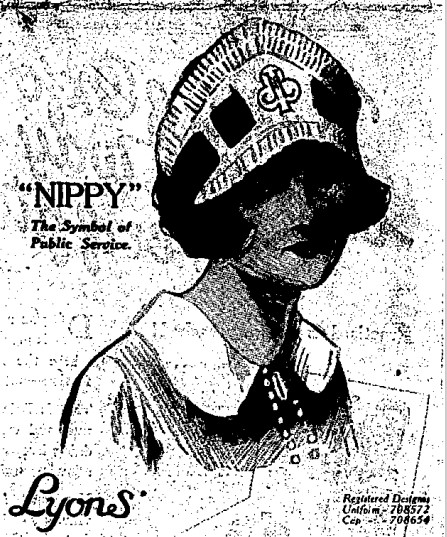
Clearly, the Trocadero restaurant was not intending to be an open and public space for female customers, who were rather expected to visit a Corner House instead. The gendered differences between the Trocadero and Corner Houses also extended to the waiting staff: all waiters at the Trocadero were male, whereas the Corner Houses had exclusively female waitresses, who came to be known as ‘Nippies’.

It was conventional in London that waiting staff in restaurants were male and waiting staff in teashops were female.[vi] Male waiting staff were perceived as similar to the butler or footman in a grand house; by attending a restaurant the (male) customer could experience something akin to what a gentleman in a country estate would experience. In the teashops, on the other hand, the female staff were appreciated for their speed, efficiency, and decorative function.

The Nippy grew into a cultural phenomenon in and of itself, to the point that she became a fictional character that both represented the Lyons brand and a host of positive feminine values. Internal guidance to female waiting staff placed a lot of emphasis on physical presentation: Nippies were required to have their hair “neat and tidy”; “teeth well cared for”; “cap correctly worn” and “no conspicuous use of make-up”.[vii] Lyons deliberately crafted this aspirational persona for its female staff and encouraged them to take pride in their femininity.[viii] In advertising for the brand, Nippy became the ‘Symbol of Public Service’.

Advert on front page of Daily Express, 14 April 1925

J. Lyons & Co. had a huge influence on the interwar London dining-out scene; there are countless references to its restaurants and Corner Shops in memoirs and fictional representations of this period. As this piece has shown, Lyons catered to two very different audiences through its restaurants and tea shops respectively. It is in the interwar period that these venues first reached their mass appeal, and the Nippy became established as a cultural reference point. For women, the choice was between conforming to a symbol of feminine perfection or risking being labelled as a prostitute. The venues lasted well beyond this period: the last Corner House closed in 1977 and the Trocadero remained active as an entertainment venue until 2011.


[i] Judith Walkowitz, Nights Out: Life in Cosmopolitan London (New Haven: Yale University Press, 2012), p. 197

[ii] Ibid., p. 198

[iii] Matt Houlbrook, ‘The Man with the Powder Puff’ in Interwar London’ The Historical Journal, Vol. 50, No. 1 (Mar., 2007), 145-171 (149)

[iv] Walkowitz, Nights Out, pp. 198-199

[v] London Metropolitan Archives: ACC 3527/186 – Rules and regulations for Trocadero Restaurant staff (indexed)

[vi] Rosalind Eyben, ‘The Moustache Makes Him More of a Man’: Waiters’ Masculinity Struggles, 1890–1910’, History Workshop Journal 87 (2009), 188-210 (197)

[vii] London Metropolitan Archives: ACC/3527/201/A ‘The Perfect Nippy’

[viii] Walkowitz, Nights Out, p. 205

Ralph Lynn

Ralph Lynn was born in 1882 in Salford and became one of the most popular comic actors in interwar Britain. Together with Tom Walls, Ralph Lynn formed the heart of a comedy ensemble that put on 10 plays and adapted 9 of those into films. The plays were put on in the Aldwych theatre, which Walls co-owned. During the interwar period, the term ‘Aldwych farce’ signified a very specific type of comedy production.

A version of Lynn’s performances in these shows are still available to us through his film work, which in addition to the nine adaptations of stage productions also include another eight films with Walls, not based on an existing stage production. These seventeen films were all made in the period 1930-1937, during which Lynn was also still acting on stage productions. After this enormously productive period Lynn mostly turned his back on film work, although he continued to appear on the London stage until 1958.[1]

The celebrity power that ‘Lynn and Walls’ had during the interwar period is still evident, for example in A Night Like This (1932), where the song that plays over the opening credits repeatedly reminds the audience “It’s Lynn and Walls.” There is also a newsreel of Ralph Lynn crowning the winner of an international beauty contest in 1935. This shows he was well-known enough to be asked to perform such minor public duties; the clip also gives a flavour of his comic talents:

This British Pathé newsreel of 1927, which shows clips from the stage production of Thark at the Aldwych, quickly dispenses with character names and refers to the characters as “Tom and Ralph”. Coincidentally, the clip also demonstrates why the Aldwych crew waited until 1930, when sound film started to become available, before they made their first film: the plays’ reliance on witty dialogue does not translate to silent film.

Modern audiences, then, can best experience Lynn as an actor through the film work he produced in interwar London. His character is invariably the ‘silly ass’, a foppish, hapless man who never tries to get into problems, but always ends up there. Ben Travers, the Aldwych’s regular script writer, remembers Lynn saying of one of his characters “[he] didn’t try to be funny but just walked rationally and naturally into trouble.”[2]

In A Night Like This (1932) for example, Lynn plays the upper-class, dim Clifford Tope, who decides to visit a nightclub in London. On the same evening, undercover police officer Michael Mahoney, played by Tom Walls, is undertaking an observation of the club because he suspects that the (legal) nightclub is a front for an illegal gambling club. Once inside, Tope gets inadvertently caught up in Mahoney’s investigation, primarily by physically getting in his way. In his apparent incompetence and naivete, Tope keeps unintentionally assisting Mahoney. In the end, of course, the men manage to bust the illegal gambling operation that is running upstairs. Mahoney is rewarded with praise from his superior officer; Tope has made an impression on nightclub dancer Cora (Winnifred Shotter).  

The stage production of A Night Like This, which had been put on in 1930, had benefited from a comfortable budget, which shows in the use of the elaborate nightclub setting. It had even been planned to use a real horse on stage.[3] The film version confidently uses the attractive nightclub setting and uses the cinematic medium to its advantage, for example through the insertion of lengthy sequences of Cora’s dance performances (which was a common trope in interwar films set in nightclubs) and in its focus on action over dialogue.

In other films that were adapted from stage plays, the action is more static and much of the enjoyment derives from the quick dialogue. Take for example this clip from Dirty Work (1934) which had been performed at the Aldwych Theatre in 1932:

Here, Jimmy Milligan (played by Lynn, on the right) and Nettle (played by Gordon Harker, on the left) are trying to convince Clement Peck (Robertson Hare) to don a disguise, in order to stage a fake burglary in the jewellery shop in which Milligan and Peck work. This short description adequately captures the absurdity of the plot, which, like many of the Aldwych farces, hinges on deception, disguise, and misunderstanding.

The pleasure of these films is not in their intricate narratives, well-developed characters or their ability to transport audiences to fantasy worlds. Instead, they provide a constant stream of witty gags, mix-ups and farcical situations right up until the happy resolution of the narrative. Ralph Lynn’s talents were strongly geared towards improvised comedy and wordplay, and in the Aldwych farces he had a perfect medium to display his craft. However, the historic and cultural specificity of comedy, as well as its perceived lower cultural value, has meant that the films have been relegated to relative obscurity. Because Lynn did not work in any other genre, he, too, has been largely forgotten; but his comic instinct and timing still work for twenty-first century audiences.

Most of the Aldwych farces are available on DVD via Network On Air.


[1] Morley, S.  (2020, November 12), ‘Lynn, Ralph Clifford (1882–1962), actor’ Oxford Dictionary of National Biography, https://doi.org/10.1093/ref:odnb/37702

[2] Ben Travers, A-Sitting on a Gate (London: WH Allen, 1978), p. 90

[3] Ibid., p. 110

All-Night Card Clubs

On 8 March 1927 the Daily Express ran a sensational exposé on its front page:

“London’s All Night Card Clubs – Women who play from tea-time to breakfast”

The story ran nearly the full length of the front page. It noted that an advertisement had been appearing in respectable broadsheet The Times, which read:

BEAUCHAMP CLUB
56 Beauchamp Place, S.W. 3 (Sloane 3340)
Mrs Hands has regular games of straight poker daily, at 3 and 9pm. Bridge lessons given

Poker clubs such as this one functioned as private member clubs, where members paid an annual fee to attend. The legislation of private member clubs had been drawn up with the classic Pall Mall club for upper-class men in mind. In the interwar period, however, club legislation and licensing were increasingly exploited by entrepreneurs to facilitate transgressive behaviour. Nightclubs of the period operated under the same legislation; they were nominally private member clubs, which allowed them to evade a level of external scrutiny. However, where the old clubs in ‘Clubland’ often had (and still have) extensive vetting procedures for new members, nightclubs and poker clubs usually allowed anyone to join as long as they paid their annual fee. The poker clubs were perfectly legal, but clearly they were stretching the intentions of club legislation beyond its originally intended purpose.

The Daily Express held the Beauchamp Club up as an example of a supposed sudden influx of private member clubs that catered to poker players. The members of these clubs were alleged to be mainly women, playing into persistent fears of the potential corrupting effect of modern society on women. The article states confidently that: “Women gamblers are patronising these clubs in increasing numbers. They begin in the afternoon, break off for dinner, and then sit down to another long session, which often lasts till dawn.” The question that this may raise in the reader’s mind is – what happens to these women’s families whilst they are spending time at the poker table? At a time when a married woman’s primary role was to support and look after her family, a woman who spends hours at the poker table was presumably neglecting her responsibilities towards her husband and children.

Mrs Hand, the owner of the Beauchamp Club, is quoted as saying “Women will always gamble”; this is presented as a simple fact of life, that all the readers of the article can agree on. Players are described as attending the club after the theatre shows finish, then playing until breakfast, and returning at 3pm for the next round. It is implied that women are particularly susceptible to this addictive behaviour. What is more, Mrs Hand’s earning model banks on it; on top of the club’s annual fee, she charges players for each hour they spend at the table.

The location of the club and the fact that the advert had been placed in The Times – the stalwart of the upper classes – implied that the club members were of a high social standing. The Daily Express was aimed at a lower-middle class audience; this story allowed the Express reader to feel indignation at the wealthy Londoners who were supposedly spending all day gambling their money away. Mrs Hand is quoted as explaining that club members “play for four-shilling rises (…) That means you would have to be most unlucky to lose as much as £10 in a sitting.” Ten pounds was a substantial amount of money for most people; Mrs Hand’s comments only highlight how removed she is from the average person in her understanding of the value of money.

The Express article traces the reason for the sudden increase in poker clubs specifically to a few key court cases of previous years. In 1921 the owner of the Cleveland Club was charged with allowing illegal gambling activity in his club because it contained a poker room. The Express notes that in that instance, “The stakes were low, and play was never continued for more than half an hour after midnight”. Nevertheless, the club owner pleaded guilty and paid a fine.

However, a similar case that was brought to trial not long after was put to a jury, which delivered a verdict of ‘not guilty’ on the basis that poker required a level of skill and was therefore not a form of gambling. According to the Express, the police have since stopped taking action against poker clubs as the jury’s verdict set a precedent. The debate on whether poker is a sport or a form of gambling continues to this day, with both sports and betting companies arguing for their respective positions. A variation of poker called ‘Match Poker’, which removes the random element of which cards a player is dealt. This version of poker is now recognised as a sport, but more commonly played versions such as Texas Hold’em are a mainstay in casinos, and players are required to be at least 18 years old (in the UK) to play.

It is clear where the Express stands on the matter of prosecution, even if the clubs are currently primarily frequented by those who can afford to lose some of their wealth. It argues that complaints keep arising of “women and young men losing much more money than they could afford in poker clubs, and of other evils arising out of this form of gambling.” The article’s final sentence notes that publicly advertising these clubs, as The Times is allowing to do, gives opportunity to professional gamblers to swindle others out of their money.

It is unlikely that many Express readers themselves had been affected by poker clubs, but it was a pretty safe topic to gain their audience’s approval, as it put people of a different social class in the firing line. The article did not spark a bigger inquiry into poker clubs and the Express did not pursue the story. For the paper, private poker clubs were a way to generate indignation towards women, the upper classes, The Times, and the government and police who were not taking any action against these clubs.