Kate Meyrick’s Private Diaries

Kate Meyrick’s Private Diaries

Kate Meyrick was known as the ‘Nightclub Queen’ in interwar London. She ran a string of nightclubs, of which the ‘43’ in Gerrard Street was the best-known. Nightclubs operated on the edge of the law – a club in itself was not an illegal space, but if alcohol was sold outside of hours permitted by the club’s license, the club owner could face hefty fines or even prison time. Additionally, clubs were supposed to only be open to members, who paid yearly subscriptions and were known to be of good character. In practice, Meyrick and other club owners generally allowed guests to become ‘members’ upon arrival.

Kate Meyrick made substantial money from her nightclub ventures, although they also cost her a lot to maintain. Her career effectively ended when it was revealed in 1929 that she had been bribing Police Sergeant George Goddard.[1] Goddard would tip Meyrick off if any of her clubs were likely to get raided, so that she could make sure no illegal activity was taking place in them.[2] Both Goddard and Meyrick were convicted – the latter to fifteen months’ hard labour which negatively impacted her health.

Throughout Meyrick’s career as a nightclub owner, she had become a well-known public figure, recognizable from press reports to those who would never get close to setting a foot in her clubs. After her death in 1933, publisher John Long published her memoirs, The Secrets of the 43.[3] Extracts from her ‘private diaries’ were subsequently serialised in the Sunday Express. These posthumous publications show how Meyrick’s family worked to shape her public image from convicted criminal to caring mother.

Meyrick had eight children, and professed that her main goal in entering the nightclub business was to give her family financial support. Many of her children entered her business as managers and staff in her ever-expanding network of clubs. Although Meyrick did not leave her children much capital when she passed, she had been able to secure advantageous marriages for most of them. Mary, one of Meyrick’s eldest daughters, married the Earl of Kinnoull. It was with his introduction that Meyrick’s diaries were published in the Sunday Express, giving them an aura of respectability.

In his introduction, the Earl calls his mother-in-law a ‘remarkable’ and ‘dynamic’ woman who hoped to give her children ‘brilliant chances she had been so determined they should enjoy.’[4] Her decision to start selling alcohol illegally is framed as the only option she had to make money for her children, as well as a result of her ‘impulsive nature’. The subsequent move through periods of financial success followed by raids, fines and prison sentences is related as ‘the slow slipping of the power of wealth from her fingers, her powerlessness to help her children as she longed to do.’

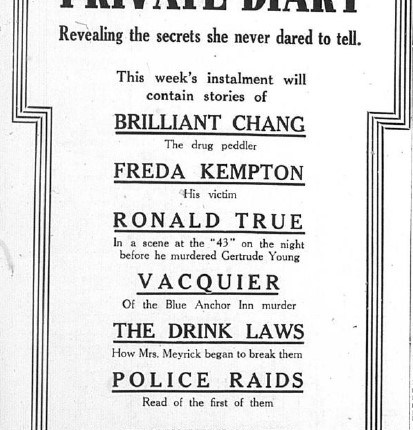
Advert in the Daily Express of 4 March 1933

The diary serialisation was advertised by the Sunday Express with reference to the notorious criminals Meyrick had hosted in her clubs, consciously tightening the public’s association between nightclubs and serious crime. If we accept the printed diaries as accurate copies of what Meyrick recorded, she herself was also eager to align herself and her clubs with notorious criminal cases. She describes that Ronald True, who was convicted of the murder of Gertrude Young, was in the ‘43’ the night before his arrest:

Have just seen the account of the arrest of Ronald True for the murder of Gertrude Young. He was in the 43 last night. Wonder if I am psychic? I went downstairs at 4 a.m. to stop the band, and ask them to come up to the first floor. When I went upstairs I felt I must turn round. When I did turn I found Ronald True gazing at me with murder in his eyes. (…) I suppose I ought to have warned somebody. But who?[5]

True was arrested on 9 March 1922 and was therefore in the club on 8 March – Gertrude Young had been murdered on 6 March, so any warning Meyrick could have given would not have saved her life. The ‘murder’ in True’s eyes was presumably imagined by Meyrick after she heard of his arrest.

This didn’t dissuade Meyrick from believing in her psychic abilities. She raises the topic again when she describes allegedly greeting Patrick Mahon in one of her clubs, shortly before he is arrested for the ‘Crumbles murder’; one of the more graphic murders to take place in England in the 1920s.

He [Mahon] was only in last week. How dreadful to think I shook hands with a murderer. (…) I am sure I am psychic. Just as in the case of Ronald True, Mahon’s eyes impressed me. They were not like the eyes of ordinary people: there was something behind them.[6]

Through the publication of Meyrick’s autobiography and diaries, her family were able to exercise control over her public image, which in turn affected their own reputations. By downplaying the illegal activities in which Meyrick had participated and foregrounding her commitment to her children, the Earl of Kinnoull was presenting his mother-in-law as a courageous and hardworking woman. He also profited from her by selling her diary to a newspaper. The Sunday Express, in the meantime, milked Meyrick’s proximity to notoriety to boost its own circulation. After her death, Meyrick’s own words became a tool for others to use.


[1] Heather Shore, ‘Constable dances with instructress’: the police and the Queen of Nightclubs in inter-war London’, Social History, (2013) Vol. 38, No. 2, 183–202, p. 199

[2] Clive Emsley, ‘Sergeant Goddard: the story of a rotten apple or a diseased orchard?’ In: Srebnik, Amy Gilman and Levy, Rene eds. Crime and culture: an historical perspective. Advances in Criminology (Aldershot, UK: Ashgate, 2005), pp. 85–104

[3] Kate Meyrick, The Secrets of the 43 (London: John Long, 1933)

[4] Earl of Kinnoull, ‘The Things She Could Never Tell’, Sunday Express, 25 February 1933, p. 9

[5] ‘Sergeant Goddard’s First Raid’, Sunday Express, 5 March 1933, p. 13

[6] ‘Valentino – Mahon – Kreuger – and Jimmy White’, Sunday Express, 12 March 1933, p. 13

E.M. Delafield – Messalina of the Suburbs (1924)

In 1924, six years before she would become a household name with her Diary of a Provincial Lady, E.M Delafield penned Messalina of the Suburbs, a fictionalised take on one of the most notorious murder trials of interwar Britain. In December 1922, Edith Thompson and her lover Frederick Bywaters were convicted of the murder of Edith’s husband, Percy. They were both hanged, despite the fact that it was Bywaters who stabbed Percy Thompson, and Edith claimed not to have any knowledge that he would do this. At the time, some newspapers launched a campaign to have Bywaters’ sentence commuted or quashed; as historian Lucy Bland notes drily: ‘No public steps were taken at the time on behalf of Edith.’[1] More recently, the case has been re-assessed in favour of Edith’s innocence; there is even a dedicated website that argues her conviction was a miscarriage of justice.

In Messalina of the Suburbs book, Delafield imagines one version of events that could have led to Edith (Elsie in the book) ending up in an unhappy marriage, with a lover who kills her husband. Against the prevailing attitude of the time, Delafield is surprisingly sympathetic to Elsie, without shying away from her more questionable decisions.

The book starts with Elsie as a teenager, living with her sister in the boarding house run by their mother. Elsie is already aware that men find her attractive; in the book’s opening she agrees to go to the cinema with an (older) male lodger, and does not protest when he kisses her. Delafield describes going to the cinema as a sensual experience for Elsie, foregrounding her sexuality:

To-night, as she entered the hot, dark, enervating atmosphere of the cinema theatre, she thrilled in response to the contrast with the street outside. When she heard the loud, emphasised rhythm of a waltz coming from the piano beneath the screen, little shivers of joy ran through her.[2]

After this escapade with the lodger, Elsie ends up working as a live-in help with a doctor and his wife. Before long, the doctor makes advances to her, which culminates in the pair having sex several times. Needless to say, even describing sexual relations between a married man and a younger woman was daring on the part of Delafield. But the scenes also make clear that the doctor is using Elsie for his gratification, with little regard for her well-being. When the doctor’s wife starts to realise what is going on, it’s Elsie who has to pack her bags.

Her next job is as a clerk in the office of Mr Williams, a lawyer. Initially, Elsie thinks the job will be very boring, but she cheers herself up by dressing up for her first day of work:

Elsie spent the week-end in cutting out and making for herself a blue crepe blouse, which she intended to wear on Monday morning. She also made a pair of black alpaca sleeves, with elastic at the wrist and at the elbow, to be drawn on over the blouse while she was working. She put the sleeves, her shorthand pad and pencil, a powder-puff, mirror, pocket-comb, and a paper-covered novel in a small attaché case on Monday morning, pulled on the rakish black velvet tam-o’-shanter, and went off to Mr. Williams’ office.[3]

This quote captures how Delafield consistently presents Elsie as a slightly childish innocent. Although she is aware of her effect on men, and enjoys physical relations with them, she is hardly a calculating vamp.

At the law office, Williams, too, starts flirting with Elsie, and suggests that she go with him on a weekend to the seaside. At this point, Elsie’s friend Irene advises her that she should hold out, as that will persuade Williams to marry her. Marriage represents safety and stability, and both the doctor and Williams indicate to Elsie that her sexual experience lowers her ‘value’. Elsie manages to persuade Williams to marry her by holding off all his sexual advances. Williams tells her that he respects her propriety – but as soon as they get married he makes it clear that she is now his property and he gets to decide what she does, when, and with whom.

Trapped in this stifling marriage with a man she does not find attractive, Elsie eventually meets ‘Morrison’, a friend of her sister’s. From this point, Messalina of the Suburbs largely follows the real-life narrative of Thompson and Bywaters, including the romantic letters they wrote (she destroyed his letters, he didn’t destroy hers – something that weighed heavily against her during the trial) and the fateful events of the final evening. It is here, at the end of the novel, that Delafield makes her sympathies most clear. There is no doubt at all for the reader that Elsie has no idea that Morrison is going to kill Williams. There is no suggestion that she is the mastermind behind the plan, or that she spurred him on to do it, which were suggestions made during the trial. Instead, Elsie’s naiveté and her repeated abuse by men land her in the dock, where the novel ends.

That Messalina of the Suburbs was somewhat controversial is clear from the reviews it received. It was not reviewed very widely, and mostly in the local papers. The most positive review appeared in the Yorkshire Post & Leeds Intelligencer on 16 April 1924:

a powerful psychological reconstruction of the woman in a recent murder case. (…) Miss Delafield does more to make comprehensible the motives of the unhappy and blundering woman than any of the more scientific analyses have succeeded in doing.(…) The story is not pleasant, but it is well told. Miss Delafield knows with incredible intuition the hearts of the lower middle classes’[4] 

The review implies that the writer and readers of the book are of a different species than the ‘lower middle classes’ which populate the novel. Nonetheless, the reviewer appears to grasp and approve of the ultimately sympathetic portrayal at the novel’s core. Other reviewers were not so generous, instead protesting that the novel had no reason to exist. The review in the Westminster Gazette stated

Miss Delafield tells the story very well; but, whether, merely as an exercise in fiction, it was worth telling or not is another matter[5]

and the Birmingham Daily Gazette grumbled that

Whether it was worthwhile thus recalling a sordid tragedy eighteen months afterwards is a little doubtful, but the analysis of indiscipline is very skilful.[6]

Somewhat surprisingly, the most negative review appeared in Common Cause, the newspaper of the National Union of Women’s Suffrage Societies:

the characters in this novel are so unrelievedly sordid that there is little pleasure to be derived from their acquaintance.[7]

Delafield’s psychological analysis did not win her many fans, and her career did not take off until she returned to writing the comic works for which she is now best known. With Messalina of the Suburbs, however, she demonstrated a real sensibility for the complex character of Edith Thompson, and an acute awareness of the structural exploitation young women faced, which could lead to devastating consequences.


[1] Lucy Bland, ‘The Trials and Tribulations of Edith Thompson: The Capital Crime of Sexual Incitement in1920s England’, Journal of British Studies, Vol. 47, No. 3 (Jul., 2008), p. 645

[2] E.M. Delafield, Messalina of the Suburbs (London: Hutchinson, 1924), p. 16

[3] Ibid. p. 64

[4] ‘Messalina of the Suburbs’, Yorkshire Post & Leeds Intelligencer, 16 April 1924, p. 4

[5] ‘A Bold, Bad Girl’, Westminster Gazette, 4 June 1924, p. 5

[6] ‘An Ilford Novel’, Birmingham Daily Gazette, 14 April 1924, p. 4

[7] ‘Messalina of the Suburbs’, Common Cause, 16 May 1924, p. 6

First a Girl (1935)

First a Girl (1935)

Musical star Jessie Matthews was at the prime of her career in 1935 when she starred as the lead in First a Girl.[1] This musical comedy directed by Victor Saville is one version of a popular film plot; it is a remake of the German comedy Viktor und Viktoria (1933), which was re-made in West Germany in 1957, and most famously adapted by Hollywood in 1982, as Victor/Victoria starring Julie Andrews.

The basic plot of all four films, including First a Girl, is similar. An aspiring stage actress (in the British film she’s called Elizabeth, and naturally is played by Matthews) meets Victor, an actor who aspires to Shakespeare but in reality performs as a female impersonator. When a bad cold prevents Victor from performing one evening, he persuades Elizabeth to take his place, by pretending to be a man who pretends to be a woman. This is a great success, and ‘Victoria’ quickly becomes an international star, forcing Elizabeth to appear as a man when in public. Things get complicated when Elizabeth falls in love with a (straight) man, who believes her to be a man also.

Whilst both the 1933 original and the 1982 American version are regularly interpreted as queer films, First a Girl underplays the homosexual possibilities of Elizabeth’s flirtation with her male love interest. This is partly due to Matthews’ own appearance. As The New York Times noted upon First a Girl’s US release in 1936:

Normally it is with sorrow and self-hatred that this column hints at the inadequacies of a star, but this time it is a distinct pleasure to call Miss Matthews’s acting performance hopelessly bad. In “First a Girl” she is pretending to be a man and making no headway at all, except with the members of her supporting cast, who swoon with astonishment upon discovering her sex. 

Quite beside Matthew’s obviously feminine appearance, First a Girl underplays any potential sexual tension between Elizabeth and her love interest, Robert, until Robert understands that Elizabeth is a woman. Prior to that point, the film focuses on the comedic potential of Elizbeth’s cross-dressing, rather than any transgressive possibilities in her relationship with Robert.

Jessie Matthews as ‘Victoria’, appearing with Sonnie Hale, in First a Girl

All versions of the film appear to include a similar sequence in which ‘Victoria’ is ‘forced’ to perform activities which are coded as specifically masculine, to comic effect. In First a Girl this sequence is set in a Parisian nightclub, where Victor and Elizabeth find themselves during their European tour. Elizabeth has to wear a tuxedo here, and hangs out at the bar with Robert – a part of the club only available to men. She quickly gets drunk when trying to keep up with Robert’s rate of drinking, and struggles when trying to smoke a cigar. Whilst these scenes give Matthews an opportunity to display her comedic talent, they also undermine her sexual capital whilst she is performing as a man. As soon as Elizabeth’s true gender identity is revealed to Robert, she turns from an unsophisticated youth into a charming young woman.

It is significant that these scenes of gender-bending performance are set in Paris – a location that invited connotations of licentiousness and sexual transgression in the British popular imagination of the 1930s. Interestingly, in the 1933 German film, ‘Victoria’ is in London when forced to undertake activities which may ‘out’ her as a woman. ‘Victoria’ finds herself in an environment that is both literally and figuratively foreign to her.

As Jeffrey Richards points out, male and female impersonation had a long tradition on the British theatrical and music hall stage.[2] The character of Victor, then, works well in this British film. He is portrayed as older than Elizabeth (although actor Sonnie Hale was only five years Matthews’ senior) and can easily be read as a music hall performer in the Victorian tradition. His female impersonation act is purely comic, whilst Elizabeth’s is sophisticated. He links the film’s plot to a specifically British performance tradition, whereas the glossy song-and-dance numbers performed by Elizabeth have more in common with Hollywood productions.[3] The film makes no explicit reference to its German origins.

First a Girl, then, significantly dilutes the queer and transgressive possibilities of the original source material, which allowed the film to flourish in interwar Britain. According to the BFI, it was a great commercial success when it was released (something also suggested by its export to the US the following year). It remains a very watchable and enjoyable film for modern audiences; and a good example of how British interwar filmmakers moderated both European and Hollywood influences to arrive at a British compromise between the two.

First a Girl is available for rental on BFI Player (UK only)


[1] Jeffrey Richards, The Age of the Dream Palace: Cinema and Society in 1930s Britain (London: IB Tauris, 2010), pp. 217-218

[2] Ibid., p. 218

[3] This is not unusual for Jessie Matthews films. See Sarah Street, ‘Got to Dance my Way to Heaven’: Jessie Matthews, art deco and the British musical of the 1930s, Studies in European Cinema, 2:1, (2005), 19-30

Woman: Her Health and Beauty (1919)

Woman: Her Health and Beauty (1919)

At the close of the First World War, publisher John Long put an English translation on the market of the French book La culture physique de la femme: beauté et santé par la gymnastique rationnelle. Written by the French sports and physical health specialist Max Parnet, the book provides the reader with daily exercises she should do to stay fit and healthy. The Wellcome Trust estimate that the French edition was originally published in 1913. In its English translation, it was titled: Woman: Her Health and Beauty.

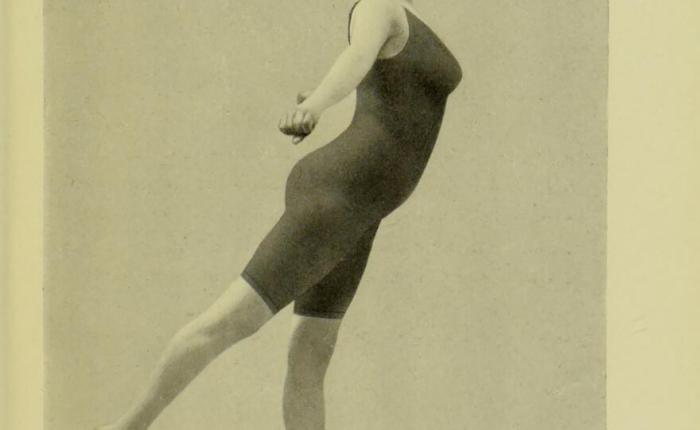
The bulk of the book consists of a weekly exercise schedule, which gives the reader six compulsory and one optional exercise for each day of the week. These exercises are accompanied by illustrative photographs of a woman in a bathing suit demonstrating them. The French edition, which contains the same photographs as the English edition, has been preserved by the Internet Archive. The exercises look familiar enough to anyone who has undertaken a fitness class, although they are all on the less vigorous end of the exercise scale. The book also spends some time instructing the reader in proper breathing techniques; this holistic approach to breath and movement can also be found in many twenty-first century approaches to fitness.

Before the book goes through the exercises, however, there are some 50 pages of text which set out a general argument as to why women should exercise. It is telling that John Long decided to publish the English translation immediately following the Great War. At a time when so many of the country’s young men had either died or been maimed, the book stressed the need for women to stay fit and healthy, explicitly linking female health to the health of the nation:

It is a service to the country and to humanity to make women understand the importance of physical culture, of which health is the principal aim.[1]

Ten years before books like Sleeveless Errand exposed the mental toll to which young women who had survived the war were subjected, Woman: Her Health and Beauty encourages women to use exercise to improve themselves. However, it consistently couches the language of self-improvement in the context of becoming more beautiful. Rather than pursuing physical health as a goal in itself, women were assumed to want to be beautiful above all things.

True beauty depends especially on perfect health, that is to say, on the perfect harmony of the whole organism.[2]

[we] do not aim at producing remarkable muscles which, in a woman’s case, would not be aesthetic, but only to acquire suppleness of the body and harmony of form.[3]

A significant portion of the book’s introduction is devoted to arguing that high heels and corsets are bad for a woman’s form and health. If the French original was written in the early 1910s as suggested, corsets at that point had not yet been as fully abandoned as they would be in the 1920s. However, after arguing that wearing heels deforms a woman’s spine and corsets compress the chest, the book states that ‘civilization demands’[4] that women wear high heels and to suggest a woman should abandon the corset is ‘such a radical step [that] would bring ridicule upon us.’[5] Instead, women are advised to wear heels for as short a time as possible and not lace their corsets overly tightly. Women are instructed to adhere to the conventions of beauty over their own health.

This patriarchal tone pervades throughout the introduction, which states that

In consequence of her more delicate organism, certain exercises which are suitable to men, and even children, might be dangerous to women[6]

And

women, as we have said, do not know how to breathe[7]

The reader is also scolded for her perceived insistence to do things her own way and not follow the advice of the male experts:

The first requirement of rational and beneficial gymnastic exercises is to perform them in accordance with defined rules, and not according to the personal ideas of each individual.[8]

The end result is a book that chastises women for not applying themselves sufficiently to the rational requirements of physical exercise, but at the same time holds out the promise that any woman can be ‘graceful and agreeable to look upon, provided that they take pains to suitably and completely develop their physical condition’.[9] It gives women information about how fashionable clothes may be hurting them, but then tells them to keep wearing them anyway as it makes them beautiful. Ultimately, the book’s exercises are even presented as an inferior replacement for ‘real’ exercise such as horse riding:

Natural gymnastics are in reality the most salutary of all, and they alone are sufficient for health and beauty; but in our unnatural and civilized existence it is almost impossible for most people to indulge in them.[10]

Woman: Her Health and Beauty is therefore a prime example of the type of self-help books that leave the reader feeling insufficient and at the same time offer up a path to salvation, gained through the rigorous adherence to, in this case, a daily exercise regime. It is not possible to trace how many women bought the book or followed its instruction (although there appears to have only been one edition of the English version published). The existence of Woman: Her Health and Beauty in the first place, however, gives an insight in how patriarchal structures created a space for women to be held personally accountable for the health of the nation following the war.


[1] Max Parnet, Woman: Her Health and Beauty (London: John Long, 1919), p. 19

[2] Ibid., p. 15

[3] Ibid., p. 22

[4] Ibid., p. 24

[5] Ibid., p. 27

[6] Ibid., p. 21

[7] Ibid., p. 35

[8] Ibid., pp. 29-30

[9] Ibid., p. 19

[10] Ibid., p. 49

Gracie Fields in Picture Post (1938)

Gracie Fields in Picture Post (1938)

Gracie Fields was one of Britain’s biggest stars during the interwar period, and she is certainly one of the stars that is best remembered today. With her signature Lancashire accent; dry, witty comedy; and hearty songs, she came to represent a version of Britishness grounded in no-nonsense hard work and companionship. Whilst the music hall stage was her natural home, in the 1930s Fields expanded her reach through appearing in a string of musical comedy films. In these, she generally played a working-class woman with aspirations to perform as a singer. Her characters, often called Grace/Gracie or Sally, met any obstacles with good cheer and eventually achieved their ambitions.

In 1938, Fields was invited to perform for Queen Mary (the late King’s wife and grandmother of Queen Elizabeth II) in the Royal Albert Hall. To mark the occasion, Picture Post featured an extensive spread titled ‘A Day With Gracie’.[1] The text and pictures of this article give an insight in how Fields’ celebrity persona was constructed at this stage of her career, when she had become an established star.

Rochdale News | News Headlines | Appeal for Gracie Fields memories for new  biography - Rochdale Online

The article starts with an imaginative recounting of how a six-year old Gracie used to sing on the streets of Rochdale, whilst dreaming of future riches: ‘She thought of the day when she would be a famous actress, with enough money to buy clothes, mansions, motor-cars, and holidays abroad.’[2] The article positions Fields’ working-class and Northern background as a pivotal part of her development as a singer. However, it also states that a desire for material wealth underpinned her ambition.

The article goes on to describe Fields’ first attempts as a singer: supporting an existing music hall act; singing at local competitions and charity events; joining a troupe of ‘Juveniles’ on tour. Throughout these descriptions, the article constantly refers back to Fields’ father’s scepticism of her ambitions, and the need for Fields to bring income into the family. After the failed Juveniles tour, Fields’ mother ‘got Gracie a job as an errand girl to a confectioner.’[3] The article goes into the formative part of Fields’ career in such detail, because it allows the journalist to present Fields as completely determined in her ambition to succeed. Like Fields’ personas in her various films, she was not deterred by setbacks, but instead kept trying to find a way to realise her ambitions.

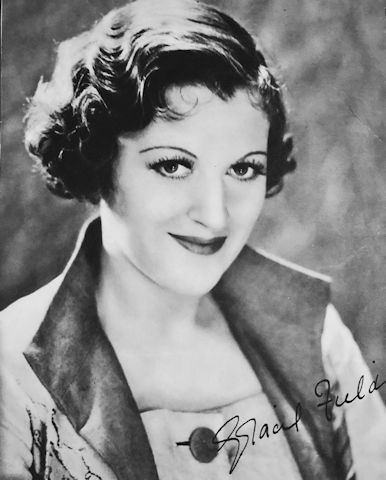
Initially, this path to success took the form of incredibly hard work: Fields was working shifts in a local mill, going to school, and also attending dance classes in Manchester several times a week.[4] She studied music hall acts and eventually was given another opportunity to perform at a local music hall. Rather ironically, it was not until Archie Pitt, a performer sixteen years her senior, ‘spotted’ her and decided to build his next show around her, that Fields’ career really took off. She married Pitt in 1923, when she was 25 and he 41; the couple divorced in 1939 and the marriage was already very rocky by the time the Picture Post article was published – Pitt does not appear in any of the images accompanying the piece.

Although the article refers to Fields as ‘probably the highest-paid woman in the world’[5] and the ‘Most-interviewed woman in the world’[6] (both unsubstantiated claims), the article is at great pains to stress that Fields is no diva. She finds buying clothes ‘a bore’, likes walking around in old clothes, and is ‘vague’ – a characteristic apparently demonstrated by her tendency to leave half-written letters lying about the house. Although the article originally set up the premise that the young Gracie dreamt of riches, it then takes pains to underline how little the adult Grace is interested in a wealthy lifestyle.

Even more strikingly, the article refers very minimally to Fields’ actual work, despite her enormous success in that area. Instead it focuses a great deal on her work with children. No fewer than 8 out of the 17 photographs that accompany the piece, feature her nephew Michael, who looks about three years old. The captions state that ‘There are almost always children in the house’[7] and ‘Hundreds of children have spent happy afternoons’[8] in Grace’s garden. She also set up a charitable children’s home near Brighton.

What is glaringly absent through the many references to her apparent fondness of children, is any acknowledgement that Fields herself was childless. At the time the article was written she was 40, which is explicitly referred to in the text; the conclusion is quickly drawn that Fields’ childlessness at that age was not wanted. The reality is that Fields’ battled cervical cancer which greatly diminished her ability to get pregnant. Whilst it is understandable that Fields was not keen that her medical history would be known to the public, one wonders how she felt about being presented as such an explicitly maternal figure in this article.

Overall, the Picture Post article is ambiguous in the way it presents Fields. She is both British through and through and someone with international allure and star power. The article devotes considerable attention to her ‘talent, hard work, and personality’[9] and ability to overcome setbacks. At the same time, it frames Archie Pitt as the catalyst of her success. It presents Fields as a rich woman who loves re-modelling her vast house, but also someone who ‘is not interested in money’.[10] It provides an interesting study of how the interwar press attempted to present a successful female star as she moved into middle age.

See Gracie Fields in action in this clip recorded in 1938

[1] ‘A Day With Gracie’, Picture Post, 29 October 1938, pp. 10-16 and 70

[2] Ibid., p. 12

[3] Ibid., p. 14

[4] Ibid., pp. 15-16

[5] Ibid., p. 12

[6] Ibid., p. 15

[7] Ibid., p. 12

[8] Ibid., p. 14

[9] Ibid., p. 70

[10] Ibid.

W. Lusty & Sons Ltd – Furniture Makers

W. Lusty & Sons Ltd – Furniture Makers

During the 1930s, London’s suburbs developed and expanded at a rapid pace.[1] The droves of new ‘white-collar’ workers were sold on the promise that they, too, could own their own home and garden. All these new homes needed furniture. Before IKEA, there was W Lusty & Sons, makers of solid-wood furniture for affordable prices.

The workshop of Lusty & Sons was based in Bromley-by-Bow, more specifically just south of Empson Street. The yard bordered on the Limehouse Cut, which allowed for the easy transportation of goods in and out of the premises. Customers were obviously not expected to attend here; instead, the company maintained a showroom in Paul Street (just east of Old Street station). The bulk of Lusty & Sons customers, however, appear to have bought out of their catalogues. The company boasted a UK wide delivery service by goods or even passenger train – the latter if the order was particularly urgent.

Drawing of Lusty & Sons yard in Bromley-by-Bow, as included in 1936 catalogue

To allow for these shipping methods, Lusty & Sons built furniture that was delivered in parts, and could be easily assembled in the home. Dining tables, which in 1936 ranged in price from 7 shilling and 3 pence to £1, 19 shilling and 9 pence, came with detachable legs. The catalogue reassured prospective customers that this novel way of furniture production was not dangerous: ‘Although the legs are detachable, the tables, when fitted together, are perfectly rigid and strong.’[2]

It is not just the affordable prices for the cheaper versions of the furniture that indicate that Lusty & Sons clientele were white-collar workers rather than the leisured classes. The company also provided a number of furniture styles which were explicitly designed to fit into modest houses. The ‘cottage’ dining table range, for example, came with two fold-out leaves.[3] When folded away, the table took up minimal space, and for dinner it could be extended to give everyone a seat at the table. This design has, of course, continued to be a welcome solution to those living in smaller spaces.

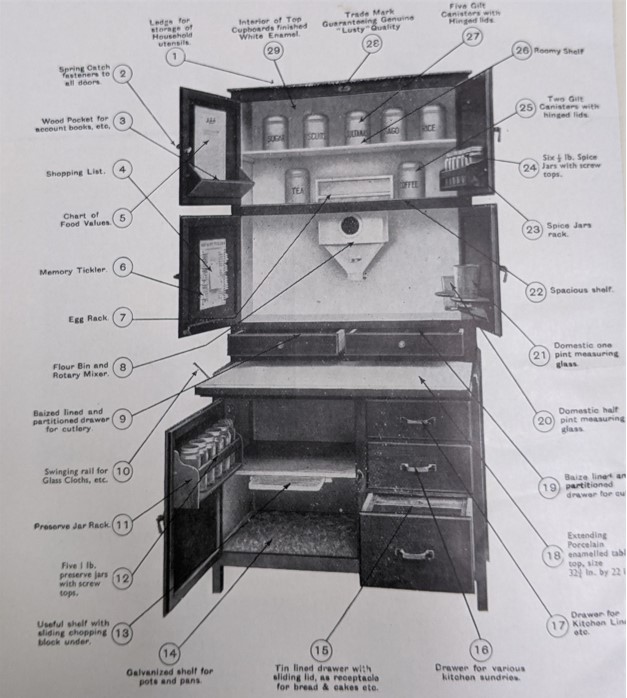
Their kitchen furniture catalogue reveals even more strongly that Lusty & Sons furniture was aimed at newly married couples of reasonably modest means, setting up house together. The supply of domestic servants had been steadily shrinking since the Edwardian era: by the 1930s, young women had plenty of other employment options which were more appealing than a life in service.[4] Additionally, the expense of live-in servants was one that newlywed couples were unlikely to be able to afford. Lucky for the inexperienced housewife, then, that Lusty & Sons could supply her with an all-in-one kitchen unit which provided her with all the tools she needed to run her household.

Multi-functional kitchen cabinet sold by Lusty & Sons in 1936

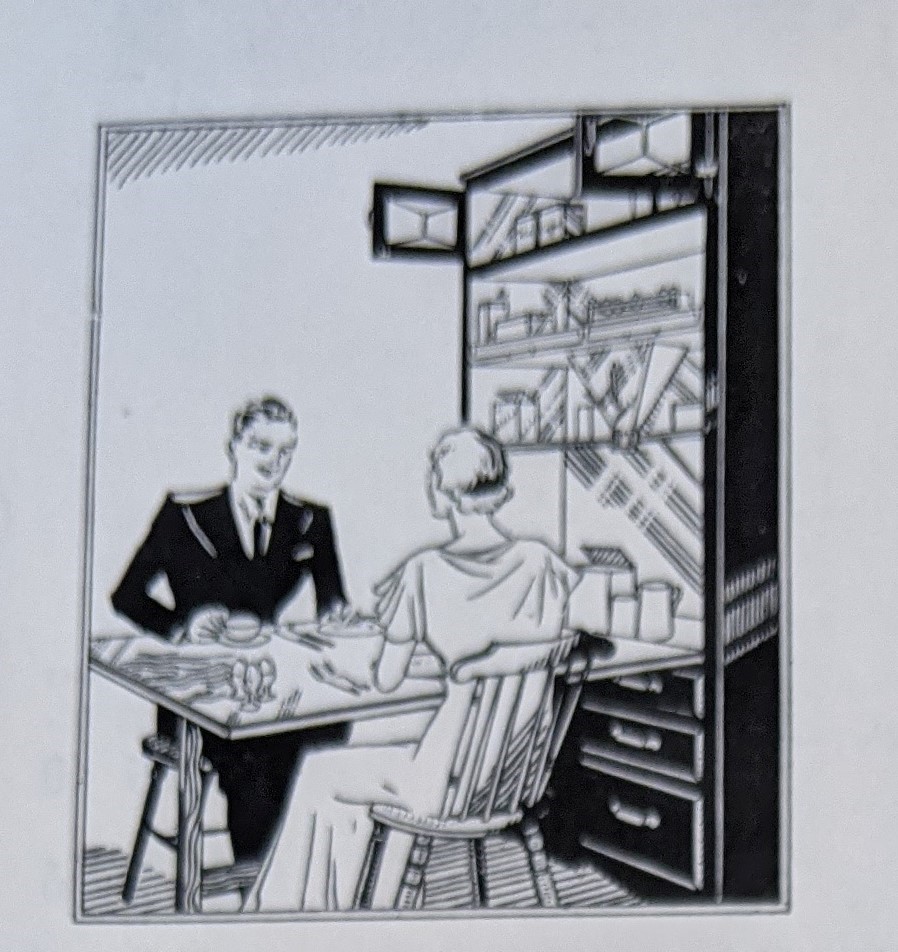
These comprehensive kitchen cabinets again came in a range of prices; the more expensive the model, the more functionality it had. This model, which at £9 was one of the more expensive ones, came with an instructive image which explained to the prospective buyer exactly how to use the unit. The 29 (!) arrows tell the housewife that she should put her large household utensils on top of the cabinet; keep her preserves in the jars in the bottom left cabinet; and put her ‘various kitchen sundries’ in the middle drawer on the bottom right. This particular cabinet comes with a chart of food values built in, and a pocket for household account books: these underline that the housewife’s task is a serious one. The health and economic survival of the household are her responsibility. The porcelain table top extends to a dining table; the catalogue provides a drawing that depicts the white-collar couple harmoniously at breakfast, using the full range of the cabinet’s functions.

Drawing included in catalgue, demonstrating use of cabinet

The Lusty & Sons furniture catalogues shine a light on how the new interwar workers furnished their homes. Like contemporary mass-furniture makers, each piece of Lusty & Sons furniture was available in a wide range of finishes. Customers were able to personalise their furniture to fit their tastes and budgets, thus avoiding the risk of having exactly the same furniture as their neighbours. At the same time, the catalogues instructed customers on how to use the furniture, and by extension, how to manage their households. Far from being a neutral object, the catalogue’s tacit and explicit instructions make visible what was considered an appropriate way of living for white-collar workers in the mid-1930s.


[1] Mark Clapson, Suburban Century: social change and urban growth in England and the United States (Oxford: Berg, 2003), p. 2

[2] ‘W. Lusty & Sons Ltd Catalogue’, 1936, held by Tower Hamlets Local History Library and Archives, LC10550

[3] Ibid.

[4] Miriam Glucksmann, Women Assemble: women workers and the new industries in inter-war Britain (London: Routledge, 1990), pp. 52-3

Night Alone (1938)

Night Alone (1938)

The 69 comedies produced in Britain in 1938 include two George Formby vehicles (I see Ice! and It’s in the Air), Break the News starring Jack Buchanan and Maurice Chevalier, and the marital comedy Night Alone. With a modest run-time of one hour and 16 minutes, the film nevertheless manages to combine a comedy about misunderstandings between husband and wife with a sub-plot involving the international smuggling of fraudulent banknotes.

By the tail end of the 1930s, the British film industry was steadily producing upwards of 150 films a year, and the majority of them were comedies. Comedy is more culturally specific than crime or melodrama, and cheaper to produce. Despite their increased output, British film studios could not usually hope to compete with high-budget Hollywood productions.

Welsh actor Emlyn Williams (who in the same year starred in the hard-boiled They Drive By Night) plays Charles Seaton, a solicitor who for seven years has been happily married to Barbara (Lesley Brook). Whilst on route to visit Barbara’s sister Vi, and see Vi’s daughter in a school play, Charles is unexpectedly detained by urgent business. This means the couple have to spend a night apart for the first time in seven years: Charles in a hotel and Barbara at Vi’s house. Despite Charles’ best intentions to stay in his room for a quiet night in, when he meets his old friend Tommy, he is persuaded to go to a nightclub in Villiers Street. Vi, at the same time, needles Barbara to the point that she starts doubting Charles’ loyalty.

A fair portion of the film is set in the nightclub that Charles, Tommy and two of Tommy’s friends, Gloria and Celia, visit. By 1938, the perceived threat of nightclubs to society had mellowed to the point that the film can joke about the club’s dubious legal status. When Tommy first tries to persuade Charles that he should come out, Charles tries to get out of it by arguing that he is not a member of the nightclub. ‘All you have to do is put a bob in a slot machine and you’re a member for life!’ scoffs Tommy. Towards the end of the film, when Tommy has to give an account of the party’s movements to a police officer, he immediately gives a fake name and address, on the assumption that he is part of a regular nightclub raid and will be let off with a warning.  

Tommy is presented as a bit dim-witted, but ultimately harmless and fun; he certainly knows how to behave in the nightclub. Charles inability to do the same, and his awkwardness in the pub, is played up for its comedic value. After his initial refusal to dance, he sits at the table with Celia, who appears to be in league with the nightclub staff. She first gestures over the cigarette seller. Charles agrees to buy a cigar, but baulks when he’s told it will cost 10 shillings. He then feels obliged to buy a packet of cigarettes instead, even though that is still overpriced at 4 shillings. Celia then waves the girl who sells chocolates, over. Charles again feels that decency compels him to buy some chocolates for Celia, even though they cost 25s and the girl does not give him any change.

Later in the evening, Charles shares a few dances with Gloria, with whom he gets on much better than with Celia. In his nervousness, Charles keeps drinking until he passes out. The other three manage to get him out of the club and into Gloria’s apartment, which is nearby. Celia and Tommy head out again, and Gloria is about to settle in on the couch when her American boyfriend unexpectedly shows up. He has just arrived by plane from Paris with a suitcase of forged banknotes, and the police are hot on his heels. Gloria and he escape the flat, leaving the drunk Charles snoring on the bed. When the police raid the flat shortly afterwards, they arrest Charles as an accomplice to the smuggling and put him in a cell for the rest of the night. The next morning, Charles has to try his hardest to get back to the hotel before Barbara and Vi come back. He manages to do so with seconds to spare and Barbara believes him when he says he’s not left the hotel all night: marital bliss is restored.

Charles has several dances with Gloria and the pair share light-hearted jokes (sample: Charles: ‘I’m not as young as I look’; Gloria: ‘You don’t look young at all’). It is not until Charles thinks he’s about to be arrested for forgery that he is concerned about Barbara finding out what has happened during the night. Night Alone presents Charles initial devotion to his wife and his quiet life as unnatural and comic. In line with other popular comedies of the time, such as the Aldwych farce A Cuckoo in the Nest, the narrative suggests that there is nothing wrong with spending a night in another woman’s flat, as long as your wife doesn’t find out about it.

Barbara, for her part, is admired by one of the other parents at the school play. Vi encourages her to enjoy a little flirtation on the grounds that Charles is bound to be doing the same. The ‘flirtation’ goes no further than an awkward, stilted conversation between Barbara and the man. Her refusal to engage with the man is part of her virtue as a wife, as is her blind belief that Charles would never do anything untoward. Barbara is constantly compared to Vi, whose cynicism and jokes about sex mark her out as coarse, in the same way Tommy is shown to be unreliable compared to Charles. Vi and Tommy are a lot of fun to watch but Night Alone makes it clear that the reward of a stable marriage with trust and companionship is worth more than short-term fun and entertainment.

Dorothy L. Sayers – Murder Must Advertise (1933)

Dorothy L. Sayers – Murder Must Advertise (1933)

Dorothy L. Sayers is readily regarded as one of the most prominent contributors to the ‘Golden Age of Crime Fiction’: a period that spans nearly all of the interwar period. It marked not only a huge increase in the popularity of crime stories in Britain, but also saw innovations in the genre, for example the unreliable narrator in Agatha Christie’s The Murder of Roger Ackroyd (1926) and a crime with half a dozen possible solutions in Anthony Berkeley’s The Poisoned Chocolates Case (1929).

Sayers’ main contribution to the genre were the eleven novels she wrote around amateur sleuth Lord Peter Wimsey; the debonair younger brother of the Duke of Denver who combines a passion for antiquarian book-collecting with his hobby of crime detection. The first Wimsey novel, Whose Body? appeared in 1922 in the US and in Britain a year later. Sayers’ continued writing Wimsey novels until Busman’s Honeymoon in 1937, after which she turned her attention to writing scholarly works on theology.[1]

The eight Wimsey novel out of a total of eleven, Murder Must Advertise, appeared in 1933. In this book, Wimsey goes undercover to work as a copywriter at a fictional advertising firm, Pym’s Publicity. He is invited to do this by the manager, Mr Pym himself, after a suspicious death on the firm’s premises: one of the staffers has fallen to his death from a spiral staircase. Sayers drew on inspiration from her own time working as a copywriter in the early 1920s for S.H. Benson; the Benson office even had a steep spiral staircase like the one that appears in Murder Must Advertise.[2]

Sayers’ real-life work experience lend the novel’s descriptions of the office life in an advertising firm an authentic air. The novel’s opening sees all the firm’s office staff gathered in the typists’ room, to surreptitiously organise a sweep on the horse races. There are pages of rapid, overlapping dialogue of staff discussing the sweep and the arrival of the new colleague. When they hear one of the managers approach,

‘the scene dislimned as by magic. (…) Mr Willis (…) picked a paper out at random and frowned furiously at it (…) Mr Garrett, unable to get rid of his coffee-cup, smiled vaguely and tried to look as though he had picked it up by accident and didn’t know it was there (…) Miss Rossiter, clutching Mr Armstrong’s carbons in her hand, was able to look businesslike, and did so.’[3]

It is a scene still familiar from modern office-based comedies and dramas such as Mad Men (2007-2015) and The Devil Wears Prada (2006). Throughout the book, the copywriting staff spend most of their time chatting and trying to come up with new slogans, interspersed with bursts of extreme stress when an advert needs to be reworked close to the printing deadline. A key scene in the novel sees the Morning Star newspaper ring the office at 6.15pm because they have noticed an unintentionally rude image in one of the adverts due to be printed that evening.[4] The resolution to the murder investigation ultimately also lies in the adverts: Wimsey finds out that a drug racket uses advertisements to communicate with one another.

Because of Wimsey’s aristocratic background, he does not normally engage in paid work in any of the books. Alongside the murder mystery, Murder Must Advertise gives the reader the opportunity to glimpse the world of advertising in 1930s Britain. The subject matter gives Sayers’ ample opportunity to poke fun at the public. During his time at Pym’s, Wimsey accidentally comes up with a wildly successful campaign for (fictional) Whifflet cigarettes:

‘It was in that moment, (…) that [Wimsey] conceived that magnificent idea that everybody remembers and talks about today – the scheme that achieved renown as ‘Whiffling Round Britain’ (…) It is not necessary to go into details. You have probably Whiffled yourself.’[5]

Essentially, the campaign is a coupon scheme; coupons collected on cigarette packets could be traded for hotel stays, train tickets, holiday outings et cetera. Sayers’ describes the scheme as growing beyond the initial campaign to

‘Whifflet wedding[s] with Whifflet cake[s] (…) a Whifflet house, whose Wihfflet furniture included a handsome presentation smoking cabinet, free from advertising matter and crammed with unnecessary gadgets. After this, it was only a step to a Whifflet Baby.’[6]

At the time the novel was published, this type of all-encompassing branding had also been embraced by the British Union of Fascists, as discussed in a previous post. Advertising and marketing in general had taken an enormous flight during these decades, in no small part due to the increased circulation of daily newspapers.

Sayers herself is sceptical of the industry – the novel ends with a paragraph of fictional advertising slogans and the closing line ‘Advertise, or go under.’[7] Although Sayers apparently enjoyed her time working at S. H. Benson in 1923,[8] when Murder Must Advertise was published ten years later she appears to have been more critical of the industry. Nonetheless, Murder Must Advertise provides a comic look into what was a growing industry in interwar Britain, written by someone with first-hand knowledge of its operations.

A 1973 TV adaptation of Murder Must Advertise can be found on YouTube.


[1] Francesca Wade, Square Haunting: Five Women, Freedom and London Between the Wars (London: Faber & Faber, 2020), pp. 329-331

[2] Martin Edwards, The Golden Age of Murder (London: Collins Crime Club, 2016), p. 13

[3] Dorothy L. Sayers, Murder Must Advertise (London: New English Library, 2003 [1933]), p. 6

[4] Ibid., pp. 135-145

[5] Ibid., p. 288

[6] Ibid., p. 289

[7] Ibid., p. 388

[8] Wade, Square Haunting, p. 125

Jack Hulbert

Jack Hulbert

A wildly popular musical comedy star of stage and screen in the 1930s, Jack Hulbert has since been dismissed by some critics as a ‘light entertainer’[1] who ‘can seem tirelessly jaunty company.’[2] During the peak of his film career, Hulbert ranked high in popularity charts. In 1933 he was voted the top British male star in audience questionnaires and 1936 he was the third most popular British star based on domestic box office returns.[3] He starred in fourteen films across the decade.

Jack Hulbert was born in Cambridgeshire in 1892 to a doctor. He studied at Cambridge where he joined the Cambridge Footlights. His brother Claude Hulbert, who was eight years his junior, followed the same trajectory. Both brothers became two of the first Footlights alumni to reach acting success and fame. After Cambridge, Jack Hulbert got a role in a theatre production, playing opposite Cicely Courtneidge. The couple married in 1916 and stayed together for the rest of their lives, often working together on stage and screen.

After completing his war service, Hulbert returned to his career in variety theatre and produced and acted in numerous stage productions across the West End. During the 1920s, British films were still silent and therefore did not provide a suitable medium for comedy stage stars like Hulbert and Courtneidge, who depended on witty dialogue and song-and-dance numbers to win over their audiences. Further, until the adoption of the 1927 Cinematograph Films Act, very limited numbers of British films were being produced at all.

By the start of the 1930s the couple found themselves in debt due to financial mismanagement. As the British film industry was at the same time transitioning to sound, the time had come for Hulbert and Courtneidge to make the leap to the silver screen. Their first appearance was as themselves in Elstree Calling! (1930). As implied by the title, this film was a series of separate sketches performed by popular entertainers supposedly broadcasting from Elstree studios north of London.

After Elstree Calling! Hulbert moved into narrative fiction films, and increasingly worked separately from Courtneidge. In common with other popular comedy stars of the period, such as George Formby and Gracie Fields, Hulbert usually played characters called Jack. The titles of some of his films, such as Jack’s the Boy (1932), Jack Ahoy (1934), Bulldog Jack (1935) and Jack of All Trades (1936) worked to eliminate the difference between the actor and his characters even further.

Hulbert’s persona was a confident and likeable middle-class charmer who was able to be both comic and romantic.[4] . His films ‘appear to exist primarily for the display of [his] talents as singer, dancer and comedian.’[5] In Jack of All Trades, he plays a likeable chancer who is looking for a job. After striking up an acquaintance with Lionel, a bank clerk (played by Robertson Hare) Jack starts showing up at Lionel’s office and pretend that he works there. His pretence is so successful that he ends up convincing the bank bosses to build an entire new shoe factory. The scenes where Jack and Lionel present their proposal to the Board, all of whom approve the plans because they are too embarrassed to admit that they have no idea what they are being shown, still have the power to resonate with modern audiences. The final third of Jack of All Trades, however, descends into fast-paced slapstick action typical of Hulbert films with a lot of physical comedy.

Hulbert singing ‘Where There’s You, There’s Me’ in Jack of All Trades

A similar tension between narrative and apparently stand-alone action can be found in Bulldog Jack, a film satirising the extremely popular Bulldog Drummond book and film series. Bulldog Drummond was a fictional, highly successful police inspector. At the start of Bulldog Jack, Jack Hulbert’s character accidentally crashes his car into Bulldog Drummond’s, injuring the latter and making him bed-bound. When the young daughter of a jeweller asks for help because her father has fallen victim to a gang of thieves and blackmailers, Drummond asks Jack to pretend to be the famous ‘Bulldog’ and take on the case.

Again, the first section of the film gives plenty of space for comedy and romance, before the action-packed climax set in the London Underground. The criminal gang have set up their headquarters in a disused Underground station, and the gang leader hijacks an Underground train in an attempt to get away. Jack ends up crawling over the top of the train carriages, like a true action hero, to stop the train. Prior to this final chase, Bulldog Jack uses sped-up shots of Jack and his friends chasing the criminals up and down the spiral staircases of the Underground station.

By the mid-1930s the use of sped-up film was quite unusual; it was a device much more often used in the ‘cinema of attractions’ that pre-dated World War One. Jack Hulbert’s films did not fully conform to the conventions of narrative filmmaking. Instead, they applied techniques from earlier film genres and from the variety stage onto the long-form fiction film medium. Although this allowed Hulbert to perform in a similar mode across his stage and film productions, as a result his 1930s film work can jar to modern audiences and make it more challenging to understand Hulbert’s enormous popularity at the time.

Elstree Calling! can be viewed on YouTube.


[1] James Chapman, ‘Celluloid Shockers’, in The Unknown 1930s: An alternative history of the British cinema, 1929-1939, ed. Jeffrey Richards (London: IB Tauris, 1998), p. 91

[2] Brian McFarlane, ‘Jack of All Trades: Robert Stevenson’, in The Unknown 1930s, p. 164

[3] Jeffrey Richards, The Age of the Dream Palace: Cinema and Society in 1930s Britain (London: IB Tauris, 2010) pp. 160-161

[4] McFarlane, ‘Jack of All Trades’, p. 163

[5] Ibid.