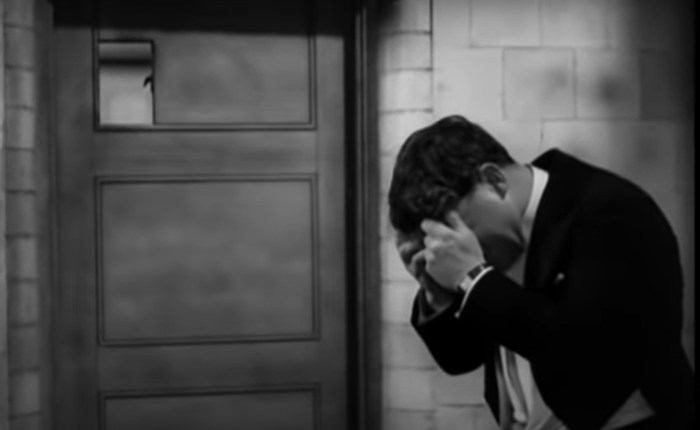
Murder in Soho (1939)

Murder in Soho (1939)

On the eve of the Second World War, Associated British Picture Corporation produced Murder in Soho, a gangster flick starring American actor Jack La Rue (not his real name, obviously). The presence of Italian-American La Rue, with his cleft chin and strong jawline, brings Hollywood glamour to what is otherwise a crime film with an extremely thin plot. Murder in Soho appears to be a solitary British outing for the actor, although he did take the opportunity to get married whilst visiting London for the film’s shooting.

Like the almost contemporaneous They Drive By Night, Murder in Soho works hard to incorporate American slang into its dialogue, presumably to appeal to younger audiences. They Drive By Night, however, was produced by the British arm of American studio Warner Brothers. Murder in Soho comes from a British production company that was Hitchcock’s home for many of his silent films including Blackmail (1929); Murder! (1930)and The Skin Game (1931). Alongside these British thriller/crime films, ABPC (which previously operated as British International Pictures) also produced musical films such as Harmony Heaven (1930) and Over She Goes (1937). They did not have a strong background in producing American-style crime films – and it shows.

The plot of Murder in Soho is extremely thin. La Rue plays nightclub owner Steve Marco, who runs the ‘Cotton Club’ in Soho. He has just hired a new singer for the club, Ruby Lane. Steve is interested in Ruby as he thinks she has ‘class’. He doesn’t know, however, that Ruby is married (but separated from) Steve’s British associate Joe Lane. When Joe betrays Steve and steals £2000 off him, Steve kills Joe. Soon police inspector Hammond comes asking questions. He recruits Ruby to work with him and reveal Steve’s criminal activities. Also in the mix, although largely superfluous to the plot, are a journalist called Roy Barnes who frequently visits the club and falls in love with Ruby; Steve’s ex Myrtle who he has dumped in favour of Ruby; and performing duo ‘Green and Matthews’ who also work at the club.
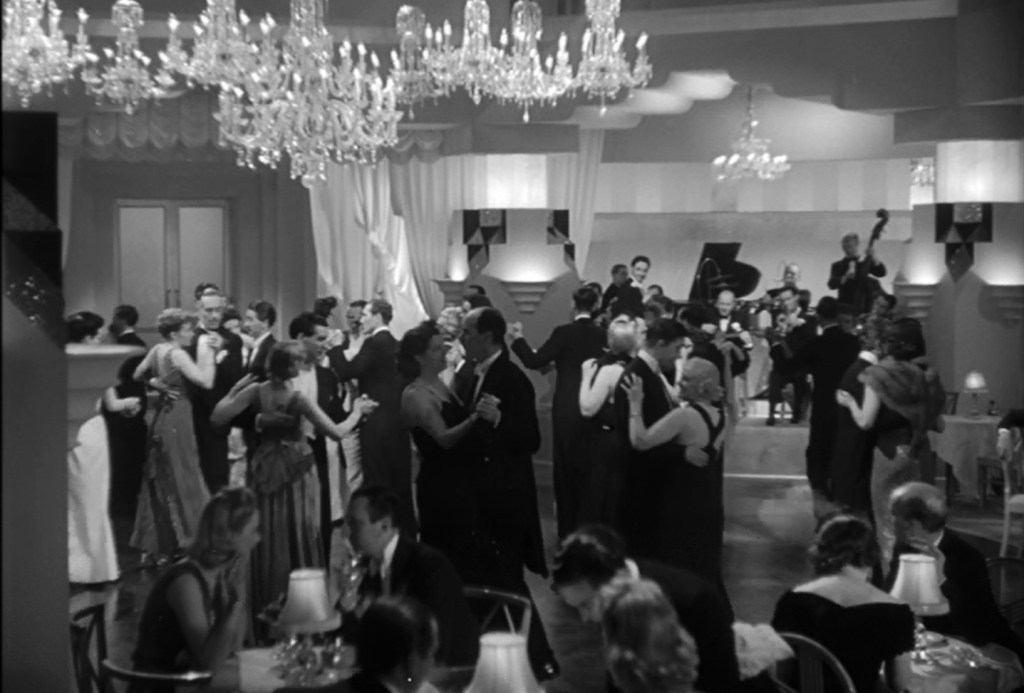
The ‘Cotton Club’ in Murder in Soho

Murder in Soho contains all the popular elements of a 1930s crime film: a nightclub; an international criminal gang; a singer; a police inspector; a journalist. Yet these elements are not fused together with a compelling plot or livened up by any original ingredient. Indeed, the film’s insistence to try and introduce Americanisms into the narrative detracts even more from the action. Steve and his henchmen speak in thick Italian-American accents. The character ‘Lefty’ in particular, who is the young comedy sidekick, litters his dialogue with references to ‘dames’ and ‘cops’. The name of the club obviously refers to the famous Harlem nightclub – but there were no British Cotton Clubs and the name does not have the resonance in Britain as it would do in the United States. Steve employs Black bartenders in his club – again a practice which was much more common in the States than it was in Britain. Compared to depictions of nightclubs in other British films of the 1930s, the Cotton Club in Murder in Soho feels more like a replica of a Hollywood set than of anything resembling British nightlife.
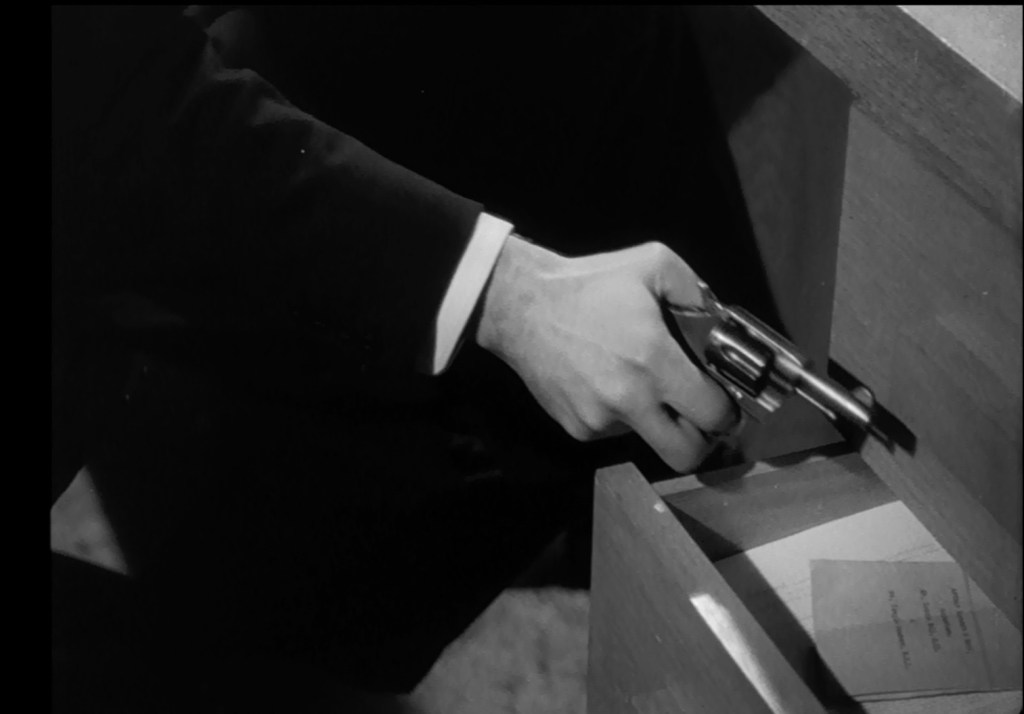
Gun-toting American gangsters in Murder in Soho

The very opening of Murder in Soho also presents a version of Soho that was much more deliberately criminal and seedy than what is usually presented in British films. Familiar shots of the neon lights of Piccadilly Circus are interspersed with a close-up shot of a roulette table; a shot of an underground dive bar; and a shot of two prostitutes propositioning a man in an alleyway. Unlike the majority of British films of the period, which worked to preserve an image of London and Londoners as ultimately adhering to the law and to a high moral code, Murder in Soho explicitly positions Soho as a criminal space. Granted, the main criminal element in the film is foreign, but Joe Lane is British, as is Myrtle, Steve’s scorned ex who ends up killing him. Soho here is a lot seedier than the Soho portrayed in, for example, Piccadilly (1929).

Rather surprisingly, then, Murder in Soho also contains plenty of comic notes, and a few secondary characters who are only included to provide comedy relief. Most notably, the performing duo Green and Matthews, which weave throughout the narrative. Lola Matthews is portrayed by Googie Withers, who this early on in her career already had made a name for herself as an excellent comic actress. As Lola she patters on non-stop, innocently flirting with every man and completely oblivious that her dance partner Nick Green is besotted with her. A frequent club visitor whose role is simply credited as ‘Drunk’ provides diversion in scenes when he tries to eat with chop sticks or enters the dancefloor for a solo performance. These interludes do undercut the drama and suspense that the film attempts to create at other points.

Murder in Soho is a late-interwar curiosity – a film that tries to appeal to British audiences by inserting American glamour; a film that tries to be both serious and funny at the same time; and that ends up feeling like a painting-by-numbers effort that adds up to less than the sum of its parts.

Mr Smith Wakes Up (1937)

Although the 1930s are primarily remembered for the rise of right-wing politics across Europe, including the increased popularity of the British Union of Fascists (see blog posts here and here), there were of course also activists on the left of the political spectrum. Although the Labour party served in the opposition rather than the Government from 1931 until the outbreak of the Second World War, the 1930s saw the start of some social reforms, particularly in housing and medical care.

In 1937, the Co-op sponsored a short film designed to encourage viewers to question some of the tenets of capitalism and free markets. This information film, Mr Smith Wakes Up, would have been shown in cinemas as part of a mixed programme of features, newsreels and cartoons. Advertisement films from the period were often also lengthy and designed as mini-narratives, making them quite close in appearance to this short film. Mr Smith Wakes Up, however, does not aim to sell goods but rather to influence people’s political thinking.

In Mr Smith Wakes Up, we are introduced to William and Elizabeth, a middle-aged and fairly wealthy couple who live in a nice suburb in a house called ‘Utopia’. Their house is worth a couple of thousand pounds and all the other people in the area are of the ‘better class’ which William defines as them being ‘mostly on the stock exchange.’ The vast majority of houses sold in 1930s Britain were worth less than a thousand pounds, so it would have been immediately clear to the contemporary viewer that William and Elizabeth are well-off. They also still keep a parlour maid and a cook, despite the ever-increasing servant problem significantly raising the cost of keeping servants.

William and Elizabeth are unexpectedly visited by Mr Smith, a friend of their son who had been to Africa. We never learn Mr Smith’s first name or which part of Africa he is from. By his own accord, he has come to the ‘great civilization’ of Britain to learn how it is set up, so that he can take it back to his tribe which he himself describes as ‘very primitive people’. For the remainder of the film, Mr Smith asks William and Elizabeth about how things like housing, medical care and food distribution are arranged in Britain. William consistently takes the position defending capitalism and the free market, whereas Elizabeth acknowledges that there are problems with wealth distribution in the country.

When discussing housing, for example, Mr Smith asks if all people in England own their own homes. William admits that this is not the case, but that the working classes can live in rental homes on ‘nicely planned’ housing estates. His arguments are accompanied by shots of one such an estate. Elizabeth then points out that there is still a housing shortage and that the new estates may lead people to have long and expensive commutes. She also raises the prospect of slums, which were still commonplace in pre-War British cities. The audience is duly presented with shots of slum housing, followed by images of very skinny children being examined by a doctor, when Elizabeth points out that slum living makes people ill.

Later on in the discussion the three actors discuss food distribution, re-armament and the ‘cost of living’. Wages have risen, but so have the costs of food, housing and heating, meaning many people are still struggling to make ends meet. In phrases that will sound very familiar to viewers in the early 2020s, William argues that people need to economise more, while Elizabeth points out that for large, low-income families there is nothing left to economise on.

Unfortunately, there are no opening credits preserved to the film so it is not possible to identify the actor playing Mr Smith, but it is safe to presume he was either born in Britain or one of Britain’s overseas territories in the Caribbean. Like American actor and activist Paul Robeson, who was often forced to portray stereotypical African tribesmen, the character of Mr Smith supposedly comes straight from an African rural tribe. At the same time, he also wears a very smart suit and overcoat when arriving at Utopia, and his English is flawless. Although his skin colour causes some consternation when he first arrives at the house, Mr Smith is accepted because he is able to pass as a gentleman, and he does not criticise any aspect of Britain. He even praises the food available in Britain as superior to African food, which stretches credibility.

At the end of the film, Mr Smith states that a nation should give its people food, health and protection. The preceding discussion has made clear to him that Britain is failing to provide this to all its citizens. His voice is accompanied by idyllic scenes of African tribes working and playing together. He argues that African tribes do not go to war as long as there is sufficient food available; and that if they do go to war, their methods of combat are more equal than those of Western nations. Nonetheless, he remains grateful for what William and Elizabeth have ‘taught’ him, and takes his leave.

After he has gone, Elizabeth looks in on the kitchen. Cook is just packing her bag to go home, and decides to take left-over meat to cook for her husband, as otherwise it will only go to waste. Elizabeth indulgently smiles and lets her take the food, and then tells the parlour maid she can go up to bed even though the washing up has not been completed. From her position of privilege, Elizabeth generously allows her staff these luxuries. William sits in the study pondering whether ‘peace and plenty’ are as adequately provided for in Britain as he had assumed. There is no indication, however, that either will take any further-reaching political action as a result of their conversation. Instead, their actions stay on the personal plane.

Despite the leading role of Mr Smith, and the film’s sympathetic portrayal of ‘African’ culture, it is clear that its target audience is white. Contemporary audiences for Mr Smith Wakes Up were unlikely to have recognised themselves in William and Mary – cinema viewing remained largely an activity for the working- and lower-middle classes, who were more likely to already be sympathetic to the left-of-centre views the film espouses. Although the filmmakers may have wanted to encourage people like William and Mary to re-consider their political views, it is doubtful whether many wealthy people would have seen the film or taken any notice of it. Although Mr Smith Wakes Up gives modern audiences insight into the socio-political debates and concerns of the late 1930s, it possibly was not effective in generating political change at the time it was created.

Mr Smith Wakes Up is available to view on YouTube.

Brooklands

Brooklands

Brooklands race course was an institution in interwar England. Opened in 1907 in Weybridge, just south of London, it was the world’s first purpose-built, permanent racing circuit. Coinciding with the rise of car manufacturing in England, Brooklands was used to test out and perfect new car models. Like greyhound racing and horse racing, Brooklands races became a popular entertainment. Each race held the potential for injury and death, which piqued the audiences’ interest.

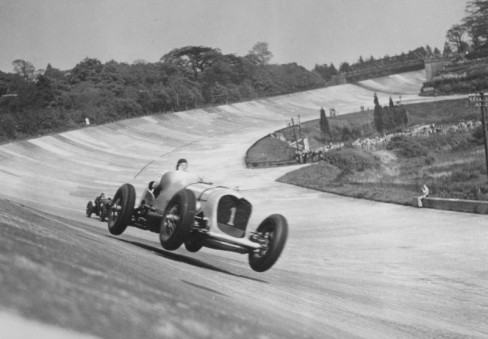
Still from Death Drives Through (1935) which was shot at Brooklands

The Brooklands track could be shaped into different configurations, but was mostly used as a long oval lap, made of concrete, and concave, so that the outer edges of the track were higher than the middle (like a modern indoor speed cycling circuit). Footage shot in 1928 shows how cars started on a flat section, and how drivers were positioned outside their vehicle at the start of a race. Pit stop booths were available for technical check-ups during the race. Although the cars in this particular footage look fairly similar to normal road cars, there were plenty of racing cars being developed also.[1]

Examples of these racing cars are on display in the 1935 film Death Drives Through, directed by Edward L. Cahn. Most of the action of this film is set in and around Brooklands, as the main characters of the film are two rival race car drivers. Kit Woods (Robert Douglas) is an up-and-coming driver who built his own race car and used to drive on local tracks before being talent-spotted and contracted to appear at Brooklands. Once he arrives there, established racer Garry Ames (Miles Mander) does everything within his power to destroy Kit’s reputation, including causing accidents on the race track. Death Drives Through features a staged crash at Brooklands which ends in the death of a driver, highlighting the potential for danger which was contained in each race.

A 1938 Gaumont newsreel features footage of a real Brooklands crash. Because the driver in that instance survived the accident, the newsreel commentator can play the incident up as thrilling entertainment, which was ‘filmed exclusively by Gaumont British News’.

‘Mr Clayton was flung out into the trees….miraculously he escaped death although he was seriously injured…his car was reduced to wreckage…below the banking outside the track it was a crumpled mess…hardly to be recognised as a car.’

The newsreel as a whole is titled ‘120 M.P.H CRASH AT BROOKLANDS’, making no bones about the fact that the crash, rather than the overall race, was what was expected to be of interest to audiences.

Racing drivers became celebrities, to the point that by the mid-1930s, their endorsements were featured in Castrol car oil adverts. Drivers not only competed in England, but also participated in European competitions which potentially increased their profile even more.[2] The British Government gratefully used the fame and prestige of some drivers in its own ‘Safety First’ campaign, launched in 1934. The purpose of this campaign was to increase road safety. In the absence of any formal driving test, racing driver the 5th Earl of Howe patiently explains to viewers how to indicate and overtake, and advises against canoodling with a lover whilst driving a car. Although none of the regular traffic rules would apply on a race track, the audience is still asked to presume the Earl to be an expert adviser, both due to his title and his status as a racing driver.

Racedriver John Cobb endorsing Castrol XXL – Front page of the Daily Express, 11 August 1934

There were plenty of women racing at Brooklands too – like aviation, car racing was a sport in which technical skill, rather than physical strength, were paramount. Despite initial opposition, from 1932 onwards women were allowed to compete in the same races as men. One of the most famous female drivers, Kay Petre, appears in the 1938 video showing a crash, referred to above. There are plenty of stories about other female drivers available on the Brooklands Museum website.

A final note on the audiences to these races. The 1928 footage referred to at the top of this blog shows an audience apparently exclusively made up of middle-aged men in three-piece suits and top hats. By 1938, the audience is much more mixed both in terms of gender and (judging by the clothes) social status. There are plenty of men visible in flat caps, or even, no hats at all. There also appears to be a much larger crowd than ten years’ prior.

This change reflects the overall change to car ownership which happened in parallel, away from the race track. Whereas car ownership had started off as something exclusive and only available to the very wealthy, by the end of the 1930s cars were affordable to most middle-class families. This greater exposure to car driving likely also increased interest in car racing. Although most racing drivers came from privileged backgrounds (if not from the actual aristocracy, then at least from wealthy families), there was always the possibility for a ‘regular’ person with technical knowledge and talent to establish him- or herself. Death Drives Through pandered to this fantasy, as Kit is exactly the kind of enterprising and plucky hero whom audience members could relate to. The tracks of Brooklands become not just a space for thrills and entertainment, but also a site of dreams of social mobility.


[1] Bart H. Vanderveen (ed), British Cars of the Late Thirties, 1935-1939, (London: Frederick Warne & Co, 1973)

[2] Bernhard Rieger, ‘Fast  couples’:  technology,  gender  and  modernity  in  Britain  and  Germany  during  the  nineteen-thirties”, Historical Research, vol. 76, no. 193 (August 2003), 370

Fascination (1931)

Fascination (1931)

Three years after his directorial debut, the silent film The First Born (1928), Miles Mander tried his hand on two sound films. The first, The Woman Between, was an adaptation of his own stage play ‘Conflict’. The second, Fascination, was based on another writer’s script. Unlike some actor-directors, like Tom Walls, Mander decided to restrict his duties to directing only and did not appear in either film.

Fascination’s main attraction for modern audiences is the starring role of future ‘Hitchcock Blonde’ Madeleine Carroll, appearing here four years before her famous role in The 39 Steps opposite Robert Donat. According to the DVD sleeve notes, only one 35mm copy of Fascination survives in Britain, of which the sound and image quality leave something to be desired. It is, however, eminently watchable, not only for Carroll’s performance, but also as an interesting counterpoint to The Divorce of Lady X which was released seven years later. Both films deal with marital fidelity, but whereas the later film treats infidelity as a comic subject and accepts its existence as a matter of course, Fascination is much more moralistic on the subject.

Madeleine Carroll as Gwenda Farrell in Fascination

Fascination opens with a scene in a children’s playroom, where a little boy and girl are playing with a toy train set. They are Larry and Vera, the protagonists of the film. Mander’s directorial style comes across immediately in the close-up shots of various toys, which give an emotive impression of the room from a child’s perspective. He shuns any establishing shot of the space. In foreshadowing of Larry and Vera’s later troubles, the toy train runs of the rails and Larry, in trying to fix it, breaks the tracks altogether. However, the children quickly make up and a third boy, who had been playing in a corner, orders that they should be ‘married’; a mock ceremony ensues.

The film then briefly moves to Larry and Vera’s courtship as young adults (Larry is ‘in his last term at Oxford’ studying to be an architect) before moving on to a time three years into their marriage, when the main action of the film begins. Vera and Larry have been established as a devoted couple, who laugh and play together and commit to a series of ten ‘commandments’ of marriage, which include ‘telling the other everything that matters’ rather than the more traditional expectation for the wife to obey the husband.

Vera and Larry courting in Fascination

Three years into the marriage, there are no children yet (more on that later) but Larry has established himself as an up-and-coming architect/interior designer and Vera is a content housewife. Larry has received a request to do the interior design of an apartment for a famous stage actress, Gwenda Farrell, who is currently starring in the hit play ‘Fascination’. Gwenda, of course, is played by Madeleine Carroll. Reeling from a recent break-up, Gwenda is taken by Larry and he is smitten by her. The reasons for his attraction to Gwenda are never explained; the audience is asked to assume that it is inevitable for a happily married man like Larry to fall in love with another women based on her looks and glamour alone.

After an initial meeting in a cafeteria, ostensibly to discuss the business of the flat, it is Larry who suggests that they go out on the river for the rest of the day and have a picnic. Once outside, he starts flirting with Gwenda and she calls him a ‘silly boy’ and tells him not to ‘spoil things’. However, she immediately follows this up with an invitation to supper in her flat – and as if the audience needs reminding, Mander here inserts a shot of a sign in the adjacent pond which announces ‘Danger’.

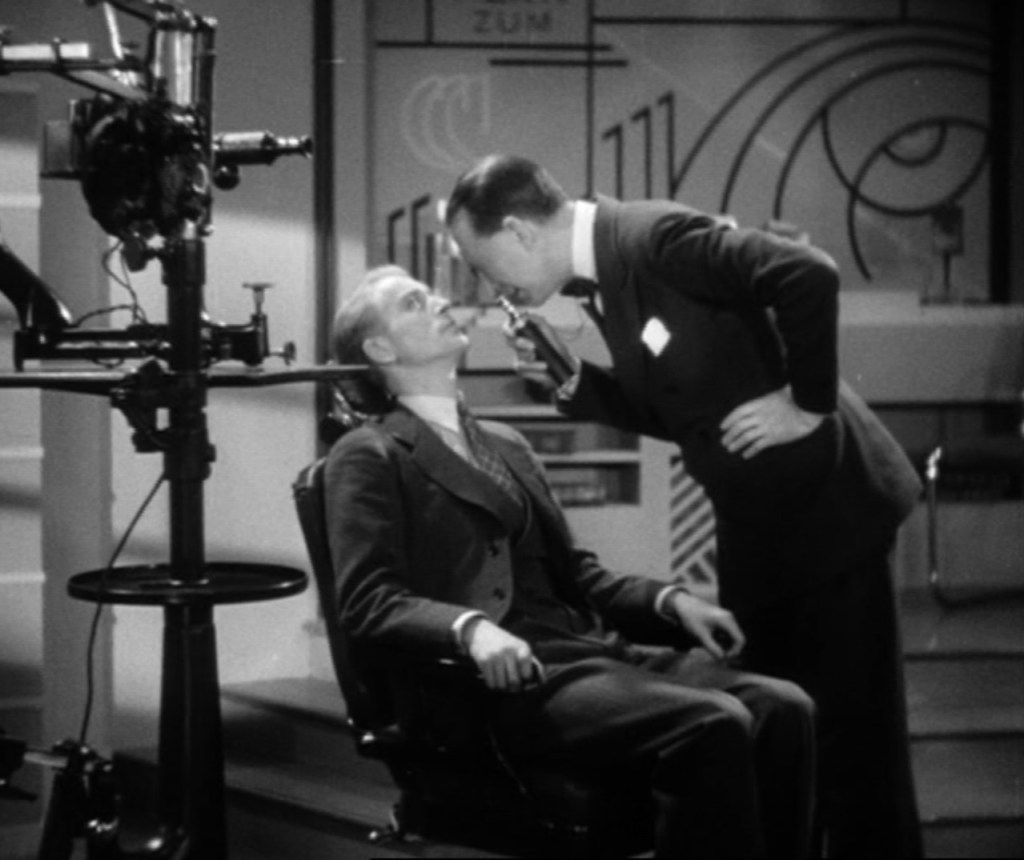
Although Larry is clearly an active and willing participant in the affair, it is no surprise that Gwenda is presented as the primary guilty party, as she reciprocates his attention and moves the relationship along. At the night of the supper (where we can assume the relationship is consummated), Vera is starting to get upset with Larry’s frequent absences from home. Her suspicions are confirmed when Gwenda sends Larry an intimate letter which Vera reads. But even here Vera has not done anything illicit or objectionable: Larry has eye trouble and asks Vera to read his letters out to him, even encouraging her to open the one marked ‘Personal’. Vera does not reveal to Larry what she has read and burns the letter without him being any the wiser.

Larry visiting a very modernist optician in Fascination

Although Larry by this point is starting to feel very conflicted about his affair and wants to end it, Gwenda ostensibly still has too much of a hold on him to enable him to break things off. Thankfully for him, his wife has found a solution. Vera writes to Gwenda under false pretences and invites the other woman to her marital home. Here, rather than having an argument, Vera explains that she loves Larry and wants to protect her marriage, so she is happy to silently consent to his affair with Gwenda. In Vera’s reasoning, if she were to cause a big fuss, Larry would be driven into Gwenda’s arms more.

Before Gwenda has a chance to respond to this proposal, Larry comes home – Vera hides Gwenda quickly behind a curtain. Larry confesses his affair to Vera, begs her forgiveness and offers to write to Gwenda immediately to break off the relationship. Gwenda decides to reveal herself and explains to Larry that Vera, in her generosity, had agreed to him continuing the affair just to keep her marriage intact. She insists on ending her relationship with Larry now that she has met Vera.

Vera warmly says goodbye to Gwenda in Fascination

Fascination ends with the contrast of Gwenda, smoking alone in her dressing room and forcing herself to get ready for yet another night’s performance; and Vera and Larry, cuddled together in a chair where Vera reveals to him that she is pregnant.

Larry and Vera happily reunited at the end of Fascination

Unlike in The Divorce of Lady X, then, divorce is an impossible outcome in Fascination. If Vera had opted to divorce Larry, she would have had to stand the shame and exposure of the divorce court, with a famous actor cited as co-respondent in the case. Clearly, for a respectable middle-class woman this was not really a route to contemplate, even without the added complexity of pregnancy or children. Her willingness to allow the affair to continue, then, is perhaps less magnanimous than the film presents, and more pragmatically her only option.

Yet, by perpetuating the narrative that single women ‘steal’ husbands away from faithful wives; and faithful wives should accept this and allow husbands to come back in their own time, Fascination clearly sides with patriarchal norms. Vera’s ostensible agency is in fact non-existent- something also stressed by a scene where she visits Larry’s office to ask him for household money. Fascination presents marriage as the route to a woman’s happiness, and independence and professional success as poor substitutes. Despite the increasingly progressive position of women in British society by the early 1930s, this film demonstrates that cultural texts often still expounded traditional viewpoints.

The Divorce of Lady X (1938)

The Divorce of Lady X (1938)

Just as the end of the 1920s saw the introduction of sound film in British cinema, by the time the 1930s drew to a close, a new innovation was introduced: Technicolor – or more correctly, three-strip Technicolor. Earlier versions of ‘two-colour Technicolor’ had been used in Hollywood since the First World War, for example for segments of Carl Laemmle’s 1925 The Phantom of the Opera starring Lon Chaney. Three-strip Technicolor gave more realistic colour images, and is the process which is famously used in The Wizard of Oz (1939).

Technicolor required financial investment, so it took some years to bring it to Britain. The first British Technicolor film was Wings of the Morning, made in 1937. It was followed hot on its heels by a film of Britain’s most lavish film producer, Alexander Korda. A Hungarian by birth, Korda moved in Britain in the early 1930s, when he’d already worked in Hollywood and various European film industries. In 1933, he had a huge success on both sides of the Atlantic with The Private Life of Henry VIII, a lavish period piece that depicted Henry Tudor belching and stuffing his face with food at regular intervals. The role of Anne Boleyn is played by Merle Oberon, in one of her first substantial screen roles.

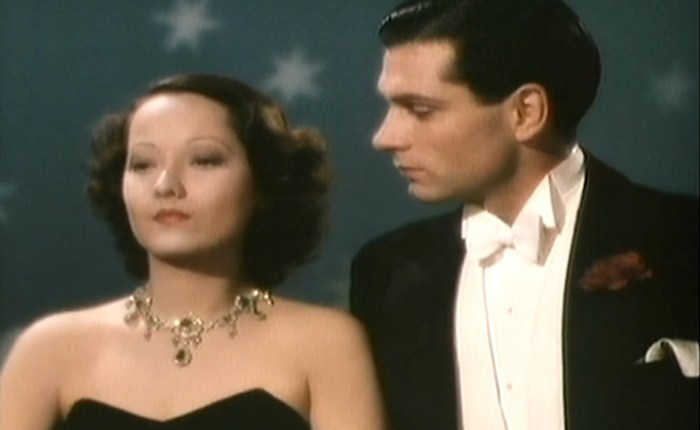
Korda cast her again as the female lead in The Scarlet Pimpernel in 1934, and also in The Private Life of Don Juan in the same year. By 1939, the pair were married, although the marriage only lasted to the end of the Second World War. During their courtship, they made The Divorce of Lady X (1938), in which Oberon stars opposite Laurence Olivier. This comedy, with its frank discussion of divorce and extramarital relations, shows how ‘propriety’ became less important in Britain towards the end of the interwar period.

The Divorce of Lady X is a re-make of a 1933 film, Counsel’s Opinion, which Korda also produced. Both films are based on a play by Gilbert Wakefield. The 1933 film, whilst favourably received upon its release, is no longer extant. The Divorce of Lady X, by contrast, was syndicated for TV release in the US in the 1940s, and is widely available on DVD and online.

The story of The Divorce of Lady X centres on that favourite trope of British interwar cinema: a man and a woman, who are not married, are forced to spend a night together in a (hotel) room. Nothing untoward happens, but everyone assumes the couple must be having an affair. A similar trope is used in Night Alone, as well as numerous Aldwych farces, such as A Cuckoo in the Nest, Rookery Nook, and Lady in Danger. In The Divorce of Lady X, Leslie Steele, a young socialite, and Everard Logan, a divorce lawyer, are thrown together due to an impenetrable fog, which leaves them both stuck in the same central-London hotel. Leslie talks Logan into sharing his suite with her – her sleeping in bed, him on a mattress in the adjacent sitting room.

Laurence Olivier as Everard Logan, getting ready for an
uncomfortable night on the floor in The Divorce of Lady X

During the course of the evening Logan incorrectly assumes Leslie is married. The next day, a member of his club, Lord Meere, comes to Logan’s office and asks him to arrange for a divorce from Lady Meere, as the latter spent the previous night in the same central-London hotel, with a man in her room. Logan assumes that Leslie, who has not given him her last name, is Lady Meere, and that he unwittingly has become both the barrister and the co-respondent in Lord Meere’s divorce suit.[1]

Logan continues to court Leslie, telling her he does not care that his career will be ruined, as long as she will marry him after she’s obtained her divorce from Lord Meere. Leslie continues to play along, although she herself has also fallen in love with Logan. Eventually, Leslie meets the real Lady Meere, and the two women concoct a plan to reveal the truth to Logan. Logan is initially embarrassed by being taken for a ride and he storms off to France, but Leslie follows him onto the boat and manages to change his mind.

Leslie (Merle Oberon) nursing a sick Logan (Laurence Olivier) on the boat to France

Right from the outset of the film, it is made clear that Logan has had multiple affairs – when Leslie comments that his pyjamas are hideous and he should dump the woman who buys them for him, he shoots back ‘we parted six months ago!’. At the same time, he rings up another woman to apologise for not being able to see her that evening, due to the fog. Although Leslie is not explicitly shown to have any lovers of her own, she is very confident and flirts with Logan in a way that makes it unlikely that he is her first love interest. The real Lady Meere, moreover, is repeatedly quoted as having had four husbands and several ‘episodes’ with other men, and at the end of the film it is made clear that she is cheating on Lord Meere. Crucially, none of this is depicted as wrong or objectionable; although all characters admit that four divorces is perhaps a bit much, Lady Meere is also shown to be a sympathetic and attractive woman. When Logan admits to his assistant that he (as he thinks) has fallen in love with a married woman, it is a matter of amusement rather than embarrassment, and divorce is depicted as largely normalised.

Lady Meere (Binnie Barnes) and Leslie (Merle Oberon)
plotting on how to break the truth to Logan (Laurence Olivier)

This representation of marriages as likely not lasting nor monogamous clearly presents a challenge when the central relationship of the film must also fulfil narrative convention. For the audience to be invested in the relationship between Leslie and Logan they must believe that it will end in a happily ever after, not a marriage that will quickly dissolve because one or both parties are conducting affairs.

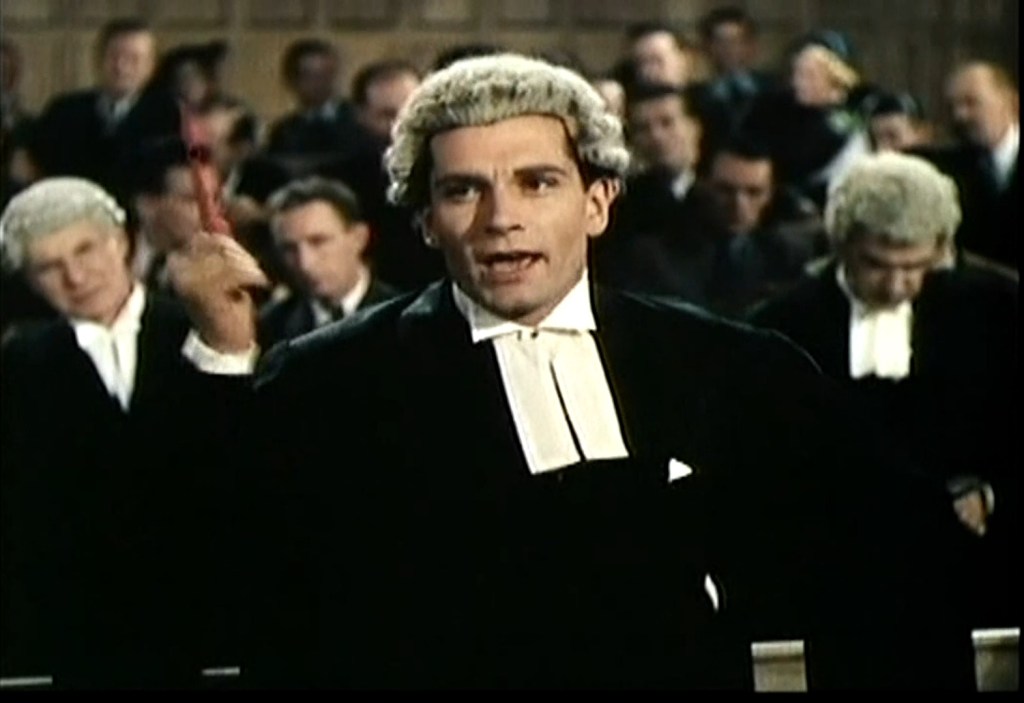
To resolve this, The Divorce of Lady X uses the trope of the woman-as-saviour: Leslie, for all her modern manners, is essentially a respectable girl. When she first meets Logan, he is extremely cynical about women, due to his experience in the divorce court. This cynicism reaches a high point during a withering closing-arguments monologue in one of his divorce cases, which Leslie witnesses from the public gallery. ‘Modern woman has disowned womanhood, and refuses man’s obligation!’ he thunders. ‘She demands freedom, but won’t accept responsibility! She insists upon time to “develop her personality”, and she spends it in cogitating on which part of her body to paint next.’

Laurence Olivier as Everard Logan, spouting against Modern Woman in court

Little wonder that Leslie is not impressed after hearing that speech! But no fear – her steadfast conviction that she is the one to save and reform Logan is rewarded in the end. When she follows him onto the boat to France at the film’s close, the choppy waters give her a chance to mother and nurture Logan. Her triumph is crowned by a final scene in the divorce court, in which Logan’s speech is the opposite of his earlier outburst. Appearing now as the defence of the woman accused of divorce, rather than as counsel for the husband, Logan gushes that his client is ‘a woman – that unique and perfect achievement of the human species (…) especially evolved for the comfort and solace of man.’ The message is clear: Leslie has managed to persuade Logan that married life is, after all, best. The open discussion of, and jokes about, divorce that form the backbone of The Divorce of Lady X point towards the ‘permissive society’ of post-War Britain; but its resolution of the protagonists’ story in a traditional marriage shows that in the 1930s the stability of conservative traditions still held sway.

The Divorce of Lady X can be viewed on the PBS website.


[1] In British divorce law, a co-respondent is a person cited in a divorce case as having committed adultery with the respondent ie. the half of the couple not initiating the divorce.

Co-operette (1938)

Co-operette (1938)

The Co-operative Wholesale Society (CWS), now the Co-operative Group, has had a presence in Britain since 1863. From its foundation, it set itself apart from other grocers with the notion of ‘dividend’: members who purchased goods from the business would also get a share of the profits – the more goods purchased, the bigger the dividend returned. In the interwar period, the CWS was a wholesaler supplying goods to a range of local co-operative grocers, particularly in the north of England.

In 1938, CWS produced Co-operette, a substantial advertising film for the company’s products. A version of the film is available to watch for free on the BFI player, (for those based in the UK). The BFI copy of the film lasts around 15 minutes, and appears to be incomplete. Nevertheless, the available footage gives a great insight into British advertising films of the late 1930s. A film like this would be shown as part of a cinema screening, which at the time usually comprised of a combination of feature films, educational films, cartoons, trailers, and advertisements.

Like a shampoo commercial produced two years’ previously, Co-operette is framed around the deceit of being ‘on set’ whilst the advert is being filmed. The first shot after the opening credits is of a shooting script, which describes the opening credits we have just seen, and the announcer we are about to see – although the shot ‘close up of shooting script’ does not appear.

Close-up of the shooting script in Co-operette (1938)

The announcer tells the audience who will be featured in the film: comedian Stanley Holloway, band leader Debroy Somers and his band, comedian Harold Walters, and the ‘Six Co-operettes’: a dancing troupe of young women in skimpy outfits. (The fact that the famous and popular Stanley Holloway barely features is an indication that this may not be the full film). The next sequence moves us on to a film set, where Debroy Somers and his band are set up on a sound stage, ready to be recorded. In the set’s lobby, a Co-operette walks past whilst chatting to a man dressed in native American costume, to heighten the effect that this is an active film set on which multiple productions are being shot. Harold Walters plays Sam Small, a character in fact developed by Stanley Holloway who by 1938 would have been very familiar to audiences. Throughout the fifteen minutes, Sam Small serves as the comic relief character who creates confusion on the set.

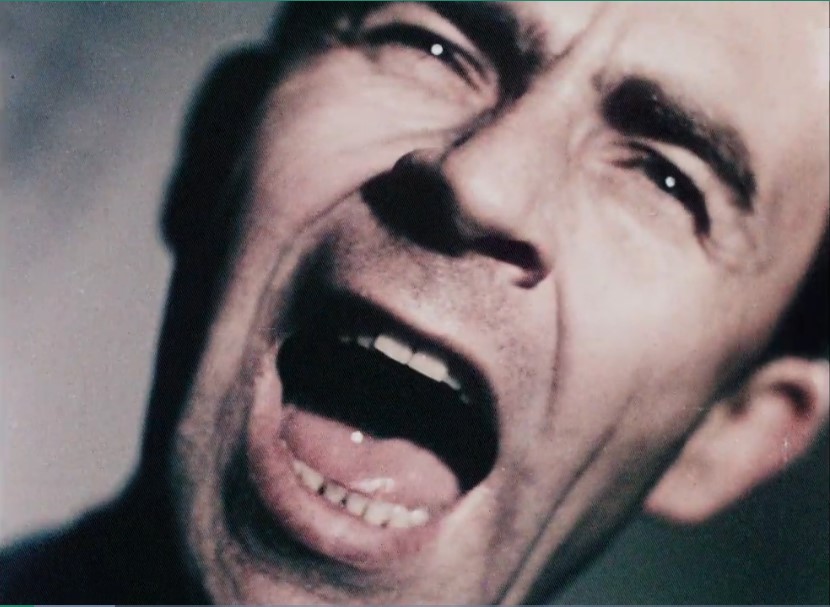
When filming of Debroy Somers and his band is about to get started, Co-operette serves up a series of close-ups of crew members on the set shouting for ‘QUIET!’

This over-emphasis on the need for absolute silence on the set make the inevitable disruptions of the hapless Sam Small onto the set’s operations even more impactful. The close-up shots are sharply angled, lending an unexpectedly expressionist air to proceedings which is not repeated at any other point in the film.

As Debroy Somers and his band get going for their first song – on a beach set with some women in swimwear decorously arranged in the foreground – the band’s trio of singers start a Co-op-themed song to the tune of ‘Heads, Shoulders, Knees and Toes’:

There is a Co-op in the town
And there, my true love sits her down
And well she knows each penny she could spend
Will go towards her dividend

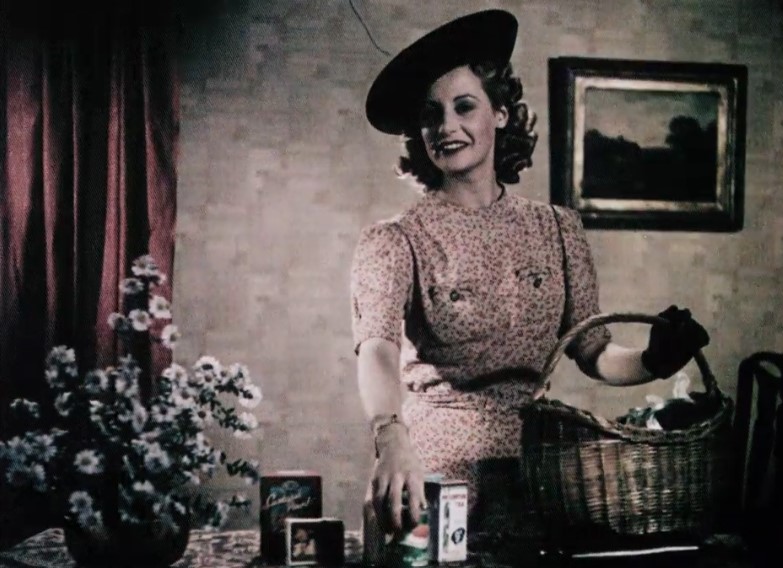
At this point the scene changes to a shot of a young, fashionably dressed housewife, who is pointedly unpacking her CWS-bought groceries, taking care to position the labels carefully towards the camera.

A housewife unpacking Co-op goods in Co-operette (1938)

This song seamlessly blends into the next one, in which the singers describe the various customer types of the Co-op in catchy rhymes accompanied by visual representations of these customers: a retired couple (“Charles and Jane live all alone/in a four-room flat they call their home”); a young man buying his wedding suit (“Lovely fit/I must admit”); a young woman who cleverly saves money on day-to-day purchases so she can still dress fashionably (“She knows the way to shop/where value is the top”); a young married couple of whom the husband always tries to eat everything in the larder immediately after the wife has done her Saturday shop at the Co-op.

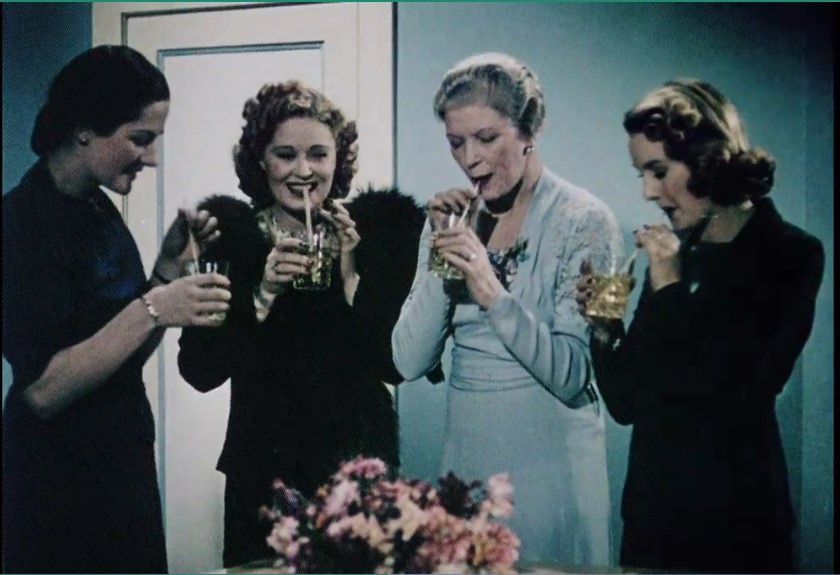
Despite the inclusion of the young groom, women are firmly established as the Co-ops main customer base. They are pithily categorised and visualised as ‘maid’, ‘widow’, ‘flaunty extravagant queen’ and ‘housewife that’s thrifty’. These four women are then shown to harmoniously share a pitcher of lemonade, drinking ‘to the health of CWS.’

From left to right: ‘housewife that’s thrifty’; ‘flaunty extravagant queen’; widow; maid

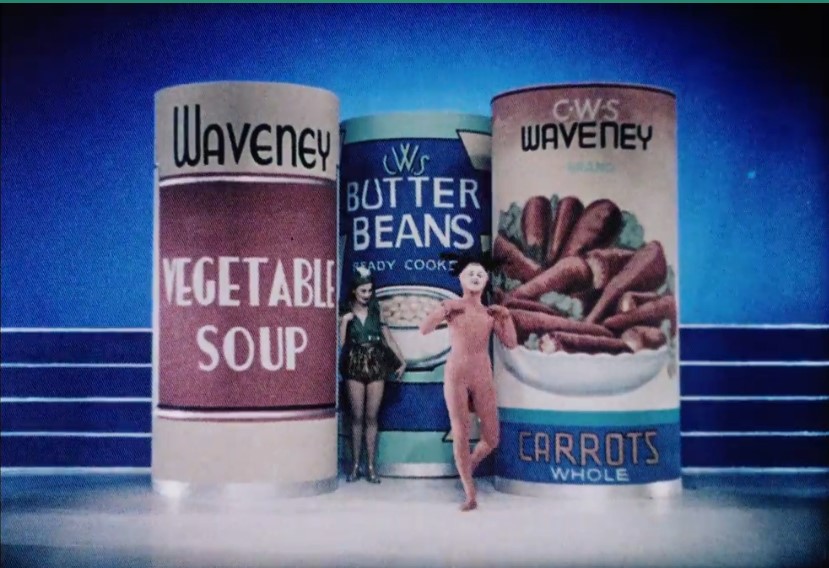
This section takes up about half of the fifteen-minute video. It is followed by a dance sequence of the six ‘Co-operettes’, after which the most surreal part of the film is launched: the ‘Carrot and Onion dance’. Against a set of three larger-than-life tins (Vegetable Soup, Butter Beans, and Carrots) two female dancers emerge. One is dressed in an orange suit that covers her entire body with a green head-dress; the other in a green, short-skirted dress.

Onion and Carrot emerging for their dance

As Carrot and Onion they dance a graceful pas-de-deux in which they overcome the difficulty of Onion’s smelly leaves. Their performance is followed by more work by the Co-operettes, this time tap-dancing. The final minutes of the film include more comic relief by Harold Walters, and a final song by the Debroy Somers band:

In every town there is a store
You pay much less, you get much more
For CWS has goods galore
For you, fair maid

Remember, remember
From January to December
There are always goods in store
For you, fair maid

The film ends with a title card reading that ‘All the goods featured in this film are CWS products’ – but hardly any goods are featured with any prominence. The first housewife featured is shown unpacking products, and there are some shots of a full larder, but in either case it is not possible for the audience to easily identify what the products are. The only packages that are really clear are the three enlarged cans used as the set for the ‘Carrot and Onion’ dance. No foodstuffs are mentioned by name in any of the songs.

Instead, the focus of the whole film is about the customers who shop at Co-op, and how the organisation caters to what the film presents as the full range of different women. In what is an early example of customer segmentation, women are primarily distinguished by their marital status (unmarried, married, widowed). However, whilst the film may be presumed to target women as the primary shoppers, the repeated display of the ‘Co-operette’ dancing troupe instead suggests a male target audience. During these dance sequences, the deceit and comedy of the sound stage set is dropped in favour of a more straightforward attempt at Hollywood glamour.

Co-operette shows how a British firm used cinematic conventions to create an advertising film that was much more about selling a concept than about selling specific items. The overall effectiveness of the film is, perhaps, somewhat reduced by its attempt to provide comedy, catchy songs, stage performance, and the Carrot and Onion dance which appears to be in a genre all of its own. Despite the overt messaging in the film implying that only women are the CWS’ customers, the film’s varied format indicates that it tries to appeal to all audience groups in the cinema, including men and children.

Co-operette can be viewed for free on BFI Player, for readers based in the UK.

First a Girl (1935)

First a Girl (1935)

Musical star Jessie Matthews was at the prime of her career in 1935 when she starred as the lead in First a Girl.[1] This musical comedy directed by Victor Saville is one version of a popular film plot; it is a remake of the German comedy Viktor und Viktoria (1933), which was re-made in West Germany in 1957, and most famously adapted by Hollywood in 1982, as Victor/Victoria starring Julie Andrews.

The basic plot of all four films, including First a Girl, is similar. An aspiring stage actress (in the British film she’s called Elizabeth, and naturally is played by Matthews) meets Victor, an actor who aspires to Shakespeare but in reality performs as a female impersonator. When a bad cold prevents Victor from performing one evening, he persuades Elizabeth to take his place, by pretending to be a man who pretends to be a woman. This is a great success, and ‘Victoria’ quickly becomes an international star, forcing Elizabeth to appear as a man when in public. Things get complicated when Elizabeth falls in love with a (straight) man, who believes her to be a man also.

Whilst both the 1933 original and the 1982 American version are regularly interpreted as queer films, First a Girl underplays the homosexual possibilities of Elizabeth’s flirtation with her male love interest. This is partly due to Matthews’ own appearance. As The New York Times noted upon First a Girl’s US release in 1936:

Normally it is with sorrow and self-hatred that this column hints at the inadequacies of a star, but this time it is a distinct pleasure to call Miss Matthews’s acting performance hopelessly bad. In “First a Girl” she is pretending to be a man and making no headway at all, except with the members of her supporting cast, who swoon with astonishment upon discovering her sex. 

Quite beside Matthew’s obviously feminine appearance, First a Girl underplays any potential sexual tension between Elizabeth and her love interest, Robert, until Robert understands that Elizabeth is a woman. Prior to that point, the film focuses on the comedic potential of Elizbeth’s cross-dressing, rather than any transgressive possibilities in her relationship with Robert.

Jessie Matthews as ‘Victoria’, appearing with Sonnie Hale, in First a Girl

All versions of the film appear to include a similar sequence in which ‘Victoria’ is ‘forced’ to perform activities which are coded as specifically masculine, to comic effect. In First a Girl this sequence is set in a Parisian nightclub, where Victor and Elizabeth find themselves during their European tour. Elizabeth has to wear a tuxedo here, and hangs out at the bar with Robert – a part of the club only available to men. She quickly gets drunk when trying to keep up with Robert’s rate of drinking, and struggles when trying to smoke a cigar. Whilst these scenes give Matthews an opportunity to display her comedic talent, they also undermine her sexual capital whilst she is performing as a man. As soon as Elizabeth’s true gender identity is revealed to Robert, she turns from an unsophisticated youth into a charming young woman.

It is significant that these scenes of gender-bending performance are set in Paris – a location that invited connotations of licentiousness and sexual transgression in the British popular imagination of the 1930s. Interestingly, in the 1933 German film, ‘Victoria’ is in London when forced to undertake activities which may ‘out’ her as a woman. ‘Victoria’ finds herself in an environment that is both literally and figuratively foreign to her.

As Jeffrey Richards points out, male and female impersonation had a long tradition on the British theatrical and music hall stage.[2] The character of Victor, then, works well in this British film. He is portrayed as older than Elizabeth (although actor Sonnie Hale was only five years Matthews’ senior) and can easily be read as a music hall performer in the Victorian tradition. His female impersonation act is purely comic, whilst Elizabeth’s is sophisticated. He links the film’s plot to a specifically British performance tradition, whereas the glossy song-and-dance numbers performed by Elizabeth have more in common with Hollywood productions.[3] The film makes no explicit reference to its German origins.

First a Girl, then, significantly dilutes the queer and transgressive possibilities of the original source material, which allowed the film to flourish in interwar Britain. According to the BFI, it was a great commercial success when it was released (something also suggested by its export to the US the following year). It remains a very watchable and enjoyable film for modern audiences; and a good example of how British interwar filmmakers moderated both European and Hollywood influences to arrive at a British compromise between the two.

First a Girl is available for rental on BFI Player (UK only)


[1] Jeffrey Richards, The Age of the Dream Palace: Cinema and Society in 1930s Britain (London: IB Tauris, 2010), pp. 217-218

[2] Ibid., p. 218

[3] This is not unusual for Jessie Matthews films. See Sarah Street, ‘Got to Dance my Way to Heaven’: Jessie Matthews, art deco and the British musical of the 1930s, Studies in European Cinema, 2:1, (2005), 19-30

Night Alone (1938)

Night Alone (1938)

The 69 comedies produced in Britain in 1938 include two George Formby vehicles (I see Ice! and It’s in the Air), Break the News starring Jack Buchanan and Maurice Chevalier, and the marital comedy Night Alone. With a modest run-time of one hour and 16 minutes, the film nevertheless manages to combine a comedy about misunderstandings between husband and wife with a sub-plot involving the international smuggling of fraudulent banknotes.

By the tail end of the 1930s, the British film industry was steadily producing upwards of 150 films a year, and the majority of them were comedies. Comedy is more culturally specific than crime or melodrama, and cheaper to produce. Despite their increased output, British film studios could not usually hope to compete with high-budget Hollywood productions.

Welsh actor Emlyn Williams (who in the same year starred in the hard-boiled They Drive By Night) plays Charles Seaton, a solicitor who for seven years has been happily married to Barbara (Lesley Brook). Whilst on route to visit Barbara’s sister Vi, and see Vi’s daughter in a school play, Charles is unexpectedly detained by urgent business. This means the couple have to spend a night apart for the first time in seven years: Charles in a hotel and Barbara at Vi’s house. Despite Charles’ best intentions to stay in his room for a quiet night in, when he meets his old friend Tommy, he is persuaded to go to a nightclub in Villiers Street. Vi, at the same time, needles Barbara to the point that she starts doubting Charles’ loyalty.

A fair portion of the film is set in the nightclub that Charles, Tommy and two of Tommy’s friends, Gloria and Celia, visit. By 1938, the perceived threat of nightclubs to society had mellowed to the point that the film can joke about the club’s dubious legal status. When Tommy first tries to persuade Charles that he should come out, Charles tries to get out of it by arguing that he is not a member of the nightclub. ‘All you have to do is put a bob in a slot machine and you’re a member for life!’ scoffs Tommy. Towards the end of the film, when Tommy has to give an account of the party’s movements to a police officer, he immediately gives a fake name and address, on the assumption that he is part of a regular nightclub raid and will be let off with a warning.  

Tommy is presented as a bit dim-witted, but ultimately harmless and fun; he certainly knows how to behave in the nightclub. Charles inability to do the same, and his awkwardness in the pub, is played up for its comedic value. After his initial refusal to dance, he sits at the table with Celia, who appears to be in league with the nightclub staff. She first gestures over the cigarette seller. Charles agrees to buy a cigar, but baulks when he’s told it will cost 10 shillings. He then feels obliged to buy a packet of cigarettes instead, even though that is still overpriced at 4 shillings. Celia then waves the girl who sells chocolates, over. Charles again feels that decency compels him to buy some chocolates for Celia, even though they cost 25s and the girl does not give him any change.

Later in the evening, Charles shares a few dances with Gloria, with whom he gets on much better than with Celia. In his nervousness, Charles keeps drinking until he passes out. The other three manage to get him out of the club and into Gloria’s apartment, which is nearby. Celia and Tommy head out again, and Gloria is about to settle in on the couch when her American boyfriend unexpectedly shows up. He has just arrived by plane from Paris with a suitcase of forged banknotes, and the police are hot on his heels. Gloria and he escape the flat, leaving the drunk Charles snoring on the bed. When the police raid the flat shortly afterwards, they arrest Charles as an accomplice to the smuggling and put him in a cell for the rest of the night. The next morning, Charles has to try his hardest to get back to the hotel before Barbara and Vi come back. He manages to do so with seconds to spare and Barbara believes him when he says he’s not left the hotel all night: marital bliss is restored.

Charles has several dances with Gloria and the pair share light-hearted jokes (sample: Charles: ‘I’m not as young as I look’; Gloria: ‘You don’t look young at all’). It is not until Charles thinks he’s about to be arrested for forgery that he is concerned about Barbara finding out what has happened during the night. Night Alone presents Charles initial devotion to his wife and his quiet life as unnatural and comic. In line with other popular comedies of the time, such as the Aldwych farce A Cuckoo in the Nest, the narrative suggests that there is nothing wrong with spending a night in another woman’s flat, as long as your wife doesn’t find out about it.

Barbara, for her part, is admired by one of the other parents at the school play. Vi encourages her to enjoy a little flirtation on the grounds that Charles is bound to be doing the same. The ‘flirtation’ goes no further than an awkward, stilted conversation between Barbara and the man. Her refusal to engage with the man is part of her virtue as a wife, as is her blind belief that Charles would never do anything untoward. Barbara is constantly compared to Vi, whose cynicism and jokes about sex mark her out as coarse, in the same way Tommy is shown to be unreliable compared to Charles. Vi and Tommy are a lot of fun to watch but Night Alone makes it clear that the reward of a stable marriage with trust and companionship is worth more than short-term fun and entertainment.

They Drive By Night (1938)

Towards the end of the interwar period, Warner Brothers’ British arm produced the thriller They Drive by Night, directed by Arthur Woods. This should not be confused with the 1940 American film of the same title, starring George Raft and Ida Lupino; although both films make reference to the long-distance lorry driving community, which is what their titles also refer to. Woods was still only in his early thirties when he directed They Drive By Night, but he’d already had a long career in the industry as a director (Radio Parade of 1935; Music Hath Charms) and screenwriter (Red Wagon; I Spy). They Drive By Night is a thriller, different from the majority of Woods’ work which was in musical comedy. Woods died in 1944 in active combat after joining the RAF at the outbreak of the Second World War.

The hero of They Drive By Night is ‘Shorty’ Matthews, played by Emlyn Williams. A the start of the film Shorty has just been released from prison, and he goes to look up Alice, an old flame who works as a dance hostess. When he arrives at her lodgings, Alice is dead in her room. Shorty panics and goes on the run, by posing as a long-distance lorry driver. With the help of Molly, one of Alice’s friends and colleagues, he keeps out of the hands of the police and is eventually able to track down Alice’s real killer. The killer is an older man with an obsession for the ‘criminal mind’, who used to often dance with Alice at the dance hall.

Although They Drive By Night is based on a British novel and set in England, the influence of the American producers on the film is marked. It is a prime example of the kind of film that met the criteria of a ‘British’ film under the 1927 Cinematograph Films Act, without actually conveying the British cultural values the Act also aimed to promote. For example, the characters use Americanisms and slang throughout the film. When Shorty first gets out of prison, he meets a woman in a bar: she is ostentatiously chewing gum, and her hair is dyed platinum blonde. This was hardly the type of womanhood thought to reflect British values, but Shorty and the barman look after the woman appreciatively.

They Drive By Night’s overall narrative also espoused values that are not typical of British films of the period. The main characters are a convicted criminal and a dance hostess turned lorry girl. As Julia Laite has explored, the lorry driving community caused concern in 1930s Britain as some young women hitched rides from drivers. It was suggested that this type of hitchhiking sometimes involved an exchange of sexual favours, which in turn led to the spread of venereal diseases amongst the lorry driving community.[1] This in turn could lead, it was feared, to unsafe road situations when lorry drivers were ill, thus neatly linking the whole matter to ongoing road safety debates.

In They Drive By Night, however, there is no suggestion that Molly sleeps with the lorry drivers that help her, and the general practice of girls hitching rides is not condemned. When one of them tries to take advantage of her, she fights him off. This driver is presented as a ‘bad sort’ and not representative of the whole lorry driving community – a second driver whom Shorty spends some time with is shown to be faithful to his wife at home. Overall, the lorry driver scene is presented as a more positive male environment than Shorty’s criminal network back in London; but ultimately the film presents a heterosexual coupling as the only truly appropriate outcome for Shorty.

The police play only a minor part in They Drive By Night, and they are not instrumental to the capture of Alice’s killer. Unlike other thrillers of the late 1930s such as The Squeaker or The Dark Eyes of London, the police inspector in They Drive By Night is not one of the protagonists who leads on the resolution of the case. Indeed, they do not feature in the film’s climax, in which Shorty and Molly are at home with the killer and he nearly succeeds in murdering Molly, at all. They Drive By Night skips over the killer’s arrest and trial – the parts of the process in which the police would be involved – straight to the day of his execution.

The police primarily feature as a plot device that gives urgency to Shorty’s actions as the police chase him. Shorty’s criminal record is no impediment to his status as the film’s hero, but throughout the film characters encourage him to ‘go straight’. First the owner of his regular bar tells Shorty not to go back to his old criminal habits. Then Molly’s steadfast support of Shorty whilst he is on the run for the police persuades him to say goodbye to his criminal life for good and turn himself in voluntarily. Only then is he able to outwit the killer and save Molly’s life as a traditional hero would. The eighteen months Shorty has done in prison for his earlier crimes are sufficient to wipe these off his slate and allow him a fresh start; arguably a philosophy more reflective of American culture than British values. Molly, too, is presented as a suitable romantic partner despite her past as a lorry girl and her work as a dance hostess; two roles which were regularly connected with loose morals.

They Drive By Night seems to represent a transitional point in British interwar cinema, where American values had influenced British culture so much that they started to permeate British films. Despite the best efforts of the legislators, they were not able to stem the tide of American cultural influence on the domestic film industry. This influence went beyond hairstyles and mannerisms to a fundamental re-appraisal of morality and social values.

They Drive By Night is available to view on Youtube.


[1] Julia Laite, ‘Immoral Traffic: Mobility, Health, Labor, and the “Lorry Girl” in Mid-Twentieth-Century Britain’, Journal of British Studies (2013) 52:3, pp. 693-721 (693-4)