Featured

Ethel Lina White – The Wheel Spins (1936)

This is the first of a two-part blog looking at the novel The Wheel Spins, and its film adaptation The Lady Vanishes.

Ethel Lina White is one of a mass of interwar authors who were quite prolific, had some commercial success during their lifetime, and whose names have been mostly forgotten by the general public. In the case of White, if it were not for the successful adaptation of two of her novels into films, she may have dropped into obscurity altogether. However, her 1933 novel Someone Must Watch was adapted for the screen in 1946 as the American horror film The Spiral Staircase, and her 1936 novel The Wheel Spins was filmed by Alfred Hitchcock in 1938 under the title The Lady Vanishes.

The plot of the book is relatively straightforward: Iris Carr is a young, wealthy, but bored woman who is travelling back to London by train after a holiday in Eastern Europe. On the first stage of the journey there is another British woman in her carriage, a Miss Froy. Iris has suffered sunstroke just before boarding the train and falls asleep. When she wakes up, Miss Froy has disappeared, and everyone else in the train appears to deny she has ever existed at all. Iris gets increasingly frantic trying to prove that Miss Froy exists, and attempts to enlist the help of the various British passengers on the train.

The Wheel Spins is an unusual entry to the suspense and mystery genre, in that the solution to the problem of what happened to Miss Froy is probably quite clear to the reader at an early stage. Instead, the tension of the novel is much more psychological, centring on whether the protagonist, Iris Carr, will be believed or will be dismissed as mentally unstable. That the fear of women being dismissed as crazy, and potentially locked up, has enduring cultural resonance is in evidence in texts such as the 1963 American novel The Group, where a (sane) character is checked into a mental institution by her husband against her will; or the 2018 Stevan Soderbergh film Unsane, in which the female protagonist also appears to be institutionalised against her will. Throughout The Wheel Spins, the other characters, particularly the men, repeatedly tell Iris that she is making things up. The sunstroke she has suffered has given her ‘delirium’ (p. 107); she is ‘loopy’ (p. 207), in a ‘dangerous mental state’ (p. 227) or ‘deranged’ (p. 230). At various points, the conspiracy against her makes Iris believe that perhaps they are right, and Miss Froy never existed; but then she finds a clue left by the other woman which reinforces her resolve.

The bond between these two women, who have never previously met and have very little in common, stands in contrast to the efforts of the passengers on the train to get Iris to give up her search. At the beginning of the book, Iris is part of a ‘crowd’ of ‘vain, selfish and useless’ people (p. 16). She has no interest in others and actively alienates the other British tourists in the hotel; something that comes back to her later when those same tourists are on the train and she appeals for their help. When Iris meets Miss Froy, she quickly finds her company grating: ‘She’s decent, although she is a crashing bore’ is Iris’ verdict on the other woman (p. 77). Yet when Miss Froy disappears, Iris is relentless in her attempts to find her, despite the obstacles in her way. This suggests a connection between women, helping one another out even if their personalities have little in common.

The other theme running throughout the book is that of British people sticking together against foreigners. Time and again, Iris expects other passengers on the train to help her because they are British, even if she has treated them poorly. When Iris first notices Miss Froy is gone, she goes into the dining carriage of the train to ask for help. It is when she explains to two British men that ‘an English lady’ has gone missing, that they feel compelled to help her (p. 100). Two sisters, the Misses Flood-Porters, can be depended on because they are of aristocratic British stock and will therefore always feel obliged to come through in a crisis. A British vicar, despite being sick, also feels it his duty to come to Iris’ aid. The foreigners on the train are variously described as ‘pallid’, ‘callous’ (p. 70), with ‘grinning faces’ (p. 206) that sneer (p. 211). The kidnapping of Miss Froy is part of a political plot in an unspecified Eastern European country, which is described as ‘feudal, and centuries behind us’ (p. 75). The agents of the ruling party do not blanch at the idea of killing someone like Miss Froy, who has accidentally inserted herself into their affairs. The British characters, in contrast, uphold decency and the rule of law.

Throughout The Wheel Spins, the reader is treated to interludes describing Miss Froy’s parents, an elderly couple who live in the British countryside and are eager for their daughter to come home. These scenes have multiple functions: they reassure the reader that Iris is right and Miss Froy is a real person; they raise the emotional stakes of the story as they highlight how devastated the parents would be if Miss Froy were to come to harm; and they reinforce the notion that the orderly, somewhat boring lifestyle of the Froys is aspirational. Iris has no family and no fixed abode; this is presented as giving her a lack of purpose, rather than freedom. The novel ends with Miss Froy safely arriving at her parents’ house at last; ensuring a restoration of the traditional British family.

The Wheel Spins is not a traditional whodunnit, in that the puzzle of what happened to Miss Froy is resolved halfway through the novel, and the details of who was behind her disappearance are left underdeveloped. Instead, it explores themes of alienation and belonging across a range of different registers.

The Wheel Spins has recently been reissued by British Library Publishing. All page numbers given refer to this 2023 paperback edition.
Featured

J. J. Connington – The Sweepstake Murders (1931)

J. J. Connington was the alias of Albert Walter Stewart, a Scottish-born chemist, crime writer and one of the founding members of the Detection Club. Alongside a successful academic career, Connington published seventeen novels between 1923 and his death in 1947. T.S. Eliot was an admirer of Connington’s detective fiction.[1] Connington’s main ‘sleuth’ was Chief Constable Sir Clinton Driffield, who was accompanied by Wendover, a man of independent means, as a side-kick. These characters reveal Connington’s conservative political views; they have independent wealth and are no political radicals.

The Sweepstake Murders was Connington’s 13th published work, and coincidentally the concept of ‘bad luck’ (accidental or manufactured) is a key motif in the work. The book starts with Wendover, Sir Driffield’s companion, attending a bridge party at a house in the neighbourhood. The nine men in attendance agree to join into a syndicate and buy nine sweepstake tickets for the Epsom Derby. If any of the tickets win, they agree to divide the winnings equally between them.

When one of their number unexpectedly dies before the sweepstake results are announced, it occurs to Wendover that their signed agreement means that the fewer members of the syndicate remain, the more money each individual will receive, as they will have to split the winnings amongst fewer people. When the syndicate wins the second prize, or £241,920, members start getting bumped off with alarming speed. Sir Driffield comes to visit Wendover and helps the local police with their investigation, as he is concerned about his friend’s safety.

The tension in The Sweepstake Murders is two-fold: the reader does not know who the next member of the syndicate will be who will get murdered; but as the murders progress, fewer and fewer suspects remain, as it is assumed that one of the remaining syndicate members is the perpetrator. In this set-up, the murderer can only obtain the highest possible monetary return by revealing themselves as the last person standing. Connington avoids this problem by having some of the syndicate members sell on part of their stake to people not originally involved in the syndicate, thus widening the pool of potential beneficiaries. The set-up also allows Connington to include a range of murder methods and weapons in his story, as the murderer gets creative to make the deaths look like accidents.

The narrative of The Sweepstake Murders is liberally interspersed with letters sent between legal advisers and syndicate members; excerpts of Sir Driffield’s notebook; and various jottings-down of accounts and sums to allow the reader to stay on top of who is entitled to which sum at each stage of proceedings. Towards the end of the story, the behaviour of a roll of film in a photo camera becomes a crucial clue to the plot, and this is duly illustrated with some diagrams. These extra-textual elements add to the puzzle-like feel of the story and engage the reader in its resolution.

The Sweepstake Murders is a high-concept crime story, which incorporates many of the tropes of the genre including meticulous timing of alibis, use of technology to cover and uncover tracks, and a closed circle of potential suspects. Despite Connington’s professional success during the interwar period, he is now a mostly forgotten crime writer and his books are not as readily available as those of other authors of the period. Yet The Sweepstake Murders is a good quality murder mystery and is worth seeking out by readers with an interest in interwar crime literature.


[1] Martin Edwards, The Golden Age of Murder (London: Harper Collins, 2016), p. 186

Featured

From investigation to trial

This is the fourth and final post of this year’s May Murder Month. You can read posts one, two and three elsewhere on the blog.

Most contemporary readers will get their knowledge about interwar murder stories from the realms of fiction – Hercule Poirot gathering together suspects for a drawing room reveal (a device which Agatha Christie actually only used sparingly) or a hard-boiled police officer picking up on a seemingly minute clue that unravels the whole case. Once the murderer is identified, interwar fiction is either silent about what happens next, or the perpetrator is given the opportunity to take the ‘honourable way out’ by committing suicide.[1]

In reality, of course, investigations were conducted by police inspectors. Unlike in modern criminal cases, there was no Crown Prosecution Service in interwar England. Instead, the police both conducted the investigation and prepared the documentation for the criminal trial. The Director of Public Prosecutions was ultimately responsible for bringing the case to trial in the interest of the people. England then, as now, had a two-tier criminal justice system. The magistrate courts were convened locally and dealt with most of the day-to-day criminal offences. Crown courts were reserved for jury trials, which included murder charges.

Before a case could be referred to the crown court, a prima facie case had to be established in the magistrate court that a crime had been committed and it was of a magnitude appropriate to be considered in the crown court. Interwar murder trials were therefore effectively heard twice: once in the magistrate court and then again in the crown court, where the sentencing would take place. It was generally the latter proceedings that drew the attention of the national press. In murder cases, the coroner’s inquest ran in tandem to the magistrate court proceedings. In the interwar period, coroner courts sat with their own juries, who were tasked with determining whether death had occurred naturally, through suicide, accident, or murder. Usually, if foul play was suspected but the police investigation was ongoing, the coroner would suspend the inquest to give the police more time to complete their investigations.

The reading public, then, were experiencing criminal narratives in two different ways. When reading newspapers, the reports mostly focused on the criminal trial, with its rhythm of prosecution, defence, cross-examination, witness statements, a possible statement by the accused, and the judge’s summing up, all cumulating to the jury’s verdict. In crime fiction, the narrative focused on the investigation, with witness statements noted as the investigation developed. Particularly in stories where the protagonist is an amateur sleuth as opposed to a police officer, the formal police and court procedures can be completely outside the scope of the narrative. As crime historian Victoria Stewart has noted: ‘Detective novels tend not to recount the trial of the individual whom the investigator identifies as the guilty party because the watertightness of the investigation itself acts as a substitute for the depiction of the judicial process. An account of the trial would simply reiterate the findings of the investigation that has formed the body of the narrative.’[2]

Other scholars have noted that trial reporting reveals contemporary attitudes to potentially contentious topics such as changing attitudes to gender identity and sexuality.[3] Newspaper historians have also argued that the increased popularity of crime fiction changed crime reporting, with journalists paying more attention to ‘human interest detail’ of the story as opposed to the judicial process. This, in turn, potentially obscured the public’s awareness of legal procedures.[4] Additionally, journalists on occasion played a very active role in gathering evidence that led towards a conviction, for example in the case of Buck Ruxton who murdered his wife and a servant.[5] Conversely, crime fiction novels which had a police inspector as their protagonist, such as the Inspector French novels by Freeman Wills Croft, potentially educated their readership about police procedures in more detail than newspaper reports did.

Whether fictional or factual, murder stories fascinated interwar audiences and allowed them to explore the limits of what was considered acceptable or transgressive behaviour; and how this changed over the course of the two decades. Newspapers and crime novels presented readers with two different lenses through which to consider the criminal justice process, from investigation to trial.


[1] Lord Peter Wimsey’s increasing mental distress at sending murderers to the gallows, which comes to a head at the end of the final Wimsey novel Busman’s Honeymoon, is a notable exception.

[2] Victoria Stewart, Crime Writing in Interwar Britain (Cambridge: University of Cambridge Press, 2017), p. 11

[3] Lucy Bland, Modern Women on Trial: sexual transgressions on the age of the flapper (Manchester: Manchester University Press, 2013), p. 2

[4] Judith Rowbotham; Kim Stevenson; Samantha Pegg, Crime News in Modern Britain (London: Palgrave, 2013), p. 140

[5] Shani D’Cruze, ‘Intimacy, Professionalism and Domestic Homicide in Interwar Britain: the case of Buck Ruxton’, Women’s History Review, vol. 16, no. 5 (2007), 701-722

Featured

Rose Macaulay – Dangerous Ages (1921)

Prolific interwar author Rose Macaulay won the 1922 Femina-Vie Heureuse Prize for her novel Dangerous Ages. The prize was founded in 1919 as a British counterpart to the French Prix Femina: an annual novel prize awarded by an all-female committee. The winning author was often, but not always, female too. Other illustrious winners include E.M. Forster who was awarded the prize in 1925 for A Passage To India; Radclyffe Hall who won for Adam’s Breed in 1927, and Virginia Woolf who was given the prize in 1928 for To The Lighthouse. The British prize was awarded until 1939; the original French prize is still running today.

Dangerous Ages was Macaulay’s eleventh novel, published when she was forty. Her age when writing the novel is significant, as the work chronicles six female members of the same family, each at a different, but equally ‘dangerous’ age. Grandmamma is eighty-four; her daughter Mrs Hilary is sixty-three; Mrs Hilary’s daughters Neville, Pam and Nan are forty-three; thirty-nine and thirty-three respectively. Finally, Neville’s daughter Gerda is twenty. The novel spends little to no time describing the men of the family; brothers and husbands exist, but are only given cursory mention and their inner lives are not explored in depth. Instead, the work is deeply concerned with the emotional experience of womanhood in early 1920s Britain, and Macaulay appears to take a fairly dim view on this. Almost all the female characters experience a deep emotional lack, brought about by the expectation that their primary role in life is to be a wife and a mother.

Mrs Hilary’s first name is Emily, but she is only called that in the novel by her own mother. At all other points she is ‘Mrs Hilary’, foregrounding the perceived importance of her marital status to herself and her children and grandchildren. Her husband has passed away ten years previously and Mrs Hilary lives with her mother in a seaside town. She is described as being not intelligent and having no hobbies. Grandmamma has settled into a life of little eventfulness, knowing that she is near the end of her time on earth. Nonetheless, she makes a point of always visiting any new babies born in the family. Mrs Hilary, on the other hand, knows she may have several decades more to live, and has no meaningful work to fill it with.

Similarly, Neville at forty-three is casting around for a purpose now that her two children are grown up. We are told that when she was in her early twenties, Neville started medical school, but left the course without qualifying at twenty-two when she met her husband and got married. Now that she is done raising her children, the role of MP’s wife does not seem sufficiently fulfilling for Neville. She determines to return to medical school to finish her studies and qualify. However, Macaulay does not grant Neville a simple triumph. Instead, she finds her studies ‘difficult beyond her imaginings.’[1]

After weeks of studying her brother Jim, who did qualify as a surgeon, quizzes Neville and she realises that she’s not going to be able to reach the required level of academic knowledge after twenty years of not applying her brain with any discipline. When she asks her brother what else she can do to give meaning to her life, he can only suggest that she continues her ‘political work – public speaking, meetings, and so on. Isn’t that enough?’[2] It is clear to the reader that it will not be enough for Neville, who is repeatedly described as having a keen mind.

For Mrs Hilary, temporary salvation of a sort comes from taking a course of psycho-analysis. In this new type of talking therapy, which had recently arrived on British shores, she finds a man who, for two hours every week, has to listen to all of her memories, thoughts and dreams and has to show an interest in them. For a woman like Mrs Hilary, who is endured and indulged by her children but not taken seriously, this therapeutic relationship gives her a sense of importance and purpose, even if she quickly becomes dependent on her therapist.

Nan, Mrs Hilary’s youngest daughter and an author, has spent her thirty-three years to date dating around without making a serious emotional commitment to anyone. One of her admirers is thirty-five year old Barry Briscoe. After years of keeping Barry at arms’ length, Nan realises that she is ready to settle down. She resolves to spend a few weeks in Cornwall finishing her latest book, and then to invite Barry over and let him know that she is ready to commit to him. Unfortunately for Nan, during the weeks she is in Cornwall writing, Barry decides that she is probably never going to agree to marry him and he falls in love with her niece Gerda instead.

Nan has missed her opportunity for conventional happiness and is left travelling abroad and pursuing a very public but rather unhappy affair with a married painter. Gerda, initially absolutely committed to not subjecting to the institution of marriage, is eventually persuaded by Barry to drop her ideals and agree to matrimony. His assurance that ‘Next time we differ I’ll try to be the one to do it [change his mind], I honestly will….’ rings hollow to the reader, who can foresee Gerda walking into a life of compromise and self-neglect like her mother and grandmother before her.

Despite the book’s publication shortly after the Great War, the conflict plays no role in the novel’s plot, beyond a few references to the notion of ‘surplus women.’ There is no sense that these post-war women have greater freedom or opportunities than previous generations: instead, almost all the women in the novel see their lives dictated by the expectations of marriage and motherhood. The exception is thirty-nine year old Pam, who lives with a female friend in a Hoxton flat and does social work. Macaulay allows Pam the final word: ‘Pamela, who seemed lightly, and, as it were, casually, to swing a key to the door against which Neville, among many others, beat’.[3] Pam’s secret is a supreme detachment from the details and emotions of life: ‘I certainly don’t see quite what all the fuss is about…’[4] The choice these 1920s women have, according to Macaulay, is to either remove themselves from life’s passions and emotions; or to live a life of constant frustration.


[1] Rose Macaulay, Dangerous Ages (London: British Library, 2020), p. 39

[2] Ibid., p. 90

[3] Ibid., p. 206

[4] Ibid.

Featured

Rose Macaulay – Keeping Up Appearances (1928)

Author and journalist Rose Macaulay has largely receded from the collective memory. Nevertheless, she published 24 novels, three volumes of poetry and 18 works of non-fiction during her lifetime. Born in 1881, her literary career started during the Edwardian period. The interwar decades were prolific for her though: she published 12 novels in the 1920s and 1930s. The 1920s were also the decade in which Macaulay found widespread commercial success for the first time.[1] Some of these interwar works have been republished since their first appearance, including her 1928 work Keeping Up Appearances which was re-issued by the British Library in 2022 as part of their Women Writers series.[2]

Not to be confused with the popular 1990s BBC sitcom, Keeping Up Appearances is about two half-sisters, Daisy and Daphne. Daisy is 30, Daphne is 25. Daisy is awkward in social situations and considers herself a coward; Daphne is cool, confident and ‘good fun’. The girls’ father was an upper-middle class intellectual; Daisy’s mother is a lower-middle class woman from East Sheen who had Daisy as a result of a youthful fling. She has since married a labourer and had three more children, who are now adults. Daisy is embarrassed about her mother, whom she considers uncultured. For reasons that will become clear in a moment, we do not find out anything about Daphne’s mother.

At the opening of the novel both women are on holiday with a middle-class family, the Folyots, to act as au-pairs to the family’s younger children, Cary and Charles. The Folyots also have an adult son, Raymond, who is a biologist. Daisy is hopelessly in love with Raymond, who in turn seems only charmed by the cooler Daphne. Mrs Folyot is involved in myriad political causes, including the sheltering of ‘White’ Russians who fled the country after the bolshevist revolution; and the support of independence and self-governance of such varied groups as Basque Spaniards, Estonians and Indians. Although Mrs Folyot’s activities mostly serve as a (comical) backdrop to the novel’s main activities, they remind the modern reader of the huge political turmoil underway across Europe in the interwar period. They also highlight the longstanding nature of some debates that remain unresolved today: both Catalan and Scottish independence get a name-check.

About one hundred pages into the novel, Macaulay reveals the central deceit which sets Keeping Up Appearances apart from many other novels concerned with the emotional life of 20-something women: Daphne and Daisy are one and the same person. Daphne Daisy Simpson, as is the woman’s full name, considers ‘Daisy’ to be the self she is when she is alone, or with her birth family. Daisy is lower-middle class and has to work hard as a journalist and novelist to make some independent income. Daphne is the funnier, cleverer, and younger persona she has adopted when she is around more sophisticated friends, such as the Folyots.

When Raymond proposes to ‘Daphne’, it sets the two personas on a collision course. Daisy’s family understandably are confused why Daisy does not want to introduce her fiancé to them; Daisy has to work extremely hard to prevent Raymond from seeing her ‘real’ self, which she is sure he will not like. The lies pile up and become impossible to all keep hidden. First Raymond finds out that Daphne works as a journalist and writer, under the pen name Marjorie Wynne. He is puzzled why Daphne has not been open about it, but lets it slide. Then Daisy struggles to continue the pretence that she is interested in Raymond’s work: Daphne has always happily escorted Raymond on endless jaunts around the cold and muddy countryside, but Daisy increasingly snaps at Raymond when she is freezing on a heath. Finally, inevitably, Daisy’s mother and aunt visit the Folyot’s unannounced, and all of Daisy’s lies come out.

The book’s preoccupation with ‘real’ selves versus ‘presented’ selves is cleverly mirrored in its discussion of the popular press. Both Daisy and her half-brother Edward work for the Daily Wire, a fictional popular daily along the lines of the Daily Express. But whilst Edward is a reporter, constantly churning out peppy headlines like ‘West End Flat Mystery Surprise – Dead Girl Sensation – Amazing Revelations’; Daisy as Marjorie Wynne is condemned to the women’s pages.[3] Throughout the book, she is asked to write articles on topics such as ‘can a woman run a baby and a business at the same time’[4], ‘modern married life’[5] and ‘should flappers vote?’[6] When Daisy tries to return a sarcastic article under the latter headline, she is promptly told to rectify it to fit with the newspaper’s expected tone. ‘The remuneration was good, so Daisy (…) wrote the article on these lines.’[7]

It is understood by Daisy throughout, as it would have been by Macaulay herself, that women journalists are almost always pigeonholed into providing content relating to ‘the women question’ only. Whereas Edward is mobile during his working day, dashing to and fro to get interviews and eye-witness accounts, Daisy types all her work in her flat. It is, however, the only way she sees that allows her to make an independent income.

By the end of Keeping Up Appearances, Daisy’s second novel (written under the pseudonym Marjorie Wynne) becomes a modest commercial success. Daisy’s regard for her own writing is extremely low; she considers her novels to be middle-brow at best. However, their commercial success gives her financial independence at the novel’s close.[8] They also give her the tantalising opportunity to shed both Daisy and Daphne and adopt Marjorie Wynne as yet another persona in which to navigate the world.

Although Keeping Up Appearances ends on a happy note of sorts for Daphne Daisy, it makes clear that all people, including men, continue to be trapped between behavioural expectations and their true desires. Throughout the novel Macaulay gives the reader glimpses of the ‘secret life’ of the other characters, including Raymond. Everyone behaves differently when unobserved, and despite the loosening of rigid social conventions after the First World War, there remained plenty of conventions to follow in order to ensure financial and romantic success.


[1] Sarah Lonsdale, Rebel Women Between the Wars (Manchester: Manchester University Press, 2020), p. 45

[2] Rose Macaulay, Keeping Up Appearances (London: British Library, 2022)

[3] Ibid., p. 49

[4] Ibid., p. 64

[5] Ibid., p. 157

[6] Ibid., p. 137

[7] Ibid., p. 138

[8] Ibid., p. 247

Freeman Wills Crofts – The 12.30 from Croydon (1934)

Freeman Wills Crofts – The 12.30 from Croydon (1934)

Freeman Wills Crofts today is not one of the more famous writers of the Golden Age of Detective Fiction. During the 1920s and 1930s, however, he was a prominent and early member of the Detection Club, a select circle of crime authors that included Agatha Christie, Anthony Berkeley, Dorothy L. Sayers and others. T.S Eliot rated Crofts as ‘the finest detective story writer to have emerged during the Twenties.’[1] An engineer by training, Crofts’ detective stories often include modes of transport which he describes in exact detail. In Mystery in the Channel, published in 1931, two dead bodies are found on a yacht in the English Channel. The eventual unravelling of the case by Crofts’ regular police protagonist, Inspector French, hinges on the exact timings several vessels embarked on their journey, their relative speeds, and the weather conditions.

The title of Inspector French’s 1934 outing, The 12.30 from Croydon, would have immediately communicated to a contemporary audience that airplanes, not boats, were the mode of transport under scrutiny this time. Like Christie’s more famous Death in the Clouds, published the following year, Crofts’ murder victim dies whilst up in the air.

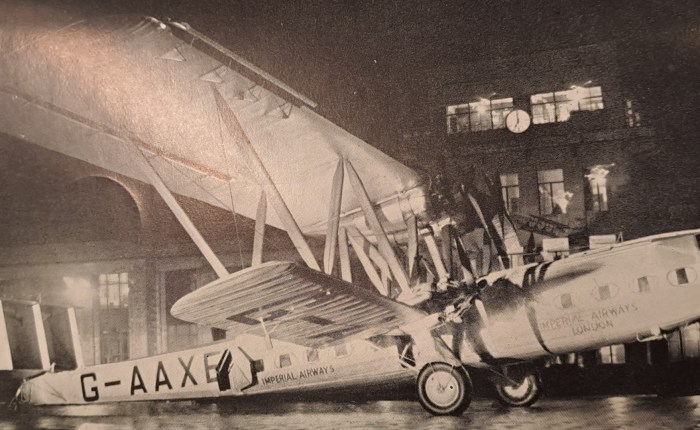
The 12.30 from Croydon opens with a delightful chapter told from the perspective of the murder victim’s ten-year-old granddaughter Ruby, who is terribly excited that she will be flying for the first time. Ruby, her father Peter, her grandfather Andrew, and Andrew’s butler Weatherup are all due to fly to Paris because Ruby’s mother Elsie has been in a traffic accident in the French capital. Crofts’ engineer’s eye for detail is evident in this opening chapter, which describes the Imperial Airways plane the family board:

It was just a huge dragonfly with a specially long head, which projected far forward before the wings like an enormous snout. And those four lumps were its motors, two on each wing, set into the front edge of the wing and each with its great propeller twirling in front of it. And there was its name, painted on its head: H, E, N, G, I, S, T; HENGIST.’[2]

‘Hengist’ was the colloquial name for a real Imperial Airways plane which until 1934 (the year of the book’s publication) flew on the European routes. It was subsequently converted to fly long-distance and as far as Australia, until the plane was destroyed in an accident in 1937. Once up in the air, Ruby and her family are served a ‘four-course lunch followed by coffee, all very nice and comfortably served’.[3] When they land, disaster strikes: Andrew Crowther, Ruby’s grandfather, is found unresponsive and declared dead.

A contemporary photo of the real Hengist plane standing outside Croydon Aerodrome, taken from A Million Miles in the Air,
the memoirs of pilot Gordon P. Olley, published in 1934

After the murder in the opening chapter, Wills Crofts shifts perspective and takes the reader back in time. The 12.30 from Croydon is a ‘psychological crime novel’ – rather than the reader trying to work out who has committed the murder and how, the author takes the reader into the mind of the murderer as he plots out his murder and attempts to escape justice. Andrew Crowther’s murderer, as it turns out, is his nephew Charles Swinburn. Charles is the managing director of the Crowther Electromotor Works, a firm originally set up by Andrew and his business partner Henry Swinburn. Although modest in size, the firm had been flourishing under Andrew’s leadership.

By the early 1930s, however, Charles is finding it impossible to stay afloat in the challenging economic environment following the 1929 Wall Street crash. Having already sunk his personal capital and a bank loan into the business, Charles approaches his uncle for financial help. Andrew, however, is not willing to give more than £1000, when Charles needs at least £6000. Knowing that he is one of the two heirs to Andrew’s estate (alongside Andrew’s daughter Elsie), Charles devises his plan to kill Andrew.

Charles method for murdering Andrew is one also used on occasion in other crime novels of the period. Andrew takes a ‘patent medicine’ against indigestion after lunch each day. Patent medicine were mass-produced pills designed to remedy common ills. Unlike more traditional medicine which was prescribed by a doctor and then mixed up to order by a pharmacist, patent medicines were available in standardized bottles and could be purchased without a doctor’s prescription.

In novels of the 1920s and 1930s they are often treated with disdain and considered to be inferior to the personalised prescriptions that a doctor would give out. However, their wide availability and uniform appearance also made them an ingenious murder weapon. Charles buys a bottle of pills identical to the one Andrew uses, but replaces one of the pills with a pill filled with potassium cyanide, an extremely lethal poison. Like in the Poirot short story ‘Wasps’ Nest’, Charles manages to obtain the poison with the excuse that he needs to eradicate a wasps nest from his garden. When at dinner with Andrew, Charles distracts him and swaps the pill bottles, pocketing Andrew’s bottle and replacing it with the one that contains the one deadly pill. He then books himself onto a Mediterranean cruise to be out of the way when Andrew eventually takes the poisoned pill.

Although the murder plan works and Charles duly inherits half of Andrew’s estate, Charles swiftly finds out that murderers rarely rest easily. First Weatherup reveals that he has seen Charles swap the pill bottles, and starts blackmailing him. Charles swiftly decides to kill Weatherup, too. Then Inspector French arrives and starts asking some awkward questions. The arrest, when it inevitably comes, takes Charles by surprise. It is not until the final chapter of the book that the reader is shown how Inspector French conducted his investigation, and how his powers of deduction led him to correctly identify Charles as the murder. The perfect murder plan conceived by Charles is revealed to have had some rather large holes in it.

Charles is duly condemned to death and executed. There is less moral ambiguity in The 12.30 from Croydon than, for example, Anthony Berkeley’s Malice Aforethought, or even than in Henry Wade’s Heir Presumptive. Although Andrew Crowther is not a hugely sympathetic character, there is no doubt to the reader that Charles’ actions are wrong, and that the policing and justice systems will catch up with him and serve him the expected sentence. The book’s reversed structure allows Wills Crofts to reveal Inspector French’s intellect in the final chapter, transmitting the reassuring fiction to the reader that no matter how well one may think they have planned a crime, the men from Scotland Yard will always ensure that justice is dispensed.


[1] Martin Edwards, The Golden Age of Murder (London: Collins Crime Club, 2016), p. 75

[2] Freeman Wills Crofts, The 12.30 from Croydon (London: British Library, 2016), p. 16

[3] Ibid., p. 19

Winifred Holtby – South Riding (1936)

Journalist, author, feminist and activist Winifred Holtby was a distinctive voice in interwar Britain’s press. In her journalism pieces she often challenged social inequalities and advocated for change. Aside from her journalistic output, Holtby also wrote seven novels. The most famous of these is South Riding, which was published posthumously after Holtby’s death at the age of 37. Vera Brittain, Holtby’s close friend and an accomplished author in her own right, edited the manuscript of South Riding and got it ready for publication.[1] The book met with critical success upon its publication, and was turned into a Victor Saville-directed film in 1938. The story’s enduring resonance is evidenced by the BBC adaptation which appeared as recently as 2011.

The scope and order of South Riding are ambitious: the novel opens with a list of characters no shorter than 6 pages in length. The story is set in the fictional South Riding of Yorkshire. A facsimile of a hand-drawn map by Holtby in the front of the Virago edition of the book shows that she imagined the Riding to be located in the triangle between York, Scarborough and the northern border of Lincolnshire.

South Riding is a novel concerned with local government. Across its 500 or so pages, the novel is divided into eight ‘books’, each named after a sub-committee of South Riding Council. Through ‘Education’; ‘Highways and Bridges’; ‘Public Health’ and others, Holtby weaves a tale of modernity and tradition, and the deep interconnectedness of rural communities.

In a book with such a vast range of characters, the closest thing South Riding has to a protagonist is Miss Sarah Burton, M.A. (Leeds), B.Litt (Oxon), the thirty-something new headmistress of the local girls school, whose return to the county of her upbringing kicks off the book’s narrative. Sarah has decidedly modern ideas about education and life in general. Her modernising spirit runs up against the traditions of the South Riding Aldermen, who sit on the Council and have been used to running things their own way.

These Aldermen also reflect a changing society, however: Anthony Snaith is a rich business owner and Mrs Beddows is the Riding’s first female Alderman. Holtby famously modelled Beddows on her own mother, Alice, who was the first woman Alderman in the East Riding of Yorkshire. Alice Holtby initially opposed the publication of South Riding, worried as she was to the damage it may do to local political relations.

The central relationship in South Riding is between Sarah Burton and Robert Carne, a gentleman farmer who occupies the local ‘Big House’, Maythorpe Hall, with his teenage daughter Midge. In an echo of Victorian Gothic literature, Carne’s wife is alive but insane and permanently locked up in an institution. The prohibitive medical costs for her care have led Carne to the brink of financial destitution. Maythorpe Hall is falling apart around him. Divorce is not an option for him, not because it is legally impossible but because he finds it morally unpardonable.

The emotional and intellectual connection between Sarah and Carne builds up throughout the novel. One of the key scenes of South Riding occurs when the pair find themselves staying over in the same hotel. Under the chapter heading ‘Two in a Hotel Find Themselves Temporarily Insane’, Holtby pens what was a decidedly modern and transgressive scene for mid-1930s Britain. A pleasant dinner turns into a night of dancing, and several drinks build the intimacy between the couple. As the evening draws to a close, Sarah invites Carne to visit her in her bedroom, room number ‘five hundred and seventeen.’[2] For a woman to invite a man to her bedroom was of course already frowned upon, but to do so to a married man broke all the rules of propriety. Equally, Carne’s grateful and enthusiastic response did not match behaviour expected of a gentleman.

Throughout the scene, Sarah remains calm and steadfast. Whilst awaiting Carne’s arrival in her room, she smiles at herself. When he asks her if she is really sure she wants to go ahead with it, she confirms ‘I know now I have never been sure of anything before in my life.’[3] The only reason the relationship does not get consummated is because Carne has an acute attack of a recurring heart problem. This rather disturbs the mood and the couple do not get a chance to be alone again for the night after that. Morally and emotionally, however, both Sarah and Carne were committed to an affair which neither of them believed to be wrong, despite it going against the generally espoused conservative values of the time.

South Riding conveys the effect of modern ideas on a traditional community, both for better and for worse. At the same time, it treats the local community and the Council with a deep respect. Everyone in the South Riding needs one another eventually, and progress, however difficult, does penetrate the region through the diligent work of the local representatives.


[1] Shirley Williams, ‘Preface, in Winifred Holtby, South Riding (London: Virago Press, 2010), p. x

[2] Winifred Holtby, South Riding, p. 367

[3] Ibid., p. 368

Leonard Gribble – The Arsenal Stadium Mystery (1939)

Ahead of the 2022 World Cup starting in Qatar, there will be a couple of weeks of football-related content on the blog. Football was a popular sport for working-class spectators in interwar Britain, alongside (greyhound) racing and motor sports. Some historians even credit the popularity of football with bringing diverse social and ethnic groups togethers as neighbours went to support their local teams.[1] By the end of the interwar period, football clubs at the top end of the league were almost completely populated by professional footballers; but there were also still plenty of amateur clubs which delivered players of a high calibre. League matches were usually played on a Saturday afternoon, as most workers finished their weekly shifts at lunchtime on Saturday.

At the close of the 1930s, the Daily Express decided to capitalise on the increased popularity of professional football by commissioning author Leonard Gribble to write a serialised murder mystery which featured the real-life players and staff of Arsenal Football Club.[2] After serialisation, The Arsenal Stadium Mystery was published as a book and a film version was made almost immediately; both appearing shortly before the outbreak of the Second World War.

The plot of The Arsenal Stadium Mystery is fairly straightforward: Arsenal play an amateur team, the Trojans. During the match, one of the Trojan players, Doyce, collapses on the field and dies shortly afterwards. Scotland Yard are called in and conclude Doyce was poisoned; Inspector Slade methodically works through the possible suspects until the case is resolved. Although a number of Arsenal players appear as characters in the book (and the Arsenal manager, George Allinson, even got a speaking part in the film adaptation) they are naturally not implicated in the murder or its resolution.

The police investigation concentrates solely on the Trojan players and staff. The conceit of the football game provides the type of ‘closed circle’ which interwar detective fictions liked to use: a very limited number of suspects, a tightly controlled window in which the murder must have taken place; and limited ways in which the weapon could be disposed of.

Aside from the murder story, The Arsenal Stadium Mystery provides the modern reader with plenty of insight into 1930s professional football practices. Gribble was clearly given access to the Arsenal club players and grounds in the writing of the book – the parts of the stadium to which the public do not usually have access are described in detail. The rapid professionalisation of football is reflected in the vigorous training practices of the players: ‘The game to-day is faster than it has ever been (…) Only the fit can survive.’[3] Arsenal also apparently already had a youth academy set up, dubbed a ‘nursery’, to train up promising young players.[4]

When it comes to the game itself, Gribble provides a diagram reflecting the starting positions of both teams. Both Arsenal and Trojans are shown to play with five forwards, three midfielders and two defenders[5]; a formation that was much more common in the early days of professional football than it is today. The author also provides an almost play-by-play account of the match, in sections of the story clearly written with football-mad Daily Express readers in mind.

As well as details about the actual gameplay, Gribble pays substantial attention to convey the culture of football fandom. For example, he spends several pages describing the convivial atmosphere in the streets and train stations around the stadium after the match is over:

‘In the trains the corridors and entrance platforms are choked (…) The air is full of expunged breath, smoke, human smells, and heat. But there is plenty of laughter, plenty of Cockney chaff. Whatever happens, however great the discomfort, the crowd keeps its good-temper. This herded homegoing is just part of the afternoon’s entertainment.’[6]

Needless to say, this ‘entertainment’ is described as an innately masculine past-time. It would not be possible for women to enter this crush of human bodies. When Inspector Slade of Scotland Yard enters the story, he too enters in a social pact with the football players which excludes women. During his investigation, he questions one of the Trojan players, Morring, in front of a woman friend, Jill. Morring implies in guarded language that his fiancée, Pat Laruce, had had an affair with the victim, Doyce. Slade:

‘‘I take it you told him to be careful or next time he’d have more painful reason to regret his – um – interference?’ The two men grinned, while the girl looked from one to the other, wide-eyed, unable to appreciate a humour that was essentially masculine.’[7]

Phrases like this make it clear enough that Gribble was writing for a male audience; he also made the main female character, Pat Laruce, extremely unlikeable. Not only is Pat revealed as having cheated on her fiancé Morring, Gribble also portrays her as an extremely calculating woman who uses fake emotional outbursts to control men’s behaviour. He describes her as follows: ‘The daughter of a chorus girl who had married a publican after burning her fingers with a scion of the aristocracy, she [Pat] had imbibed her mother’s outlook on life.’[8]

Pat works as a model for advertisements; a job that entails her offering up her physical appearance for (male) consumption. Pat’s independence and modernity are unequivocally rejected by Gribble, and presented as intergenerational faults that are passed on from mother to daughter. There are several points in the book at which Pat is described as confused that her emotional manipulations are not working on men as she expects them to. Her friend Jill, by contrast, is presented as pure and innocent (as in the quote above which implies her complete ignorance about sex), and therefore a much more suitable life partner.

The Arsenal Stadium Mystery reveals much about the practicalities of professional football in 1930s Britain, as well as delivering a reasonably competent murder mystery story. It also carries its sexist gender views on its sleeve, by using the medium of football to promote a misogynist worldview in which professional sport is equated with male sociability.

The film version of The Arsenal Stadium Mystery (starring the real 1939 Arsenal squad) can be viewed for free on YouTube.


[1] Benjamin Lammers, ‘The Birth of the East Ender: Neighborhood and Local Identity in Interwar East London’, Journal of Social History, Vol. 39, No. 2, (2005), pp. 331-344 (pp. 338-9)

[2] Martin Edwards, ‘Introduction’, in Leonard Gribble, The Arsenal Stadium Mystery, (London: British Library, 2018), p. 7

[3] Gribble, The Arsenal Stadium Mystery, p. 123

[4] Ibid., p. 119

[5] Ibid., p. 19

[6] Ibid., p. 38

[7] Ibid., p. 171

[8] Ibid., p. 106

Interwar Spooky Stories

Interwar Spooky Stories

With Halloween nearly upon us, it is time for a review of spooky short stories written in interwar Britain. Although Halloween was not celebrated in the modern sense during the interwar period, All Hallows Eve was a longstanding feature of the Church calendar, originating out of pagan Samhain celebrations. Short stories were an immensely popular format in the interwar years, with many short stories published in newspapers and dedicated magazines such as Strand Magazine. Many journalists and authors worked in the genre, which could be lucrative.

In recent years, the British Library publishing arm has re-issued many original stories of the 1920s and 1930s in various edited collections. Spooky short stories of the period often crystallise contemporary fears about technology, alienation, and modernity. They can also address social inequalities in a pointed way. For example, F Tennyson Jesse’s story ‘The Railway Carriage’, published in Strand Magazine in 1931, hinges on the third-class railway carriage as a democratic space that forces together people from wildly different backgrounds.[1]

The story’s protagonist, a young woman named Solange, finds the closed nature of the railway carriage oppressive: ‘she would have given a great deal to be out of that little third-class carriage, to be in a modern corridor train, to be – this, above all – away from her travelling companions.’[2] The design of the train means that Solange cannot change carriages whilst the train is in motion, heightening her feeling of being trapped with two unusual companions. Solange ‘had to stay with them whether she would or no. It was really an outrage, she thought to herself, that such a thing as a non-corridor train should still exist.’[3]

Solange is a modern, somewhat entitled young woman, who by the end of the story has to accept that there are things beyond the rational realm and that she cannot always control the world around her in the way she would like. When the train crashes, Tennyson Jesse introduces a supernatural element to the story and meditates on the justness of capital punishment, a practice that was under much debate during the interwar period. Despite the introduction of a possible ghost, the true horror of the story lies in the very real judicial practices of interwar Britain.

Another story which effectively conveys the terror that the proximity of strangers can bring is E.M. Delafield’s ‘They Don’t Wear Labels.’[4] It also demonstrates how the anonymity of the big city can be exploited, and how patriarchal structures can put women in danger. The story’s protagonist is Mrs Fuller, a boarding house keeper, who takes in a couple, Mr and Mrs Peverelli. Mr Peverelli is very charming, but his wife is sickly. From the moment the couple enter the house, Mr Peverelli plays on sexist stereotypes which Mrs Fuller is very happy to accept. He implies that his wife’s ailments are nervous disorders; Mrs Fuller then tells Mrs Peverelli ‘shed’ a good deal to be thankful for, with her husband in a good job, and always ready to do what would please her.’[5]

When Mrs Peverelli tries to tell Mrs fuller that Mr Peverelli is forcing her to eat and drink things against her will, and that she thinks her husband is trying to poison her, Mrs Fuller naturally rubbishes the suggestion. E.M. Delafield neatly demonstrates the pervasive assumptions about domestic violence: ‘If you really believed it, why – you’d left him. It’s surely the very first thing you’d have done’ huffs Mrs Fuller. ‘You don’t understand’, responds Mrs Peverelli. ‘I love him.’[6]

Shortly thereafter, the Peverelli’s move on, the wife looking ‘worse than ever – sallower and more frightened.’ The true horror of Mr Peverelli’s designs is revealed at the close of the story, when Mrs Fuller realises he has ground up a Christmas bauble and fed the powdered glass to his wife.[7] Murder by ground glass was, incidentally, one of the ways in which Edith Thompson suggested murdering her husband in her letters to her lover Freddie Bywaters. E.M. Delafield had followed the Thompson-Bywaters case closely, and is surely referencing it in this story. Mrs Fuller, and the reader, are confronted by their willingness to believe strangers at face value, and to believe men over women. The horror here is not supernatural, but rather the by-product of an inherently unequal society.

A final female-penned, London-based, spooky short story appeared slightly after the interwar period, at the close of the Second World War. In 1945, Elizabeth Bowen published the (very short) story ‘The Demon Lover’.[8] It effectively uses the bombed-out locales of war-torn London. Bowen’s protagonist, Mrs Drover, is checking up on her Kensington house after an extended stay in the country, away from the Blitz.

Things take a dark turn when Mrs Drover discovers a mysterious letter from a past lover, which warns her that today is ‘our anniversary, and the day we said. (…) I shall rely upon you to keep your promise.’[9] It transpires that Mrs Drover had a soldier lover during the First World War, who went missing. In fear of him, she decides to get a taxi as quickly as possible before the man can come to the house and claim her. Yet rather than a means of escape, the taxi becomes her prison, as she realises too late that the man behind the wheel is the very man she is fleeing from.

As in ‘The Railway Track’, in ‘The Demon Lover’ a means of transport traps a woman rather than give her freedom. The latter story also includes ample reflections on ageing and the compromises made by women: marriage, children and a big house in Kensington versus the excitement of a passionate love affair. Like Mrs Peverelli, Mrs Drover ultimately is unable to escape masculine power. The scariest thing for women turns out to be the patriarchy itself.

All of the stories and books mentioned in this post are available to purchase through the British Library online shop.


[1] F Tennyson Jesse, ‘The Railway Track’, in Blood on the Tracks: Railway Mysteries, edited by Martin Edwards (London: British Library, 2018), pp. 267-286

[2] Ibid., p. 272

[3] Ibid., p. 277

[4] E. M. Delafield, ‘They Don’t Wear Labels’, in Capital Crimes: London Mysteries, edited by Martin Edwards (London: British Library, 2015), pp. 265-273

[5] Ibid., p. 268

[6] Ibid., p. 270

[7] Ibid., p. 273

[8] Elizabeth Bowen, ‘The Demon Lover’, in Into the London Fog: Eerie Tales from the Weird City, edited by Elizabeth Dearnley (London: British Library, 2020), pp. 81-91

[9] Ibid., p. 85