The Bow Cinema Murder – the East End family

The Bow Cinema Murder – the East End family

This is the fourth in a 11-part investigation into the 1934 ‘Bow Cinema Murder’. You can read all entries in the series here. 

When John Stockwell decided to attack and rob his employer, he was living as a lodger with a local East End family. He had met Eliza Roake, the head of the family, through the charitable activities she undertook for her Church. After John lost his place in the Salvation Army Boys Home after being convicted of theft, Ellen took him in. After the events of 7 August 1934, their association with John drew this poor but respectable family into a police investigation and a tabloid press sensation.

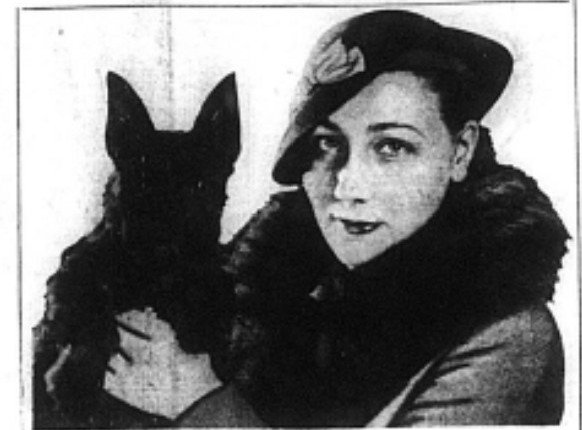
Ellen Eliza Roake was born Ellen Hoare in 1876; when she was 26, she married Henry George Roake who was five years her junior. The couple had five surviving children: Nellie, born in 1903; William, born in 1906; Eva, born in 1909; Frederick, born in 1913; and Violet, born in 1915. In addition, there were at least two other sons who did not survive past early childhood. All the children were born in Bromley-by-Bow, where Ellen and Henry settled after their marriage. Henry worked as a railway porter in nearby Liverpool Street Station.
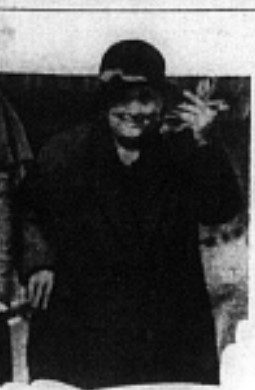
Ellen Roake. This photo appeared in the Daily Herald on 12 Sept 1934

In 1926, Henry passed away; five years later, William and Eva both married and moved out of the family home on Empson Street in Bromley. The space that was freed up by their departure is perhaps one of the reasons why Ellen felt able to invite John Stockwell to move into the family home in early 1932.

The Empson Street house was considered small even at that time; the police inspector investigating the murder of Dudley Hoard commented on the house’s small size in one of his reports. There was only one bedroom, which Ellen shared with Nellie and Violet. Beyond the bedroom, there were no other rooms on the house’s first floor. The ground floor consisted of a sitting room, kitchen and scullery. John and Frederick had to make up their beds in the sitting room floor every night. The toilet was attached to the back of the house and needed to be accessed through the garden.

Nellie Roake, who was around 30 at the time of the murder, worked as a ‘chocolate finisher’ in Millwall, an adjacent neighbourhood. The manufacture of chocolates and sweets was an industry that typically employed women, who were believed to be better suited to the detailed work. In addition to her job, Nellie also took care of part of the household chores including cooking meals. She was engaged to William Hilsdon, a labourer who lived around the corner from the Roakes with his parents. William was also born in Bromley; also had a number of siblings; and his parents were also working-class. Although he and Nellie moved in together (with William’s mother) some time in the late 1930s, they did not get married until 1953, after Ellen Roake passed away. There does not appear to have been any bad blood between Ellen and William, however; on the night before the murder on Dudley Hoard in 1934, William spent the evening at the Roake’s house playing cards with the family until nearly midnight.

Unlike his elder sister, Frederick Roake appears to have provided less support to the family. At the time of the murder, he was unemployed due to a knee injury for which he was receiving outpatient treatment at St Andrew’s hospital, where Maisie and Dudley were also taken after the attack. Beyond that, Frederick seems to have spent considerable time loafing around the neighbourhood; he was able to immediately go over to the cinema once news of the attack broke. Frederick and John were not friendly; after John’s arrest, Frederick reported that he usually did not have ‘a lot to say’ to the other man. Despite sharing a bed together every night, the pair appear to have tried to avoid one another as much as possible. Frederick had a girlfriend, Henrietta, who was also born locally. They married in 1938 and stayed in the East End, where Frederick ended up working as a transporter of goods on horse cart.

Violet Roake was the youngest of the family, and the one most closely involved with John Stockwell. They were of the same age, and had been going out from around 1931, when they were both 16. Violet worked as a biscuit packer in a Bethnal Green factory; for many young working class women, light factory work had replaced domestic service as the career of choice. Every morning, John walked Violet to the bus stop around 7.30am. Her shifts started at 8am and finished at 6pm. Because John’s hours at the cinema did not finish until 11pm, most days the only time they had together was that half hour in the morning. The exception was Tuesday, when John was off work and they could do something in the evening. If they were at home, it was likely that there were other people around, and the small size of the house would have afforded them no privacy.
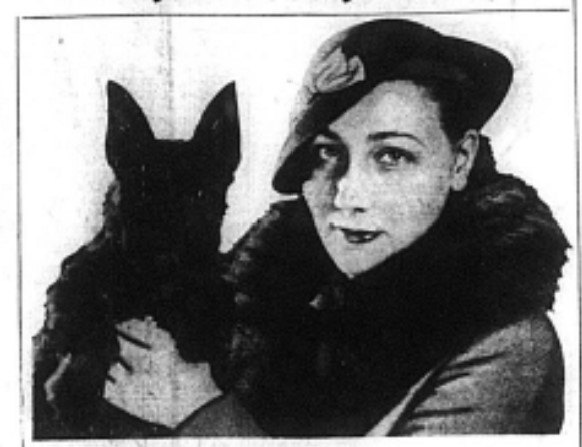
Violet Roake. This photo appeared in the Daily Herald on 14 November 1934

Until the murder, Violet had assumed that she and John would be getting married some day. She eventually married a naval officer in 1939 and moved down to Portsmouth with him. They had a son in 1939 and a daughter in 1949. Unlike most other participants in this story, Violet left the East End definitively when she was in her early twenties. It is possible that her association with a murderer, however unwitting, left a lasting mark on her reputation in the local area.

The Roakes were a typical East End family, with blue collar jobs, little money, a small living space, and a lot of family and friendship ties to the local area. Despite their small house, Ellen invited John to live with them when he became homeless, which speaks to her civic-mindedness. If it had not been for their involuntary involvement in the story of the Bow Cinema murder, they would have been absorbed in history without a trace. The case no doubt had a lasting impact on Violet in particular, whose expectations for her life were radically changed as a result of the case. As part of the fall-out, the family were exposed to police investigators, which came onto the scene within minutes of the crime being discovered. The next blog post will unpick who got involved in the police investigation, and how they approached the East End community in which the crime had taken place.
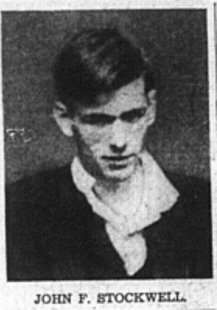
The Bow Cinema Murder – the Killer 

The Bow Cinema Murder – the Killer 

This is the third in a 11-part investigation into the 1934 ‘Bow Cinema Murder’. You can read all entries in the series here. 

So who was the man who rang the Hoard’s doorbell on the morning of 7 August 1934 and attacked Dudley and Maisie with such deadly consequences? The initial police investigation assumed that the crime was committed by one or perhaps two criminals, who potentially allowed themselves to be locked into the cinema the night before. Investigators were reported to be questioning known criminals in the East End for clues.[1]

The truth was somewhat different, and closer to home. The attack on Dudley and Maisie was committed by a nineteen-year-old employee of the Eastern Palace Cinema: John Frederick Stockwell. John had only worked at the cinema for a few months, after being hired by Dudley. As an attendant, it was his duty to check tickets and show patrons to their seats. Like many neighbourhood cinemas at the time, the Eastern Palace operated on a ‘continuous performance’ basis, meaning that once the first screening of the day started, screenings continued on a loop until the end of the day. Patrons could show up at any time and stay as long as they liked. A crew of male and female attendants were therefore constantly occupied with letting people in and out of the auditorium.

Like many people in the East End, John Stockwell came from an impoverished background – but he was not brought up locally. He was born on 2 March 1915 near King’s Cross. His father had died at the front at Mons before John was even born. His mother re-married, but died in 1926 when John was 11. John had a brother, Horace, who was three years’ his senior – by the time the men had grown up they were no longer close. After his mother’s death, John went to live with an aunt, Elizabeth Brown. Because John’s father had died in the war, Elizabeth received a financial contribution from the state for John’s upkeep. Elizabeth decided around 1930 to move away from central London, and out to Bromley in Kent.

For the teenage John, who was no longer required to attend school, the change from Kings Cross to Bromley was not beneficial. Elizabeth reported that John no longer accepted her as a parental authority; he appears to have been out and about with a group of other young men. Eventually, Elizabeth decided she could no longer support John living with her, and he moved to a Salvation Army Boys Home in Bow Road some time in 1930. These homes were designed exactly for people like John: young men who lacked family or community support. They intended to give these men the skills to get employment and become independent. The SA arranged for John to get a job at a cloth manufacturer at Barbican. During his time there, John stole some cloth; he was caught and appeared before the Magistrate’s court in December 1931. John was sentenced to two year’s probation, meaning he had to meet up with a probation officer regularly.  

The Salvation Army had a zero-tolerance policy when it came to criminal activity, so John lost his lodgings. He had met, through the Army’s church activities, a local widow, Ellen Roake, and had become particularly close to Eliza’s youngest daughter Violet. Ellen agreed to take John on as a lodger, and he moved into the tiny Roake family home in early 1932. John and Violet became an official couple. After a short period working for a pastry chef, John was unemployed until he found the job at the Eastern Palace Cinema, which was only a 15-minute walk from the Roake’s home. One of the cinema’s other attendants, Charles Whitnell, lived practically next door to the Roakes.


As an attendant, John earned 32 shillings and sixpence a week. He paid 15 shillings a week for his board and lodging, leaving him with less than £1 a week for any other expenses. At the time of the murder, he did have a savings account with the Post Office, but it contained only 30 shillings (£1.50). Clearly, John had always lived in poverty. The nearly £90 that he stole from the cinema safe after attacking Dudley and Maisie was probably more money than he had ever seen together in his life; it was certainly more than he could ever imagine to save up himself. By August 1934, John and Violet had been going out for several years, but he could probably not imagine how he would ever make enough money to enable them to get married and start their own family.

He also had virtually no contact with his family at this point, and no social community to fall back on; he’d been removed from the community in King’s Cross in which he had grown up. The East End neighbourhood in which he lived from 1930 was one in which family ties counted for a lot, and he was perceived as an outsider. During the police investigation, his colleagues reported that they had found John odd, and his previous conviction for theft was known and made people suspicious of him.

None of these things justify his attack on the Hoards, but they do illustrate that the lack of structural social care in interwar Britain left individuals vulnerable. If you did not have a strong personal support network, you could very quickly find yourself in a situation that felt interminable. Once John committed the theft of cloth in 1931, what little social support he had been able to count on was also removed. In addition, rigid class boundaries made it even less likely for someone in his position to materially improve his circumstances. It is understandable, then, that someone of his young age, with little adult supervision to guide him, came to the conclusion that the only way to get ahead was to break the rules and commit a theft.

Once John had committed his attack and stolen the money, he managed to leave the Eastern Palace Cinema unseen. Tuesday was his weekly day off work. That evening, when Violet finished her shift at the Kearley & Tonge biscuit factory in Bethnal Green, John treated her to a trip to the Stoll cinema in the West End. Unbeknownst to Violet, he used part of the stolen money to pay for the tickets. On the way to the cinema, they discussed Dudley Hoard’s murder, as it was splashed over the evening papers. It would be the last evening they spent together, as the next day John used his stolen money to escape London, triggering a multi-day manhunt that captured the attention of the nation.


[1] ‘“Yard” reconstructs the crime,’ Daily Herald, 8 August 1934, p. 2

The Bow Cinema Murder – the Victim

The Bow Cinema Murder – the Victim

This is the second in a 11-part investigation into the 1934 ‘Bow Cinema Murder’. You can read all entries in the series here.

One of the effects of a well-publicised murder investigation is that it can put ordinary people into the press spotlight. This was as true in the interwar period as it is today. The Bow Cinema murder was briefly on the front pages of all major newspapers, and the victims, the perpetrator, and the people around them all got dragged onto those front pages too. This can make a murder story a valuable source for the historian: it highlights and preserves the stories of ordinary people as they are put into extraordinary circumstances.

Dudley Henry Hoard, the victim of the Bow Cinema Murder, was one such an ordinary person. If not for the extremely violent end to his life, it’s unlikely his name would ever have entered into the annals of history. He was born in Wandsworth, south-west London, in 1892. His family moved to Croydon when Dudley was a child, and his parents remained in that area. Dudley had an elder sister, Dorothy, and two younger sisters, Avery and Winifred. His father, William, was born in Devon; his mother Mary was from Chelsea in London. Dudley’s father worked as a clerk, indicating the family were in the lower middle class. This is also borne out by the fact that Dudley attended the independent Whitgift School in Croydon.

By the time he was eighteen, Dudley considered himself to be an actor. At 5 ft. 9.5in he was quite tall, and he may have cut a dashing figure on stage. According to his father, Dudley left school to take part in a production at Sadler’s Wells theatre, and toured the country as part of a travelling theatre group. At the same time, he was interested in cinema, which was becoming increasingly popular. Dudley briefly ran his own cinema, the Hippodrome, in Sutton (near Croydon) in the early 1910s.[1]

During the War, Hoard served as a Private in the London Regiment. He did not have a distinguished war record; the most the newspapers can say about it after his death is that he served in France and Greece, and got gassed in an enemy gas attack.[2] After the war he returned to repertoire acting, including a stint working for the Melville Brothers, who were part of a theatre producing dynasty.

At some point, Dudley met Maisie Tait, a native of Newcastle who was close to him in age and also an actor. According to Dudley’s father, the pair met when they were in their late teens; however, they did not get married until 1933, when Dudley was 41 and Maisie was 38. Details of Maisie’s early life are difficult to trace; she was also known as Maisie Robson, and it is not clear whether either Tait or Robson was her birth name, or whether both were assumed names. One thing that is certain is that Maisie had a daughter from a previous marriage; after the attack in 1934, this adult daughter came to visit Maisie in hospital. Her existence may be what stopped Dudley and Maisie getting married any sooner.

Around the time of their wedding, Dudley apparently decided to give up the touring life and to return to the cinema. In 1933, he got his first appointment as cinema manager in London, at the Brittania Picture Theatre in Camden. By the 1930s, cinemas had become enormously popular in Britain, and the industry had professionalised significantly since Hoard’s last foray into cinema management in 1911. The average cinema had upwards of a dozen staff members, and cinema managers were required to ensure that all operations went smoothly; staff were trained appropriately; and the cinema drew as many patrons as possible. Marketing was a significant part of the cinema manager’s role. Trade magazine Kinematograph Weekly highlighted in each issue the innovative and successful marketing stunts that managers up and down the country came up with to draw in audiences.

At the same time, cinemas became increasingly consolidated into chains, such as Odeon and ABC. Within the chains, the patrons’ experiences were increasingly homogenised. Rather than being rewarded for originality and innovation, managers in chains were expected to comply with central directives on how their cinemas should be managed. Dudley never worked for a chain cinema; at the Brittania in Camden he had to make two men redundant to save the cinema money. These men had families to maintain, and they threatened Dudley after he had fired them. This probably was one of the reasons why Dudley swiftly moved on to work at the Cinema House in Oxford Street and then, finally, the Eastern Palace Cinema in Bow.

These three posts in the space of 18 months indicate how fast-moving and insecure the work of cinema management was. For Dudley and Maisie, the job at the Eastern Palace was a step up, as it came with their own private apartment (although they had to pay rent for its use). With it, though, they arrived into a close-knit East End neighbourhood, where many of the staff were neighbours or even family members of one another. The Hoards were outsiders; and as it turned out, so was the man who attacked them.


[1] ‘London Manager Murdered’, Kinematograph Weekly, 9 August 1934

[2] ‘Actor and Producer’, Daily Mirror, 8 August 1934, p. 2; ‘London Cinema Outrage’, Evening Standard, 7 August 1934, p. 2

The Bow Cinema Murder (1934)

The Bow Cinema Murder (1934)

This is the first in a 11-part investigation into the 1934 ‘Bow Cinema Murder’. You can read all entries in the series here.

This blog is no stranger to interwar murder stories. Over the next ten weeks, posts will investigate one 1934 murder case in depth. Unlike some of the other cases covered previously, this murder is no longer well known – it has not been adapted in any novels, plays or films (to the best of my knowledge) and did not become a byword for evil. At the time it was committed, however, it caused a media storm and thrust a group of working-class East Enders into the limelight. It was the Bow Cinema Murder.

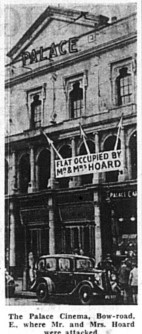
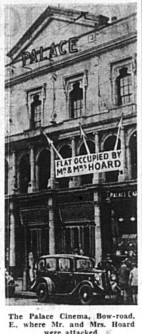
The murder took place on Tuesday morning, 7 August 1934, at the Eastern Palace Cinema in Bromley-by-Bow, in the East End of London. The Eastern Palace cinema was a neighbourhood cinema, co-owned by two local Jewish professionals. It was located on the busy Bow Road, in between a café and a general store. It could seat around 1000 patrons in its auditorium and balcony, where audiences could enjoy the ornate (if somewhat shabby) ‘Oriental’ decorations on the walls.

The facade of the Eastern Palace Cinema. This photo appeared in the Daily Express the day after the murder

The day-to-day management of the cinema fell to 41-year-old Dudley Henry Hoard. As part of his role, Dudley and his wife Maisie were required to live in a flat adjacent to the auditorium – the lease of the building required that it was partially used for domestic occupancy. Dudley got the cinema manager job in March 1934, and he and Maisie moved in a few weeks later. It was the first time since their wedding in spring 1933 that they had their own flat; they had previously been staying with Dudley’s parents in Croydon.

On the morning of 7 August, Dudley and Maisie were sleeping in after a busy Bank Holiday weekend. Ordinarily, one of Dudley’s first tasks every day was to deposit the cinema’s previous day’s takings at the Midland Bank on Mile End Road. Due to the banks having been shut on the Bank holiday Monday, there were now three days’ worth of ticket earnings in the safe in Dudley’s office, one floor below the flat. For the Eastern Palace, the Bank holiday weekend had resulted in total takings of 89 pounds, 5 shillings, and tuppence. By comparison, Dudley earned about £5 a week as cinema manager, and he was the best-paid member of staff in the cinema. Even for him, the nearly £90 in the safe represented around 10 months’ worth of wages.

Around quarter to eight, someone rang the door of the flat – not the doorbell at the cinema’s entrance, but the door of the flat specifically. Dudley quickly put on some trousers over his nightshirt and went to open the door. Maisie had only half woken and was about to doze off, when she heard Dudley shout out. When Maisie walked into the living room, she saw a man standing over her husband, wielding a hatchet. Dudley had a head wound and was trying to fend off the other man. Maisie shouted out to the attacker, a young man. He then turned to her and hit her over the head with the hatchet – she blacked out immediately.

About thirty minutes later, the cinema’s regular team of cleaning women arrived for their morning shift. These three women came in six days a week to clean and tidy the cinema before the first screenings started. Because they arrived hours before any of the other staff, the head cleaner, Mrs Emily Brinklow, had her own set of keys. She let herself and her colleagues in, and they started to get their cleaning materials out. Emily noticed that the post and milk, dropped by the milkman, had not yet been taken upstairs by either Dudley or Maisie. This did not worry her unduly; she would bring them up herself in a minute. Before she could do so, a scream ripped through the building. Nellie Earrey, one of the other cleaners and sister to one of the cinema’s projectionists, had found a heavily injured Dudley Hoard on the staircase leading to the auditorium balcony. He was covered in blood, as were the walls and the staircase he was on. Emily rushed to the flat and banged on the door; after a short while, Maisie opened it. She, too, was covered in blood, and seemed completely dazed.

Nellie ran out onto the street, where a passerby quickly alerted the local Bobby who was patrolling the area. PC Mackay swiftly went over to the cinema and tried to provide emergency aid, as well as alerting his local police station by telephone. The divisional surgeon (the police doctor) is on the scene quickly, as he was still at his home further down Bow Road when the station officer rang him. He too provides emergency aid, and arranges for both Dudley and Maisie to be transported to the nearby St Andrews hospital. They arrive shortly after 10am. Although Dudley is immediately examined and treated by multiple surgeons, the fractures to his skull are too severe. He dies at 3.07pm, without regaining consciousness.

The police know that they now have a murder case on their hands. Maisie is less severely injured, but unable to give more than a brief, confused statement before she needs to rest. Detectives attached to the local police department, known as ‘H’ Division, start questioning all the cinema’s staff as they arrive for their shifts. Most of them live very close to the cinema, and they are aware very quickly that something has happened. The police realise that the cinema’s safe has been opened by the keys which would normally be carried around by Dudley, and that the full weekend’s takings have been stolen. They have a victim and a motive, but not yet a clue as to the killer’s identity.

The Poplar Rates Rebellion (1921)

In 1921, a group of thirty Labour councillors of the London Borough of Poplar were imprisoned as a result of their approach to poor relief in the borough. This almost forgotten episode, known as the Poplar Rates Rebellion or Poplar Rates Revolt, highlights the fraught relationships between national and local politicians in interwar Britain, as well as the diverging approaches to how poverty should be treated.

The Labour Party was founded in 1900 and it grew steadily in popularity in the first decades of its existence. The Party primarily targeted working-class voters. Two extensions to the franchise helped Labour gain more votes and seats in parliament: the 1918 Representation of the People Act gave the vote to all men over 21, regardless of their income or background. It also gave the vote to women over 30 who met a property qualification. In 1924, Labour delivered its first Prime Minister, Ramsey McDonald. In 1928 the vote was given to all men and women over 21, leading to the 1929 general election being dubbed the ‘flapper election.’  

For some in the Conservative Party, the extension of the franchise to include ‘the poor’ risked corrupting democracy. If those from poor backgrounds were allowed to vote, they argued, politicians could in effect ‘bribe’ voters by promising high rates of poor relief.[1] As historian Liam Ryan has pointed out, this argument echoes Victorian values which equate poverty with ‘a lack of the moral qualities needed to sustain independence in society.’[2] The actions of the Poplar Labour Party in 1921 would serve to evidence this argument.

In addition to the national party, Labour was active at a local level. The party controlled 34 out of 85 local authorities in London for at least part of the interwar period.[3] Poplar was one of London’s poorest boroughs at this time: in 1932, nearly a quarter of residents lived below the poverty line.[4] By focusing on providing generous poor relief, the Poplar Labour Party was able to build up a sold voter base even before the First World War.[5] The local councillors were themselves from the East End and from working-class backgrounds, which further embedded them in the community.[6]

Immediately following the First World War, the Poplar Labour Party decided to implement an extensive, and expensive, poor relief programme including a minimum wage of £4 a week for municipal workers. Such a local initiative had to be funded from ‘rates’, taxes on property levied on local inhabitants and businesses. A proportion of the rate income was for the local council, but some of it was supposed to be passed on to fund the London County Council, the police, and the Water Board.

Due to the high levels of poverty in the area, rate income was low, and rates could not be raised without harming the local community. When an application for financial support from the national government was denied, the local party refused to collect the proportion of the rates that was supposed to fund London-wide initiatives.[7] When the council ignored a court order to levy the rates, almost all the councillors were arrested and sent to prison for contempt of court – the men to Brixton and the women to Holloway. They remained imprisoned for six weeks, during which they received much popular support.

The Poplar Rates Protest gave rise to what became known as ‘Poplarism’ – ‘a polemical epithet used by Conservatives to refer to high-spending, left-wing poor law guardians in the 1920s.’[8] The leader of the revolt, George Lansbury, who had been a Labour MP between 1910 and 1912, returned to Parliament in 1922 and became leader of the Labour Party from 1932 to 1935. He remained on the left of the party for the rest of his career. The Conservative governments of the interwar period eventually abolished local poor law boards, which prevented a repeat of the Rates Rebellion.[9] Ultimately, though, it became accepted at both sides of the political aisle that offering poor relief did not equate to political corruption.


[1] Liam Ryan, ‘Socialism and corruption: Conservative responses to nationalisation and Poplarism, 1900–40’, in The many lives of corruption: The reform of public life in modern Britain, 1750-1950, eds. Ian Cawood and Tom Crook (Manchester: Manchester University Press, 2022), 239-258, (248)

[2] Ibid.

[3] Dan Weinbren, ‘Building Communities, Constructing Identities: The Rise of the Labour Party in London’, The London Journal, vol. 23, no. 1 (1998), 41-60 (41)

[4] Gillian Rose, ‘Imagining Poplar in the 1920s: contested concepts of community’, Journal of Historical Geography, vol. 16, no. 4 (1990), 425-437 (427)

[5] Weinbren, 45

[6] Rose, 432

[7] Ryan, 248

[8] Ibid., 240

[9] Ibid., 254

Suburban dreams

London underwent massive suburban expansion in the interwar period. The interwar period saw a combination of an increase of Londoners who were looking for suitable living space; an increase in disposable income and a reduction of housing costs; and a greater availability of accessible building plots around the outskirts of the city. These factors led to a veritable suburban ‘boom’ during the 1920s and 1930s, at the end of which London’s size had increased threefold and the population of its suburbs had grown by 2.5 million compared to the start of the century.[1]

The first London suburbs were built by private investors during the nineteenth century, when the introduction of tramcars and other modes of public transport opened up areas further away from the city centre, for residential development. By the end of the nineteenth century the London County Council also ordered the development of suburban estates, to provide healthier living quarters to poorer Londoners.[2] These two types of suburbs – private developments and council estates – continued to co-exist in the Edwardian and interwar periods. Private developments were mostly aimed at the aspirational middle-classes, who would look to mortgage a semi-detached or detached house.

Elsewhere in this blog I have considered how the suburbs were represented on film; how tennis was a key social activity for suburbanites; how an expansion of car ownership changed the entertainment opportunities open to suburban Londoners and how the experience of suburban women was captured in interwar novels. The suburbs, in short, were on the forefront of social changes and the experiences of their inhabitants provided inspiration for artists.

Yet suburbs were also synonymous with boredom and small-mindedness, particularly to the urban intelligentsia.[3] Privately developed suburbs were built by builders and speculators, who bought up cheap land, built houses on them, and then sought to sell these brand new dwellings as quickly as possible. One of the key ways they used to entice Londoners to buy a suburban house was to present suburbia as a rural environment.

‘Most advertisements and brochures were accordingly illustrated with idealised sketches or heavily retouched photographs which skilfully suggested that the house stood quite along in matured surroundings of judiciously placed trees and shrubs, against a background of windblown clouds and gently rolling hills.’[4]    

In London’s north-western corner, new estates serviced by the Metropolitan Railway were quickly badged up as part or ‘Metro-land’. Transport posters presented this new land as a rural idyll with ‘Gorgeous Autumnal Scenery’ and ‘Charming Country Walks’; as well as an excellent place to go fishing. At Radlett, near Watford, a developer promised such aristocratic pursuits as ‘Hunting, Shooting, Beagling and the like….every phase of rural life at Radlett provides the perfect antidote to business worries.’[5] At the same time, it was crucial that suburban estates had quick and easy transport lines into the centre of London. Here, misleading advertisements could be the developer’s friend: brochures and advertisements frequently cited the fastest possible travel time as standard, even if most of the daily trains would take much longer to get to the city.[6]

Because suburbs kept expanding incessantly, any estate that started out as a semi-rural enclave would quickly find itself engulfed by other estates, the ‘rolling hills’ and ‘mature trees’ covered by more semi-detached housing. Most suburban dwellers were exposed to nature primarily through their garden. Because suburban houses were often built in styles to remind people of cottages and other old-fashioned houses, historian Matthew Hollow has argued that ‘the move out to the cottage estate was accompanied by a desire to indulge in new, more family-centred, pastimes. Gardening became a popular family pastime for many.’[7] Gardening also allowed suburban houseowners to express their creativity and compete with their neighbours in popular and wide-spread estate garden shows.[8] Perhaps surprisingly, in the popular imagination the garden became the domain of the male head of the household, retreating to the garden after dinner to tend to his plants. As ever, London Underground’s poster designers had their finger on the pulse with this 1933 poster, showing a city man seamlessly transforming into a suburban gardener mowing his lawn.

One final way in which suburban inhabitants themselves sought to underline the rural character of their neighbourhoods was through their house names. As completely new developments, many privately-built suburban estates did not yet have properly assigned addresses when their first inhabitants moved in – another sign of the speed of suburban development, which outpaced the local authority administration. To ensure their homes could be identified, many suburbanites named their own houses, and names such as ‘Meadowside’, ‘Woodsview’ and ‘Fieldsend’ both highlight the semi-rural nature of the suburban environment, and indicate that for the people living in these houses, the natural surroundings were significant.

Despite its sometimes negative reputation, suburban living was a dream for many working- and middle-class Londoners during the interwar period; a dream encouraged by the sometimes fanciful advertising techniques used by speculative developers. For many, suburban living offered a first chance of home ownership, and access to private green space. The vast suburban developments of the 1920s and 1930s continue to shape London to this day.


[1] Mark Clapson, Suburban Century: Social change and urban growth in England and the United States (Oxford: Berg, 2003), p. 2; Stephen Halliday, Underground to Everywhere (Sutton: Stroud, 2001), p. 113

[2] Peter Hall, Cities of Tomorrow (Oxford: Blackwell, 2002) pp. 21 and 50-52

[3] Alan A. Jackson, Semi-Detached London (London: George Allen & Unwin, 1973), p. 162

[4] Ibid., p. 204

[5] Ibid., p. 205

[6] Ibid., p. 206

[7] Matthew Hollow, ‘Suburban ideals on England’s interwar council estates’, Garden History, vol. 39, no. 2 (2011), 203-217 (213)

[8] Ibid., p. 209

Escape (1926 and 1930)

Although British literature of the interwar period is today perhaps popularly associated with the modernism of Virginia Woolf, during the 1920s and 1930s other, less experimental authors were equally, if not more, well-known. John Galsworthy was one of the authors despised by Woolf as an ‘Edwardian’. His best-known work remain the novels that form the Forsythe Saga, but he was also a prolific playwright and a number of his plays were adapted to film during the 1930s. Galsworthy was awarded the Nobel Prize for Literature in 1932, mere months before his death.

One of Galsworthy’s last plays was Escape, which was first performed in the West End in 1926. The play transferred to Broadway the following year, where the lead role was performed by Leslie Howard. In 1930, Galsworthy collaborated with director/producer Basil Dean in adapting the story for film for Associated Radio Pictures. The film version starred screen stalwart Gerald du Maurier in the lead role of Captain Matt Denant. The brief period between the play’s premiere and the film’s release, in addition to the high-profile actors attached to both productions, indicates Galsworthy’s fame and popularity during the interwar period.

The story of Escape is somewhat unusual compared to other mainstream interwar outputs. Whereas most cultural productions of the period seek to reinforce the importance of the state in maintaining an orderly society, Escape opens with a direct challenge to authority. Captain Matt Denant, a celebrated war hero, goes for a walk in Hyde Park in the evening. Hyde Park was known as a favourite spot for prostitutes. During the interwar period, the Home Office worked hard on the management of street prostitution in London.[1] Yet the Metropolitan Police’s hard line on soliciting meant they sometimes overstepped the mark, and police officers arrested women who had not been soliciting at all.[2]

Magistrate courts, frustrated with what they perceived to be an influx of cases with insufficient evidence, insisted that in future, it would be a requirement for the man who was being solicited to provide evidence against the accused woman – women would no longer be convicted on the basis of police evidence alone.[3] This complex legal debate is key to understanding the opening of Escape. Once Captain Denant walks through the park, a prostitute comes up to him and solicits. Denant good-naturedly turns down her offer and is about to continue on his way – however, a plain-clothes police inspector has witnessed the interaction. He approaches Denant and asks him to make a statement that the woman was soliciting. In light of the higher evidence bar set by the magistrate courts, this second statement would be a requirement for any conviction. Denant refuses to co-operate and the interaction with the police officer escalates to the point that Denant hits him. The police officer hits his head and dies; Denant gets arrested and convicted for manslaughter.

After this extraordinary opening, Denant is transferred to Dartmoor, one of the most notorious prisons in the country at this time. Rather than accepting his punishment, Denant manages to escape while on work detail, and the remainder of the play/film tracks him as he encounters various people who help him on his flight. Ultimately, a parson is willing to lie to the police, who are hot on Denant’s trail. This gives Denant a moral dilemma and he decides to give himself up to protect the parson.

Not only does Denant refuse to help the police officer in the opening scene to convict a prostitute, he then rejects the punishment he is given for the manslaughter of the officer. Arguably, the prison sentence meted out to him is fair and appropriate, yet Denant does not initially accept it. This indicates he, to a certain extent, places himself above the law. He only ultimately agrees to undertake his prison sentence because he does not want to morally compromise a previously uninvolved third party – not because he necessarily thinks it is appropriate for him to be imprisoned for his actions.

Although Galsworthy was considered an ‘establishment’ writer, the protagonist in Escape rejects the conventional structures of state authority and is willing to go to considerable lengths to avoid any involvement with them. In the opening scene, Denant does not display any of the moral outrage or shock commonly associated with streetwalking in the popular media of the time. Throughout the action, he retains a keen sense of independence and trust in his own judgement: even when he does ultimately agree to sit out his prison sentence, he does so on his own terms.

This is in stark contrast to the majority of plays and films of the interwar period, in which the police in particular are presented as the unchallenged face of authority, which must be obeyed to avoid a breakdown of social norms. In Escape, Galsworthy ostensibly offers up an alternative point of view in which independent judgement rules supreme, even if that does not align with the rule of law. However, Denant’s ultimate acquiescence to the prison sentence, whether arrived at from a sense of moral obligation or not, ensures that in the end of the story social order is restored.


[1] Stefan Slater, ‘Containment: Managing Street Prostitution in London, 1918-1959’, Journal of British Studies, Vol. 49, no. 2 (2010), 332-357

[2] Julia Laite, ‘The Association for Moral and Social Hygiene: abolitionism and prostitution law in Britain (1915–1959)’, Women’s History Review, Vol. 17 (2008), 207-223

[3] Stefan Slater, ‘Lady Astor and the Ladies of the Night: The Home Office, the Metropolitan Police and the Politics of the Street Offences Committee, 1927-28’, Law and History Review, Vol. 30, no. 2 (2012), 533-573

The British Union of Fascists and material culture

This post is one of a loose series of explorations of the cultural impact of the British Union of Fascists. You can find other parts of the series here and here.

Although the British Union of Fascists (BUF) was a political party, numerous scholars have argued that it represented a social community as much as a political movement.[1] The BUF set itself apart from other political parties by its leadership cult around Oswald Mosley; mass production of branded memorabilia; and foregrounding of physical fitness as a key tenet of BUF membership. For many BUF supporters, the social and cultural aspects of membership were likely just as important as the political facets.

As the charismatic leader of the party, Mosley encouraged a leadership cult which centred on his image. The party distributed portraits of Mosley to the membership in a variety of formats, from framed pictures to postcards to, even, oil paintings.[2] Postcards, in particular, were a cheap way of mass-producing and mass-distributing an image. At party rallies, careful staging and lighting served to present Mosley in the best possible light, both literally and figuratively.[3]

Beyond photographs, BUF members could indicate their support for the party through the purchase of an array of consumables, including ‘cufflinks, bracelets, earrings, signet rings and brooches.’[4] These accessories were particularly useful after the wearing of the Blackshirt uniform was banned by law under the 1937 Public Order Act. Through the adoption of other signifiers as part of their dress, members could still signal their loyalty to the party to one another and to the public at large. The BUF had adopted a striking, simple logo of a jagged arrow pointing down through a circle. Modern, mass-produced memorabilia sporting the same logo can still be purchased from online auction houses today, demonstrating the lasting impact of the BUF’s visual identity.

Richard Hornsey has recently argued that the interwar period saw a proliferation of ‘brand mascots’ – fictional personifications of popular brands, such as the Michelin man and the ‘Nippy’ waitress.[5] Mosley’s centrality to the BUF brand arguably subverted the increasingly common use of fictional brand personification and replaced it with true personification. Mosley’s physical fitness was key to this construct; he was regularly pictured in sporting outfits and sports were central to the BUF’s activities.[6] At a rally in White City in 1934, during the peak of the BUF’s popularity and fame, Mosley’s speech was preceded by three hours of sports demonstrations: ‘physical training displays, inter-area athletics, boxing matches and fencing.’[7]

BUF members were not only expected to enjoy watching sports, but also to participate in it: the membership bulletin described the day of a typical member to include a couple of hours of ‘boxing, fencing, jiu-jitsu, and first aid.’[8] Such activities were to be undertaken in strictly sex-segregated environments, like most of the BUF’s ventures. This segregation extended to physical altercations with political opponents: there was an expectation that male BUF members would ‘handle’ male opponents, and female members would do the same for female opponents.[9] It was acknowledged internally within the party that physical fitness was pursued not just to increase discipline and mental fitness, but also in order to act offensively against detractors and opponents.

There was a wider interest in physical fitness during the interwar period, for example through the non-political Women’s League of Health and Beauty which boasted up to 170,000 members.[10] The BUF were able to tap into this general interest in physical fitness and ‘drill’ and subvert it for political ends, in the same way that they were able to use mass production and consumption to distribute branded items to a wide range of people. In this way, the BUF went much further than traditional political parties in disseminating its ideology, enabling it to filter through any aspect of a member’s life including their dress; home decoration; and leisure activities. The strong social aspects of BUF membership meant that party members were able to tap into a community, which in turn bound them closer to the party and made it harder to leave, as the party impacted on many parts of their lives.


[1] Michael A. Spurr, ‘’Living the Blackshirt Life’: Culture, Community and the British Union of Fascists, 1932-1940’, Contemporary European History, Vol. 12, No. 3 (2003), 305-322

[2] Julie Gottlieb, ‘The Marketing of Megalomania: Celebrity, Consumption and the Development of Political Technology in the British Union of Fascists’, Journal of Contemporary History, Vol. 41, No. 1 (2006), 42-43

[3] Ibid., 45

[4] Spurr, ‘Living the Blackshirt Life’, 318

[5] Richard Hornsey, ‘“The Penguins Are Coming”: Brand Mascots and Utopian Mass Consumption in Interwar Britain’, Journal of British Studies, vol. 57 (2018): 812–839

[6] Gottlieb, ‘The Marketing of Megalomania’, 43

[7] Julie Gottlieb, ‘Body Fascism in Britain: Building the Blackshirt in the Inter-War Period’, Contemporary European History, vol. 20, no. 2 (2011), 124

[8] Ibid., 121

[9] Ibid., 117

[10] Ibid., 115

Tennis in interwar Britain

Tennis in interwar Britain

Early summer is upon us and that means, in London, that the Championships of the All English Lawn Tennis and Croquet Club, aka. Wimbledon, is in full swing. The tournament was founded in 1877 and was as significant and popular a sporting event in the interwar period as it is today. As this newsreel footage from the 1928 Men Singles Final (won by René Lacoste) shows, although the players wore shirts and long trousers, the quality and pace of the game were well-developed.

Tennis originated as a lawn sport played at country houses by the upper classes. By the interwar period, however, the game had popularised and, to a certain extent, democratised.[i] Although it never reached the mass appeal of football, public tennis courts became increasingly available and numbered around 800 in London at the start of the 1930s. Suburban tennis clubs also facilitated access to the sport.[ii] And, unlike other sports, tennis was equally accessible for women as it was for men. The spectator crowd at Wimbledon in the footage embedded above is mixed. Female professional tennis players of the period, such as the French Suzanne Lenglen and the American Helen Wills, attained great fame. At the amateur level, tennis clubs were considered appropriate spaces for middle-class men and women to mix and potentially find a life partner.[iii]

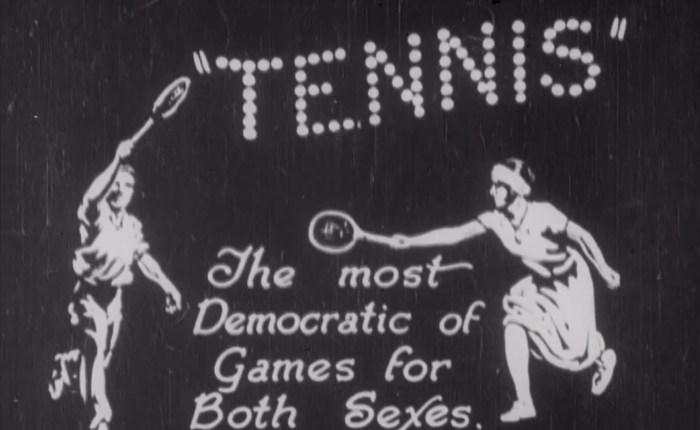
The 1924 instructional film ‘Tennis: The Most Democratic of Games for Both Sexes’ foregrounds the equal access women and men had to the game in its title. The twelve minute silent film opens with an intertitle warning the viewer that ‘If you really wish to play tennis, Don’t aimlessly knock a ball about for practice – Get taught early – Faults – like trouble – come easily.’ This insistence on hands-on teaching seems to rather undermine the purpose of the film! The opening shot is of a family group in a garden setting, with one of the women removing frames from tennis rackets and handing them out to various children. All are dressed in light-coloured clothing and mostly in short sleeves, implying that it is a summer’s day. The children then move to a tennis court elsewhere in the garden, where they demonstrate some basic techniques.

The film then introduces two professional (male) tennis players, Charles Read and Charles Hierons. In the next, most substantial, segment of the film, Read and Hierons demonstrate various tennis techniques. Here the film makes liberal use of slow-motion to allow the viewer to understand the players’ movements. Slow-motion was not often used in films of this period (in fact, comedy films tended to speed up action rather than slow it down) but its use here is seamless and sensible. The demonstration shots are interspersed with intertitles providing more explanation. Read and Hierons appear to be playing on an inner-city court, perhaps one of the public tennis courts so recently introduced in London at this time.

After this extensive segment, some shots of Helen Wills in action at a championship are included, presumably to demonstrate the ‘democratic’ nature of the sport. The film ends with a segment of a young girl, identified as ‘Betty’, playing against an unseen opponent in a private court. The focus is on her ‘beautiful footwork’, with some of the shots focusing only on her legs below the knees. This adds an odd tone of potential titillation to this supposedly instructional film, further problematised by Betty’s young age.

Throughout the interwar period, professional tennis continued to receive regular attention in newsreels, even if Britain’s successes on the international tennis stage were limited.[iv] Despite the sport’s democratisation, it continued to be endorsed by the upper classes too, culminating in the Duke of York (later King George VI) playing in the men’s doubles at the 1926 Wimbledon tournament. Although the Duke was of course not a professional player, he was able to enter because his doubles partner, Wing Commander Sir Louis Greig, qualified for Wimbledon because he was the RAF tennis champion. The couple was soundly defeated in the first round: 6-1, 6-3, 6-2.


[i] Joyce Kay, ‘Grass Roots: the Development of Tennis in Britain, 1918-1978’, The International Journal of the History of Sport, vol. 29, issue 18 (2012), p. 2534

[ii] John H. Goldthorpe, ‘Class and status in interwar England: Current issues in the light of a historical case’, The British Journal of Sociology, vol. 72, no. 2 (2021), p. 246

[iii] Ibid.

[iv] Robert J. Lake and Simon J. Eaves, ‘Defeat, Decline and Disconnect: A Critical Analysis of Attempted Reform in British Tennis during the Inter-war Period’, Sport in History, vol. 37, issue 1 (2017)