This is the seventh in a 11-part investigation into the 1934 ‘Bow Cinema Murder’. You can read all entries in the series here.
The murder on Dudley Hoard took place on Tuesday 7 August 1934. For John Stockwell, the cinema attendant who had committed the crime, Tuesday was his regular day off work. The police and his colleagues where therefore not surprised that John did not show his face around the Eastern Palace Cinema on that day. Instead, it later transpired that John that day found somewhere to stash the money he had stolen; took a brief trip to the Essex seaside; and in the evening took his girlfriend Violet to a West End cinema.
On Wednesday morning, John was still behaving like everything was normal. He knew, however, that the police were still investigating the crime scene, and he was not keen to return to the cinema. So on the morning of 8 August, he pretended to leave for work as usual, but instead took a train from Liverpool Street to Lowestoft, on the Suffolk coast. He made sure to buy a return ticket; John may have read some of the popular crime stories in which culprits often buy return tickets to avoid raising suspicion. John had no intention of coming back to London any time soon, however. He had packed most of his meagre belongings in a small suitcase, which he had managed to carry out of the house unnoticed.
Back in London, the fact that John did not show up for his regular shift at the cinema immediately raised the suspicions of the police. They started questioning the other cinema employees about Stockwell, and also questioned the family with which John was lodging. In the evening, police officers were stationed at the small house where John lived, in case he decided to return for the evening.
John had no such plans, however. He had taken a room in Lowestoft with a Mrs Alice Alberta Tripp, a short-sighted housewife. He gave his name as Jack Barnard, and claimed he wanted to stay in Lowestoft for a month’s holiday. ‘Jack’ paid 35 shillings for the first week without any protest. The first day in Lowestoft passed without incident, but by 10 August Scotland Yard had circulated a photo of John Stockwell to all the major newspapers; descriptions to all police stations; and had even arranged for an announcement to be broadcast on the BBC. They were using all modern media and technology at their disposal to circulate John’s description. It was unusual for the police to coordinate such an intense campaign, but the murder of Dudley Hoard was considered especially violent and heinous.

The popular newspapers were grateful for the copy provided by the police, and in that second week of August the hunt for the Bow Cinema Murderer dominated the front pages of all the tabloids. In Lowestoft, John Stockwell read the Sketch newspaper with his breakfast, and then told Mrs Tripp he was going to go to nearby Yarmouth for the day. After he’d left, Mrs Tripp went to see her daughter, who ran a newsagents across the road. Mrs Tripp’s daughter showed her John’s picture in the newspaper. After Mrs Tripp had returned home to pick up her glasses, she had a good look at the photograph, and realised that her lodger was the man wanted by the police in connection with a violent murder. Lacking a phone, Mrs Tripp asked her next-door neighbour to ring the police for her. When they arrived, they were able to confiscate the clothes that John had left behind; but the wanted man himself had eluded them.
Later that day, John Stockwell walked into the Metropolitan Hotel in Yarmouth, and asked for a room. When he signed the hotel register, he wrote that his name was J.F. Smith, and that he was from Luton, Hertfordshire. The hotel receptionist, Kenneth Margetson Dodman, thought he recognised ‘Mr Smith’ from the description given in the newspaper. Additionally, he noticed that ‘Smith’ had made a mistake when he was signing in: Luton was in Bedfordshire, not Hertfordshire – something that anyone from Luton would surely know. Keeping his wits about him, Dodman put ‘Mr Smith’ in a room and then rang the police. John Stockwell was arrested by a local police officer at the hotel around 6.30pm. The manhunt which had gripped the nation was finally over.
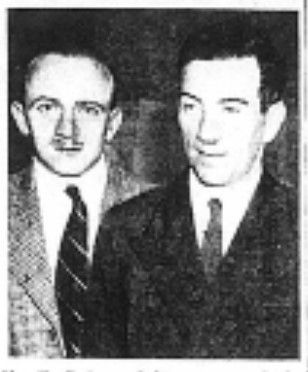
At Great Yarmouth police station, ‘Mr Smith’ admitted that he was John Stockwell, and also that he had murdered Dudley Hoard. The local police chief put a call through to Scotland Yard, and Chief Inspector Fred Sharpe drove up to Yarmouth that very evening to collect his suspect. On the way back to London on 11 August, Stockwell told Sharpe how he’d committed the crime, where he had hidden the money, and how he had spent the days between 7 and 11 August. Sharpe, not wanting to put Stockwell off, decided not to take any notes in the car. Instead he listened, and wrote up Stockwell’s confession from memory as soon as he got back to the station.

This decision would later cause some headaches: because Sharpe had not properly cautioned Stockwell, and had not given him the opportunity to check his statement, the information Stockwell had provided in the car could not be admissible in court. For now, though, the police were relieved that they had gotten their man. When Sharpe’s car arrived back at Bow Road police station just before 9pm on 11 August, a great crowd had gathered, keen to catch a glimpse of the Bow Cinema murderer, who until so recently had been living in their midst.
 Interwar London