The Bow Cinema Murder – the Killer 

FeaturedThe Bow Cinema Murder – the Killer 

This is the third in a 11-part investigation into the 1934 ‘Bow Cinema Murder’. You can read all entries in the series here. 

So who was the man who rang the Hoard’s doorbell on the morning of 7 August 1934 and attacked Dudley and Maisie with such deadly consequences? The initial police investigation assumed that the crime was committed by one or perhaps two criminals, who potentially allowed themselves to be locked into the cinema the night before. Investigators were reported to be questioning known criminals in the East End for clues.[1]

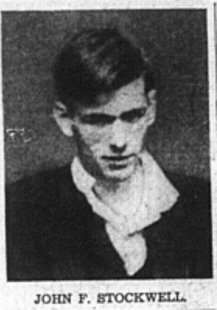
The truth was somewhat different, and closer to home. The attack on Dudley and Maisie was committed by a nineteen-year-old employee of the Eastern Palace Cinema: John Frederick Stockwell. John had only worked at the cinema for a few months, after being hired by Dudley. As an attendant, it was his duty to check tickets and show patrons to their seats. Like many neighbourhood cinemas at the time, the Eastern Palace operated on a ‘continuous performance’ basis, meaning that once the first screening of the day started, screenings continued on a loop until the end of the day. Patrons could show up at any time and stay as long as they liked. A crew of male and female attendants were therefore constantly occupied with letting people in and out of the auditorium.

Like many people in the East End, John Stockwell came from an impoverished background – but he was not brought up locally. He was born on 2 March 1915 near King’s Cross. His father had died at the front at Mons before John was even born. His mother re-married, but died in 1926 when John was 11. John had a brother, Horace, who was three years’ his senior – by the time the men had grown up they were no longer close. After his mother’s death, John went to live with an aunt, Elizabeth Brown. Because John’s father had died in the war, Elizabeth received a financial contribution from the state for John’s upkeep. Elizabeth decided around 1930 to move away from central London, and out to Bromley in Kent.

For the teenage John, who was no longer required to attend school, the change from Kings Cross to Bromley was not beneficial. Elizabeth reported that John no longer accepted her as a parental authority; he appears to have been out and about with a group of other young men. Eventually, Elizabeth decided she could no longer support John living with her, and he moved to a Salvation Army Boys Home in Bow Road some time in 1930. These homes were designed exactly for people like John: young men who lacked family or community support. They intended to give these men the skills to get employment and become independent. The SA arranged for John to get a job at a cloth manufacturer at Barbican. During his time there, John stole some cloth; he was caught and appeared before the Magistrate’s court in December 1931. John was sentenced to two year’s probation, meaning he had to meet up with a probation officer regularly.  

The Salvation Army had a zero-tolerance policy when it came to criminal activity, so John lost his lodgings. He had met, through the Army’s church activities, a local widow, Ellen Roake, and had become particularly close to Eliza’s youngest daughter Violet. Ellen agreed to take John on as a lodger, and he moved into the tiny Roake family home in early 1932. John and Violet became an official couple. After a short period working for a pastry chef, John was unemployed until he found the job at the Eastern Palace Cinema, which was only a 15-minute walk from the Roake’s home. One of the cinema’s other attendants, Charles Whitnell, lived practically next door to the Roakes.


As an attendant, John earned 32 shillings and sixpence a week. He paid 15 shillings a week for his board and lodging, leaving him with less than £1 a week for any other expenses. At the time of the murder, he did have a savings account with the Post Office, but it contained only 30 shillings (£1.50). Clearly, John had always lived in poverty. The nearly £90 that he stole from the cinema safe after attacking Dudley and Maisie was probably more money than he had ever seen together in his life; it was certainly more than he could ever imagine to save up himself. By August 1934, John and Violet had been going out for several years, but he could probably not imagine how he would ever make enough money to enable them to get married and start their own family.

He also had virtually no contact with his family at this point, and no social community to fall back on; he’d been removed from the community in King’s Cross in which he had grown up. The East End neighbourhood in which he lived from 1930 was one in which family ties counted for a lot, and he was perceived as an outsider. During the police investigation, his colleagues reported that they had found John odd, and his previous conviction for theft was known and made people suspicious of him.

None of these things justify his attack on the Hoards, but they do illustrate that the lack of structural social care in interwar Britain left individuals vulnerable. If you did not have a strong personal support network, you could very quickly find yourself in a situation that felt interminable. Once John committed the theft of cloth in 1931, what little social support he had been able to count on was also removed. In addition, rigid class boundaries made it even less likely for someone in his position to materially improve his circumstances. It is understandable, then, that someone of his young age, with little adult supervision to guide him, came to the conclusion that the only way to get ahead was to break the rules and commit a theft.

Once John had committed his attack and stolen the money, he managed to leave the Eastern Palace Cinema unseen. Tuesday was his weekly day off work. That evening, when Violet finished her shift at the Kearley & Tonge biscuit factory in Bethnal Green, John treated her to a trip to the Stoll cinema in the West End. Unbeknownst to Violet, he used part of the stolen money to pay for the tickets. On the way to the cinema, they discussed Dudley Hoard’s murder, as it was splashed over the evening papers. It would be the last evening they spent together, as the next day John used his stolen money to escape London, triggering a multi-day manhunt that captured the attention of the nation.


[1] ‘“Yard” reconstructs the crime,’ Daily Herald, 8 August 1934, p. 2

The Bow Cinema Murder – the Victim

FeaturedThe Bow Cinema Murder – the Victim

This is the second in a 11-part investigation into the 1934 ‘Bow Cinema Murder’. You can read all entries in the series here.

One of the effects of a well-publicised murder investigation is that it can put ordinary people into the press spotlight. This was as true in the interwar period as it is today. The Bow Cinema murder was briefly on the front pages of all major newspapers, and the victims, the perpetrator, and the people around them all got dragged onto those front pages too. This can make a murder story a valuable source for the historian: it highlights and preserves the stories of ordinary people as they are put into extraordinary circumstances.

Dudley Henry Hoard, the victim of the Bow Cinema Murder, was one such an ordinary person. If not for the extremely violent end to his life, it’s unlikely his name would ever have entered into the annals of history. He was born in Wandsworth, south-west London, in 1892. His family moved to Croydon when Dudley was a child, and his parents remained in that area. Dudley had an elder sister, Dorothy, and two younger sisters, Avery and Winifred. His father, William, was born in Devon; his mother Mary was from Chelsea in London. Dudley’s father worked as a clerk, indicating the family were in the lower middle class. This is also borne out by the fact that Dudley attended the independent Whitgift School in Croydon.

By the time he was eighteen, Dudley considered himself to be an actor. At 5 ft. 9.5in he was quite tall, and he may have cut a dashing figure on stage. According to his father, Dudley left school to take part in a production at Sadler’s Wells theatre, and toured the country as part of a travelling theatre group. At the same time, he was interested in cinema, which was becoming increasingly popular. Dudley briefly ran his own cinema, the Hippodrome, in Sutton (near Croydon) in the early 1910s.[1]

During the War, Hoard served as a Private in the London Regiment. He did not have a distinguished war record; the most the newspapers can say about it after his death is that he served in France and Greece, and got gassed in an enemy gas attack.[2] After the war he returned to repertoire acting, including a stint working for the Melville Brothers, who were part of a theatre producing dynasty.

At some point, Dudley met Maisie Tait, a native of Newcastle who was close to him in age and also an actor. According to Dudley’s father, the pair met when they were in their late teens; however, they did not get married until 1933, when Dudley was 41 and Maisie was 38. Details of Maisie’s early life are difficult to trace; she was also known as Maisie Robson, and it is not clear whether either Tait or Robson was her birth name, or whether both were assumed names. One thing that is certain is that Maisie had a daughter from a previous marriage; after the attack in 1934, this adult daughter came to visit Maisie in hospital. Her existence may be what stopped Dudley and Maisie getting married any sooner.

Around the time of their wedding, Dudley apparently decided to give up the touring life and to return to the cinema. In 1933, he got his first appointment as cinema manager in London, at the Brittania Picture Theatre in Camden. By the 1930s, cinemas had become enormously popular in Britain, and the industry had professionalised significantly since Hoard’s last foray into cinema management in 1911. The average cinema had upwards of a dozen staff members, and cinema managers were required to ensure that all operations went smoothly; staff were trained appropriately; and the cinema drew as many patrons as possible. Marketing was a significant part of the cinema manager’s role. Trade magazine Kinematograph Weekly highlighted in each issue the innovative and successful marketing stunts that managers up and down the country came up with to draw in audiences.

At the same time, cinemas became increasingly consolidated into chains, such as Odeon and ABC. Within the chains, the patrons’ experiences were increasingly homogenised. Rather than being rewarded for originality and innovation, managers in chains were expected to comply with central directives on how their cinemas should be managed. Dudley never worked for a chain cinema; at the Brittania in Camden he had to make two men redundant to save the cinema money. These men had families to maintain, and they threatened Dudley after he had fired them. This probably was one of the reasons why Dudley swiftly moved on to work at the Cinema House in Oxford Street and then, finally, the Eastern Palace Cinema in Bow.

These three posts in the space of 18 months indicate how fast-moving and insecure the work of cinema management was. For Dudley and Maisie, the job at the Eastern Palace was a step up, as it came with their own private apartment (although they had to pay rent for its use). With it, though, they arrived into a close-knit East End neighbourhood, where many of the staff were neighbours or even family members of one another. The Hoards were outsiders; and as it turned out, so was the man who attacked them.


[1] ‘London Manager Murdered’, Kinematograph Weekly, 9 August 1934

[2] ‘Actor and Producer’, Daily Mirror, 8 August 1934, p. 2; ‘London Cinema Outrage’, Evening Standard, 7 August 1934, p. 2

The Bow Cinema Murder (1934)

FeaturedThe Bow Cinema Murder (1934)

This is the first in a 11-part investigation into the 1934 ‘Bow Cinema Murder’. You can read all entries in the series here.

This blog is no stranger to interwar murder stories. Over the next ten weeks, posts will investigate one 1934 murder case in depth. Unlike some of the other cases covered previously, this murder is no longer well known – it has not been adapted in any novels, plays or films (to the best of my knowledge) and did not become a byword for evil. At the time it was committed, however, it caused a media storm and thrust a group of working-class East Enders into the limelight. It was the Bow Cinema Murder.

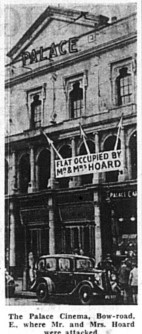
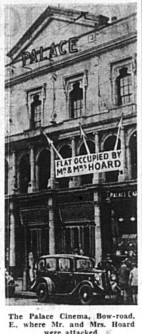
The murder took place on Tuesday morning, 7 August 1934, at the Eastern Palace Cinema in Bromley-by-Bow, in the East End of London. The Eastern Palace cinema was a neighbourhood cinema, co-owned by two local Jewish professionals. It was located on the busy Bow Road, in between a café and a general store. It could seat around 1000 patrons in its auditorium and balcony, where audiences could enjoy the ornate (if somewhat shabby) ‘Oriental’ decorations on the walls.

The facade of the Eastern Palace Cinema. This photo appeared in the Daily Express the day after the murder

The day-to-day management of the cinema fell to 41-year-old Dudley Henry Hoard. As part of his role, Dudley and his wife Maisie were required to live in a flat adjacent to the auditorium – the lease of the building required that it was partially used for domestic occupancy. Dudley got the cinema manager job in March 1934, and he and Maisie moved in a few weeks later. It was the first time since their wedding in spring 1933 that they had their own flat; they had previously been staying with Dudley’s parents in Croydon.

On the morning of 7 August, Dudley and Maisie were sleeping in after a busy Bank Holiday weekend. Ordinarily, one of Dudley’s first tasks every day was to deposit the cinema’s previous day’s takings at the Midland Bank on Mile End Road. Due to the banks having been shut on the Bank holiday Monday, there were now three days’ worth of ticket earnings in the safe in Dudley’s office, one floor below the flat. For the Eastern Palace, the Bank holiday weekend had resulted in total takings of 89 pounds, 5 shillings, and tuppence. By comparison, Dudley earned about £5 a week as cinema manager, and he was the best-paid member of staff in the cinema. Even for him, the nearly £90 in the safe represented around 10 months’ worth of wages.

Around quarter to eight, someone rang the door of the flat – not the doorbell at the cinema’s entrance, but the door of the flat specifically. Dudley quickly put on some trousers over his nightshirt and went to open the door. Maisie had only half woken and was about to doze off, when she heard Dudley shout out. When Maisie walked into the living room, she saw a man standing over her husband, wielding a hatchet. Dudley had a head wound and was trying to fend off the other man. Maisie shouted out to the attacker, a young man. He then turned to her and hit her over the head with the hatchet – she blacked out immediately.

About thirty minutes later, the cinema’s regular team of cleaning women arrived for their morning shift. These three women came in six days a week to clean and tidy the cinema before the first screenings started. Because they arrived hours before any of the other staff, the head cleaner, Mrs Emily Brinklow, had her own set of keys. She let herself and her colleagues in, and they started to get their cleaning materials out. Emily noticed that the post and milk, dropped by the milkman, had not yet been taken upstairs by either Dudley or Maisie. This did not worry her unduly; she would bring them up herself in a minute. Before she could do so, a scream ripped through the building. Nellie Earrey, one of the other cleaners and sister to one of the cinema’s projectionists, had found a heavily injured Dudley Hoard on the staircase leading to the auditorium balcony. He was covered in blood, as were the walls and the staircase he was on. Emily rushed to the flat and banged on the door; after a short while, Maisie opened it. She, too, was covered in blood, and seemed completely dazed.

Nellie ran out onto the street, where a passerby quickly alerted the local Bobby who was patrolling the area. PC Mackay swiftly went over to the cinema and tried to provide emergency aid, as well as alerting his local police station by telephone. The divisional surgeon (the police doctor) is on the scene quickly, as he was still at his home further down Bow Road when the station officer rang him. He too provides emergency aid, and arranges for both Dudley and Maisie to be transported to the nearby St Andrews hospital. They arrive shortly after 10am. Although Dudley is immediately examined and treated by multiple surgeons, the fractures to his skull are too severe. He dies at 3.07pm, without regaining consciousness.

The police know that they now have a murder case on their hands. Maisie is less severely injured, but unable to give more than a brief, confused statement before she needs to rest. Detectives attached to the local police department, known as ‘H’ Division, start questioning all the cinema’s staff as they arrive for their shifts. Most of them live very close to the cinema, and they are aware very quickly that something has happened. The police realise that the cinema’s safe has been opened by the keys which would normally be carried around by Dudley, and that the full weekend’s takings have been stolen. They have a victim and a motive, but not yet a clue as to the killer’s identity.

Featured

The Poplar Rates Rebellion (1921)

In 1921, a group of thirty Labour councillors of the London Borough of Poplar were imprisoned as a result of their approach to poor relief in the borough. This almost forgotten episode, known as the Poplar Rates Rebellion or Poplar Rates Revolt, highlights the fraught relationships between national and local politicians in interwar Britain, as well as the diverging approaches to how poverty should be treated.

The Labour Party was founded in 1900 and it grew steadily in popularity in the first decades of its existence. The Party primarily targeted working-class voters. Two extensions to the franchise helped Labour gain more votes and seats in parliament: the 1918 Representation of the People Act gave the vote to all men over 21, regardless of their income or background. It also gave the vote to women over 30 who met a property qualification. In 1924, Labour delivered its first Prime Minister, Ramsey McDonald. In 1928 the vote was given to all men and women over 21, leading to the 1929 general election being dubbed the ‘flapper election.’  

For some in the Conservative Party, the extension of the franchise to include ‘the poor’ risked corrupting democracy. If those from poor backgrounds were allowed to vote, they argued, politicians could in effect ‘bribe’ voters by promising high rates of poor relief.[1] As historian Liam Ryan has pointed out, this argument echoes Victorian values which equate poverty with ‘a lack of the moral qualities needed to sustain independence in society.’[2] The actions of the Poplar Labour Party in 1921 would serve to evidence this argument.

In addition to the national party, Labour was active at a local level. The party controlled 34 out of 85 local authorities in London for at least part of the interwar period.[3] Poplar was one of London’s poorest boroughs at this time: in 1932, nearly a quarter of residents lived below the poverty line.[4] By focusing on providing generous poor relief, the Poplar Labour Party was able to build up a sold voter base even before the First World War.[5] The local councillors were themselves from the East End and from working-class backgrounds, which further embedded them in the community.[6]

Immediately following the First World War, the Poplar Labour Party decided to implement an extensive, and expensive, poor relief programme including a minimum wage of £4 a week for municipal workers. Such a local initiative had to be funded from ‘rates’, taxes on property levied on local inhabitants and businesses. A proportion of the rate income was for the local council, but some of it was supposed to be passed on to fund the London County Council, the police, and the Water Board.

Due to the high levels of poverty in the area, rate income was low, and rates could not be raised without harming the local community. When an application for financial support from the national government was denied, the local party refused to collect the proportion of the rates that was supposed to fund London-wide initiatives.[7] When the council ignored a court order to levy the rates, almost all the councillors were arrested and sent to prison for contempt of court – the men to Brixton and the women to Holloway. They remained imprisoned for six weeks, during which they received much popular support.

The Poplar Rates Protest gave rise to what became known as ‘Poplarism’ – ‘a polemical epithet used by Conservatives to refer to high-spending, left-wing poor law guardians in the 1920s.’[8] The leader of the revolt, George Lansbury, who had been a Labour MP between 1910 and 1912, returned to Parliament in 1922 and became leader of the Labour Party from 1932 to 1935. He remained on the left of the party for the rest of his career. The Conservative governments of the interwar period eventually abolished local poor law boards, which prevented a repeat of the Rates Rebellion.[9] Ultimately, though, it became accepted at both sides of the political aisle that offering poor relief did not equate to political corruption.


[1] Liam Ryan, ‘Socialism and corruption: Conservative responses to nationalisation and Poplarism, 1900–40’, in The many lives of corruption: The reform of public life in modern Britain, 1750-1950, eds. Ian Cawood and Tom Crook (Manchester: Manchester University Press, 2022), 239-258, (248)

[2] Ibid.

[3] Dan Weinbren, ‘Building Communities, Constructing Identities: The Rise of the Labour Party in London’, The London Journal, vol. 23, no. 1 (1998), 41-60 (41)

[4] Gillian Rose, ‘Imagining Poplar in the 1920s: contested concepts of community’, Journal of Historical Geography, vol. 16, no. 4 (1990), 425-437 (427)

[5] Weinbren, 45

[6] Rose, 432

[7] Ryan, 248

[8] Ibid., 240

[9] Ibid., 254