The Woman from China (1931)

FeaturedThe Woman from China (1931)

As has been covered on this blog before, in 1927 the British Government adopted the Cinematograph Films Act, a legal measure which prescribed a minimum volume of British-made films which each exhibitor had to show. It was no longer possible for a cinema to solely show Hollywood films. The intention of the Act was to boost the British film industry; its unintended consequence was that American studios set up cheap studio contracts in Britain and started churning out low-quality films which became known as ‘quota quickies’.[1]

Shortly after the Act was passed, Britain started transitioning to sound film, with the earliest ‘talkies’ with continuous sound appearing in 1929/1930. The transition was rapid, with sound film becoming the norm within just a few years. Yet for the ‘quota quickie’ industry, sound film could be an expensive business. It was generally the aim of American studios to shoot their British films as cheaply as possible, often for as little as £1 per foot of film.[2] Shooting sound film required additional technology such as microphones, and also forced on-set shooting in the early years, as location shooting was too noisy and complicated. It is not surprising, then, that quota quickie producers continued to make silent films into the early 1930s.

One of these is The Woman from China, which was made in 1930. According to Steve Chibnall, the film was produced in a rush. Under the 1927 Act, the ‘quota year’ ran from 1 April to 31 March, meaning that by 31 March each year exhibitors had to be able to evidence that they had shown the appropriate proportion of British films in the preceding twelve months. In January 1930, the major American studio MGM commissioned two British producers to create a film by the end of March that year. The result was The Woman from China, for which shooting and editing was completed within four weeks, with a half-finished script.

The final scenes were shot five days before the scheduled trade show, and director Dryhurst was obliged to double as editor with the help of one young assistant. The two worked ninety hours without sleep to meet the deadline, although the first of the two shows as lacking the final reel.[3]  

Considering those circumstances, The Woman from China can be considered a fairly accomplished film from a technical perspective, although it perpetuates many obvious and damaging stereotypes in its narrative, staging and costuming. The plot is one familiar from films of this period: a young secretary and a naval officer are engaged, but their relationship is thwarted by a mysterious British woman who has recently arrived from China, and who is in love with the naval officer. The ‘woman from China’ is being blackmailed by a Chinese Svengali, Chung-Li, who in turn wants to marry the secretary. The Chinese man directs his henchmen to kidnap both the officer and the secretary, and proceeds to emotionally torture them until they can break free. The ‘woman from China’ has a change of heart and sacrifices herself to save the naval officer; the Chinese man and his henchmen are killed; and the original couple are able to get away unscathed.

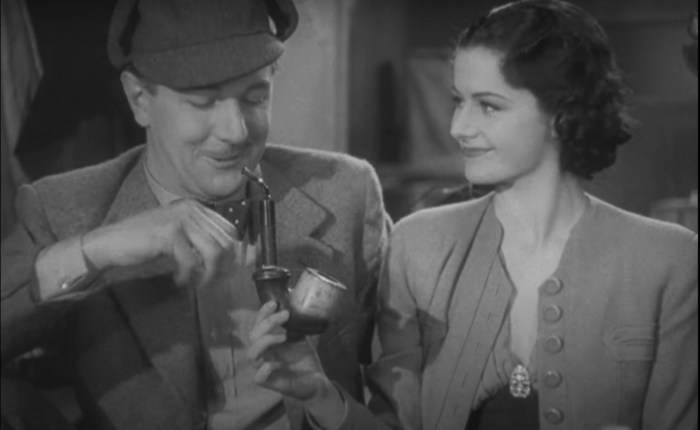
Frances Cuyler and Tony Wylde as the protagonists in The Woman from China

There was already an established history of racist depictions of Chinese characters in popular culture in Britain. The most successful proponent of this was pulp writer Sax Rohmer, who started his ‘Fu Manchu’ series of books just before the First World War. In these books, a Chinese evil mastermind is working to reinstate China as a superior power. Fu Manchu is associated with Limehouse, which at that time was London’s Chinatown. The Woman from China acknowledges its debt to these earlier pulp novels by a character noting that Laloe Berchmans, the woman who has made a deal with Chung-Li, is ‘like a character from an Edgar Wallace novel.’

Julie Suedo as ‘the Woman from China’ and Tony Wylde in The Woman from China

Chung-Li is played by white British actor Gibb McLaughlin in yellowface. The second most prominent Chinese character, an anonymous ‘Chinaman’, is played by Japanese actor Kiyoshi Takase. The Woman from China incorporates such racist tropes as Chung-Li having pointedly filed fingernails; leering after the secretary; and working to increase China’s power in the world. (I’ve deliberately not included any stills from the film featuring McLaughlin in this post as his costume and appearance throughout is offensive).
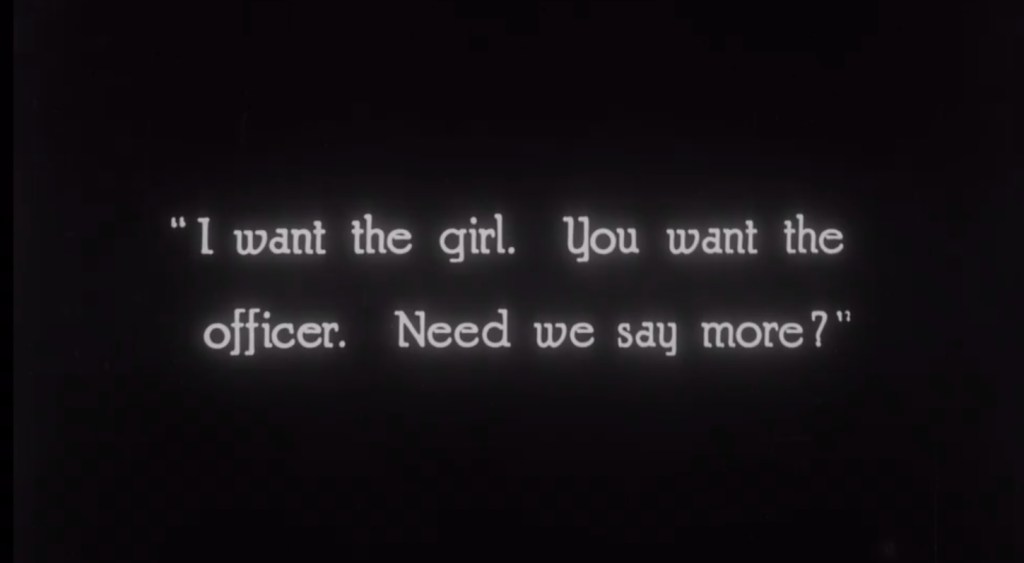
Chung-Li proposes his deal to the woman under his control

Although The Woman from China may appear to be a good example of a 1930s British film that is best forgotten about, it also allows us to explore the conditions of film production during this volatile period of the British film industry; contemporary portrayals of race; and a late example of a British silent film which includes on-location shooting. Its preservation allows us to appreciate the full range of British film output of this period, and to engage with the challenging legacy of racial discrimination which was pervasive in Britain during the interwar years.

Readers based in the UK can watch The Woman from China for free on the BFI Player.


[1] Steve Chibnall, Quota Quickies: The Birth of the British ‘B’ Film (London: BFI, 2007), p. 4

[2] Ibid., p. xii

[3] Ibid., p. 19

A Week in Whitechapel (1933)

FeaturedA Week in Whitechapel (1933)

In early 1933, international politics was increasingly tense, with Mussolini having overseen a Fascist regime in Italy for over 10 years, and the inexorable rise of Hitler and the National Socialist Party in Germany. It had become increasingly clear to Britons that anti-Semitism was a key tenet of Nazism.

In the run-up to the March 1933 German federal election, which Hitler hoped to use to reach a majority in parliament, the Daily Express printed a 6-part series of articles headlined ‘A Week in Whitechapel.’ Although the Express was in no way a left-wing paper, it used this series of articles to shine a positive light on Whitechapel’s Jewish community. Although the articles are not labelled as explicitly political, and present as ‘human interest’, they were printed for six consecutive days on page 3 of the paper, a prominent position otherwise reserved for national and international news reports.

The headline of the first article, which appeared on Monday 27 February 1933, states ‘Jewish Youth Looks Westward’. Although the body of the article makes it clear that this is meant to be London’s West End, the headline holds the double connotation of Jewish people looking to Western Europe as the basis for its future. According to the article, Jewish people have ‘found sanctuary’ in Whitechapel after persecutions in ‘Europe’.[1] A young Jewish woman is described as ‘lusciously pretty’ and dressed ‘magnificently.’ Although the young Jews are presented as dressing slightly more loudly than British (white) people, the overall tone of the article is not derogatory and the Jewish woman is presented as desirable.

The second article, printed the next day, champions a Jewish business owner who, according to the article headline, had a ‘£5,000 business built up in four years – Photographic studio opened with a capital of 6s 6d.’[2] In contradiction to the anti-Semitic stereotype of money-obsessed Jews, this anonymous photographer is held up as a savvy businessman. The man argues that ‘The Gentile [a non-Jewish person] works for an old-age pension: the Jew to be his own master.’ The reporter has to conclude that the Jewish photographer has made the better deal – he has £5,000 in capital, whereas ‘the old-age pension is only 10s a week.’[3]

On the same day, the front page of the Express was given over to a large report on the Reichstag fire, which had occurred the previous night. Historians agree that this fire, for which Hitler blamed Communists, was a key event in the establishment of Nazi power. It allowed Hitler to argue for emergency powers, which allowed him to order the arrest of thousands of Communists, only days before the federal election. The Daily Express’s juxtaposition of this story with the positive depiction of Jewish Londoners in the ‘A Week in Whitechapel’ series highlights how much attitudes towards Jewish people were contested in this period.

The series of reports continues on 1 March with a description of a Jewish wedding, which was again positive although it followed a tried-and-tested tabloid reporting method by highlighting the custom of shattering glass: this would have appeared unusual to any readers not familiar with Jewish traditions. Nevertheless, the article is not exploitative in its tone. For the fourth instalment, the reporter visited a Jewish pub. Again, a potential stereotype – Jewish people eat a lot of food – is touched on but turned into a positive: ‘Everywhere was food, for the Jew eats as he drinks, and so surpasses a Gentile in sobriety.’[4]

For the penultimate article, the reporter attended a Christian mission attempting (and failing) to convert Jews, and a synagogue. The rabbi is described as ‘a marvel of learning’ and the Jewish school as a place where ‘the seed is lovingly sown. The shoot is exquisitely nurtured.’[5] The Christian mission, by contrast, is described as providing free healthcare to the poor only as long as they attend a Christian gospel service.

Only for the final article, printed on Saturday 4 March, the day before the German elections, does the series touch on the other thing that made Whitechapel famous: the Jack the Ripper murders.[6] This is the only of the articles which does not focus on the Jewish community, instead quoting an East End housewife whom the author encountered. Several pages further in the same paper, a Sidney Strube cartoon was very clear about what he thought about the German elections – a shaking old man is intimidated and led up to a ballot box placed under a guillotine.[7]

A Sidney Strube cartoon, printed in the Daily Express, 4 March 1933, p. 8

Although the Daily Express was not as politically explicit as some of its competitor papers like the Daily Mail or the Daily Herald (on the right and left of the political spectrum, respectively), it commissioned and printed a series of articles which spoke positively about the Jews. At a politically fraught period for Jews in Europe, this indicates that the paper’s editors were willing to quietly counteract the anti-Semitic sentiments that were also becoming more prominent in Britain, following the founding of the British Union of Fascists the year before.


[1] ‘Jewish Youth Looks Westward’, Daily Express, 27 February 1933, p. 3

[2] ‘£5,000 Business Built Up in Four Years’, Daily Express, 28 February 1933, p. 3

[3] Ibid.

[4] ‘The Landlord of the Aspidistra has a Plan to Settle the Irish Problem’, Daily Express, 2 Mach 1933, p. 3

[5] ‘The Definition of Hope – A Mission to the Jews’, Daily Express, 3 March 1933, p. 3

[6] ‘Along the “Ripper’s” Route’, Daily Express, 4 March 1933, p. 3

[7] ‘Vox Populi’, Daily Express, 4 March 1933, p. 8

Featured

Suburban dreams

London underwent massive suburban expansion in the interwar period. The interwar period saw a combination of an increase of Londoners who were looking for suitable living space; an increase in disposable income and a reduction of housing costs; and a greater availability of accessible building plots around the outskirts of the city. These factors led to a veritable suburban ‘boom’ during the 1920s and 1930s, at the end of which London’s size had increased threefold and the population of its suburbs had grown by 2.5 million compared to the start of the century.[1]

The first London suburbs were built by private investors during the nineteenth century, when the introduction of tramcars and other modes of public transport opened up areas further away from the city centre, for residential development. By the end of the nineteenth century the London County Council also ordered the development of suburban estates, to provide healthier living quarters to poorer Londoners.[2] These two types of suburbs – private developments and council estates – continued to co-exist in the Edwardian and interwar periods. Private developments were mostly aimed at the aspirational middle-classes, who would look to mortgage a semi-detached or detached house.

Elsewhere in this blog I have considered how the suburbs were represented on film; how tennis was a key social activity for suburbanites; how an expansion of car ownership changed the entertainment opportunities open to suburban Londoners and how the experience of suburban women was captured in interwar novels. The suburbs, in short, were on the forefront of social changes and the experiences of their inhabitants provided inspiration for artists.

Yet suburbs were also synonymous with boredom and small-mindedness, particularly to the urban intelligentsia.[3] Privately developed suburbs were built by builders and speculators, who bought up cheap land, built houses on them, and then sought to sell these brand new dwellings as quickly as possible. One of the key ways they used to entice Londoners to buy a suburban house was to present suburbia as a rural environment.

‘Most advertisements and brochures were accordingly illustrated with idealised sketches or heavily retouched photographs which skilfully suggested that the house stood quite along in matured surroundings of judiciously placed trees and shrubs, against a background of windblown clouds and gently rolling hills.’[4]    

In London’s north-western corner, new estates serviced by the Metropolitan Railway were quickly badged up as part or ‘Metro-land’. Transport posters presented this new land as a rural idyll with ‘Gorgeous Autumnal Scenery’ and ‘Charming Country Walks’; as well as an excellent place to go fishing. At Radlett, near Watford, a developer promised such aristocratic pursuits as ‘Hunting, Shooting, Beagling and the like….every phase of rural life at Radlett provides the perfect antidote to business worries.’[5] At the same time, it was crucial that suburban estates had quick and easy transport lines into the centre of London. Here, misleading advertisements could be the developer’s friend: brochures and advertisements frequently cited the fastest possible travel time as standard, even if most of the daily trains would take much longer to get to the city.[6]

Because suburbs kept expanding incessantly, any estate that started out as a semi-rural enclave would quickly find itself engulfed by other estates, the ‘rolling hills’ and ‘mature trees’ covered by more semi-detached housing. Most suburban dwellers were exposed to nature primarily through their garden. Because suburban houses were often built in styles to remind people of cottages and other old-fashioned houses, historian Matthew Hollow has argued that ‘the move out to the cottage estate was accompanied by a desire to indulge in new, more family-centred, pastimes. Gardening became a popular family pastime for many.’[7] Gardening also allowed suburban houseowners to express their creativity and compete with their neighbours in popular and wide-spread estate garden shows.[8] Perhaps surprisingly, in the popular imagination the garden became the domain of the male head of the household, retreating to the garden after dinner to tend to his plants. As ever, London Underground’s poster designers had their finger on the pulse with this 1933 poster, showing a city man seamlessly transforming into a suburban gardener mowing his lawn.

One final way in which suburban inhabitants themselves sought to underline the rural character of their neighbourhoods was through their house names. As completely new developments, many privately-built suburban estates did not yet have properly assigned addresses when their first inhabitants moved in – another sign of the speed of suburban development, which outpaced the local authority administration. To ensure their homes could be identified, many suburbanites named their own houses, and names such as ‘Meadowside’, ‘Woodsview’ and ‘Fieldsend’ both highlight the semi-rural nature of the suburban environment, and indicate that for the people living in these houses, the natural surroundings were significant.

Despite its sometimes negative reputation, suburban living was a dream for many working- and middle-class Londoners during the interwar period; a dream encouraged by the sometimes fanciful advertising techniques used by speculative developers. For many, suburban living offered a first chance of home ownership, and access to private green space. The vast suburban developments of the 1920s and 1930s continue to shape London to this day.


[1] Mark Clapson, Suburban Century: Social change and urban growth in England and the United States (Oxford: Berg, 2003), p. 2; Stephen Halliday, Underground to Everywhere (Sutton: Stroud, 2001), p. 113

[2] Peter Hall, Cities of Tomorrow (Oxford: Blackwell, 2002) pp. 21 and 50-52

[3] Alan A. Jackson, Semi-Detached London (London: George Allen & Unwin, 1973), p. 162

[4] Ibid., p. 204

[5] Ibid., p. 205

[6] Ibid., p. 206

[7] Matthew Hollow, ‘Suburban ideals on England’s interwar council estates’, Garden History, vol. 39, no. 2 (2011), 203-217 (213)

[8] Ibid., p. 209

The Lady Vanishes (1938)

FeaturedThe Lady Vanishes (1938)

This is the second of a two-part blog looking at the novel The Wheel Spins, and its film adaptation The Lady Vanishes. You can find the first part here.

Following last week’s analysis of the 1936 novel The Wheel Spins by Ethel Lina White, this week we consider its film adaptation The Lady Vanishes. The film was released in 1938 and directed by Alfred Hitchcock, who by the late 1930s was directing acclaimed and increasingly high-profile films in England. He would move to Hollywood in 1939. The Lady Vanishes includes a number of stylistic flourishes that make it instantly recognisable as a Hitchcock film.

Although there was only two years between the publication of the novel and the release of the film, and the novel is credited as the source material, there are fairly significant differences between the book and the film. The focus on the female experience, present in the book, is watered down in the film in favour of a more traditional positioning of the female protagonist as assistant to the active, male counterpart. The film’s final section deviates completely from the book, and links much more explicitly to Europe’s political situation in the late 1930s.

As with the novel, the film opens not on a train, but in a hotel in a fictional Eastern European country. The female protagonist, here called Iris Henderson, is on a girls’ trip before travelling back to London to be married. Although Iris and her friends have the hotel staff eating out of their hands, they are presented much more sympathetically than Iris and her friends are in the book. Miss Froy, the lady who vanishes, is also staying at the hotel and she and Iris have some interaction before boarding the train; Iris also meets her eventual love interest, Gilbert, in the hotel.

Gilbert (Michael Redgrave) and Iris (Margaret Lockwood) playing Holmes and Watson in The Lady Vanishes

Hitchcock introduced two additional characters, Charters and Caldicott, two men who are determined to get back to England before the end of the Ashes cricket match. This comedy duo proved so popular that they ended up appearing in ten more films, working with a range of directors. To ensure the film does not get too overcrowded, many of the other British characters that appear in the book are not in the film.

Caldicott (Naunton Wayne) and Charters (Basil Radford) in The Lady Vanishes

Once the action moves onto the train, the film largely follows the same trajectory as the novel, although Gilbert takes a much more pro-active role in the hunt for Miss Froy and Iris is increasingly relegated to his assistant. This is made explicit in a scene where he poses as Sherlock Holmes with Iris as his Watson. Gilbert even gets to demonstrate his physical daring when climbing out of the carriage window and into the next carriage from the outside of the train.   

Gilbert (Michael Redgrave) climbing down the side of the train in The Lady Vanishes

Once the pair have located and saved Miss Froy, the action goes in a drastically different direction. The nefarious gang that are trying to kill Miss Froy decouple the two train carriages that contain all the British characters and divert it to a side track into the forest. Once there, the carriages are ambushed by the gang and repeatedly shot at.

It is here that Europe’s political situation has clearly strongly influenced the script. The British characters are debating whether they should get away, fight back, or surrender. One character does not want to fight and instead exits the carriage waving a white handkerchief – he is promptly shot dead by the antagonists. The parallels with Chamberlain’s appeasement approach to Germany could not have been missed by British audiences. Ultimately, with only one bullet left between them, the British passengers manage to get the train running again and are able to get away, but not before Miss Froy has admitted to Iris and Gilbert that she is a spy working for the Foreign Office, and has been given a message for the British government in code. She teaches the code to Gilbert before exiting the train and running into the forest.

This is a significant deviation from the novel, in which Miss Froy is targeted by gangsters because she has unwittingly witnessed something she should not have seen. In the film, Miss Froy is not an innocent bystander who was at the wrong place at the wrong time, but rather part of an international network of spies and informants working for the British state. Rather than being reunited with her family in a celebration of traditional British domestic values, Miss Froy is reunited with Gilbert and Iris as they come off the train. Their triumph is that they have helped the British government gained vital intelligence, with the Foreign Office taking the place of the parental home. In times of political turmoil and with war on the horizon, it is the duty of British citizens not just to help one another, but also to help the State in its mission to suppress international unrest.

The main source of tension in The Wheel Spins, Iris’ concern that she will be locked up in an asylum because no-one believes her, is absent in The Lady Vanishes. Instead, the danger comes not from the British passengers on the train, but from the Europeans who are looking to eliminate a British secret agent. This makes the story much more conventional and in line with many other suspense films of the period. The film is elevated by Hitchcock’s direction and dialogue that balances comedy and drama. The novel and the film stand alongside one another as distinct texts, each using the same plot to foreground different themes.

The Lady Vanishes is available on Youtube.